
Judge, 1915-10-16 · page 17 of 28
Judge — October 16, 1915 — page 17: what you’re looking at
What you’re looking at
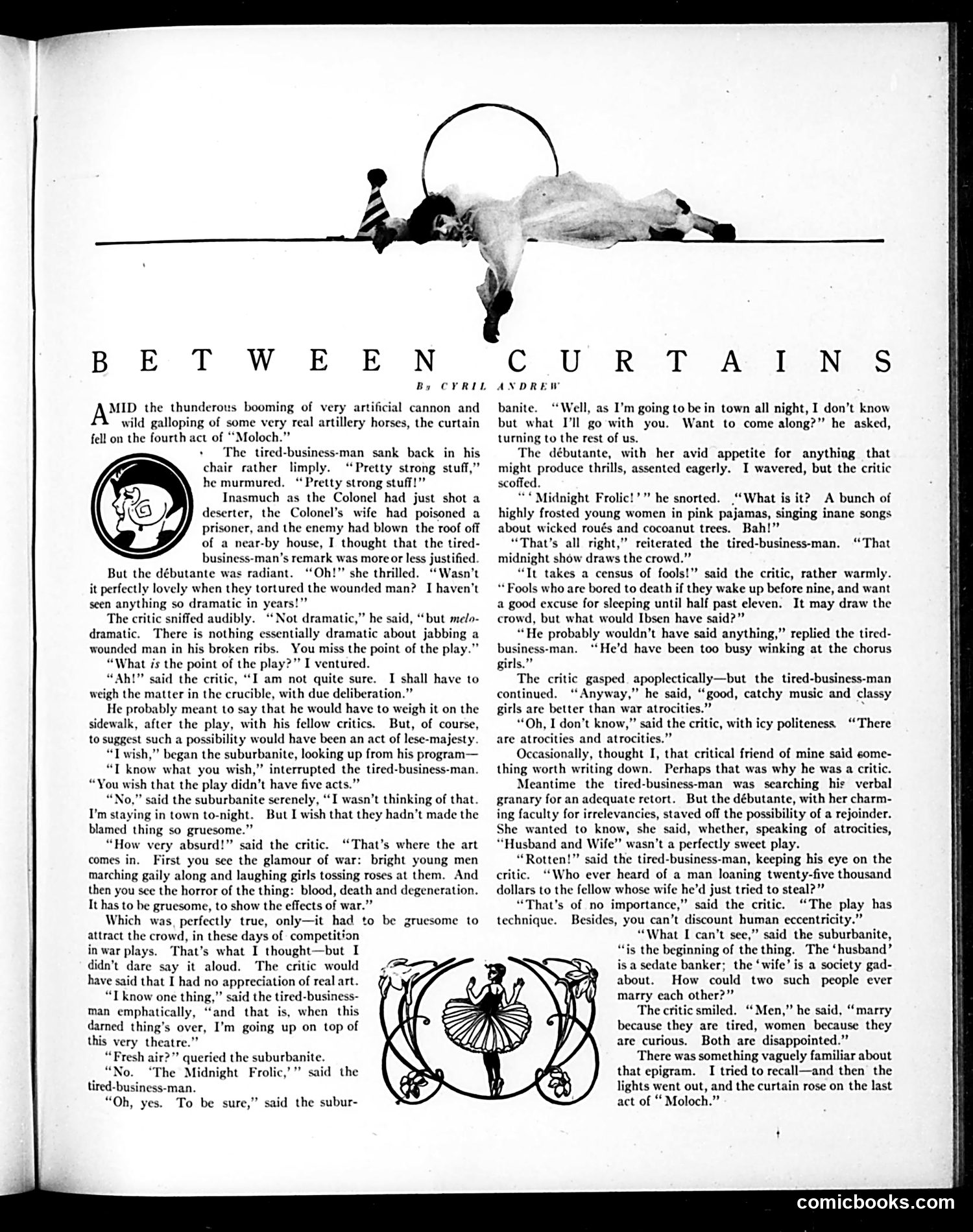
This piece satirizes early 20th-century theater culture and conflicting tastes in entertainment. The dialogue contrasts four archetypal characters attending a war play called "Moloch": 1. **The tired-business-man** - represents ordinary audiences seeking escapist entertainment 2. **The débutante** - a wealthy young woman who enjoys sensational violence for thrills 3. **The suburbanite** - a middle-class attendee seeking reasonable entertainment 4. **The critic** - a self-important arts snob defending "serious" dramatic art The satire mocks the critic's pretentious reverence for gruesome realism in war plays, while the tired-business-man pragmatically notes such scenes exist merely to "draw the crowd." The humor peaks when the businessman prefers the "Midnight Frolic" (apparently a Ziegfeld Follies-style revue) over serious drama—precisely what the critic scorns. The piece gently ridicules both artistic pretension and the commercialization of entertainment, with the businessman's common sense winning out over the critic's self-importance.
📄 Transcribed text from this page (OCR, searchable)
Machine-transcribed from the original scan — historical spelling and the odd misread are preserved.
BET W EEN By CYRIL AMD the thunderous booming of very artificial cannon and wild galloping of some very real artillery horses, the curtain fell on the fourth act of “Moloch.” + The tired-business-man sank back in his chair rather limply. ‘Pretty strong stuff,” he murmured. “Pretty strong stuff!” Inasmuch as the Colonel had just shot a deserter, the Colonel’s wife had poisoned a prisoner, and the enemy had blown the roof off of a near-by house, I thought that the tired- business-man’s remark was more or less justified But the débutante was radiant. ‘‘Oh!” she thrilled. “Wasn't it perfectly lovely when they tortured the wounded man? I haven't seen anything so dramatic in years!” The critic sniffed audibly. dramatic. There is nothing Not dramatic,” he said, “but melo- ssentially dramatic about jabbing a wounded man in his broken ribs. You miss the point of the play.” “What is the point of the play?” I ventured. “Ah!” said the critic, “I am not quite sure. weigh the matter in the crucible, with due deliberation.” He probably meant to say that he would have to weigh it on the I shall have to sidewalk, after the play, with his fellow critics. But, of course, to suggest such a possibility would have been an act of lese-majesty “T wish,” began the suburbanite, looking up from his program— “I know what you wish,” interrupted the tired-business-man. “You wish that the play didn’t have five acts.” “No,” said the suburbanite serenely, ‘I wasn’t thinking of that. I’m staying in town to-night. But I wish that they hadn’t made the blamed thing so gruesome.” “How very absurd!” said the critic. ‘“That’s where the art comes in. First you see the glamour of war: bright young men marching gaily along and laughing girls tossing roses at them, And then you sce the horror of the thing: blood, death and degeneration. It has to be gruesome, to show the effects of war.” Which was, perfectly true, only—it had to be gruesome to attract the crowd, in these days of competition in war plays. That’s what I thought—but I didn’t dare say it aloud. The critic would have said that I had no appreciation of real art. “T know one thing,” said the tired-business- man emphatically, “and that is, when this darned thing’s over, I’m going up on top of this very theatre.” “Fresh air?” queried the suburbanite. “No. ‘The Midnight Frolic,’” said the tired-business-man. “Oh, yes. To be sure,” said the subur- C U R T At Danes ANDREW banite. “Well, as I’m going to be in town all night, I don’t know but what I'll go with you. Want to come along?” he asked, turning to the rest of us. The débutante, with her avid appetite for anything that might produce thrills, assented eagerly. I wavered, but the critic scoffed. “* Midnight Frolic!’ he snorted. ‘What is it? A bunch of highly frosted young women in pink pajamas, singing inane songs about wicked roués and cocoanut trees. Bah!” “That’s all right,” reiterated the tired-business-man. midnight show draws the crowd.” “It takes a census of fools!” said the critic, rather warmly. “Fools who are bored to death if they wake up before nine, and want a good excuse for sleeping until half past eleven. It may draw the crowd, but what would Ibsen have said?” “He probably wouldn’t have said anything,” replied the tired- business-man. “‘He’d have been too busy winking at the chorus girls.” The critic gasped. apoplectically—but the tired-business-man continued. ‘ Anyway,” he said, “good, catchy music and classy girls are better than war atrocities.” : “Oh, I don’t know,” said the critic, with icy politeness. are atrocities and atrocities.” Occasionally, thought I, that critical friend of mine said eome- thing worth writing down. Perhaps that was why he was a critic. Meantime the tired-business-man was searching his verbal granary for an adequate retort. But the débutante, with her charm- ing faculty for irrelevancies, staved off the possibility of a rejoinder. She wanted to know, she said, whether, speaking of atrocities, “Husband and Wife” wasn’t a perfectly sweet play. “Rotten!” said the tired-business-man, keeping his eye on the critic. ‘Who ever heard of a man loaning twenty-five thousand dollars to the fellow whose wife he'd just tried to steal?” “That's of no importance,” said the critic. “The play has technique. Besides, you can’t discount human eccentricity.” “What I can’t see,” said the suburbanite, “is the beginning of the thing. The ‘husband’ is a sedate banker; the ‘wife’ is a society gad- about. How could two such people ever marry each other?” The critic smiled. “Men,” he said, “marry because they are tired, women because they are curious. Both are disappointed.” There was something vaguely familiar about that epigram. I tried to recall—and then the lights went out, and the curtain rose on the last act of “‘ Moloch.” “That “There comicbooks.com