
Judge, 1915-10-16 · page 4 of 28
Judge — October 16, 1915 — page 4: what you’re looking at
What you’re looking at
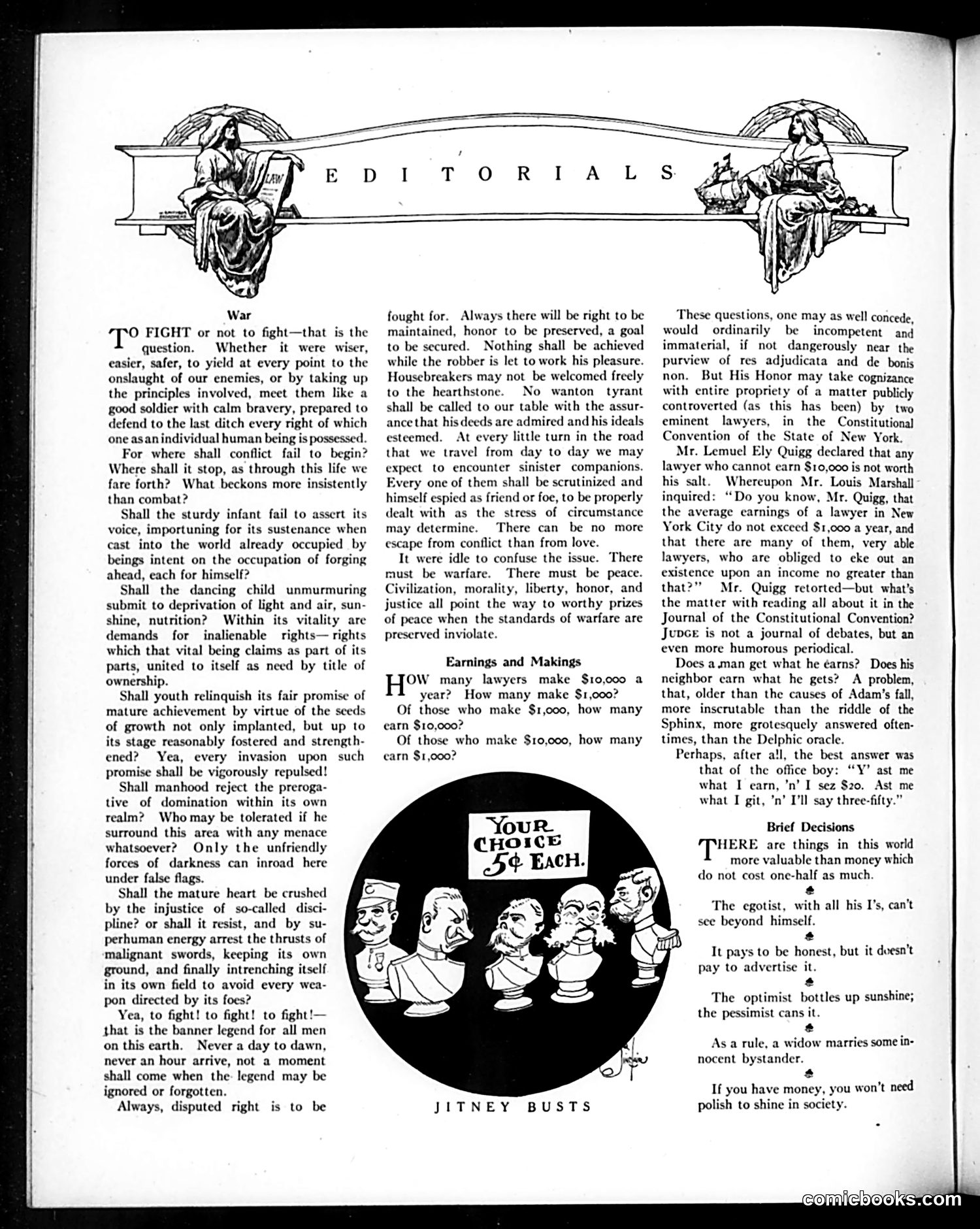
The central cartoon depicts four caricatured men's busts labeled "Jitney Busts," priced at 5¢ each. This appears to mock the "jitney" phenomenon—informal, unlicensed small buses or shared taxis that undercut established transportation monopolies in the early 1900s. The satire targets jitney operators themselves, likely portraying them as worthless or contemptible figures deserving mockery. By presenting their busts as cheap novelties, Judge ridicules both the service and the entrepreneurs behind it. The surrounding editorial content discusses war, morality, and legal/financial questions—suggesting the magazine positioned jitneys as emblematic of broader social disruptions and ethical decline in early 20th-century America. The jitney controversy represented tensions between small operators and established transit companies.
📄 Transcribed text from this page (OCR, searchable)
Machine-transcribed from the original scan — historical spelling and the odd misread are preserved.
4 Bas FIGHT or not to fight—that is the question. Whether it were wiser, easier, safer, to yield at every point to the onslaught of our enemies, or by taking up the principles involved, meet them like a good soldier with calm bravery, prepared to defend to the last ditch every right of which one asan individual human being is possessed. For where shall conflict fail to begin? Where shall it stop, as through this life we fare forth? What beckons more insistently than combat? Shall the sturdy infant fail to assert its voice, importuning for its sustenance when cast into the world already occupied by beings intent on the occupation of forging ahead, each for himself? Shall the dancing child unmurmuring submit to deprivation of light and air, sun- shine, nutrition? Within its vitality are demands for inalienable _rights— rights which that vital being claims as part of its parts, united to itself as need by title of ownership. Shall youth relinquish its fair promise of mature achievement by virtue of the seeds of growth not only implanted, but up to its stage reasonably fostered and strength- ened? Yea, every invasion upon such promise shall be vigorously repulsed! Shall manhood reject the preroga- tive of domination within its own realm? Who may be tolerated if he surround this area with any menace whatsoever? Only the unfriendly forces of darkness can inroad here under false flags. Shall the mature heart be crushed by the injustice of so-called disci- pline? or shall it resist, and by su- perhuman energy arrest the thrusts of malignant swords, keeping its own ground, and finally intrenching itself in its own field to avoid every wea- pon directed by its foes? Yea, to fight! to fight! to fight!— that is the banner legend for all men on this earth. Never a day to dawn, never an hour arrive, not a moment shall come when the: legend may be ignored or forgotten. Always, disputed right is to be fought for. Always there will be right to be maintained, honor to be preserved, a goal to be secured. Nothing shall be achieved while the robber is let to work his pleasure. Housebreakers may not be welcomed freely to the hearthstone. No wanton tyrant shall be called to our table with the assur- ance that his deeds are admired and his ideals esteemed. At every little turn in the road that we travel from day to day we may expect to encounter sinister companions. Every one of them shall be scrutinized and himself espied as friend or foe, to be properly dealt with as the stress of circumstance may determine. There can be no more escape from conflict than from love. It were idle to confuse the issue. There must be warfare. There must be peace. Civilization, morality, liberty, honor, and justice all point the way to worthy prizes of peace wl the standards of warfare are preserved inviolate. Earnings and Makings H°’ many lawyers make $10,000 a year? How many make $1,000? Of those who make $1,000, how many earn $10,000? Of those who make $10,000, how many carn $1,000? JITNEY BUSTS These questions, one may as well concede, would ordinarily be incompetent and immaterial, if not dangerously near the purview of res adjudicata and de bonis non. But His Honor may take cognizance with entire propriety of a matter publicly controverted (as this has been) by two eminent lawyers, in the Constitutional Convention of the State of New York. Mr. Lemuel Ely Quigg declared that any er who cannot carn $10,000 is not worth his salt. Whereupon Mr. Louis Marshall inquired: “Do you know, Mr. Quigg, that the average earnings of a lawyer in New York City do not exceed $1,000 a year, and that there are many of them, very able lawyers, who are obliged to eke out an existence upon an income no greater than that?” Mr. Quigg retorted—but what's the matter with reading all about it in the Journal of the Constitutional Convention? Jupce is not a journal of debates, but an even more humorous periodical. Does a.man get what he ¢arns? Does his neighbor carn what he gets? A problem, that, older than the causes of Adam’s fall, more inscrutable than the riddle of the Sphinx, more grotesquely answered often- times, than the Delphic oracle. Perhaps, after all, the best answer was that of the office boy: “Y’ ast me what I earn, 'n’ I sez $20. Ast me what I git, ’n’ I'll say three-fifty.” Brief Decisions HERE are things in this world more valuable than money which do not cost one-half as much. ¢ The cgotist, with all his I’s, can’t see beyond himself. 2 It pays to be honest, but it doesn’t pay to advertise it. ¢ The optimist bottles up sunshine; the pessimist cans it. ¢ Asa rule, a widow marries some in- nocent bystander. 2 If you have money, you won't need polish to shine in society.