
A complete issue · 25 pages · 1915
Judge — June 26, 1915
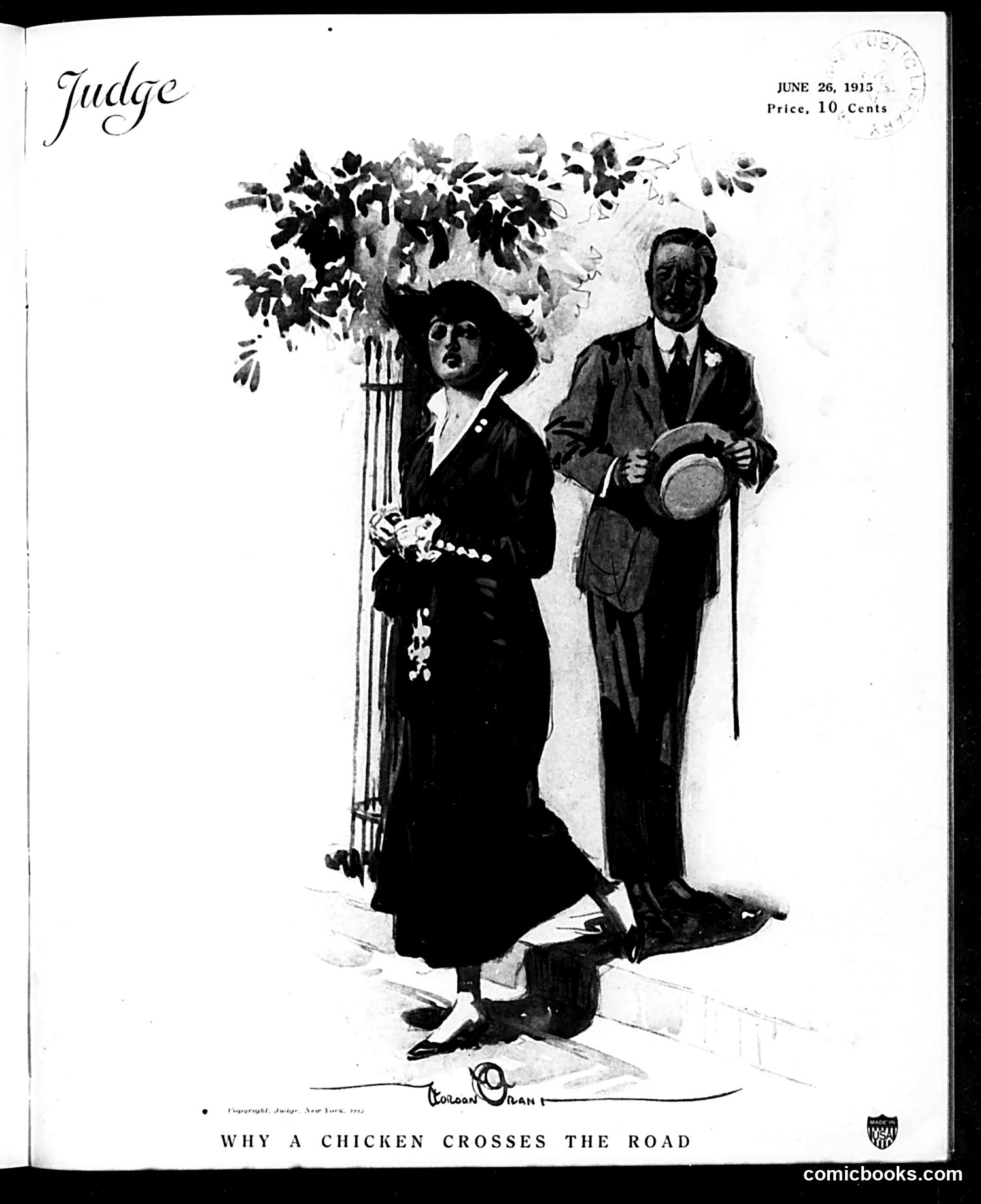
This Judge magazine cover from June 26, 1915, presents a visual pun on the popular riddle "Why does a chicken cross the road?" The cartoon shows two well-dressed men in formal attire standing beside a decorated doorway, apparently waiting to greet someone. The title suggests they represent obstacles or reasons preventing a chicken from crossing—likely satirizing some contemporary social or political situation. The specific figures and their identities are unclear from the image alone. However, the formal setup and the absurdist juxtaposition of elegant gentlemen with the mundane riddle suggest this is political or social satire of early 20th-century America, though the precise target remains uncertain without additional historical context.
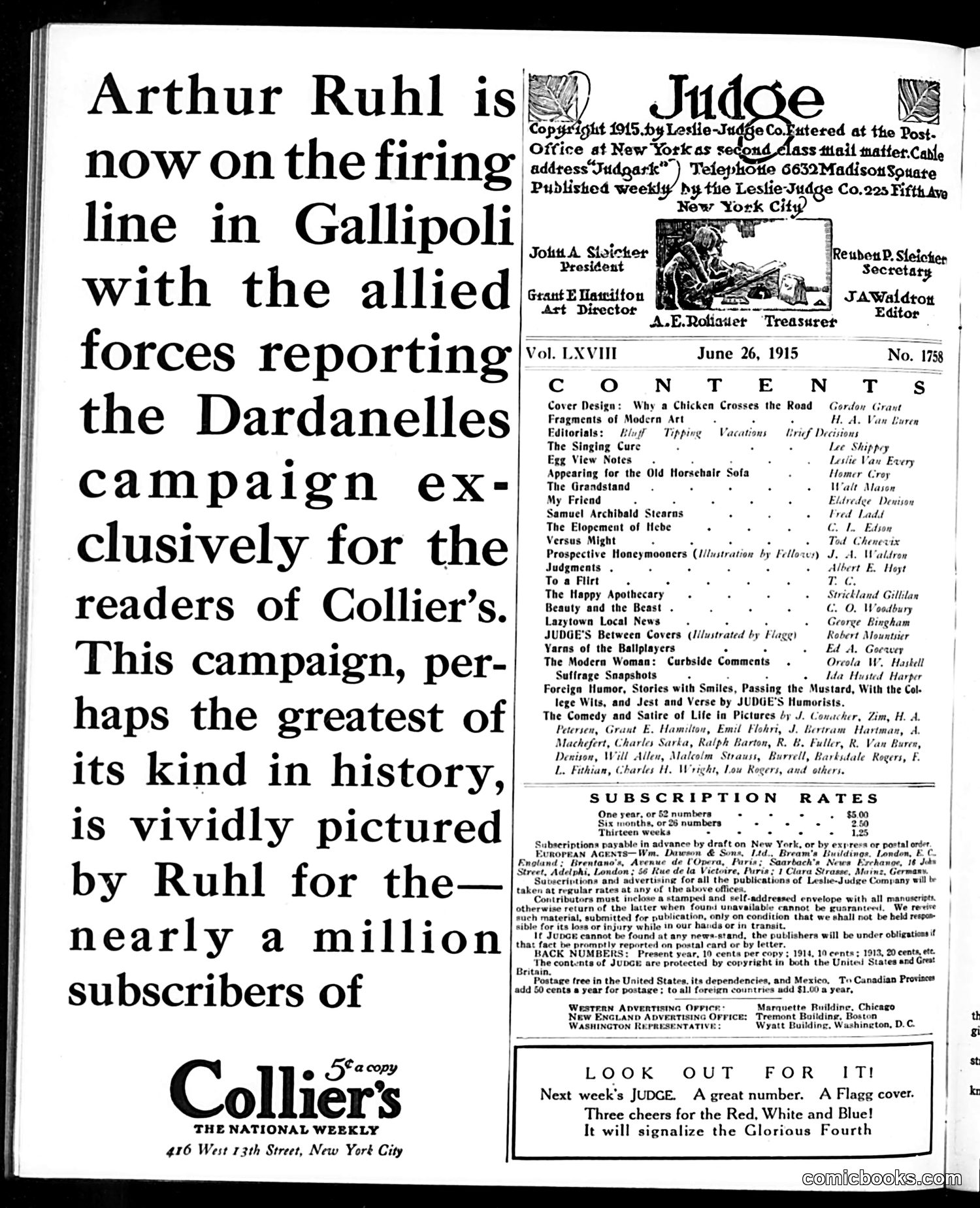
This page is primarily an **advertisement for Collier's magazine**, not a political cartoon. The large left-side text promotes Arthur Ruhl's exclusive reporting from the Gallipoli campaign (the WWI Allied offensive against Ottoman forces, 1915-1916). The ad claims Collier's has nearly a million subscribers and highlights Ruhl's vivid pictorial coverage of "perhaps the greatest of its kind in history." The right side shows the table of contents for *Judge* magazine (June 26, 1915, Vol. LXVIII, No. 1758), listing various articles and illustrations. A small boxed notice at bottom teases next week's issue with a Flagg cover celebrating Independence Day. This is primarily **commercial content** rather than satire requiring historical decoding.
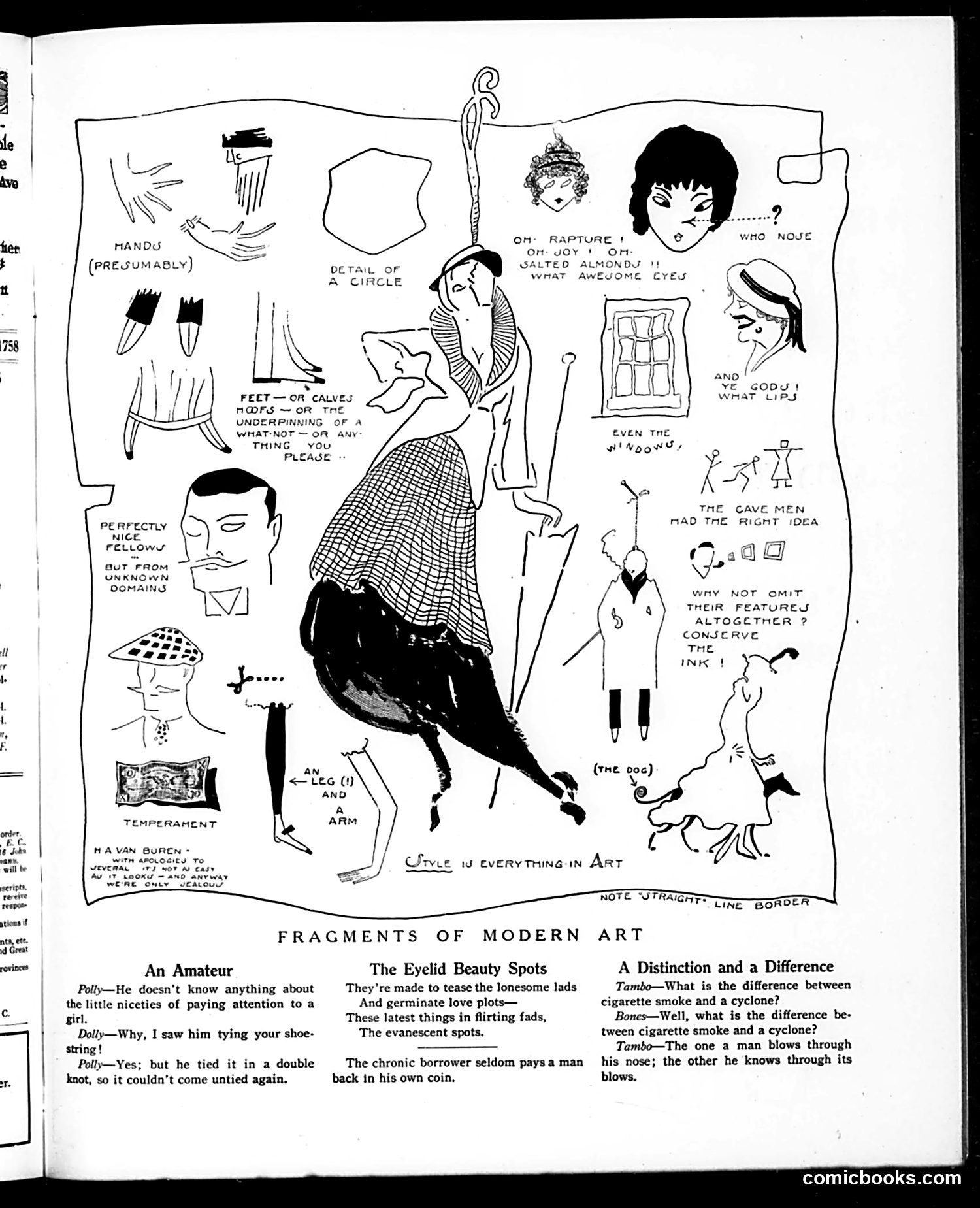
This page satirizes modernist art movements of the early 20th century through crude, deliberately amateurish sketches. The central figure appears to be a woman suspended by a rope in an awkward pose, surrounded by fragmented anatomical studies—disembodied hands, feet, eyes, and architectural elements. The satire mocks modernists' tendency to deconstruct human form into abstract components and their esoteric jargon ("style in everything in art"). The annotations poke fun at artists' pretentious explanations for strange compositions. Below, brief jokes about social trends suggest the page treats artistic modernism as ridiculous affectation. The overall message: these avant-garde movements are incomprehensible nonsense masquerading as serious art—a common conservative critique of early modernism in popular American magazines.
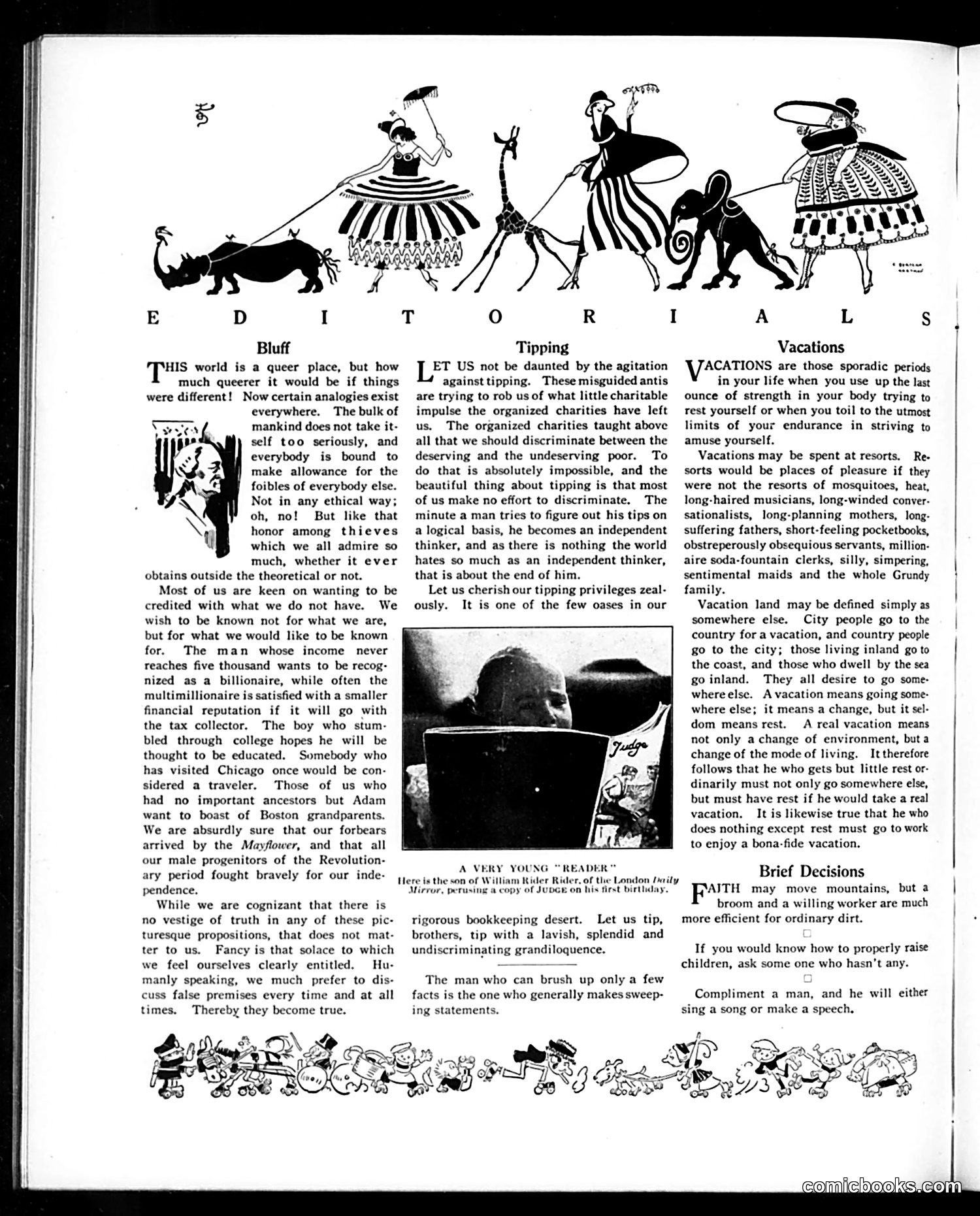
At the top, the word "EDITORIALS" is illustrated with stylized figures representing social commentary. The three main articles—"Bluff," "Tipping," and "Vacations"—discuss contemporary etiquette and social practices. The "Tipping" section satirizes the American tipping culture, arguing that while tipping *seems* to reward merit and independent thinking, it actually creates social obligation and hypocrisy. The author suggests organized charities are more honest than the "tipping privilege" system. The "Vacations" piece discusses leisure travel as essential rest for working people, distinguishing between resort vacations and meaningful changes of environment. The "Brief Decisions" section offers humorous social advice about child-rearing and flattery. The bottom illustration shows various figures in comedic poses—likely satirizing the social behaviors discussed above.
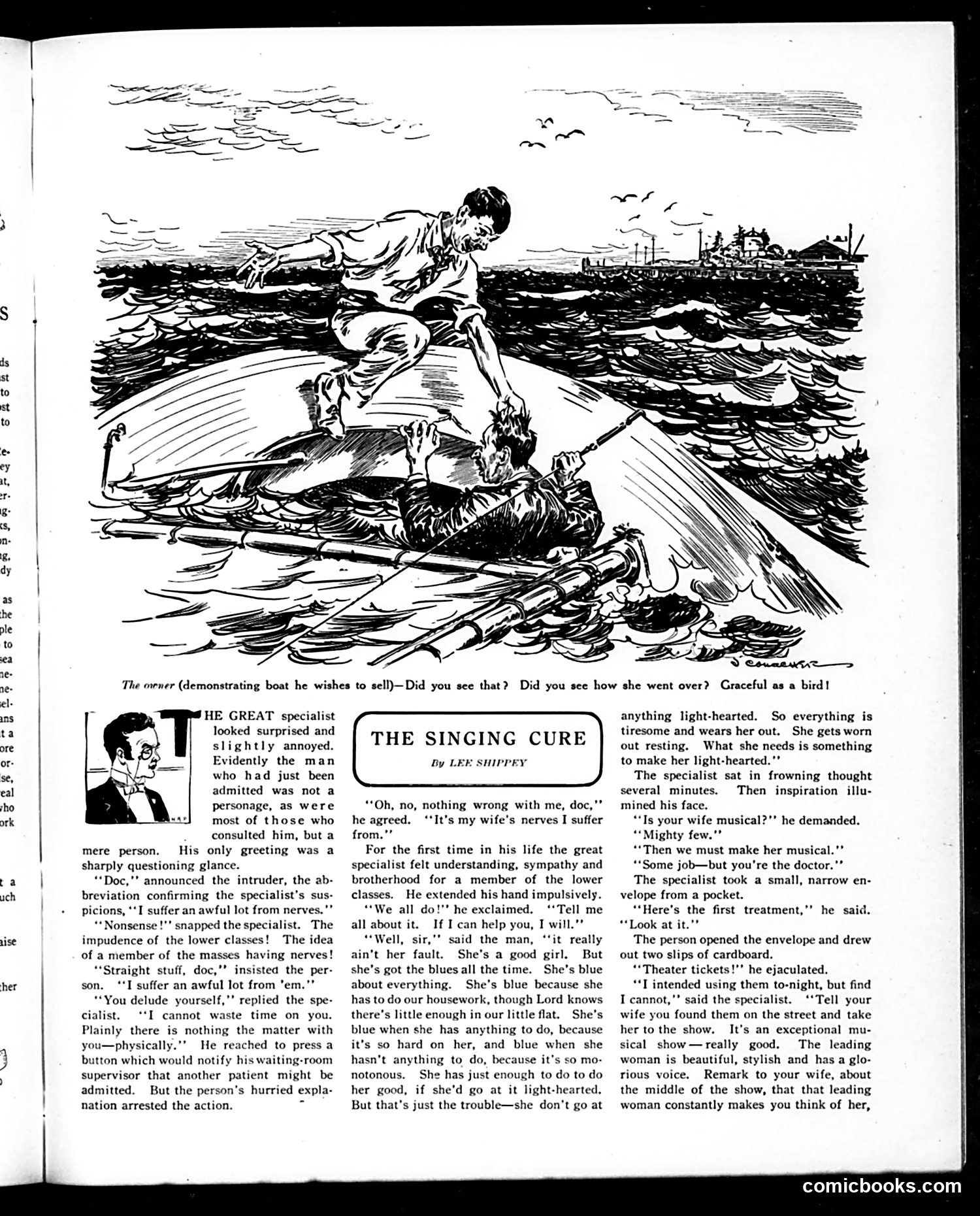
This page presents a satirical short story by Lee Shippey about a doctor's prescription for a nervous wife: attending musical theater. The narrative mocks both the wife's condition ("she's blue") and the era's casual medical advice. The accompanying cartoon shows a man demonstrating a boat he wishes to sell, capsizing it intentionally to prove its seaworthiness. The caption sarcastically praises this as careful salesmanship ("Careful as a bird!"). The satire targets two common early-20th-century absurdities: dubious medical treatments for women's nervous conditions, and overzealous product demonstration. The cartoonist suggests that both doctors and salesmen employ questionable logic to sell their services or goods to the public.
This page contains two distinct satirical pieces: **"The Singing Cure"** presents a humorous story about a doctor prescribing constant singing as a treatment for depression. The joke escalates absurdly: a patient and his wife adopt the habit so thoroughly they lose jobs but become successful vaudeville performers ("the Human Canaries"), eventually thanking the doctor for launching their show-business career. The satire mocks both the era's dubious medical "cures" and the notion that relentless optimism (through singing) could solve real problems. **"Egg View Notes"** are brief, folksy anecdotes from a rural community—a humorous local-gossip column. They include: a man claiming ownership of an uprooted apple tree by pointing to old carved initials; philosophical observations; and a man buying a bridle but finding his horse distracted by looking backward at it. These mock small-town pretension and simple logic. **"The Gilded Hearth"** (bottom) is a single-panel joke: a woman asks if her husband has been home, and he responds he "ran across him at breakfast only the other day"—implying their marriage is so distant they barely see each other. All three pieces target domestic life and social pretension through gentle, absurdist humor typical of Judge's satirical approach.
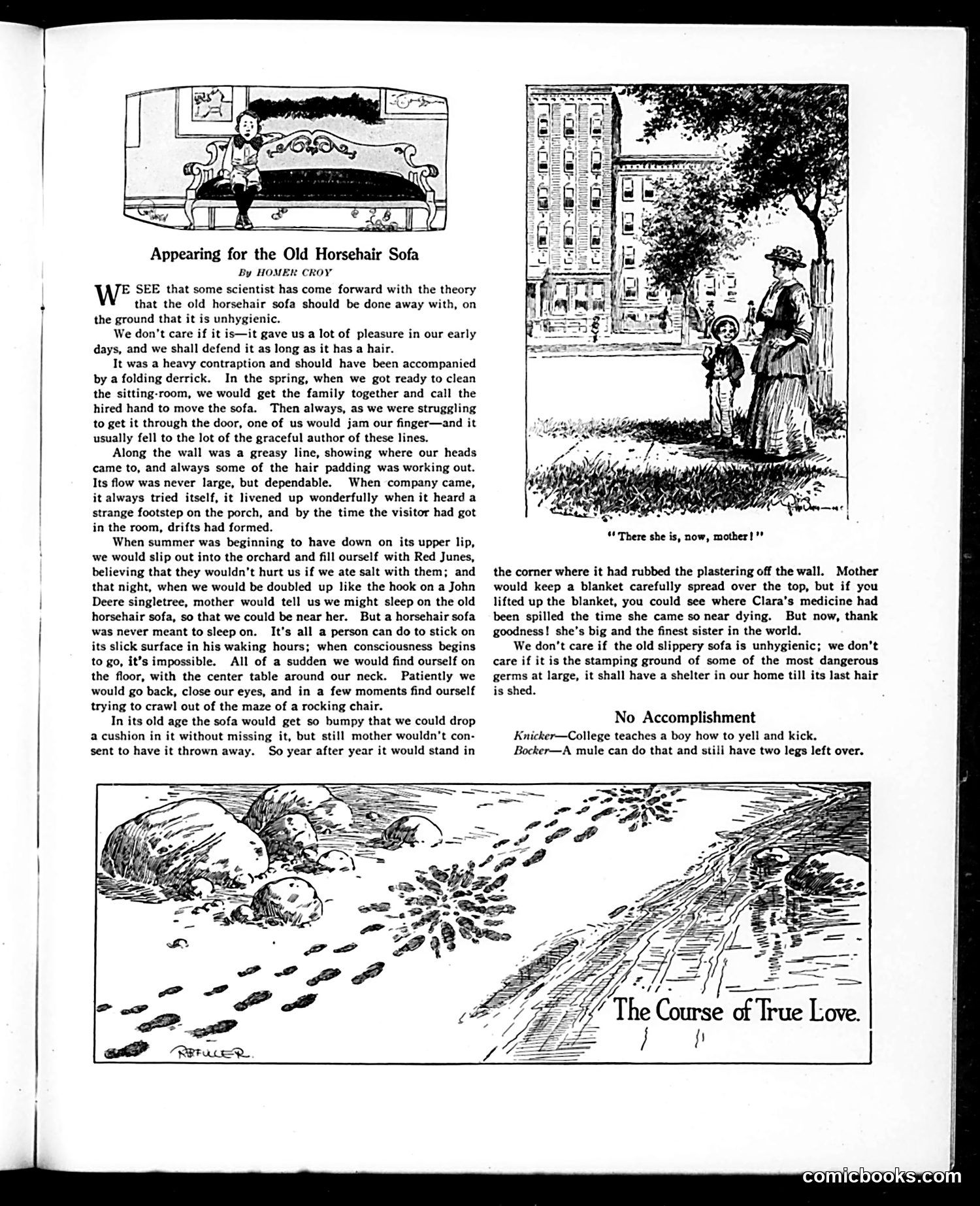
This page contains nostalgic humor and light social commentary typical of early-20th-century Judge magazine. **"Appearing for the Old Horsehair Sofa"** is a humorous essay by Homer Croy defending the old-fashioned horsehair sofa against modern scientific criticism that it's unsanitary. The piece uses exaggeration and vivid domestic memories—the sofa's weight requiring multiple people to move it, hair padding constantly shedding, its slippery surface causing people to fall onto the floor, its use as a sickbed—to argue sentimentally that comfort and family tradition outweigh hygiene concerns. It's gentle satire of both scientific progressivism and nostalgic attachment to outdated things. **"The Course of True Love"** is a cartoon showing footprints in sand approaching a couple, suggesting romantic pursuit or the "path" leading to love. **"No Accomplishment"** is a brief joke mocking college education as teaching boys only to "yell and kick"—skills a mule already possesses naturally—implying college is useless.
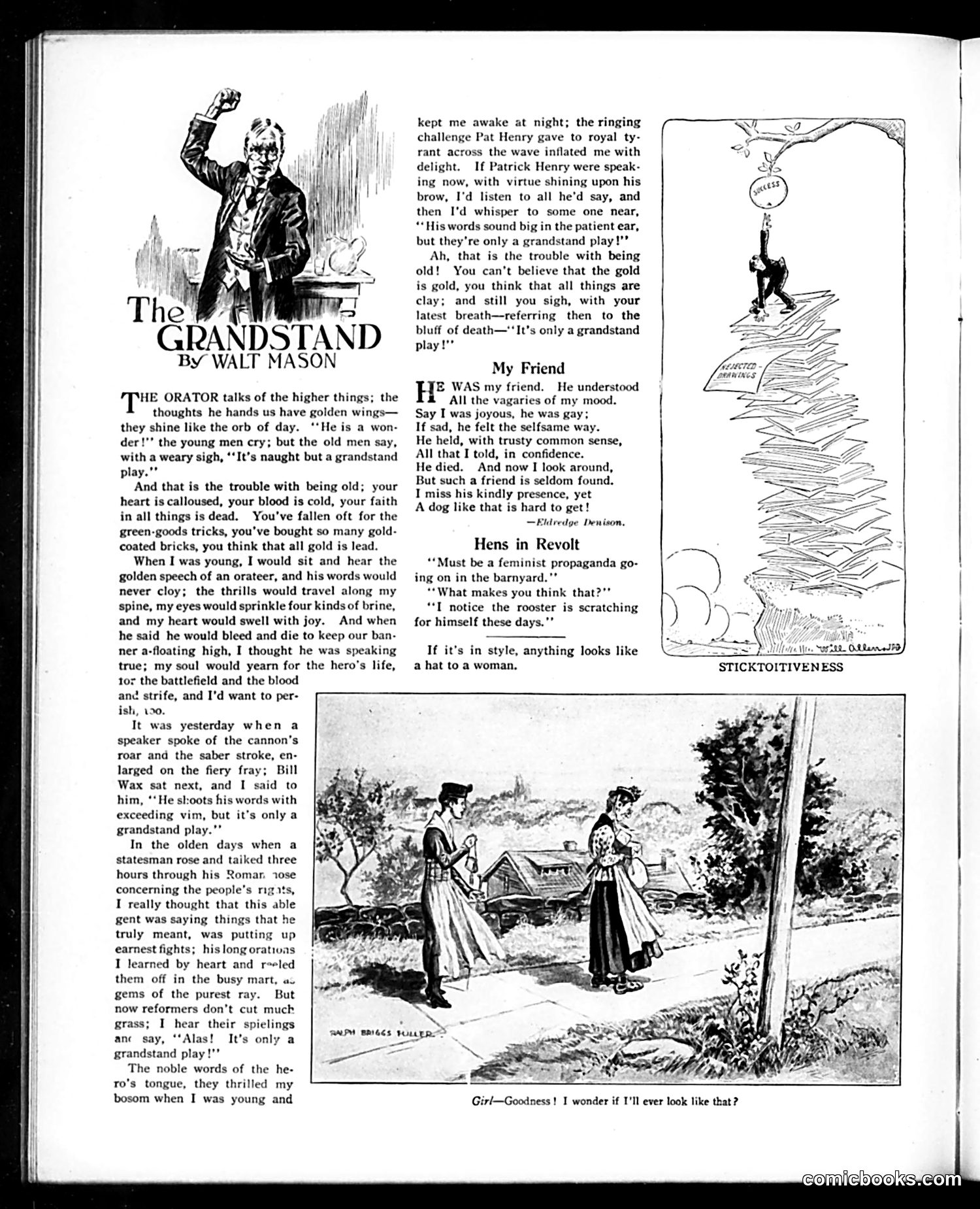
This page contains three pieces by Walt Mason and others from *Judge* magazine: **"The Grandstand Play"** is a nostalgic lament about aging and cynicism. The speaker contrasts his youthful enthusiasm for rousing oratory (invoking Patrick Henry's famous speech) with his current jaded dismissal of all passionate rhetoric as mere "grandstand play"—performative shows rather than genuine conviction. The point is that growing old hardens the heart and kills faith in noble words. **"My Friend"** is a sentimental poem praising a loyal companion who understood the speaker's moods and kept confidences—ending with the reveal that this friend was a dog, a humorous twist on what initially reads as a eulogy for a human relationship. **"Hens in Revolt"** is a brief joke mocking both feminism (framed as "propaganda") and fashion-obsessed women. The humor rests on the rooster now doing his own scratching for food, and the gag that women will wear anything if it's fashionable—even unsuitable hats.
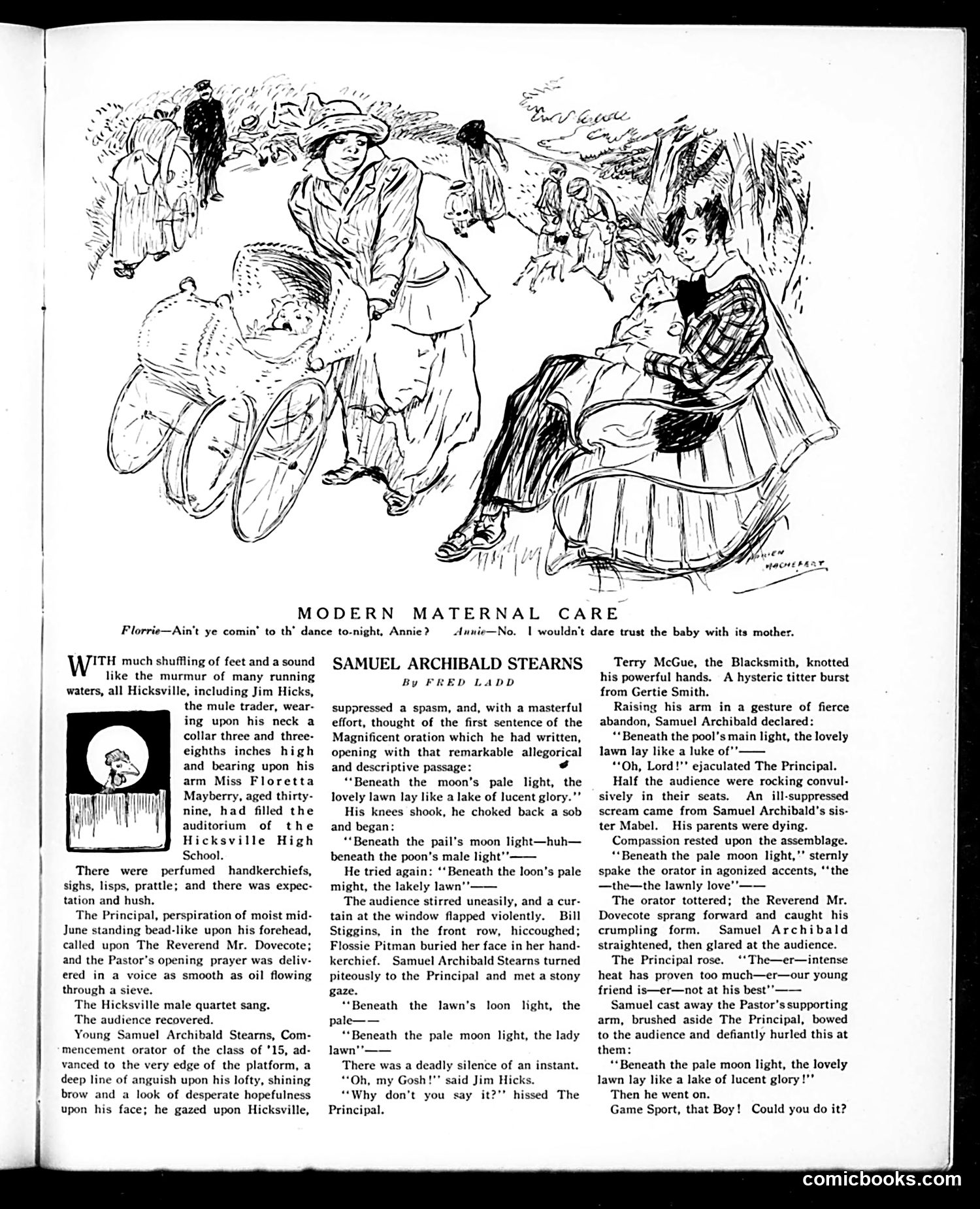
This is a humorous story about a high school commencement speaker who catastrophically fails during his prepared oration. Samuel Archibald Stearns, the class orator, attempts to deliver a flowery allegorical speech beginning with "Beneath the moon's pale light, the lovely lawn lay like a lake of lucent glory." Paralyzed by nerves before the entire town of Hicksville, he repeatedly mangles the opening line—saying "pail's moon light," "poon's male light," "loon's pale might," etc.—while the audience suppresses laughter and his mortified family suffers. After nearly collapsing, he defiantly recovers, delivers the line correctly, and continues. The satire mocks overwrought Victorian oratory, small-town pretension, and adolescent anxiety. The accompanying cartoon "Modern Maternal Care" shows mothers discussing motherhood duties, likely reinforcing contemporary expectations about women's roles.
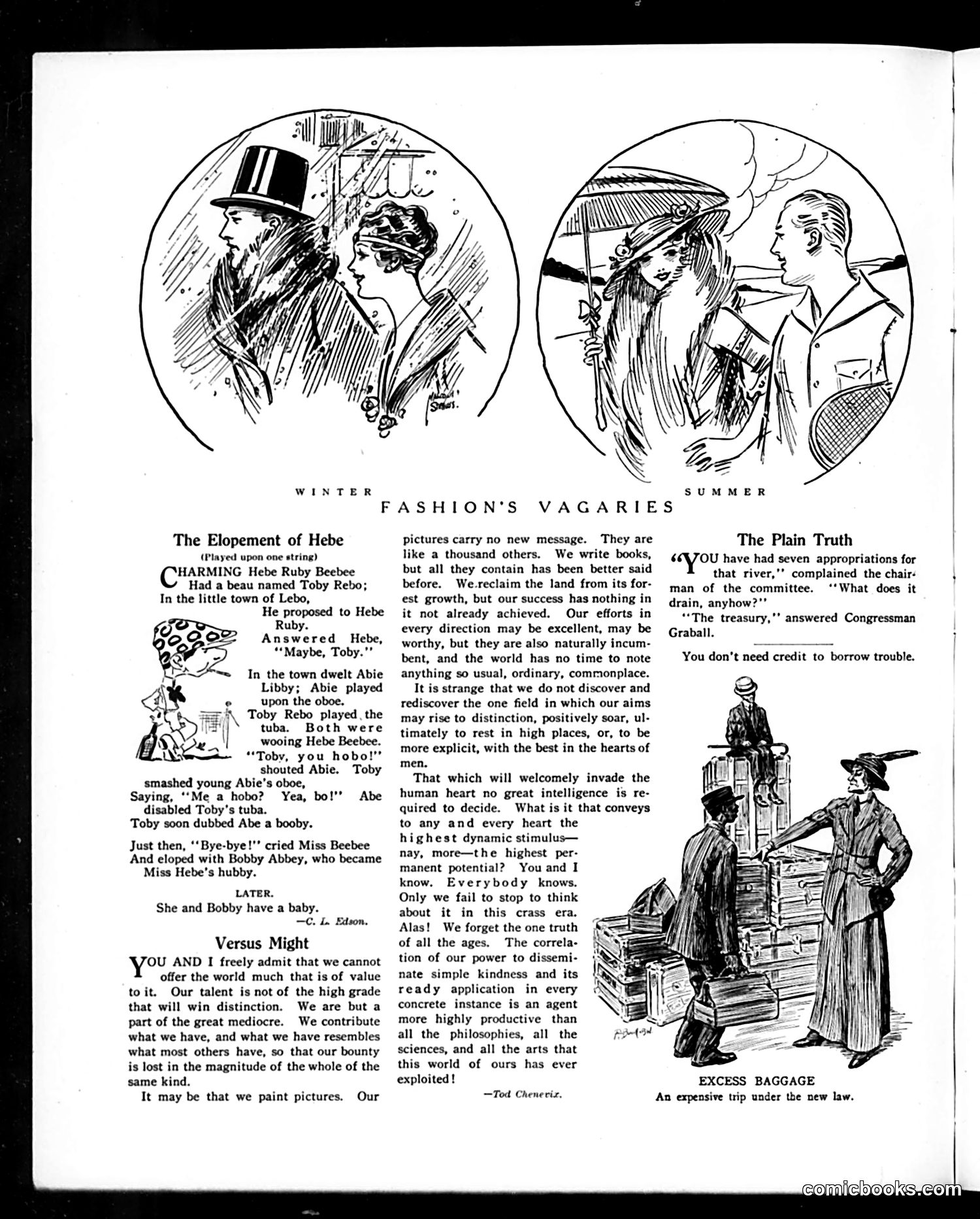
This page contains three distinct pieces from *Judge* magazine: **"The Elopement of Hebe"** (left): A lighthearted comic verse story about romantic rivalry. Three suitors—Toby, Abie, and Bobby—compete for Hebe Ruby Beebee's affection in the town of Lebo. After Toby and Abie destroy each other's musical instruments in a fight, Hebe elopes with Bobby Abbey instead, eventually having a baby. It's a silly tale with no particular political message—just humor through absurd names and romantic chaos. **"Versus Might"** (center): An editorial essay by Tod Cheneviz arguing that despite humanity's mediocre accomplishments in art, literature, and industry, we overlook our greatest power: disseminating kindness. It's a moralizing piece about spiritual values over material achievement. **"The Plain Truth"** and **"Excess Baggage"** (right): Two separate political cartoons. The first satirizes wasteful government spending—a congressman admits a river appropriation only benefits the treasury (drains money). The second cartoon, titled "Excess Baggage," illustrates a new luggage tax law creating travel expenses for citizens.
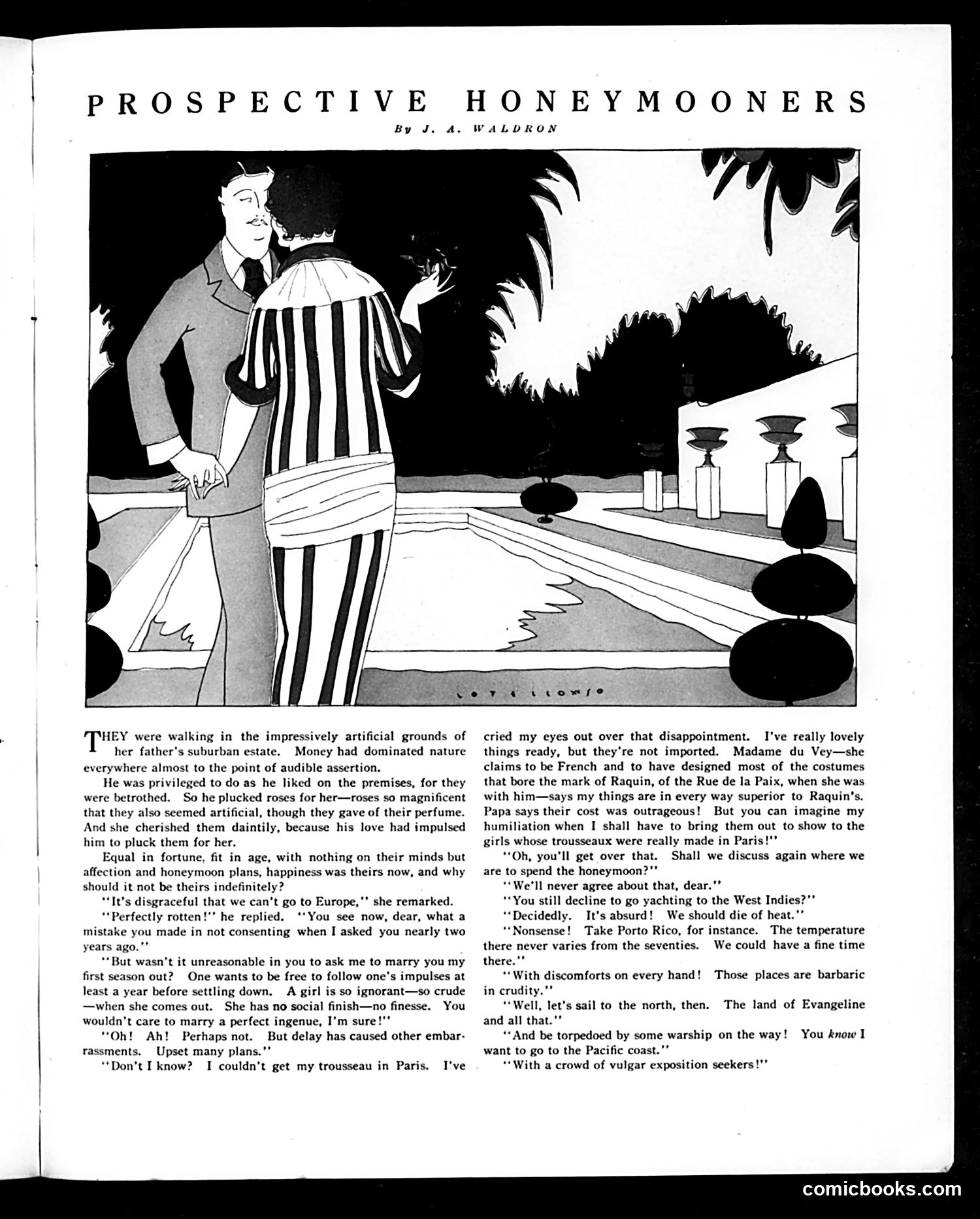
This story satirizes wealthy young engaged couples of the early 1900s, mocking their superficiality and entitlement. The couple—shown in an artificially manicured estate—bicker endlessly about honeymoon destinations while displaying conspicuous consumption values: the woman regrets her delayed marriage cost her a Paris trousseau, and both obsess over fashionable travel. The satire targets their frivolous priorities: they have wealth, youth, and love, yet find nothing satisfactory. Each proposed destination gets rejected with snobbish complaints—Europe is impossible, the West Indies too hot, the Pacific coast attracts "vulgar" tourists, and sailing risks warship torpedoes (a topical WWI reference). The author lampoons how privilege creates perpetual dissatisfaction and how social pretension—imported French gowns, exclusive vacation spots—dominates their thinking over genuine happiness. Their perfect circumstances yield only complaint.
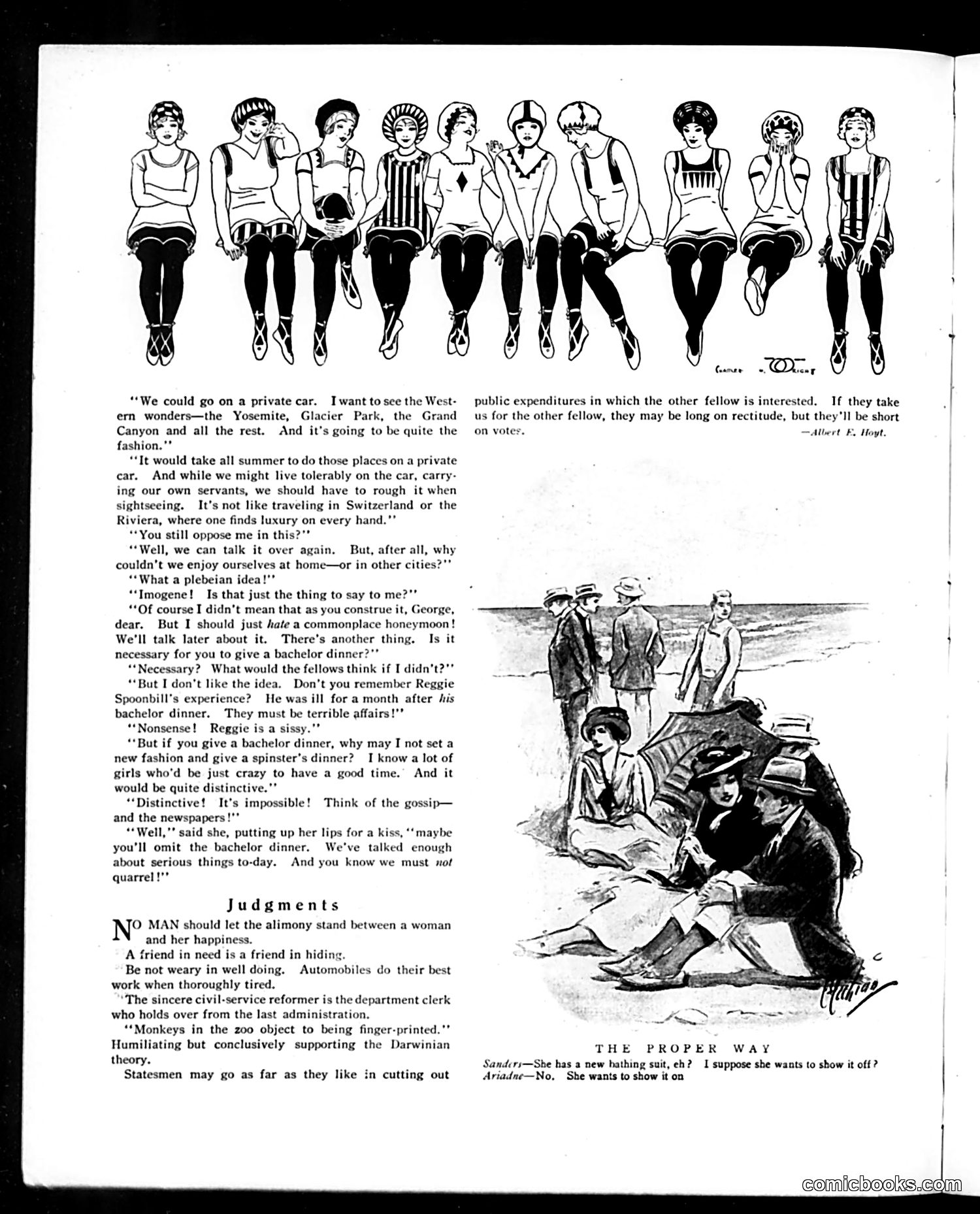
**Top Illustration:** Ten women in 1910s fashion seated together, likely representing modern, independent women. **Main Text/Dialogue:** A engaged couple debate their honeymoon and wedding plans. The woman (Imogene) opposes her fiancé George's plans for a Western trip and bachelor dinner, instead proposing she host a "spinster's dinner"—a novel, gender-reversed social custom. The satire mocks both upper-class pretension (obsessing over luxury travel and fashionable social rituals) and emerging women's demands for equality in social conventions traditionally reserved for men. **Bottom Right Cartoon:** "The Proper Way"—a beach scene where a woman displays her new bathing suit. The joke plays on whether she's showing it "off" (to impress) versus showing it "on" (wearing it), likely satirizing women's liberation and changing attitudes toward female bodies and swimwear. **Lower Section:** "Judgments"—witty one-liners on various topics, including civil service and Darwinian theory. **Context:** This reflects early 1900s anxieties about women's growing social independence and changing gender roles.
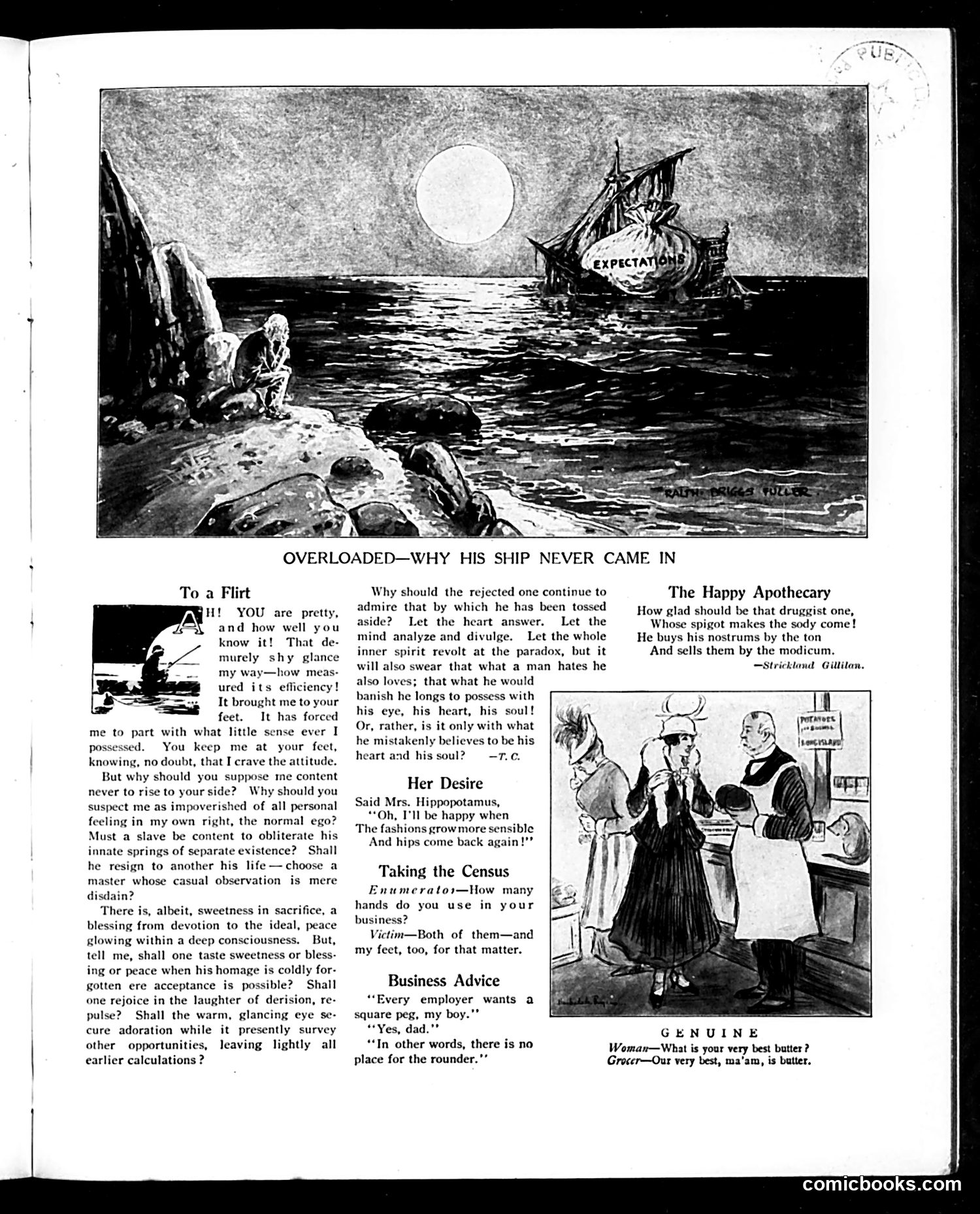
The top illustration, "Overloaded—Why His Ship Never Came In," depicts a shipwrecked sailor watching a damaged vessel with "Expectations" written on its sail. It satirizes disappointed hopes—the sailor's literal shipwreck mirrors the metaphorical failure of unrealistic expectations. Below are several short humor pieces: **"To a Flirt"** critiques romantic manipulation—a lengthy complaint from a man who feels emotionally exploited by a woman's calculated charm. **"Her Desire"** jokes about fashion cycles, with Mrs. Hippopotamus wishing larger hips would return to style. **"Taking the Census"** uses wordplay: when asked how many hands he uses in his business, a worker replies "both of them—and my feet, too," suggesting he works exhaustingly hard. **"Business Advice"** warns that employers only want conformists ("square pegs"), with no room for unconventional workers ("rounders"). **"The Happy Apothecary"** celebrates a pharmacist's profitable scheme selling medicines in small quantities despite bulk purchasing. The "Genuine" bit offers deadpan grocer humor about butter quality.
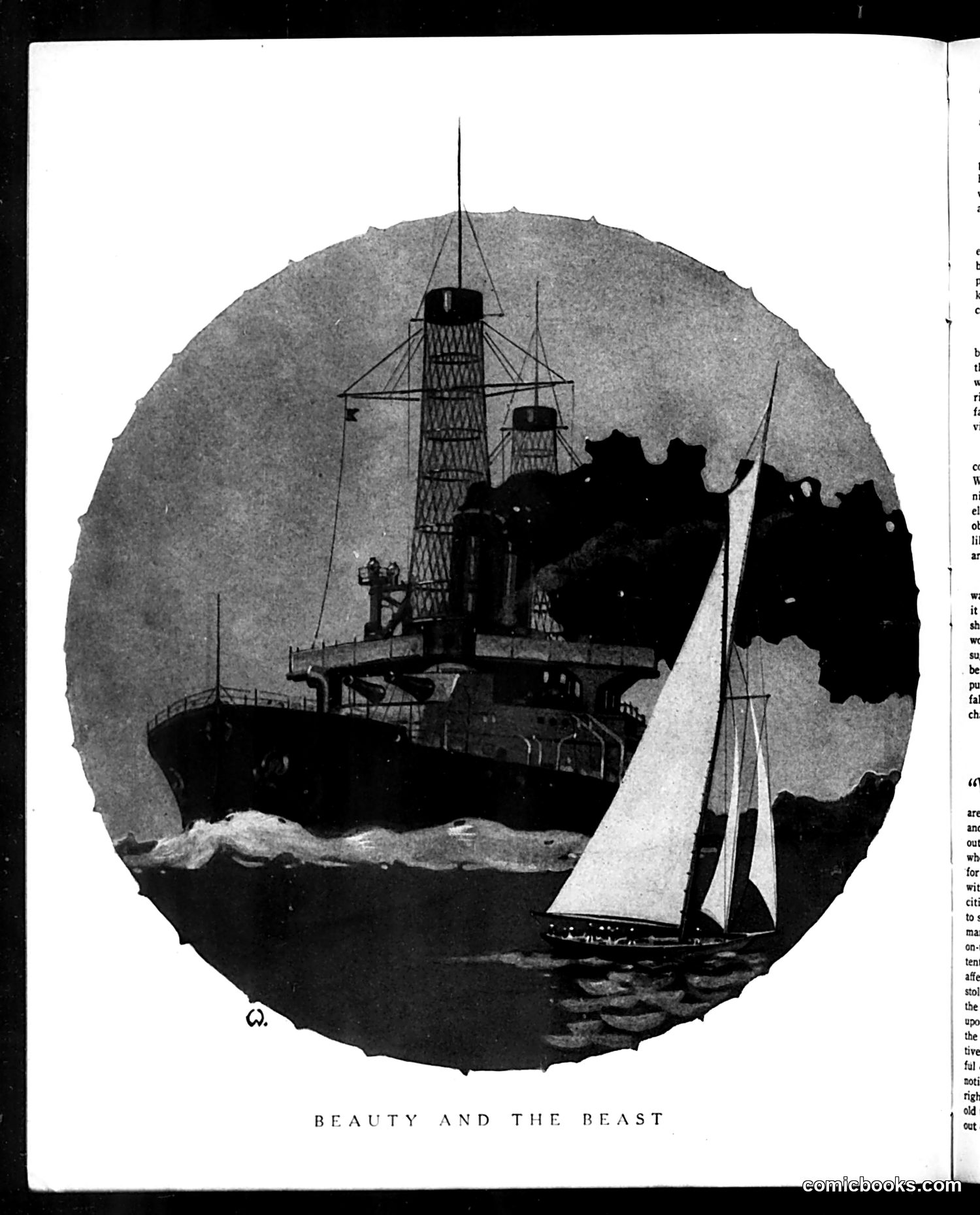
This illustration presents a stark visual contrast between two vessels: a graceful sailing yacht with white sails (the "Beauty") and an industrial steamship (the "Beast"). The composition appears to be social commentary on the contrast between traditional maritime elegance and modern industrial technology. The steamship's imposing structure, heavy machinery, and utilitarian design represent the "beast" of industrial progress, while the sailboat embodies classical beauty and grace. This likely satirizes tensions between 19th-century industrial advancement and nostalgic preferences for earlier, more aesthetically pleasing technologies—a common theme in Judge magazine's social criticism.
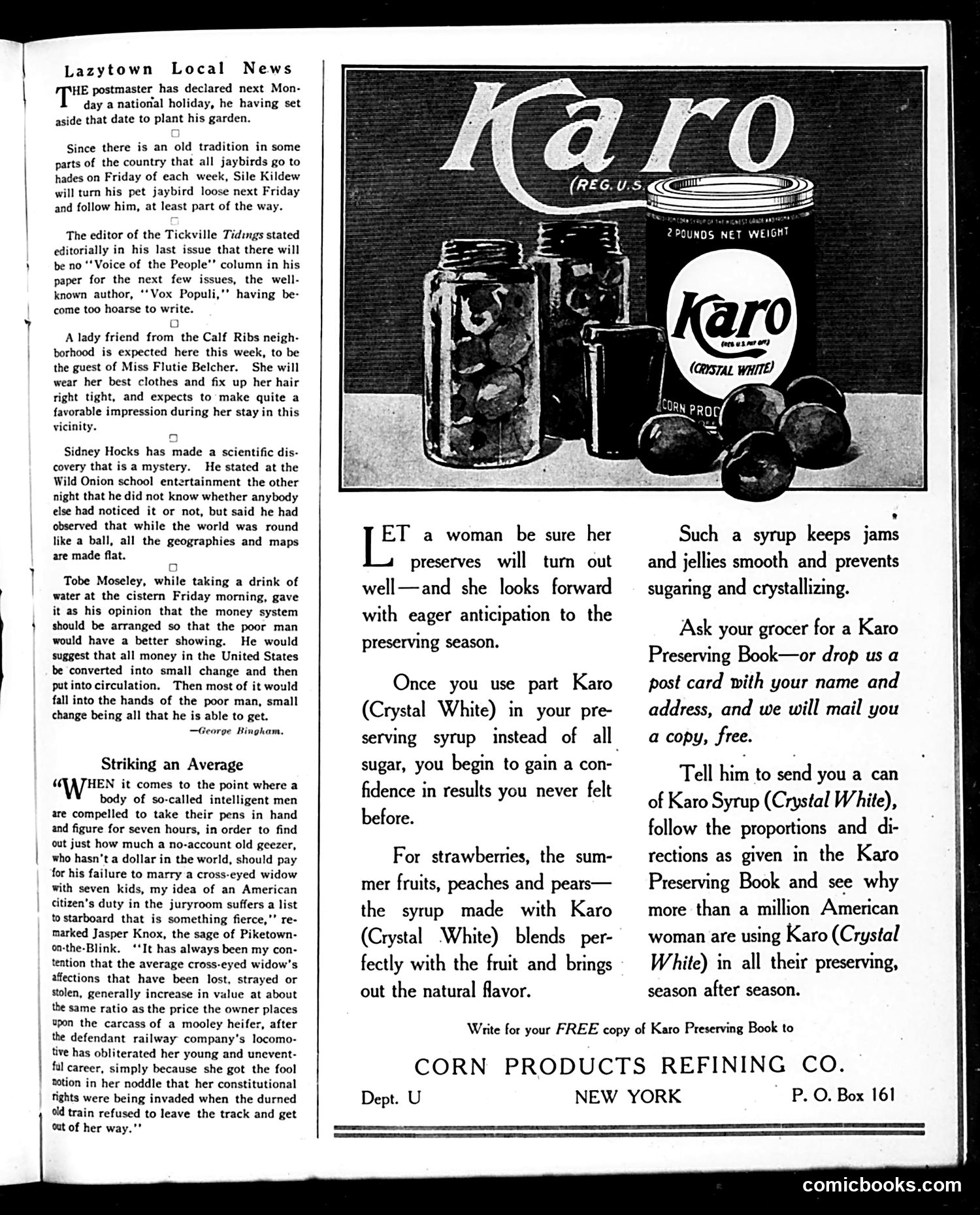
This page combines humorous local news from fictional small towns with a product advertisement. **The "Lazytown Local News" section** consists of absurdist rural humor—brief comedic anecdotes about townspeople with invented names (Sile Kildew, Tobe Moseley) engaged in ridiculous activities or expressing naive opinions. The jokes target rural simplicity: a postmaster prioritizing gardening over duties, confusion about whether jaybirds go to hell on Fridays, and a man's solution to poverty being converting all currency to small change. **"Striking an Average"** is a longer satirical piece by George Bingham mocking jury duty and legal damages calculations, particularly regarding a widow's injury claim after a train accident. The narrator sarcastically questions how courts determine monetary value for personal suffering. **The right half is a Karo Syrup advertisement** promoting their corn syrup product for home preserving, promising superior results to sugar alone. It's a straightforward commercial, not satire. The page represents Judge's mix of rural satire and advertising typical of early-20th-century magazines.
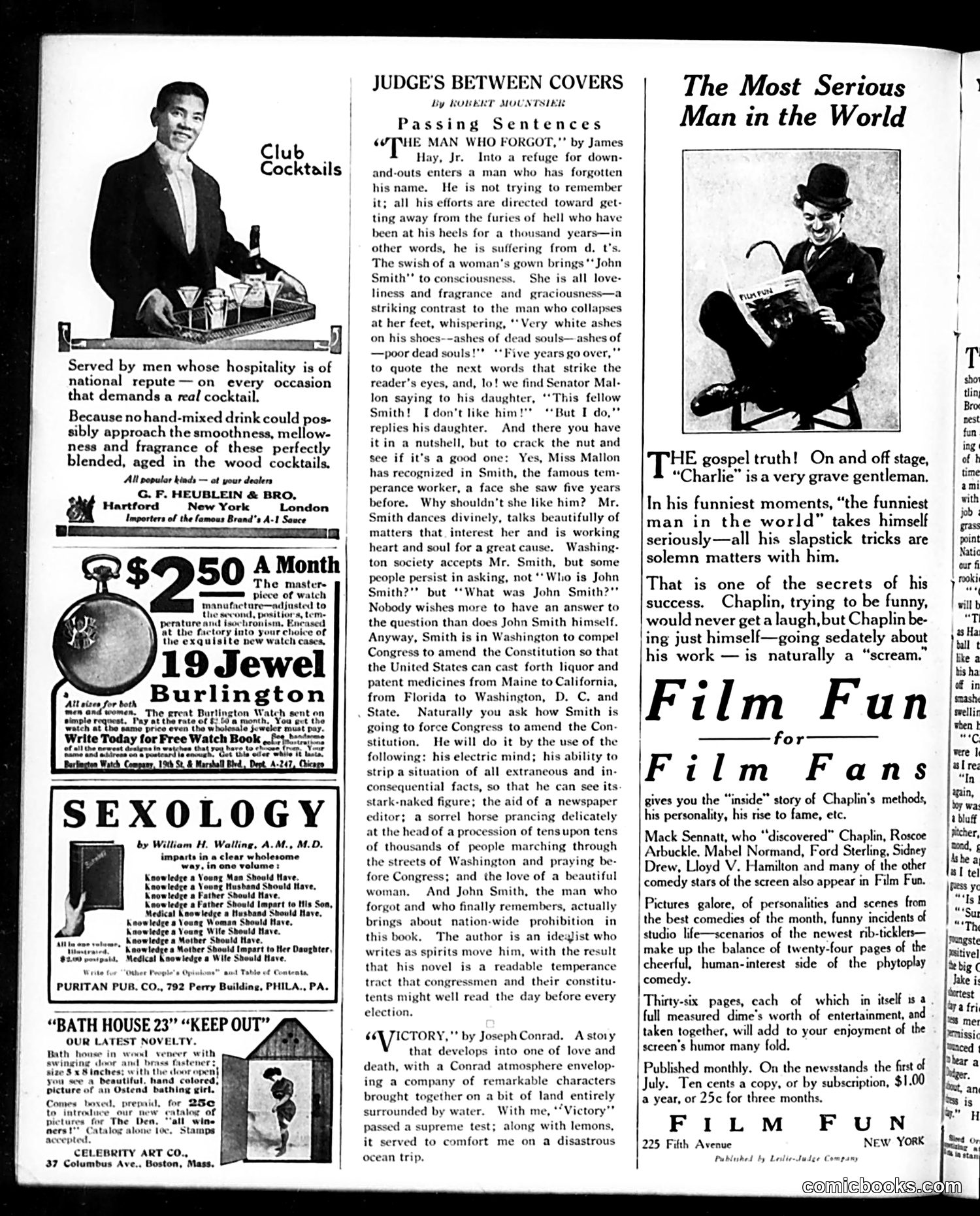
This page is primarily **advertising and book reviews** rather than political satire. The layout includes: **Advertisements**: Heublein cocktails (emphasizing machine-mixed precision), Burlington pocket watches, and a "Sexology" instructional book—typical early 20th-century magazine fare. **Book Reviews**: The "Judges Between Covers" column reviews two novels. "The Man Who Forgot" by James Hay Jr. concerns a temperance advocate with amnesia working to achieve nationwide prohibition. The review appears sympathetic to the protagonist's reform goals. "Victory" by Joseph Conrad receives brief mention. **"The Most Serious Man in the World"**: The right column features what appears to be **Charlie Chaplin** (identifiable by his bowler hat and cane silhouette) with text praising his comedic talent and seriousness—likely promoting his film work. The page reflects early 1900s concerns: Prohibition sentiment, popular literature, emerging film culture, and consumer products. No sharp political satire is evident here.
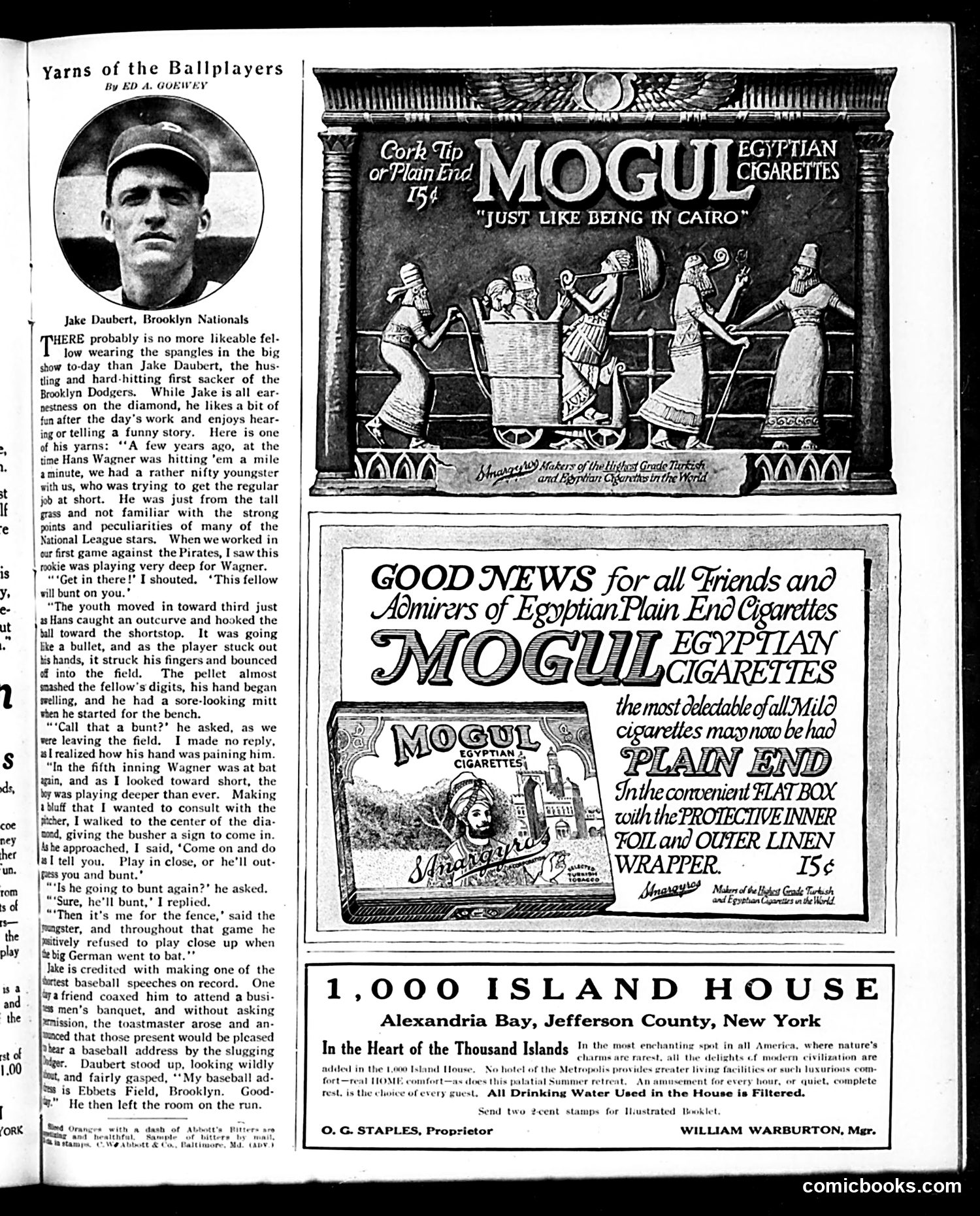
This page features a sports anecdote by Ed A. Guevey about **Jake Daubert**, first baseman for the Brooklyn Dodgers. The "yarn" (tall tale) recounts how a young, inexperienced player misjudges a bunting situation during a game against the Pirates. After being hit in the hand by a line drive, the rookie refuses to play close to home plate for the rest of the game, convinced the batter (Hans Wagner) will bunt again—missing the point that the previous hit was accidental, not intentional bunting. The humor lies in the rookie's stubborn misunderstanding and overreaction. A brief anecdote follows about Daubert's wit at a banquet, where asked for a baseball speech, he simply declares "My baseball address is Ebbets Field, Brooklyn" before leaving. The remainder consists of advertisements for Mogul Egyptian Cigarettes and the 1,000 Island House resort.
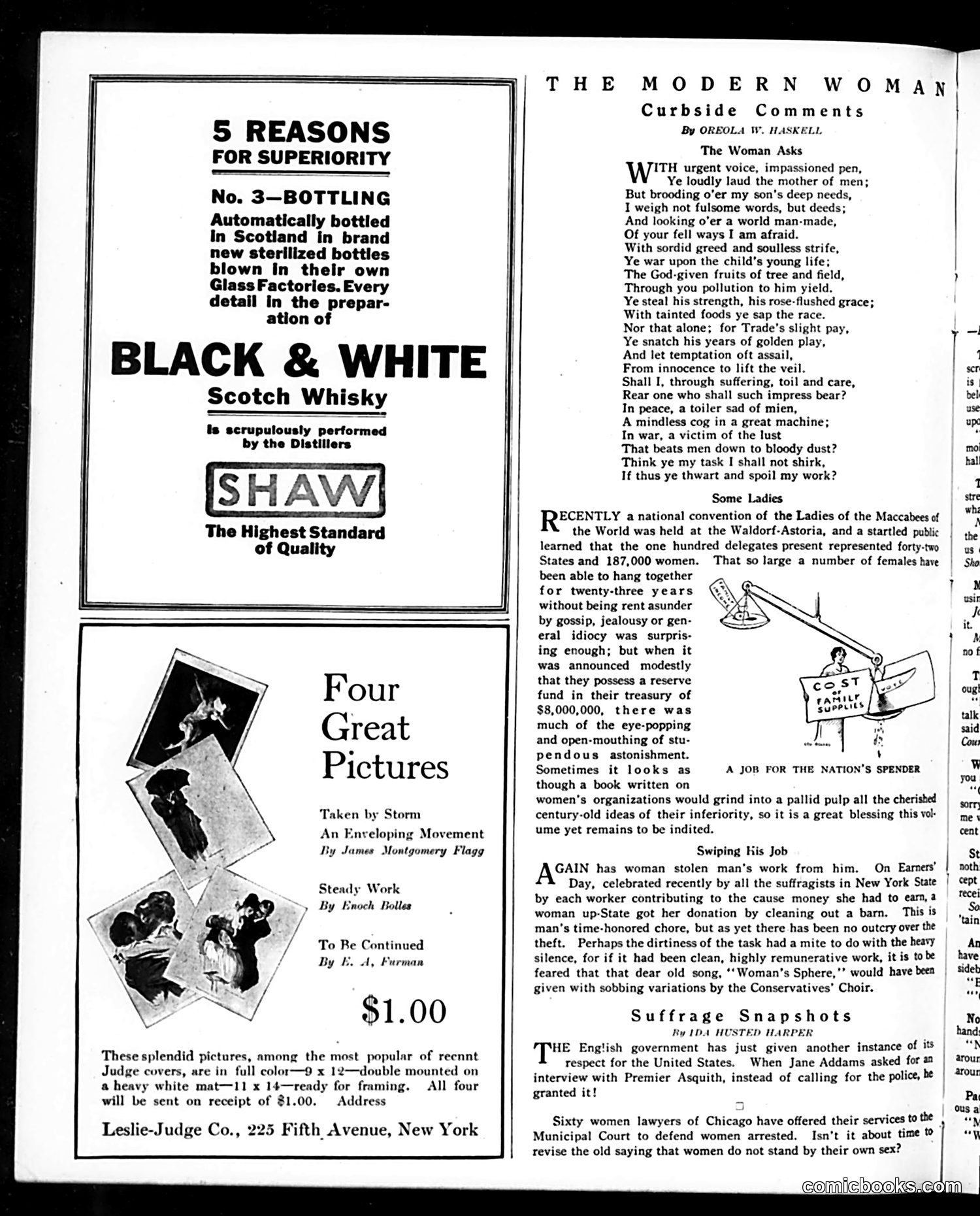
This Judge magazine page satirizes women's expanding social roles and activism circa 1910s. The main content critiques modern motherhood and women's organizations through three pieces: **"The Woman Asks"**: A poem expressing a mother's anxiety that industrial society—with its "sordid greed," polluted food, child labor, and war—corrupts children despite maternal care. **"Some Ladies"**: Mocks surprise that the Ladies of the Maccabees (a women's fraternal organization) maintained 187,000 members and accumulated $8 million over 23 years without dissolving into "gossip, jealousy or general idiocy"—backhanded praise undermining women's competence. **"Suffrage Snapshots"**: Brief anecdotes praising women's activism: suffragists fundraising, women cleaning barns for donations, female lawyers volunteering—presented as noteworthy achievements challenging traditional gender roles. The page balances mockery of women's ambitions with grudging acknowledgment of their organizational capability, typical of Judge's era when women's suffrage and professional participation remained controversial.
This page from *Judge* magazine contains primarily **humor columns and advertisements** rather than political cartoons. The main text piece, "Passing the Mustard," satirizes a retired businessman whose economic retrenchment (stopping advertising) caused his business to disappear—ironically, he didn't retire from business; business retired from him. It's commentary on Depression-era economic anxiety and the counterproductive nature of cost-cutting. The remaining items are brief humorous anecdotes on various topics: a heckler correcting an orator about land and fish, a street fight over job titles, a mother rejecting Shakespeare-quoting Johnny as company, and domestic humor about receipts and old age. The **advertisements** occupy substantial space: Arcadia Mixture smoking tobacco (50¢ for 1/4 pound) and Beeman's Pepsin Chewing Gum ("good for digestion"). These represent typical early 20th-century patent medicine and consumer product marketing. The page is primarily **light entertainment and advertising**—representative of *Judge*'s evolution toward mainstream humor magazine rather than hard political satire.
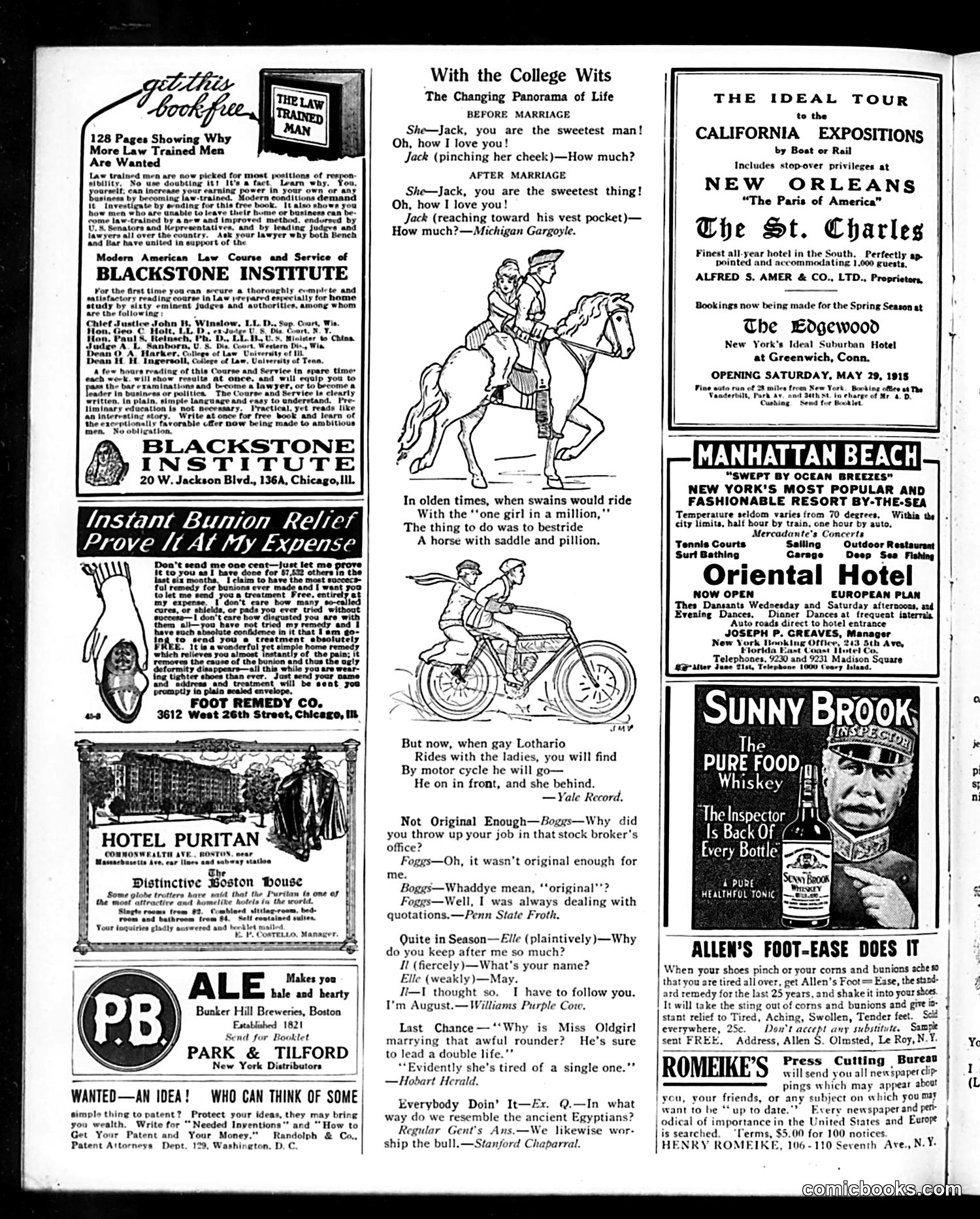
This page is primarily **advertising** with some light humor interspersed. The main content includes: **Humorous Sections:** The "College Wits" section contains brief jokes from college humor magazines, mostly playing on romantic and courtship themes. One notable joke contrasts pre- and post-marriage attitudes: a woman who gushes "you are the sweetest man" before marriage becomes more mercenary after, prompting the husband to reach for his wallet. Another contrasts old-fashioned horseback courting with modern motorcycles, where "he on in front, and she behind." These satirize shifting gender dynamics and commercialization of relationships. **Advertisements:** The bulk of the page advertises hotels (The St. Charles in New Orleans, The Edgewood in Connecticut, Manhattan Beach, Oriental Hotel), law training courses, bunion remedies, and alcoholic beverages—typical of 1915 publications. The dating suggests this is from around **May 1915**, based on hotel opening announcements. The humor is genteel and era-appropriate rather than politically pointed.
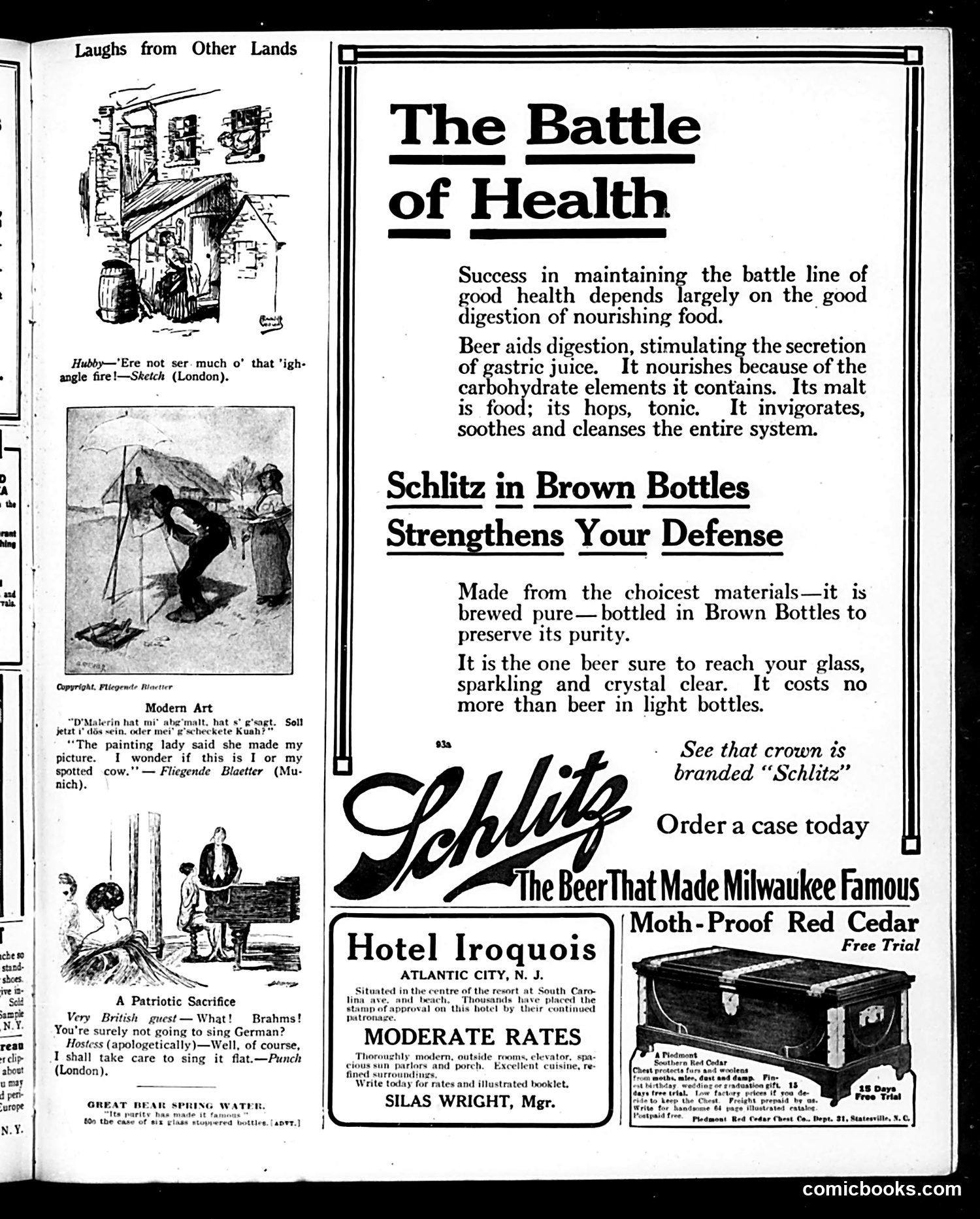
This page mixes international humor cartoons with advertising. The left side contains three satirical cartoons from European publications (British *Sketch*, German *Fliegende Blätter*, and British *Punch*): 1. A British husband warns against "high-angle fire"—likely WWI trench warfare humor 2. A German modernist art joke: a woman painted someone's portrait so poorly the subject can't tell if it's themselves or their spotted cow 3. A British hostess promises to sing German composer Brahms "flat" to avoid patriotic offense—WWI-era British anti-German sentiment The page's dominant feature is a **Schlitz beer advertisement** claiming health benefits: beer aids digestion, provides nourishment through carbohydrates, and the brown bottle preserves purity. This reflects early 20th-century advertising's now-discredited claims about alcohol's medicinal properties. The ad also includes a hotel advertisement and cedar chest promotional offering.
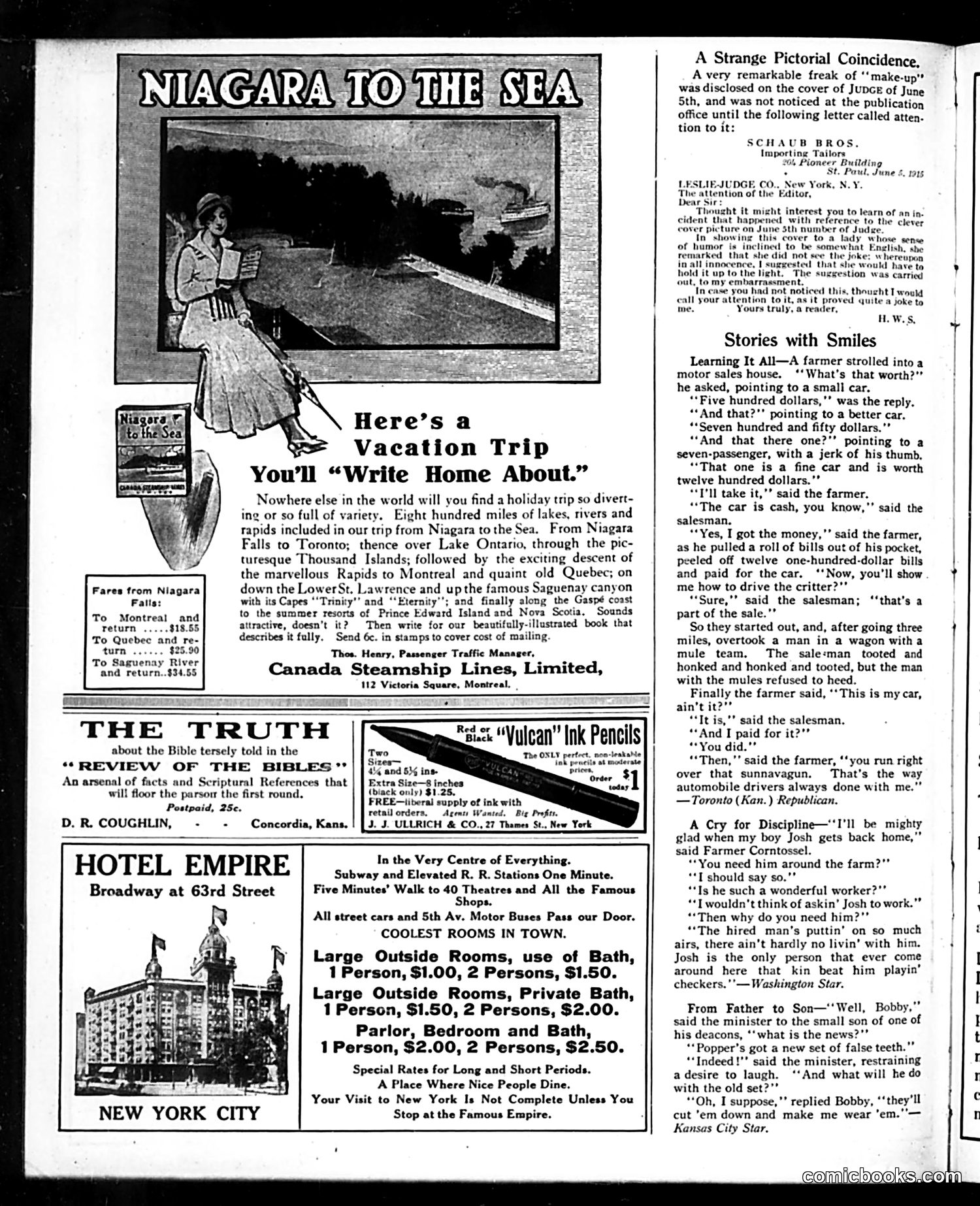
This page is primarily **advertisements and filler content** typical of Judge magazine. The main items are: 1. **"Niagara to the Sea" travel advertisement** for Canada Steamship Lines—promoting a vacation tour with pricing and booking information. 2. **"A Strange Pictorial Coincidence"** letter—A reader reports noticing something hidden in Judge's June 5th cover illustration that only appears when held to light. The letter doesn't specify what the hidden image is, but calls it a "joke." This appears to be an editor's note about an Easter egg or optical illusion deliberately placed in the cover art. 3. **"Stories with Smiles"** section—brief humorous anecdotes, including one about a farmer purchasing an automobile, unaware of its actual function or cost. The joke relies on rural/urban stereotypes common to early-1900s American humor. The page contains no political satire or recognizable caricatures—it's primarily commercial content and light humor typical of Judge's secondary pages.
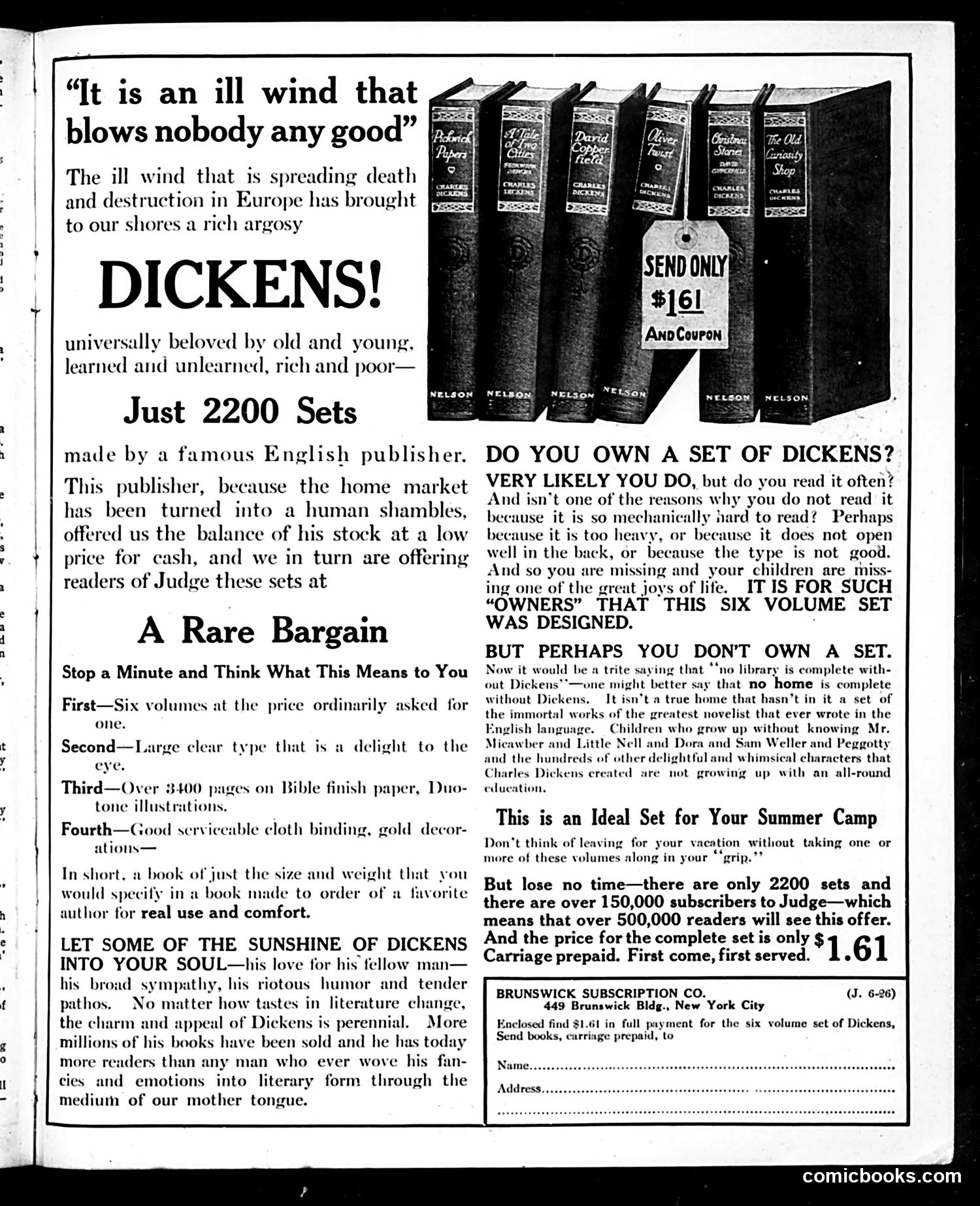
This is primarily a **mail-order advertisement**, not a political cartoon. It capitalizes on World War I disruptions to sell discounted Dickens book sets. **The "Angle":** A famous English publisher, facing collapse due to the European war ("death and destruction"), dumped surplus inventory at cost. Judge offers readers six volumes for the price of one—only 2,200 sets available. **The Appeal:** The ad emphasizes Dickens's universal, timeless moral value ("sunshine," sympathy for the poor, family education) while addressing practical concerns: improved typography, lighter binding, and portability for summer camps. **The Satire:** Mild—the opening quote frames war's destruction as having a silver lining (cheap books). There's gentle irony in marketing literature's moral uplift amid global violence, and subtle class messaging: Dickens belongs in every "true home." **Context:** Published during WWI (likely 1915-1917 based on "death and destruction in Europe"), exploiting wartime supply-chain disruptions for commercial gain.
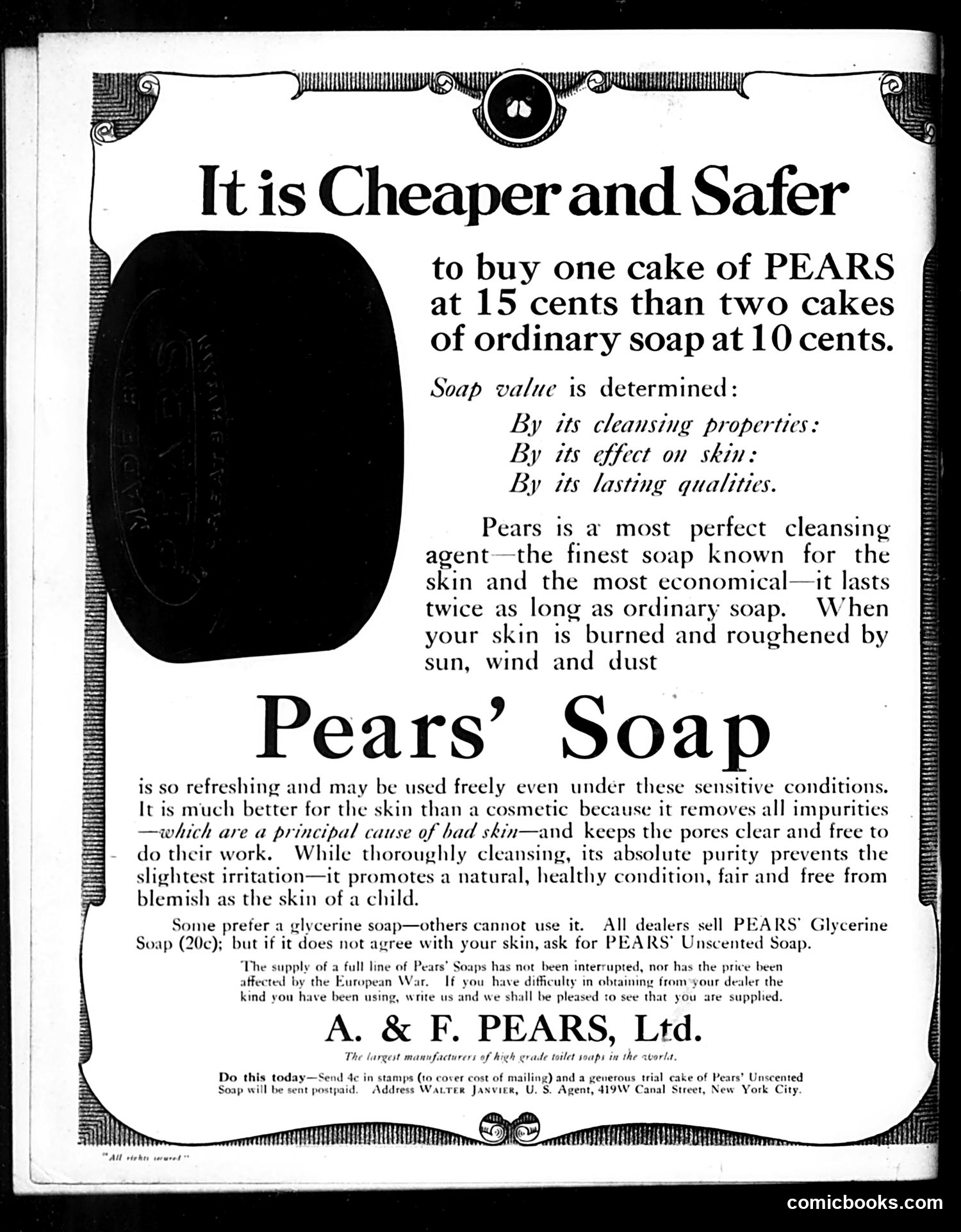
This is **not a political cartoon or satire**—it's a straightforward **product advertisement** for Pears' Soap from the early 20th century (likely WWI era, given the reference to "European War"). The page makes a direct value argument: one 15-cent cake of Pears lasts twice as long as two 10-cent cakes of ordinary soap, making it economical. The ad emphasizes the soap's gentleness on sun-damaged or sensitive skin, positioning it as superior to both ordinary soaps and cosmetics. The reference to the European War and assurances that supply and pricing are unaffected suggests this ran during WWI rationing concerns, reassuring American consumers of product availability. The ornamental border and large soap cake illustration are typical period advertising design. There is no satire or political commentary—simply promotional copy appealing to practical consumer concerns and vanity.

I can see this is a page from *Judge* magazine, but the image is almost entirely black with only minimal visible details—a few faint lines and sketches in the center that are too unclear to interpret with confidence. The OCR text provides only "comicbooks.com," which appears to be a watermark rather than actual magazine content. Without legible text or clear imagery, I cannot reliably identify the cartoon's subject, figures, political references, or satirical intent. To properly analyze this page's historical and political context, I would need a clearer image or legible OCR text accompanying the visual content.