
Judge, 1915-06-26 · page 4 of 25
Judge — June 26, 1915 — page 4: what you’re looking at
What you’re looking at
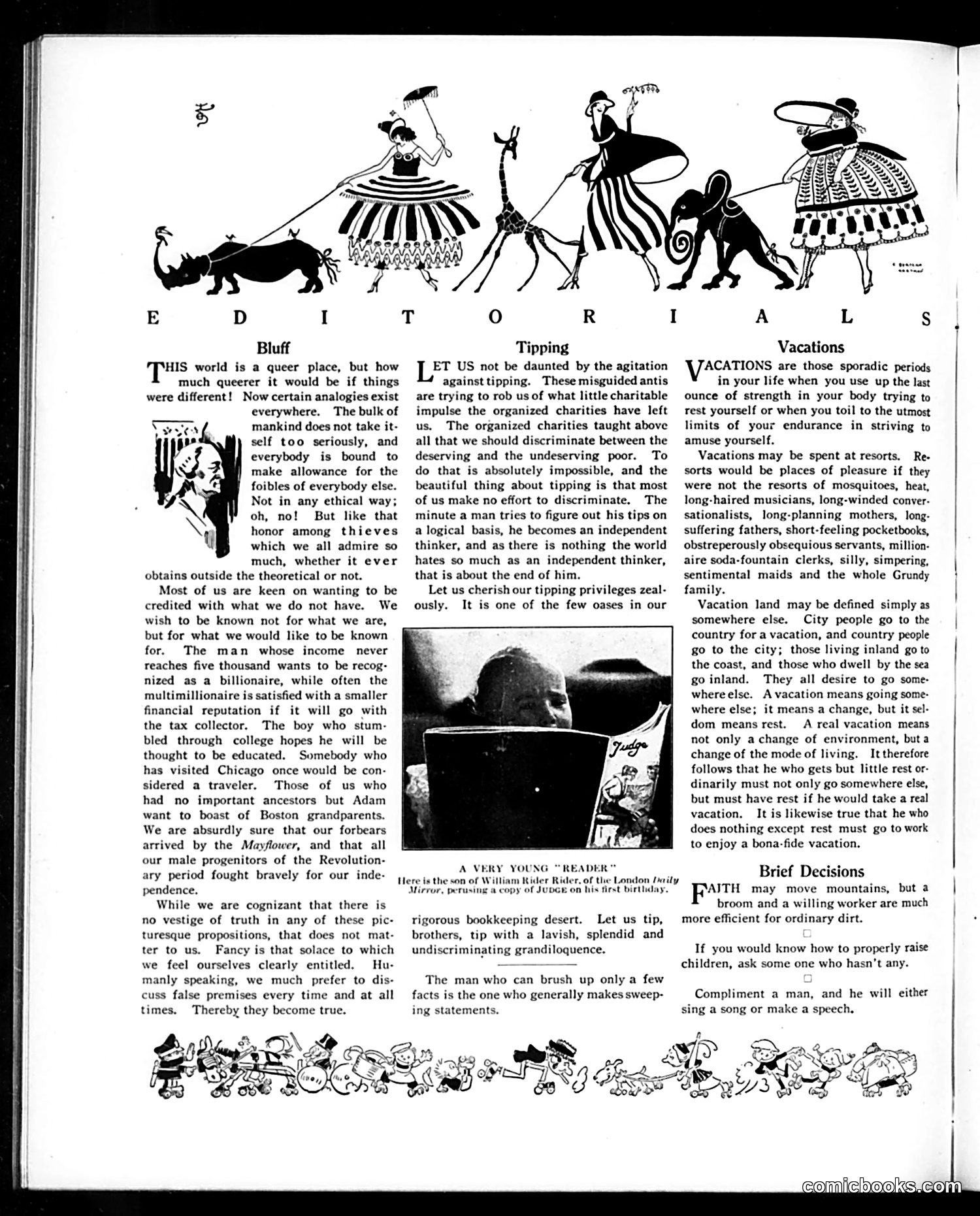
At the top, the word "EDITORIALS" is illustrated with stylized figures representing social commentary. The three main articles—"Bluff," "Tipping," and "Vacations"—discuss contemporary etiquette and social practices. The "Tipping" section satirizes the American tipping culture, arguing that while tipping *seems* to reward merit and independent thinking, it actually creates social obligation and hypocrisy. The author suggests organized charities are more honest than the "tipping privilege" system. The "Vacations" piece discusses leisure travel as essential rest for working people, distinguishing between resort vacations and meaningful changes of environment. The "Brief Decisions" section offers humorous social advice about child-rearing and flattery. The bottom illustration shows various figures in comedic poses—likely satirizing the social behaviors discussed above.
📄 Transcribed text from this page (OCR, searchable)
Machine-transcribed from the original scan — historical spelling and the odd misread are preserved.
D i Bluff HIS world is a queer place, but how much queerer it would be if things were different! Now certain analogies exist | everywhere. The bulk of mankind does not take it- self too seriously, and everybody is bound to make allowance for the foibles of everybody else. Not in any ethical way; oh, no! But like that honor among thieves which we all admire so much, whether it ever obtains outside the theoretical or not. Most of us are keen on wanting to be credited with what we do not have. We wish to be known not for what we are, but for what we would like to be known for, The man whose income never reaches five thousand wants to be recog- nized as a billionaire, while often the multimillionaire is satisfied with a smaller financial reputation if it will go with the tax collector. The boy who stum- bled through college hopes he will be thought to be educated. Somebody who has visited Chicago once would be con- sidered a traveler. Those of us who had no important ancestors but Adam want to boast of Boston grandparents. We are absurdly sure that our forbears arrived by the Mayflower, and that all our male progenitors of the Revolution- ary period fought bravely for our inde- pendence. While we are cognizant that there is no vestige of truth in any of these pic- turesque propositions, that does not mat- ter to us. Fancy is that solace to which we feel ourselves clearly entitled. Hu- manly speaking, we much prefer to dis- cuss false premises every time and at all times. Thereby they become true. q Tipping ET US not be daunted by the agitation against tipping. These misguided antis are trying to rob us of what little charitable impulse the organized charities have left us. The organized charities taught above all that we should discriminate between the deserving and the undeserving poor. To do that is absolutely impossible, and the beautiful thing about tipping is that most of us make no effort to discriminate. The minute a man tries to figure out his tips on a logical basis, he becomes an independent thinker, and as there is nothing the world hates so much as an independent thinker, that is about the end of him. Let us cherish our tipping privileges zeal- ously. It is one of the few oases in our A VERY YOUNG “READER” Here is the son of William Rider Rider, of the London Daily Mirror, peru: of JuDGE: on his first birthday. rigorous bookkeeping desert. Let us tip, brothers, tip with a lavish, splendid and undiscriminating grandiloquence. The man who can brush up only a few facts is the one who generally makes sweep- ing statements. L Vacations Vacations are those sporadic periods in your life when you use up the last ounce of strength in your body trying to rest yourself or when you toil to the utmost limits of your endurance in striving to amuse yourself. Vacations may be spent at resorts. Re- sorts would be places of pleasure if they were not the resorts of mosquitoes, heat, long-haired musicians, long-winded conver- sationalists, long-planning mothers, long- suffering fathers, short-feeling pocketbooks, obstreperously obsequious servants, million- aire soda-fountain clerks, silly, simpering, sentimental maids and the whole Grundy family. Vacation land may be defined simply as somewhere else. City people go to the country for a vacation, and country people go to the city; those living inland goto the coast, and those who dwell by the sea goinland. They all desire to go some- whereelse. A vacation means going some- where else; it means a change, but it sel- dom means rest. A real vacation means not only achange of environment, but a change of the mode of living. It therefore follows that he who gets but little rest or- dinarily must not only go somewhere else, but must have rest if he would take a real vacation. It is likewise true that he who does nothing except rest must go to work to enjoy a bona-fide vacation. Brief Decisions Fogqe may move mountains, but a broom and a willing worker are much more efficient for ordinary dirt. If you would know how to properly raise children, ask some one who hasn't any. Compliment a man, and he will either sing a song or make a speech,