
Judge, 1915-06-26 · page 6 of 25
Judge — June 26, 1915 — page 6: what you’re looking at
What you’re looking at
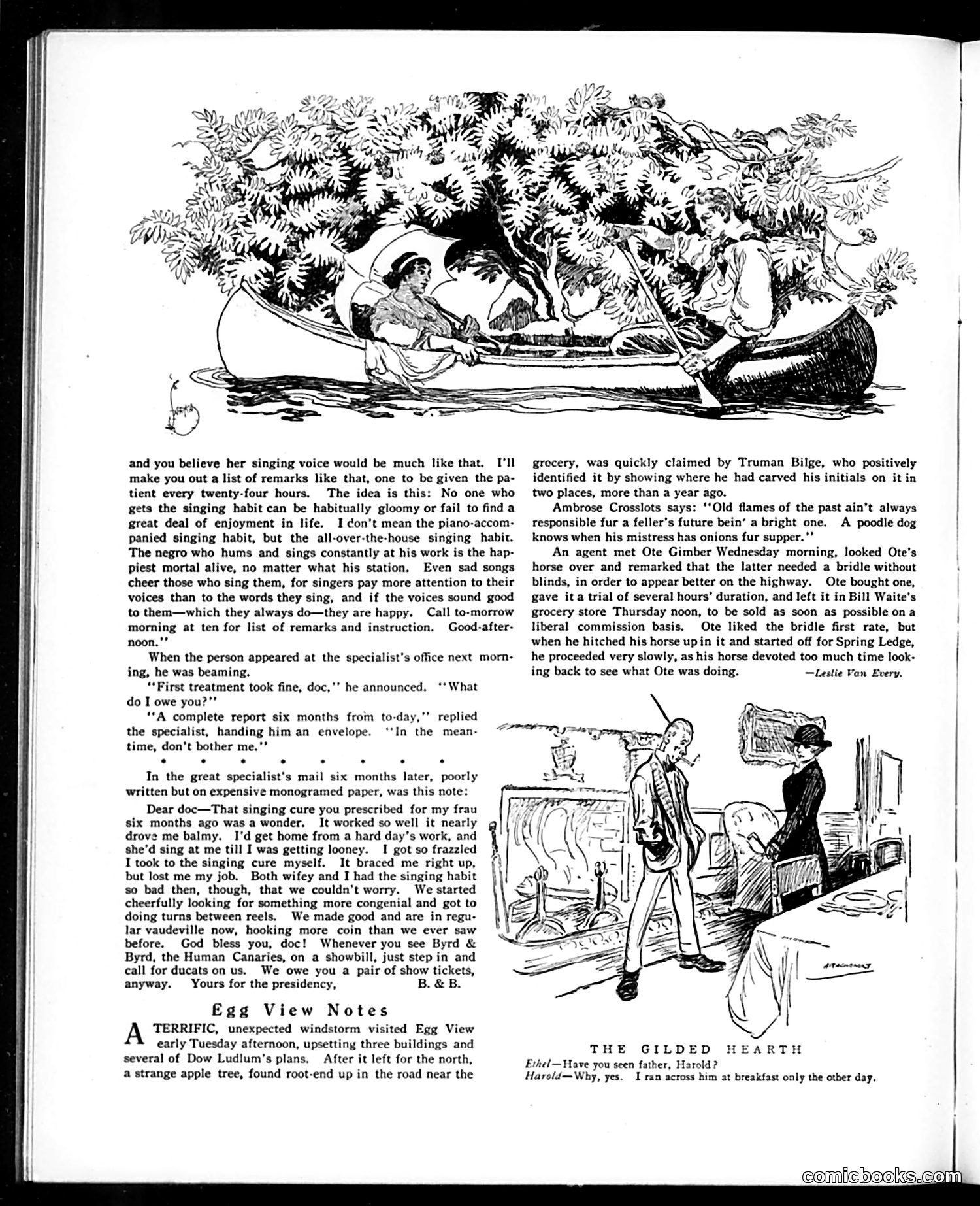
This page contains two distinct satirical pieces: **"The Singing Cure"** presents a humorous story about a doctor prescribing constant singing as a treatment for depression. The joke escalates absurdly: a patient and his wife adopt the habit so thoroughly they lose jobs but become successful vaudeville performers ("the Human Canaries"), eventually thanking the doctor for launching their show-business career. The satire mocks both the era's dubious medical "cures" and the notion that relentless optimism (through singing) could solve real problems. **"Egg View Notes"** are brief, folksy anecdotes from a rural community—a humorous local-gossip column. They include: a man claiming ownership of an uprooted apple tree by pointing to old carved initials; philosophical observations; and a man buying a bridle but finding his horse distracted by looking backward at it. These mock small-town pretension and simple logic. **"The Gilded Hearth"** (bottom) is a single-panel joke: a woman asks if her husband has been home, and he responds he "ran across him at breakfast only the other day"—implying their marriage is so distant they barely see each other. All three pieces target domestic life and social pretension through gentle, absurdist humor typical of Judge's satirical approach.
📄 Transcribed text from this page (OCR, searchable)
Machine-transcribed from the original scan — historical spelling and the odd misread are preserved.
<= Min aye BTU WY ESO) G and you believe her singing voice would be much like that. I'll make you out a list of remarks like that, one to be given the pa- tient every twenty-four hours. The idea is this: No one who gets the singing habit can be habitually gloomy or fail to find a great deal of enjoyment in life. I don’t mean the piano-accom- panied singing habit, but the all-over-the-house singing habit. The negro who hums and sings constantly at his work is the hap- piest mortal alive, no matter what his station. Even sad songs cheer those who sing them, for singers pay more attention to their voices than to the words they sing, and if the voices sound good to them—which they always do—they are happy. Call to-morrow morning at ten for list of remarks and instruction. Good-after- noon."” When the person appeared at the specialist's office next morn- ing, he was beaming. “*First treatment took fine, doc,"’ he announced. do I owe you?"’ “*A complete report six months from to-day,’’ replied the specialist, handing him an envelope. ‘‘In the mean- time, don’t bother me.’ . . . . . . . . In the great specialist's mail six months later, poorly written but on expensive monogramed paper, was this note: Dear doc—That singing cure you prescribed for my frau six months ago was a wonder. It worked so well it nearly drove me balmy. I'd get home from a hard day’s work, and she'd sing at me till I was getting looney. I got so frazzled I took to the singing cure myself. It braced me right up, but lost me my job. Both wifey and I had the singing habit so bad then, though, that we couldn’t worry. We started cheerfully looking for something more congenial and got to doing turns between reels. We made good and are in regu- lar vaudeville now, hooking more coin than we ever saw before. God bless you, doc! Whenever you see Byrd & Byrd, the Human Canaries, on a showbill, just step in and call for ducats on us. We owe you a pair of show tickets, anyway. Yours for the presidency, B.& B. A TERRIFIC, unexpected windstorm visited Egg View early Tuesday afternoon, upsetting three buildings and several of Dow Ludlum's plans. After it left for the north, “What Egg View Notes a strange apple tree, found root-end up in the road near the grocery, was quickly claimed by Truman Bilge, who positively identified it by showing where he had carved his initials on it in two places, more than a year ago. Ambrose Crosslots says: ‘‘Old flames of the past ain’t always responsible fur a feller's future bein’ a bright one. A poodle dog knows when his mistress has onions fur supper.’’ An agent met Ote Gimber Wednesday morning, looked Ote's horse over and remarked that the latter needed a bridle without blinds, in order to appear better on the highway. Ote bought one, gave ita trial of several hours’ duration, and left it in Bill Waite's grocery store Thursday noon, to be sold as soon as possible ona liberal commission basis. Ote liked the bridle first rate, but when he hitched his horse up in it and started off for Spring Ledge, he proceeded very slowly, as his horse devoted too much time look- ing back to see what Ote was doing. Leslie Van Every. THE GILDED HEARTH Ethel—€iave you seen father, Harold? Harold—Why, yes. I ran across him at breakfast only the other day. comichooks.