
A complete issue · 24 pages · 1915
Judge — May 1, 1915
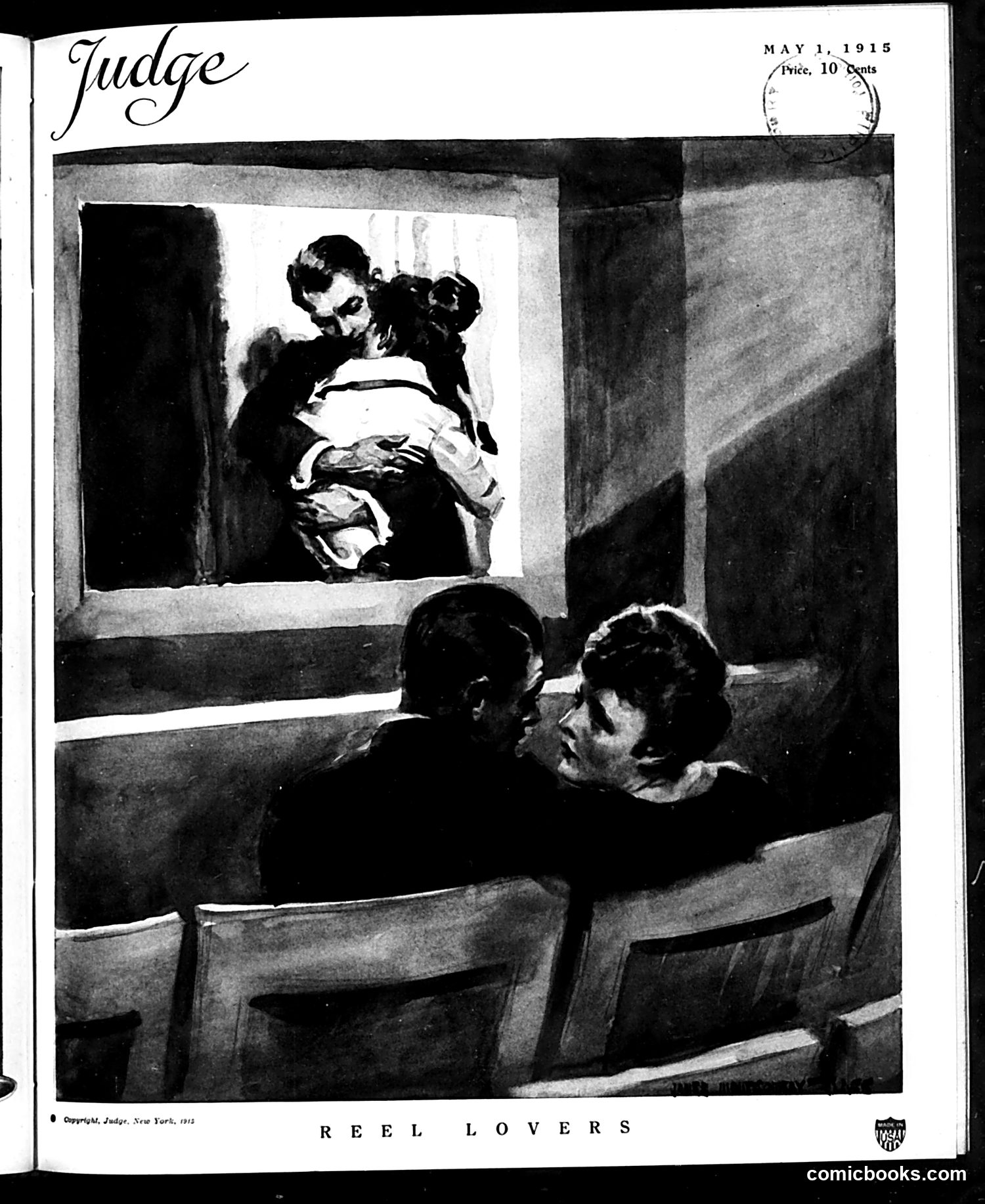
This is a satirical illustration about cinema-going in 1915. The cartoon shows two men seated in a movie theater, watching a film projected on screen. The on-screen image depicts what appears to be a romantic scene between two figures. The title "Reel Lovers" puns on "real lovers" versus "reel" (film), suggesting the humor lies in the contrast between cinematic romance and actual human behavior. The seated spectators' body language and positioning imply they're absorbed in—or perhaps overly invested in—the theatrical romance playing before them. This satirizes early cinema's emotional impact on audiences and the escapism movies provided during this era of growing film popularity.
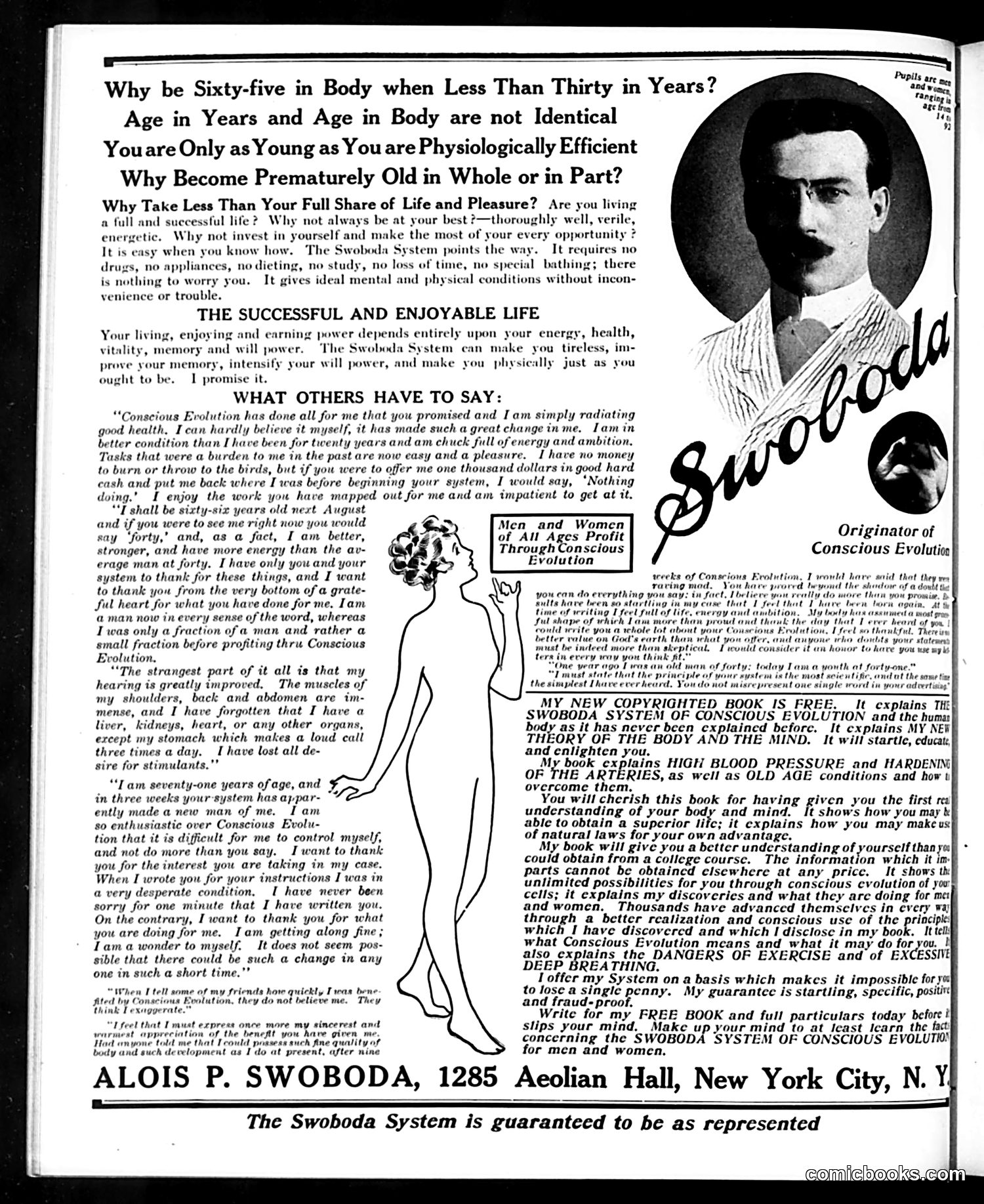
This page is primarily **advertising, not satire**. It promotes the "Swoboda System of Conscious Evolution," a pseudo-scientific health scheme offered by Alois P. Swoboda (shown in the portrait). The advertisement uses testimonial quotes from supposed satisfied customers claiming the system cured various ailments—hearing loss, digestive issues, lack of energy—without drugs or exercise. The small anatomical figure illustrates the "system." **The satirical element is subtle**: Judge magazine may be running this as *mockery* of popular health fads of the era (early 1900s), when unproven "systems" promising youth and vigor through mysterious means proliferated. By presenting Swoboda's grandiose claims without editorial comment, the magazine likely invites readers to recognize the obvious charlatanism—a common Judge approach to pseudoscience and quackery.
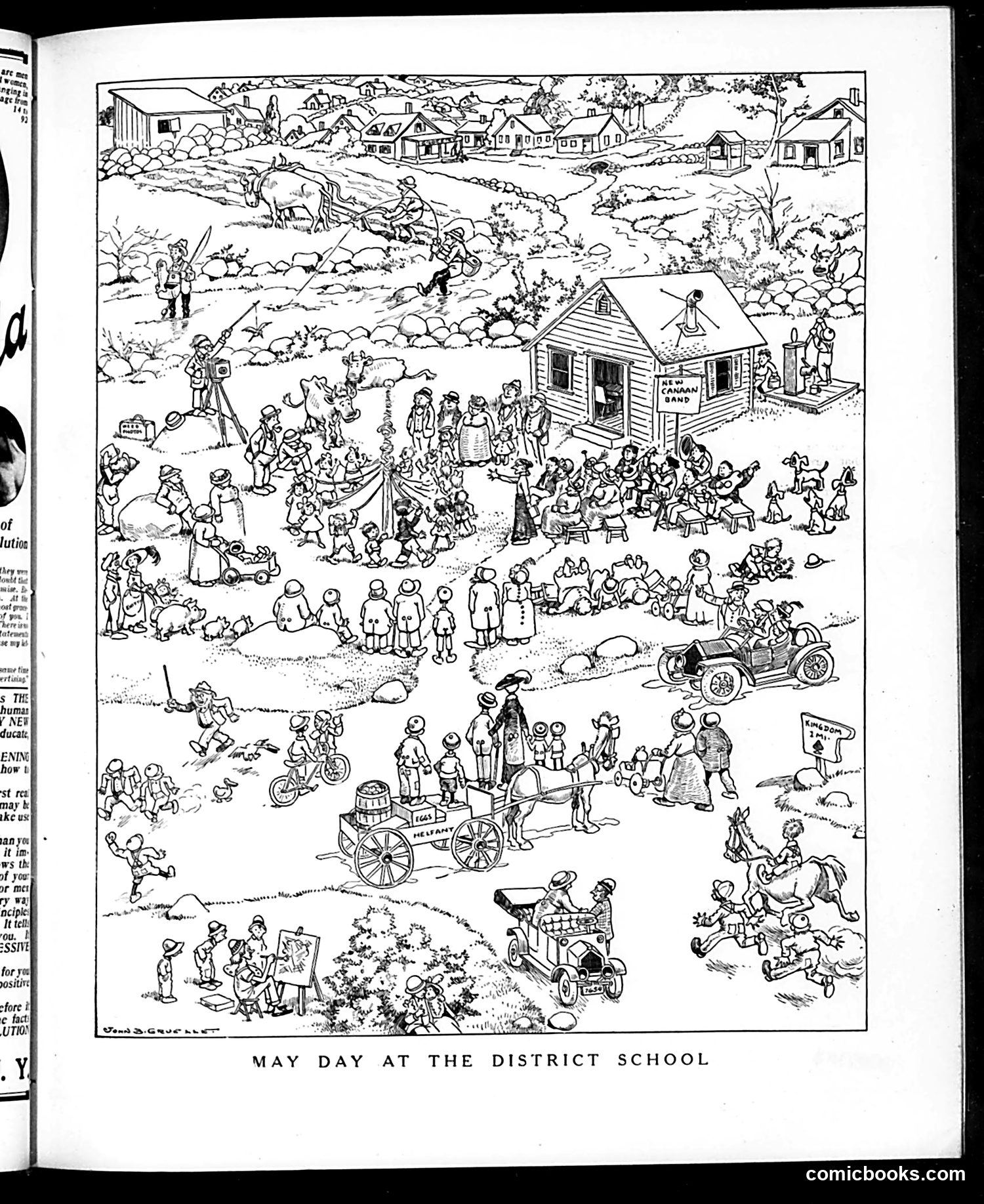
This illustration depicts a rural American school's May Day celebration—a traditional spring festival popular in early 20th-century America. The detailed scene shows dozens of children engaged in various activities: playing games, riding bicycles and in carriages, performing around a maypole, and participating in organized festivities on the schoolhouse grounds. The satire appears gentle rather than pointed—likely poking fun at the idealized, chaotic nature of such community events. The dense composition humorously captures the organized chaos of children's activities, from formal gatherings to wild play. This reflects Judge magazine's regular use of detailed, densely-packed humorous scenes to satirize American life and customs, rather than targeting specific political figures or events.
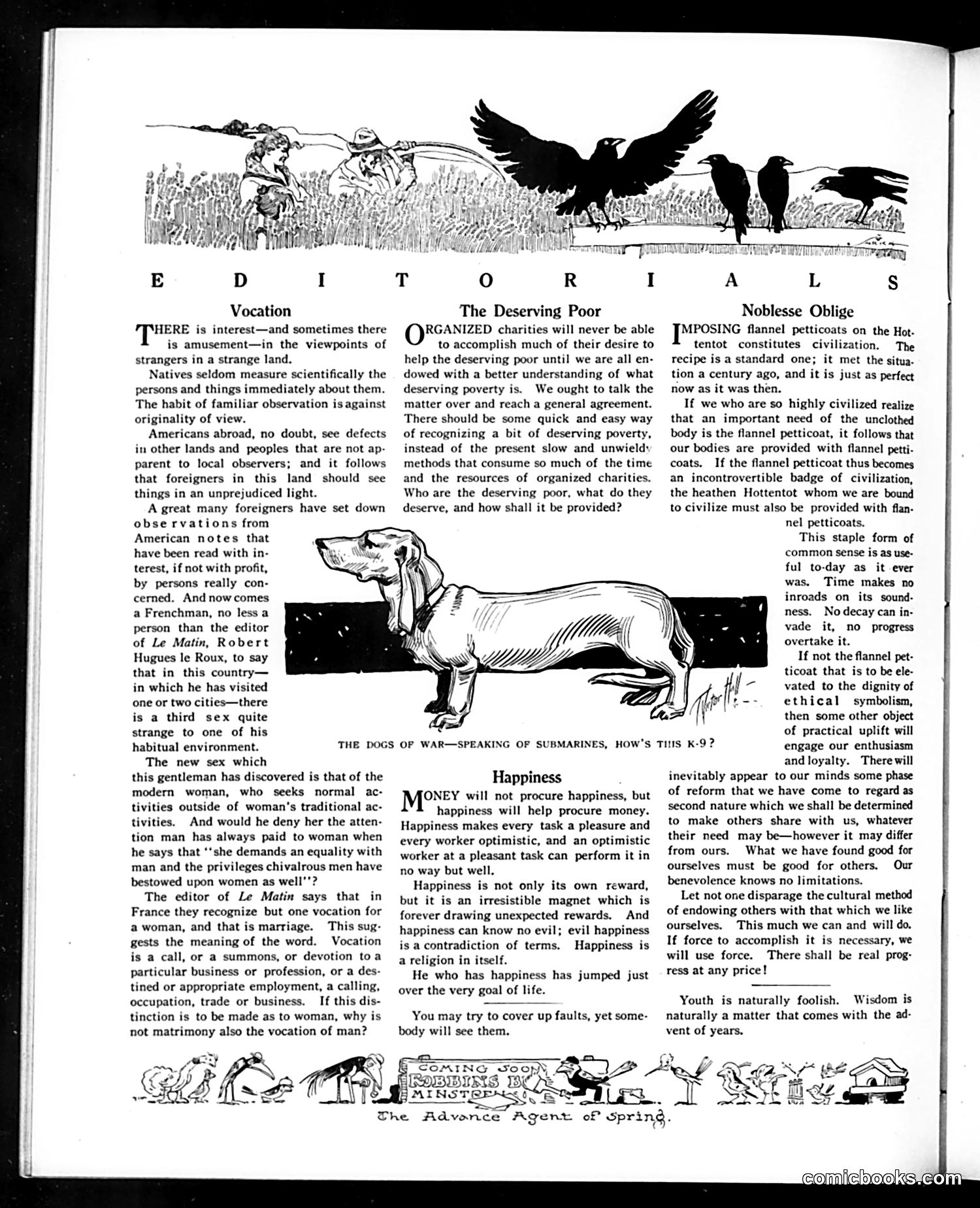
This page contains three opinion essays ("Vocation," "The Deserving Poor," and "Noblesse Oblige") rather than political cartoons. The illustrations are decorative: birds at the top and a dachshund captioned "THE DOGS OF WAR—SPEAKING OF SUBMARINES, HOW'S THIS K-9?" referencing World War I submarine warfare through a pun on "K-9" (canine). The essays reflect early 20th-century Progressive Era concerns: employment dignity for women, charitable obligation toward the poor, and social responsibility of the wealthy. The submarine reference suggests this was published during WWI (likely 1917-1918). The tone is reformist rather than satirical—these are earnest arguments for social change aimed at Judge's educated, affluent readership.
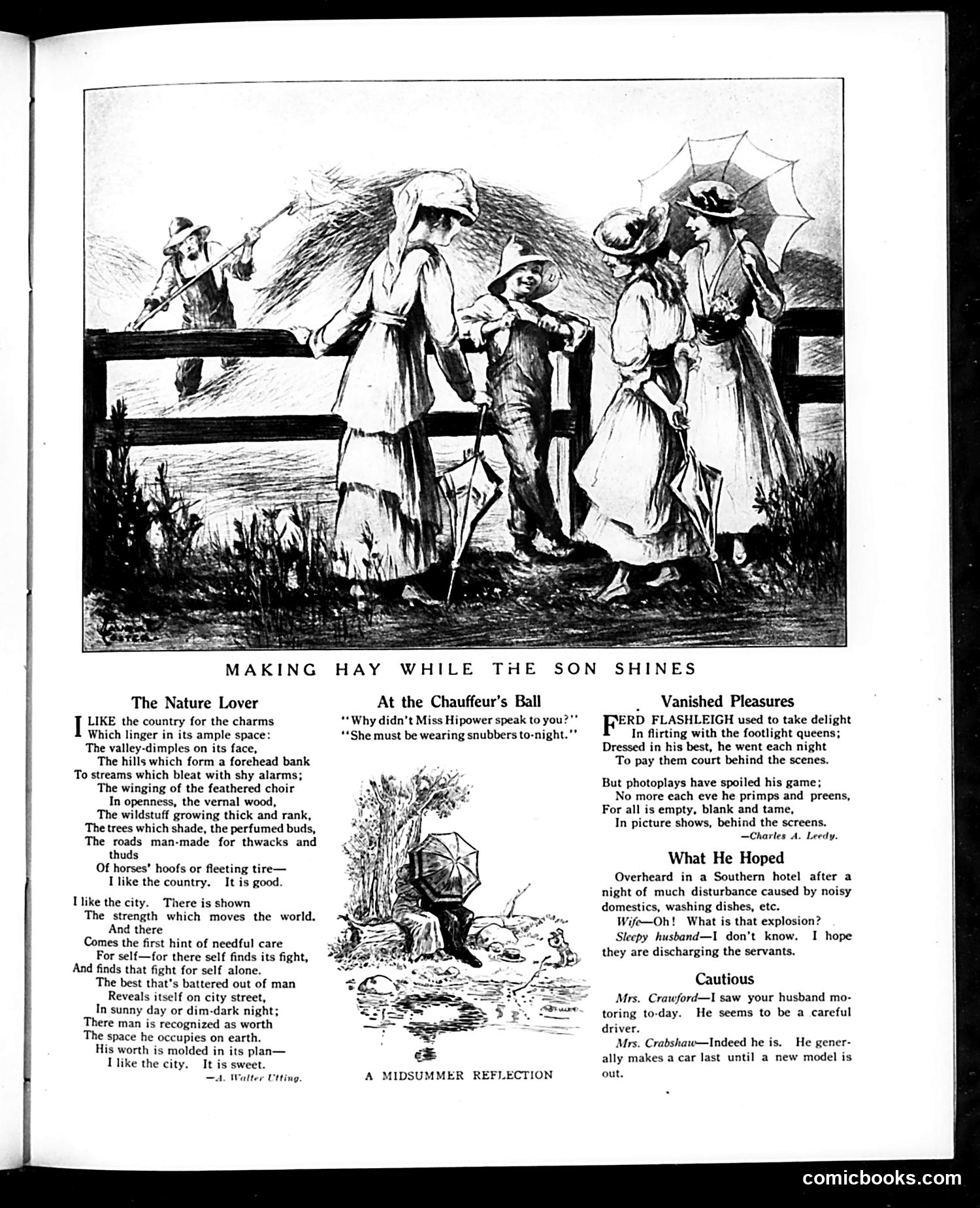
This page contains literary and humorous content rather than political cartoons. The top illustration "Making Hay While the Son Shines" depicts rural figures (a man and women with parasols and farming tools) by a fence—likely illustrating the proverb about taking advantage of good weather. Below are three separate pieces: "The Nature Lover" (a Walter Utter poem about preferring countryside to city), "At the Chauffeur's Ball" (a brief joke about automobile culture and evening wear), and "Vanished Pleasures" (commentary on how photography has changed theatrical entertainment). The bottom section includes everyday humor—"A Midsummer Reflection" (a tree illustration) and dialogue snippets about automobiles and domestic life. The page emphasizes early 20th-century themes: nature versus urban life, emerging automobile culture, and domestic comedy.
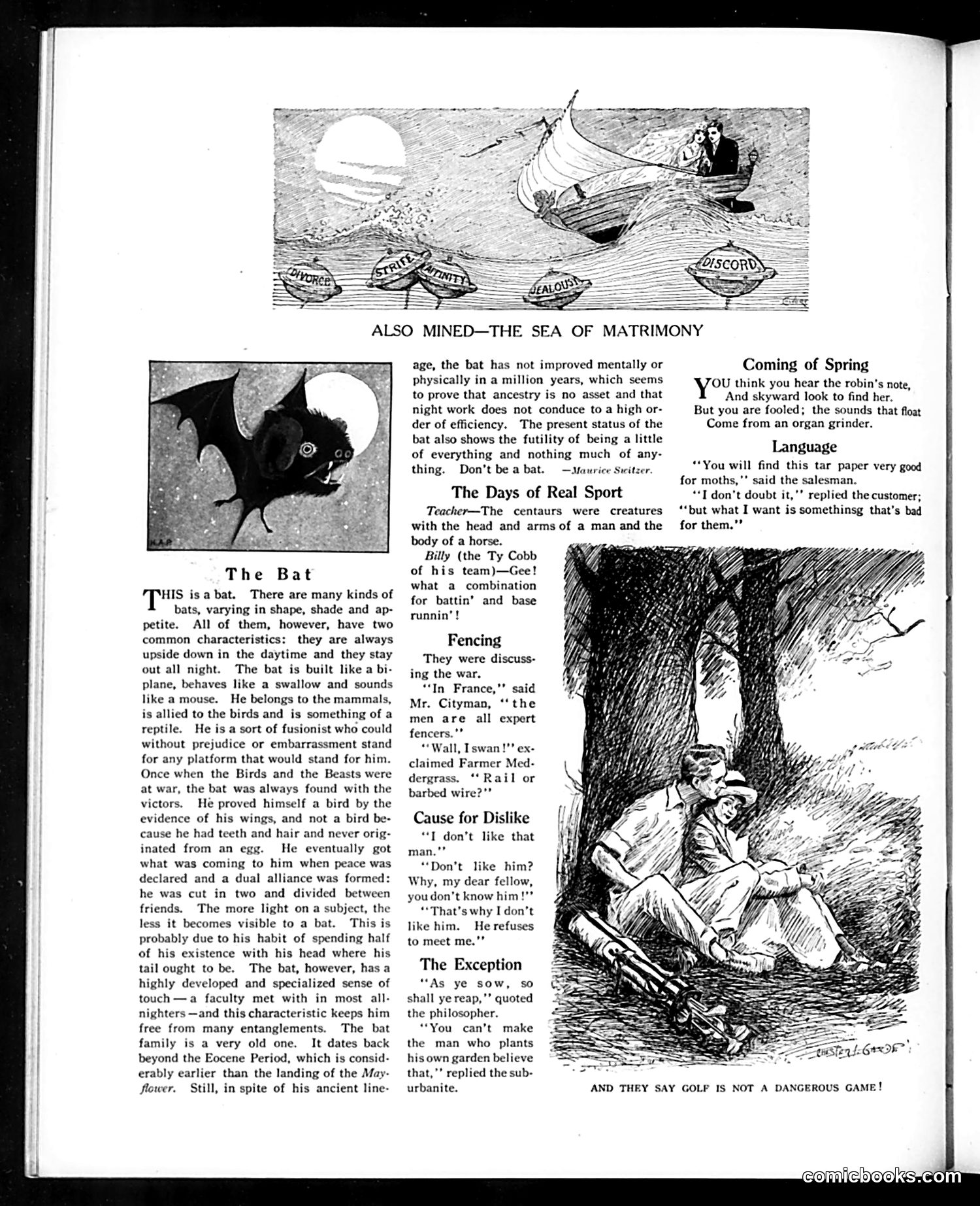
This page contains multiple unrelated satirical pieces typical of Judge's format. The main essay, "The Bat," is a mock-serious zoological treatise using the bat as extended metaphor for political opportunists—creatures who align with whoever's winning, possess contradictory traits, and ultimately lack substance. The phrase "fusionist who could without prejudice...stand for any platform" appears to reference politicians who shift positions opportunistically. The shorter humor pieces mock various subjects: "The Days of Real Sport" includes a joke about Ty Cobb (famous baseball player) and centaurs, plus rural-urban dialect humor about "fencing" (wire types vs. swordsmanship). Other brief jokes target consumer confusion, romantic rejection, and suburban gardening. The bottom cartoon, "And they say golf is not a dangerous game!" shows a golfer in peril, likely mocking golf's reputation as a safe sport. The overall page reflects Judge's satirical approach: political commentary disguised as innocent humor and essays.
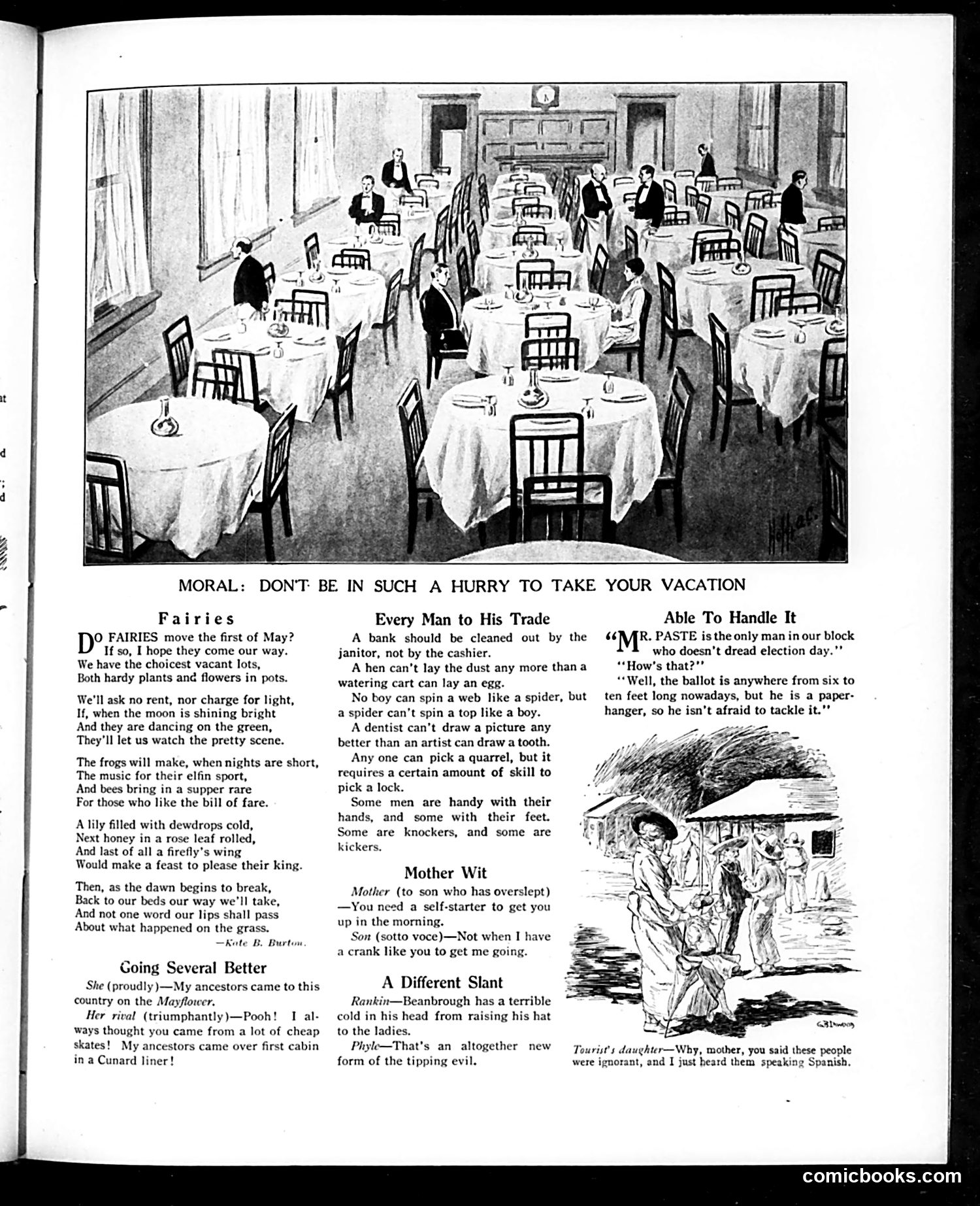
The top illustration shows a formal dining room with diners rushing through their meal, accompanying the moral: "Don't be in such a hurry to take your vacation." This satirizes Americans' frantic pace and impatience. The text contains various humorous short pieces typical of Judge's satirical format: - **"Going Several Better"** mocks social climbing—a woman boasts her ancestors came on the Mayflower; her rival counters that hers arrived in first-class on a Cunard liner, suggesting nouveau riche absurdity. - **"Every Man to His Trade"** offers witty one-liners about occupational competence (banks cleaned by janitors not cashiers, etc.), poking fun at incompetence crossing professional boundaries. - **"Mother Wit"** jokes about a lazy son and nagging mother. - **"Able to Handle It"** puns on a paperhanger's ability to handle long ballots during elections—likely referencing increasingly complex voter materials. These pieces represent Judge's lighthearted social commentary on American customs, class pretensions, and contemporary concerns like political voting procedures.
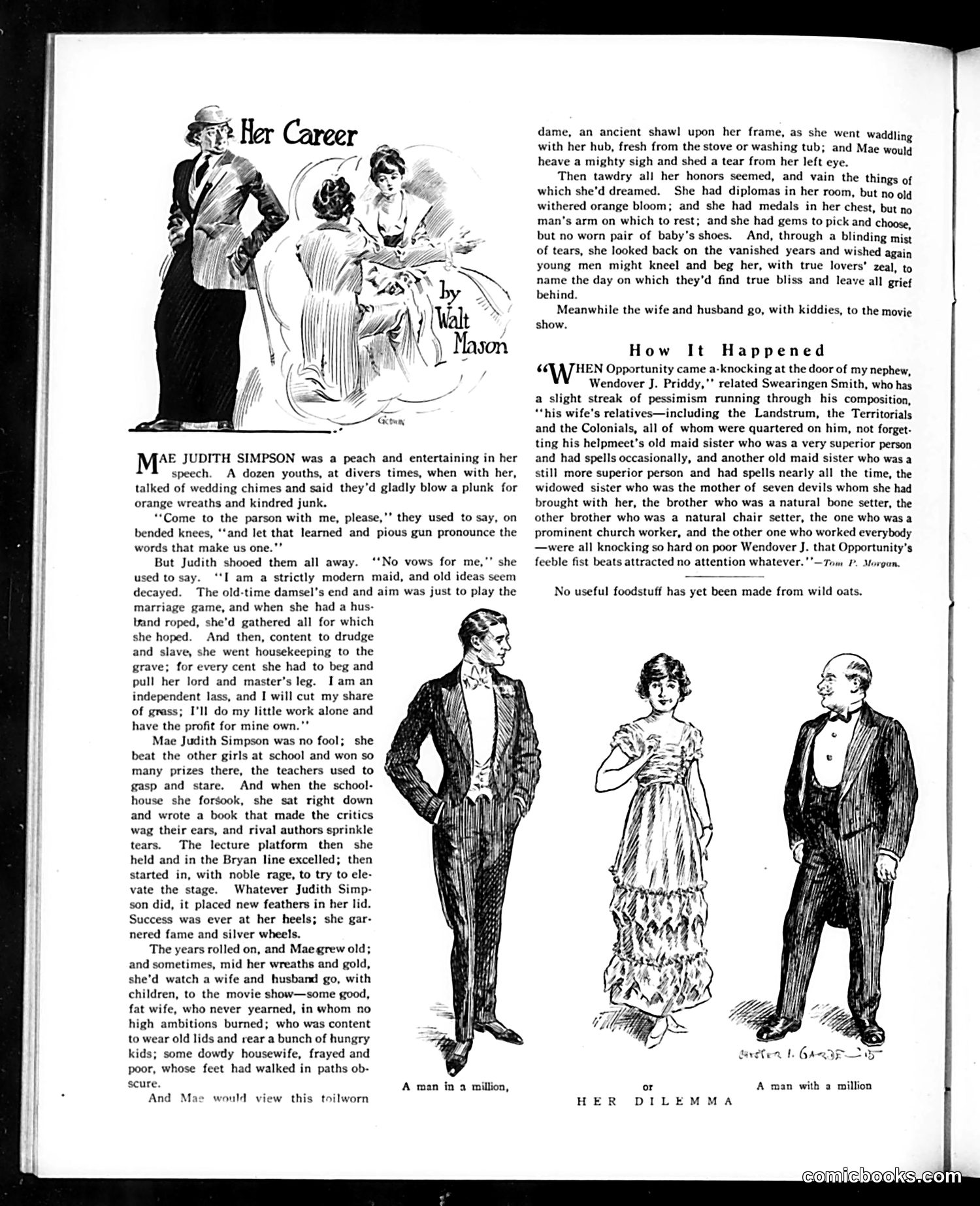
This story satirizes the "New Woman" of the early 20th century—specifically, women pursuing careers and independence rather than marriage. Mae Judith Simpson rejects multiple marriage proposals, insisting "I am an independent lass" and building success as a writer and lecturer instead. The satire's sting lies in its ending: aging and alone, Mae watches ordinary housewives with children and envies them. She realizes her achievements—diplomas, medals, wealth—cannot replace "a worn pair of baby's shoes" or "man's arm on which to rest." The moral: a woman's true fulfillment comes through marriage and motherhood, not ambition. This reflects contemporary anxieties about women's changing roles. While ostensibly praising Mae's intelligence, the story ultimately argues that female independence and career success are hollow substitutes for traditional domestic life—a common anti-feminist argument of the era.
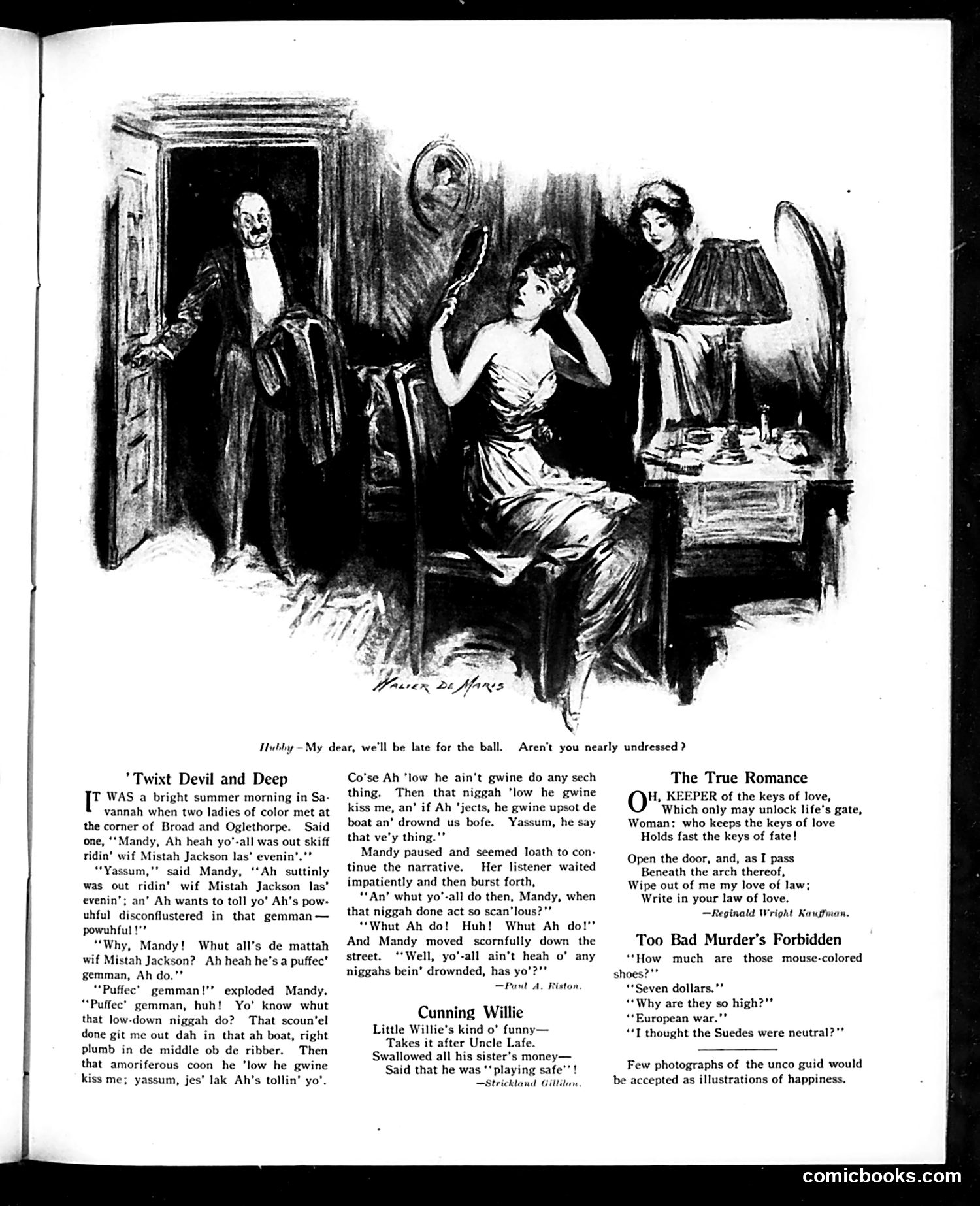
This page contains multiple pieces of satirical content typical of early 20th-century American humor magazines: **Main Cartoon** ("'Twixt Devil and Deep"): A crude racial stereotype dialogue between two Black women discussing a man's coercive behavior on a boat. The "joke" relies on offensive dialect and depicts predatory male behavior as comedic. This reflects the deeply racist attitudes normalized in the era's mainstream publications. **Other Content**: The page includes brief humorous verses and quips, including "Cunning Willie" (a joke about a child stealing his sister's money), poetry titled "The True Romance," and a dialogue joke linking shoe prices to the European War (likely WWI). **Context**: Judge was a prominent satirical weekly that frequently published racist content alongside social commentary. The cartoon's presence here illustrates how casual racism permeated American popular culture and supposedly "respectable" publications of this period.
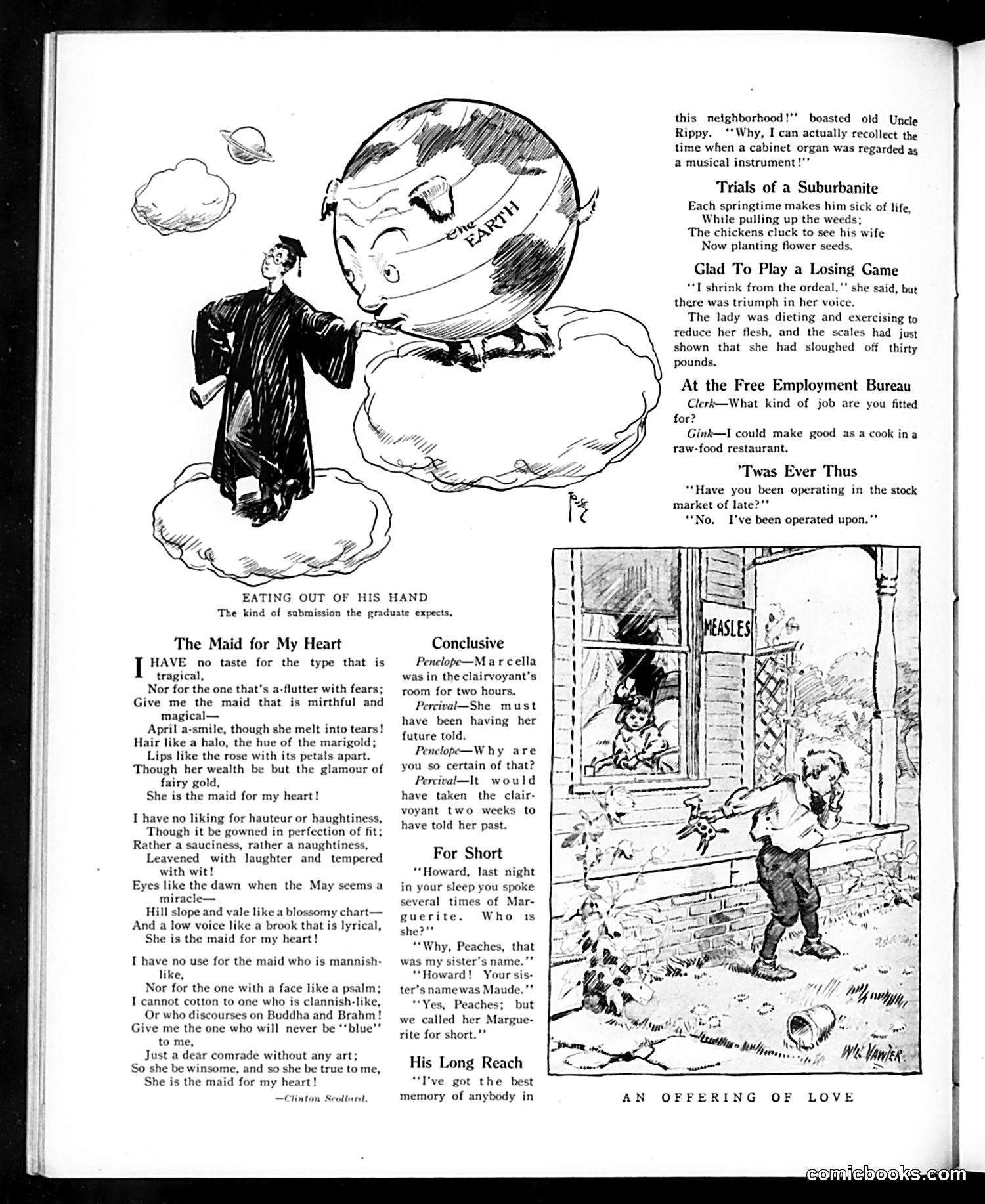
This page contains multiple brief satirical pieces typical of Judge magazine's humor: **"Eating Out of His Hand"** depicts a man standing on clouds, seemingly manipulated by a large globe labeled "Earth," satirizing male submission to romantic expectations or societal pressures. **"The Maid for My Heart"** is a sentimental poem listing contradictory ideals—the speaker wants a woman who is mirthful yet tearful, saucy yet true, magical yet practical. The satire mocks men's unrealistic romantic expectations of women. **Other short jokes** target common subjects: clairvoyants defrauding clients ("Conclusive"), wordplay on names ("For Short"), an old man's exaggerated memory of outdated technology ("His Long Reach"), suburban domestic life ("Trials of a Suburbanite"), and stock market losses ("'Twas Ever Thus"). **"An Offering of Love"** (bottom right cartoon) shows a domestic scene, likely illustrating romantic sentiment. The overall page satirizes masculine idealization of women, gullibility, nostalgia, and economic misfortune—typical early-20th-century Judge humor.
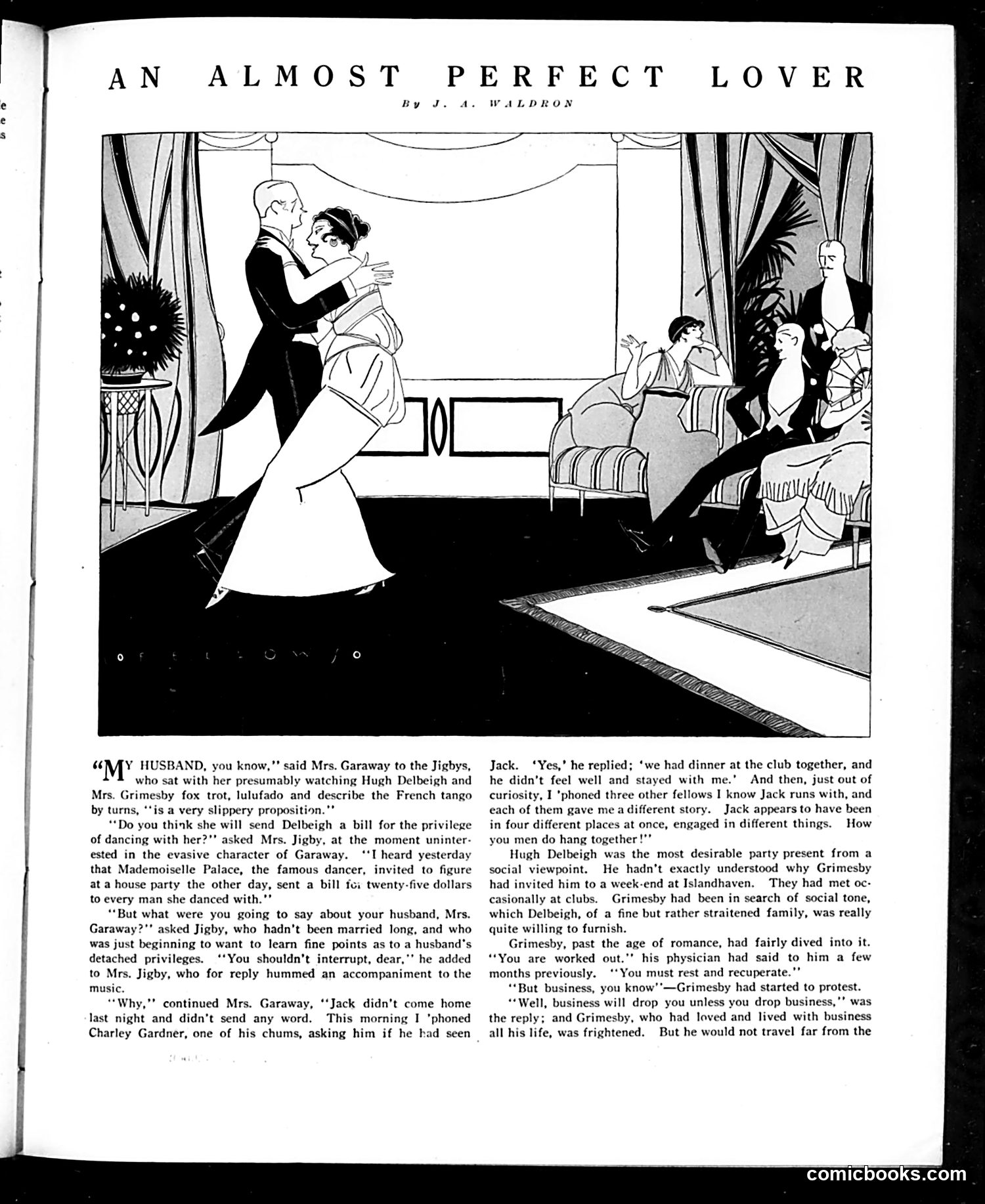
This is a story illustration from *Judge*, a satirical magazine. The narrative concerns marital infidelity and social pretense among the wealthy. The plot involves Mrs. Garaway complaining to friends that her husband Jack didn't come home, then disappeared into multiple alibis—his male friends each claimed he was with them at different locations. The joke is on male solidarity: "How you men do hang together!" The subplot features Hugh Delbeigh, a socially desirable but financially modest man, dancing with Mrs. Grimesby. Grimesby, a wealthy businessman past romance, invited Delbeigh to gain social standing. Grimesby's doctor prescribed rest from business, but he fears professional ruin if he stops working. The satire targets upper-class hypocrisy: husbands lying about whereabouts, men protecting each other's secrets, and social climbing through association. The "almost perfect lover" likely refers to Delbeigh's desirability masking his actual emptiness.
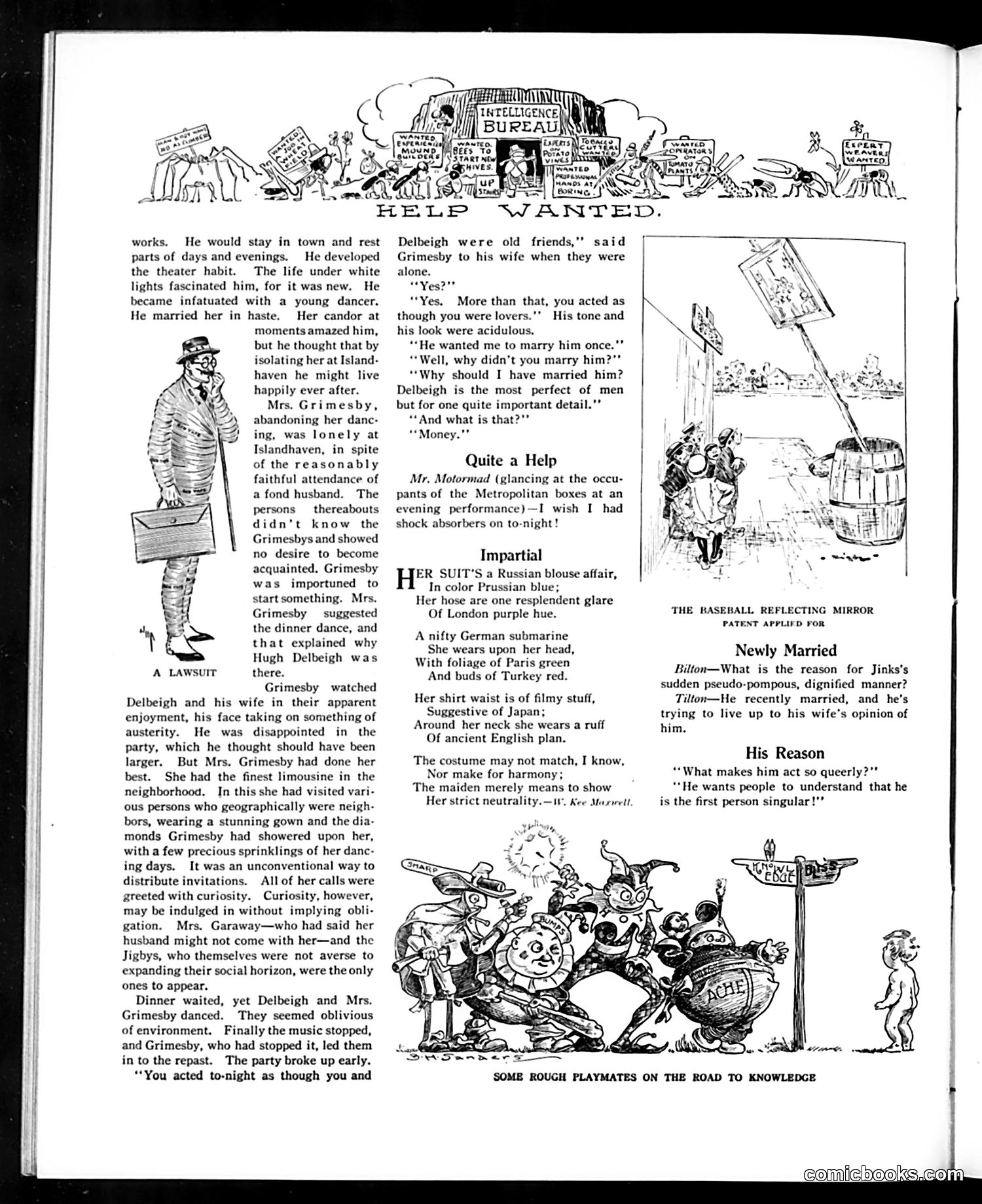
This page contains several satirical pieces typical of early 20th-century American humor: **Main Story ("A Lawsuit")**: A domestic drama about Mr. Grimesby, a wealthy man who married a former dancer and isolated her socially. His jealousy erupts when she dances with Hugh Delbeigh at a dinner party—she reveals Delbeigh once proposed but she rejected him because he lacked money. The satire targets social climbing and the superficiality of wealthy marriages built on financial rather than emotional foundations. **"Impartial"**: A poem mocking a woman's outfit composed of fashions from various warring nations (Russian, German, Japanese, English, etc.), claiming she demonstrates "strict neutrality" through her costume. This appears to reference WWI-era debates about American neutrality and commercialism. **Other Brief Jokes**: "Quite a Help" jokes about theater seats; "Newly Married" satirizes a husband's pretentious behavior after marriage. The overall theme: satirizing wealth, social pretension, marital dynamics, and wartime neutrality through humor accessible to Judge's educated, affluent readership.
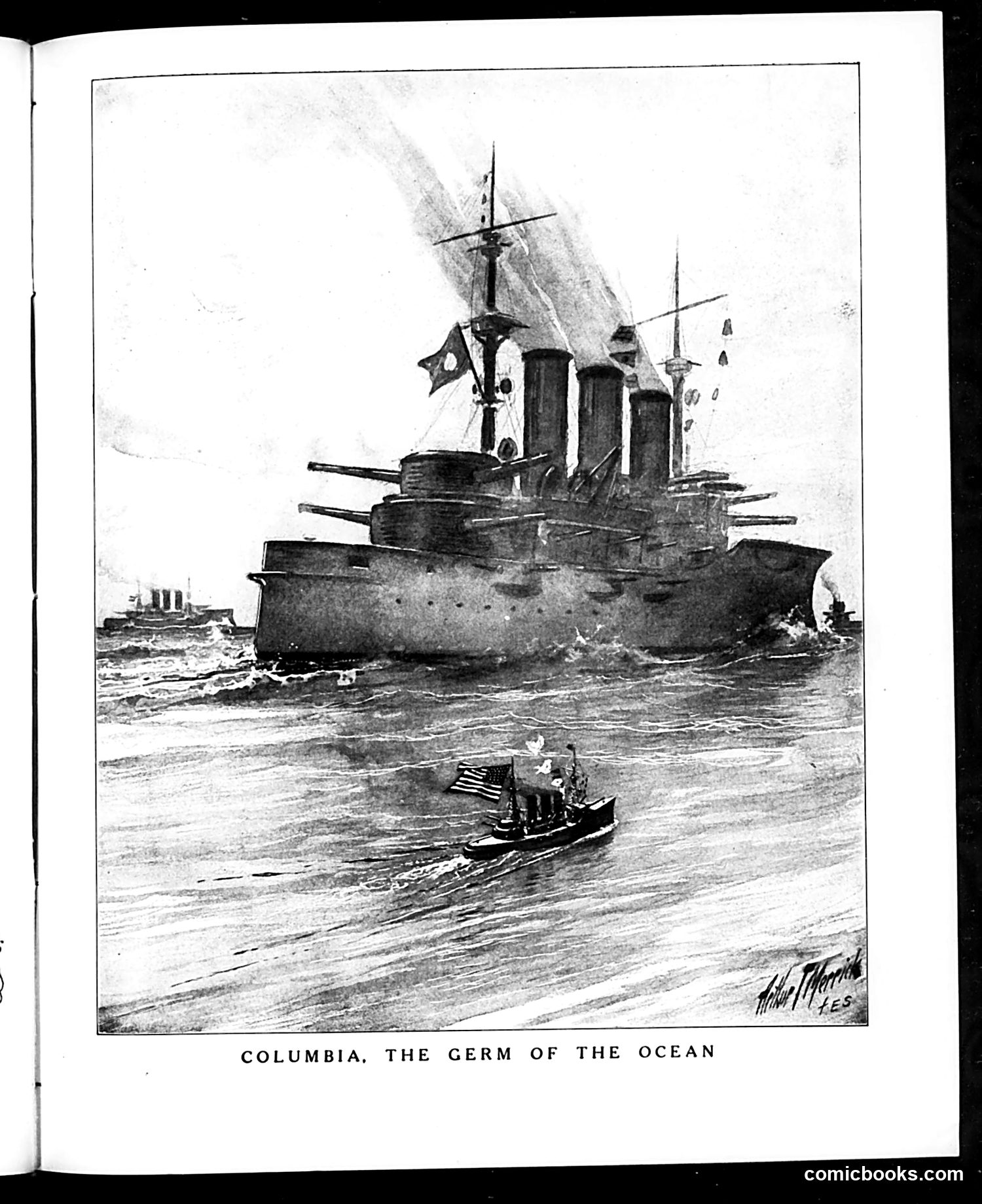
This political cartoon depicts the USS Columbia, a U.S. Navy warship, labeled as "the germ of the ocean." The image shows the battleship in the distance with a small rowboat (likely representing America or American interests) in the foreground. The satire appears critical of American naval power and expansionism. "Germ" suggests the ship is a disease or contaminating force—implying the warship represents American imperial ambitions spreading across the oceans. The metaphor transforms the vessel from a symbol of national pride into something pathogenic or unwanted. Without the publication date, the specific historical context remains unclear, but this likely critiques American naval expansion during the late 19th or early 20th century, a period of significant U.S. militarization and overseas involvement.
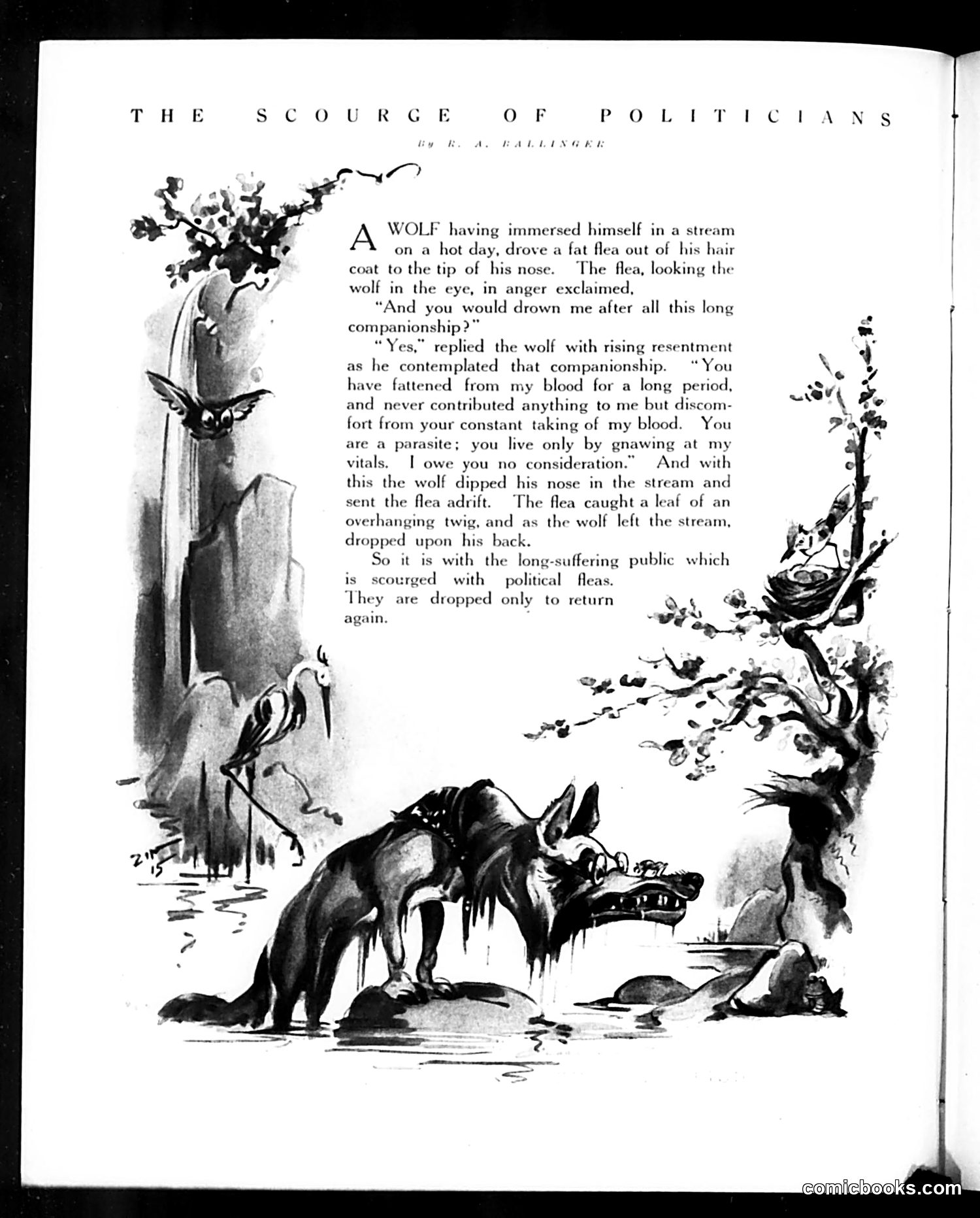
This Aesop's fable-style cartoon uses animal allegory to criticize corrupt politicians. The wolf represents the "long-suffering public," while the flea symbolizes parasitic politicians who feed off citizens' resources (blood = taxes/labor) while contributing nothing but discomfort. The moral is explicit: politicians are parasites who exploit the public for personal gain. When the public tries to rid itself of them (the wolf drowning the flea), they inevitably return—suggesting the cyclical nature of political corruption and the difficulty of removing entrenched politicians through normal means. The cartoon critiques the seeming permanence of political abuse and the public's powerlessness to permanently eliminate corrupt officeholders, a common theme in Gilded Age satire about machine politics and graft.
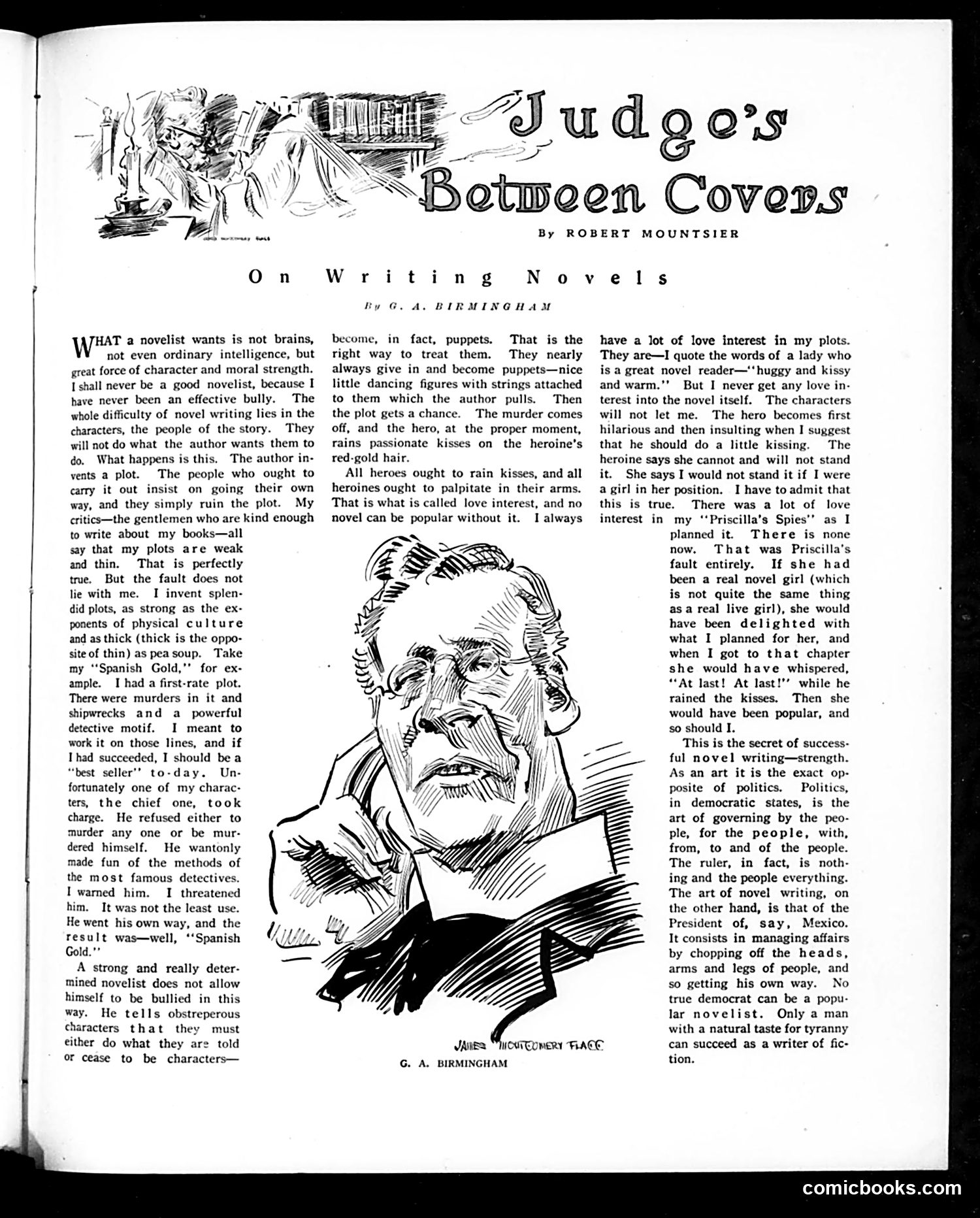
This page features an essay by G.A. Birmingham (visible in the caricature) discussing the challenges of novel writing. The central cartoon shows Birmingham's exaggerated face in profile—a caricature emphasizing his features for satirical effect. The essay's satire lies in Birmingham's complaint that novelists cannot control their own characters, who "refuse" to follow plot directions. He humorously claims strong novels require authorial tyranny like "the President of...Mexico" chopping off heads—implying dictatorial control. The joke contrasts democratic governance (rule "by the people, for the people") with authoritarian novel-writing, where authors must dominate obstreperous characters. The piece mocks both novelist pretensions and political systems, suggesting that successful fiction demands the kind of absolute control that democratic societies explicitly reject. The "Judge's Between Covers" section typically reviewed or satirized contemporary literature and authors.
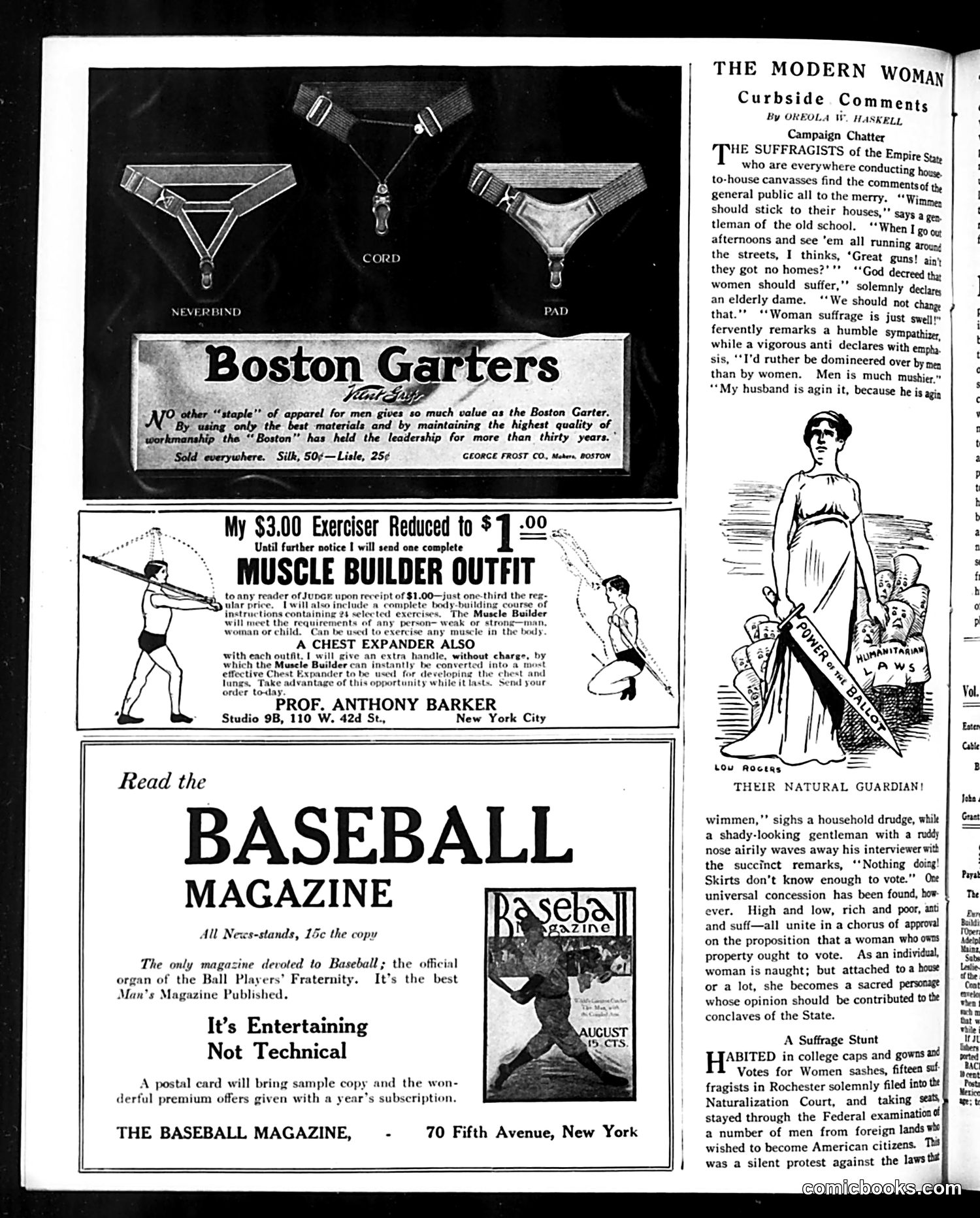
This page satirizes opposition to women's suffrage through a column collecting anti-suffrage quotes from ordinary people. The cartoon (by Lou Rogers) shows a pregnant woman labeled "Their Natural Guardian"—a visual argument that women's domestic/maternal role is their proper sphere. The accompanying text presents various objections to women voting: women should stay home; God ordained their suffering; they're insufficiently informed ("don't know enough to vote"). A recurring theme emerges—even suffrage opponents concede that *property-owning* women deserve voting rights, exposing the hypocrisy that women tied to houses/land gain political standing through *property*, not personhood. The "Suffrage Stunt" describes Rochester women silently attending naturalization hearings where foreign men gained voting rights women citizens lacked—highlighting the absurd legal disparity Judge's audience would recognize as unjust.
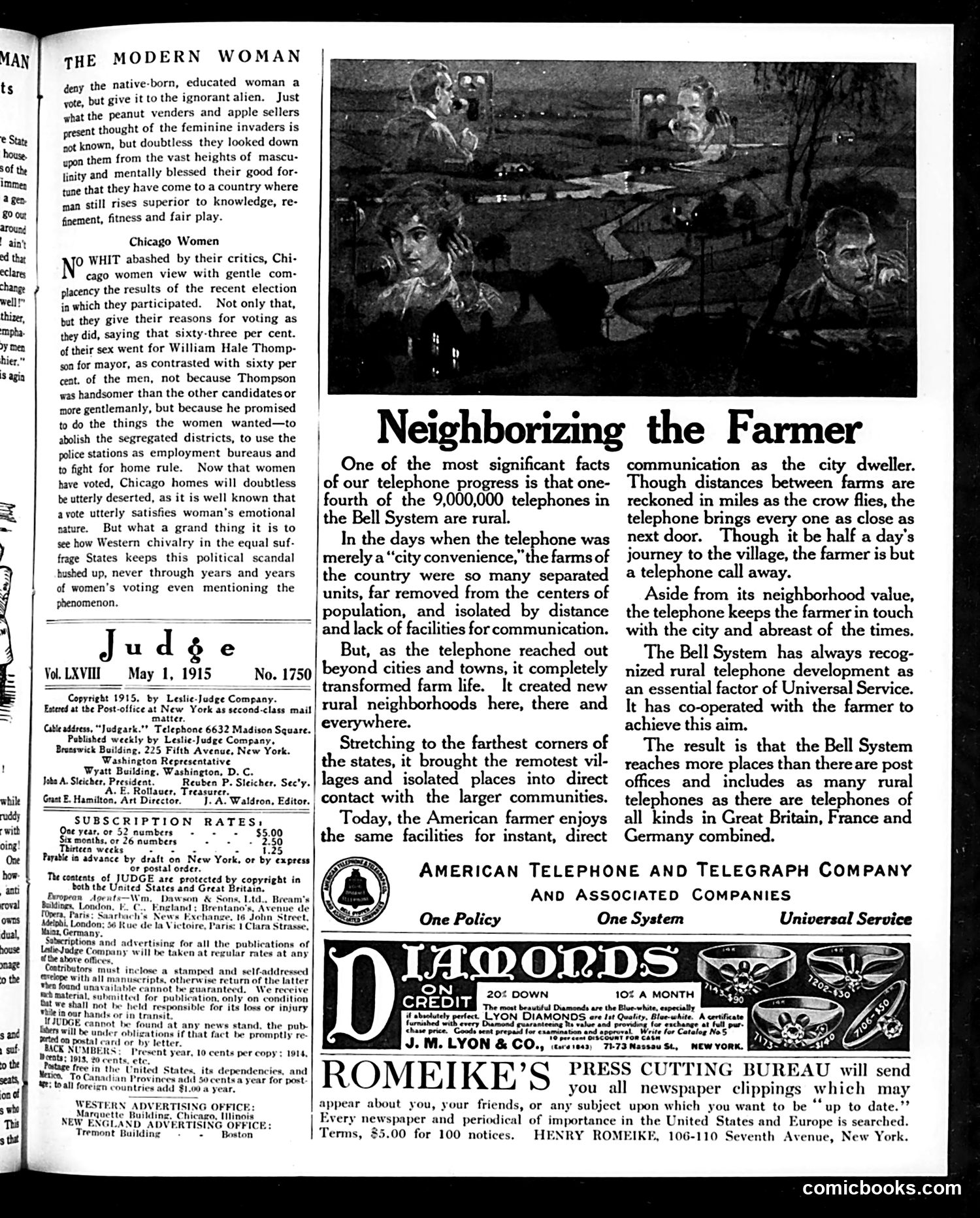
This page contains two distinct pieces: **"The Modern Woman" section** satirizes recent women's suffrage activism. It mocks women voters in Chicago—particularly those who voted for mayoral candidate William Hale Thompson—suggesting their political participation is superficial and emotionally driven rather than based on genuine civic engagement. The satire implies women voted based on Thompson's promises rather than substantive policy analysis, and sarcastically claims voting will satisfy women's emotional needs so completely they'll abandon their homes. **"Neighborizing the Farmer"** is a **Bell Telephone Company advertisement** masquerading as editorial content. It celebrates rural telephone expansion, claiming telephone service has transformed isolated farms into connected communities. The piece positions the Bell System as a modernizing force bringing urban conveniences to agricultural America. The juxtaposition reveals Judge's editorial position: skepticism toward women's political capacity alongside enthusiasm for corporate technological progress.
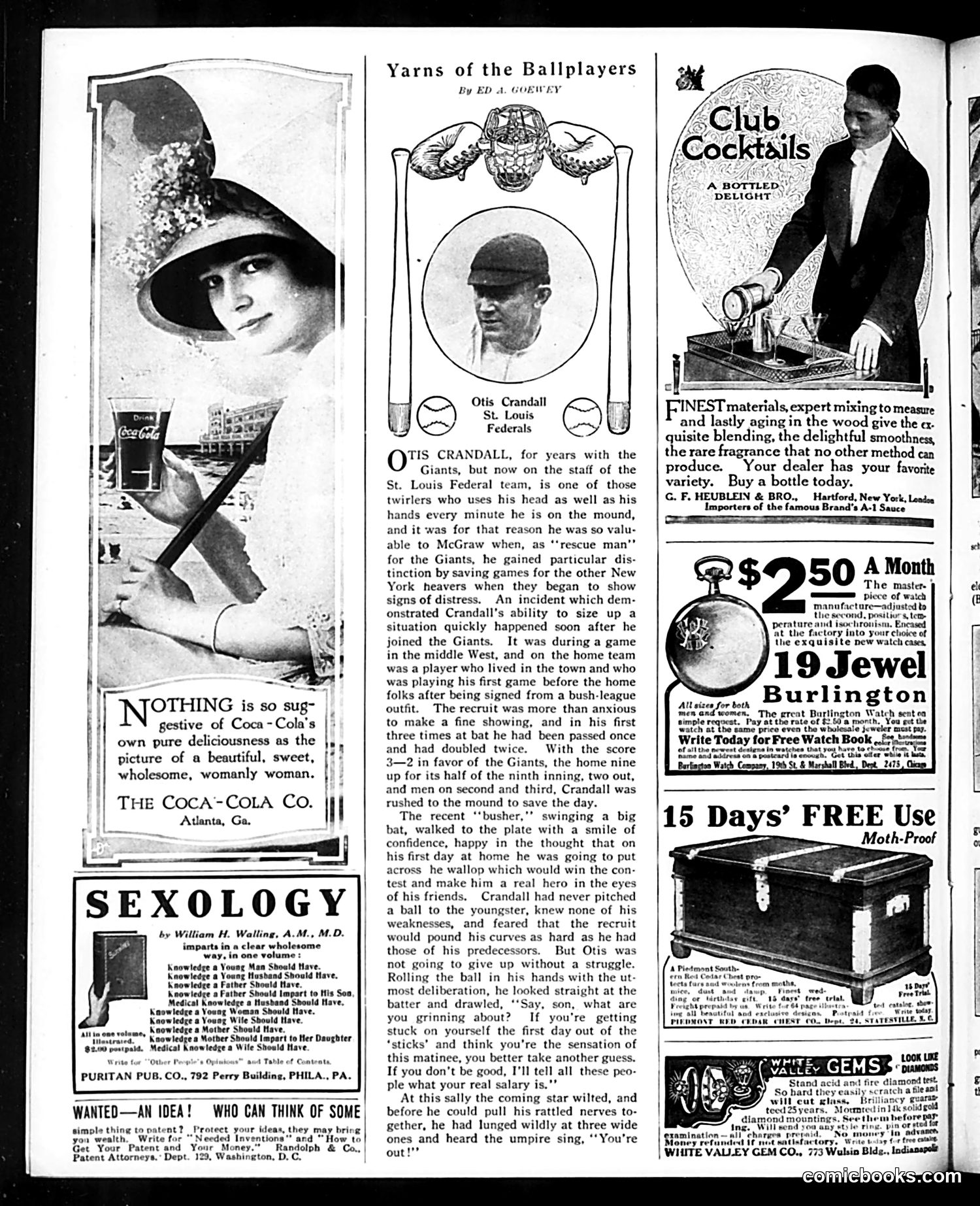
This page is primarily **advertising and sports content** rather than political satire. The main feature is "Yarns of the Ballplayers" by Ed A. Goewey, describing pitcher Otis Crandall of the St. Louis Federals (a rival baseball league to the majors, 1914-1915). The story illustrates Crandall's intelligence and psychological cunning: when a young, overconfident local player faces him in a crucial game moment, Crandall intimidates him with trash talk—threatening to reveal his low salary—causing the batter to strike out wildly. The anecdote celebrates mental strategy in baseball. The surrounding ads reflect early 1910s consumer culture: Coca-Cola emphasizes feminine beauty and wholesomeness; other ads promote patent services, medical knowledge books, watches, and cocktails. **No political cartoon appears on this page.** It's a sports narrative highlighting a pitcher's psychological tactics to win a game.
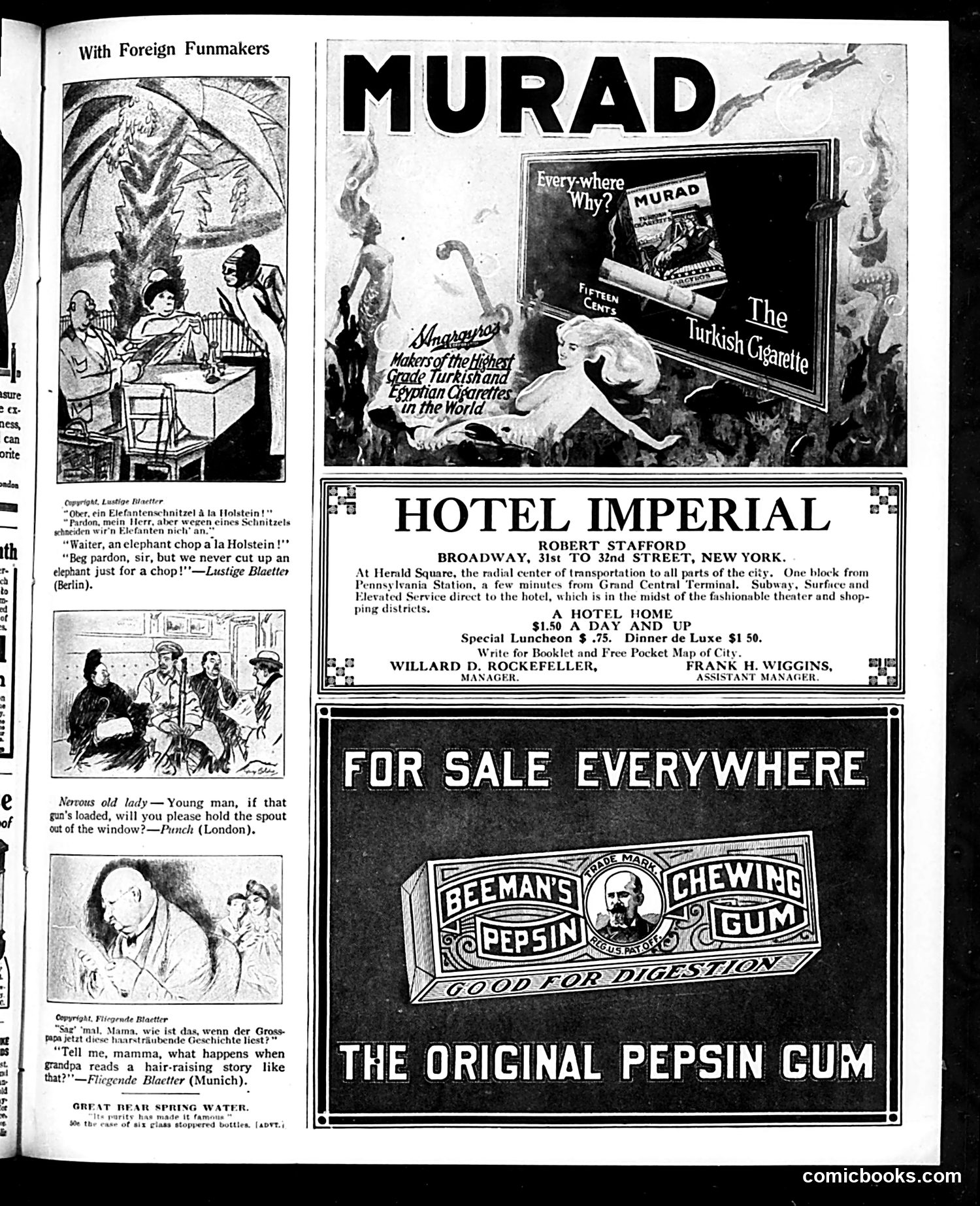
This page from *Judge* magazine contains three elements: reprinted cartoons from European satirical publications ("With Foreign Funmakers"), a hotel advertisement, and a chewing gum ad. The European cartoons are brief visual jokes. One depicts a waiter refusing a customer's request for "elephant chop," satirizing absurd restaurant orders. Another shows an elderly woman asking a young man to hold a gun's spout out a window—likely poking fun at nervous elderly people. The third involves a grandfather reading a "hair-raising story," playing on the double meaning of "hair-raising" (frightening but also literally making hair stand up). These are mild, domestic humor pieces typical of early 20th-century European comic magazines, lacking topical political content. The page primarily serves as filler between advertisements for the Hotel Imperial and Beeman's Pepsin Gum, suggesting this was a typical magazine layout of the era.
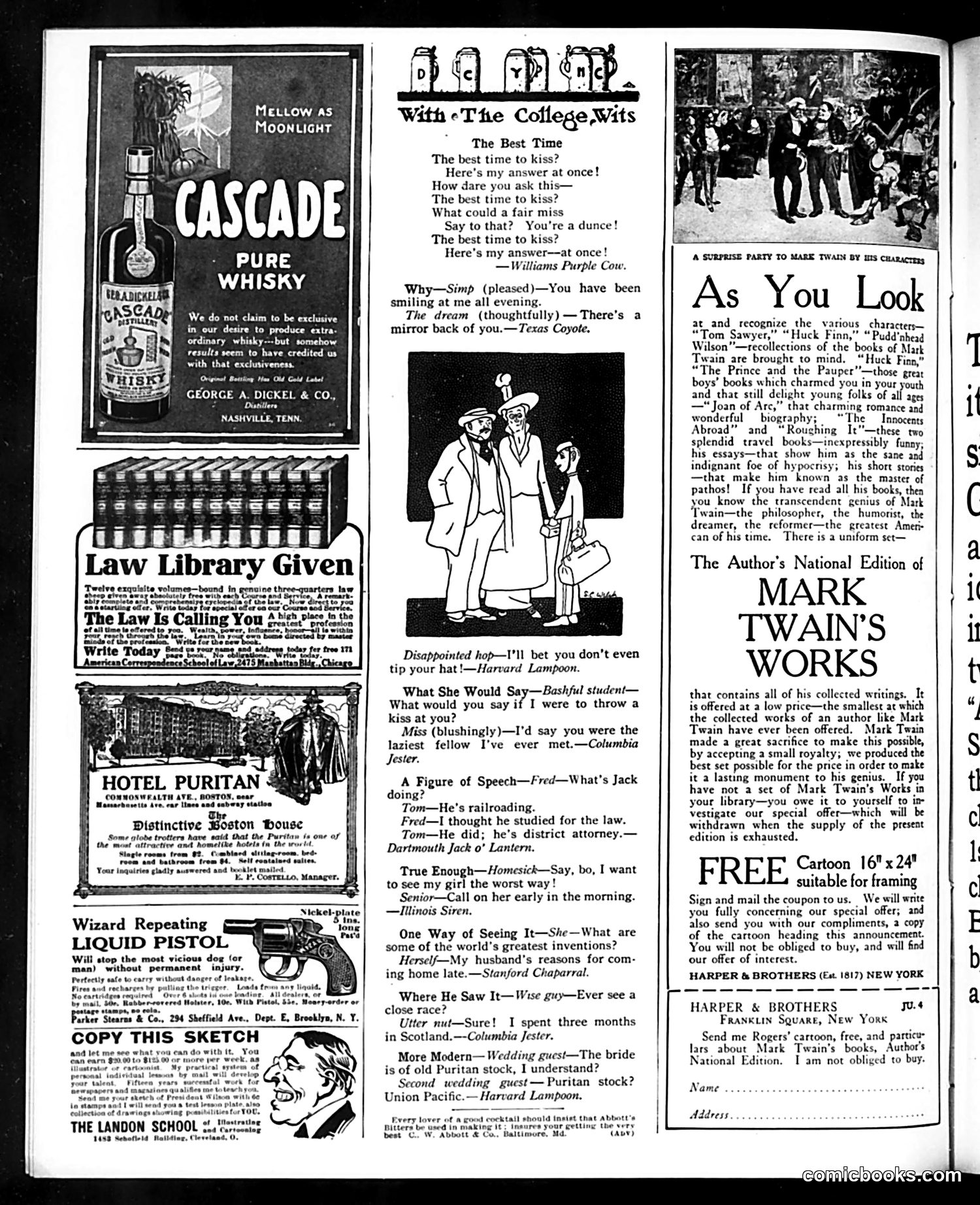
This page is primarily **advertising and editorial content** rather than political satire. The main illustrated content is "A Surprise Party to Mark Twain by His Characters"—a promotional image for a collected edition of Mark Twain's works. The drawing depicts characters from Twain's novels (Tom Sawyer, Huck Finn, Pudd'nhead Wilson) greeting the author, serving as a visual advertisement celebrating his literary legacy. The bulk of the page consists of **commercial advertisements** (Cascade Whisky, Hotel Puritan, a law school, a repeating pistol) and a humor section called "With The College Wits"—a collection of brief jokes submitted by college publications (Harvard Lampoon, Columbia Jester, etc.). These jokes are generic collegiate humor about dating, mischief, and courtship—typical of the era's light entertainment content. There is **no significant political satire** on this page. It represents Judge functioning as a general-interest magazine mixing advertising with entertainment rather than hard-hitting social commentary.
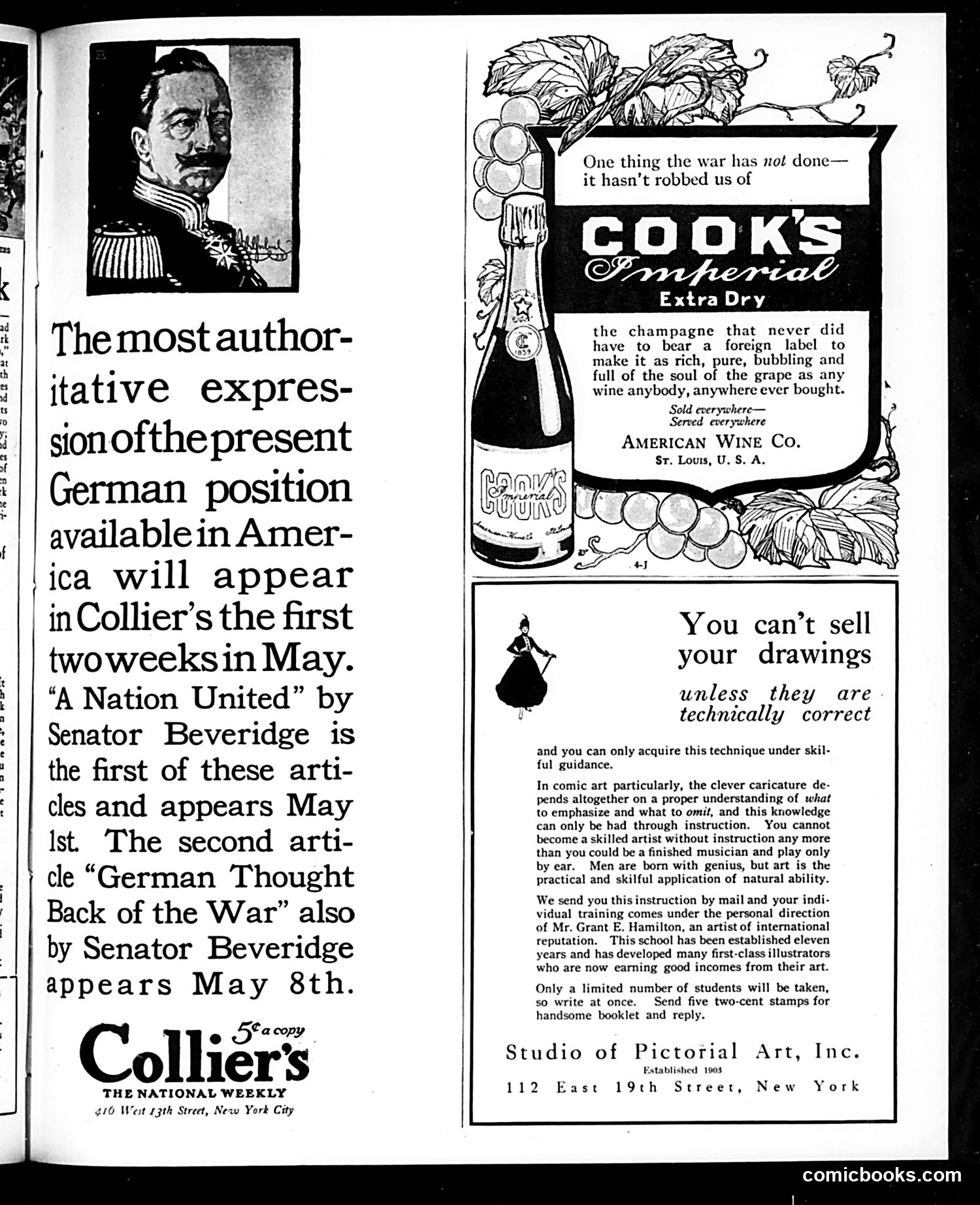
This page consists primarily of **advertisements and announcements** rather than satirical cartoons. **Left column:** Announces upcoming articles by Senator Albert Beveridge in *Collier's* magazine (May 1st and 8th) presenting "the most authoritative expression of the present German position available in America." This refers to **World War I-era debate** about German perspectives—suggesting American interest in understanding Germany's position during the conflict. **Right side:** Two unrelated advertisements—one for Cook's Imperial champagne (emphasizing American-made quality despite wartime conditions) and one for the Studio of Pictorial Art's mail-order drawing instruction course under artist Grant E. Hamilton. The page reflects **1910s-era American publishing**: wartime interest in international viewpoints, domestic product marketing during WWI, and popular correspondence art education. No specific satirical point is evident—this appears to be a standard magazine back-matter page.
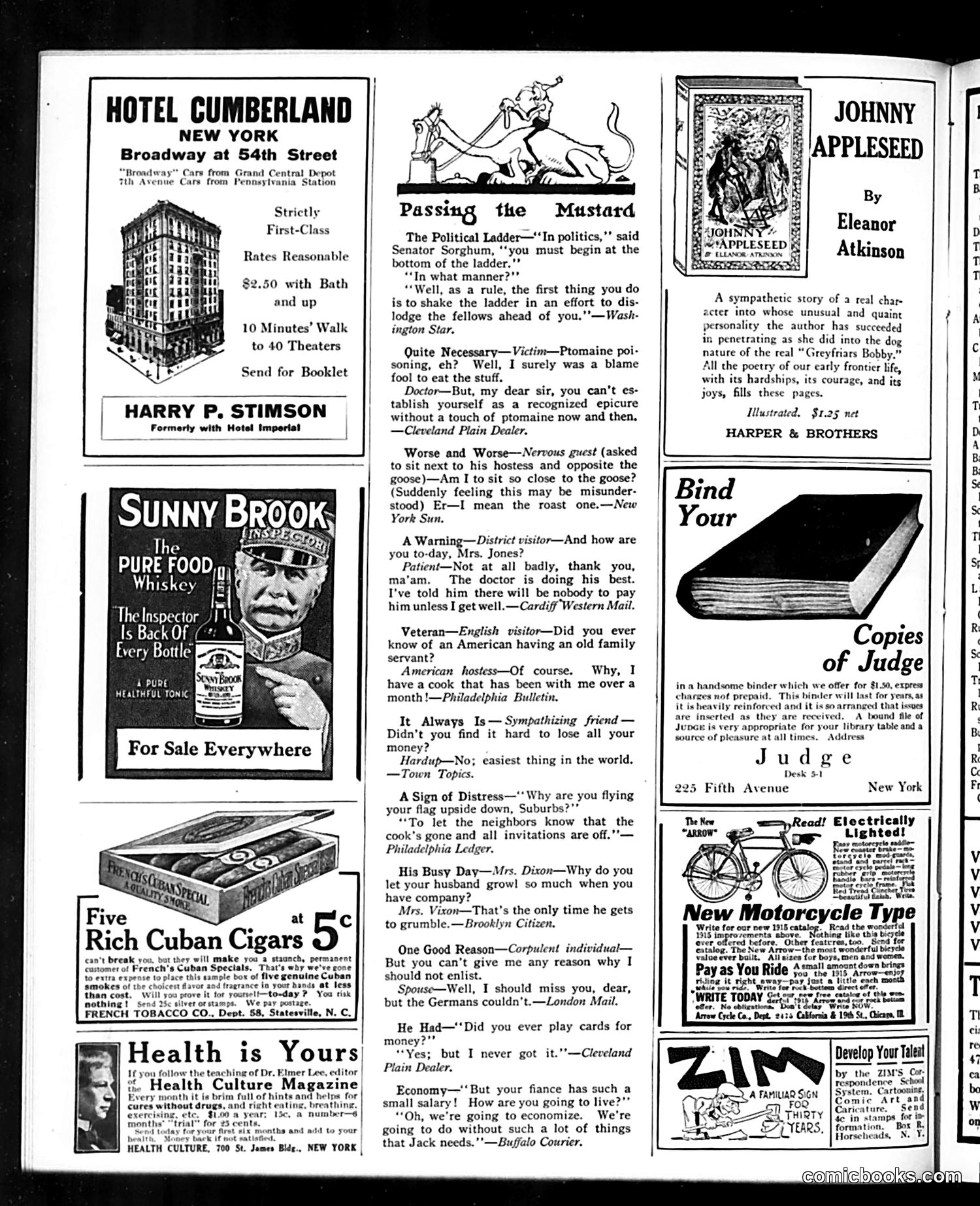
This page is primarily **advertisements and humor columns**, not political cartoons. The main satirical content appears in "Passing the Mustard," a collection of brief jokes. The humor targets everyday social anxieties of the era: - **"The Political Ladder"**: Satirizes political ambition as ruthlessly competitive—politicians must "shake the ladder" to displace rivals ahead of them. - **"Quite Necessary"**: Mocks upper-class pretension about fine dining; ptomaine poisoning (food spoilage) becomes a badge of epicurean sophistication. - **"A Sign of Distress"**: Jokes about servant scarcity—a cook lasting "over a month" is remarkable; flying a flag upside down signals social catastrophe when "the cook's gone." - **"Economy"**: Satirizes engagement negotiations where the woman expects the man to sacrifice, not herself. The repeated servant-related humor reflects post-WWI domestic labor shortages. The overall tone is lighthearted social commentary on class, ambition, and domestic life, typical of Judge's satirical approach.
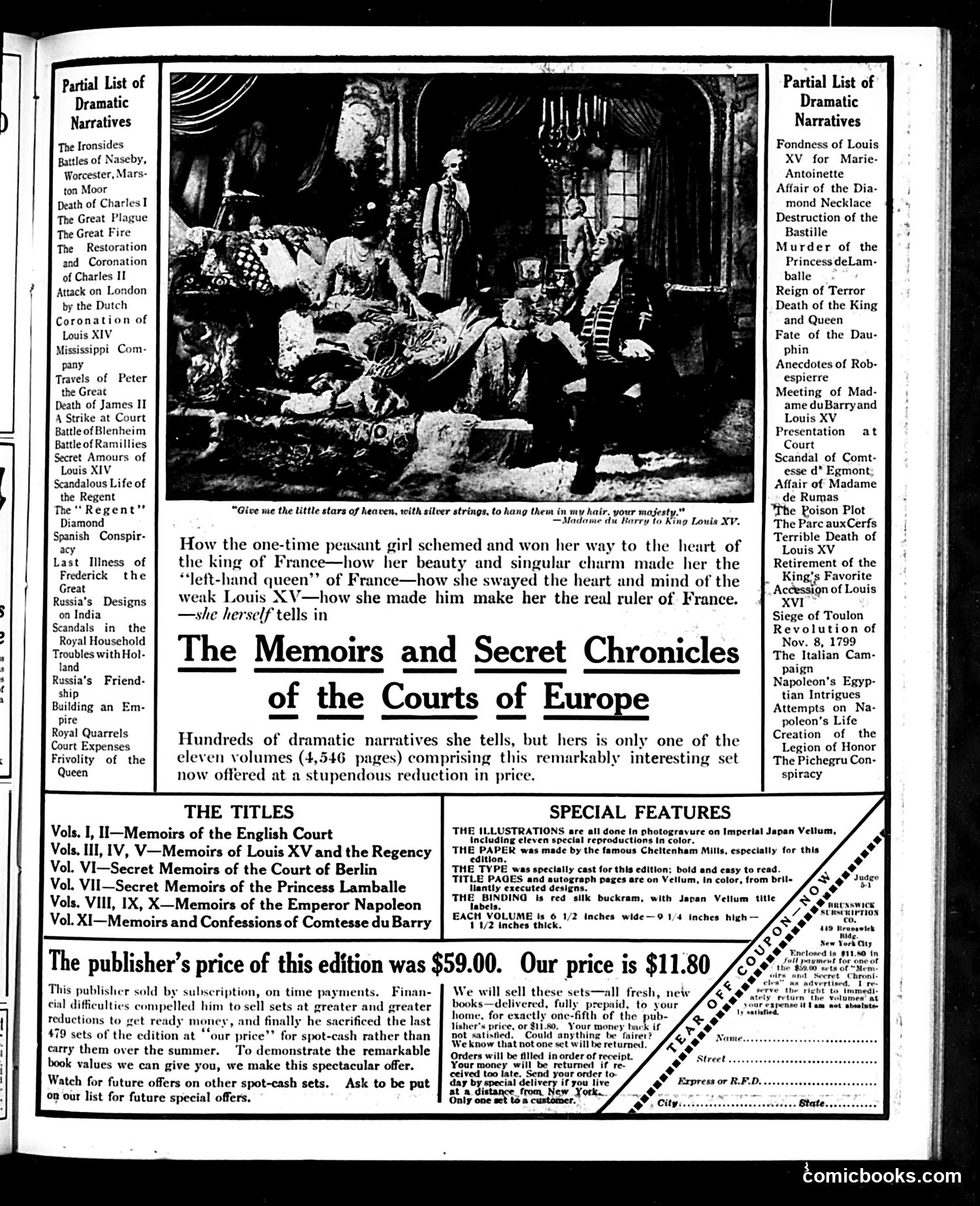
This is primarily an **advertisement**, not a political cartoon. It promotes a multi-volume set of memoirs titled "The Memoirs and Secret Chronicles of the Courts of Europe." The central image depicts a historical court scene, likely representing **Madame du Barry** (a peasant-born mistress of King Louis XV of France) presenting herself to the French court. The caption quotes her requesting the king to give her "the little stars of heaven" to wear in her hair—a reference to her legendary charm and influence over the weak king. The advertisement emphasizes scandal and intrigue: the volumes cover European royal courts from English monarchs through Napoleon, featuring dramatic narratives about affairs, poisonings, murders, and court conspiracies. The appeal is to readers hungry for juicy historical gossip about the French Revolution, royal murders, and aristocratic misconduct. The "spectacular offer" ($11.80 instead of $59.00) suggests the original publisher faced financial ruin and was liquidating remaining inventory—a detail Judge uses to make the deal seem irresistible to readers.
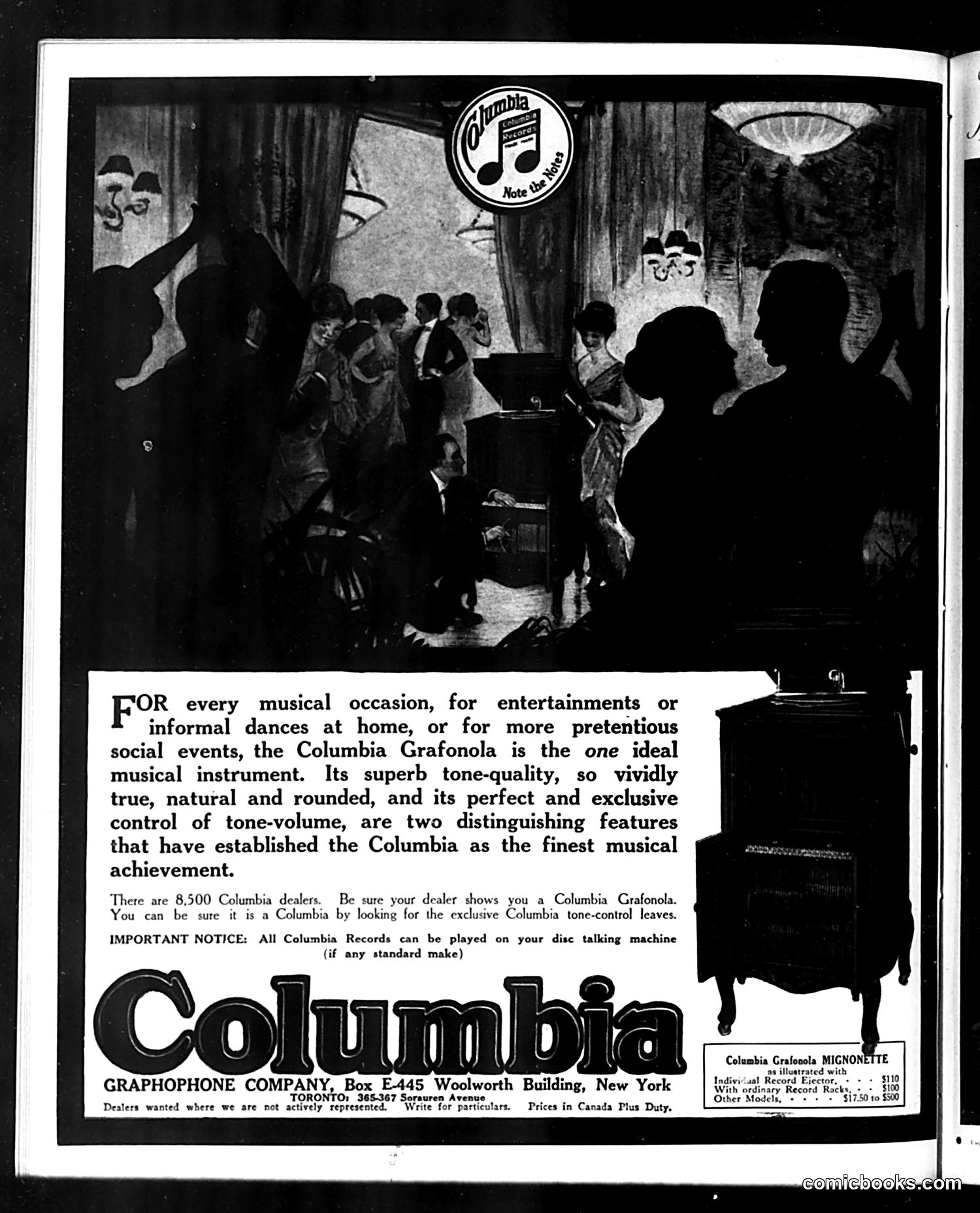
This is **primarily a full-page advertisement** for Columbia Grafonola phonographs, not a political cartoon or satire. The image shows a silhouetted scene of well-dressed people at what appears to be a formal social gathering or dance, listening to the Columbia Grafonola. This visual serves to market the device as essential for "every musical occasion"—from home dances to "pretentious social events." The advertisement emphasizes two selling points: superior "tone-quality" and exclusive "tone-volume control." It notes there are 8,500 Columbia dealers nationwide and includes an important notice that Columbia records play on any standard disc talking machine. The only potential satirical element is subtle: the advertisement's claim that owning a Columbia Grafonola is necessary for social respectability, suggesting that proper entertainment equipment signals status. However, this is standard advertising rhetoric rather than genuine satire. The page is fundamentally a commercial pitch using aspirational imagery of elegant gatherings.