
Judge, 1915-05-01 · page 8 of 24
Judge — May 1, 1915 — page 8: what you’re looking at
What you’re looking at
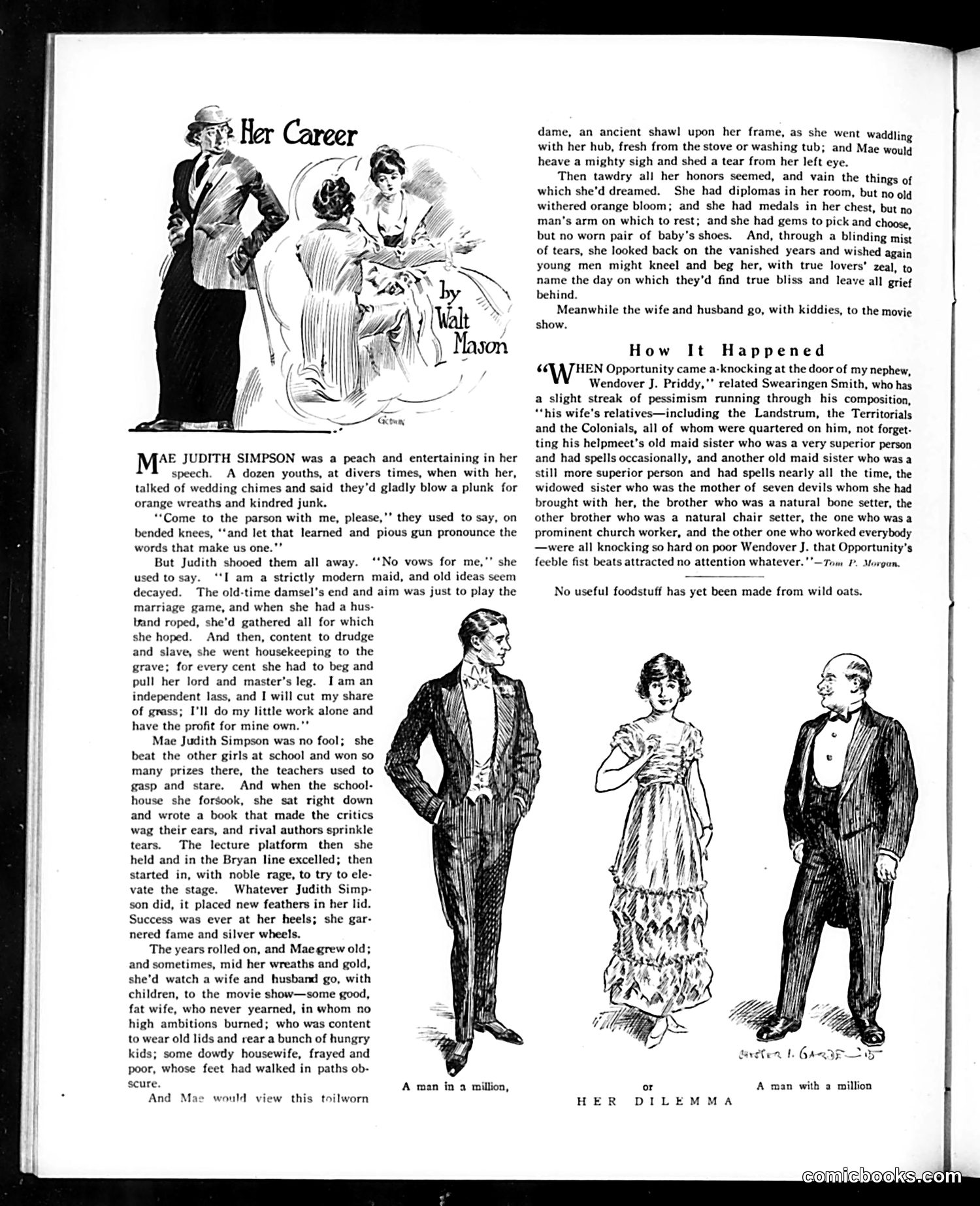
This story satirizes the "New Woman" of the early 20th century—specifically, women pursuing careers and independence rather than marriage. Mae Judith Simpson rejects multiple marriage proposals, insisting "I am an independent lass" and building success as a writer and lecturer instead. The satire's sting lies in its ending: aging and alone, Mae watches ordinary housewives with children and envies them. She realizes her achievements—diplomas, medals, wealth—cannot replace "a worn pair of baby's shoes" or "man's arm on which to rest." The moral: a woman's true fulfillment comes through marriage and motherhood, not ambition. This reflects contemporary anxieties about women's changing roles. While ostensibly praising Mae's intelligence, the story ultimately argues that female independence and career success are hollow substitutes for traditional domestic life—a common anti-feminist argument of the era.
📄 Transcribed text from this page (OCR, searchable)
Machine-transcribed from the original scan — historical spelling and the odd misread are preserved.
AE JUDITH SIMPSON was a peach and entertaining in her speech. A dozen youths, at divers times, when with her, talked of wedding chimes and said they'd gladly blow a plunk for orange wreaths and kindred junk. **Come to the parson with me, please,’’ they used to say, on bended knees, ‘and let that learned and pious gun pronounce the words that make us one."* But Judith shooed them all away. ‘‘No vows for me,"’ she used to say. ‘I am a strictly modern maid, and old ideas seem decayed. The old-time damsel’s end and aim was just to play the marriage game, and when she had a hus- rand roped, she'd gathered all for which she hoped. And then, content to drudge and slave, she went housekeeping to the grave; for every cent she had to beg and pull her lord and master's leg. I am an independent lass, and I will cut my share of grass; I'll do my little work alone and have the profit for mine own."" Mae Judith Simpson was no fool; she beat the other girls at school and won so many prizes there, the teachers used to gasp and stare. And when the school- house she forsook, she sat right down and wrote a book that made the critics wag their ears, and rival authors sprinkle tears. The lecture platform then she held and in the Bryan line excelled; then started in, with noble rage, to try to ele- vate the stage. Whatever Judith Simp- son did, it placed new feathers in her lid. Success was ever at her heels; she gar- nered fame and silver wheels. The years rolled on, and Mae grew old; and sometimes, mid her wreaths and gold, she'd watch a wife and husband go, with children, to the movie show—some good, fat wife, who never yearned, in whom no high ambitions burned; who was content to wear old lids and rear a bunch of hungry kids; some dowdy housewife, frayed and poor, whose feet had walked in paths ob- scure. And Mae A man in a million, would view this toilworn dame, an ancient shawl upon her frame, as she went waddling with her hub, fresh from the stove or washing tub; and Mae would heave a mighty sigh and shed a tear from her left eye. Then tawdry all her honors seemed, and vain the things of which she'd dreamed. She had diplomas in her room, but no old withered orange bloom; and she had medals in her chest, but no man’s arm on which to rest; and she had gems to pick and choose, but no worn pair of baby's shoes. And, through a blinding mist of tears, she looked back on the vanished years and wished again young men might kneel and beg her, with true lovers’ zeal, to name the day on which they'd find true bliss and leave all grief behind. Meanwhile the wife and husband go, with kiddies, to the movie show. How It Happened coyEN Opportunity came a-knocking at the door of my nephew, Wendover J. Priddy,"’ related Swearingen Smith, who has a slight streak of pessimism running through his composition, “his wife's relatives—including the Landstrum, the Territorials and the Colonials, all of whom were quartered on him, not forget- ting his helpmeet's old maid sister who was a very superior person and had spells occasionally, and another old maid sister who was a still more superior person and had spells nearly all the time, the widowed sister who was the mother of seven devils whom she had brought with her, the brother who was a natural bone setter, the other brother who was a natural chair setter, the one who was a prominent church worker, and the other one who worked everybody —were all knocking so hard on poor Wendover J. that Opportunity’s feeble fist beats attracted no attention whatever."’"—Tom P. Morgan, No useful foodstuff has yet been made from wild oats. dreter | Gap A man with a million DILEMMA