
Judge, 1915-05-01 · page 4 of 24
Judge — May 1, 1915 — page 4: what you’re looking at
What you’re looking at
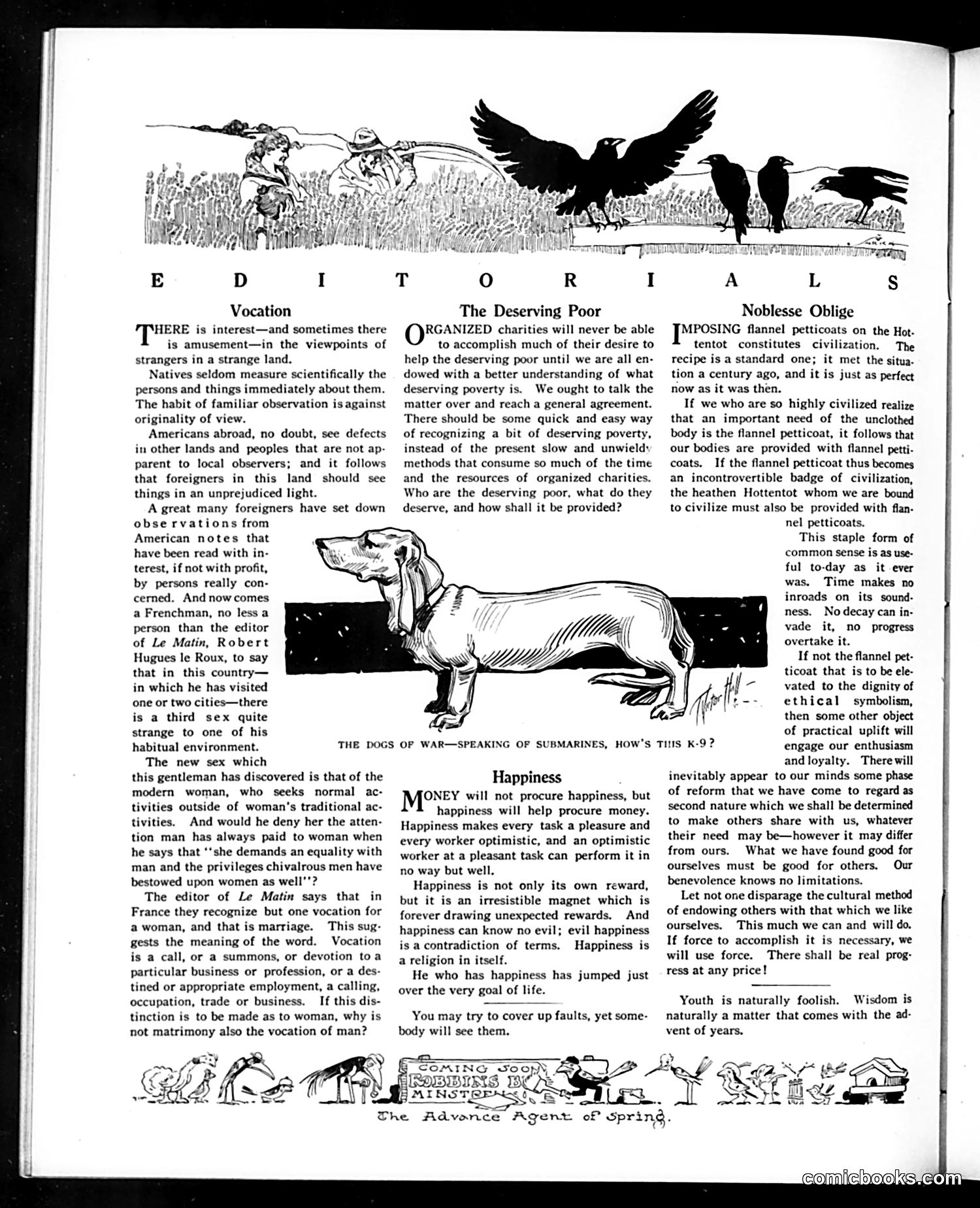
This page contains three opinion essays ("Vocation," "The Deserving Poor," and "Noblesse Oblige") rather than political cartoons. The illustrations are decorative: birds at the top and a dachshund captioned "THE DOGS OF WAR—SPEAKING OF SUBMARINES, HOW'S THIS K-9?" referencing World War I submarine warfare through a pun on "K-9" (canine). The essays reflect early 20th-century Progressive Era concerns: employment dignity for women, charitable obligation toward the poor, and social responsibility of the wealthy. The submarine reference suggests this was published during WWI (likely 1917-1918). The tone is reformist rather than satirical—these are earnest arguments for social change aimed at Judge's educated, affluent readership.
📄 Transcribed text from this page (OCR, searchable)
Machine-transcribed from the original scan — historical spelling and the odd misread are preserved.
I HERE is interest—and sometimes there is amusement—in the viewpoints of strangers in a strange land. Natives seldom measure scientifically the persons and things immediately about them. The habit of familiar observation is against originality of view. Americans abroad, no doubt, see defects in other lands and peoples that are not ap- parent to local observers; and it follows that foreigners in this land should see things in an unprejudiced light. A great many foreigners have set down observations from American notes that have been read with in- terest, if not with profit, by persons really con- cerned. And now comes a Frenchman, no less a person than the editor of Le Matin, Robert Hugues le Roux, to say that in this country— in which he has visited one or two cities—there is a third sex quite strange to one of his habitual environment. The new sex which this gentleman has discovered is that of the modern woman, who seeks normal ac- tivities outside of woman's traditional ac- tivities. And would he deny her the atten- tion man has always paid to woman when he says that ‘‘she demands an equality with man and the privileges chivalrous men have bestowed upon women as well’'? The editor of Le Matin says that in France they recognize but one vocation for a woman, and that is marriage. This sug- gests the meaning of the word. Vocation is a call, or a summons, or devotion to a particular business or profession, or a des- tined or appropriate employment, a calling, occupation, trade or business. If this dis- tinction is to be made as to woman, why is not matrimony also the vocation of man? The Deserving Poor RGANIZED charities will never be able to accomplish much of their desire to help the deserving poor until we are all en- dowed with a better understanding of what deserving poverty is. We ought to talk the matter over and reach a general agreement. There should be some quick and easy way of recognizing a bit of deserving poverty, instead of the present slow and unwield, methods that consume so much of the time and the resources of organized charities. Who are the deserving poor, what do they deserve, and how shall it be provided? THE DOGS OF WAR—SPEAKING OF SUBMARINES, HOW'S TINS K-9? Happiness ONEY will not procure happiness, but happiness will help procure money. Happiness makes every task a pleasure and every worker optimistic, and an optimistic worker at a pleasant task can perform it in no way but well, Happiness is not only its own reward, but it is an irresistible magnet which is forever drawing unexpected rewards. And happiness can know no evil; evil happiness is a contradiction of terms. Happiness is a religion in itself. He who has happiness has jumped just over the very goal of life. You may try to cover up faults, yet some- body will see them. COMING Soop, | nee BC C Noblesse Oblige [MPosine flannel petticoats on the Hot- tentot constitutes civilization. The recipe is a standard on it met the situa- tion a century ago, and it is just as perfect now as it was then. If we who are so highly civilized realize that an important need of the unclothed body is the flannel petticoat, it follows that our bodies are provided with flannel petti- coats. If the flannel petticoat thus becomes an incontrovertible badge of civilization, the heathen Hottentot whom we are bound to civilize must also be provided with flan- nel petticoats. This staple form of common sense is as use- ful to-day as it ever was. Time makes no inroads on its sound- ness. No decay can in- vade it, no progress overtake it. If not the flannel pet- ticoat that is to be ele- vated to the dignity of ethical symbolism, then some other object of practical uplift will engage our enthusiasm and loyalty. There will inevitably appear to our minds some phase of reform that we have come to regard as second nature which we shall be determined to make others share with us, whatever their need may be—however it may differ from ours. What we have found good for ourselves must be good for others. Our benevolence knows no limitations. Let not one disparage the cultural method of endowing others with that which we like ourselves. This much we can and will do, If force to accomplish it is necessary, we will use force. There shall be real prog- ress at any price! Wisdom is Youth is naturally foolish. naturally a matter that comes with the ad- vent of years.