
Judge, 1915-05-01 · page 15 of 24
Judge — May 1, 1915 — page 15: what you’re looking at
What you’re looking at
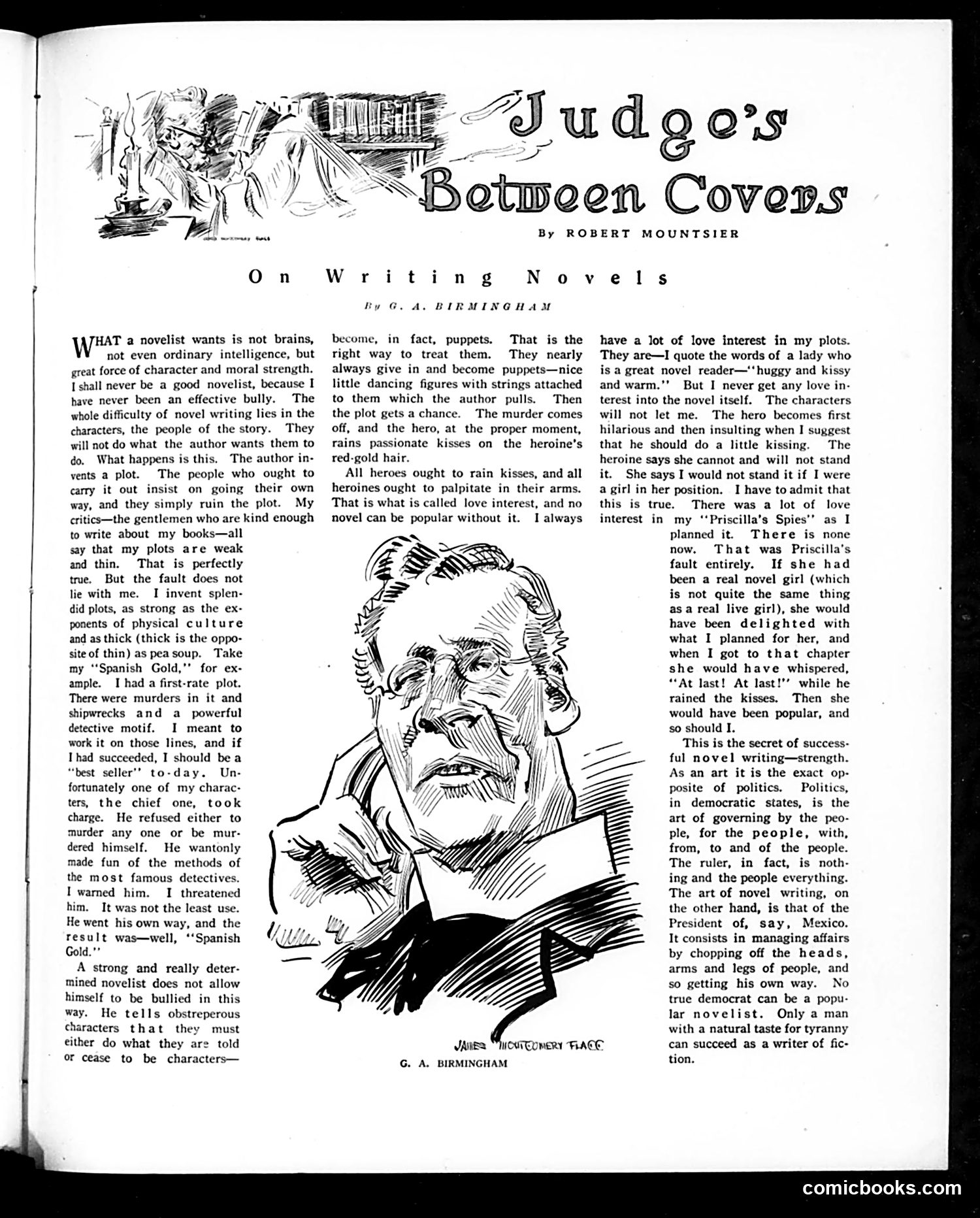
This page features an essay by G.A. Birmingham (visible in the caricature) discussing the challenges of novel writing. The central cartoon shows Birmingham's exaggerated face in profile—a caricature emphasizing his features for satirical effect. The essay's satire lies in Birmingham's complaint that novelists cannot control their own characters, who "refuse" to follow plot directions. He humorously claims strong novels require authorial tyranny like "the President of...Mexico" chopping off heads—implying dictatorial control. The joke contrasts democratic governance (rule "by the people, for the people") with authoritarian novel-writing, where authors must dominate obstreperous characters. The piece mocks both novelist pretensions and political systems, suggesting that successful fiction demands the kind of absolute control that democratic societies explicitly reject. The "Judge's Between Covers" section typically reviewed or satirized contemporary literature and authors.
📄 Transcribed text from this page (OCR, searchable)
Machine-transcribed from the original scan — historical spelling and the odd misread are preserved.
On HAT a novelist wants is not brains, not even ordinary intelligence, but great force of character and moral strength. I shall never be a good novelist, because I have never been an effective bully. The whole difficulty of novel writing lies in the characters, the people of the story. They will not do what the author wants them to do, What happens is this. The author in- vents a plot. The people who ought to carry it out insist on going their own way, and they simply ruin the plot. My critics—the gentlemen who are kind enough to write about my books—all say that my plots are weak and thin. That is perfectly true. But the fault does not lie with me. I invent splen- did plots, as strong as the ex- ponents of physical culture and as thick (thick is the oppo- siteof thin) as peasoup. Take my ‘Spanish Gold,’’ for ex- ample. I had a first-rate plot. There were murders in it and shipwrecks and a_ powerful detective motif. I meant to work it on those lines, and if Thad succeeded, I should be a “best seller’? to-day. Un- fortunately one of my charac- ters, the chief one, took charge. He refused either to murder any one or be mur- dered himself. He wantonly made fun of the methods of the most famous detectives. I wamed him. I threatened him. It was not the least use. He went his own way, and the result was—well, ‘‘Spanish Gold."” A strong and really deter- mined novelist does not allow himself to be bullied in this way. He tells obstreperous characters that they must either do what they are told or cease to be characters— Writing Novels By @. A, BIRMINGHAM become, in fact, puppets. That is the have a lot right way to always give in little dancing to them which the author pulls. the plot gets a chance. off, and the hero, at the proper moment, rains passionate kisses on the heroine's red-gold hair. All heroes ought to rain kisses, and all heroines ought That is what is called love interest, and no novel can be popular without it. G. treat them. They nearly and become puppets—nice figures with strings attached Then The murder comes By ROBERT MOUNTSIER of love interest in my plots. They are—I quote the words of a lady who is a great novel reader—‘‘huggy and kissy and warm.”" terest into the novel itself. will not let me. hilarious and then insulting when I suggest that he should do a little kissing. But I never get any love in- The characters The hero becomes first The heroine says she cannot and will not stand it. to palpitate in their arms. lalways interest in JAIES " UCMTONERY FACE A. BIRMINGHAM She says I would not stand it if I were a girl in her position. this is true, I have to admit that There was a lot of love my ‘‘Priscilla’s Spies’’ as I planned it. There is none now. That was Priscilla’s fault entirely. If she had been a real novel girl (which is not quite the same thing as a real live girl), she would have been delighted with what I planned for her, and when I got to that chapter she would have whispered, “At last! At last!’’ while he rained the kisses. Then she would have been popular, and so should I. This is the secret of success- ful novel writing—strength. As an art it is the exact op- posite of politics. Politics, in democratic states, is the art of governing by the peo- ple, for the people, with, from, to and of the people. The ruler, in fact, is noth- ing and the people everything. The art of novel writing, on the other hand, is that of the President of, say, Mexico. It consists in managing affairs by chopping off the heads, arms and legs of people, and so getting his own way. No true democrat can be a popu- lar novelist. Only a man with a natural taste for tyranny can succeed as a writer of fic- tion. comicbooks.com