
A complete issue · 24 pages · 1915
Judge — April 10, 1915
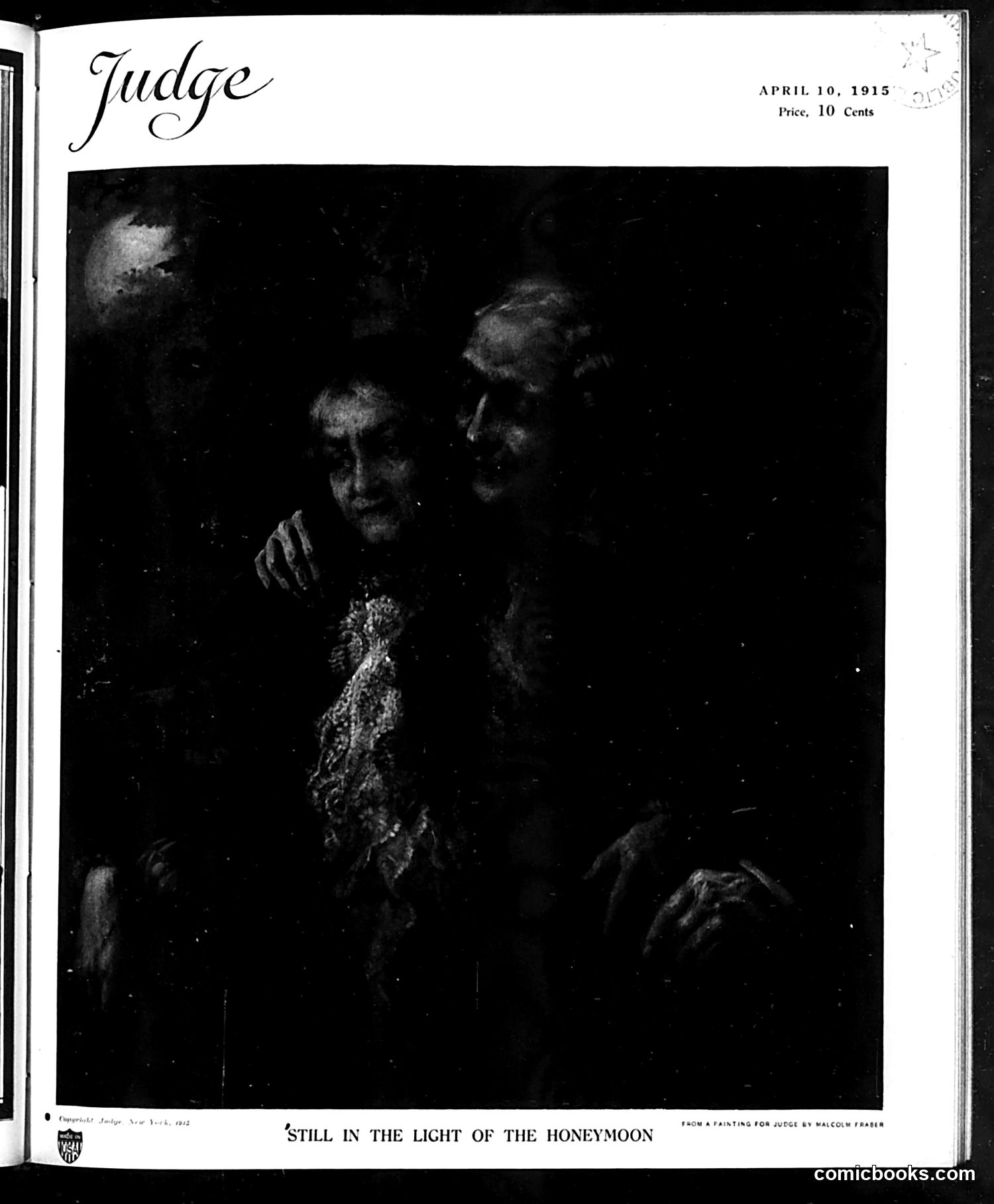
This 1915 *Judge* magazine page reproduces a painting by Malcolm Fraser depicting an intimate domestic scene. The title suggests satire about newlyweds or newly married couples remaining in romantic bliss despite real-world pressures—likely a commentary on marital idealism versus reality. The dark, shadowy artistic style emphasizes the couple's isolation in their private world, seemingly oblivious to external concerns. Given the April 1915 date, this may obliquely reference World War I's escalating impact on American life, contrasting romantic escapism with harsh global realities. Without additional context or visible caricature features, the specific satirical target remains unclear, though the ironic title suggests *Judge's* typical critique of unrealistic expectations or willful ignorance.
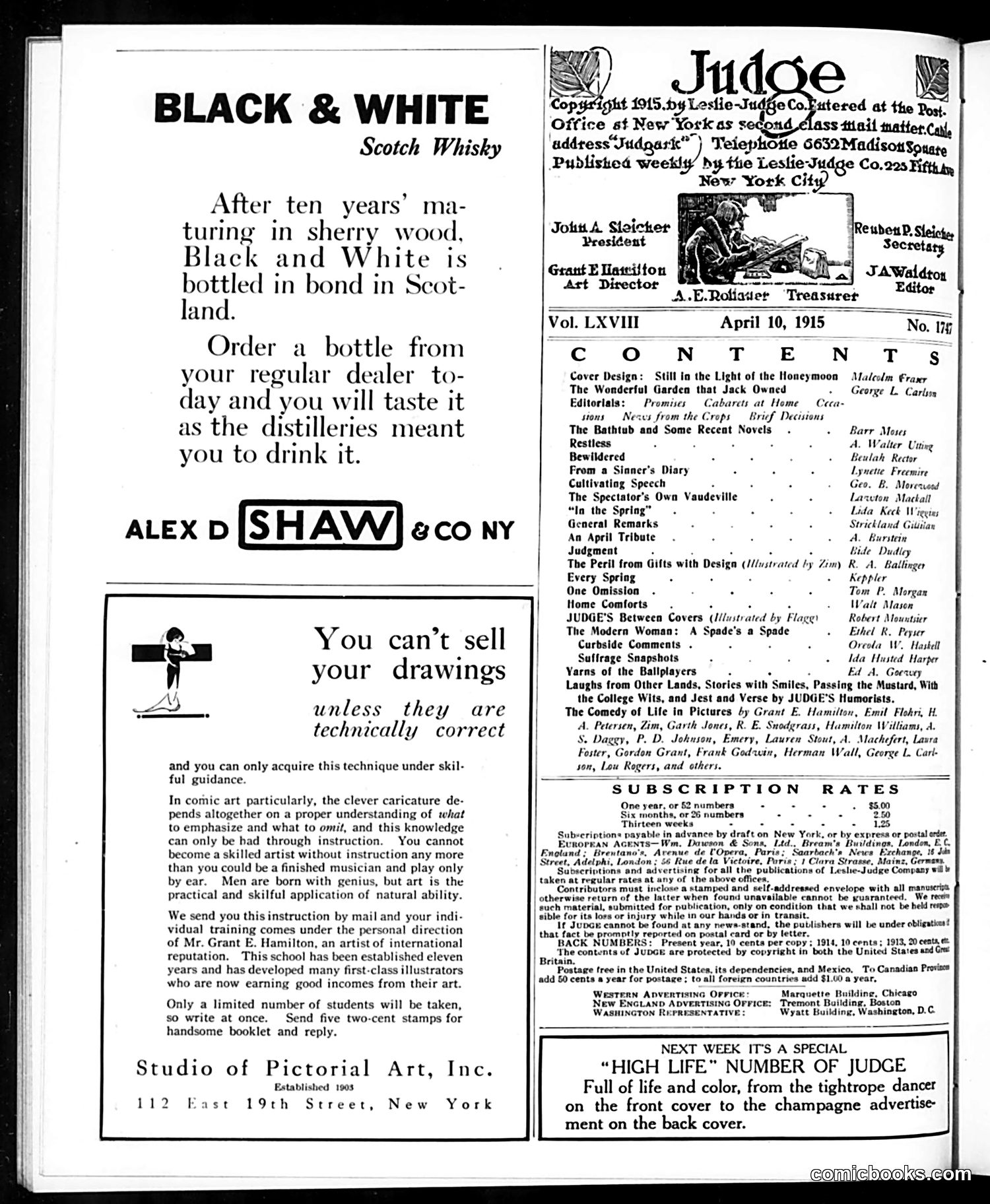
This page is primarily **advertising and editorial content** rather than political satire. The left side contains two advertisements: one for Black & White Scotch whisky and another for Studio of Pictorial Art, Inc., promoting instruction in comic art and caricature technique. The right side shows the magazine's masthead, editorial staff, table of contents, and subscription information for Volume LXVIII, No. 1176. There is **no identifiable political cartoon or satirical commentary** visible on this page. The content focuses on commercial messaging and magazine logistics typical of early 20th-century periodicals. The humor referenced in the table of contents (various articles and illustrated pieces) would appear elsewhere in the issue.
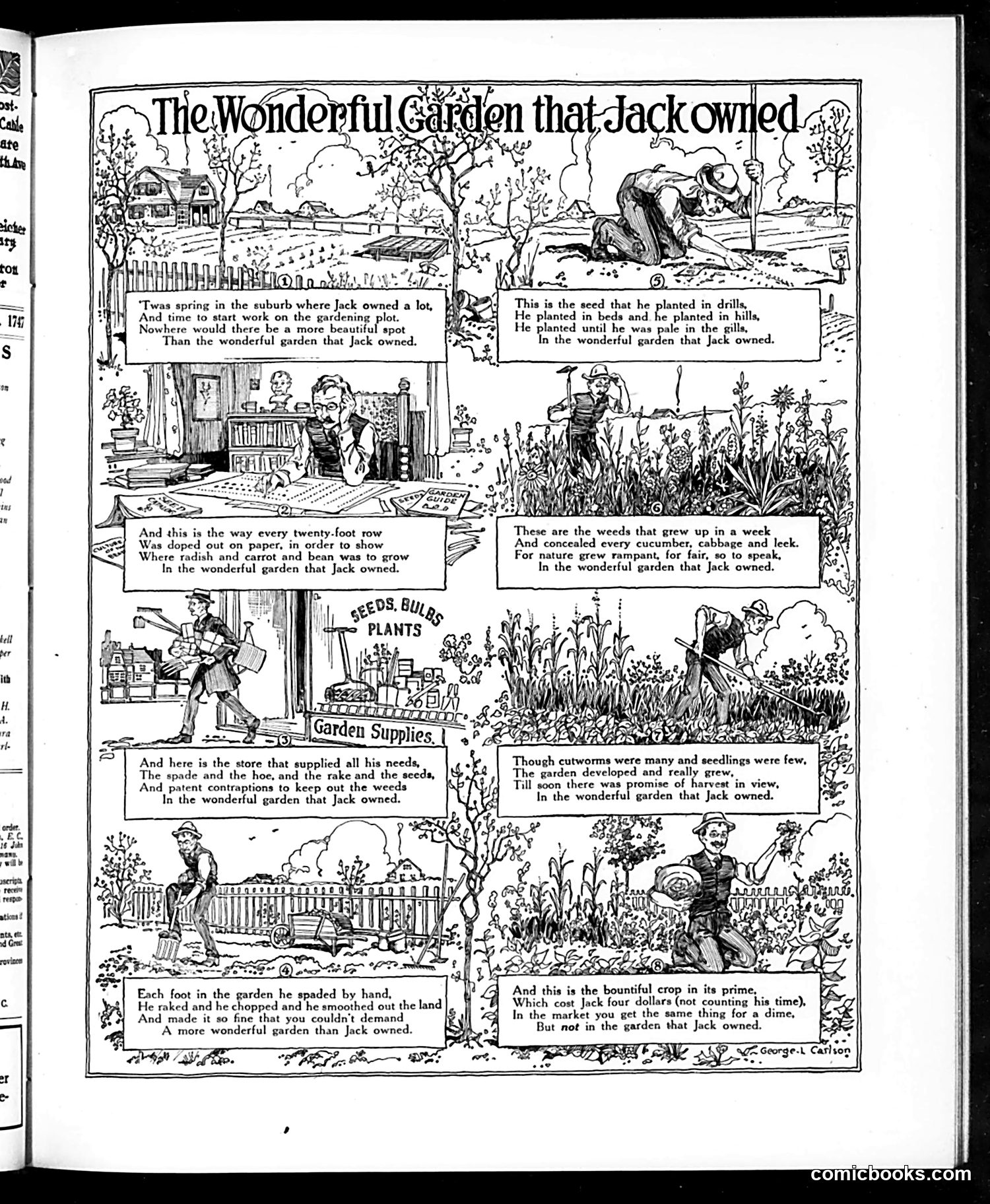
This appears to be a straightforward instructional comic strip rather than political satire, despite appearing in *Judge* magazine. It tells the story of "Jack," who starts a vegetable garden from scratch—preparing soil, planting seeds, purchasing supplies, tending crops despite pests and poor germination, and eventually harvesting a bountiful crop. The narrative emphasizes the value of homegrown produce: Jack's homegrown vegetables, though costing him four dollars to cultivate, would cost only a dime at market—highlighting self-sufficiency and the economics of home gardening. The "satire" appears gentle: celebrating industrious gardening as superior to commercial purchasing, likely appealing to *Judge's* middle-class readership during an era when home gardening was economically and socially valued.
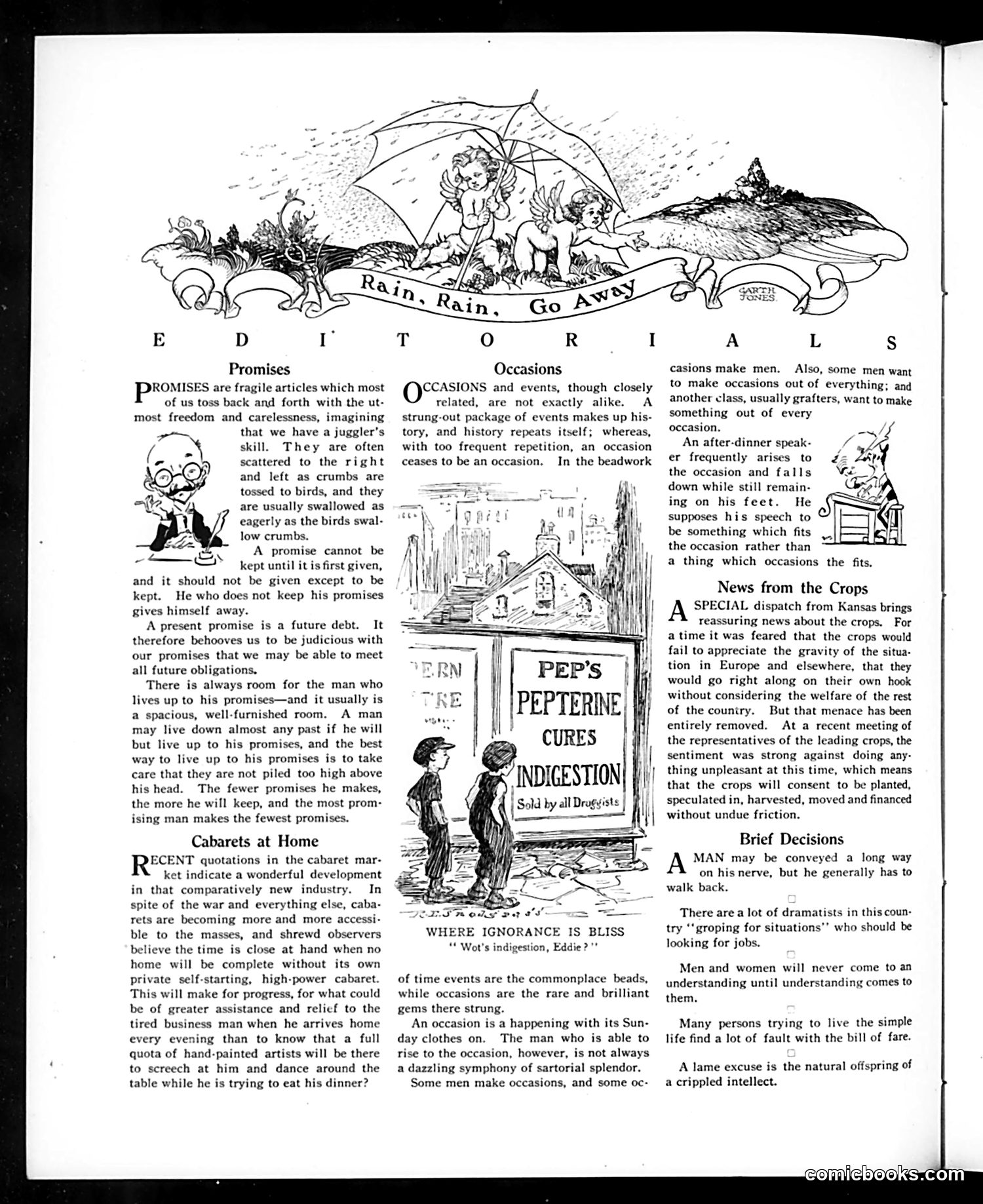
This page is primarily **editorial/advice content** rather than political satire. The header "Rain, Rain, Go Away" is decorative. The page contains four distinct advice columns: 1. **"Promises"** – warns against making careless promises, arguing that few promises are kept and they create future obligations. 2. **"Occasions"** – discusses how frequent social events differ from rare occasions; notes some men overstate speech at dinners to seem important. 3. **"Cabarets at Home"** – predicts cabaret entertainment will become popular home entertainment after the war. 4. **"News from the Crops"** – reports crop concerns in Europe, noting fears of crop failure but optimism that American crops will succeed. The included advertisement for "Pep's Pepterine" digestive cure represents typical Judge magazine advertising. The content is pragmatic advice literature rather than satirical commentary.
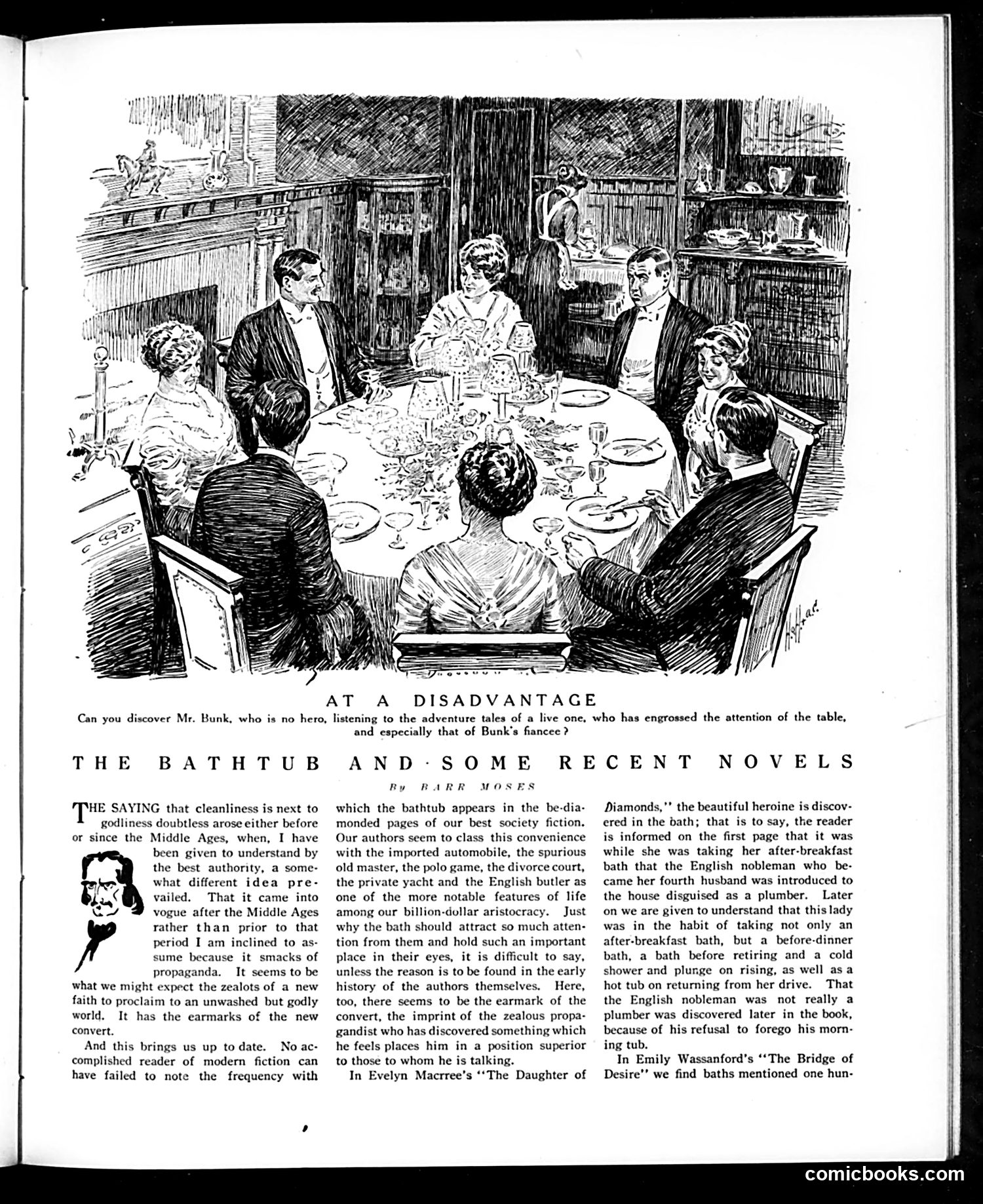
This illustration depicts a formal dinner party scene with the caption asking readers to identify "Mr. Bunk," described as "no hero" whose boring adventure tales have monopolized dinner conversation and captured particular attention from "Bunk's fiancée." The cartoon satirizes the social awkwardness of tedious storytellers at dinner parties—a common genteel setting for embarrassment in early 20th-century satirical humor. The other diners' expressions suggest polite but strained attention as one guest dominates conversation. The accompanying article discusses how bathtub scenes appear frequently in recent novels, using this as a springboard to critique literary conventions of the era. The overall page mocks both social pretension and predictable literary devices.
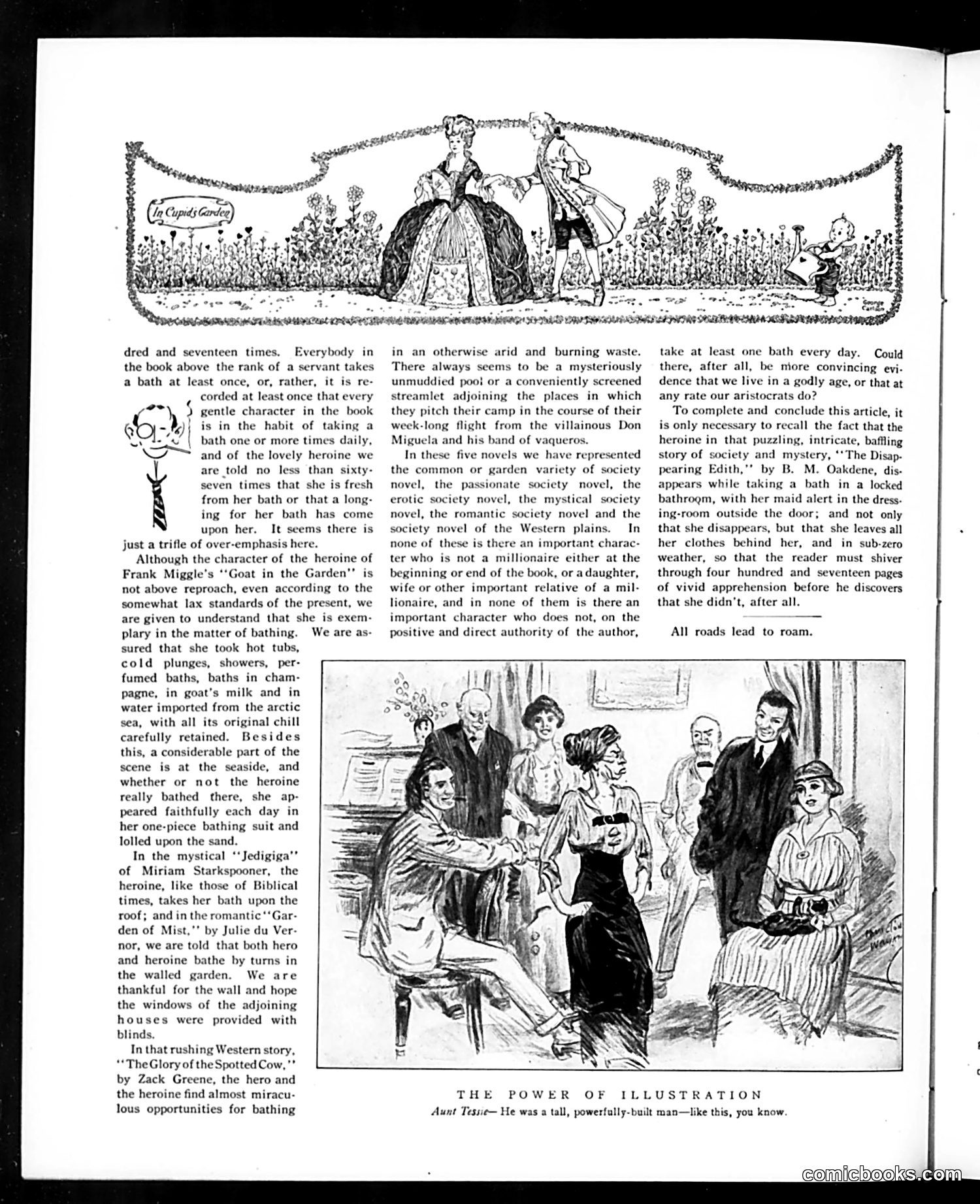
This page satirizes the obsessive focus on bathing in popular fiction, particularly society novels of the era. The text critiques five contemporary novels where bathing appears with absurd frequency—the heroine alone bathes "sixty-seven times" across one book's narrative. The satire targets both the novelists' lazy writing (repetitive bathing scenes as character development) and broader anxieties about wealth and morality. The author notes that *every* important character is either a millionaire or related to one, and *all* bathe daily—suggesting novelists conflate wealth with cleanliness as markers of virtue. The lower illustration titled "The Power of Illustration" shows a woman (Aunt Tessie) gesturing dramatically while describing a man to an audience, demonstrating how illustration exaggerates written description into absurd physicality. The satire mocks both the sentimental excess of contemporary popular fiction and society's anxiety about class, hygiene, and respectability during this period.
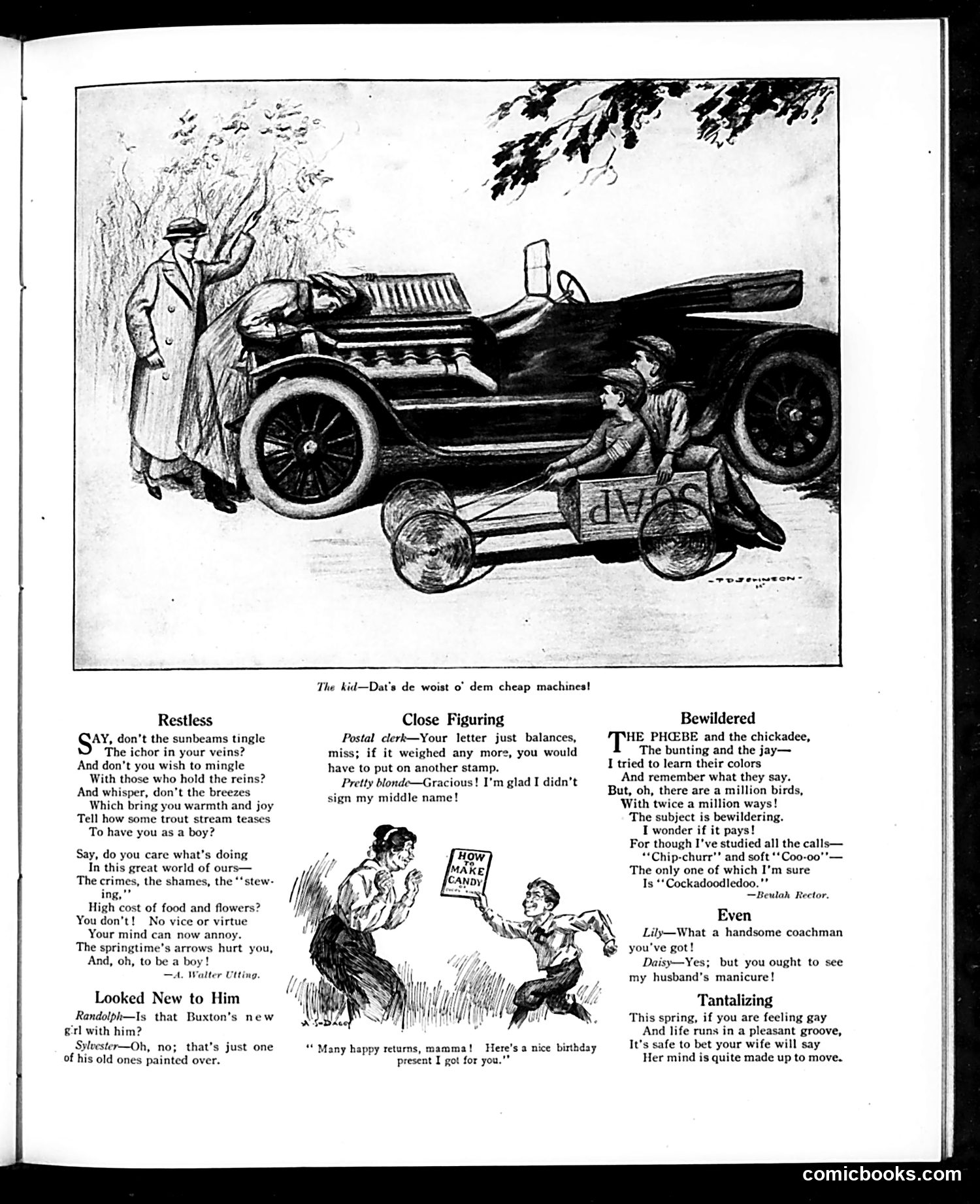
This page contains multiple brief humorous pieces typical of early 20th-century American satirical magazines. **Main Cartoon:** The top illustration shows a man examining a toy automobile next to a real car, complaining "Dat's de woist o' dem cheap machines!" The joke satirizes mass-produced, inexpensive toys—likely commenting on rapid industrialization and consumer culture's flood of low-quality goods. **Text Pieces:** The remaining content consists of short poems and joke dialogues addressing contemporary social concerns: rising costs of living ("High cost of food and flowers"), postal service inefficiencies (a clerk warning about letter weight requiring extra postage), marital dynamics, and romantic disappointments. **Overall Tone:** These pieces reflect pre-WWI American anxieties about modernization, consumerism, and changing social relations, delivered through light verse and witty dialogue rather than explicit political commentary. The humor relies on readers' familiarity with everyday frustrations of the era.
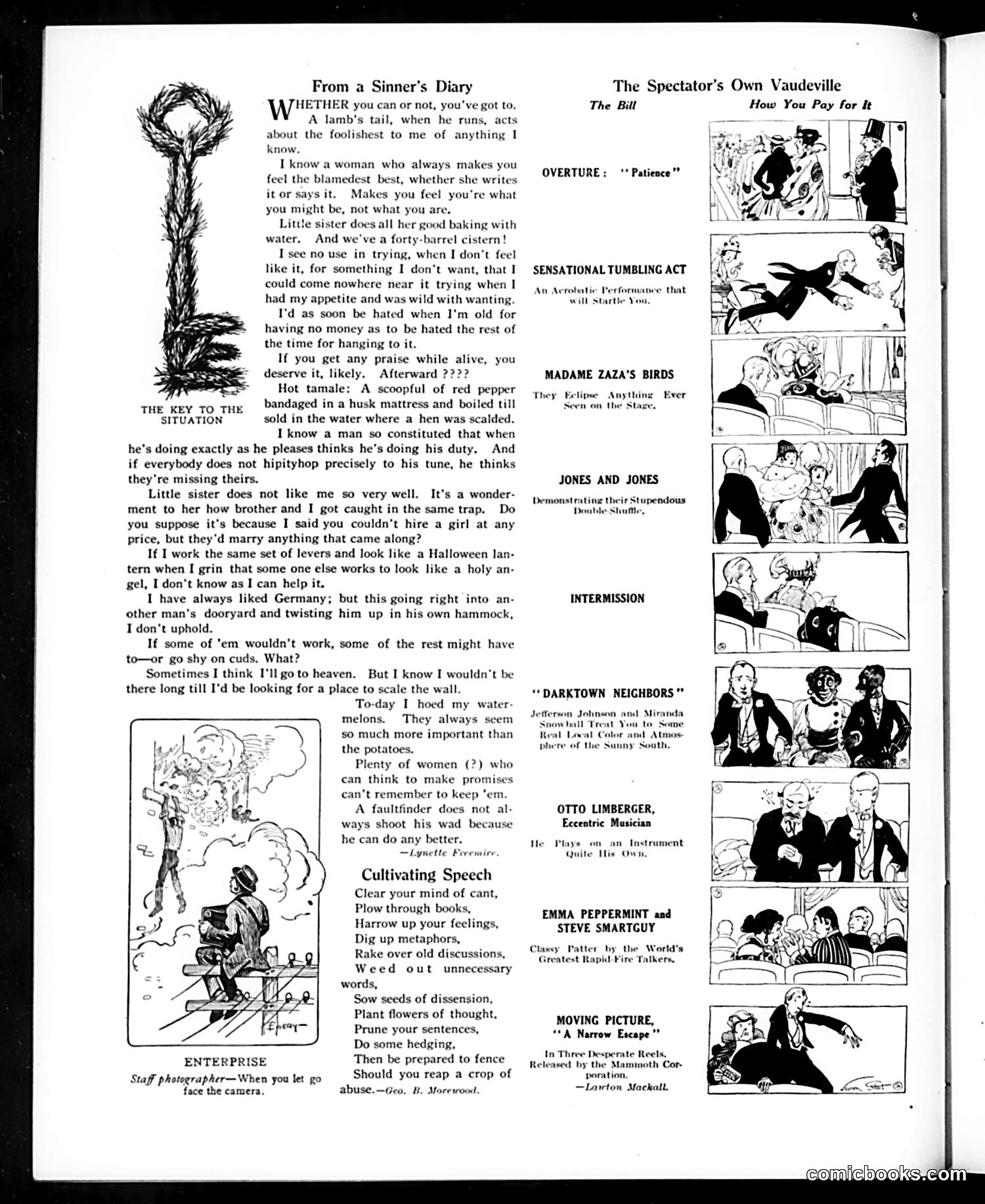
This Judge magazine page contains satirical commentary on early 20th-century American life and culture: **Left side ("From a Sinner's Diary"):** A cynical diary entry lamenting human behavior—particularly criticizing women who make promises they don't keep, people who pretend virtue while acting selfishly, and those who judge others harshly. The reference to "going right into another man's dooryard and twisting him up in his own hammock" appears to reference Germany's aggressive foreign policy (likely pre-WWI tensions). The overall tone mocks hypocrisy and pretense. **Right side ("The Spectator's Own Vaudeville"):** Parodies a vaudeville theater bill, mocking popular entertainment acts of the era with absurdist humor—"Madame Zaza's Birds," "Jones and Jones" (likely racial caricature based on "Darktown Neighbors" reference), and fictional performers like "Otto Limberger, Eccentric Musician." **Bottom ("Cultivating Speech"):** Uses agricultural metaphors to satirize pompous speech-making, suggesting one must "plow," "harrow," and "weed" before producing eloquence—mocking pretentious public speakers. The page exemplifies Judge's satirical style targeting hypocrisy, pretension, and human folly.
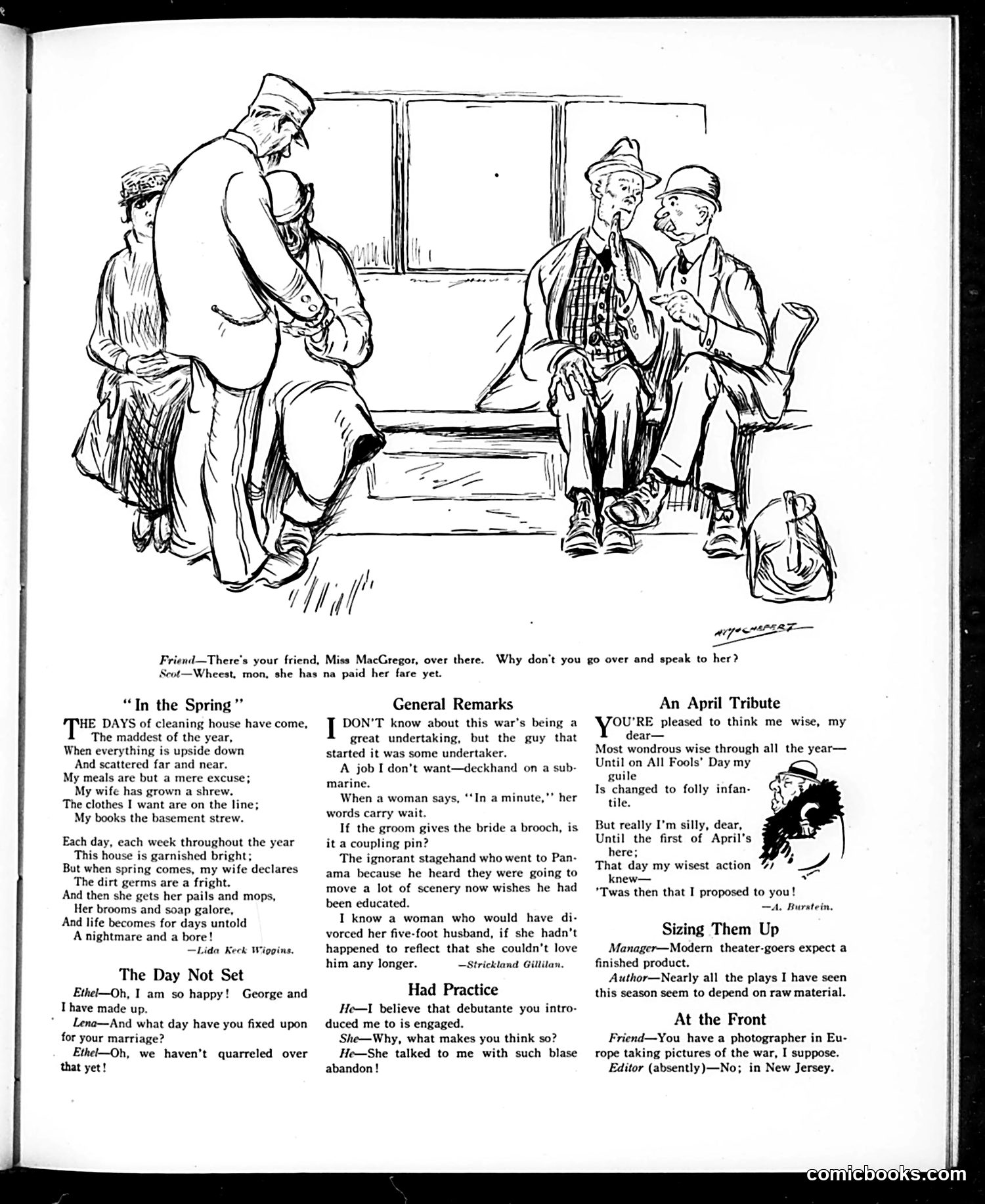
This page from Judge magazine contains multiple satirical pieces about early 20th-century American life, likely from WWI era (references to submarines and war photography suggest this timing). The main cartoon depicts a Scottish passenger refusing to greet a woman on what appears to be public transit because "she has na paid her fare yet"—a joke playing on Scottish stereotypes about frugality and penny-pinching. The text sections include humorous observations on domestic life ("In the Spring" complains about spring cleaning chaos), marriage delays, and wartime absurdities. A notable quip mocks undertakers profiting from war. Another satirizes theatrical producers expecting finished work from raw scripts. The final item jokes that while papers claim war photographers work in Europe, this editor's are actually in New Jersey—likely satirizing exaggerated war coverage or the gap between claimed and actual reporting during WWI. Overall, the page reflects American civilian concerns: domestic inconvenience, marriage customs, and skepticism about media's war narratives.
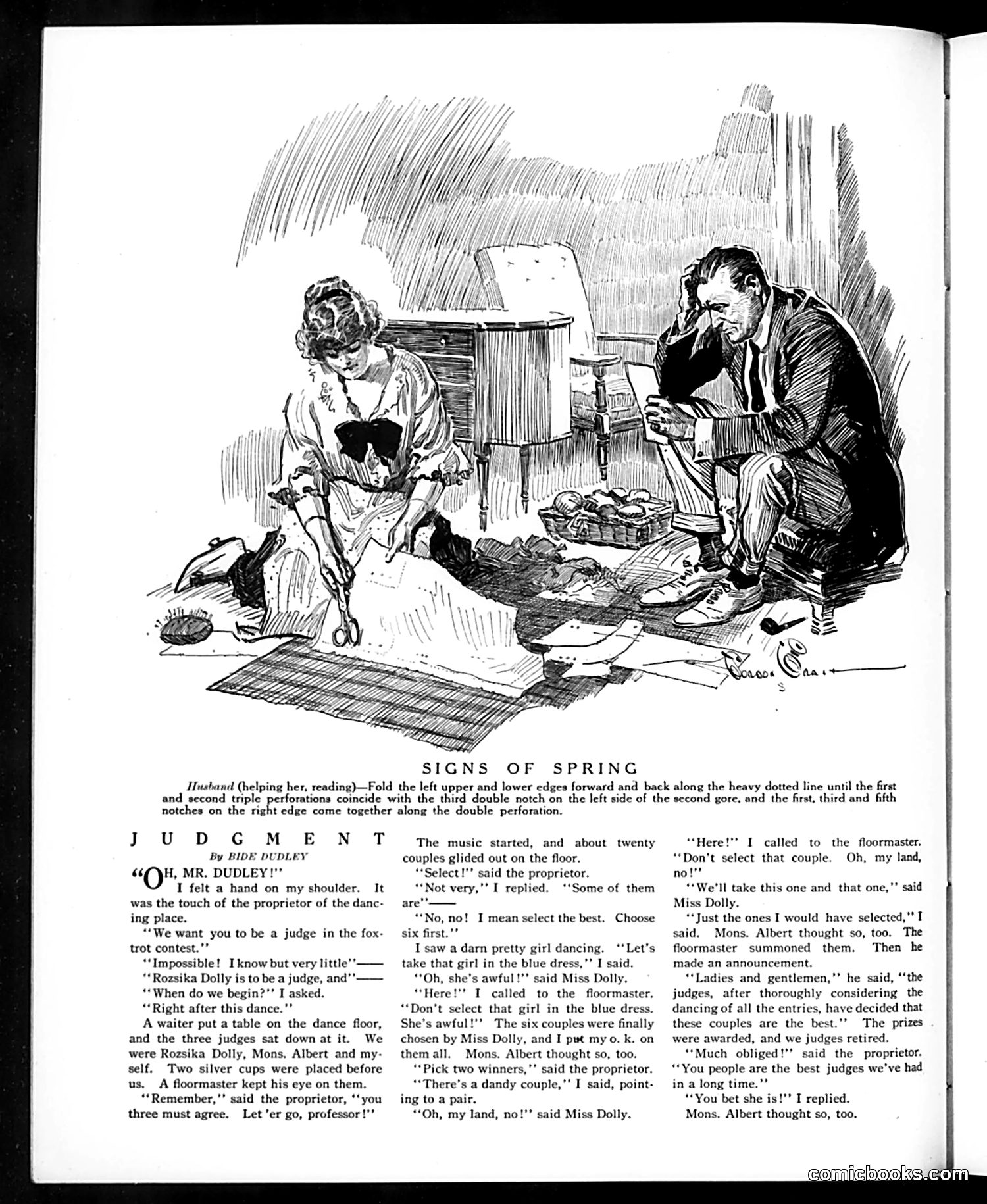
This is a humorous short story about a dance competition judge at what appears to be a 1920s nightclub or dance hall. The narrator is recruited to judge a fox-trot contest alongside Rozsika Dolly (a real Hungarian dancer famous in that era) and "Mons. Albert." The satire concerns judging itself: the narrator and his co-judges completely disagree on dancers' merit, yet mysteriously reach unanimous decisions anyway. Each judge privately selects dancers they favor, then must publicly reverse their opinions when the proprietor dismisses them as "awful" or "dandy." They ultimately declare the winners satisfactory, despite the contradictions. The joke mocks how judges often lack genuine expertise or conviction, simply conforming to authority or social pressure rather than independent assessment. The "Signs of Spring" diagram above parodies confusing fashion sewing instructions, continuing the theme of baffling complexity.
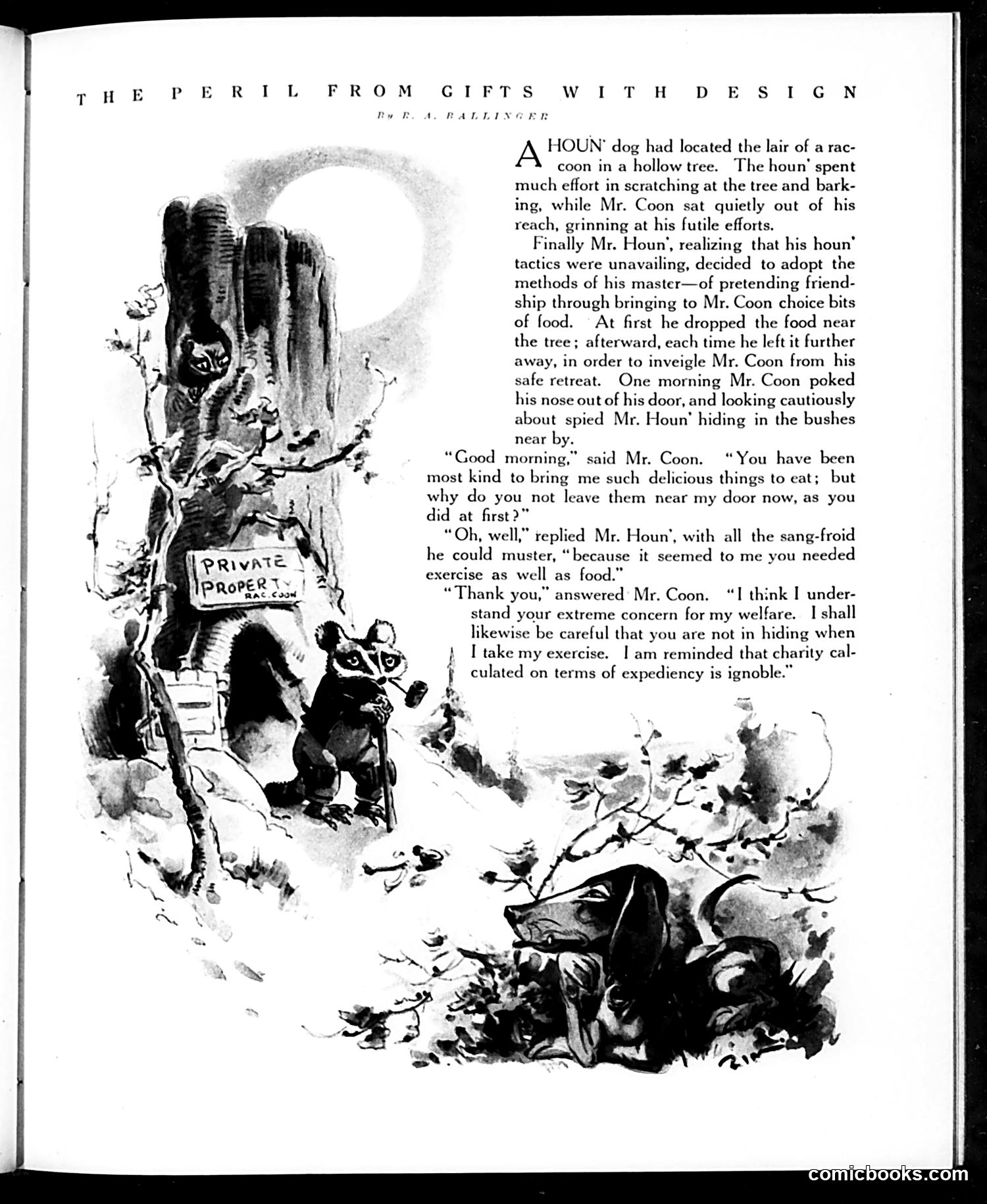
This fable by E.A. Ballinger uses animals to satirize insincere charity and manipulative patronage. A hound pretends friendship by offering food to lure a raccoon from safety, claiming concern for the raccoon's health and exercise. The raccoon sees through this—recognizing the dog hides nearby, waiting to attack once he's vulnerable. The moral, delivered by Mr. Coon, criticizes "charity calculated on terms of expediency"—aid given not from genuine concern but to exploit or control the recipient. The "private property" sign on the tree emphasizes the raccoon's right to his own space. This likely critiques American political or business practices of the era: paternalistic gestures toward workers, immigrants, or marginalized groups that mask ulterior motives. The raccoon's eloquent self-defense suggests satirizing those who see through such false benevolence.
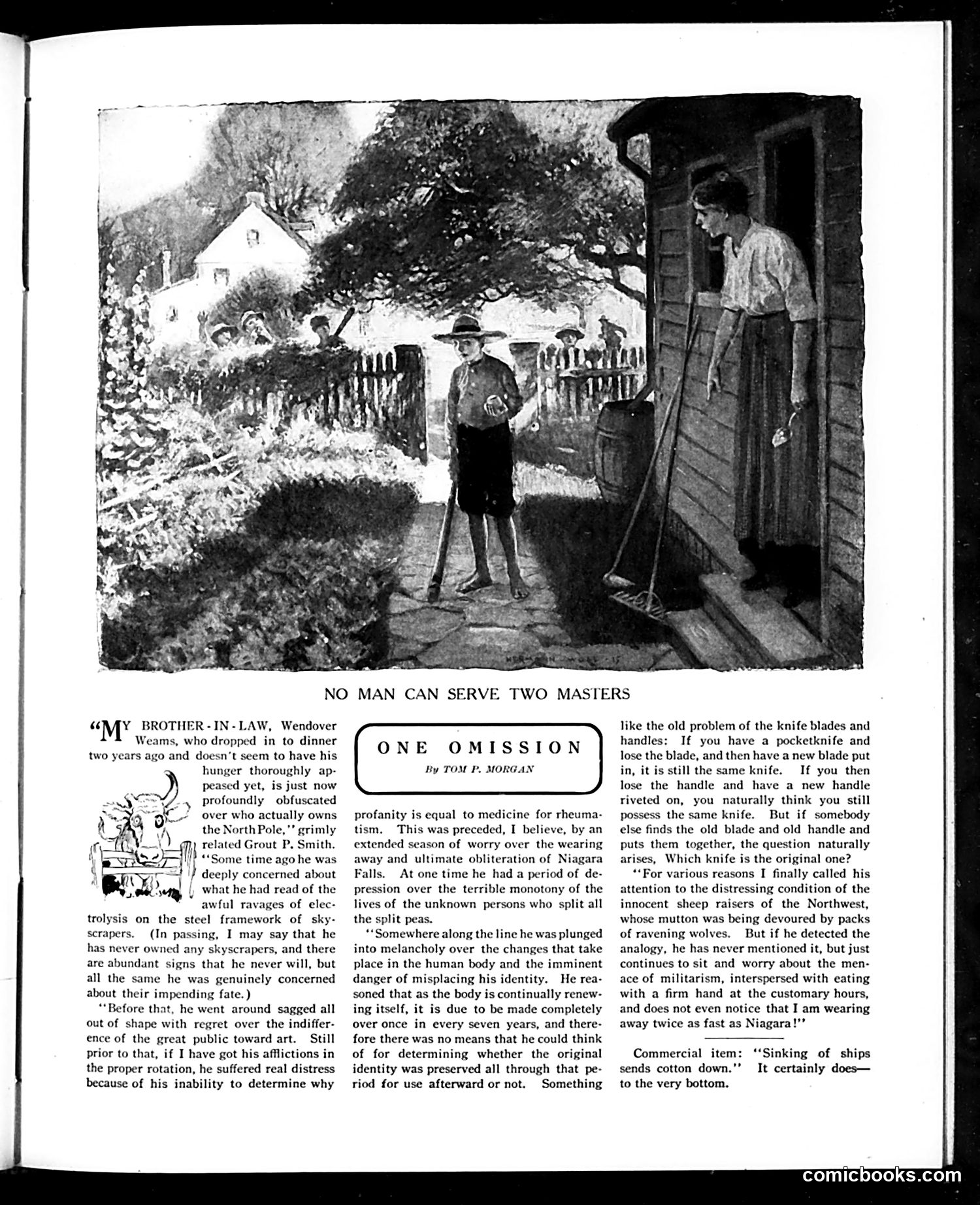
This is a humorous short story (not a political cartoon) by Tom P. Morgan titled "One Omission," illustrated with a scene of rural figures. The story's satire targets a specific personality type: the chronic worrier who obsesses over abstract, impersonal problems while remaining indifferent to actual human suffering around him. The narrator's brother-in-law Wendover Weams frets sequentially over: - Niagara Falls erosion - Skyscraper deterioration from electrolysis - The metaphysical problem of personal identity (the famous "ship of Theseus" paradox) - The monotony of pea-splitters' lives The joke's point: When the narrator finally tries redirecting this anxiety toward a real, concrete tragedy—starving sheep farmers attacked by wolves in the Northwest—Wendover either misses the hint or ignores it, continuing his abstract worrying instead. The satire mocks self-absorbed intellectualism divorced from practical compassion, suggesting some people prefer speculative anxieties to genuine human need.
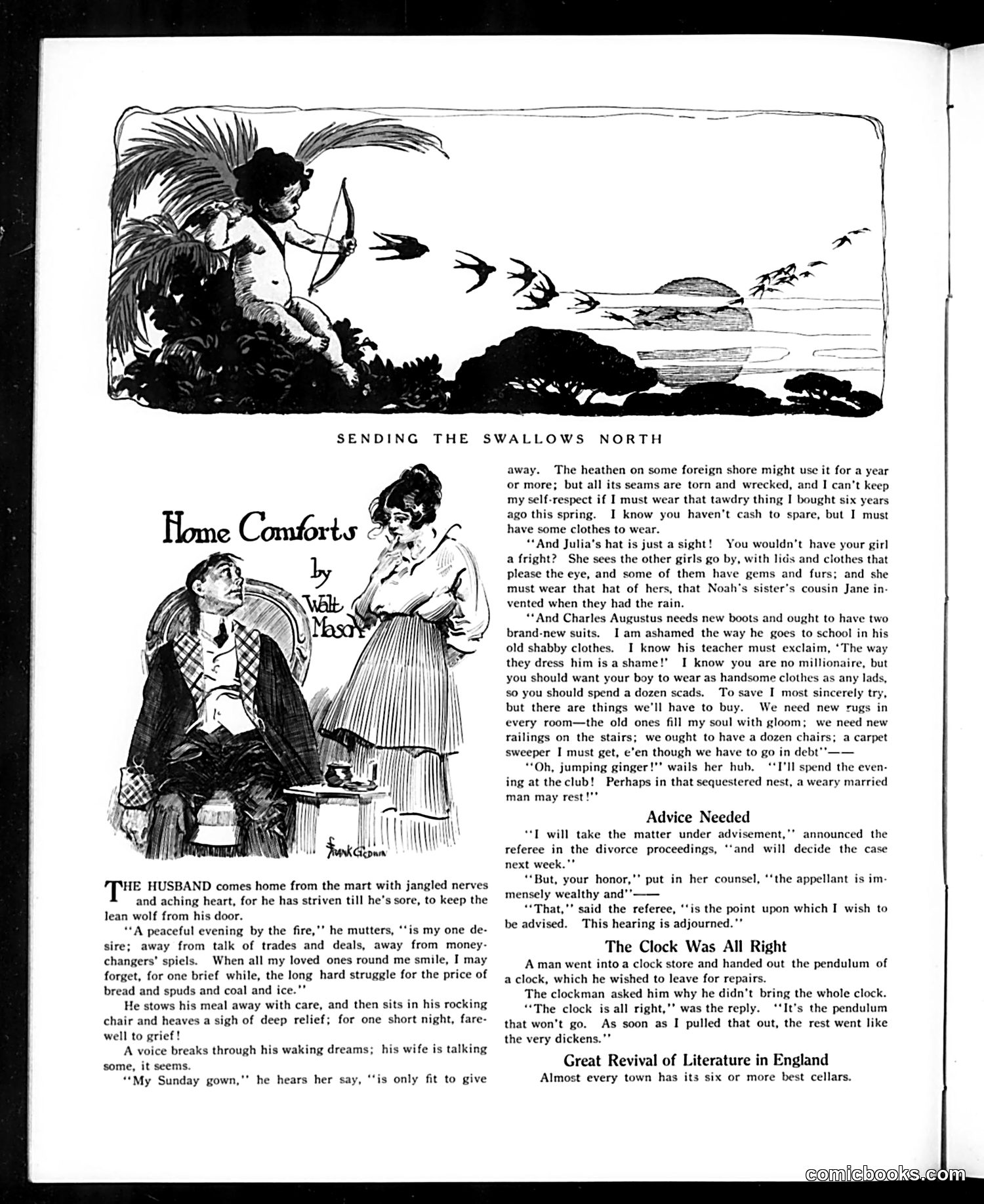
This page contains three satirical pieces from *Judge* magazine: **"Home Comforts"** (main illustration): A working-class husband seeks peaceful refuge at home after a grueling day at work, only to be ambushed by his wife's endless list of domestic demands—new clothes, shoes, furniture, rugs. His exasperated response ("I'll spend the evening at the club!") satirizes the tension between a husband's desire for rest and a wife's expectations for household improvements and family appearances. The satire targets both spendthrift wives and men avoiding domestic responsibility. **"Advice Needed"**: A brief joke about a divorce proceeding where the judge must determine which spouse is wealthy, highlighting the role of financial status in marital disputes. **"The Clock Was All Right"**: A short humorous anecdote about a man who removes only a clock's pendulum for repair, claiming everything else works fine—absurd logic that mocks customer foolishness. **"Great Revival of Literature in England"**: Likely a satirical headline (text incomplete) about English literary culture, though the specific reference remains unclear from this excerpt.
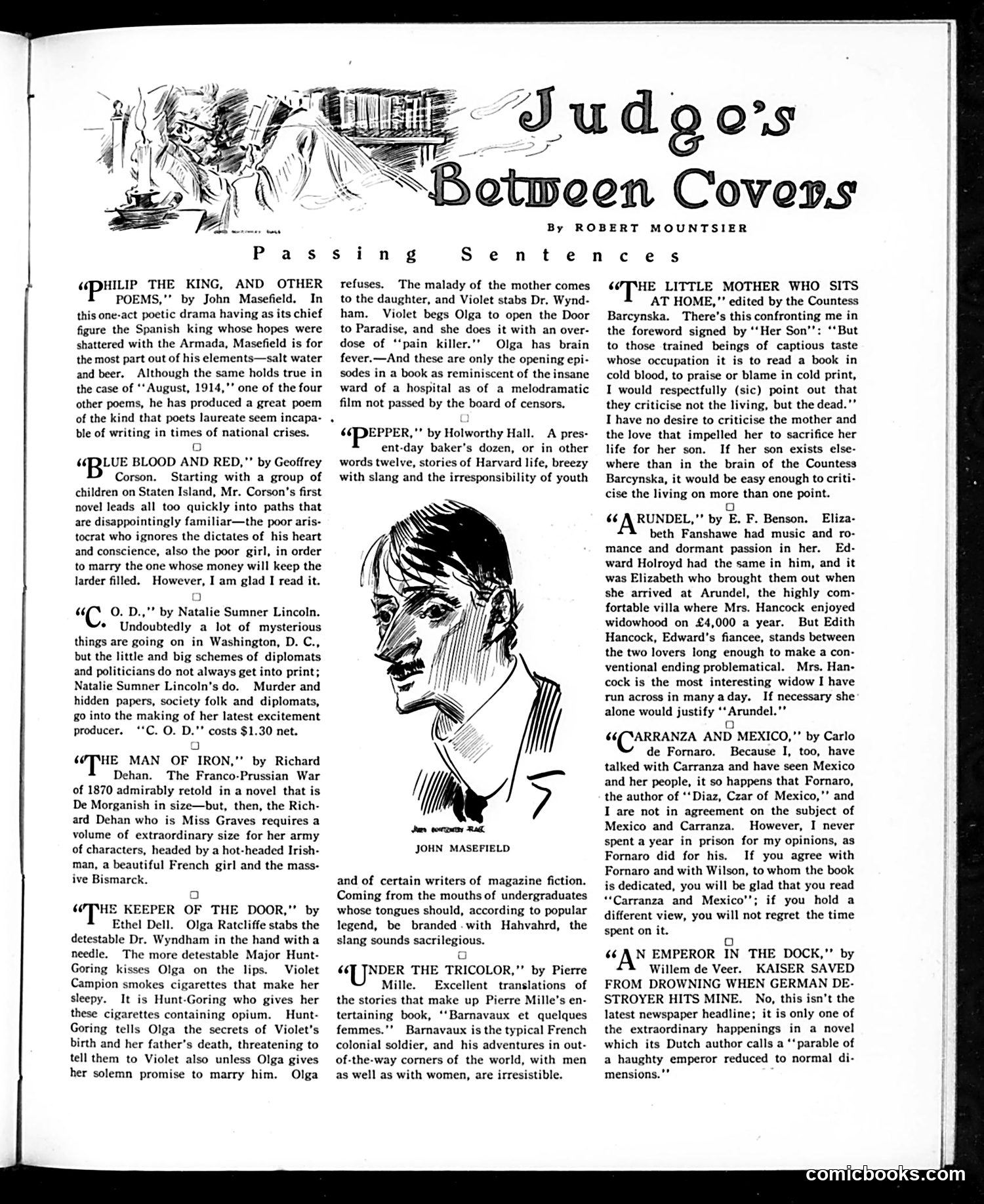
This page contains literary book reviews by Robert Mountsier, not political cartoons. The single illustration is a portrait sketch of **John Masefield**, the British Poet Laureate whose collection "Philip the King, and Other Poems" is reviewed first. The reviews are satirical commentary on contemporary fiction (circa 1915-1920). Mountsier critiques authors for melodramatic plots, clichéd characters, and overwrought narratives—particularly mocking Ethel Dell's "The Keeper of the Door" for its absurdly convoluted plot involving druggings, stabbings, and opium. He also jabs at Harvard student stories for sacrilegiously affecting "Hahvahrd" slang, and questions why a book's foreword attacks literary critics. The satire targets popular but artistically shallow fiction of the era. The title "Between Covers" ironically frames these reviews as examining what books hide within their pages.
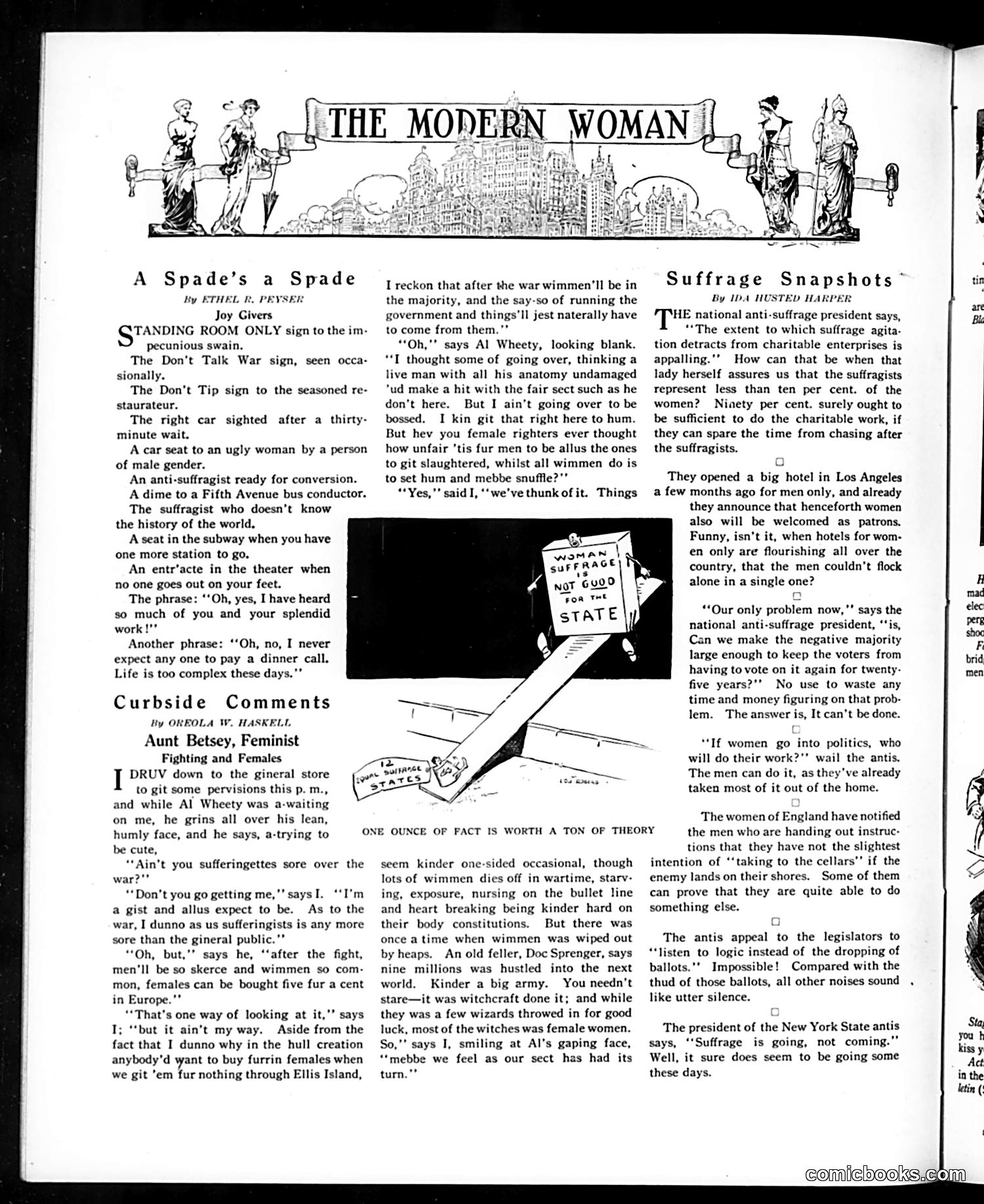
This Judge magazine page satirizes debates over women's suffrage and roles circa 1910s America. **"A Spade's a Spade"** lists absurdities presented as rarities—including "an anti-suffragist ready for conversion," mocking those opposed to women's voting rights as unreasonable. **"Curbside Comments"** features rural character "Aunt Betsey" debating a male shopkeeper about women's suffrage. When he warns women will become cheap after war kills men, she counters that women already die in wartime (starvation, childbirth, nursing) and historically suffered mass persecution (witch trials). Her point: women have already "had their turn" suffering, so voting rights are fair. **"Suffrage Snapshots"** ridicules anti-suffrage arguments as hypocritical—attacking suffragists for distracting from charity while admitting suffragists represent under 10% of women, so the remaining 90% could manage charitable work themselves. It also mocks men-only hotels that now must accept women patrons. **Overall message**: The page advocates for women's suffrage by exposing anti-suffragist logic as absurd and contradictory.
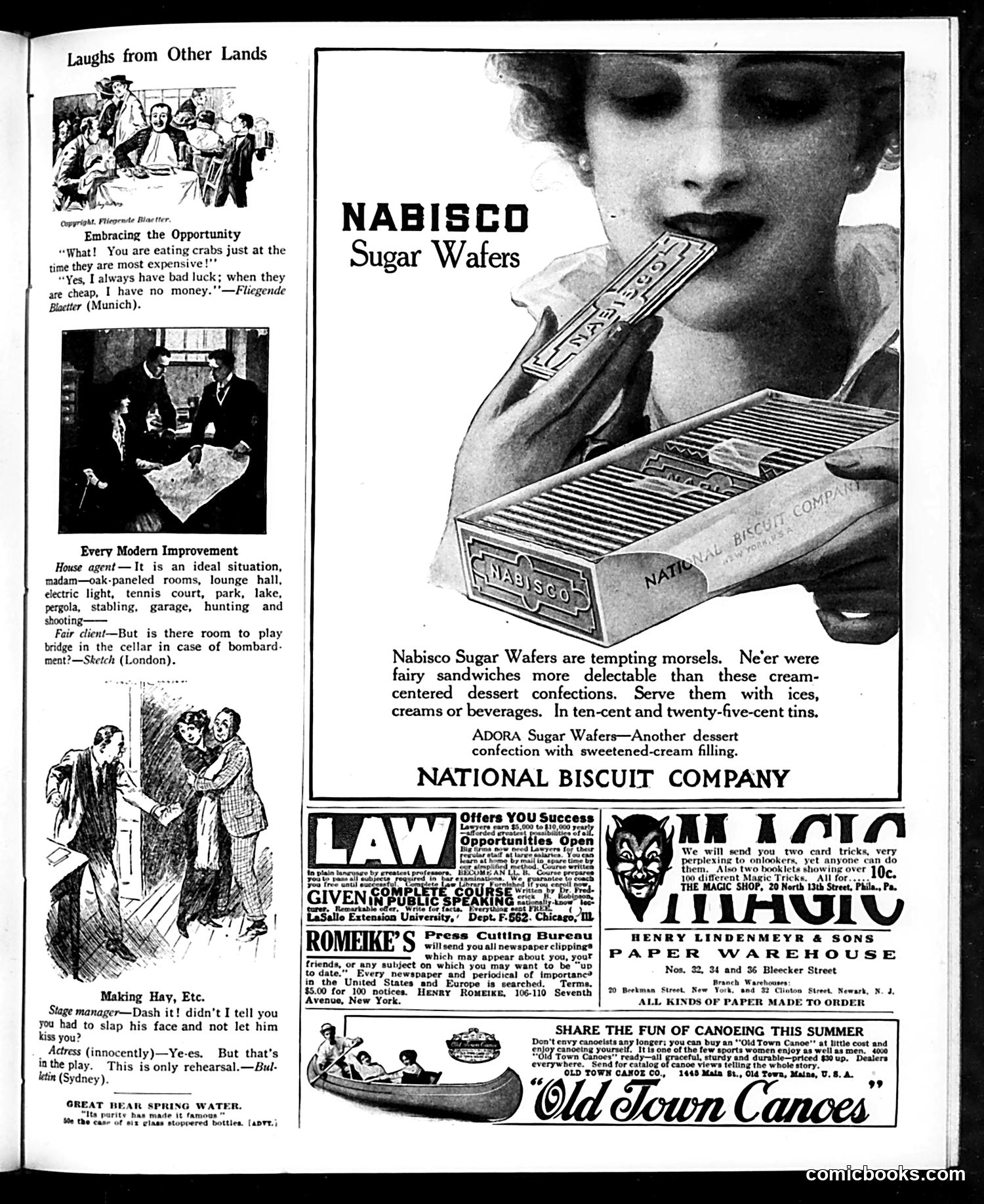
This page contains three distinct joke sections plus advertisements: **"Laughs from Other Lands"** presents translated humor from European magazines. The Munich joke satirizes economic hardship—a man eats expensive crabs only when he's broke, reversing normal consumer behavior. The London joke references **World War I bombing concerns**: a prospective tenant asks if the cellar offers space for bridge games during bombardment, mocking both wartime anxiety and the absurdity of treating air raids as minor inconveniences. **"Making Hay, Etc."** is a theatrical joke about rehearsal versus performance—an actress misunderstands stage directions, confusing the scripted slap with the unrehearsed kiss that follows. The remainder is advertising for Nabisco wafers, magic tricks, newspaper clipping services, canoes, and paper warehouses—typical of Judge's revenue model. The satirical content reflects early 20th-century concerns: economic uncertainty, wartime threats, and theatrical life.
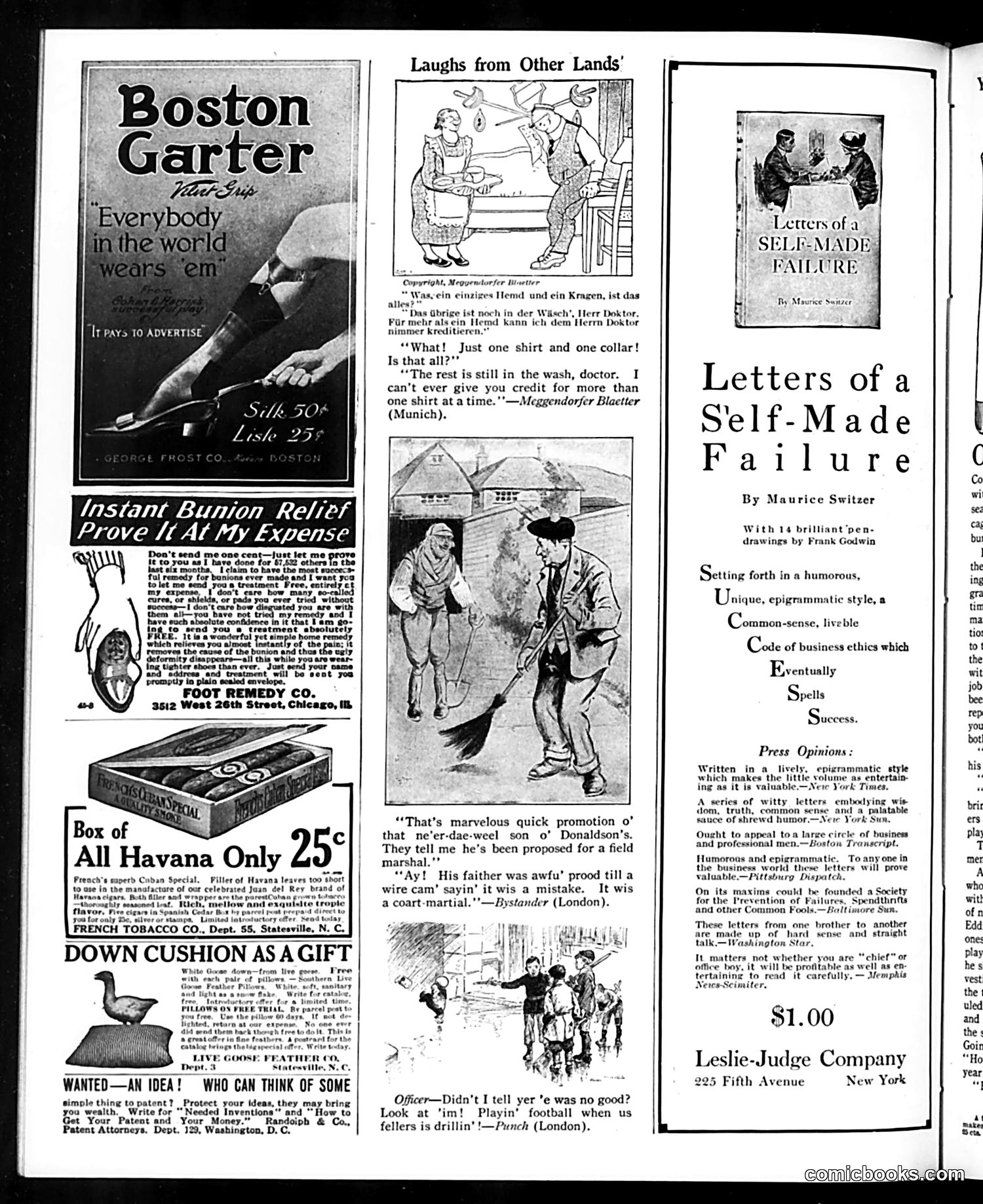
This page is primarily **advertising and promotional content** rather than satirical cartoons, though it includes several joke cartoons labeled "Laughs from Other Lands." The jokes appear to be reprints from European publications (Meggendorfer Blatter, Bystander, Punch). They feature typical early 20th-century working-class humor: a German dialogue about laundry and worn clothing; a Scottish joke about mistaken military promotion; and a British joke about soldiers' discipline. The bulk of the page advertises: bunion remedies, cigars, cushions as gifts, and patent services. The main featured book is "Letters of a Self-Made Failure" by Maurice Switzer, a humorous business ethics guide advertised through press quotations. The page reflects **Judge magazine's mixed content**: satirical cartoons appear alongside sincere advertising and reprinted international humor, targeting middle-class readers interested in self-improvement and consumer products. The "failure" book's ironic title was apparently a marketing hook for business readers of the era.
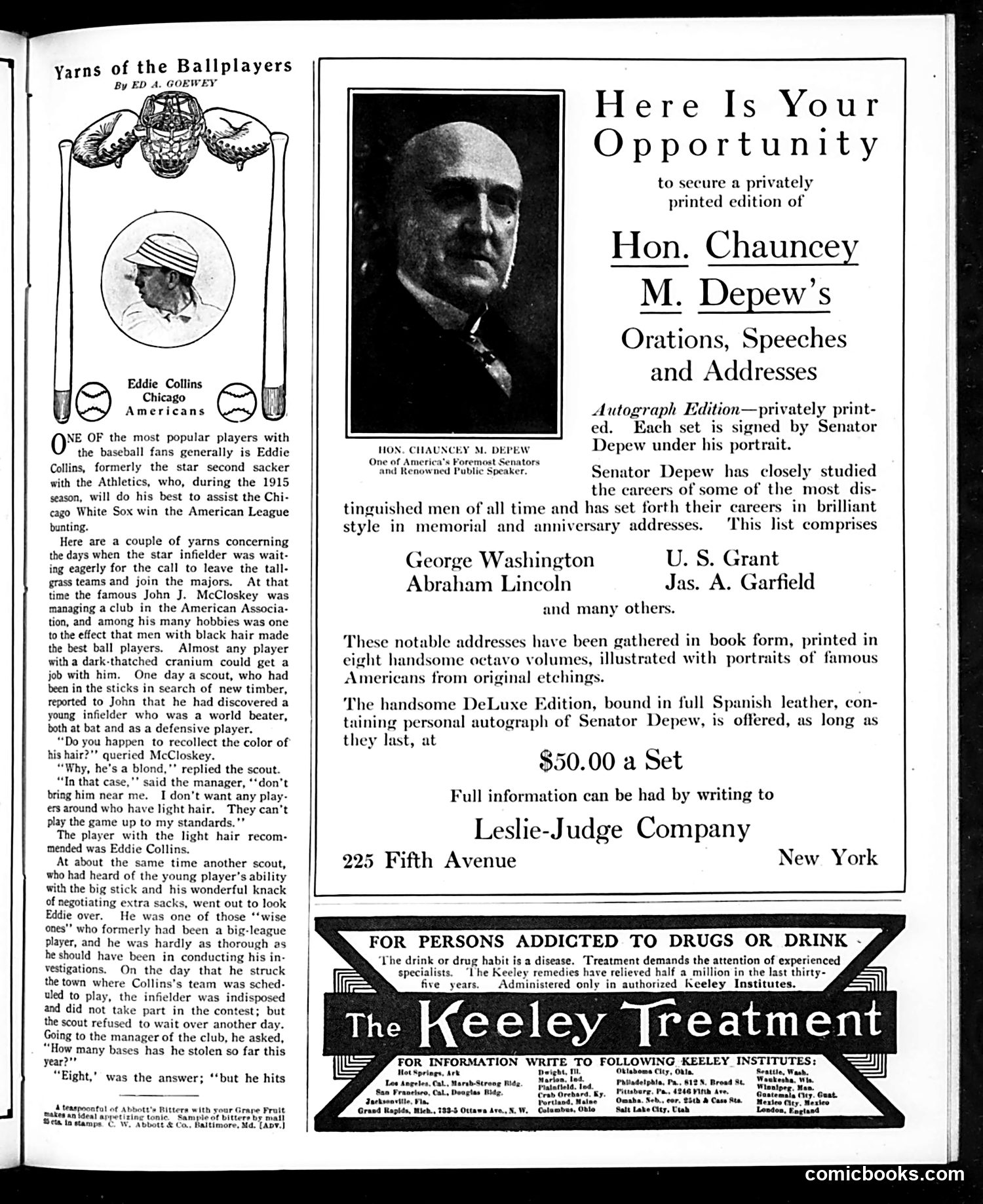
This page from *Judge* magazine contains primarily **advertising and sports content**, not political satire. **"Yarns of the Ballplayers"** (left): A humorous anecdote about Eddie Collins, a real baseball player for the 1915 Chicago White Sox. The joke satirizes a manager's superstitious belief that only dark-haired players could succeed—Collins, a blonde, went on to become excellent anyway. This gently mocks rigid, irrational hiring practices in baseball management. **Right side**: Two advertisements—one for Senator Chauncey M. Depew's privately printed collected speeches ($50 per set), and another for the Keeley Institute, a treatment facility for alcohol and drug addiction. There is **no political cartoon** on this page. The content reflects early 20th-century concerns: baseball's growing popularity, celebrity endorsements by public figures, and the then-medical framing of addiction as treatable disease requiring specialized institutions.
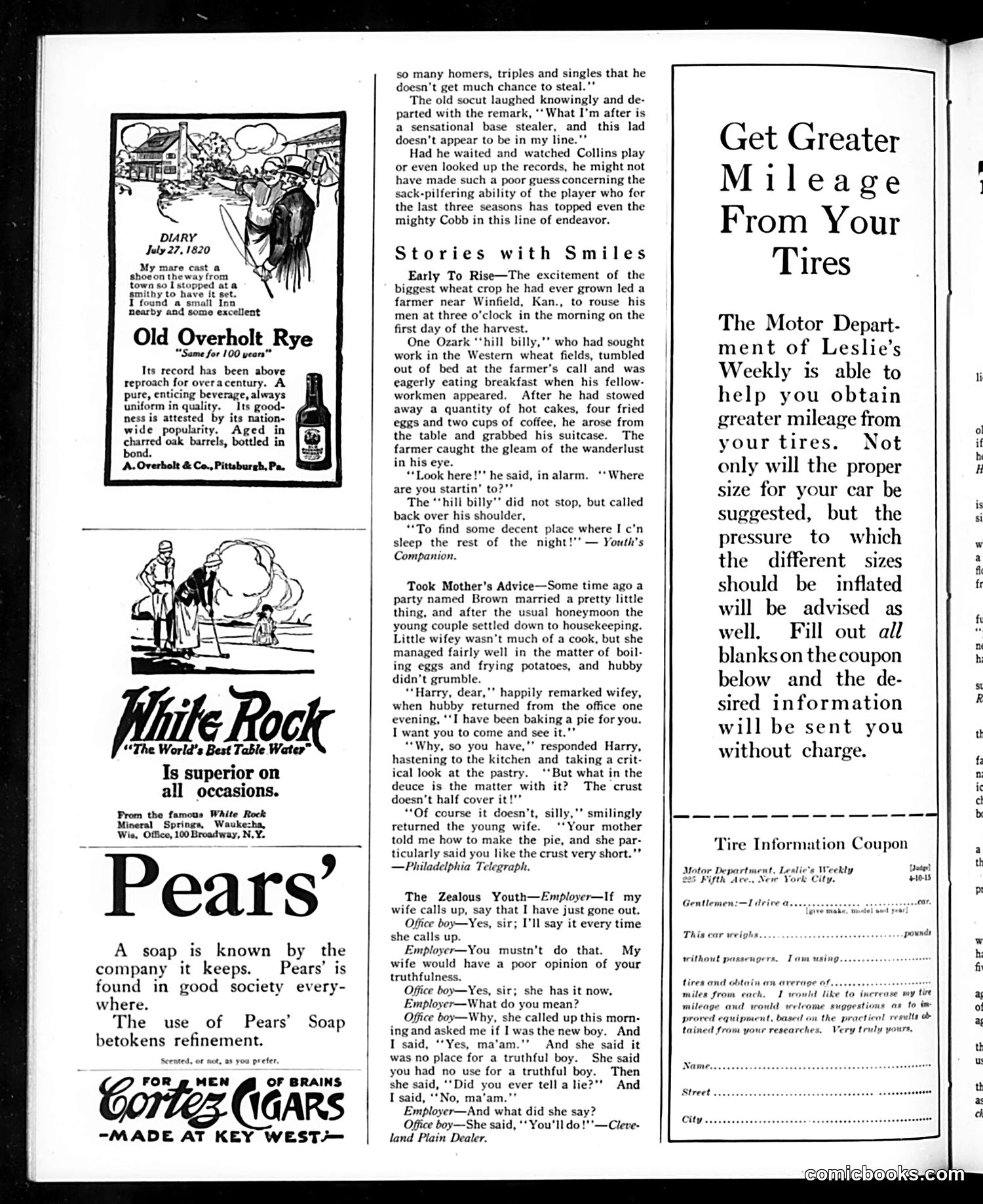
This page from Judge magazine (dated July 27, 1920) is primarily **advertising with interspersed humorous anecdotes**—not political satire. The advertisements promote luxury goods (Old Overholt Rye whiskey, White Rock mineral water, Pears' soap, Cortez cigars) targeting affluent male readers, using appeals to refinement and social status. The "Stories with Smiles" section contains three period jokes: 1. **"Early to Rise"**: A farm laborer eats an enormous breakfast then leaves immediately, joking that he needs decent sleep—humor based on working-class appetite and laziness stereotypes. 2. **"Took Mother's Advice"**: A newlywed wife misinterprets her mother-in-law's instruction to make pie crust "very short" (thin), creating an inedible pie—typical domestic comedy. 3. **"The Zealous Youth"**: An office boy's honesty backfires when the boss's wife praises his lying as a job qualification—satirizing workplace hypocrisy and marital discord. None involves identifiable political figures or contemporary events. The humor reflects 1920s attitudes toward class, gender roles, and business culture.
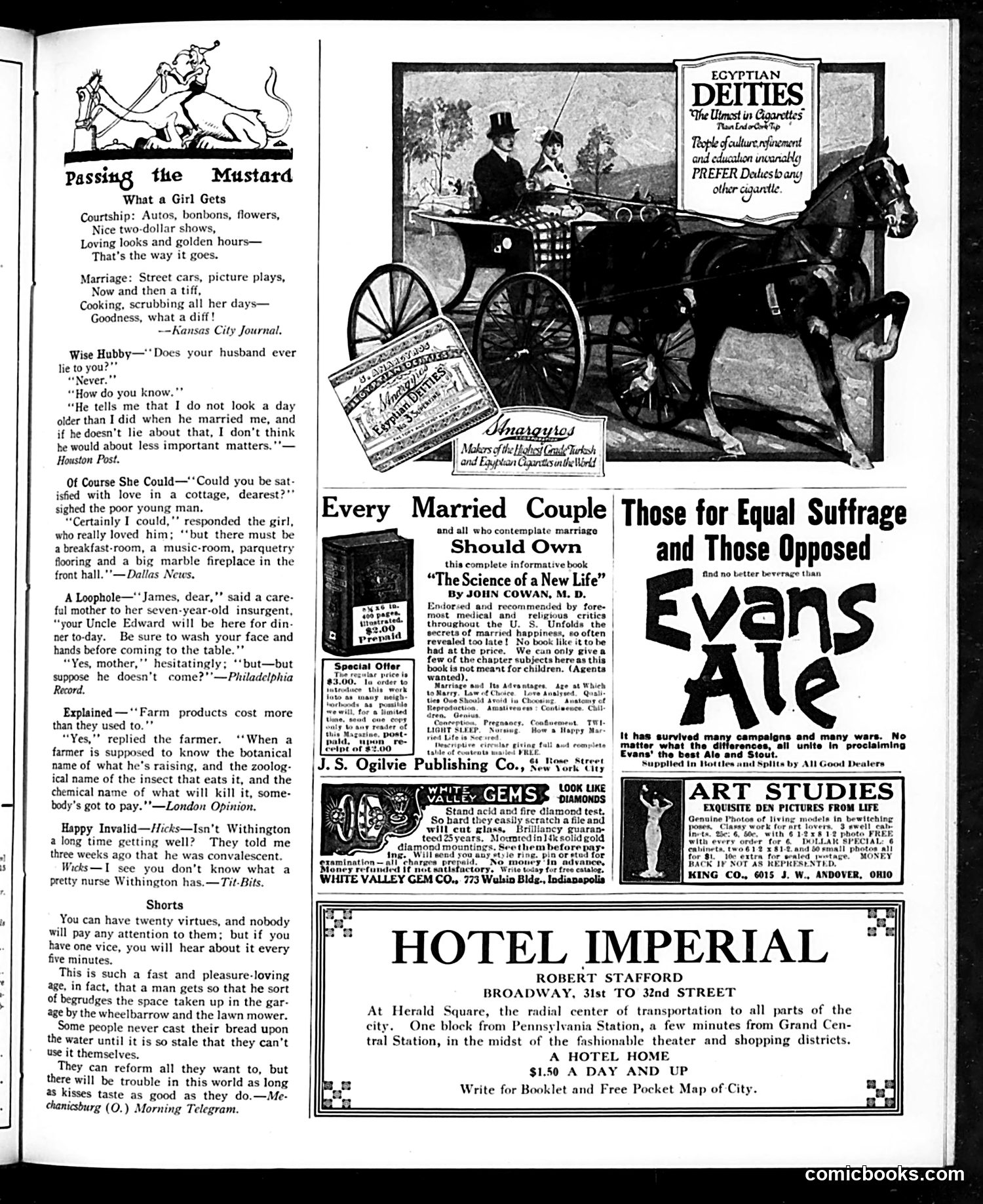
This page from **Judge** magazine presents satirical humor typical of early 20th-century American periodicals. The content mocks married life's disillusionment and contemporary gender roles. **Main Satire:** The repeated theme across multiple humor items is the stark contrast between courtship romance and marital reality. "What a Girl Gets" explicitly contrasts the pleasures of courtship (autos, flowers, affection) with marriage's drudgery (cooking, scrubbing). Other jokes extend this—the woman who'd accept a cottage *only* with multiple formal rooms; the wife who mistrusts her husband's compliments about her age. **Social Context:** These pieces reflect early 1900s anxieties about marriage and women's roles, treating household labor as comedy fodder. The "Wise Hubby" joke assumes marital deception is normal. **Other Elements:** The page is largely **advertisements**, including a marriage advice book "The Science of a New Life," diamond gems, and Hotel Imperial. A pro-suffrage liquor ad appears, though its specific argument is unclear. The humor assumes a male audience familiar with marital disappointment as entertainment.
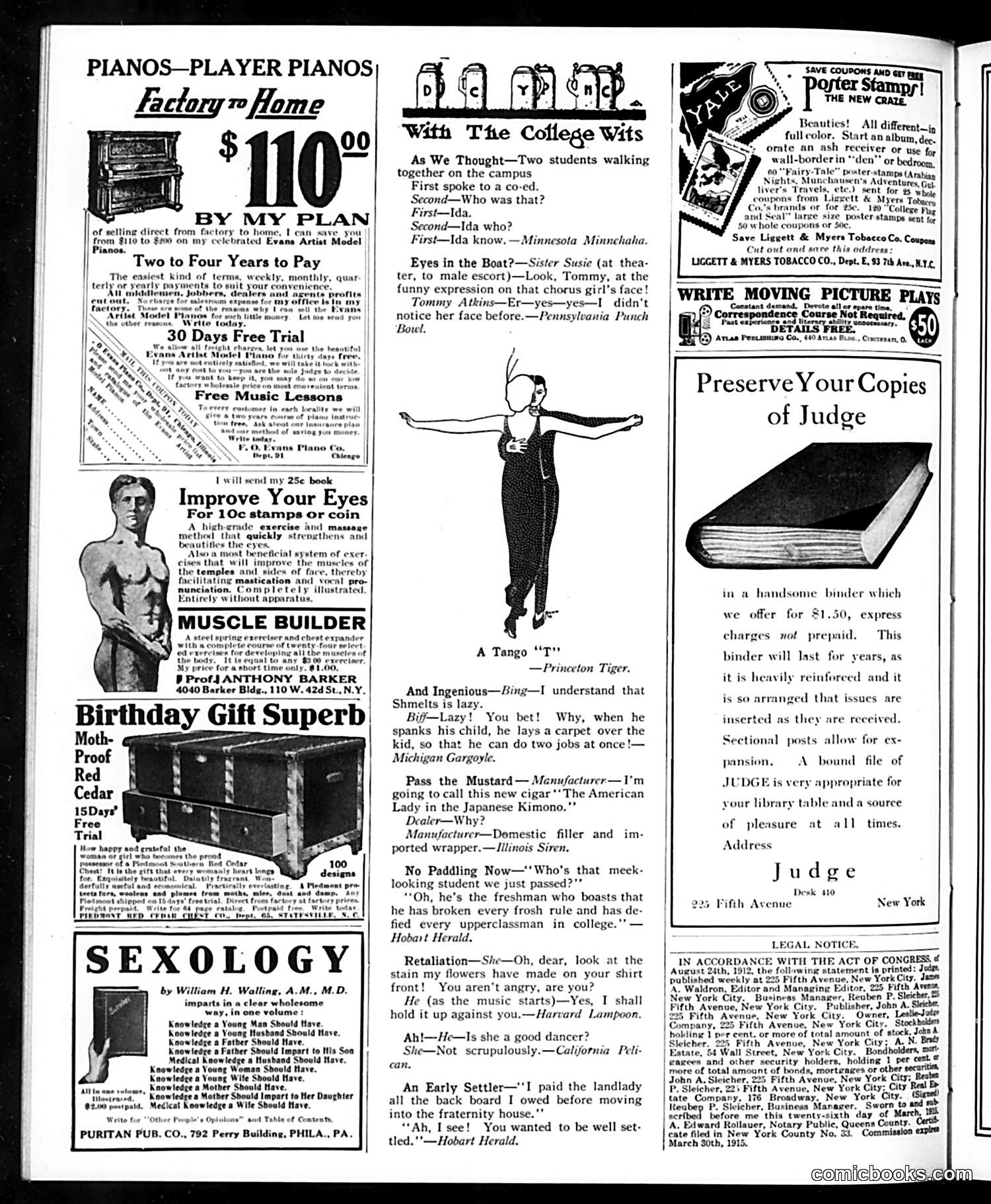
This page is primarily advertising, with a humor section titled "With The College Wits." The humor consists of brief jokes submitted from college publications (Princeton Tiger, Michigan Gargoyle, Illinois Siren, etc.), likely a regular Judge magazine feature. The jokes target early 1900s college life: sexual naivety (a boy distracted from a dancer's face), laziness, freshman rule-breaking, romantic misunderstandings, and financial irresponsibility. The humor is gentle, relying on puns ("Ida know"—"I don't know"), wordplay, and comic misunderstandings rather than sharp satire. The advertisements—for player pianos, eye exercises, bodybuilding, and "Sexology" books—reflect period anxieties about modernization, health, and self-improvement. Notably absent is political content; this page exemplifies Judge's entertainment-focused, collegiate audience rather than its satirical tradition.
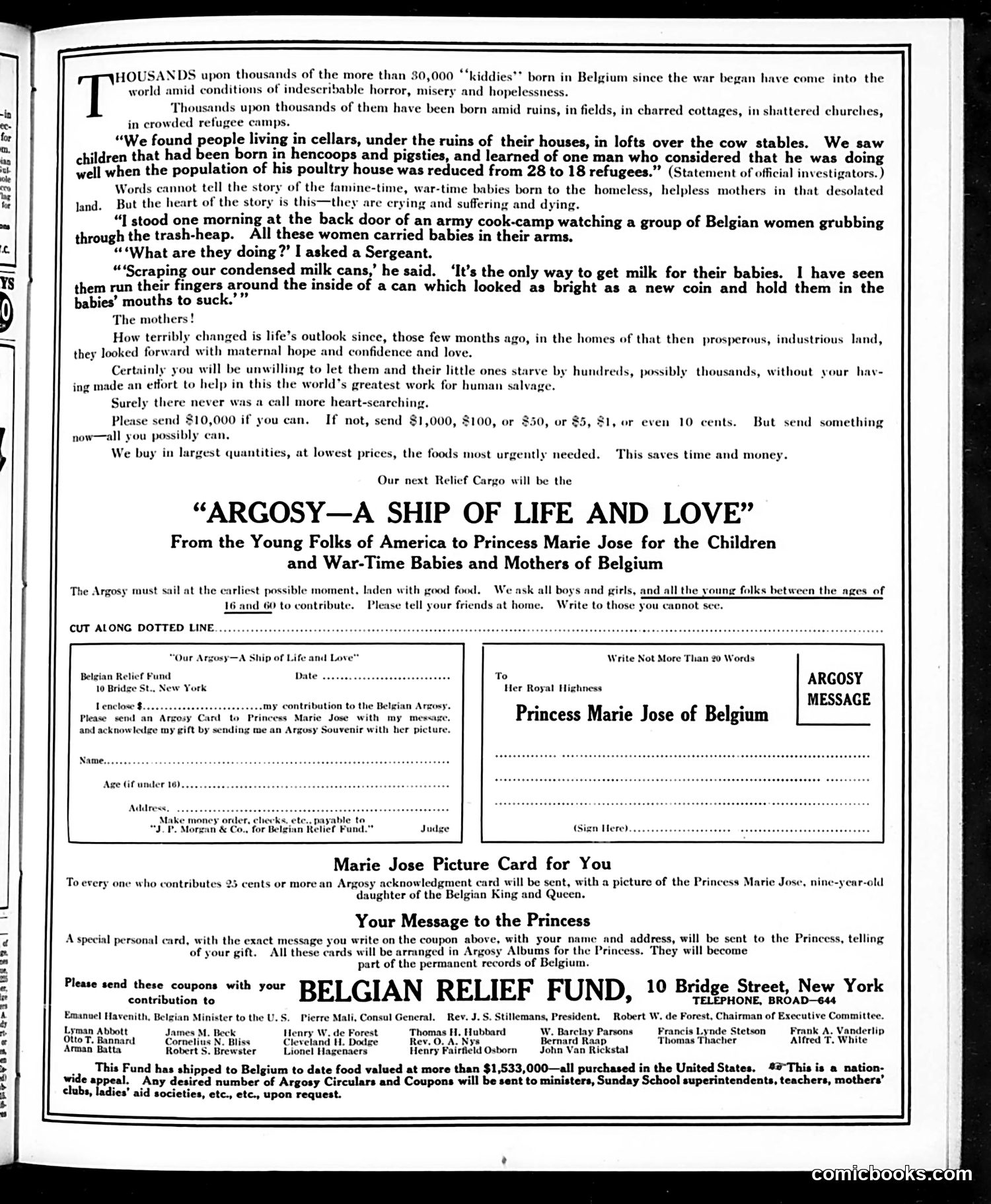
This is **not a cartoon or satire**, but a serious fundraising appeal published in *Judge* magazine during World War I. It solicits American donations for Belgian war relief, specifically to fund a relief ship called the "Argosy." The page describes genuine humanitarian crisis: over 30,000 children born in Belgium since the war began are dying of starvation and disease. It includes eyewitness accounts of desperate conditions—mothers scraping condensed milk cans to feed infants, families living in cellars and animal shelters. The appeal targets young Americans, asking contributions of any amount (from 10 cents to $10,000) and offers incentives: donors receive picture cards of Princess Marie Jose and can write messages to her. The fundraiser leverages emotion and patriotic duty to help Belgian civilians during the German occupation and resulting famine. This reflects *Judge's* shift during WWI toward serious advocacy alongside its usual satire.
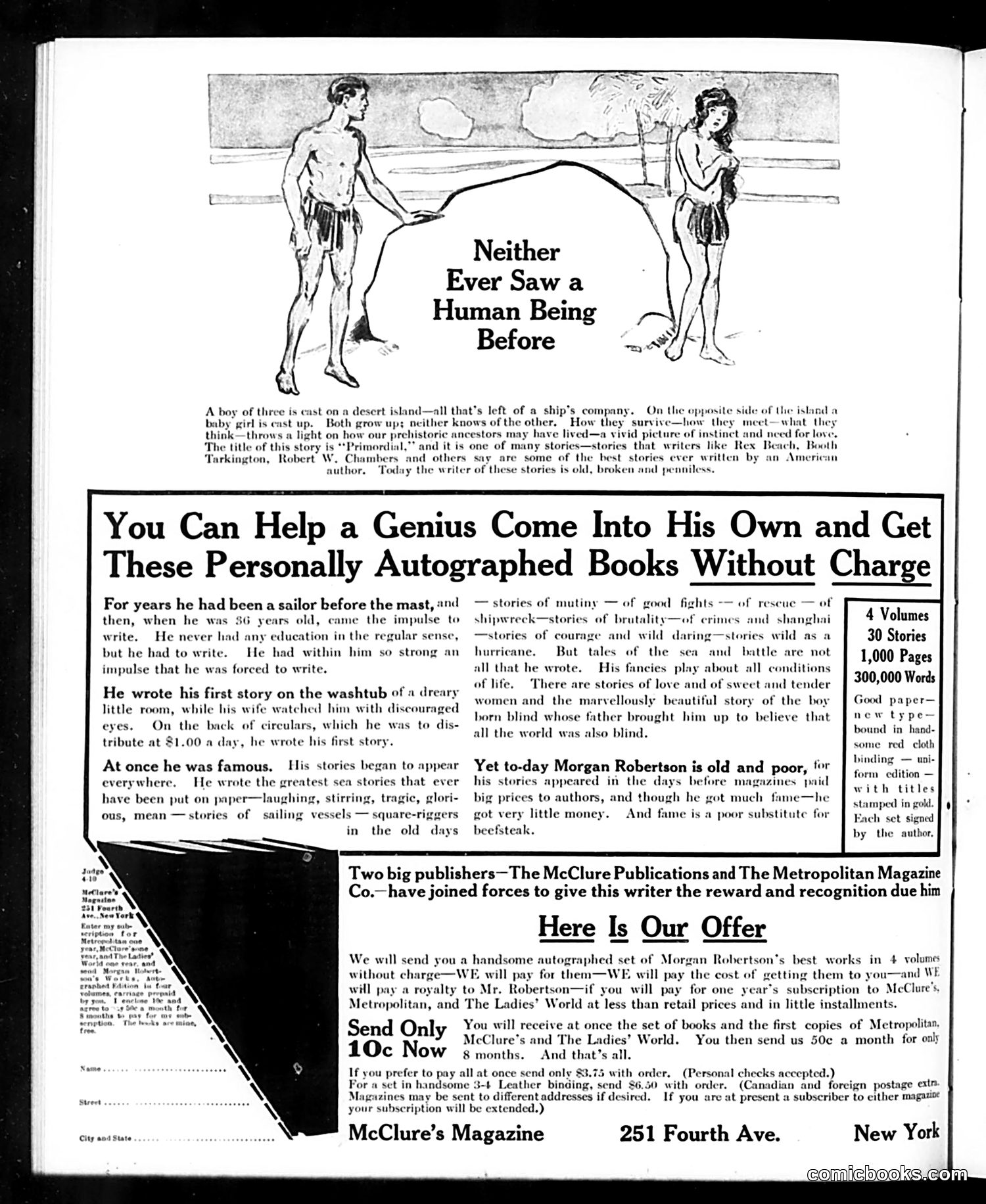
This page is primarily **advertising**, not satire. It promotes an offer by two major publishers (McClure Publications and Metropolitan Magazine Co.) to help the writer **Morgan Robertson**, described as an aging, impoverished author of sea stories. The top cartoon illustrates Robertson's famous story "Primordial"—about a boy and girl cast on a desert island, having never seen another human. This appears to be the hook to interest readers in his work. The bulk of the page is a charitable pitch: Robertson was forced to write despite lacking formal education, became famous for acclaimed sea tales, but received little financial reward. The publishers now offer his autographed 4-volume collected works **free** if readers subscribe to their magazines for one year at discounted rates. This reflects early 20th-century publisher marketing—leveraging a sympathetic "struggling genius" narrative to boost magazine subscriptions while providing Robertson modest royalties. The offer's modest cost (10¢ to start, then 50¢ monthly) positioned it as accessible and benevolent.