
Judge, 1915-04-10 · page 15 of 24
Judge — April 10, 1915 — page 15: what you’re looking at
What you’re looking at
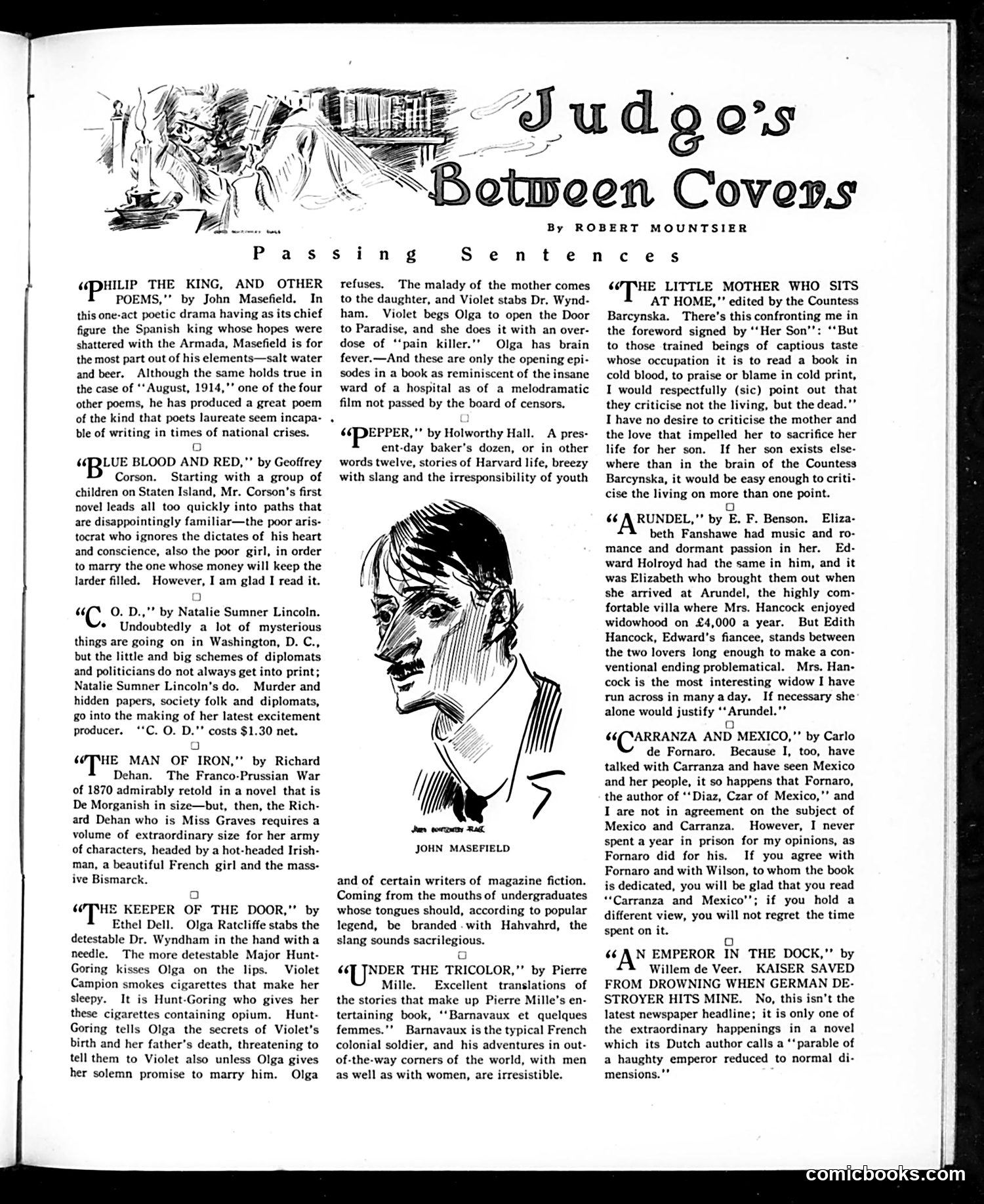
This page contains literary book reviews by Robert Mountsier, not political cartoons. The single illustration is a portrait sketch of **John Masefield**, the British Poet Laureate whose collection "Philip the King, and Other Poems" is reviewed first. The reviews are satirical commentary on contemporary fiction (circa 1915-1920). Mountsier critiques authors for melodramatic plots, clichéd characters, and overwrought narratives—particularly mocking Ethel Dell's "The Keeper of the Door" for its absurdly convoluted plot involving druggings, stabbings, and opium. He also jabs at Harvard student stories for sacrilegiously affecting "Hahvahrd" slang, and questions why a book's foreword attacks literary critics. The satire targets popular but artistically shallow fiction of the era. The title "Between Covers" ironically frames these reviews as examining what books hide within their pages.
📄 Transcribed text from this page (OCR, searchable)
Machine-transcribed from the original scan — historical spelling and the odd misread are preserved.
sepHILIP THE KING, AND OTHER POEMS," by John Masefield. In this one-act poetic drama having as its chief figure the Spanish king whose hopes were shattered with the Armada, Masefield is for the most part out of his elements—salt water and beer. Although the same holds true in the case of ‘‘ August, 1914,’ one of the four other poems, he has produced a great poem of the kind that poets laureate seem incapa- ble of writing in times of national crises. ia} 66QLUE BLOOD AND RED,”’ by Geoffrey Corson. Starting with a group of children on Staten Island, Mr. Corson’s first novel leads all too quickly into paths that are disappointingly familiar—the poor aris- tocrat who ignores the dictates of his heart and conscience, also the poor girl, in order to marry the one whose money will keep the larder filled. However, I am glad I read it. ) “C, O. D.,’’ by Natalie Sumner Lincoln, Undoubtedly a lot of mysterious things are going on in Washington, D. C., but the little and big schemes of diplomats and politicians do not always get into print; Natalie Sumner Lincoln's do. Murder and hidden papers, society folk and diplomats, go into the making of her latest excitement producer. ‘‘C. O. D."’ costs $1.30 net. a 6¢[THE MAN OF IRON," by Richard Dehan. The Franco-Prussian War of 1870 admirably retold in a novel that is De Morganish in size—but, then, the Rich- ard Dehan who is Miss Graves requires a volume of extraordinary size for her army of characters, headed by a hot-headed Irish- man, a beautiful French girl and the mass- ive Bismarck. a [email protected] KEEPER OF THE DOOR," by Ethel Dell. Olga Ratcliffe stabs the detestable Dr. Wyndham in the hand witha needle. The more detestable Major Hunt- Goring kisses Olga on the lips. Violet Campion smokes cigarettes that make her sleepy. It is Hunt-Goring who gives her these cigarettes containing opium. Hunt- Goring tells Olga the secrets of Violet's birth and her father’s death, threatening to tell them to Violet also unless Olga gives her solemn promise to marry him. Olga By ROBERT MOUNTSIER Sentences refuses. The malady of the mother comes to the daughter, and Violet stabs Dr, Wynd- ham. Violet begs Olga to open the Door to Paradise, and she does it with an over- dose of ‘‘pain killer."" Olga has brain fever.—And these are only the opening epi- sodes in a book as reminiscent of the insane ward of a hospital as of a melodramatic film not passed by the board of censors. COPEPPER,”” by Holworthy Hall. A pres- ent-day baker's dozen, or in other words twelve, stories of Harvard life, breezy with slang and the irresponsibility of youth JOHN MASEFIELD and of certain writers of magazine fiction. Coming from the mouths of undergraduates whose tongues should, according to popular legend, be branded .with Hahvahrd, the slang sounds sacrilegious. a 66] TNDER THE TRICOLOR,”’’ by Pierre Mille. Excellent translations of the stories that make up Pierre Mille’s en- tertaining book, ‘‘Barnavaux et quelques femmes."’ Barnavaux is the typical French colonial soldier, and his adventures in out- of-the-way corners of the world, with men as well as with women, are irresistible. 6@JTHE LITTLE MOTHER WHO SITS AT HOME,”’ edited by the Countess Barcynska. There’s this confronting me in the foreword signed by ‘‘Her Son’’: ‘*But to those trained beings of captious taste whose occupation it is to read a book in cold blood, to praise or blame in cold print, I would respectfully (sic) point out that they criticise not the living, but the dead.’ I have no desire to criticise the mother and the love that impelled her to sacrifice her life for her son. If her son exists else- where than in the brain of the Countess Barcynska, it would be easy enough to criti- cise the living on more than one point. a 66 ARUNDEL,” by E. F. Benson. Eliza- beth Fanshawe had music and ro- mance and dormant passion in her. Ed- ward Holroyd had the same in him, and it was Elizabeth who brought them out when she arrived at Arundel, the highly com- fortable villa where Mrs. Hancock enjoyed widowhood on £4,000 a year. But Edith Hancock, Edward's fiancee, stands between the two lovers long enough to make a con- ventional ending problematical. Mrs. Han- cock is the most interesting widow I have run across in many aday. If necessary she alone would justify ‘*Arundel.’’ [e) 66(°ARRANZA AND MEXICO,”’ by Carlo de Fornaro. Because I, too, have talked with Carranza and have seen Mexico and her people, it so happens that Fornaro, the author of **Diaz, Czar of Mexico,’’ and I are not in agreement on the subject of Mexico and Carranza. However, I never spent a year in prison for my opinions, as Fornaro did for his. If you agree with Fornaro and with Wilson, to whom the book is dedicated, you will be glad that you read “Carranza and Mexico’’; if you hold a different view, you will not regret the time spent on it. oO 66 A N EMPEROR IN THE DOCK,"’ by Willem de Veer. KAISER SAVED FROM DROWNING WHEN GERMAN DE- STROYER HITS MINE. No, this isn't the latest newspaper headline; it is only one of the extraordinary happenings in a novel which its Dutch author calls a ‘parable of a haughty emperor reduced to normal di- mensions."*