
Judge, 1915-04-10 · page 6 of 24
Judge — April 10, 1915 — page 6: what you’re looking at
What you’re looking at
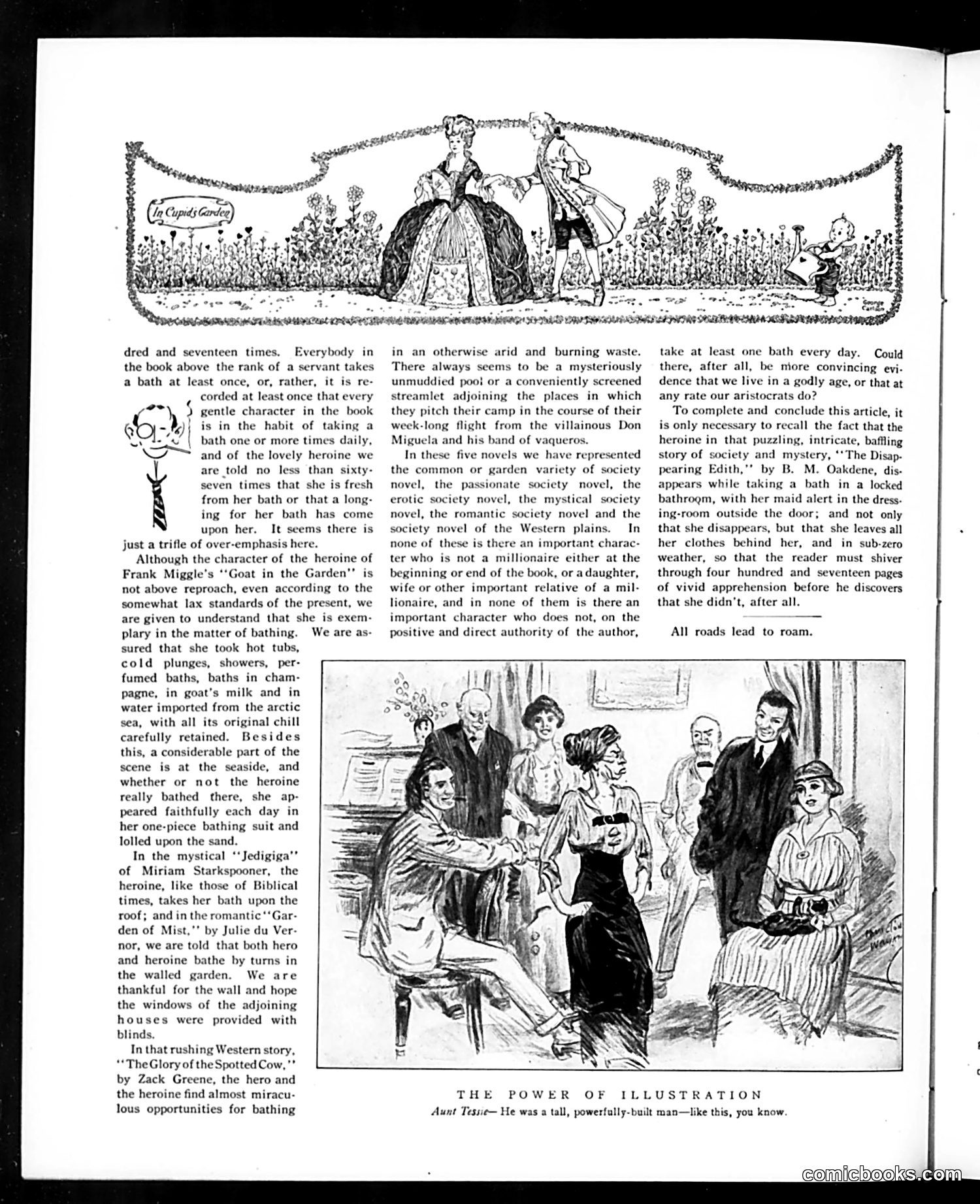
This page satirizes the obsessive focus on bathing in popular fiction, particularly society novels of the era. The text critiques five contemporary novels where bathing appears with absurd frequency—the heroine alone bathes "sixty-seven times" across one book's narrative. The satire targets both the novelists' lazy writing (repetitive bathing scenes as character development) and broader anxieties about wealth and morality. The author notes that *every* important character is either a millionaire or related to one, and *all* bathe daily—suggesting novelists conflate wealth with cleanliness as markers of virtue. The lower illustration titled "The Power of Illustration" shows a woman (Aunt Tessie) gesturing dramatically while describing a man to an audience, demonstrating how illustration exaggerates written description into absurd physicality. The satire mocks both the sentimental excess of contemporary popular fiction and society's anxiety about class, hygiene, and respectability during this period.
📄 Transcribed text from this page (OCR, searchable)
Machine-transcribed from the original scan — historical spelling and the odd misread are preserved.
dred and seventeen times. Everybody in the book above the rank of a servant takes a bath at least once, or, rather, it is re- 2 o~ | corded at least once that every gentle character in the book is in the habit of taking a bath one or more times daily, and of the lovely heroine we are told no less than sixty- seven times that she is fresh from her bath or that a long- ing for her bath has come upon her. It seems there is just a trifle of over-emphasis here. Although the character of the heroine of Frank Miggle’s ‘‘Goat in the Garden’’ is not above reproach, even according to the somewhat lax standards of the present, we are given to understand that she is exem- plary in the matter of bathing. We are as- sured that she took hot tubs, in an otherwise arid and burning waste. There always seems to be a mysteriously unmuddied pool or a conveniently screened streamlet adjoining the places in which they pitch their camp in the course of their week-long flight from the villainous Don Miguela and his band of vaqueros. In these five novels we have represented common or garden variety of society novel, the passionate society novel, the erotic society no’ the mystical society novel, the romantic society novel and the society novel of the Western plains. In none of these is there an important charac- ter who is not a millionaire either at the beginning or end of the book, or adaughte wife or other important relative of a mil- lionaire, and in none of them is there an important character who does not, on the positive and direct authority of the author, take at least one bath every day. Could there, after all, be niore convincing evi- dence that we live in a godly age, or that at any rate our aristocrats do? To comple: ind conclude this article, it is only necessary to recall the fact that the heroine in that puzzling, intricate, baffling story of society and mystery, ‘The Disap- pearing Edith, by B. M. Oakdene, dis- appears while ing a bath in a locked bathrogm, with her maid alert in the dress- ing-room outside the door; and not only that she disappears, but that she leaves all her clothes behind her, and in sub-zero weather, so that the reader must shiver through four hundred and seventeen pages of vivid apprehension before he discovers that she didn’t, after all. All roads lead to roam. cold plunges, showers, per- fumed baths, baths in cham- pagne, in goat's milk and in water imported from the arctic sea, with all its original chill carefully retained. Besides this, a considerable part of the scene is at the seaside, and whether or not the heroine really bathed there, she ap- peared faithfully each day in her one-piece bathing suit and lolled upon the sand. In the mystical ‘*Jedigiga’’ of Miriam Starkspooner, the heroine, like those of Biblical times, takes her bath upon the roof; and in the romantic *‘Gar- den of Mist,’’ by Julie du Ver- nor, we are told that both hero and heroine bathe by turns in the walled garden. We are thankful for the wall and hope the windows of the adjoining houses were provided with blinds. In that rushing Western story, “The Glory of the Spotted Cow, "* by Zack Greene, the hero and the heroine find almost miracu- lous opportunities for bathing THE POWER OF ILLUSTRATION Aunt Tessie— He was a tall, powerfully-built man—like this, you know.