
Judge, 1915-04-10 · page 5 of 24
Judge — April 10, 1915 — page 5: what you’re looking at
What you’re looking at
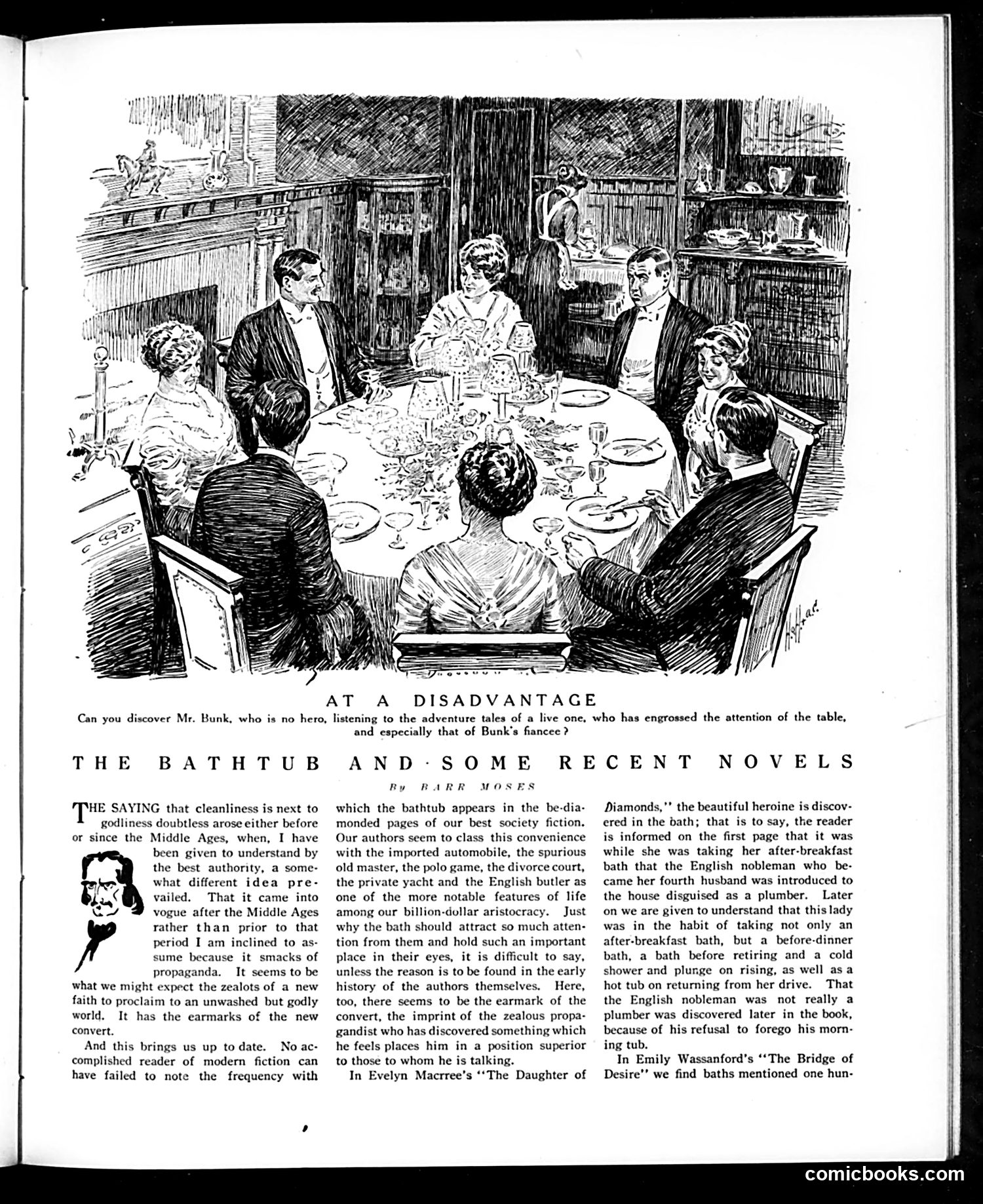
This illustration depicts a formal dinner party scene with the caption asking readers to identify "Mr. Bunk," described as "no hero" whose boring adventure tales have monopolized dinner conversation and captured particular attention from "Bunk's fiancée." The cartoon satirizes the social awkwardness of tedious storytellers at dinner parties—a common genteel setting for embarrassment in early 20th-century satirical humor. The other diners' expressions suggest polite but strained attention as one guest dominates conversation. The accompanying article discusses how bathtub scenes appear frequently in recent novels, using this as a springboard to critique literary conventions of the era. The overall page mocks both social pretension and predictable literary devices.
📄 Transcribed text from this page (OCR, searchable)
Machine-transcribed from the original scan — historical spelling and the odd misread are preserved.
AT A DISADVANTAGE Can you discover Mr. Bunk, who is no hero, listening to the adventure tales of a live one, who has engrossed the attention of the table, THE BATHTUB HE SAYING that cleanliness is next to godliness doubtless arose either before or since the Middle Ages, when, I have been given to understand by the best authority, a some- vao what different idea pre- Bx vailed, That it came into ay vogue after the Middle Ages rather than prior to that period I am inclined to as- sume because it smacks of propaganda. It seems to be what we might expect the zealots of a new faith to proclaim to an unwashed but godly world. It has the earmarks of the new convert. And this brings us up to date. No ac- complished reader of modern fiction can have failed to note the frequency with and especially that of Bunk’s fiancee ? AND-SOME RE Ru RARR MOSES which the bathtub appears in the be-dia- monded pages of our best society fiction. Our authors seem to class this convenience with the imported automobile, the spurious old master, the polo game, the divorce court, the private yacht and the English butler as one of the more notable features of life among our billion-dollar aristocracy. Just why the bath should attract so much atten- tion from them and hold such an important place in their eyes, it is difficult to say, unless the reason is to be found in the early history of the authors themselves. Here, too, there seems to be the earmark of the convert, the imprint of the zealous propa- gandist who has discovered something which he feels places him in a position superior to those to whom he is talking. In Evelyn Macrree’s ‘‘The Daughter of CENT NOVELS Diamonds,"’ the beautiful heroine is discov- ered in the bath; that is to say, the reader is informed on the first page that it was while she was taking her after-breakfast bath that the English nobleman who be- came her fourth husband was introduced to the house disguised as a plumber. Later on we are given to understand that this lady was in the habit of taking not only an after-breakfast bath, but a before-dinner bath, a bath before retiring and a cold shower and plunge on rising, as well asa hot tub on returning from her drive. That the English nobleman was not really a plumber was discovered later in the book, because of his refusal to forego his morn- ing tub. In Emily Wassanford's ‘‘The Bridge of Desire’’ we find baths mentioned one hun- comicbooks.com