
A complete issue · 24 pages · 1915
Judge — April 3, 1915
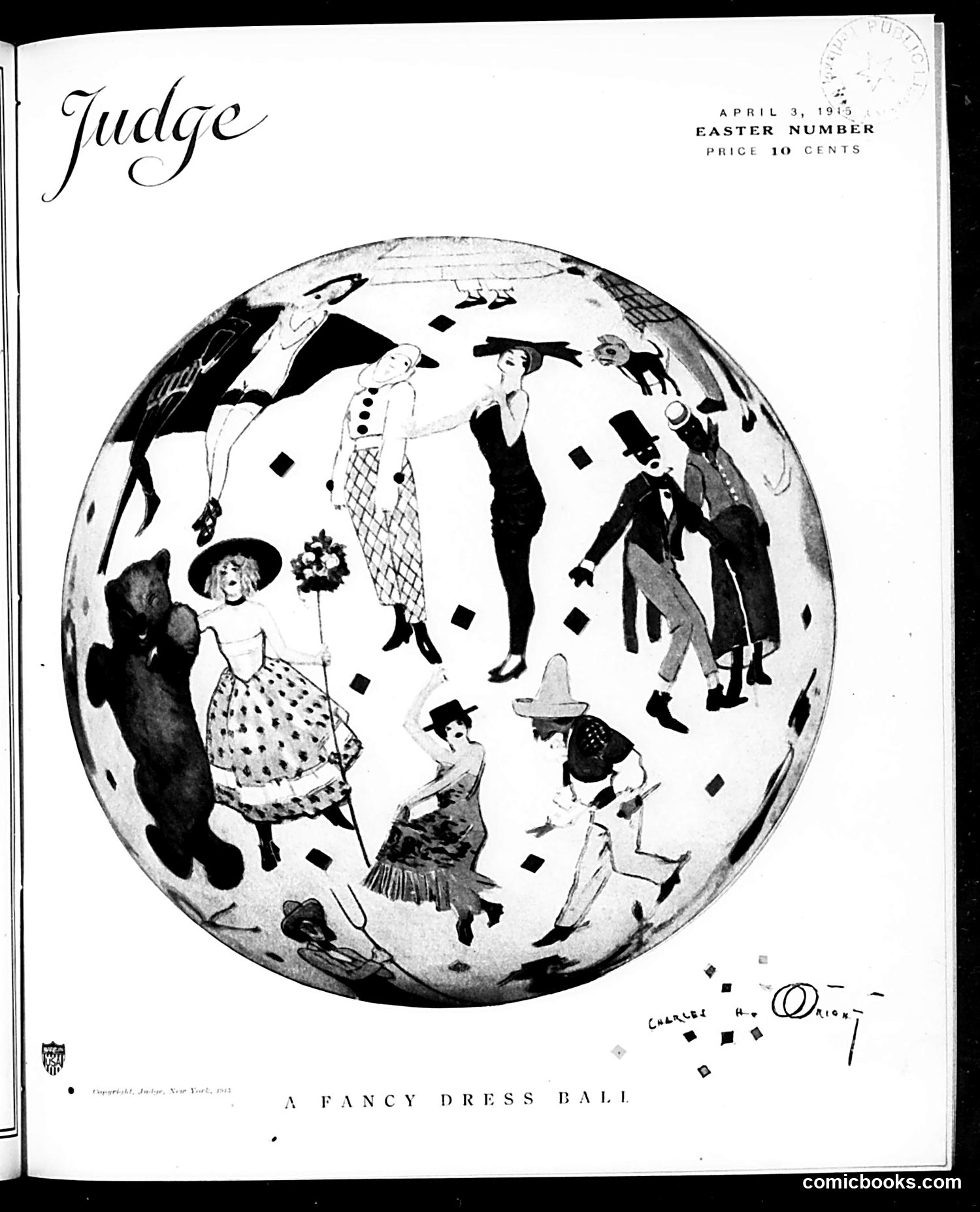
This illustration depicts people in various costumes dancing inside a large decorated Easter egg, celebrating a fancy dress ball. The figures wear formal attire mixed with costume elements—top hats, formal coats, and elaborate dress. The spherical egg frame contains the revelers, with decorative diamond shapes scattered throughout. As a 1919 Easter-themed illustration, this likely represents post-World War I celebration and social gaiety returning to American life. The "fancy dress" concept—masquerade costumes—may suggest social pretense or role-playing. The Easter egg symbolizes renewal and celebration. Without additional context or captions identifying specific figures, the cartoon appears to be general satirical commentary on the fashionable leisure class enjoying elaborate social events during this post-war period.
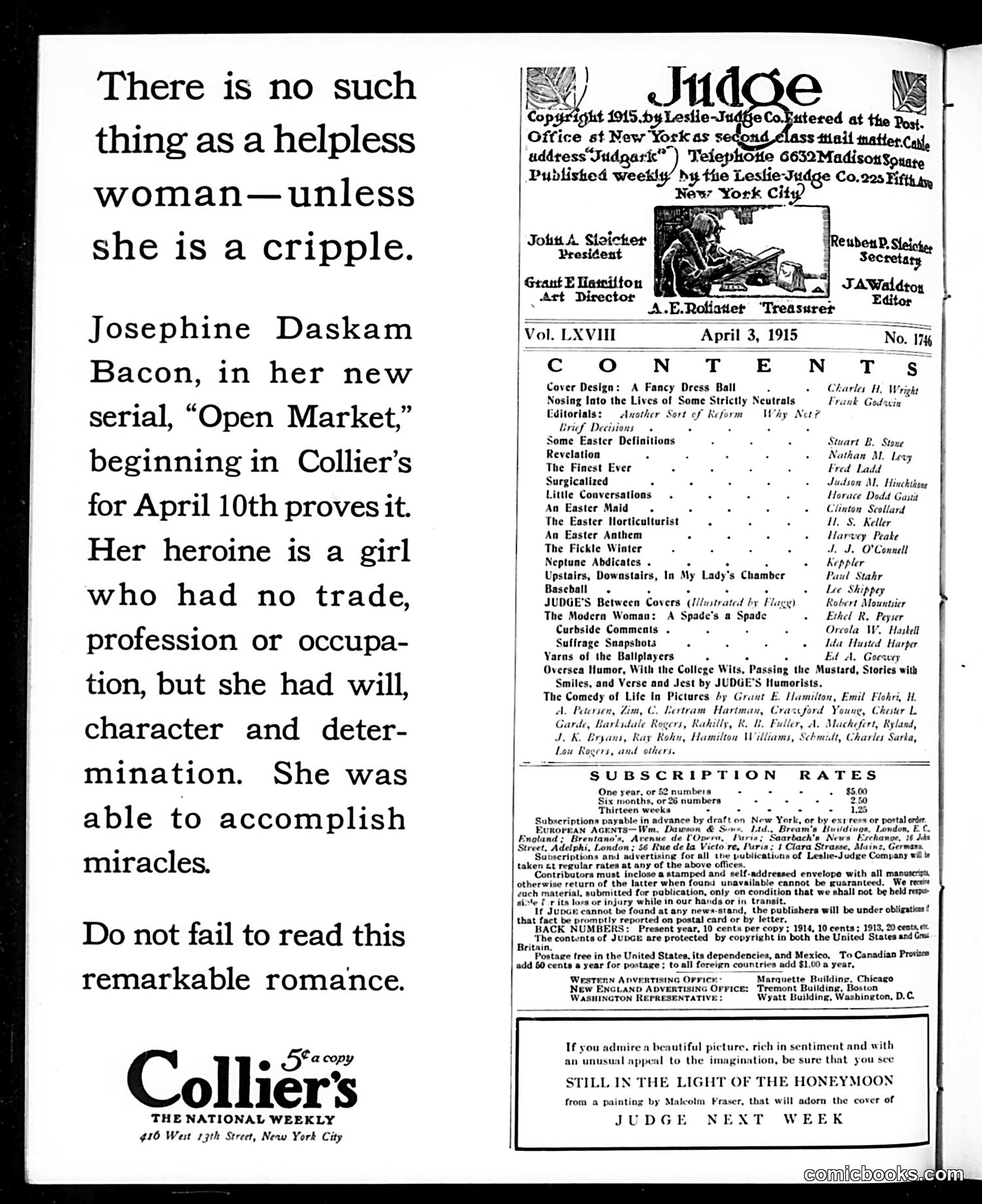
This page is primarily **advertising and editorial matter**, not a political cartoon. The left side promotes Josephine Daskam Bacon's serial "Open Market" in Collier's magazine, emphasizing its heroine as a resourceful woman who succeeds despite lacking "trade, profession or occupation." The right side shows Judge's masthead, table of contents, and subscription information. The quote about "no such thing as a helpless woman—unless she is a cripple" reflects early 20th-century attitudes about female capability and disability that would be considered offensive today. The advertisement at bottom promotes next week's cover, "Still in the Light of the Honeymoon." Overall, the page reflects 1915 publishing and social values rather than political satire.
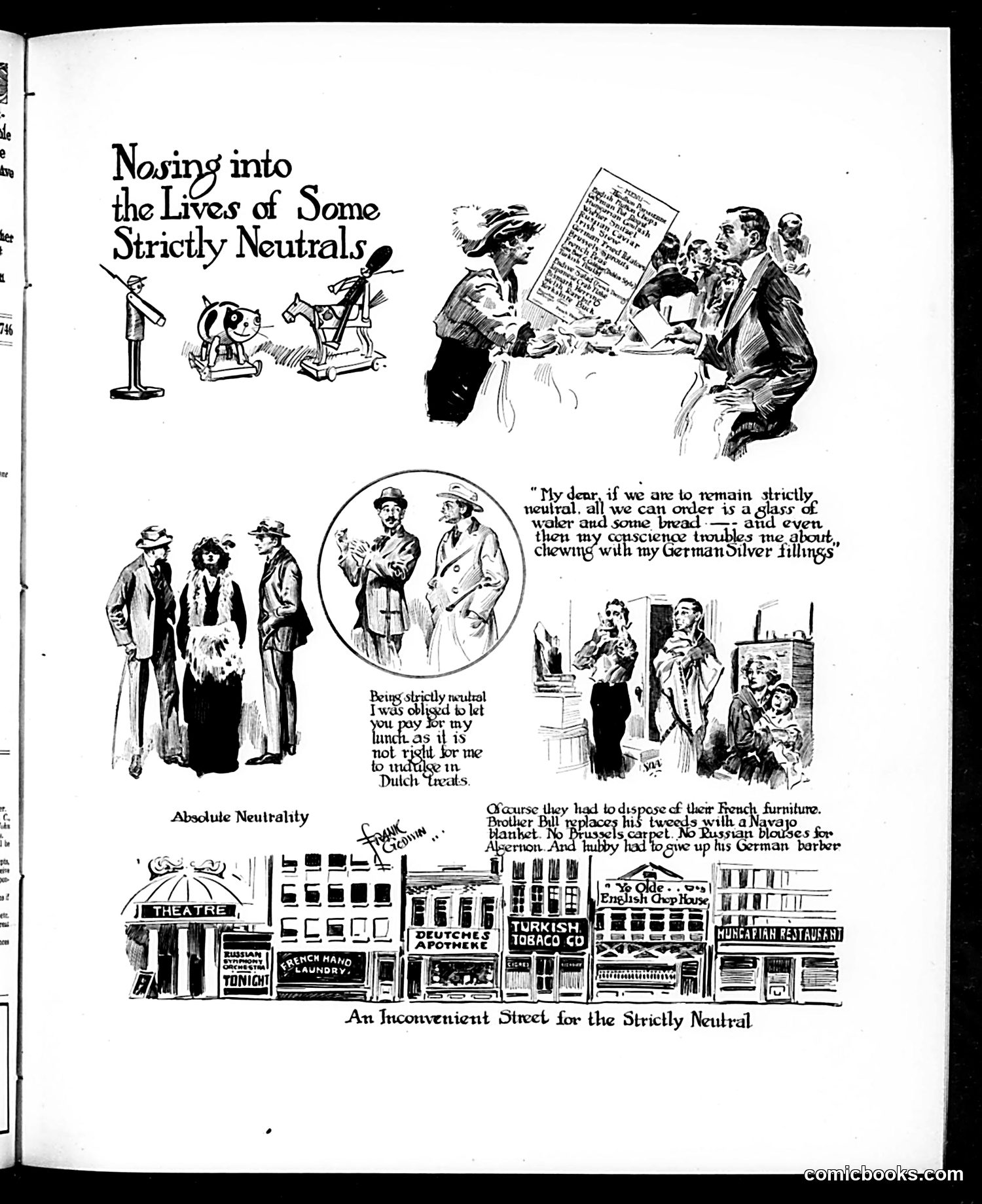
This WWI-era satire mocks Americans claiming strict neutrality while their actions contradict that stance. The cartoon shows "strictly neutral" people who nonetheless: - Patronize establishments with German names ("Deutsches Apotheke") and other foreign businesses - Consume foreign goods (German silver fillings, Turkish tobacco, French products) - Maintain cultural ties to enemy nations The joke: true neutrality is impossible in a interconnected world—even those claiming neutrality unavoidably support foreign (particularly German) commerce and culture. The "inconvenient street" illustrated at bottom demonstrates that remaining genuinely neutral requires avoiding nearly all modern commerce and dining options, an absurd impossibility. The satire likely criticizes Americans of German descent or pro-German sympathizers masquerading as neutral during the war.
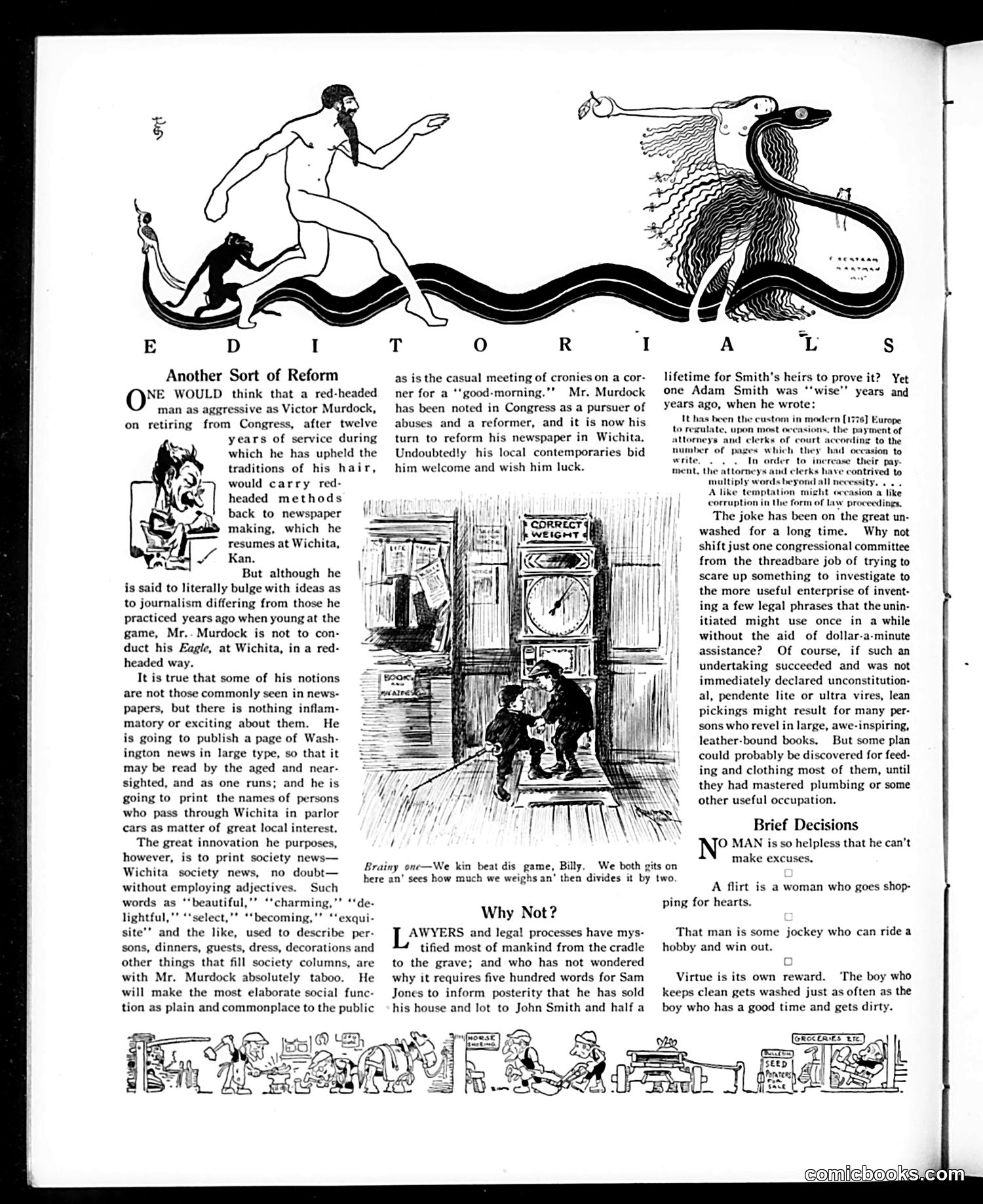
This page satirizes **Victor Murdock**, a red-headed congressman from Wichita, Kansas who recently retired after twelve years of service. The article mocks his shift from politics to newspaper work, suggesting his "reform" ideas are better suited to journalism than governance. The top illustration labeled "EDITORIALS" depicts Murdock as a mythological figure riding serpents—a visual metaphor for the chaotic, writhing nature of editorial work and reform movements. The cartoon shows Murdock's verbose, flowery writing style—criticized as filled with adjectives like "beautiful" and "charming"—as unsuitable for serious journalism. The satire implies his grandiloquent reformist rhetoric was ineffective in Congress and remains so in newspapers.
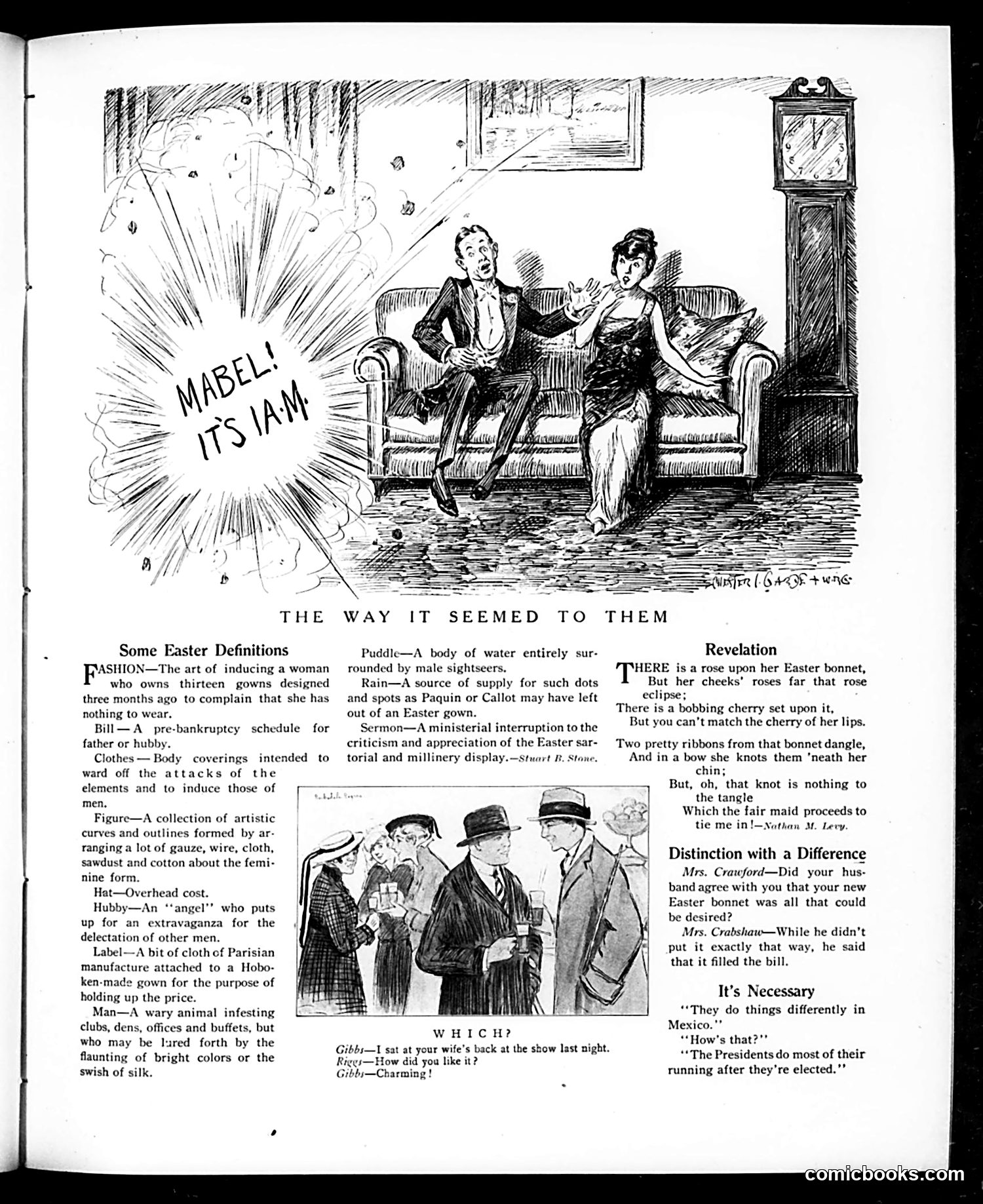
The main cartoon "The Way It Seemed to Them" depicts a couple on a sofa reacting with shock to an explosion-like announcement "MABEL! IT'S I AM!" This appears to be satirizing an unexpected or dramatic revelation in a domestic scene, though the specific reference is unclear without additional context. The "Some Easter Definitions" section provides humorous, cynical definitions of Easter-related terms (fashion, bill, clothes, figure, hat, etc.), mocking consumerism and social pretension around the holiday. Below are three brief comedic exchanges ("Which?", "Revelation", "Distinction with a Difference", "It's Necessary") offering wordplay and satirical commentary on contemporary social behaviors and gender relations. The overall page satirizes Easter celebrations, consumer culture, and domestic life in early 20th-century America.
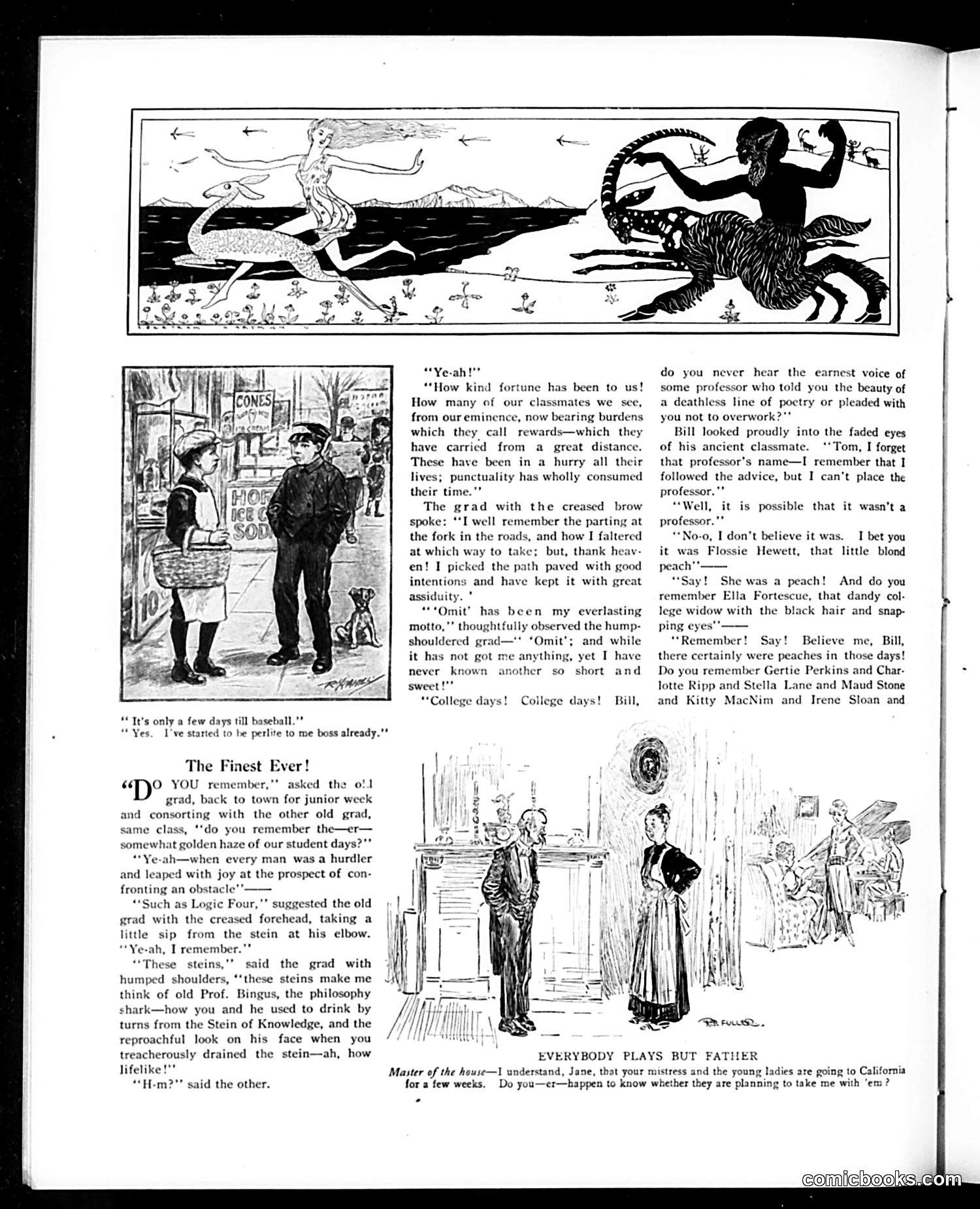
This page contains two satirical pieces about nostalgia and self-deception: **Top cartoon**: A whimsical mythological scene (mermaid and sea creature) appears decorative, unrelated to the text below. **"The Finest Ever!"**: Two middle-aged alumni reminisce about college, congratulating themselves on taking the easy path ("Omit" as their motto) and avoiding obstacles. They claim to have followed a professor's advice about not overworking, yet can't remember which professor. The satire mocks their self-satisfied revisionism—they succeeded through avoidance, not virtue, yet frame it as wisdom. Their nostalgic recollection of attractive female students ("peaches") undercuts their claimed intellectual seriousness. **"Everybody Plays but Father"**: A servant asks his master whether the master should accompany the ladies to California, suggesting the master is being excluded from family plans—gentle domestic satire about a husband's marginal status in household decisions. The overall theme: complacent self-deception and selective memory among the comfortable classes.
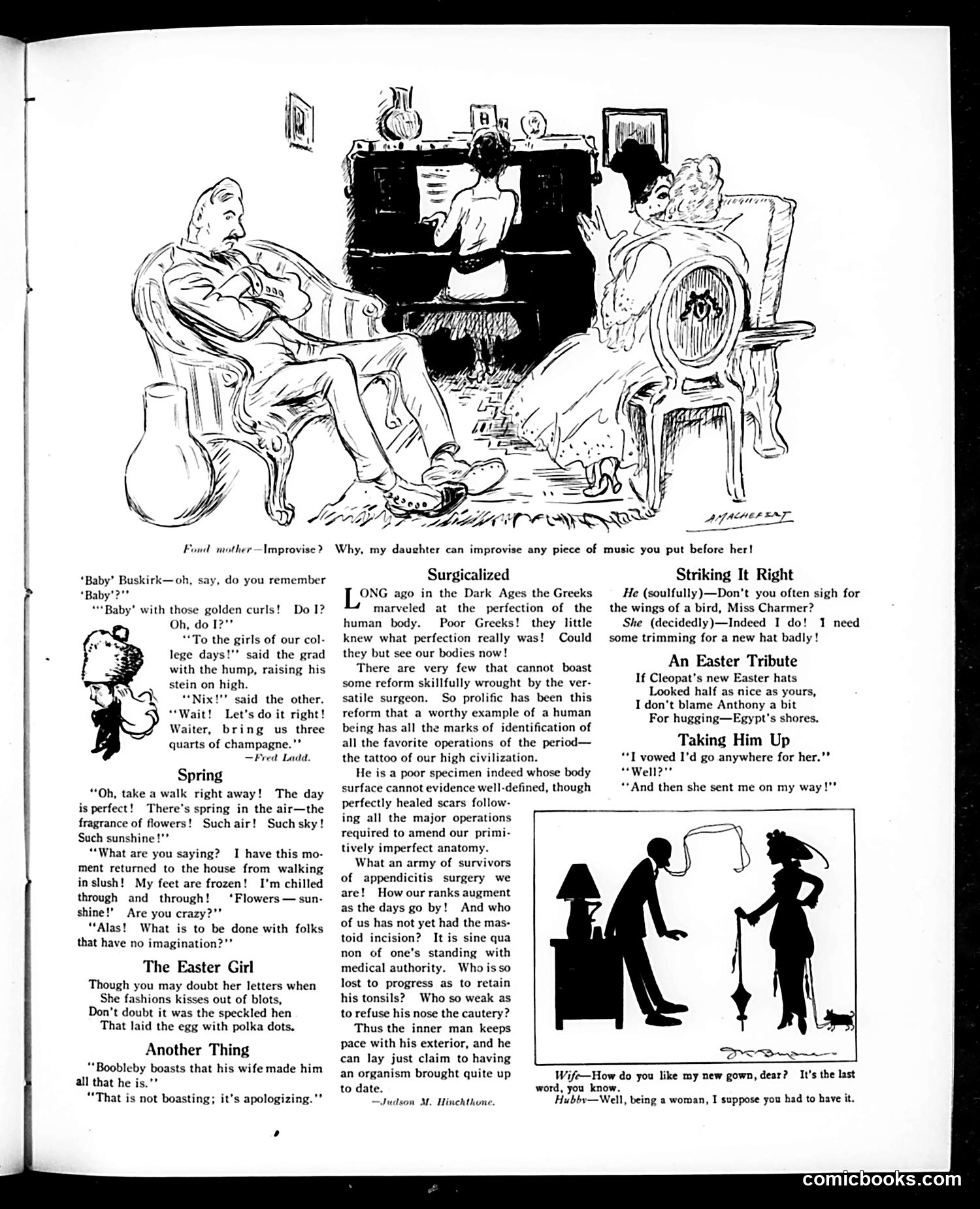
This page from Judge magazine contains several satirical pieces mocking early 20th-century social trends: **Main Cartoon (top):** A "fond mother" boasts her daughter can improvise any piano piece. The satire targets pretentious parents exaggerating their children's talents. **"Surgicalized":** This essay mocks the era's surgical obsession—appendectomies, tonsillectomies, mastoid operations, and cauterization became status symbols of "modern civilization." The piece sarcastically suggests people collect surgical scars as proof of being up-to-date. **Other pieces:** Brief comedic sketches about spring optimism versus winter reality, Easter fashions, and gender dynamics in marriage ("being a woman, I suppose you had to have it"). **Overall tone:** Gentle mockery of American middle-class aspirations, medical trends, and domestic life—typical Judge fare targeting educated, affluent readers aware of contemporary cultural pretensions.
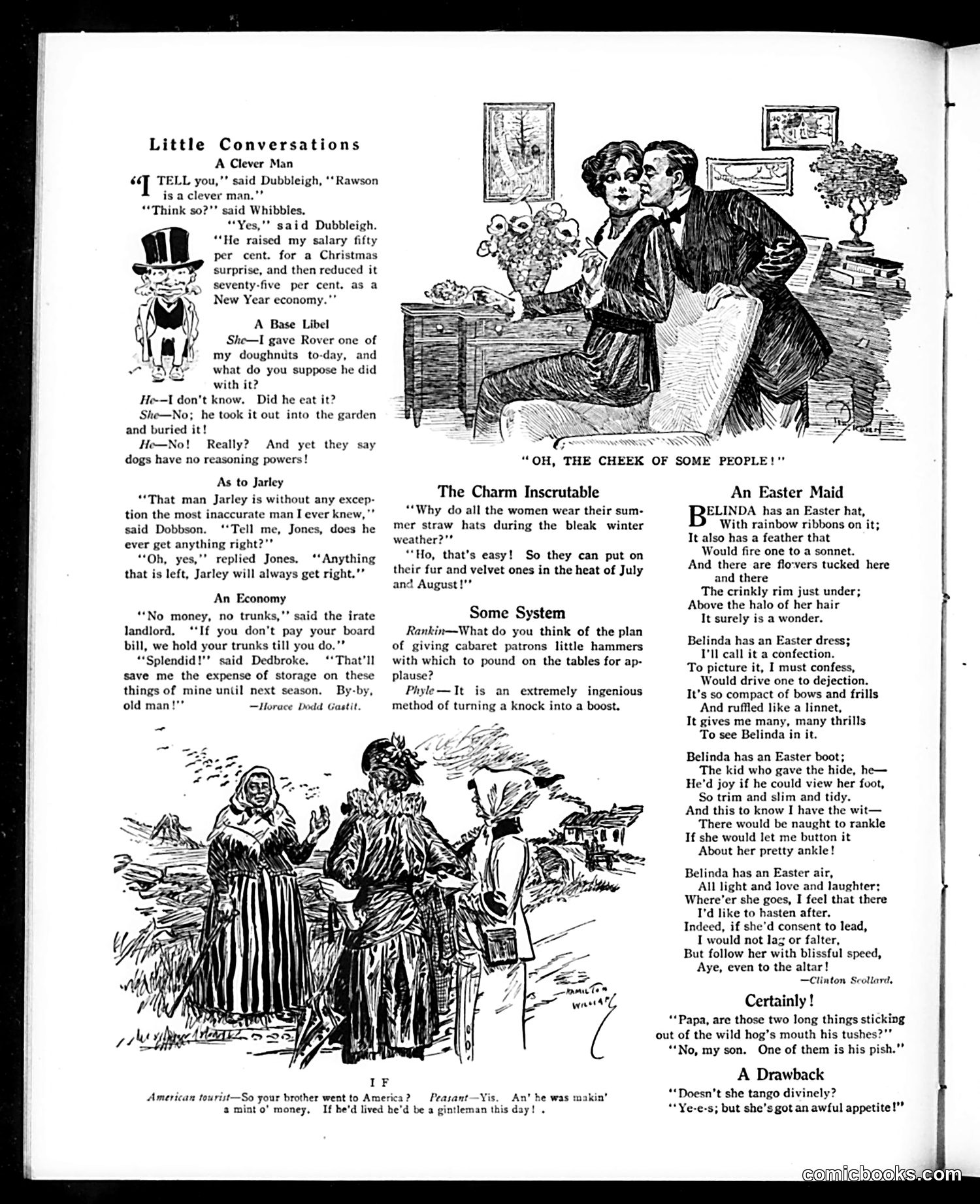
This page collects brief satirical dialogues and light verse typical of Judge's humor. The "Little Conversations" section mocks everyday absurdities: a man praising his boss for raising then slashing his salary; a woman annoyed her dog buried her doughnut rather than eating it; complaints about an inaccurate man named Jarley. "Some System" jokes about cabaret establishments giving patrons hammers to pound tables for applause—turning "a knock into a boost" (pun on applause-seeking). The illustrated pieces include romantic verse about a woman's elaborate Easter outfit, and brief comedic exchanges: a child asking if a hog's tusks are "tushes," and an Irish peasant noting his brother would be a gentleman if he'd lived (dark humor about emigrant mortality). The humor is gentle, domestic, and class-conscious rather than explicitly political—typical of Judge's entertainment-focused satirical approach in this era.
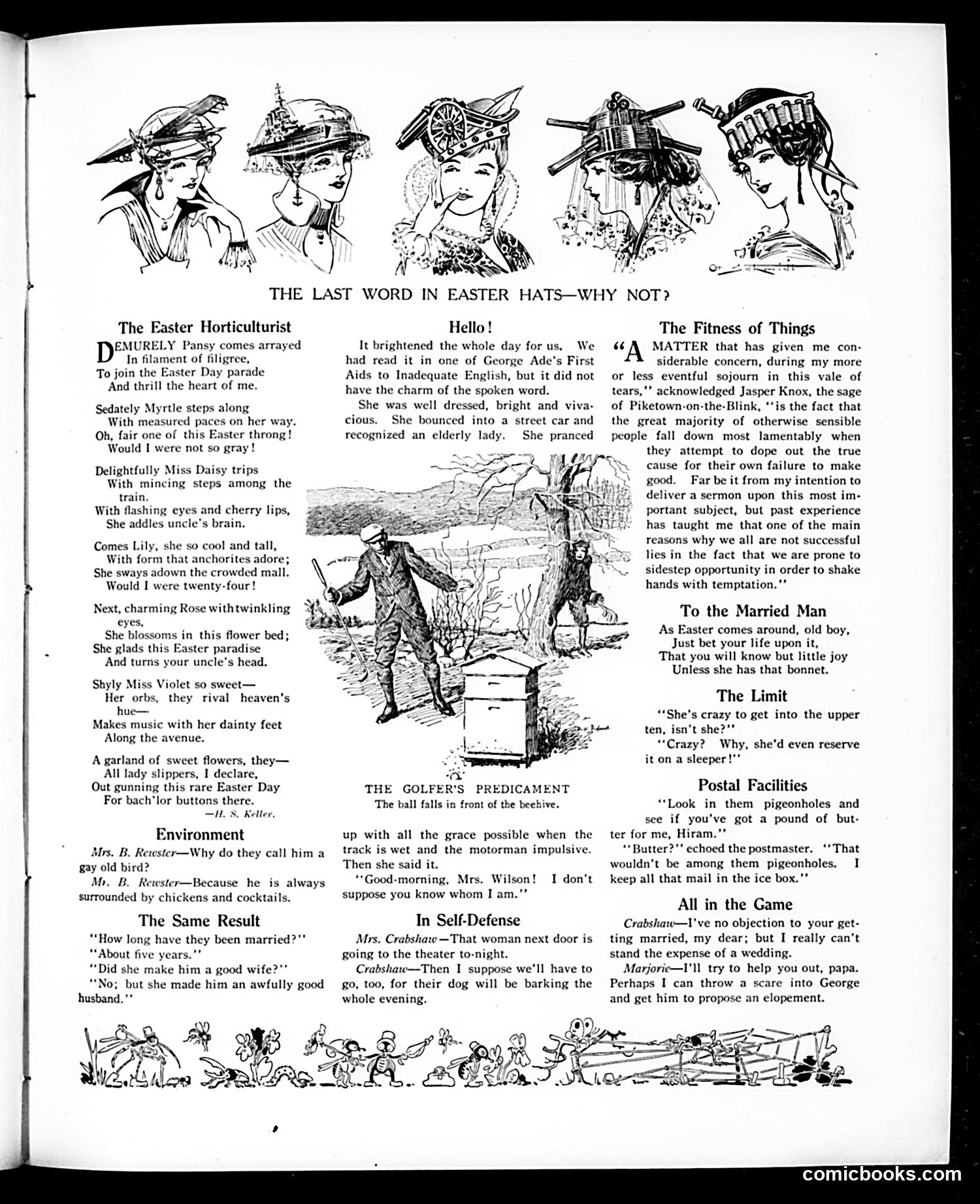
This page from Judge magazine presents **Easter-themed humor and satirical commentary**, typical of early 20th-century American magazine comedy. **Main Content:** The title illustration shows five elaborate Easter bonnets—the page satirizes women's extravagant Easter hat fashion with the heading "The Last Word in Easter Hats—Why Not?" This mocks the era's obsession with expensive, ornately decorated women's hats as status symbols. **Humorous Sketches Include:** - "The Easter Horticulturist": A sentimental poem where an aging man admires young women (described as flowers) in the Easter parade, lamenting his lost youth - "Environment": A joke about a "gay old bird" always surrounded by "chickens and cocktails"—playing on period slang - Various domestic humor pieces mocking married life, social pretension, and gender dynamics **Social Context:** The satire reflects concerns about conspicuous consumption, aging masculinity, and marital discord. The Easter parade was a genuine social event where wealth and fashion were publicly displayed—making it prime satirical material for Judge's commentary on American society.
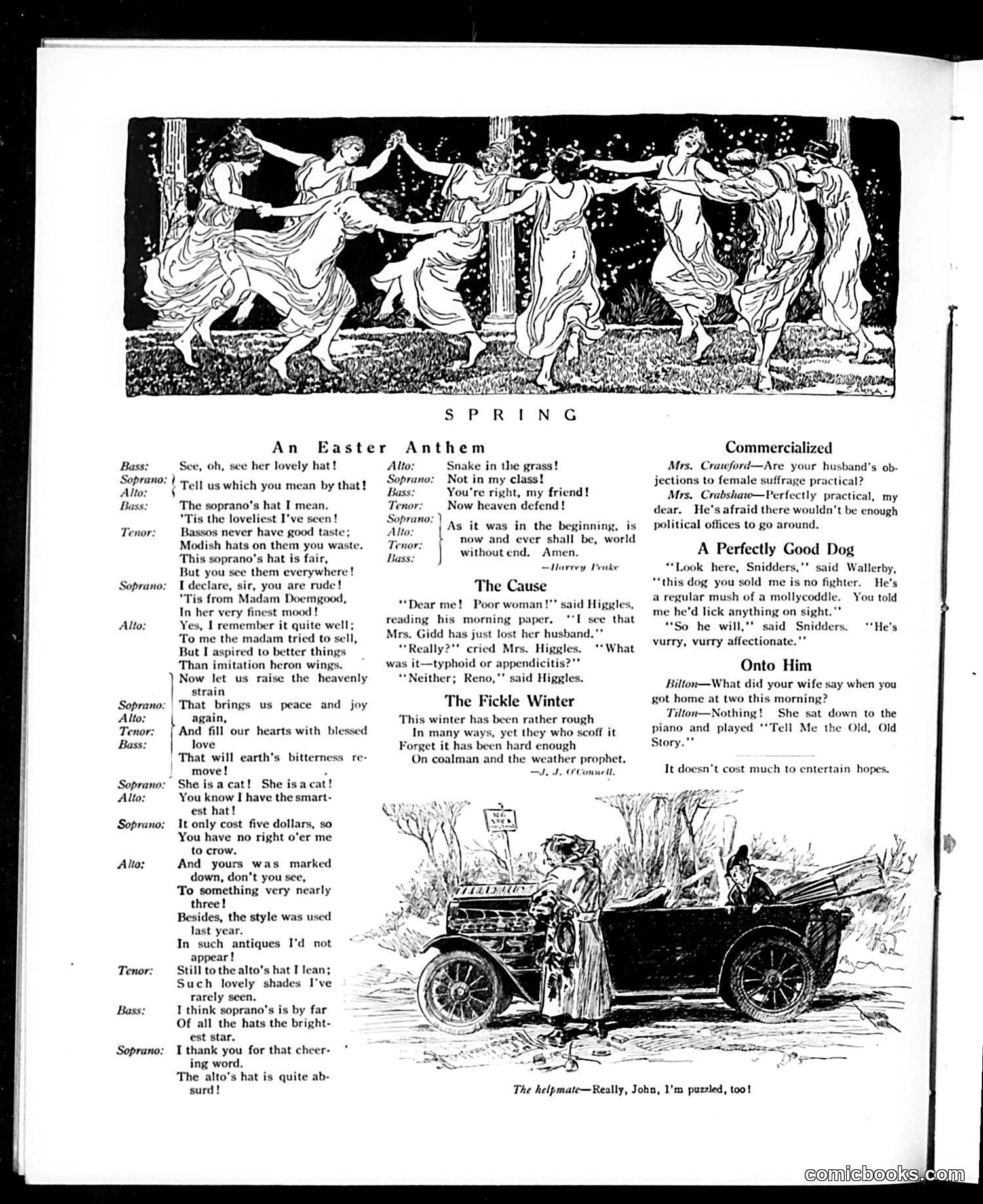
This page from *Judge* magazine contains several satirical pieces typical of early 20th-century American humor: **"An Easter Anthem"** mocks pretentious social climbing through a church choir argument about women's hats—the singers bicker cattily about whose hat is most fashionable while supposedly singing a solemn religious composition. **"The Cause"** is a brief joke about divorce: Mr. Higgles learns a woman lost her husband to "Reno" (the Nevada city famous for easy divorces), suggesting the marriage dissolved via divorce rather than death. **"The Fickle Winter"** is a light poem about harsh winter weather and its effect on coalmen and weather forecasters. **"Commercialized"** satirizes opposition to women's suffrage as financially motivated—the husband fears women voting would create too many political offices to distribute to his allies. **"A Perfectly Good Dog"** and **"Onto Him"** are brief domestic humor pieces about pets and wives playing sad piano music as passive-aggressive communication. The overall tone reflects turn-of-the-century middle-class anxieties about gender roles, voting rights, and social propriety.
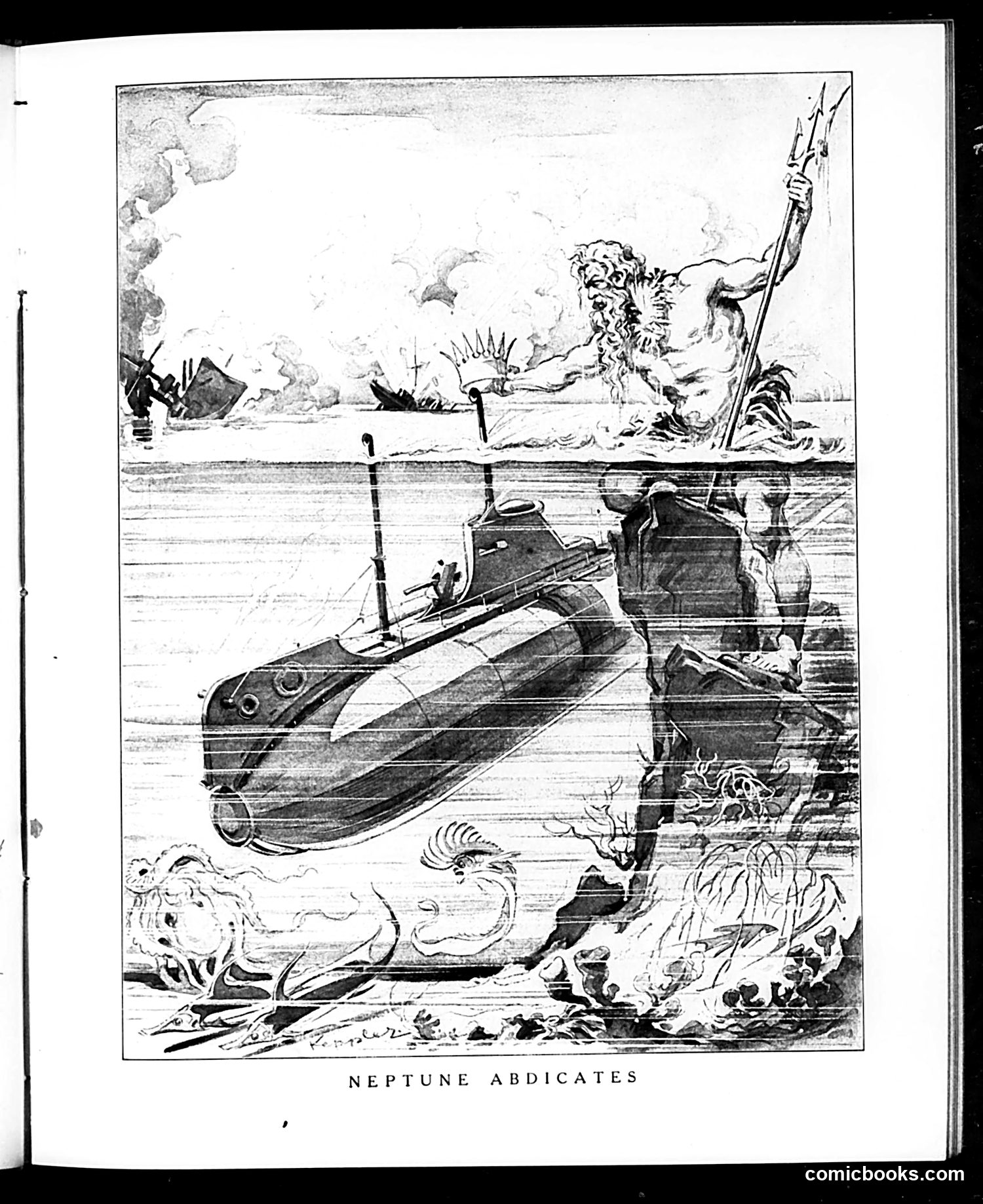
This political cartoon depicts Neptune (the Roman god of the sea, identifiable by his trident and flowing beard in the upper panel) abandoning his domain. The lower panel shows a submarine at a dock, with various naval vessels and equipment visible. The satire appears to comment on how modern naval technology—specifically the submarine—has rendered traditional maritime dominance obsolete. Neptune, who historically symbolized naval power and seafaring supremacy, is depicted as abdicating his throne to this new mechanical warfare. The cartoon suggests that mechanized, underwater vessels have fundamentally changed naval warfare and dominance, making the old god of the seas irrelevant to modern military reality.
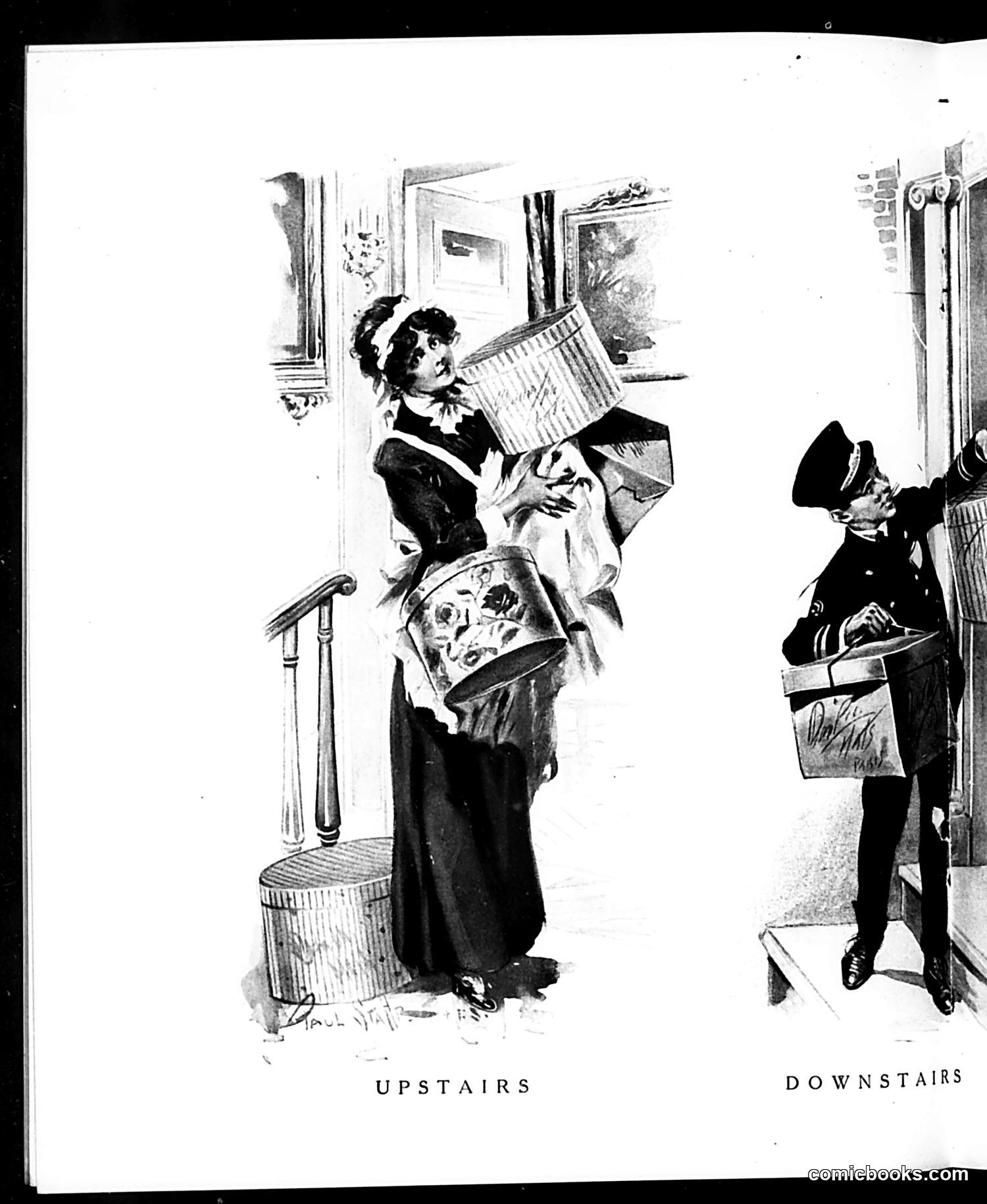
This two-panel cartoon contrasts the behavior of servants in different parts of a household. **Upstairs** (left): A maid, laden with packages and items, looks upward in apparent distress or exasperation while managing multiple household goods. **Downstairs** (right): A uniformed servant (possibly a butler or footman) stands at ease, appearing composed and collected. The satire appears to mock the class divisions and differing work conditions within domestic service—suggesting that upstairs staff (maids) endured more chaotic, demanding labor while downstairs staff (typically male servants) enjoyed comparative leisure or composure. This reflects period attitudes about the hierarchies and gender disparities within servant hierarchies in wealthy households.
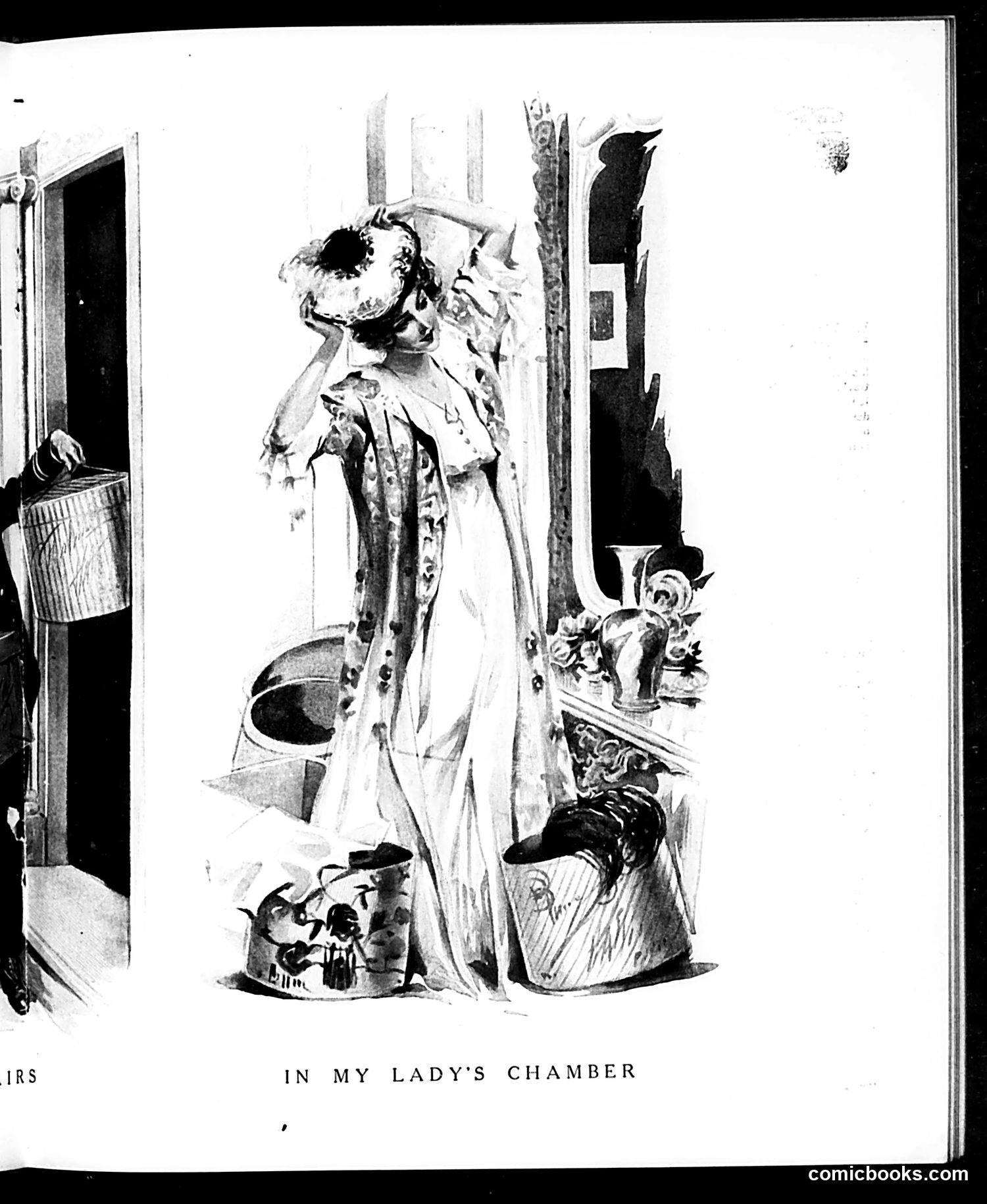
This satirical cartoon depicts a woman in an elegant negligée adjusting her appearance before a mirror in her bedroom. The sketch style and composition suggest commentary on vanity and female grooming rituals, likely from the late 19th or early 20th century. The title "In My Lady's Chamber" combined with the intimate domestic setting and the woman's focused attention on her reflection suggests the cartoon is satirizing women's preoccupation with beauty and appearance. The detailed rendering of her clothing and the room's furnishings emphasizes the materialistic aspects of her toilette. Without additional context or byline visible, the specific satirical target remains unclear, though the cartoon likely mocked contemporary attitudes about feminine vanity or beauty standards of the era.
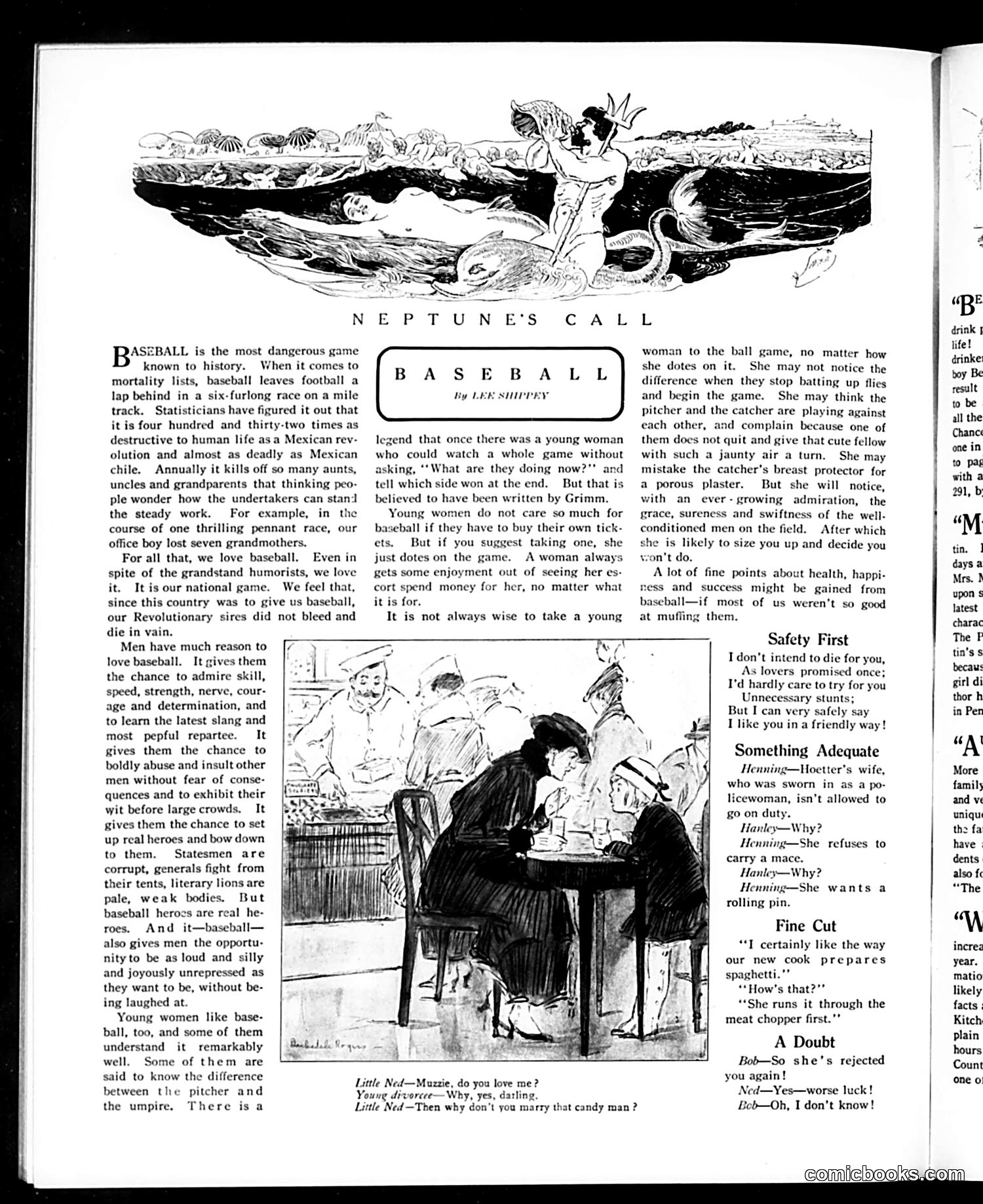
This page from Judge satirizes early 20th-century attitudes toward baseball and gender roles. **Main Article ("Baseball" by Lee Shippey):** A humorous essay praising baseball as America's national sport while mock-seriously claiming it kills more people annually than Mexican revolutions. The satire targets baseball fanatics' hyperbolic enthusiasm. **Gender Satire:** The piece ridicules women at baseball games, suggesting they don't understand the sport, attend mainly to watch attractive players, and may confuse equipment (mistaking a catcher's chest protector for a "porous plaster"). It implies women are intellectually incapable of grasping baseball's rules—a common sexist trope of the era. **Cartoons/Jokes Below:** Including domestic humor about a new policewoman preferring a "rolling pin" to a "mace," and relationship jokes about divorce and candy salesmen—typical light domestic humor of the period. **Overall Context:** The page reflects early 1900s American attitudes: baseball as masculine/patriotic, women as decorative/intellectually inferior, and domestic life as comedy fodder.
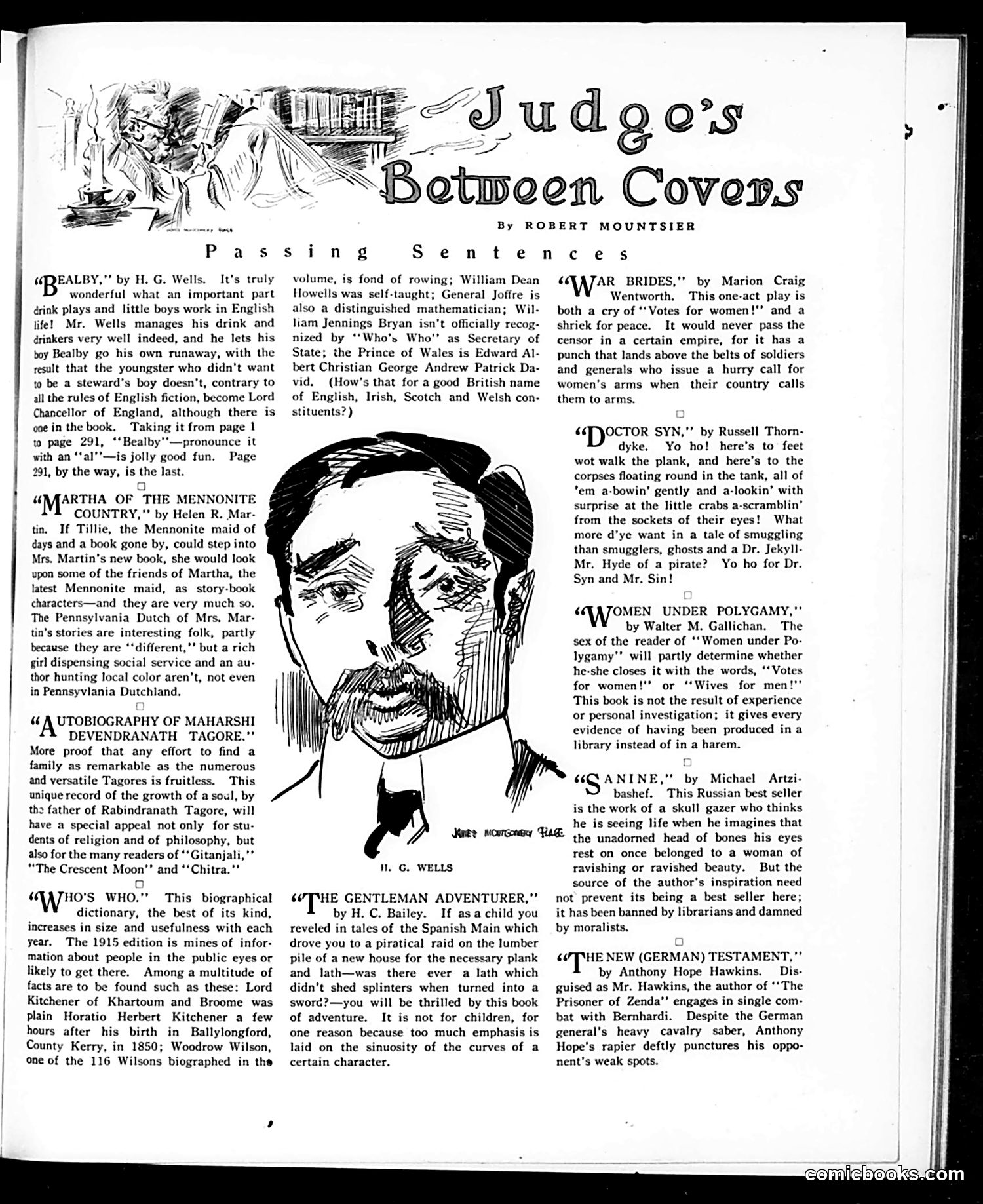
This is a **book review section** titled "Judgo's Between Covers" by Robert Mountsier, not a political cartoon. The large illustration is a **portrait of H.G. Wells**, the famous English author whose novel "Bealby" is being reviewed. The page contains brief reviews of contemporary (early 1910s) literary works, including novels by H.G. Wells, Helen R. Martin, and others. Notably, one review discusses Marion Craig Wentworth's play "War Brides," which the reviewer notes is both a feminist piece demanding "Votes for women!" and an anti-war statement so provocative it would be censored in certain empires—a reference to WWI-era censorship concerns. The content reflects Judge magazine's function as a literary and cultural commentary publication, offering witty, sometimes pointed observations about contemporary books and their social implications rather than serving as purely satirical political commentary on this particular page.
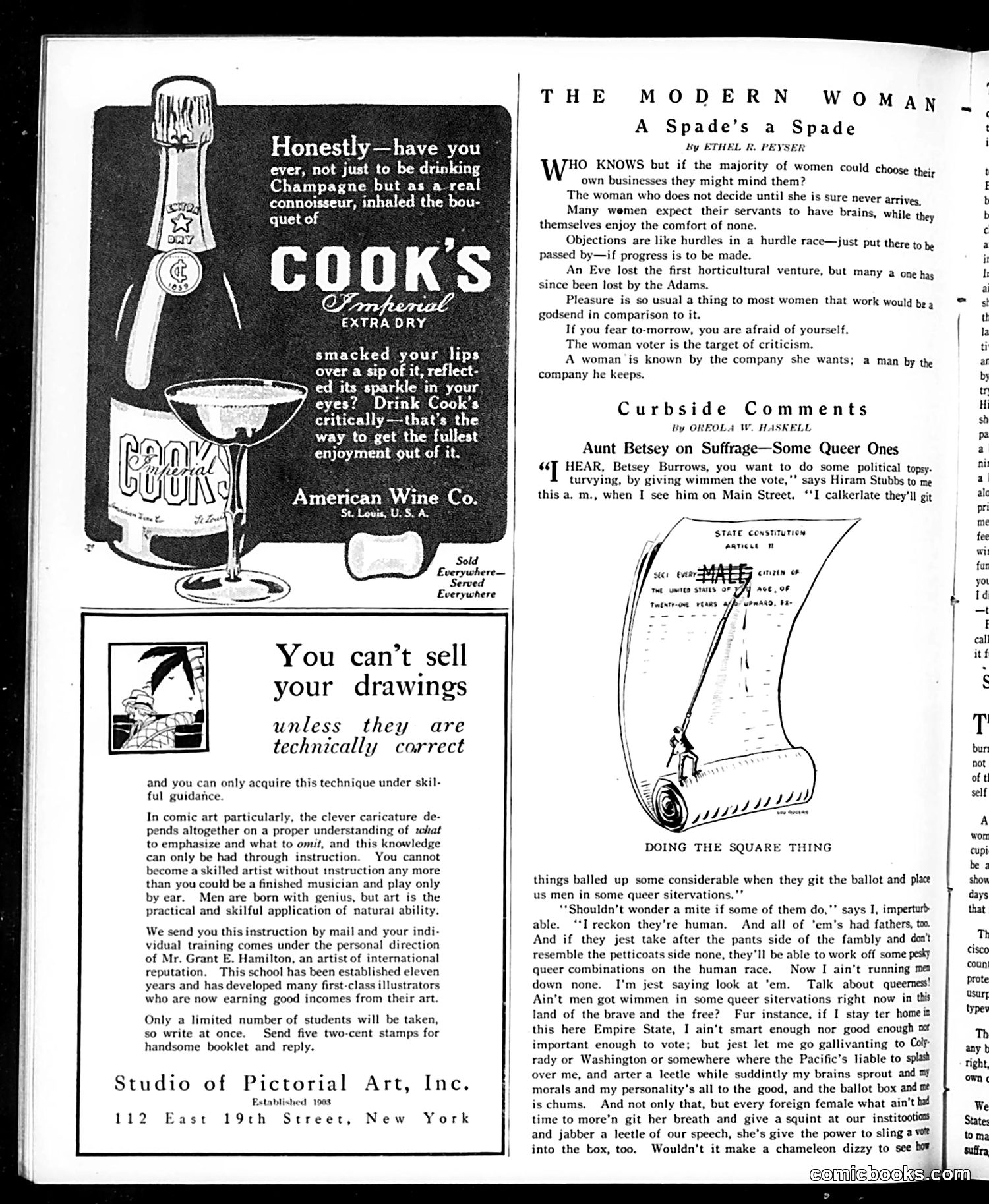
This page contains three distinct elements: **Cook's Champagne Advertisement** (left): A luxury wine ad using sensory language to appeal to sophisticated consumers, typical of early 20th-century marketing. **Art School Advertisement** (center-bottom): Studio of Pictorial Art promotes correspondence instruction in cartooning and illustration, claiming students can earn good incomes. **"The Modern Woman" Column and "Curbside Comments"** (right): Social commentary on women's issues. The column offers witty observations about women's capabilities and choices. "Aunt Betsey on Suffrage" presents a rural character's perspective on women's voting rights—humorously noting that if women voters behave as erratically as men, they'll "ball things up" considerably. The satire critiques both the inconsistency of denying women votes while allowing them other freedoms, and suggests men fear losing control if women gain political power. This reflects early 20th-century suffrage debates.
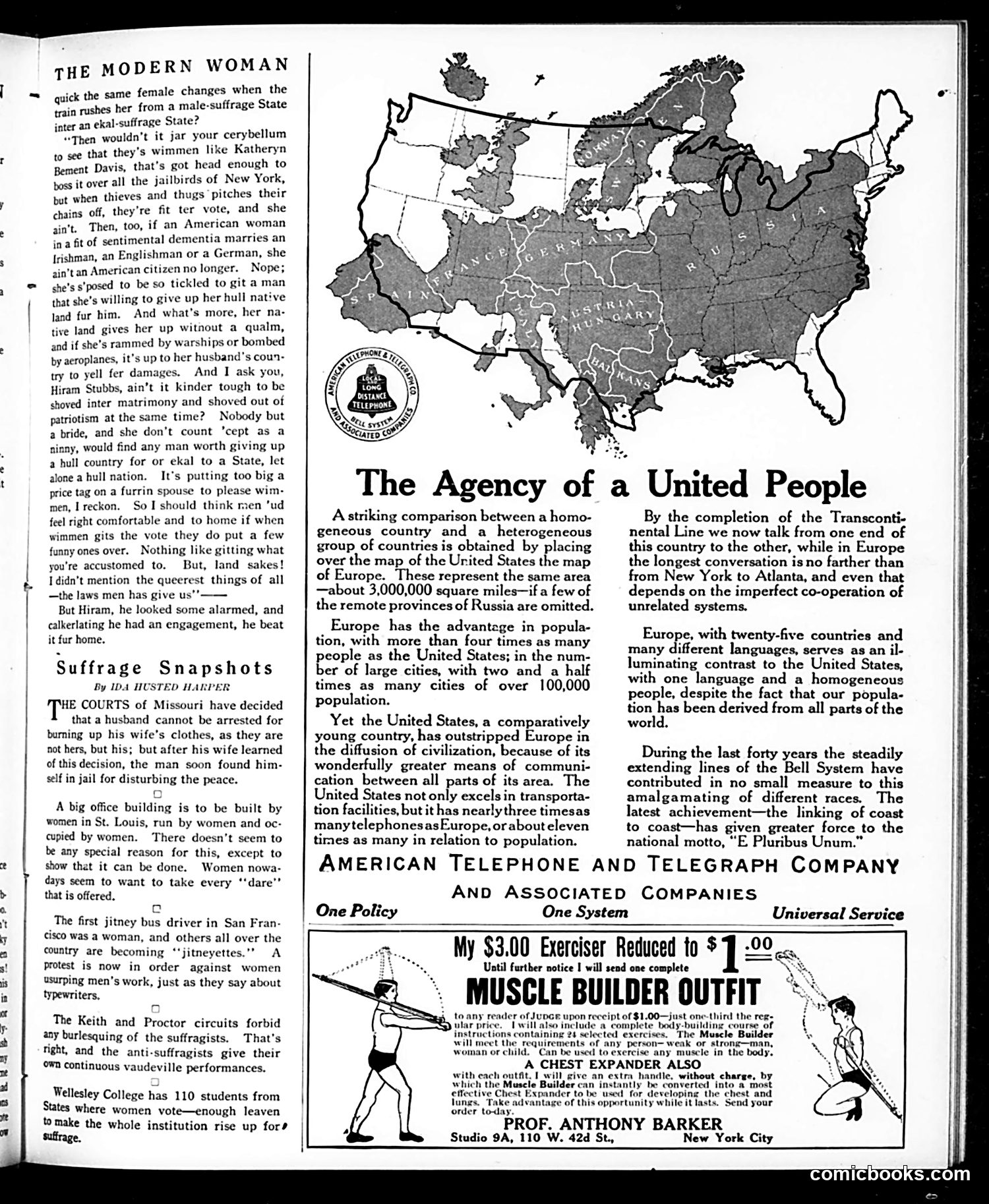
This page contains two distinct pieces satirizing women's suffrage and rights circa 1910s. **"The Modern Woman"** features a male character (Hiram Stubbs) complaining about women's contradictory legal status: women like Katheryn Bement Davis possess intelligence yet lack voting rights, while criminally convicted men can vote. The satire highlights the absurdity that American women who marry foreigners lose citizenship but must give up their "native land" without complaint. The piece mocks the hypocrisy that women are deemed unfit for political participation yet expected to sacrifice national loyalty through marriage. **"Suffrage Snapshots"** by Ida Husted Harper presents brief anecdotes supporting women's capabilities: Missouri courts rule husbands own wives' clothing (absurd property law); women successfully build and operate office buildings; women work as bus drivers ("jitneyettes"); vaudeville circuits censor suffrage mockery while anti-suffragists perform freely. The accompanying map and telegraph company advertisement are unrelated commercial content typical of magazine layout. The overall message criticizes legal discrimination against women while celebrating their demonstrated competence.
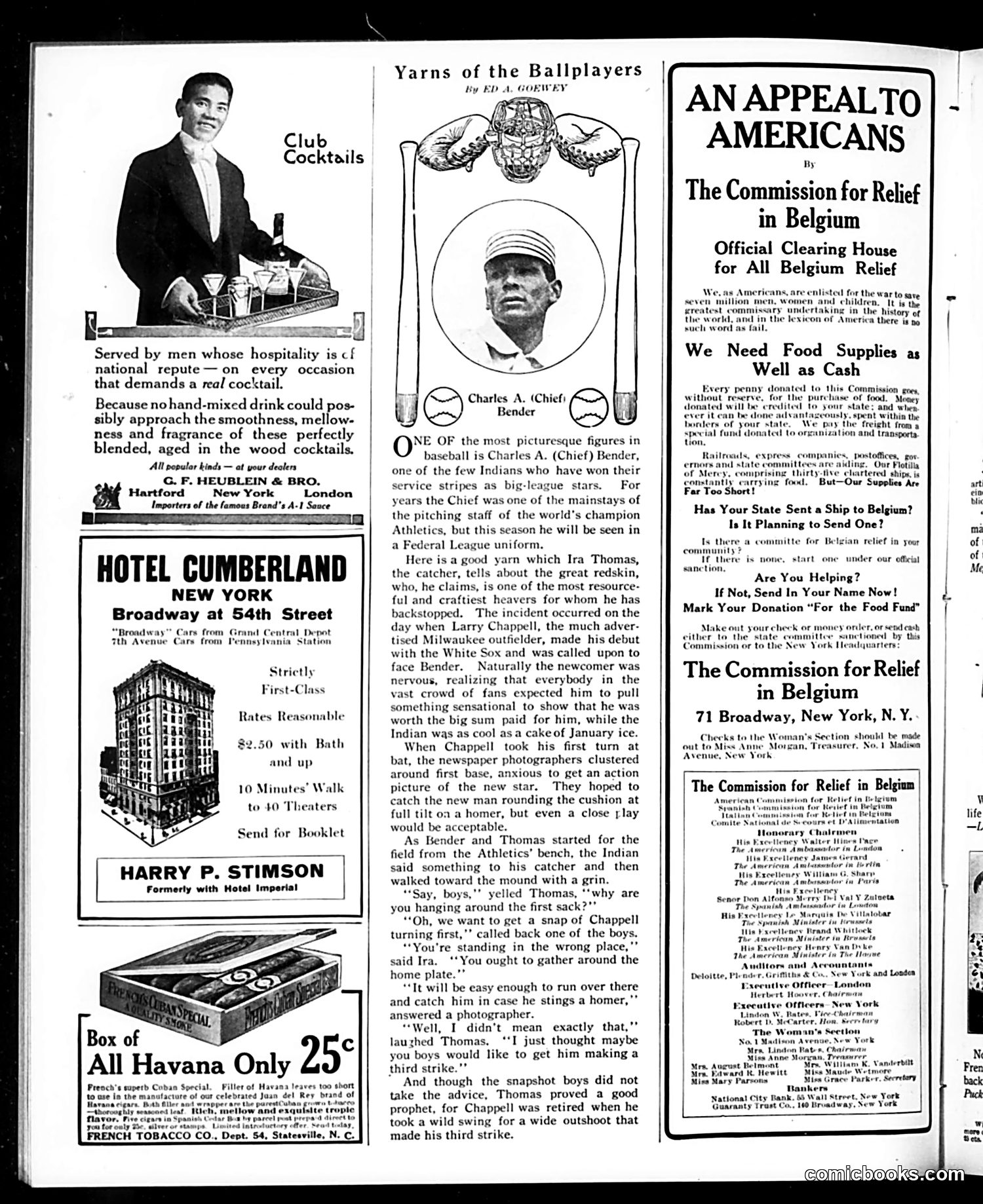
This page is primarily **advertising and public appeals**, not satire or political cartoons. The center features "Yarns of the Ballplayers" by Ed A. Godfrey, a sports story about **Charles A. (Chief) Bender**, a Native American baseball player. The narrative describes Bender joining the Athletics and depicts him as stoic and competent, though the language ("cool as a cake of January ice") reflects period racial stereotyping. The right side contains an appeal for Belgian relief funds during what appears to be **World War I**, requesting food supplies and cash for Belgian civilians. The left shows hotel and tobacco advertisements. The overall page reflects early 20th-century American magazine culture: sports heroes (including Native Americans), wartime humanitarian appeals, and commercial promotions mixed together.
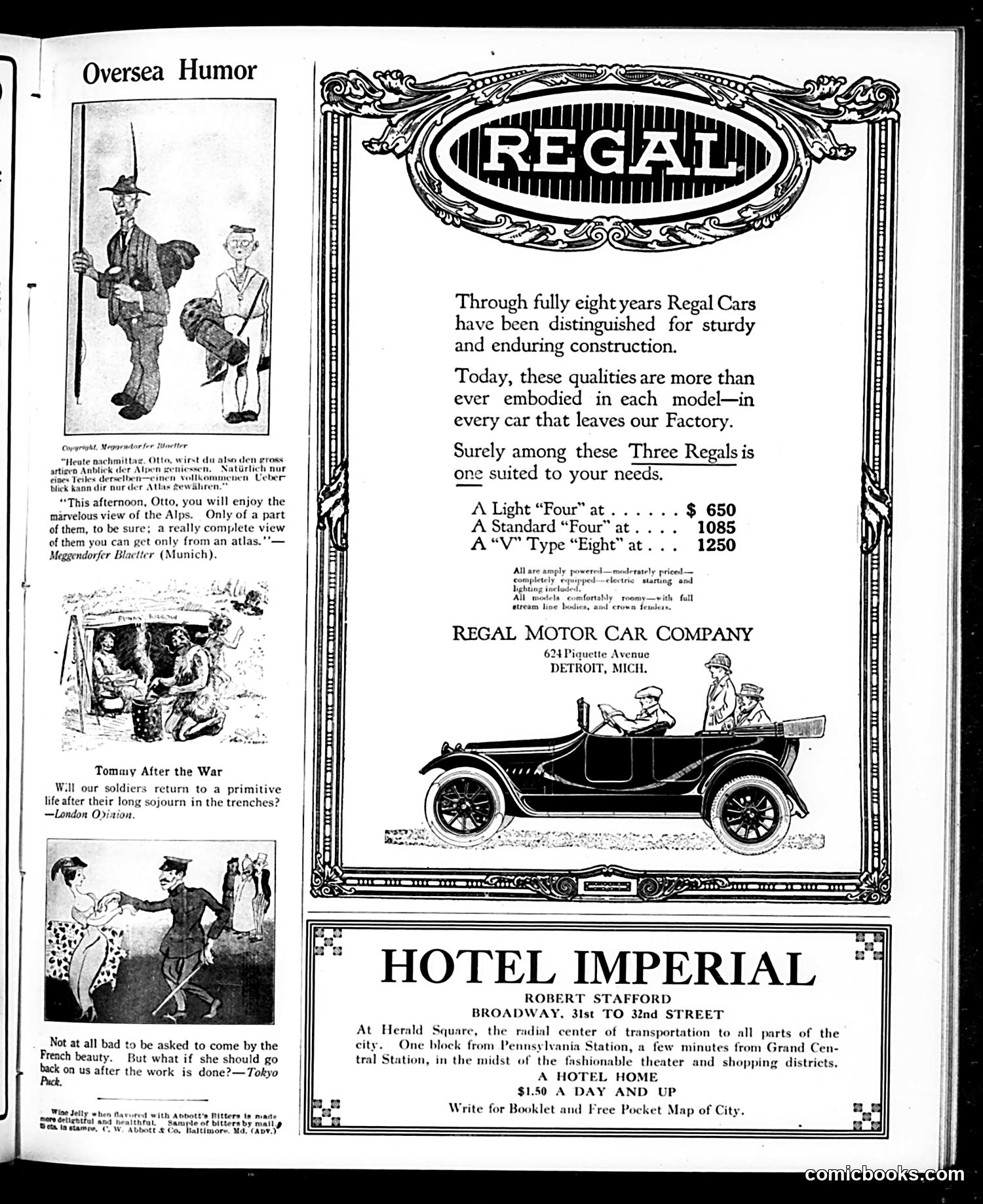
This page contains three separate satirical cartoons reflecting post-World War I anxieties: 1. **Top cartoon**: A German soldier complains to a sailor that viewing the Alps requires an atlas because you can only see part of them—mocking German boastfulness about their landscape. 2. **Middle cartoon ("Tommy After the War")**: Questions whether soldiers returning from trench warfare will revert to "primitive life," suggesting anxiety about veterans' reintegration and potential social disruption. 3. **Bottom cartoon**: A French woman invites a man on a pleasant outing, but he worries she'll abandon him "after the work is done"—likely a cynical joke about Franco-American wartime alliance dissolving once the conflict ends. The page is predominantly advertising (Regal cars, Hotel Imperial, Abbott's Bitters), with humor positioned as filler. The cartoons reflect contemporary concerns about military demobilization, international relationships, and cultural tensions in the immediate postwar period.
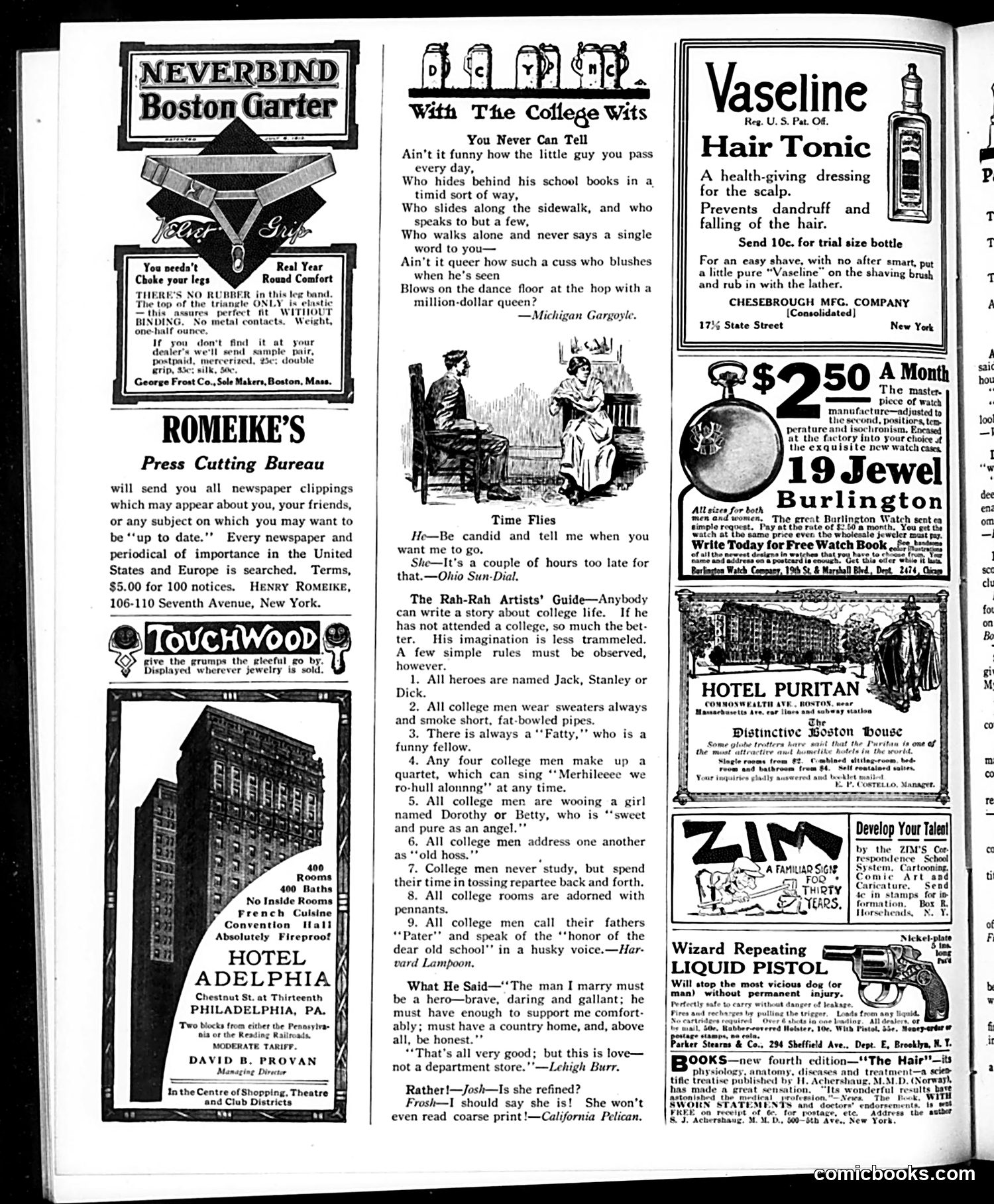
This page is **primarily advertising** with interspersed college-themed humor pieces, typical of Judge magazine's format. **Main Content:** The humor section "With The College Wits" satirizes idealized college fiction through a mock "Rah-Rah Artists' Guide." It mocks predictable tropes: all heroes named Jack/Stanley/Dick, students wearing sweaters and smoking pipes, obligatory "funny fat guy" characters, college men perpetually courting girls named Dorothy or Betty, and constant references to their fathers as "Pater" and "dear old school" in husky voices. This parodies the formulaic, romanticized college stories popular in early 20th-century literature. Short jokes like "Time Flies" play on dating and courtship humor typical of the era. **Advertisements** dominate: Vaseline Hair Tonic, Burlington Watches (19-jewel, $2.50/month), Hotel Philadelphia, Hotel Adelphi (Philadelphia), and various services. **Historical Context:** The page reflects early 1900s attitudes toward college life, youth culture, and consumer products marketed primarily to middle/upper-class readers of a satirical magazine.
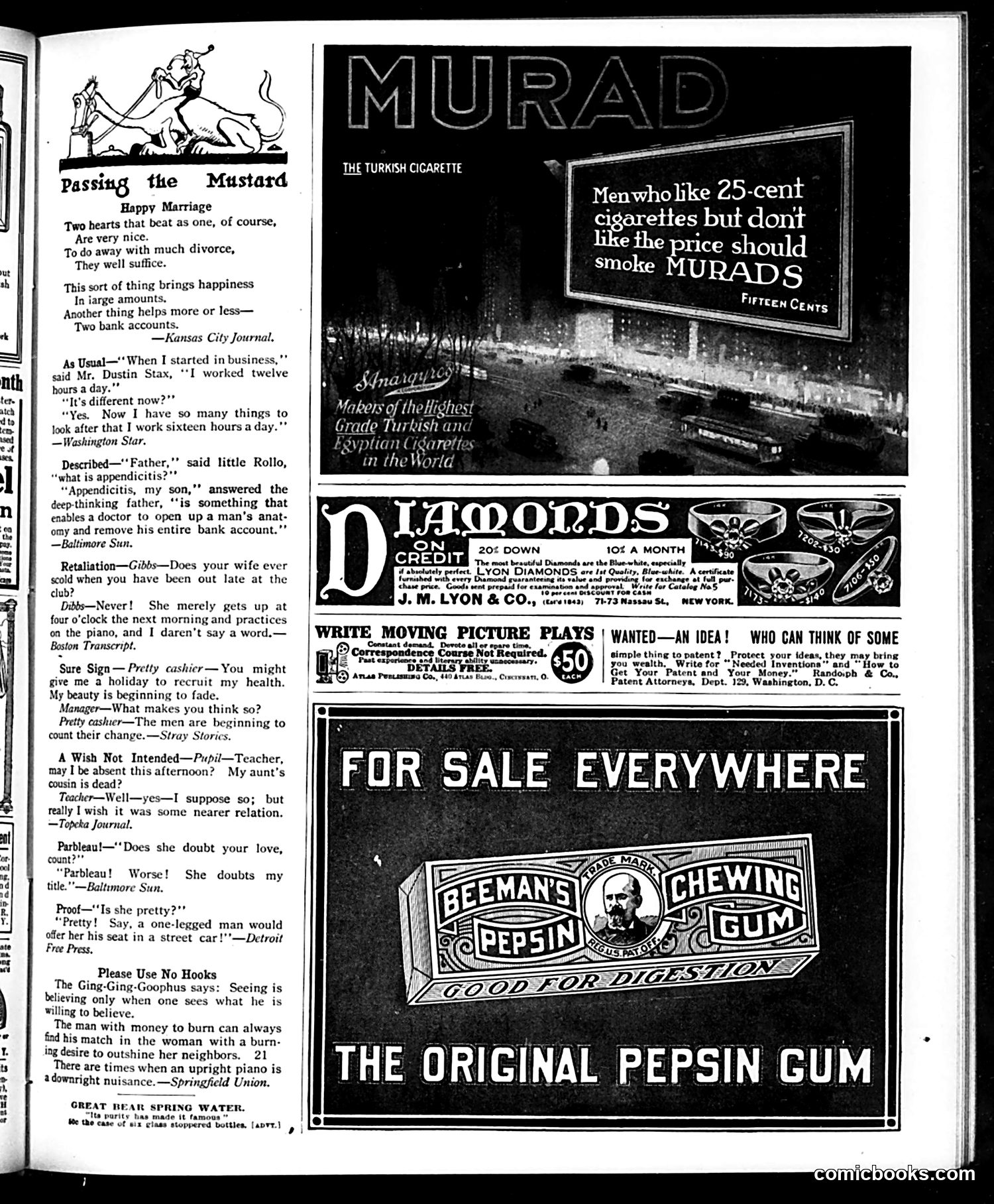
This page is primarily **advertising and humorous filler content** rather than political satire. The layout mixes: **Left column:** Brief jokes and quips from various newspapers on domestic life—wives, work, marriage finances, and social etiquette. These reflect early 20th-century concerns: wives practicing piano as passive-aggressive retaliation, the pressure of long work hours, and the anxieties of middle-class respectability. **Right side:** Large advertisements for Murad cigarettes, Lyons diamonds, and Beeman's Pepsin Gum—products marketed to affluent readers. The Murad ad emphasizes price-consciousness ("don't like the price...smoke MURADS"), while the gum ad claims digestive benefits (common medicinal claims for consumer products of this era). **Bottom:** Patent and business opportunity ads targeting entrepreneurs. The page reflects **Judge's** dual nature as satirical magazine *and* commercial vehicle. The humor targets everyday domestic friction and workplace dynamics rather than politics, while advertisements dominate. The overall tone assumes an educated, middle-class male readership concerned with propriety, leisure, and consumer goods.
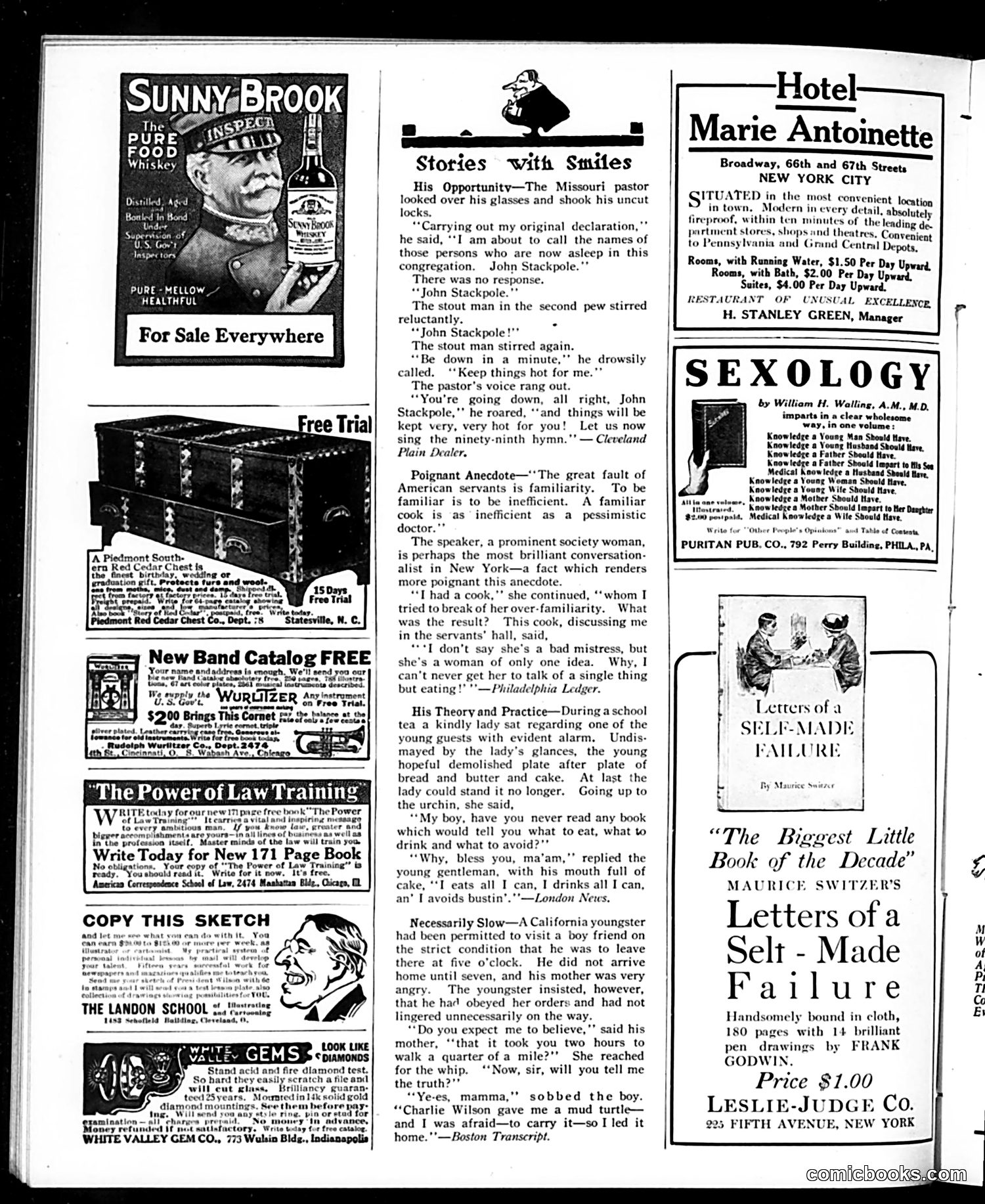
This page is primarily advertisements and entertainment features typical of the Judge magazine format—no political cartoons are present. The left side contains product advertisements (Sunny Brook Whiskey, a Red Cedar Chest, a music catalog, law training courses, and costume gems). The right side offers a hotel ad and a book advertisement. The central content consists of four brief humorous anecdotes under "Stories with Smiles," illustrating common social situations: a pastor catching a sleeping congregant, a society woman unwittingly insulting herself through servant gossip, a boy eating excessively at a tea, and a child delayed by caring for a mud turtle. These are genteel, middle-class humor pieces without political content—the kind of light entertainment that filled Judge's pages to balance its satirical commentary elsewhere.
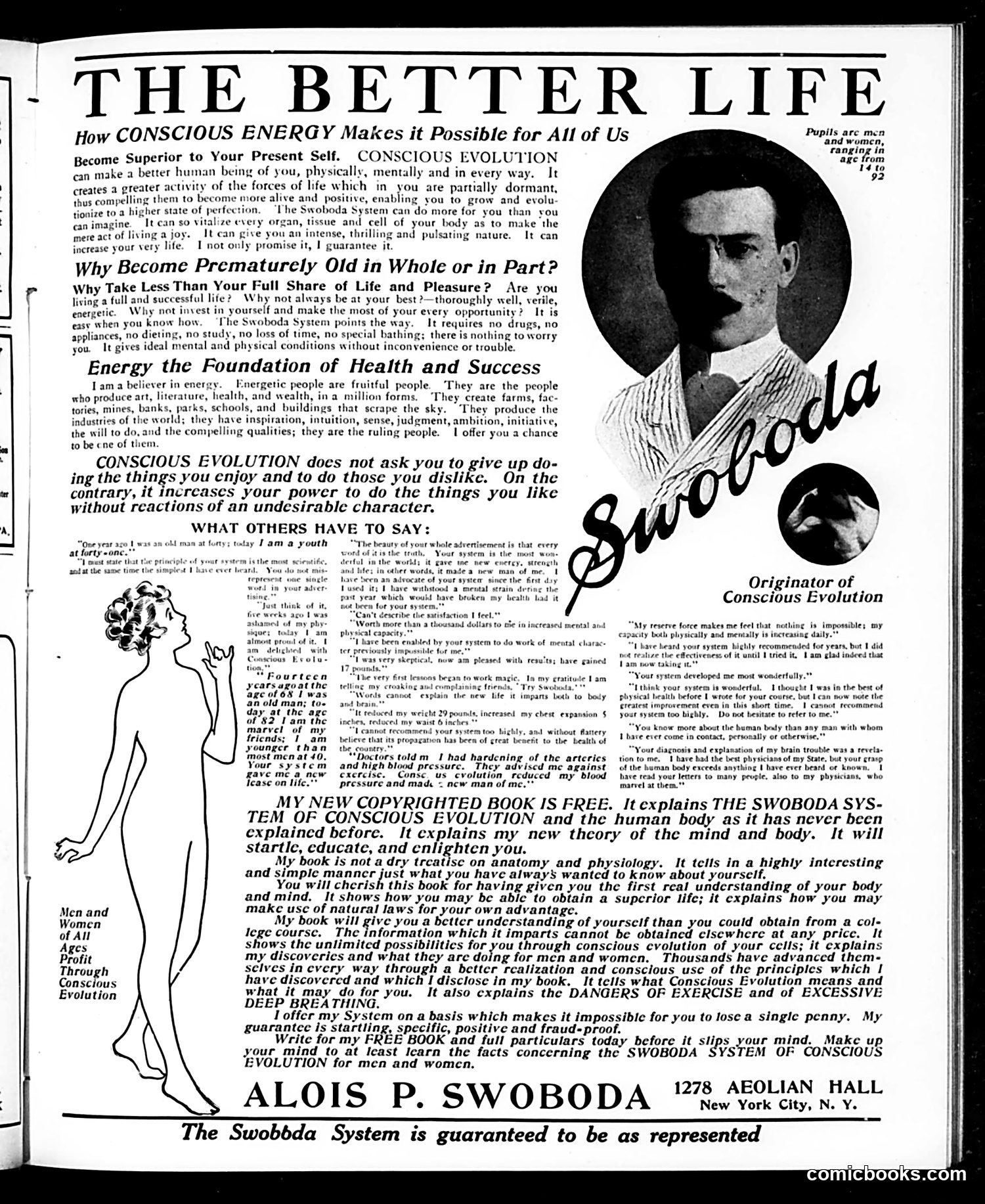
This is primarily a **full-page advertisement** for the "Swoboda System of Conscious Evolution," not a satirical cartoon. The page mixes promotional text with testimonials claiming the system improves physical and mental vitality without drugs, dieting, or special equipment. The illustration shows a stylized female figure, likely representing rejuvenation or vitality—a common advertising trope of the era. **Historical context:** This appears to be a **pseudo-scientific self-help scheme**, typical of early 20th-century American magazines. The vague promises of increased "energy" and "conscious evolution" to cure ailments (hardening of arteries, aging, low vitality) lack medical basis. **The satirical angle** (if Judge intended any) likely lay in publishing such obvious quackery alongside serious content—implicitly mocking readers gullible enough to believe such claims. The testimonials' generic praise and the system's miraculous, drug-free nature are characteristic of fraudulent wellness schemes that Judge's satirical audience would recognize as absurd.
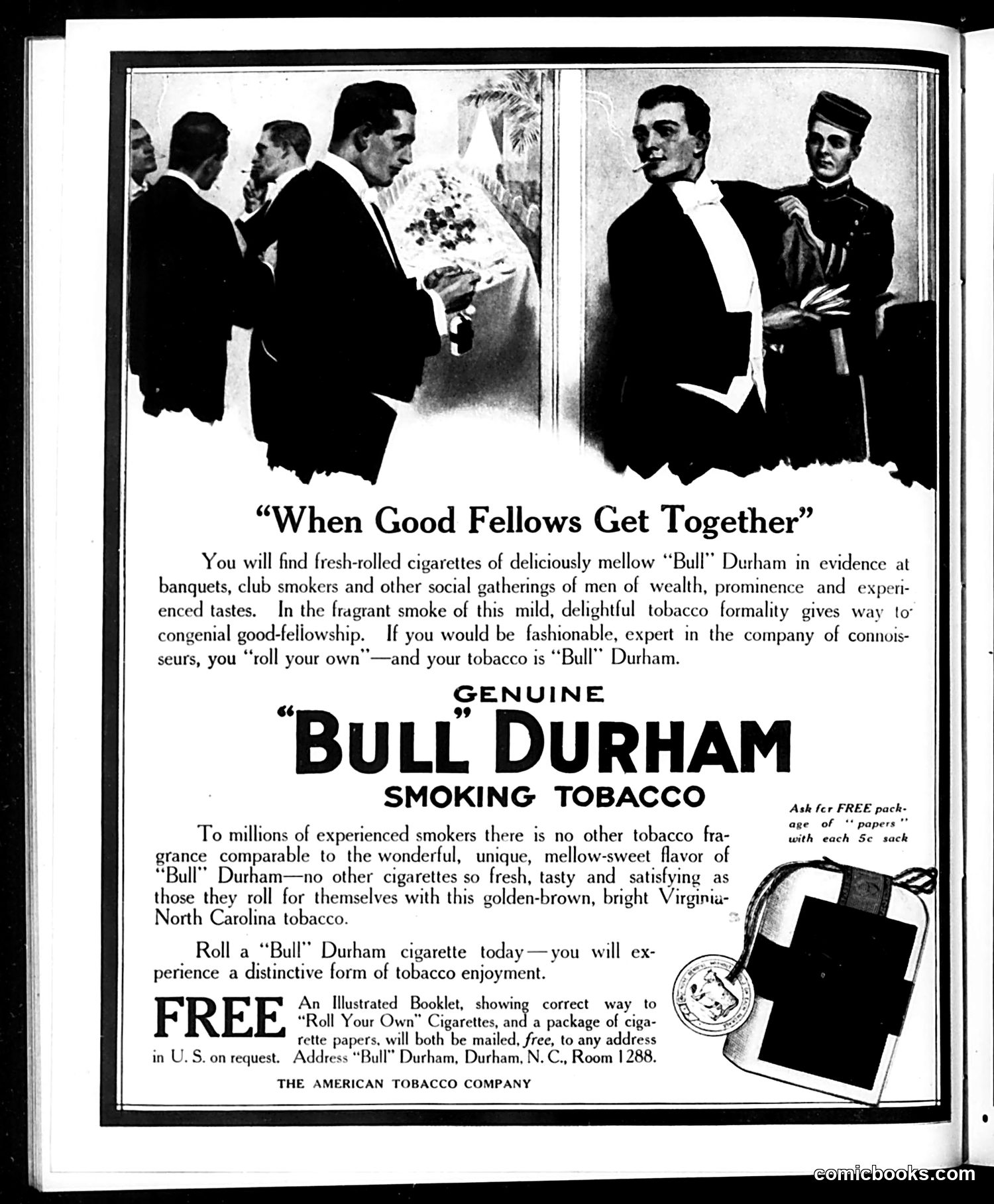
This is primarily a **tobacco advertisement**, not political satire. The page shows a "Bull" Durham smoking tobacco ad from The American Tobacco Company. The illustration depicts well-dressed men in formal attire at what appears to be an upscale social gathering—a banquet or club setting. The advertisement's appeal is to **class aspiration**: it markets roll-your-own cigarettes as a marker of sophistication and wealth, claiming that fashionable men of "prominence and experienced tastes" smoke this brand. The key sales pitch is social conformity disguised as distinction—by rolling your own "Bull" Durham cigarettes, the reader supposedly signals membership among refined connoisseurs. The ad offers free instructional materials and cigarette papers to encourage the practice. This reflects early 20th-century advertising strategy: selling products not just for use, but as badges of social status. The page contains no apparent political cartoon or satire—it's straightforward commercial messaging.