
Judge, 1915-04-03 · page 15 of 24
Judge — April 3, 1915 — page 15: what you’re looking at
What you’re looking at
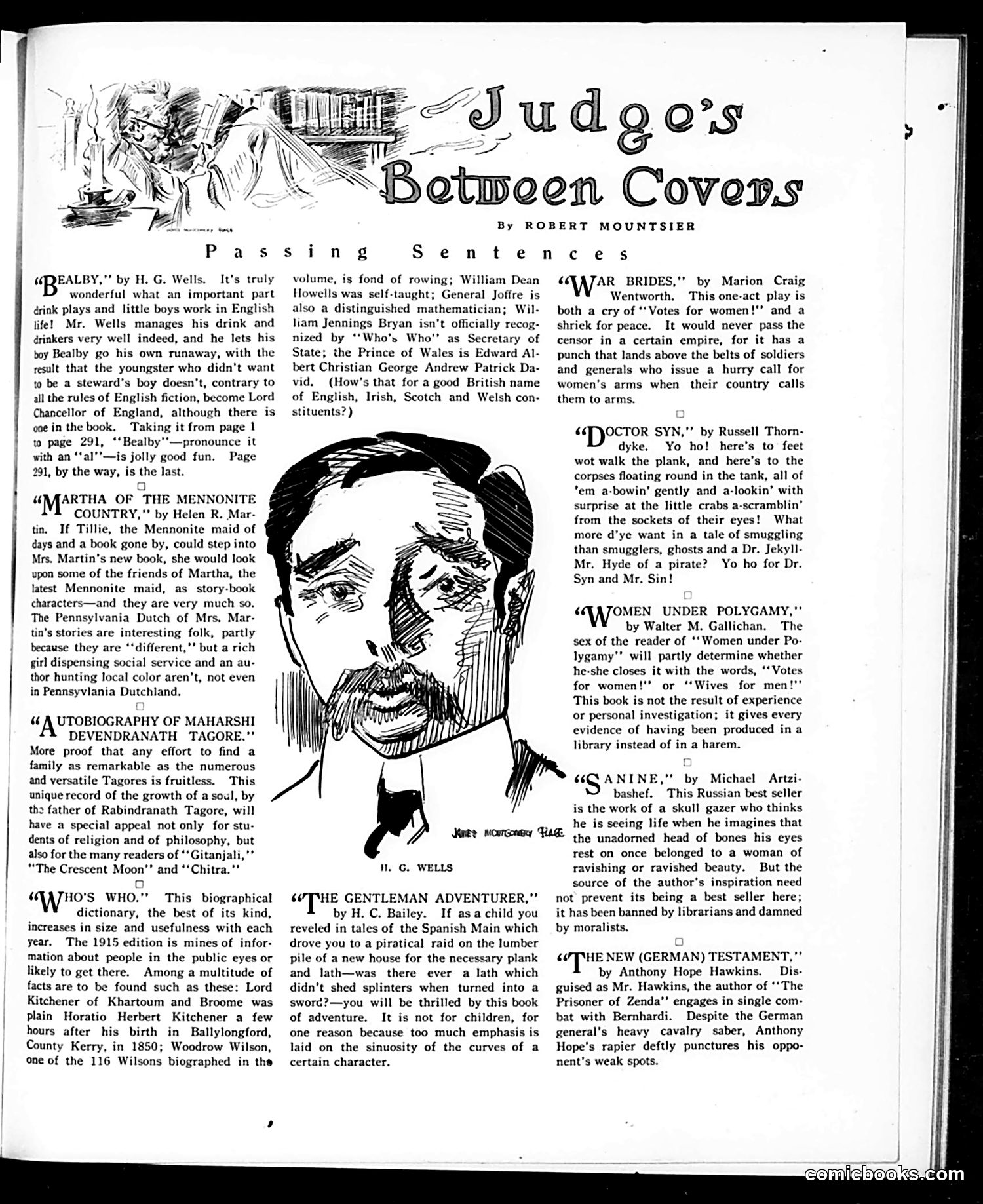
This is a **book review section** titled "Judgo's Between Covers" by Robert Mountsier, not a political cartoon. The large illustration is a **portrait of H.G. Wells**, the famous English author whose novel "Bealby" is being reviewed. The page contains brief reviews of contemporary (early 1910s) literary works, including novels by H.G. Wells, Helen R. Martin, and others. Notably, one review discusses Marion Craig Wentworth's play "War Brides," which the reviewer notes is both a feminist piece demanding "Votes for women!" and an anti-war statement so provocative it would be censored in certain empires—a reference to WWI-era censorship concerns. The content reflects Judge magazine's function as a literary and cultural commentary publication, offering witty, sometimes pointed observations about contemporary books and their social implications rather than serving as purely satirical political commentary on this particular page.
📄 Transcribed text from this page (OCR, searchable)
Machine-transcribed from the original scan — historical spelling and the odd misread are preserved.
pean. Pass sOPEALBY,”’ by H. G. Wells. It’s truly wonderful what an important part drink plays and little boys work in English life! Mr. Wells manages his drink and drinkers very well indeed, and he lets his boy Bealby go his own runaway, with the result that the youngster who didn’t want to be a steward’s boy doesn’t, contrary to all the rules of English fiction, become Lord Chancellor of England, although there is one in the book. Taking it from page 1 to page 291, ‘‘Bealby"’—pronounce it with an ‘‘al’’—is jolly good fun. Page 291, by the way, is the last. is) «MARTHA OF THE MENNONITE COUNTRY,” by Helen R. Mar- tin, If Tillie, the Mennonite maid of days and a book gone by, could step into Mrs. Martin's new book, she would look upon some of the friends of Martha, the latest Mennonite maid, as story-book characters—and they are very much so. The Pennsylvania Dutch of Mrs. Mar- tin's stories are interesting folk, partly because they are ‘‘different,’’ but a rich girl dispensing social service and an au- thor hunting local color aren't, not even in Pennsyviania Dutchland. 66 A UTOBIOGRAPHY OF MAHARSHI DEVENDRANATH TAGORE."’ More proof that any effort to find a family as remarkable as the numerous and versatile Tagores is fruitless. This unique record of the growth of a soul, by the father of Rabindranath Tagore, will have a special appeal not only for stu- dents of religion and of philosophy, but also for the many readers of **Gitanja! “The Crescent Moon’? and ‘*Chitra.’ 6 HO'S WHO." This biographical dictionary, the best of its kind, increases in size and usefulness with each year. The 1915 edition is mines of infor- mation about people in the public eyes or likely to get there. Among a multitude of facts are to be found such as these: Lord Kitchener of Khartoum and Broome was plain Horatio Herbert Kitchener a few hours after his birth in Ballylongford, County Kerry, in 1850; Woodrow Wilson, one of the 116 Wilsons biographed in the ing volume, is fond of rowing; William Dean Howells was self-taught; General Joffre is also a distinguished mathematician; Wil- liam Jennings Bryan isn’t officially recog- nized by ‘*Who’s Who"’ as Secretary of State; the Prince of Wales is Edward Al- bert Christian George Andrew Patrick Da- vid. (How’s that for a good British name of English, Irish, Scotch and Welsh con- stituents?) H. G. WELLS 60° PHE GENTLEMAN ADVENTURER,” by H. C. Bailey. If asa child you reveled in tales of the Spanish Main which drove you to a piratical raid on the lumber pile of a new house for the necessary plank and lath—was there ever a lath which didn’t shed splinters when turned into a sworé?—you will be thrilled by this book of adventure. It is not for children, for one reason because too much emphasis is laid on the sinuosity of the curves of a certain character. “Botweon Covers By ROBERT MOUNTSIER Sentences ‘ ‘AR BRIDES,"’ by Marion Craig Wentworth. This one-act play is both a cry of ‘*Votes for women!"’ and a shriek for peace. It would never pass the censor in a certain empire, for it has a punch that lands above the belts of soldiers and generals who issue a hurry call for women’s arms when their country calls them to arms. 6sP)OCTOR SYN,"’ by Russell Thorn- dyke. Yo ho! here's to feet wot walk the plank, and here’s to the corpses floating round in the tank, all of "em a-bowin’ gently and a-lookin’ with surprise at the little crabs a-scramblin’ from the sockets of their eyes! What more d’ye want in a tale of smuggling than smugglers, ghosts and a Dr. Jekyll- Mr. Hyde of a pirate? Yo ho for Dr. Syn and Mr. Sin! if OMEN UNDER POLYGAMY,"’ by Walter M. Gallichan. The sex of the reader of ‘* Women under Po- lygamy"’ will partly determine whether he-she closes it with the words, ‘‘ Votes for women!" or ‘*Wives for men!"’ This book is not the result of experience or personal investigation; it gives every evidence of having been produced in a library instead of in a harem. 6OQANINE," by Michael Artzi- bashef. This Russian best seller is the work of a skull gazer who thinks he is seeing life when he imagines that the unadorned head of bones his eyes rest on once belonged to a woman of ravishing or ravished beauty. But the source of the author's inspiration need not prevent its being a best seller here; it has been banned by librarians and damned by moralists. 607 PHE NEW (GERMAN) TESTAMEN’ by Anthony Hope Hawkins. guised as Mr. Hawkins, the author of ‘‘The Prisoner of Zenda’’ engages in single com- bat with Bernhardi. Despite the German general’s heavy cavalry saber, Anthony Hope's rapier deftly punctures his oppo- nent’s weak spots. Dis-