
Judge, 1915-04-03 · page 14 of 24
Judge — April 3, 1915 — page 14: what you’re looking at
What you’re looking at
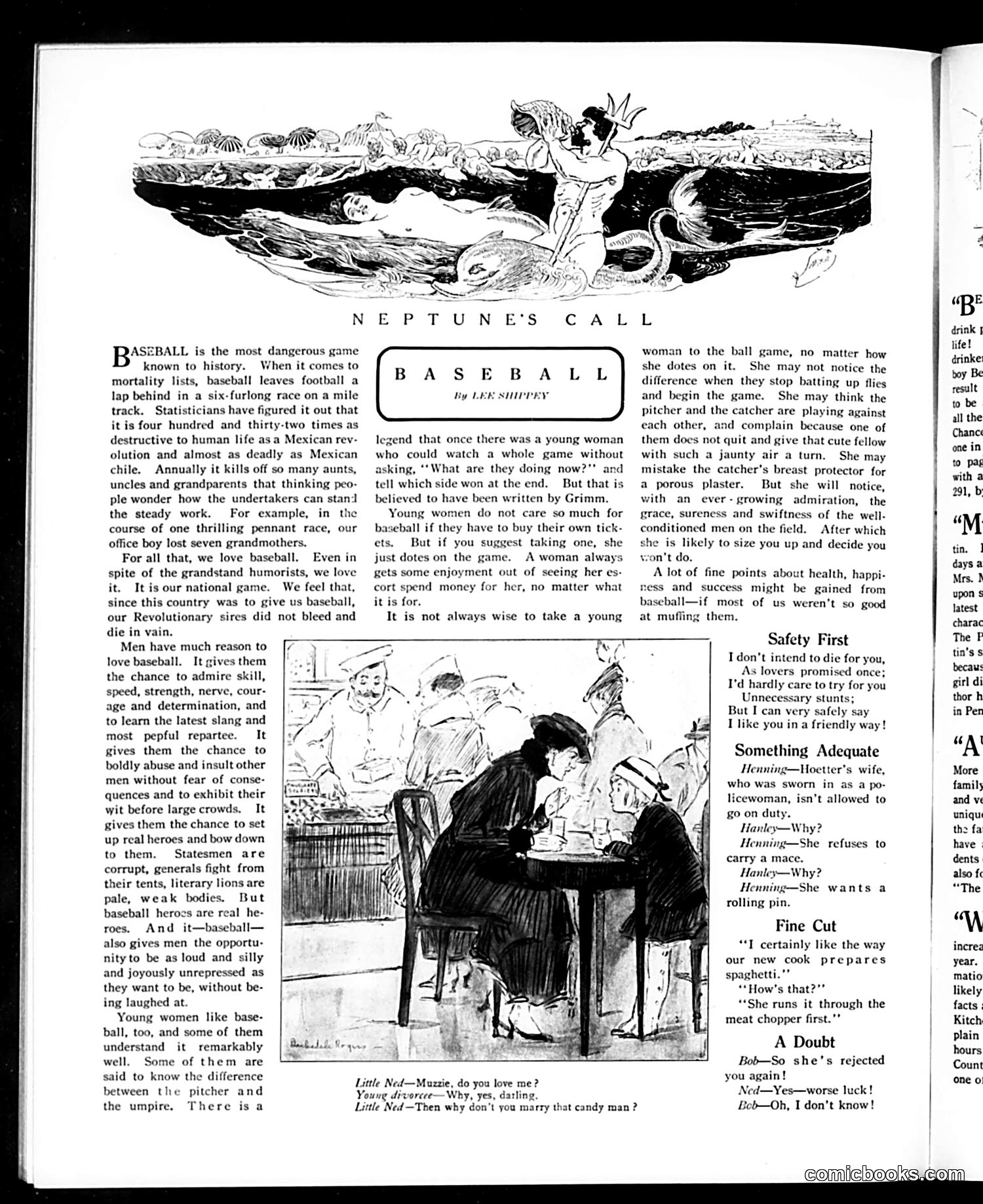
This page from Judge satirizes early 20th-century attitudes toward baseball and gender roles. **Main Article ("Baseball" by Lee Shippey):** A humorous essay praising baseball as America's national sport while mock-seriously claiming it kills more people annually than Mexican revolutions. The satire targets baseball fanatics' hyperbolic enthusiasm. **Gender Satire:** The piece ridicules women at baseball games, suggesting they don't understand the sport, attend mainly to watch attractive players, and may confuse equipment (mistaking a catcher's chest protector for a "porous plaster"). It implies women are intellectually incapable of grasping baseball's rules—a common sexist trope of the era. **Cartoons/Jokes Below:** Including domestic humor about a new policewoman preferring a "rolling pin" to a "mace," and relationship jokes about divorce and candy salesmen—typical light domestic humor of the period. **Overall Context:** The page reflects early 1900s American attitudes: baseball as masculine/patriotic, women as decorative/intellectually inferior, and domestic life as comedy fodder.
📄 Transcribed text from this page (OCR, searchable)
Machine-transcribed from the original scan — historical spelling and the odd misread are preserved.
BAseBat is the most dangerous game known to history. When it comes to mortality lists, baseball leaves football a lap behind in a six-furlong race on a mile track. Statisticians have figured it out that it is four hundred and thirty-two times as destructive to human life as a Mexican rev- olution and almost as deadly as Mexican chile. Annually it kills off so many aunts, uncles and grandparents that thinking peo- ple wonder how the undertakers can stan‘ the steady work. For example, in the course of one thrilling pennant race, our office boy lost seven grandmothers. For all that, we love baseball. Even in spite of the grandstand humorists, we love it. It is our national game. We feel that, since this country was to give us baseball, our Revolutionary sires did not bleed and die in vain. EPTUN E CAL EBA LL By LEE SHIPPEY BAS legend that once there young woman who could watch a whole game without asking, ‘What are they doing now?" and tell which side won at the end. But tha believed to have been written by Grimm. en do not care so much for © to buy their own tick- But if you suggest tal just dotes on the game. A woman alw. gets some enjoyment out of seeing her es- cort spend money for her, no matter what it is for. It is not alwa wise to take a young L woman to the ball game, no matter how she dotes on it. She may not notice the difference when they stop batting up flies and begin the game. She may think the pitcher and the catcher are playing against each other, and complain because one of them does not quit and give that cute fellow with such a jaunty air a tun, She may mistake the catcher's breast protector for a porous plaster. But she will notice, with an ever-growing admiration, the grace, sureness and swiftness of the well- conditioned men on the field. After which she is likely to size you up and decide you won't do. A lot of fine points about health, happi- Ss and success might be gained from baseball—if most of us weren't so good at mufling them. Safety First Men have much reason to love baseball. It gives them the chance to admire skill, speed, strength, nerve, cour- age and determination, and to learn the latest slang and most pepful repartee. It gives them the chance to boldly abuse and insult other men without fear of conse- quences and to exhibit their wit before large crowds. It gives them the chance to set up real heroes and bow down to them. Statesmen are corrupt, generals fight from their tents, literary lions are pale, weak bodies. But baseball heroes are real he- roes. And it—baseball— also gives men the opportu- nity to be as loud and silly and joyously unrepressed as they want to be, without be- ing laughed at. Young women like base- ball, too, and some of them understand it remarkably I don’t intend to die for you, As lovers promised once; I'd hardly care to try for you Unnecessary stunt But I can very safely say I like you in a friendly way! Something Adequate Henning—Hoetter's wife, who was sworn in as a po- licewoman, isn't allowed to go on duty, Hanley—Why? Henning—She refuses to carry a mace. Hanley—Why? Henning—She wants a rolling pin. Fine Cut “IT certainly like the way our new cook prepares spaghetti."" How’s that?’’ “She ru through the meat chopper first.’" A Doubt Bob—So she's rejected well. Some of them are said to know the difference between the pitcher and the umpire. There is a Little Ned—Muzzie, do you love me? Young divorcee—Why, yes, datli Little Ned—Then why don't you marry that candy man ? you again! Ned—Yes—worse luck! Bcb—Oh, I don't know! life! érinke boy Be result to be all the Chance one in to pag with a 291, b; MM tin, 1 days a Mrs. } upon s latest charac The P tin’s s becau: girl thor h in Pen “A More famils and ve uniqu the fa have | dents also fe “The “ incre year. mat likely facts | Kitch plain hours Count one o