
A complete issue · 24 pages · 1915
Judge — February 6, 1915
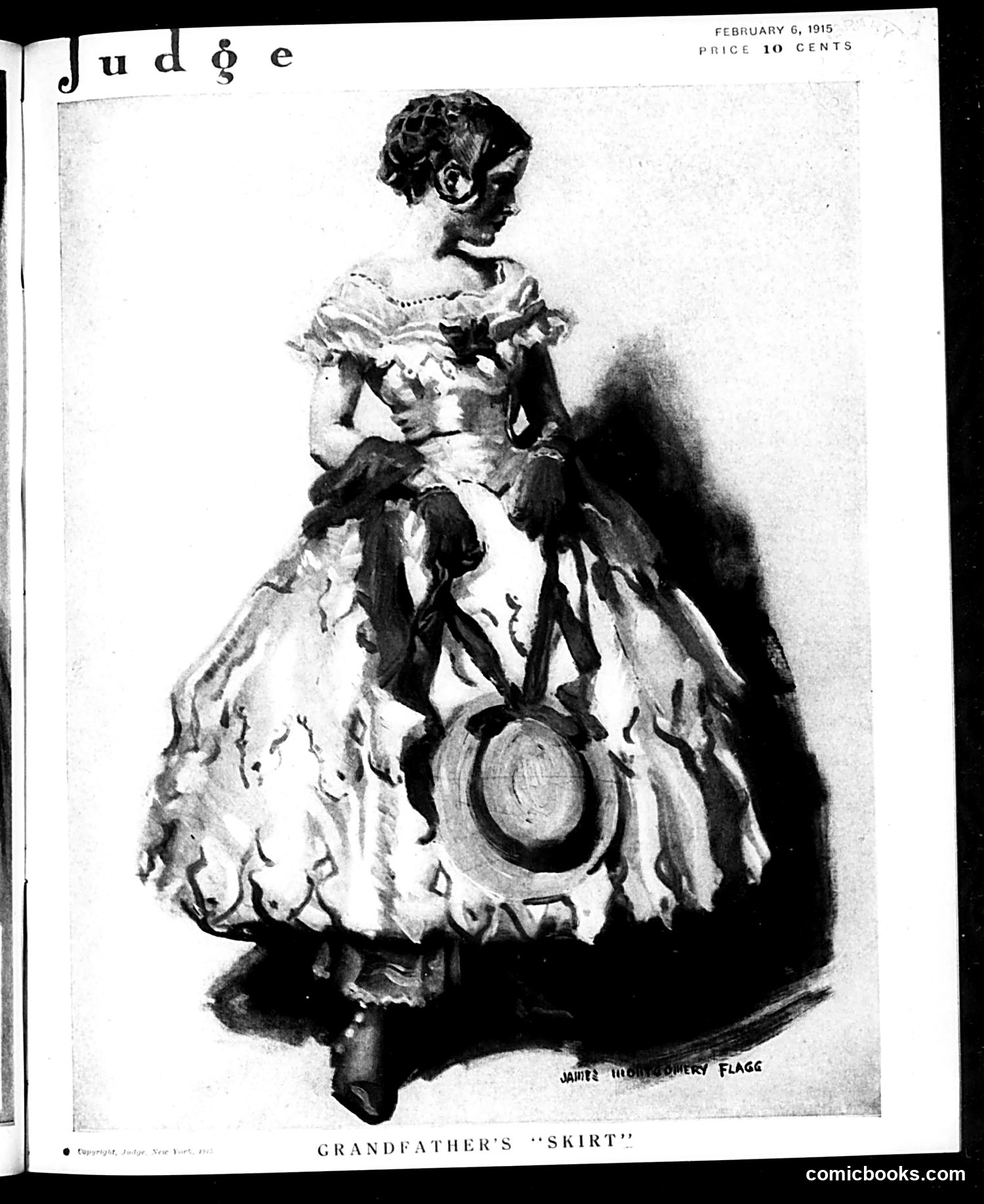
This cartoon by James Montgomery Flagg satirizes women's fashion, specifically the voluminous skirts popular in the early 1900s. The illustration shows a woman in an enormously billowing skirt so large it appears to contain multiple layers of fabric—so much material that the caption humorously compares it to a "grandfather's skirt," suggesting the garment is old-fashioned or excessively substantial. The satire likely critiques the impracticality and excess of contemporary women's fashion during this era. The vast skirt volume required significant fabric and manufacturing, making such garments expensive. The joke targets both the absurdity of the silhouette and perhaps the wasteful nature of the trend among wealthy women, a common subject of social commentary in Judge magazine's satirical humor.
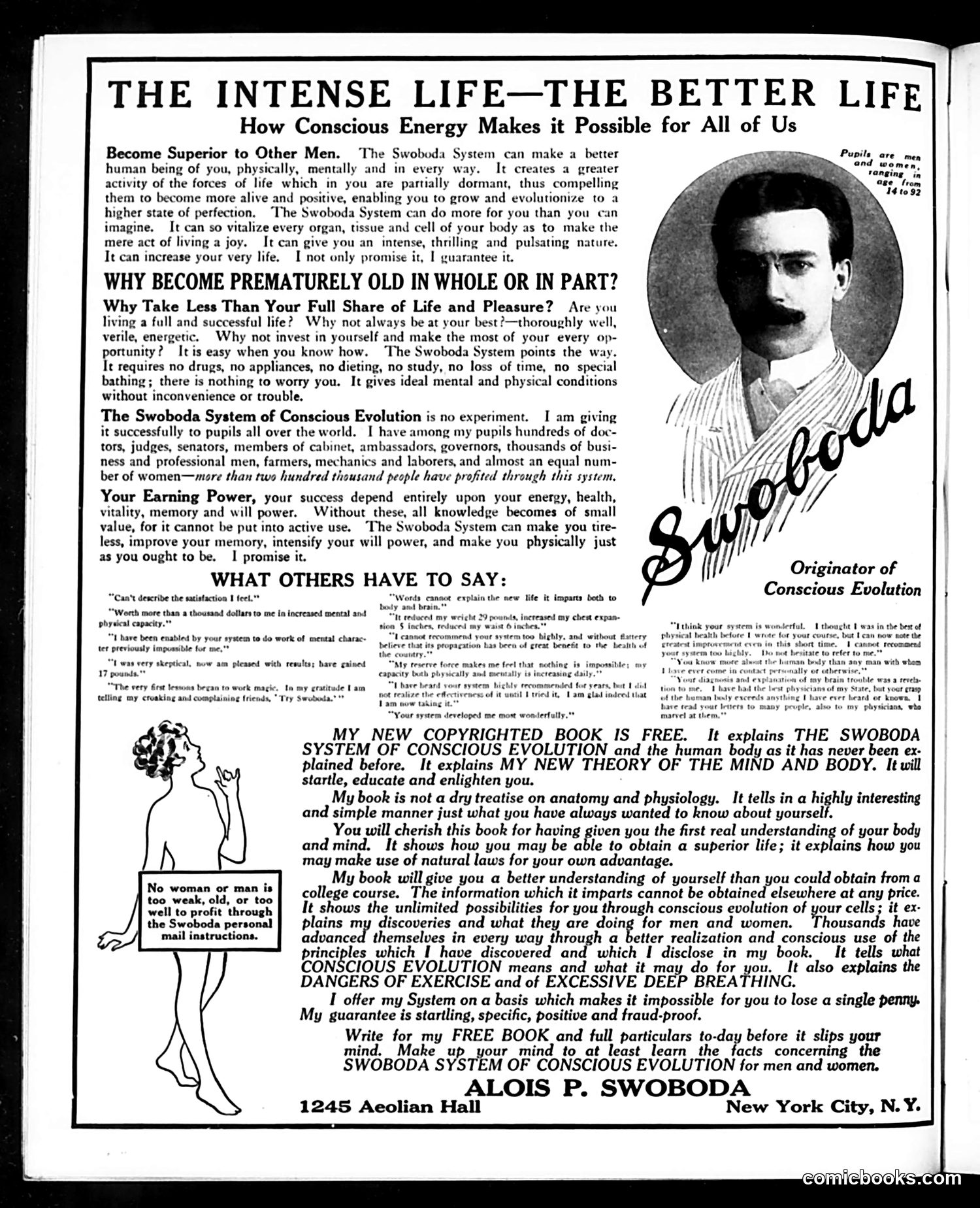
This page is **primarily an advertisement**, not political satire. It promotes the "Swoboda System of Conscious Evolution," a self-improvement program offered by Alois P. Swoboda (whose photograph appears on the right). The ad promises physical and mental enhancement—increased vitality, improved memory, and superior health—without drugs, dieting, or special study. Swoboda claims "more than one hundred thousand people" have benefited from his system. The small illustrated figures (a woman in various poses) appear to demonstrate physical exercises or postures associated with the program. This reflects early 20th-century pseudoscientific self-help marketing, when unregulated "self-improvement" systems proliferated in American magazines. The hyperbolic claims and testimonials are characteristic of the era's dubious wellness promotions.
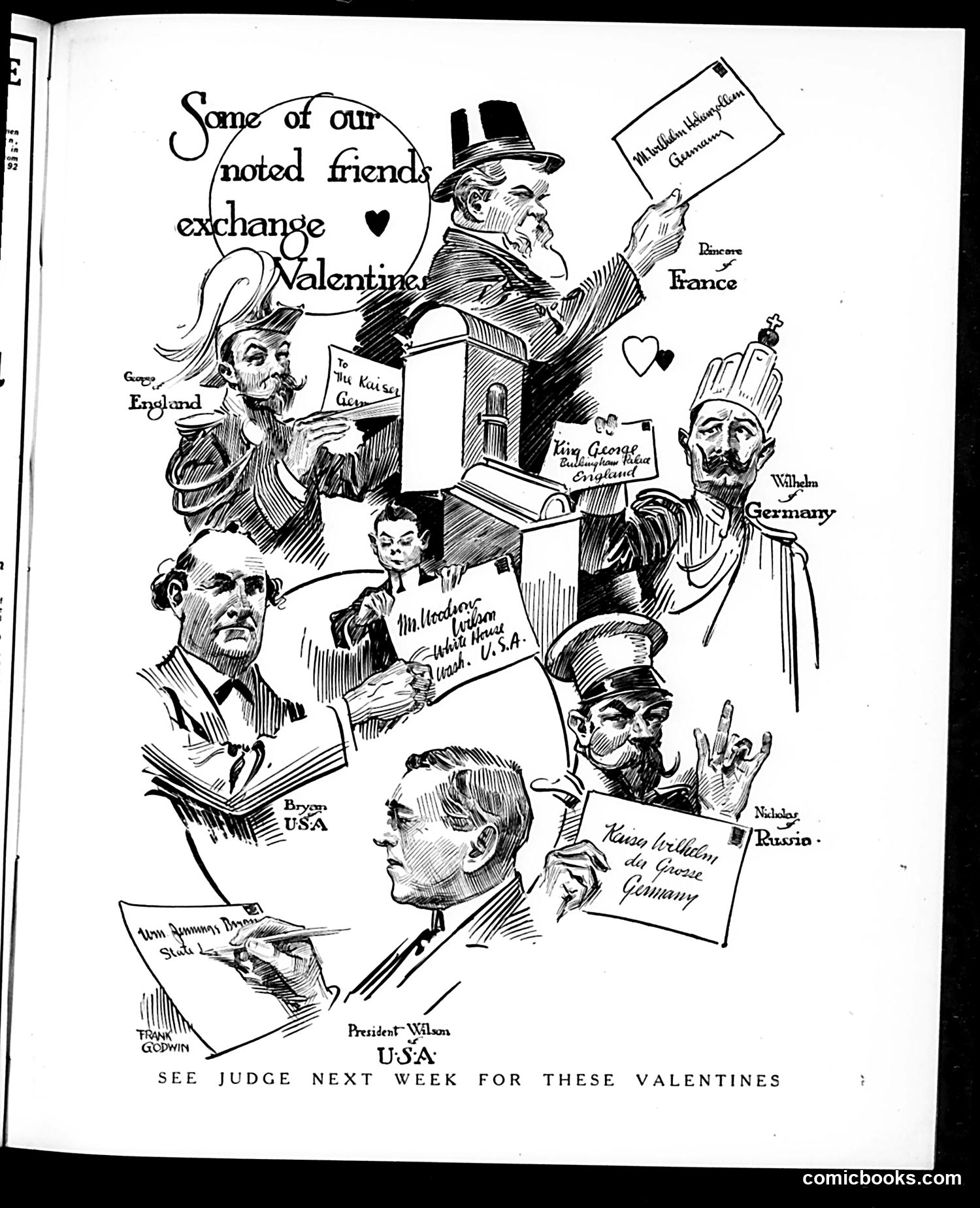
This is a satirical Valentine's Day cartoon from *Judge* magazine depicting world leaders during what appears to be World War I or the immediate post-war period. The central figure is a man in formal dress holding cards, surrounded by caricatured heads of state including representatives from England, France, Germany, Russia, and the USA (labeled Bryan and President Wilson). The satire mocks the diplomatic relationships and "exchanges" between Allied and Central Powers nations. The heart symbols and valentine theme ironically contrast with the serious geopolitical tensions of the era. The labels on cards held by various figures appear to reference diplomatic messages or treaties. The caption "See Judge Next Week for These Valentines" suggests continued commentary on international relations.
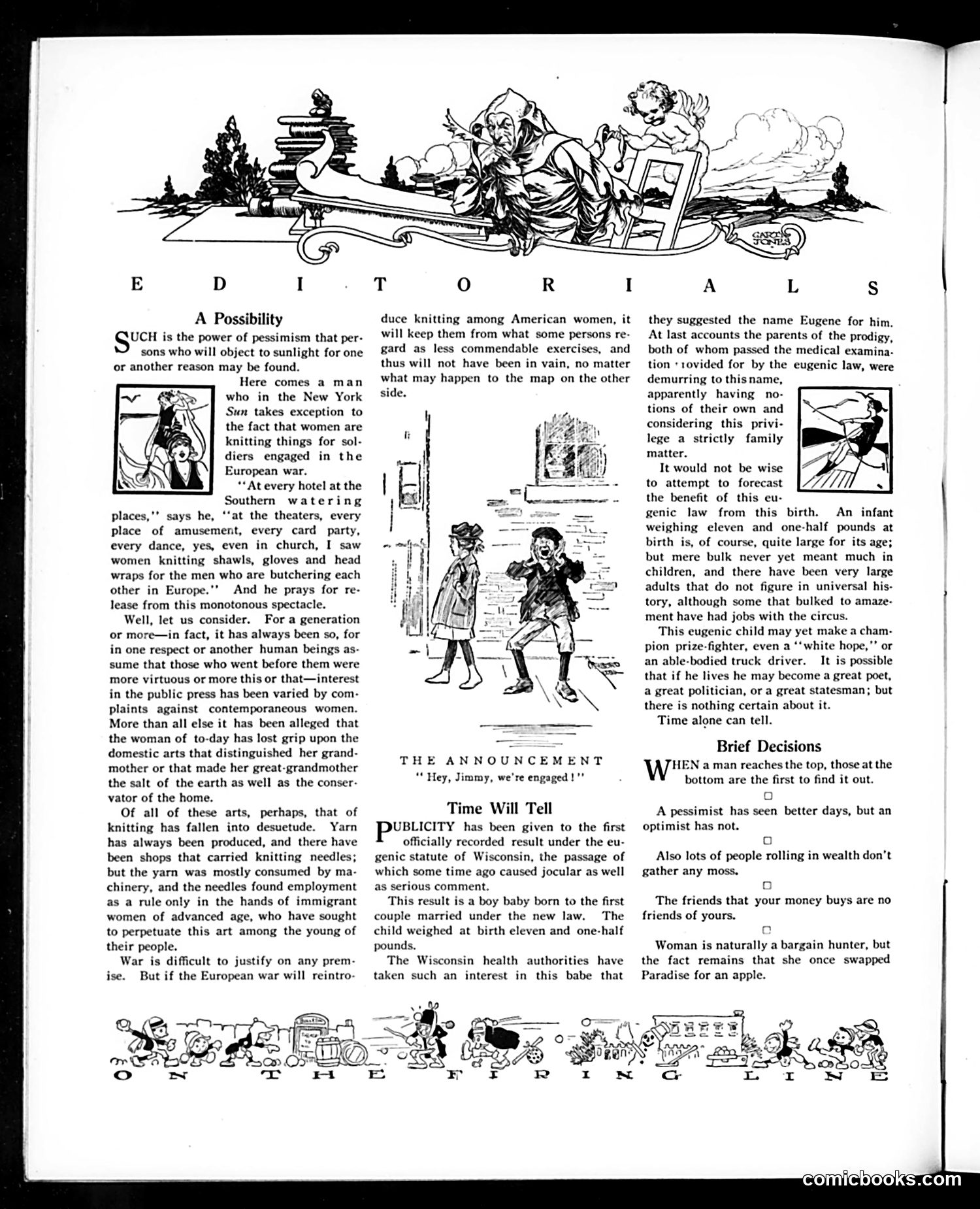
This page satirizes **pessimism** through an article titled "A Possibility," arguing that pessimists unfairly criticize women for knitting during wartime (likely WWI era, given European references). The author defends women's knitting as productive domestic contribution rather than frivolous activity. The central cartoon shows **"The Announcement,"** depicting a baby born under Wisconsin's new eugenic law. The satire targets **eugenics legislation**—contemporary pseudo-scientific policies attempting to improve human heredity through selective breeding. The article questions whether anyone can predict this child's future worth, mocking eugenic claims about predetermining human potential based on birth circumstances. The "Brief Decisions" section offers cynical life observations, maintaining the magazine's satirical tone throughout.
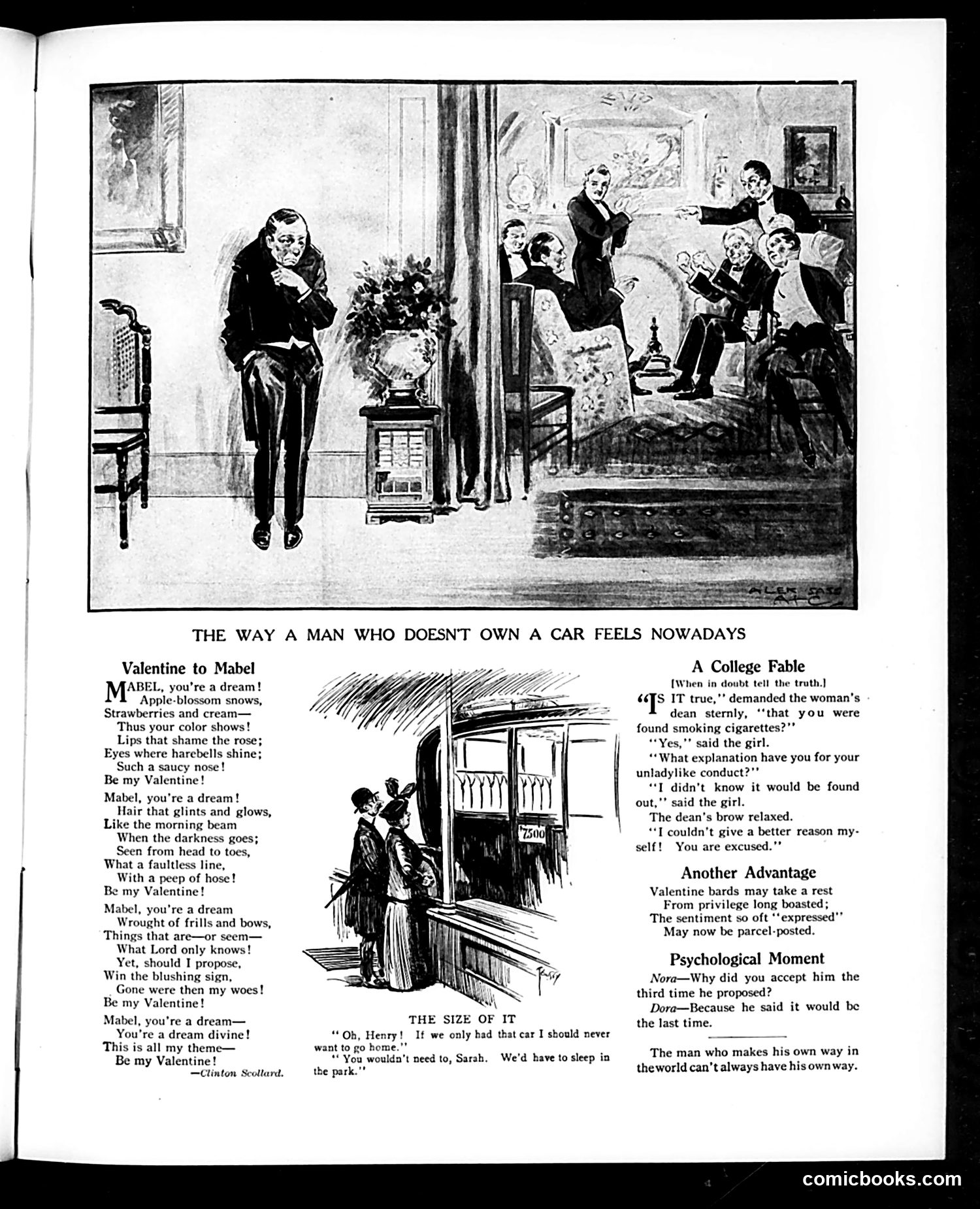
The top cartoon illustrates "The Way a Man Who Doesn't Own a Car Feels Nowadays" — showing a dejected man in an entryway while others socialize comfortably inside. This satirizes early-20th-century social anxiety around automobile ownership as a status symbol. Not owning a car apparently made one feel excluded or inferior in social settings. The surrounding literary pieces ("Valentine to Mabel," "A College Fable," etc.) use romantic and humorous verse to comment on courtship, gender relations, and social propriety of the era. "The Size of It" cartoon depicts a couple discussing whether they need a car, suggesting automotive purchases were becoming major household decisions and economic anxieties — reflecting the transformative impact of automobiles on American consumer culture and social status during the 1910s-1920s.
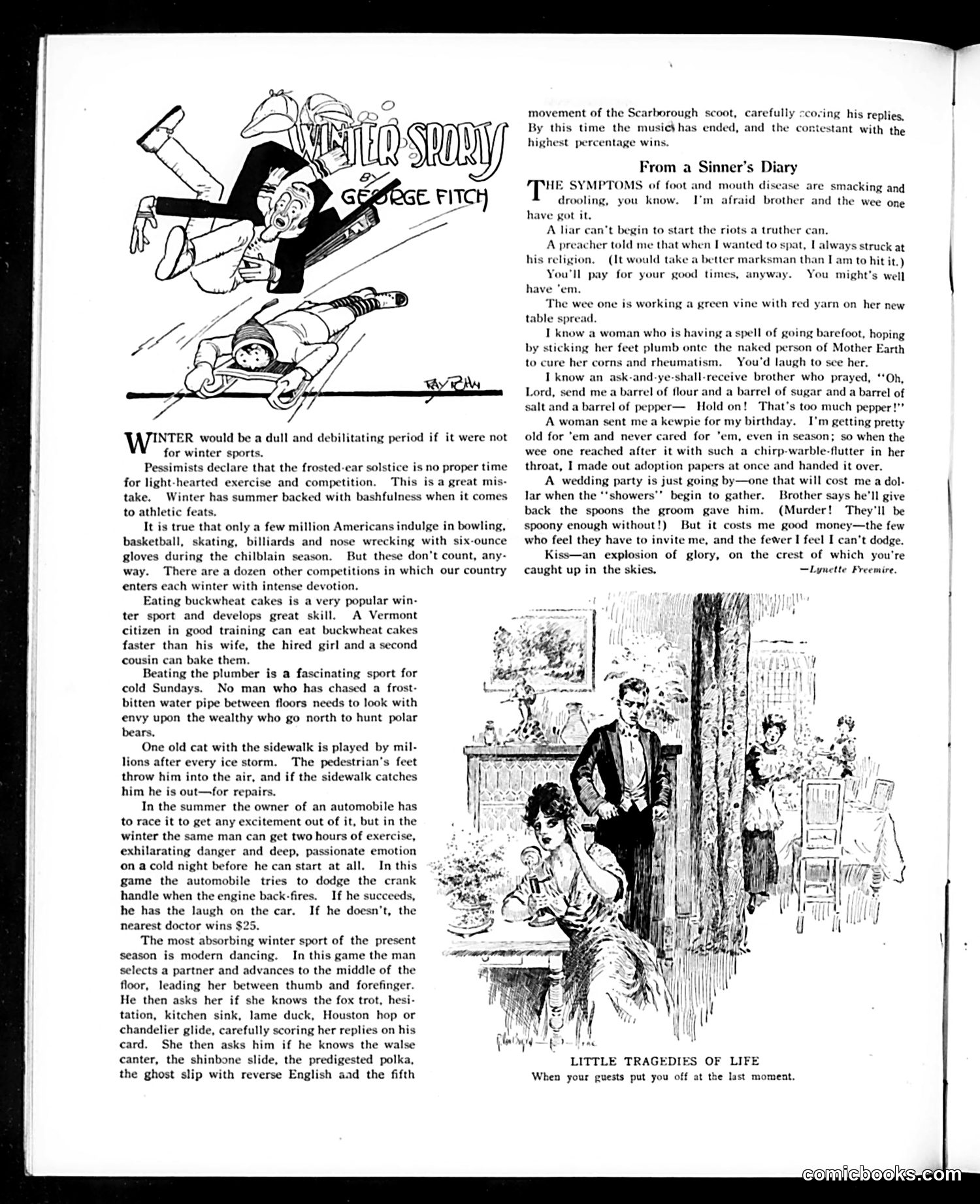
This page satirizes winter as a season of absurd "sports" and social inconveniences. The cartoons mock everyday hardships rebranded as competitive activities: eating buckwheat cakes faster than family members, chasing frozen pipes as plumbing "sport," slipping on icy sidewalks, and struggling to start automobiles in cold weather. The modern dancing section ridicules the contemporary dance craze by treating it as a competitive scoring game where partners quiz each other on fashionable dance names (fox trot, Charleston variants, etc.)—suggesting the dances are so numerous and silly that success requires memorization rather than skill. The "Sinner's Diary" column offers humorous observations about daily life's petty annoyances and social obligations (unexpected wedding gifts, unwanted kewpie dolls, mandatory wedding shower expenses). The cartoons by George Fitch employ the era's typical Judge formula: deflating pretension through exaggeration and situational irony.
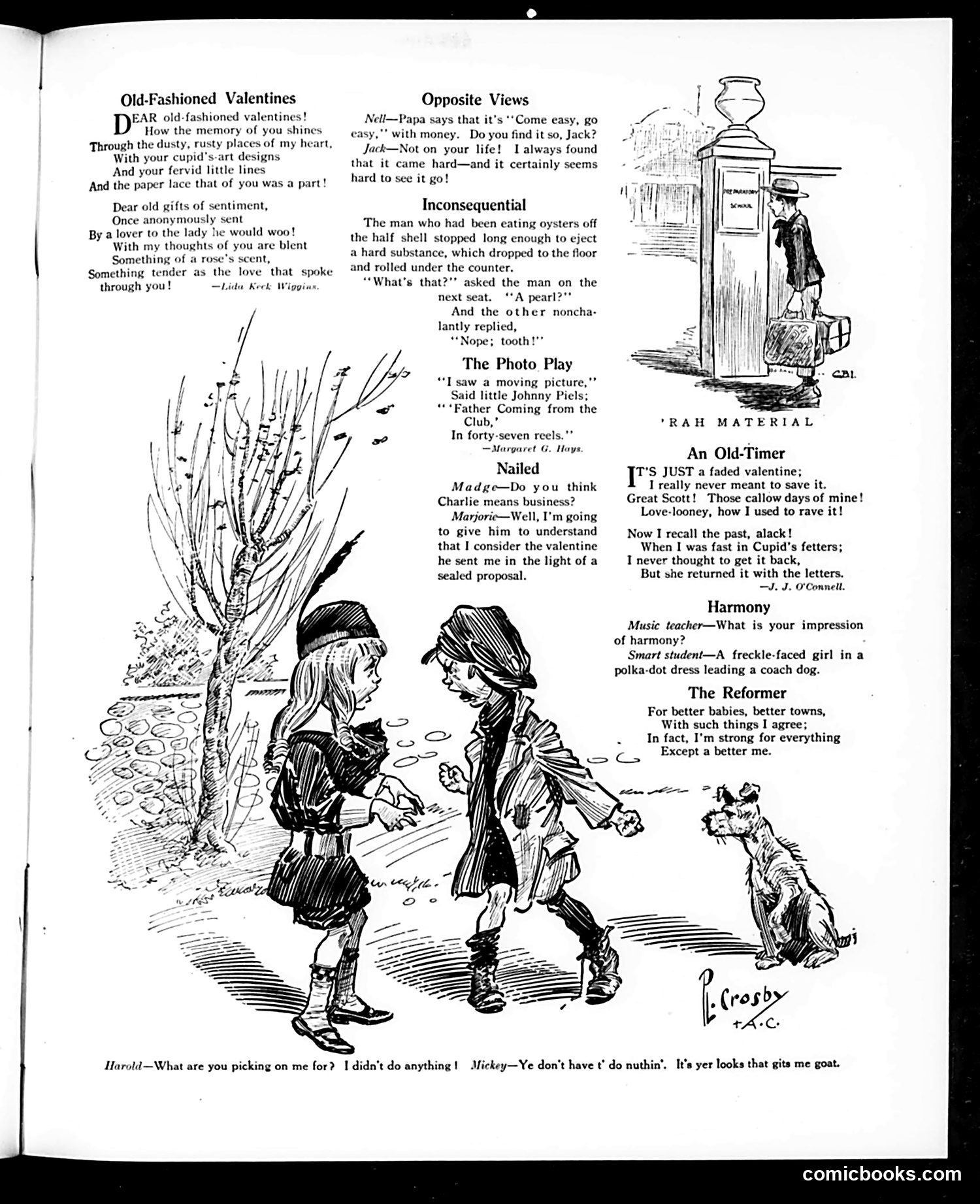
This page from Judge magazine presents early 20th-century humor through several short pieces and illustrations. **Content Overview:** The page mixes romantic nostalgia ("Old-Fashioned Valentines"), light domestic comedy, and social observation typical of the era's satirical magazines. **Key Items:** - **"Old-Fashioned Valentines"**: A sentimental poem lamenting the loss of anonymous, handwritten romantic gestures—contrasting with modern courtship practices. - **"Opposite Views"**: A brief joke about money: a father claims money comes easily; his son disagrees, noting it comes hard and goes harder. - **Comic sketches**: Dialogue between children ("Harold" and "Mickey"), young people debating valentine meanings, and classroom humor about harmony. - **"The Reformer"**: Self-aware satire mocking reform movements—the speaker champions progress for everyone except themselves. The illustrations by Crosby show period clothing and capture conversational moments. The overall tone is gentle mockery of courtship, economics, and progressive reform culture without targeting specific political figures or events.
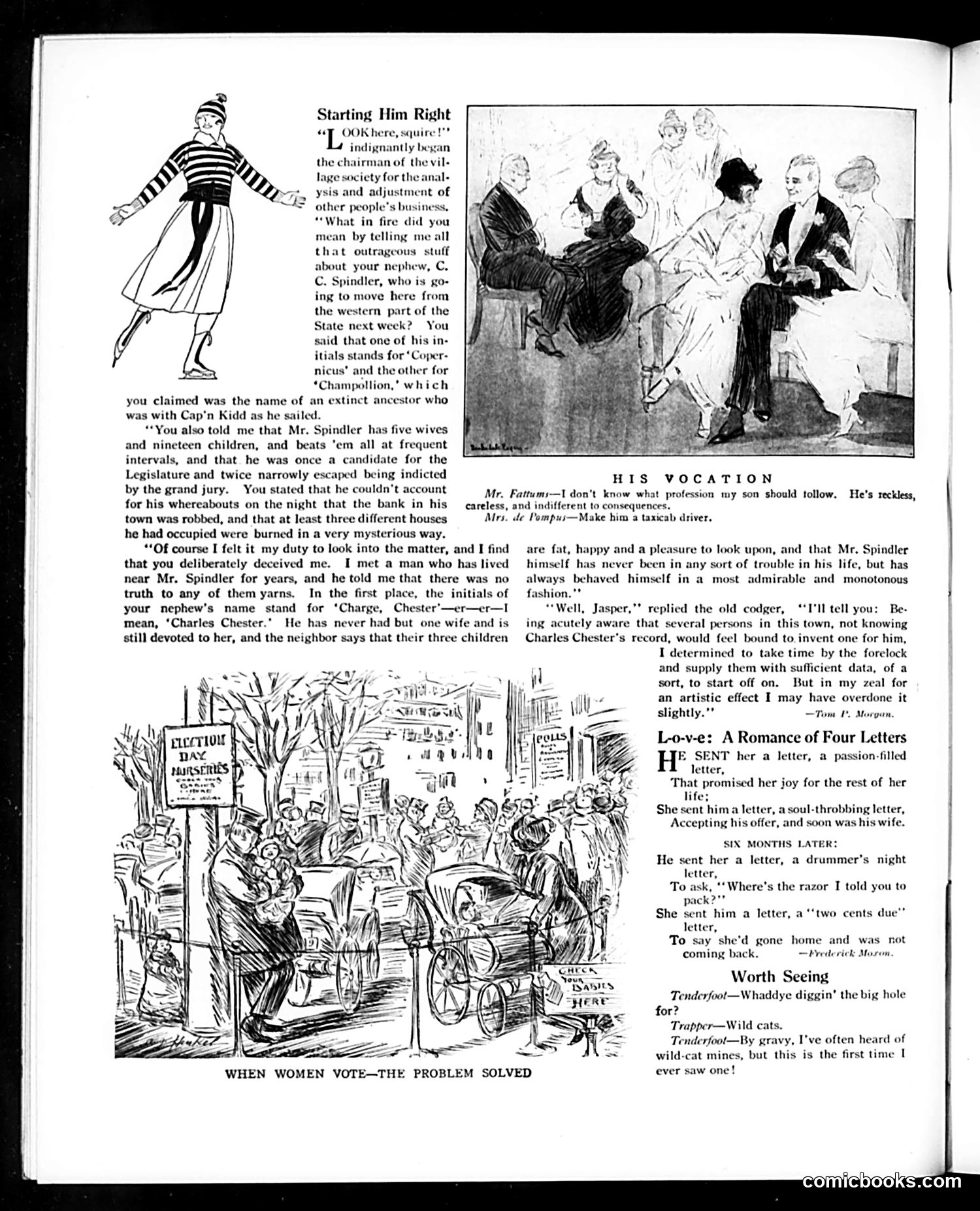
**"Starting Him Right"** satirizes small-town gossip and busybodies. A village busybody has deliberately spread false, damaging rumors about an incoming neighbor (C.C. Spindler) — claiming he's a criminal, polygamist, and arsonist. When confronted with the truth by an actual neighbor, he admits he fabricated the stories as "artistic effect" to give the town "sufficient data" for gossip. The joke mocks how small communities circulate rumors without verification, and how people like the chairman feel entitled to meddle in others' affairs while spreading misinformation. **"When Women Vote—The Problem Solved"** references women's suffrage (a contemporary political debate). The chaotic street scene with crowds and voting booths appears to satirize concerns about female voters. The implication seems to be that women voting would create chaos or be problematic — reflecting anti-suffrage attitudes common when this was published. The page also includes humorous advice columns and short comedic pieces typical of Judge magazine's satirical format.
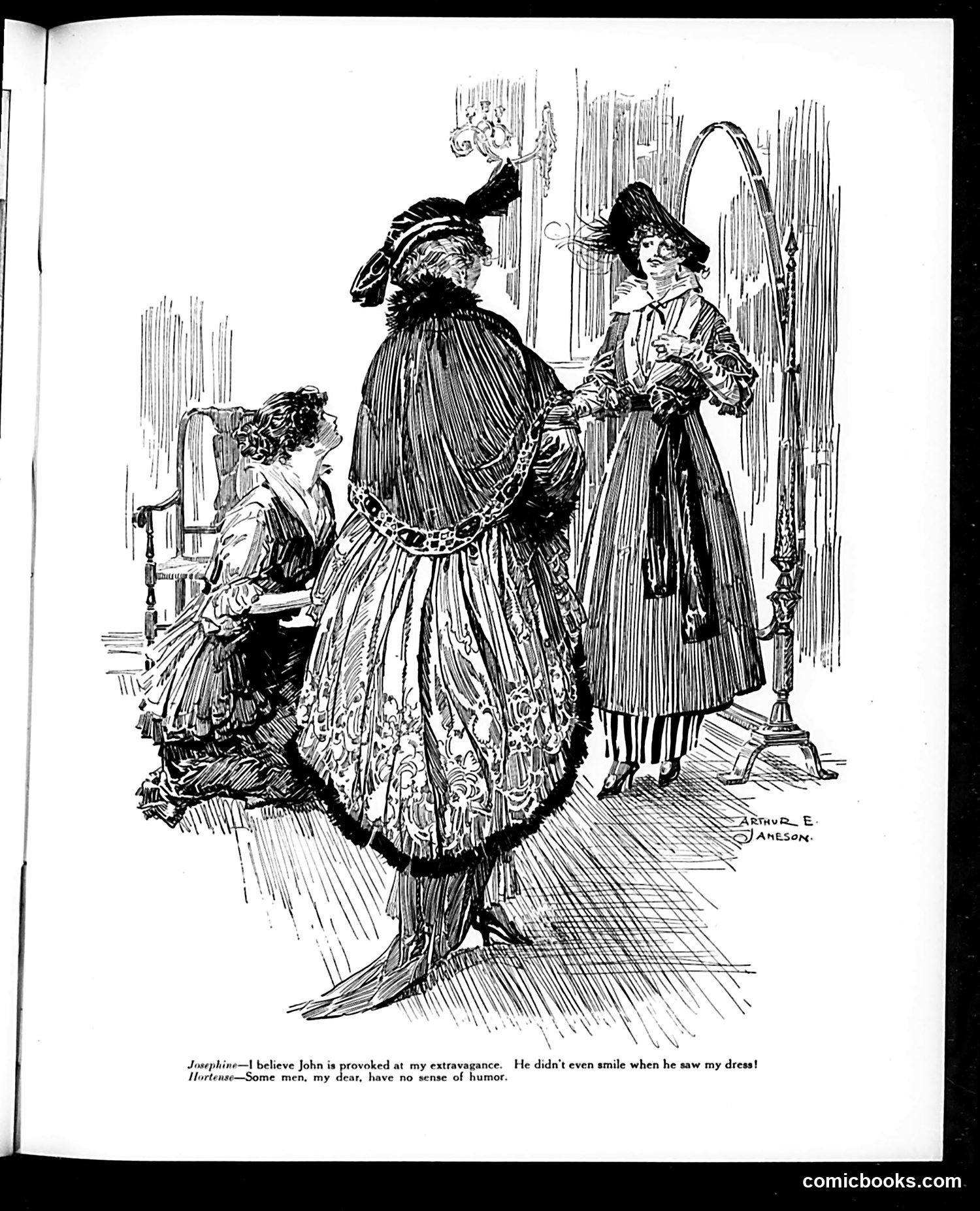
This illustration depicts two fashionably dressed women in what appears to be an elegant interior, with a third figure visible in the background. The dialogue suggests social commentary on marriage and gender dynamics. Josephine complains that her husband John is upset about her spending habits, interpreting his disapproval as a lack of humor. Hortense's response—that "some men" lack a sense of humor—satirizes the disconnect between spouses regarding financial extravagance, particularly women's spending on fashion and luxury goods. The cartoon mocks both the wife's dismissive attitude toward legitimate financial concerns and the broader early-20th-century tension between traditional male financial responsibility and women's growing consumer culture and independence. The elaborate dress depicted emphasizes the extravagance being discussed.
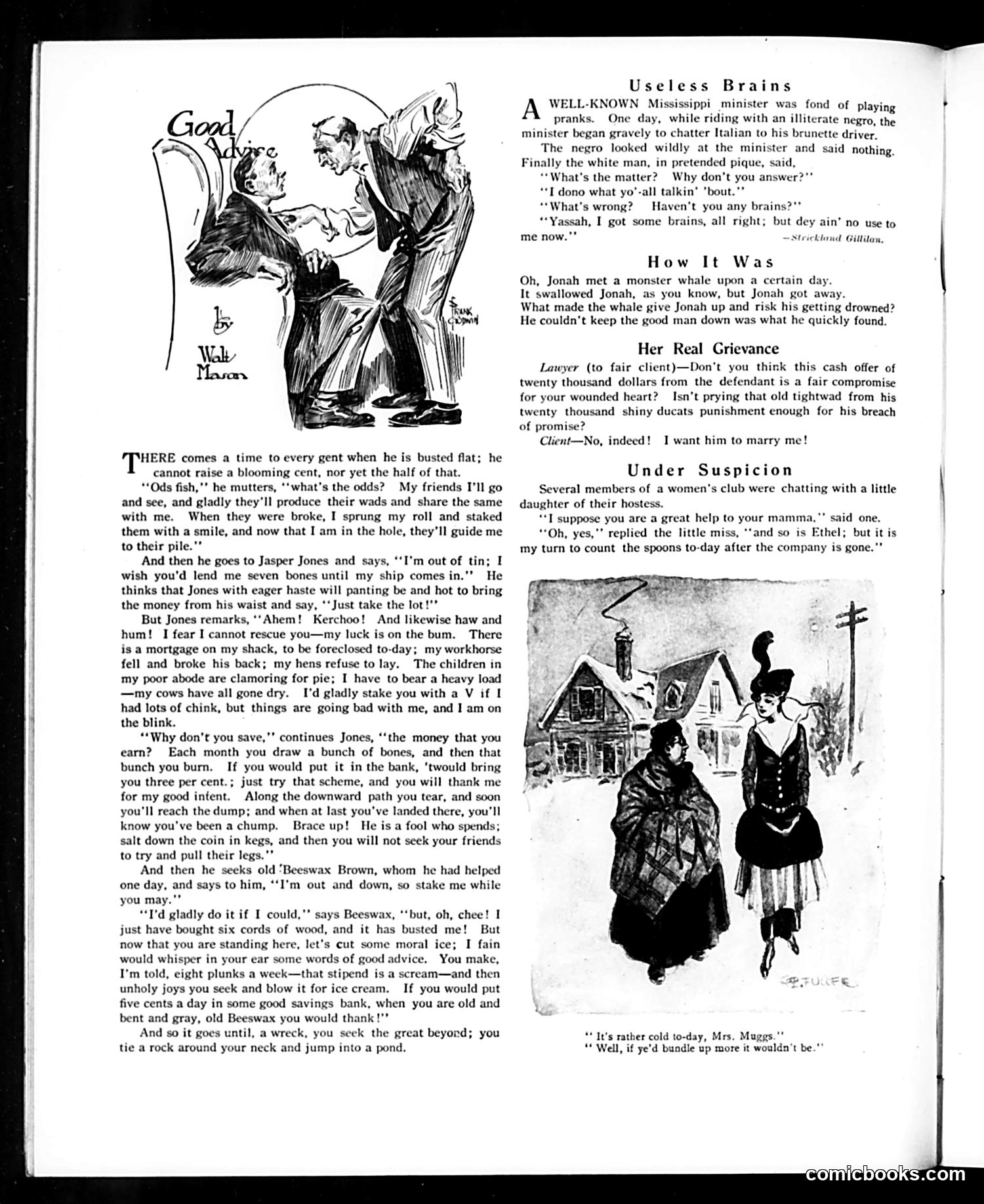
This page contains multiple short humorous pieces typical of early 20th-century American satire: **Main Story ("There comes a time")**: A cautionary tale about a broke man seeking loans from friends. When asking Jasper Jones for money, Jones refuses but lectures him on financial responsibility—saving money, avoiding frivolous spending (ice cream), and depositing earnings in banks. The story ends darkly with the protagonist committing suicide, emphasizing the period's moral anxiety about debt and financial ruin. **"Useless Brains"**: A racist anecdote featuring a white minister and an unnamed Black driver, mocking the driver's intelligence through dialect humor—standard "comic" material of the era reflecting period prejudices. **Other shorts**: Brief jokes about biblical Jonah, breach-of-promise lawsuits (a legal concern of the time), and women's club gossip. The overall tone reflects Judge's satirical commentary on class, morality, and social behavior in early 20th-century America, using crude stereotypes and dark humor now deeply uncomfortable by modern standards.
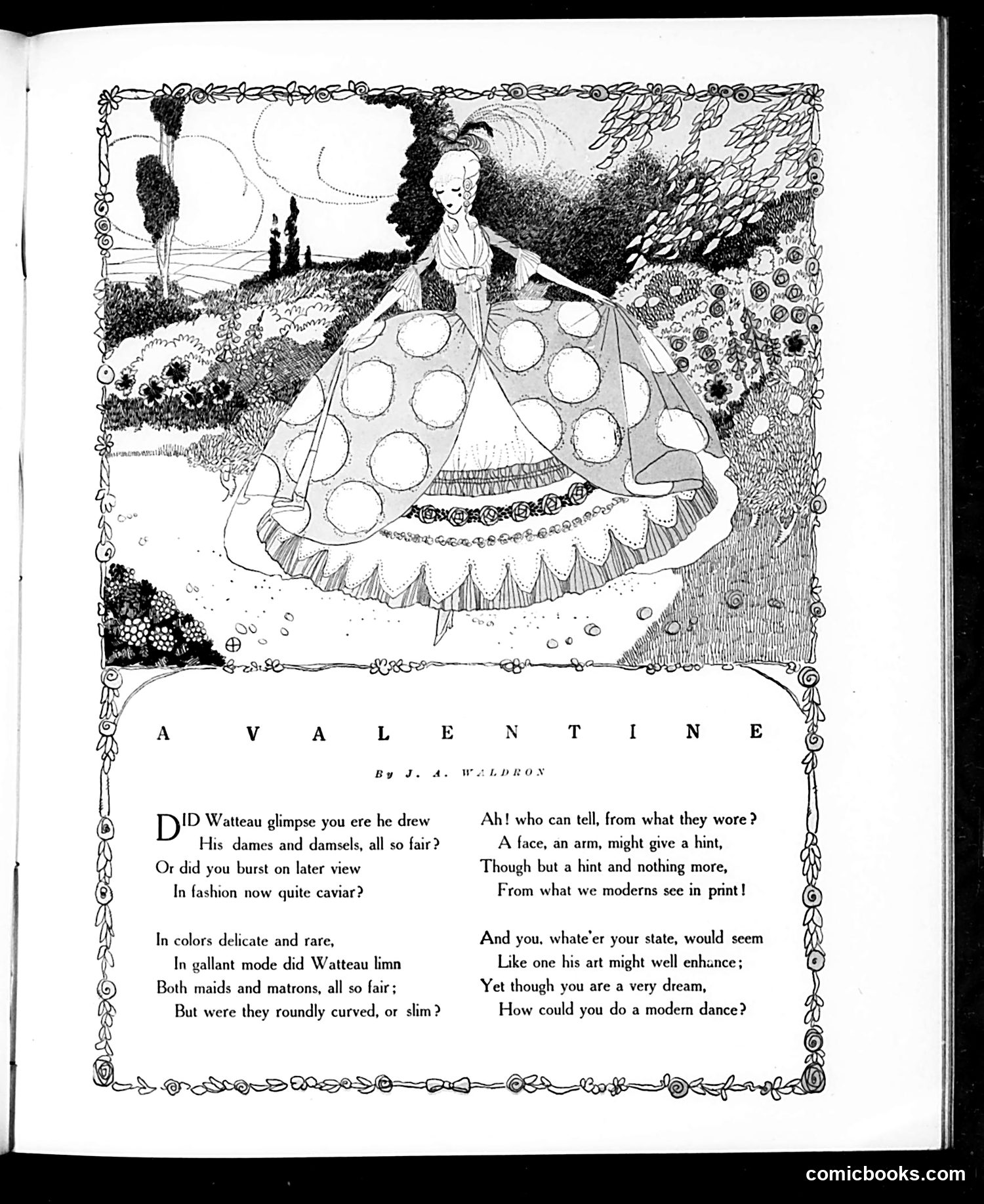
This is a satirical poem accompanying an illustration of a fashionably dressed woman. The satire contrasts 18th-century artistic ideals with modern (early 20th-century) fashion and behavior. The poem references **Watteau**, the French Rococo painter known for depicting elegant, delicately dressed aristocratic women. The joke mocks the tension between two eras: Watteau's subjects were portrayed in refined, constrained garments that obscured their actual body shapes—leaving mystery about whether they were "roundly curved, or slim." The modern woman illustrated here, by contrast, wears a revealing dress with large circular cutouts (likely representing contemporary fashion's more exposed silhouette). The satire suggests that while this modern woman might inspire Watteau's art, she could never replicate the refined manners of his era—she's too much a "modern" woman to perform the graceful, controlled movements those old paintings implied. It's social commentary on how fashion and behavior have become more revealing and less restrained.
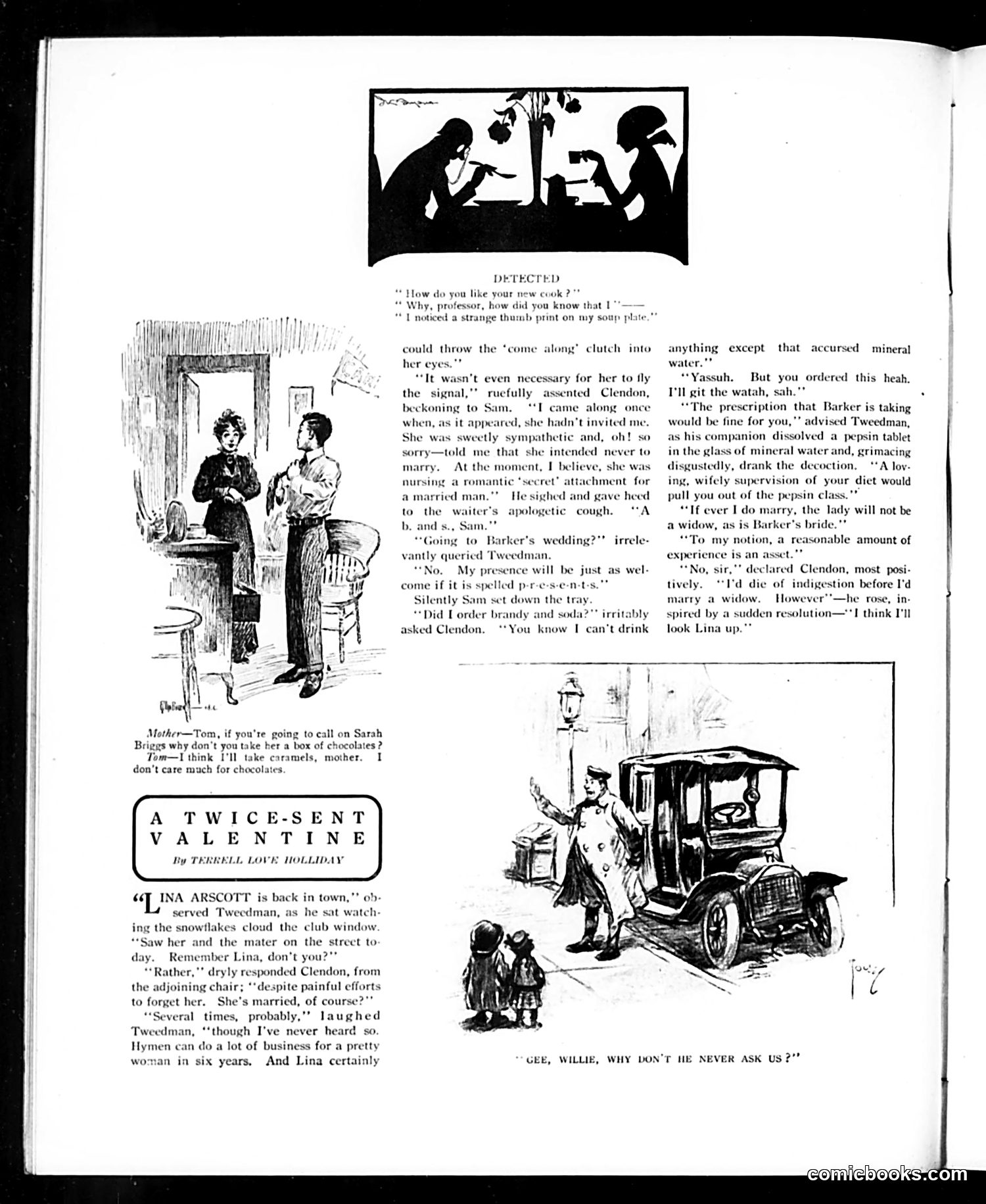
This page contains two separate pieces of early 20th-century humor: **"Detected"** (main story): A dialogue between two men at a club discussing their new cook, whom one professor recognizes as a "gold-digger" by her manipulative behavior—she feigns sympathy to trap men into marriage. The joke hinges on the period's skepticism about women's motives and satirizes masculine gullibility. The cook's scheme involves using emotional appeal to attract married men. **"A Twice-Sent Valentine"** (bottom feature): Brief vignettes mocking romantic pursuits. One depicts a mother encouraging her son to bring chocolates to a girl; another shows a man watching a woman pass, with the caption suggesting he lacks courage to approach her. The humor plays on Victorian courting anxieties and social awkwardness. **The cartoons** illustrate these scenarios with period clothing and settings. The overall tone reflects Judge's typical satire of urban social pretension and gender relations, portraying women as scheming and men as bumbling or timid.
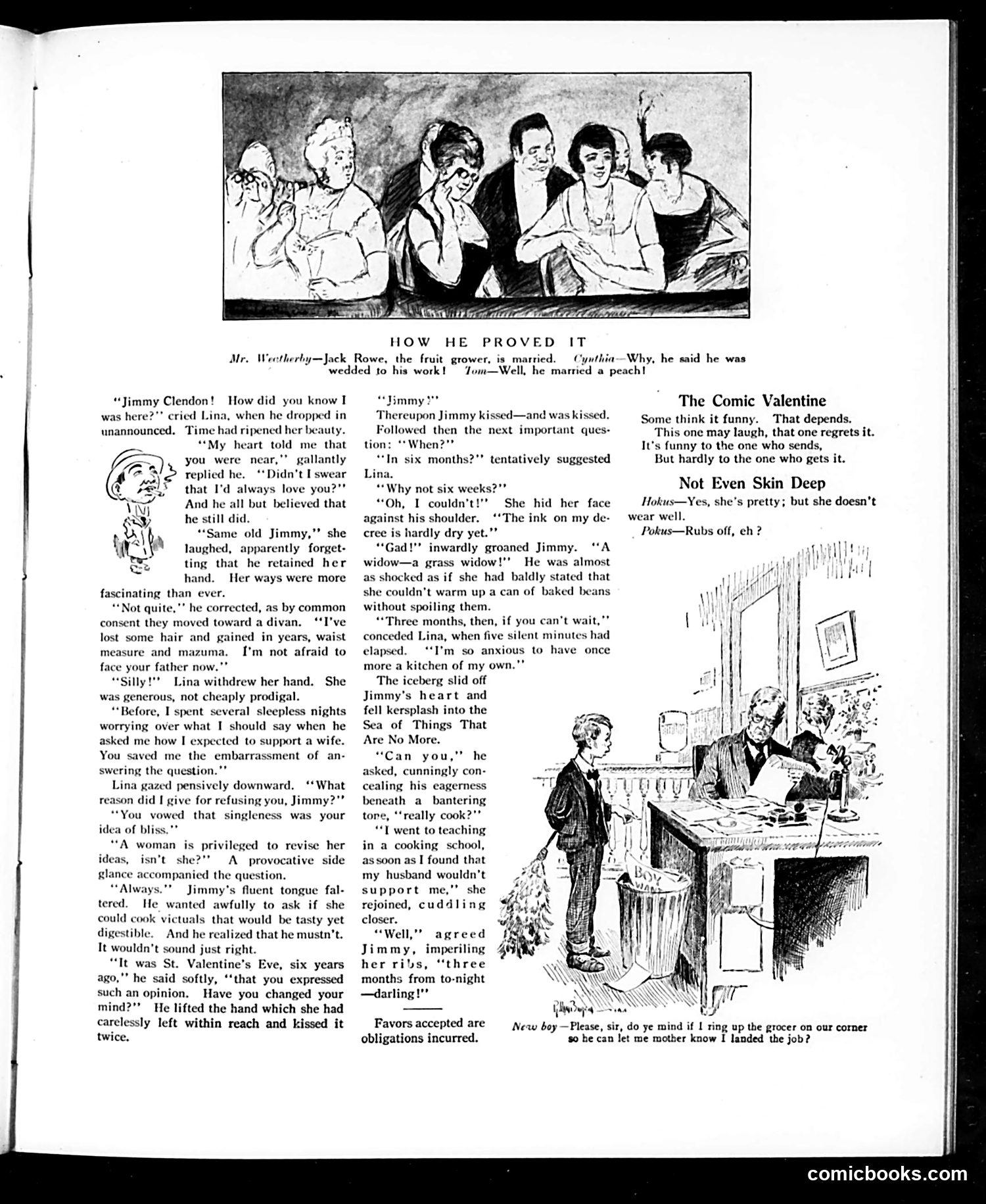
This page contains three separate pieces of comic fiction/satire, not political cartoons: 1. **"How He Proved It"**: A joke about a fruit grower named Jack Rowe who married a "peach"—a pun playing on the woman being desirable. 2. **"The Comic Valentine"**: A romantic story about Jimmy Clendon and Lina, where Jimmy must prove he can provide for a wife before marriage. The satire mocks courtship conventions and women's expectations about domestic capability (cooking, household management). 3. **"Not Even Skin Deep"**: A brief illustrated anecdote about a woman's appearance versus deeper character. These are lighthearted domestic humor pieces typical of Judge magazine's content—satirizing marriage customs, gender roles, and courtship expectations of the era rather than political issues. The humor relies on period-specific attitudes about women's roles and romantic conventions.
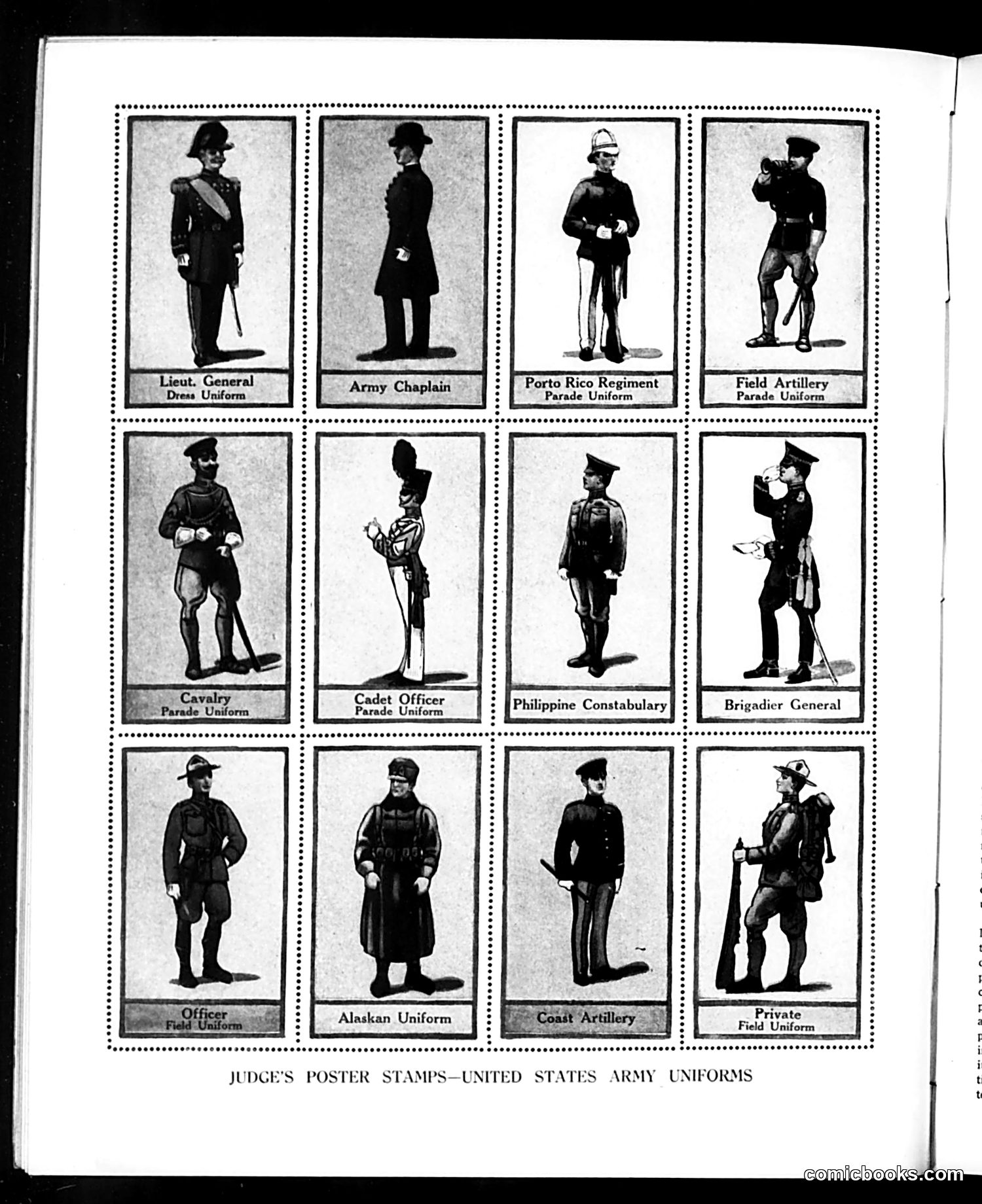
This page displays twelve illustrated military uniforms from the United States Army, presented as collectible "poster stamps." Each panel shows a different rank or unit in full dress: Lieutenant General, Army Chaplain, Porto Rico Regiment, Field Artillery, Cavalry, Cadet Officer, Philippine Constabulary, Brigadier General, Officer, Alaskan Uniform, Coast Artillery, and Private. This appears to be an educational reference rather than satire—likely from the early 20th century when Judge published such illustrated reference materials. The inclusion of "Philippine Constabulary" and "Porto Rico Regiment" reflects America's imperial expansion following the Spanish-American War. The uniform variations showcase military hierarchy and regional service distinctions. These stamps were probably collectible inserts for readers interested in military history.
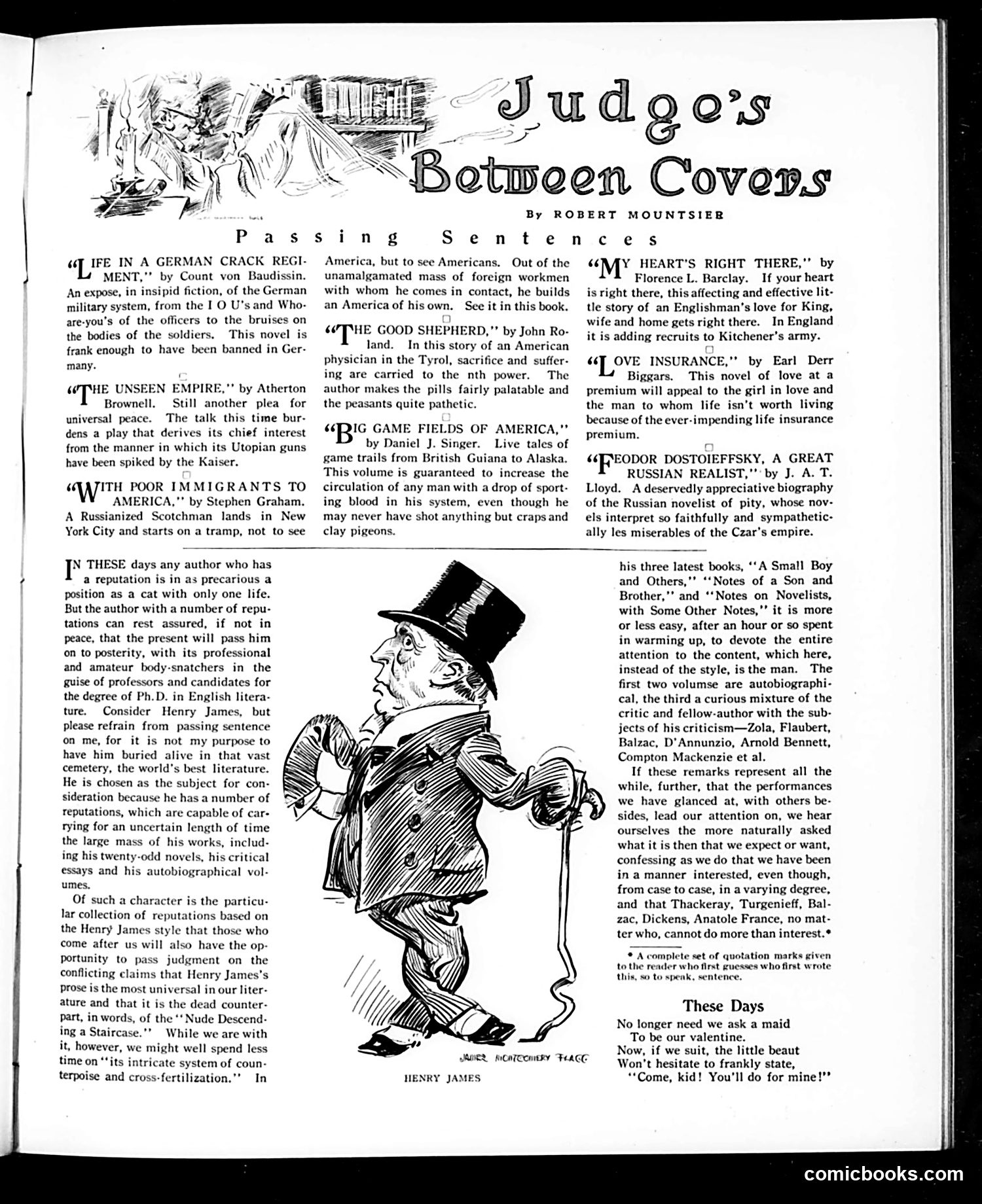
This is a **book review section** titled "Judge's Between Covers," not primarily a political cartoon. The main illustration shows **Henry James** in caricature—identifiable by the caption—depicted as a portly, well-dressed gentleman with a top hat. The text satirizes James's literary reputation and notoriously dense prose style. The reviewer argues that while James has multiple "reputations" that may sustain his work posthumously, his writing is overly complicated—comparing his prose style to Marcel Duchamp's abstract "Nude Descending a Staircase," suggesting it's incomprehensible rather than artistic. The surrounding book notices review contemporary fiction addressing topical concerns: German militarism, pacifism, immigration to America, and World War I recruitment (referencing Kitchener's army). The tone is mildly satirical toward these earnest novels while more sharply mocking James's self-important complexity.
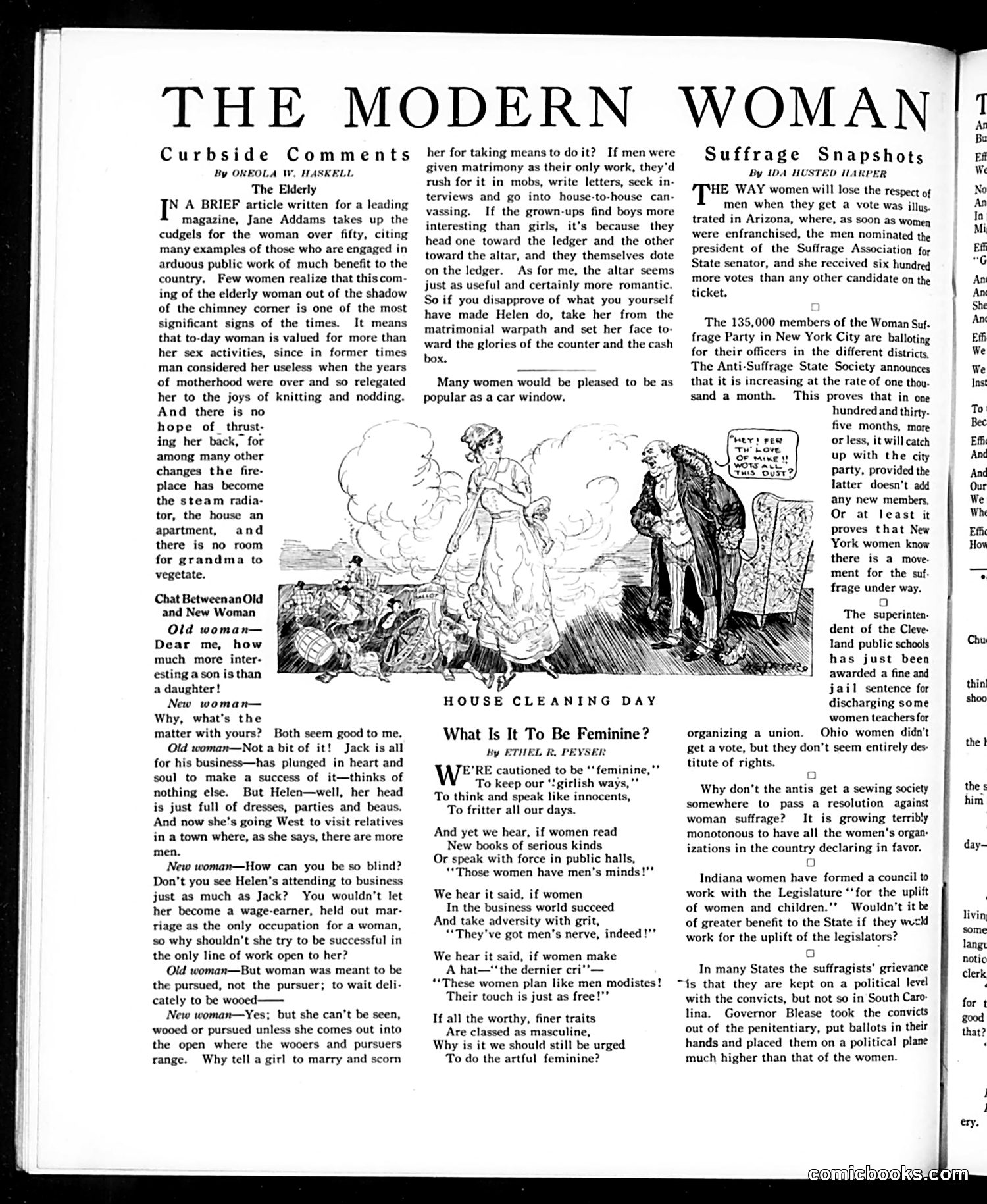
This page contains three satirical pieces on women's changing roles in early 20th-century America: **"House Cleaning Day" (center cartoon):** A woman in modern dress stands amid domestic chaos, illustrating the tension between traditional housework and women's expanding public roles. **"Chat Between an Old and New Woman":** A dialogue contrasts generational attitudes. The older woman views her daughter Helen's pursuit of marriage as proper; the younger woman counters that restricting women to matrimony as their "only occupation" is hypocritical—if men had such limits, they'd actively pursue wives too. She argues Helen is simply doing business intelligently. **"Suffrage Snapshots":** Reports on women's voting impact, including Arizona women nominating a suffragist for State senator who received 600 more votes than other candidates—suggesting women voters mobilized effectively. **Overall theme:** The satire challenges Victorian assumptions that women should remain domestic and passive, presenting the "New Woman" entering business, politics, and public life as logical, not radical.
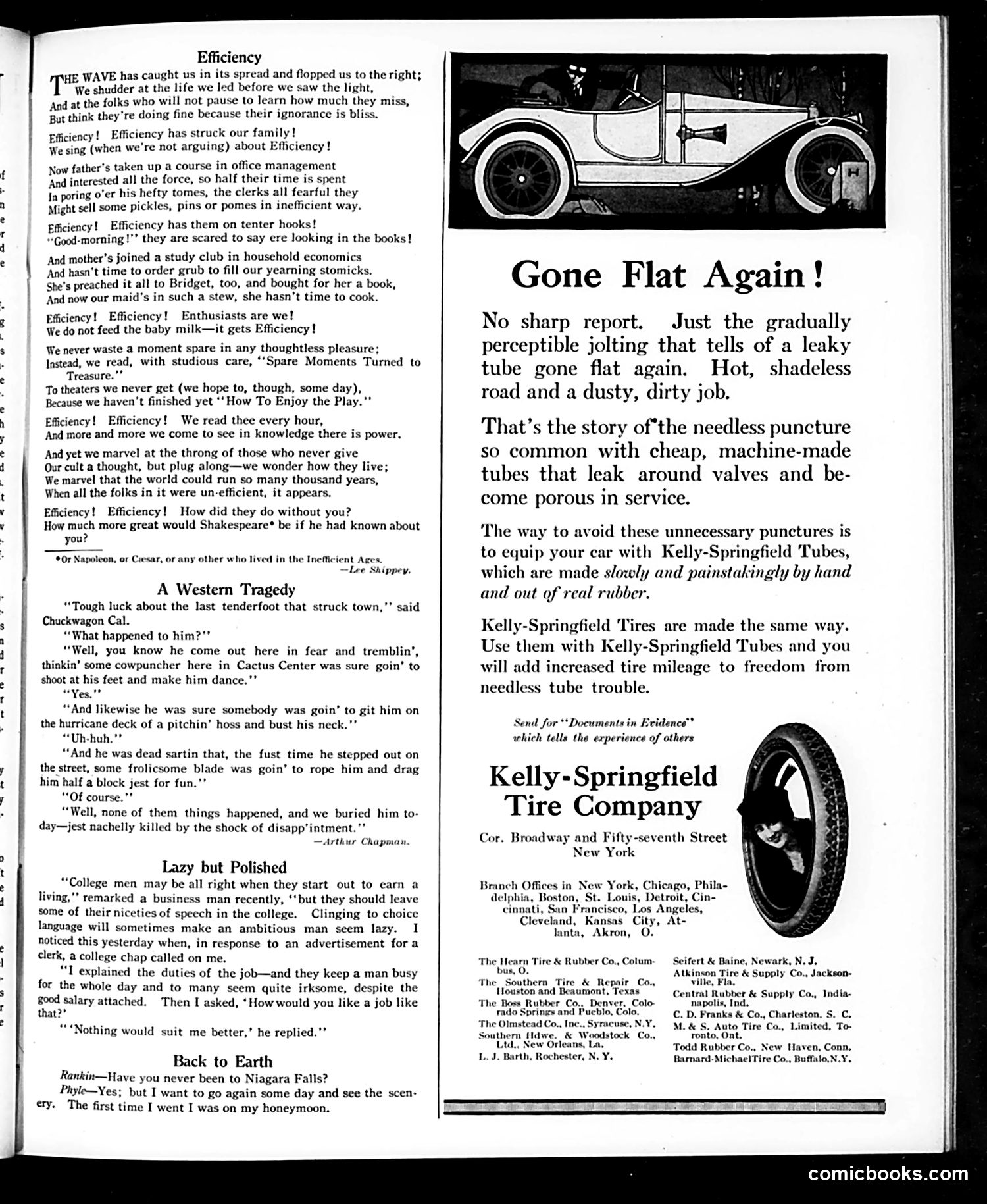
This page contains two distinct pieces: **Left side:** A satirical poem mocking the early 20th-century "Efficiency Movement"—a popular business/self-help craze emphasizing scientific management and optimization in both work and home life. The satire shows an entire family obsessed to dysfunction: the father studies office management, the mother joins a household economics club, even the maid gets efficiency instruction. The joke is that this obsession with "efficiency" has made them inefficient—they can't eat, enjoy theater, or function normally. The poem ridicules the cult-like devotion to this trend, even sarcastically suggesting Shakespeare and Napoleon would have been "greater" had they known about efficiency. **Right side:** An advertisement for Kelly-Springfield Tires and Tubes, using the common problem of flat tires to pitch their product. The "Gone Flat Again!" headline plays on motorists' frustrations with cheap, poorly-made tubes that leak. The ad emphasizes Kelly-Springfield's hand-made quality as superior to machine-made competitors.
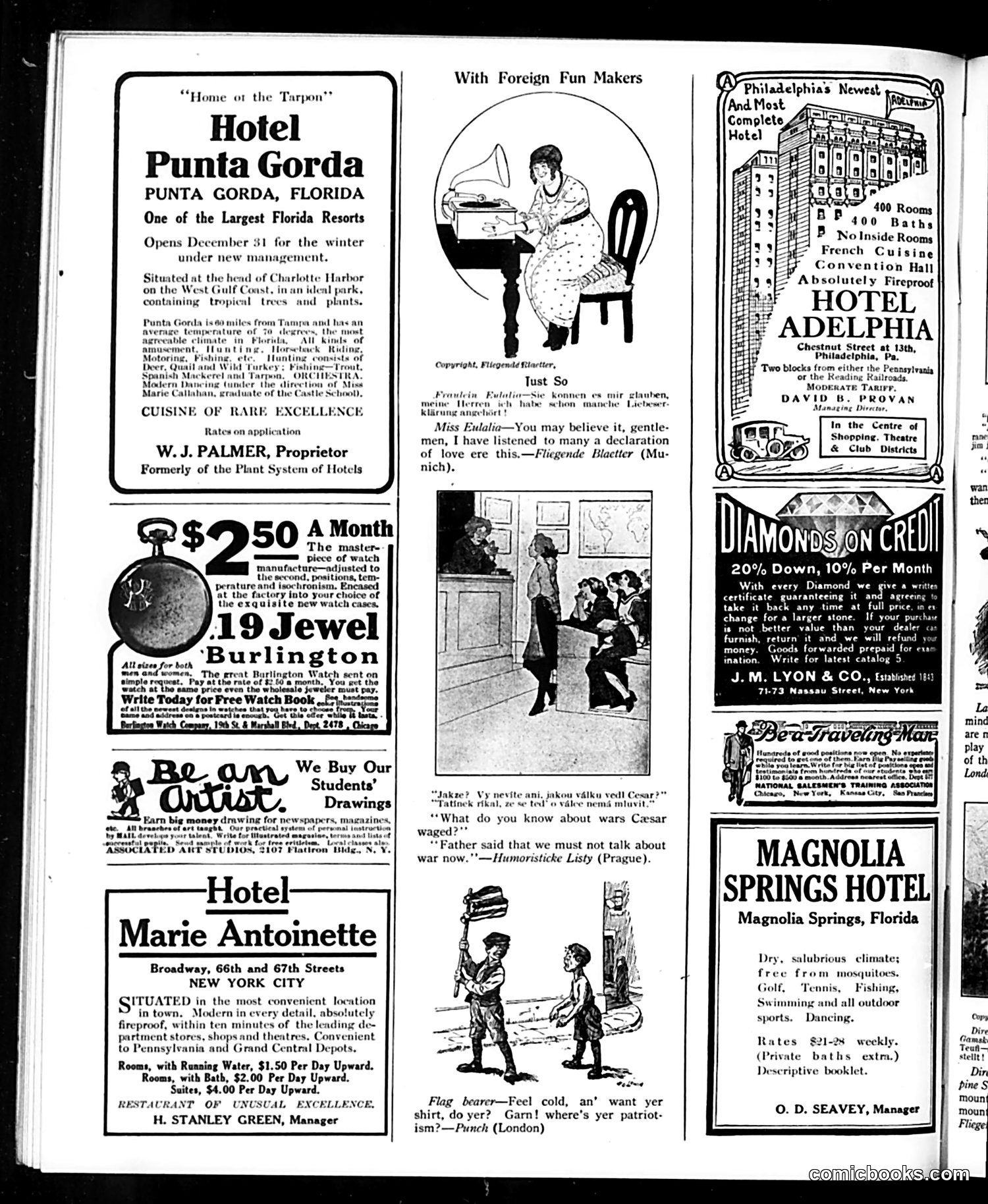
This page is primarily **advertising** for hotels and luxury goods from the early 20th century, with small satirical cartoons interspersed from European humor publications. The main cartoon shows a woman at a phonograph under the heading "Just So," with attributed text from *Fliegende Blätter* (Munich). The joke, in German, translates to something like: "Miss Eulalia, you can believe it, gentlemen, I have listened to many a declaration of love before"—a quip about women hearing romantic overtures repeatedly. A second small cartoon depicts children discussing war, attributed to *Humoristicke Listy* (Prague), likely satirizing how children absorb or avoid discussion of wartime topics. A third cartoon from *Punch* (London) shows a street vendor selling flags, asking a customer "Where's your patriotism?"—likely commenting on commercialized nationalism or war profiteering. These European cartoons represent *Judge* magazine's practice of republishing international humor. The satire is genteel, society-focused, and references romantic and patriotic themes rather than hard political critique.
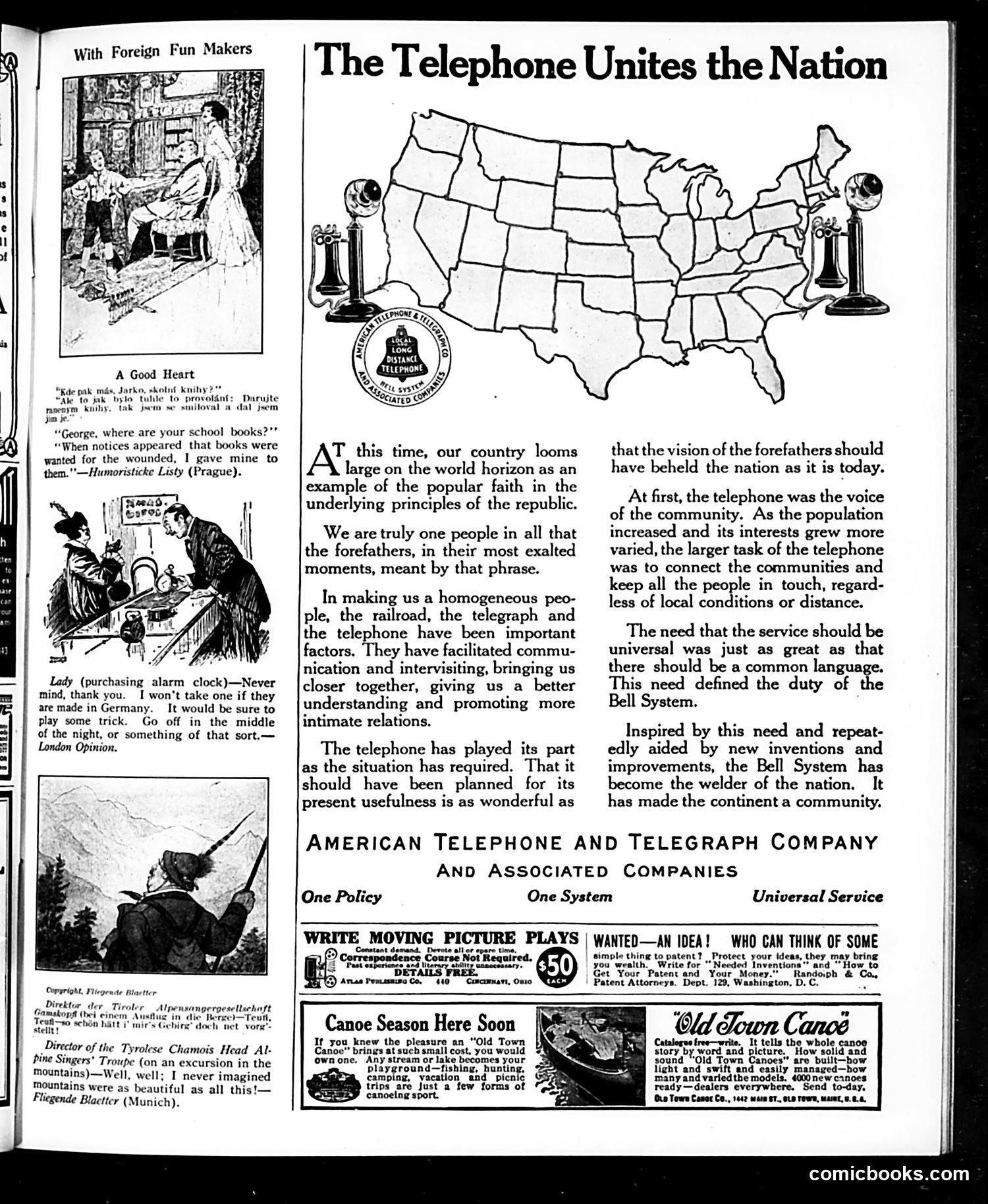
This page is primarily a corporate advertisement for AT&T and Bell System, framed as patriotic commentary. The main article uses nationalistic language to argue that the telephone, alongside railroads and telegraphs, has unified America by enabling communication across distances and fostering "intimate relations" between communities. The left side contains three brief foreign humor cartoons (from Prague, London, and Munich publications) about wartime sacrifice, German manufacturing distrust, and Alpine tourism—these appear designed to contextualize American unity and superiority. The AT&T advertisement's subtext—published during what appears to be WWI era based on references to "wounded" needing books—equates corporate infrastructure with democratic ideals. The Bell System is positioned as fulfilling the Founders' vision by literally "welding the nation" together. The page also includes smaller ads for writing screenplays, patent ideas, and Old Town Canoes, representing typical magazine revenue.
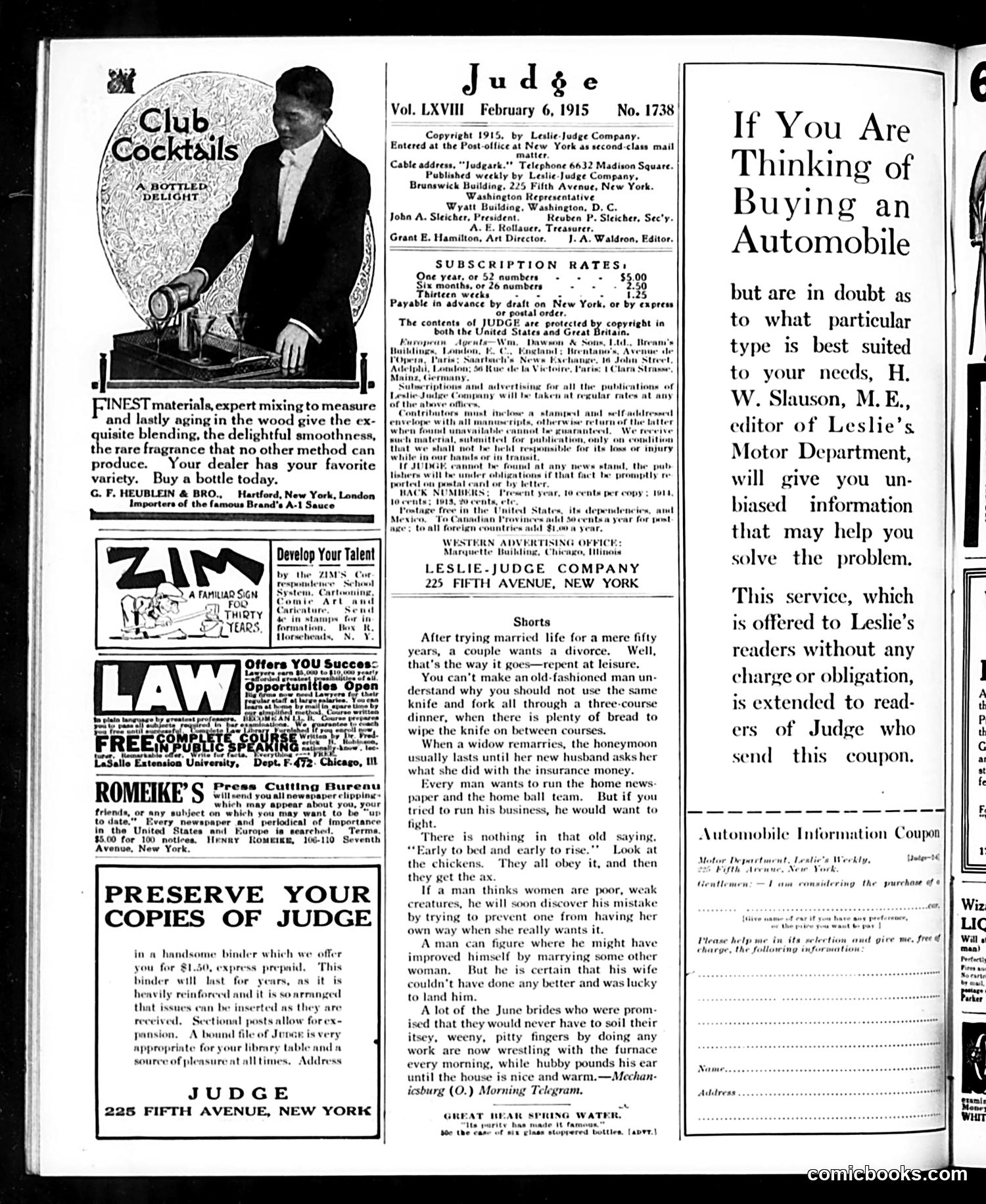
This page from *Judge* (February 6, 1915) is primarily **advertising and service announcements**, not political satire. The main content includes: 1. **Heublein cocktail advertisement** — a bartender preparing mixed drinks, promoting bottled cocktails as a quality product 2. **"Shorts" humor column** — brief, domestic jokes about marriage, divorce, and gender relations typical of 1915. These mock traditional marriage dynamics: men wanting to control home news/sports, wives surprising husbands after 50 years wanting divorce, June brides disillusioned about housework while husbands sleep 3. **Service offerings** — advertisements for magazine preservation binders, a press-clipping bureau, and law school opportunities 4. **Automobile information coupon** — offering free automotive advice to readers The "Shorts" reflect early 20th-century attitudes: gentle mockery of marital discord, wives' domestic labor, and gender role expectations. No specific political figures or events are referenced—it's general social commentary on contemporary middle-class life.

This page is primarily **advertising** with a small humor section. The main content includes: **"With The College Wits"** — A collection of brief jokes from college humor magazines (Michigan Gargoyle, Stanford Chaparral, Harvard Lampoon, etc.). These are gentle, collegiate humor pieces about romance, campus life, and wordplay — typical of early 20th-century student publication fare. One joke about a passionate embrace being a tired woman resting after running for a train exemplifies the innocent, sentimental humor of the era. **"Aw Made These Men"** — The large right-side advertisement features five headshots of men, appearing to promote a correspondence school law degree program. This reflects the era's mail-order education industry. **Remaining content** — Various product advertisements (Vaseline Hair Tonic, Wizard Liquid Pistol, jewelry, a dime bank) typical of period magazines. No significant political satire is evident on this page. The page reflects early 1900s consumer culture and collegiate humor standards.
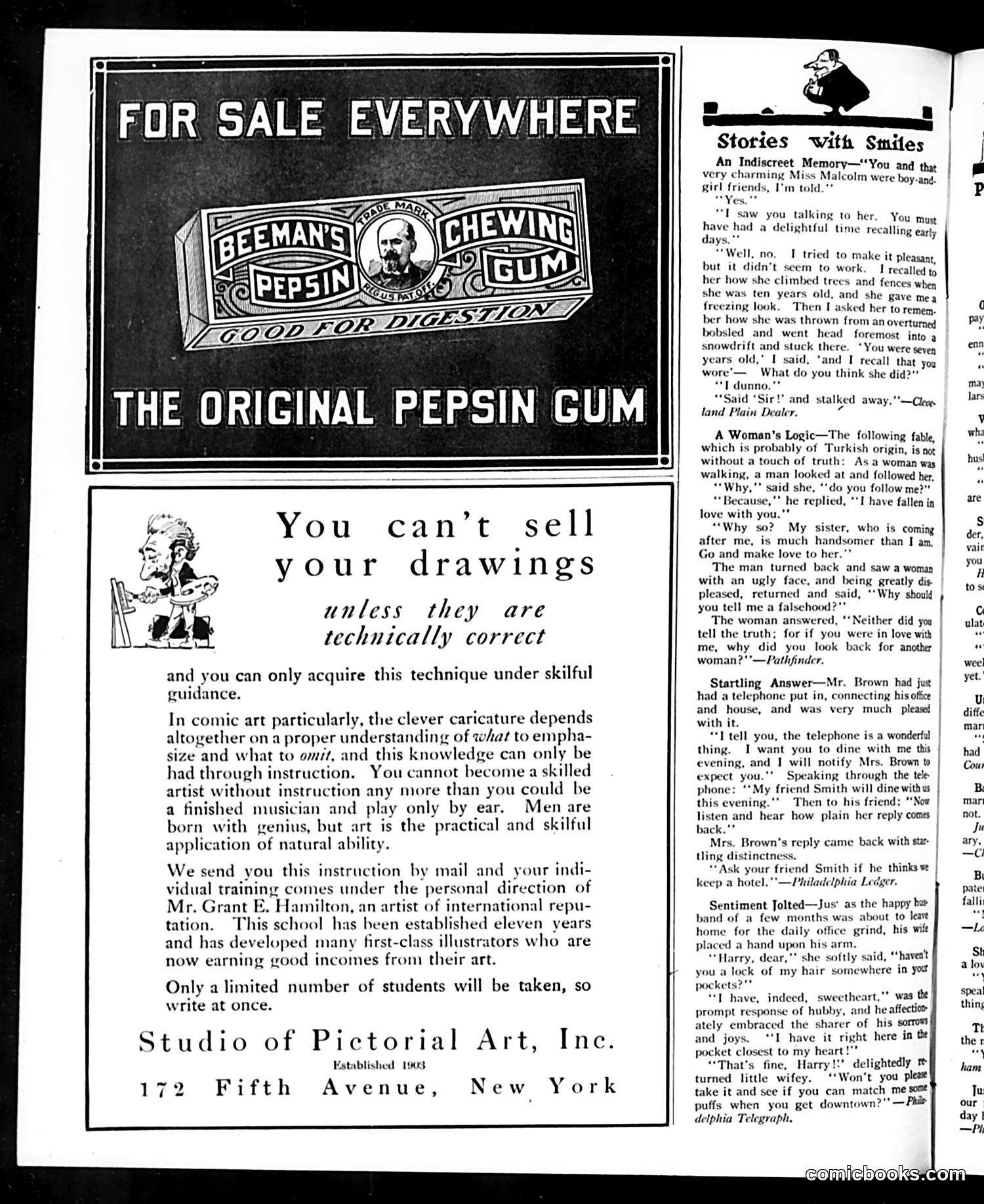
This page contains two sections: **advertising** (left) and **light humor pieces** (right). The **left side** advertises the "Studio of Pictorial Art, Inc.," a mail-order art school claiming to teach cartooning and illustration under Grant E. Hamilton's direction. The pitch argues that artistic skill cannot be self-taught—you need formal instruction to understand "what to emphasize and what to omit" in caricature. This reflects early 1900s attitudes about professionalization and the growing market for commercial illustration and comics. The **right side** contains three brief, genteel humor pieces typical of *Judge* magazine's style: "An Indiscreet Memory" (awkward reunion with childhood friend), "A Woman's Logic" (absurdist fable about male follishness), and "Sentiment Jolted" (husband's romantic gesture punctured when wife reveals she just wants him to match hair puffs at the store). These are mild domestic comedies with no political content—humor for middle-class readers.
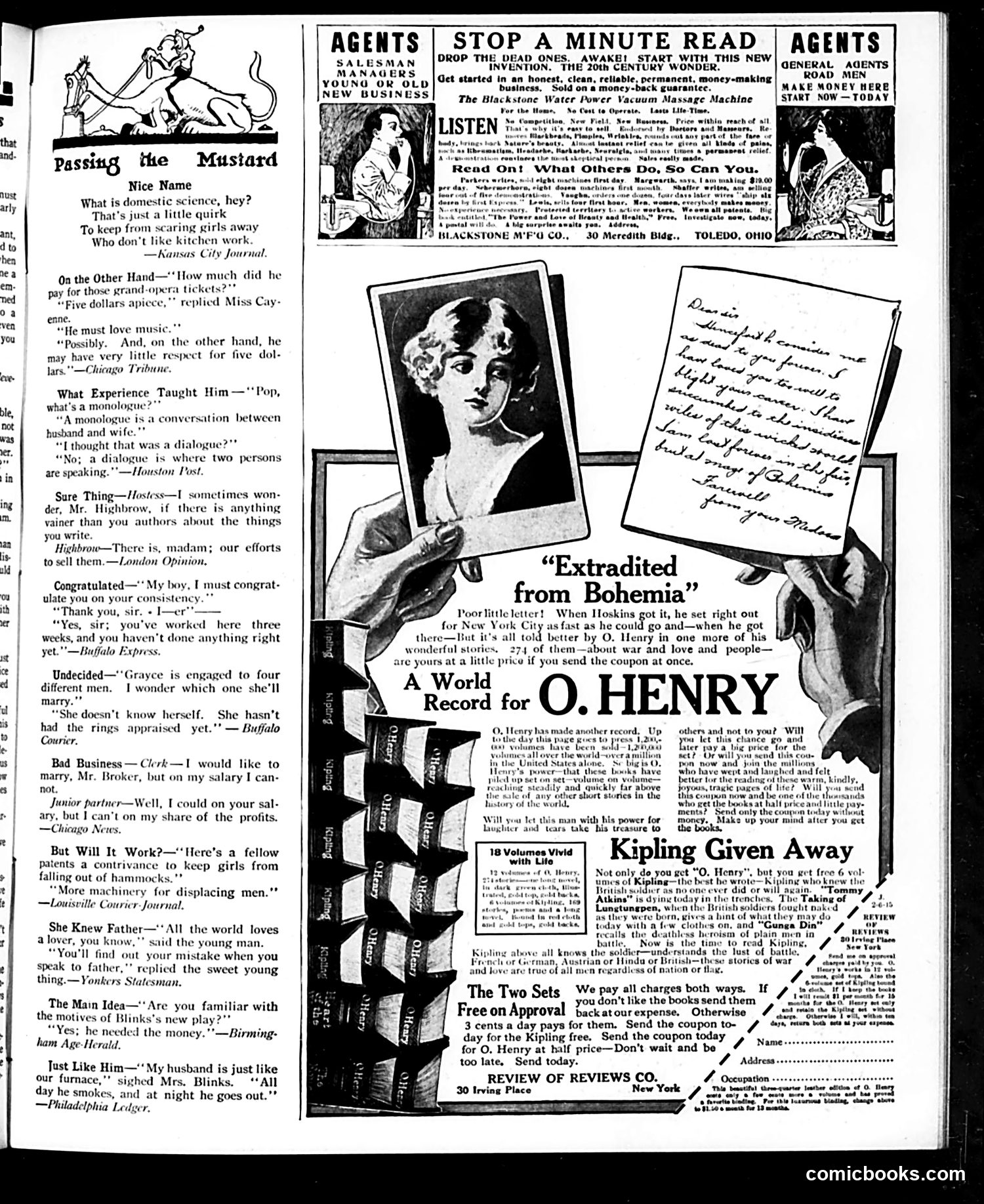
This page combines **humor columns** with **early 20th-century advertisements**, primarily targeting salesmen and mail-order customers. ## Main Content: **Left side**: Brief joke columns with attributed sources (Kansas City Journal, Chicago Tribune, etc.). These are light domestic humor—wives misunderstanding husbands, authors being vain, engagement confusion—typical period comedy. **Right side**: Large advertisements for: - **O. Henry book collection** (274 stories) promoted as a "world record" - **Kipling books** offered free with purchase - **Review of Reviews Co.** mail-order book service ## The Satire: The juxtaposition is itself somewhat satirical: cheap humor about marriage incompetence fills the left margin while advertisements promise *cultured* literature (O. Henry, Kipling) to unsophisticated mail-order customers. The implicit joke: readers enjoying lowbrow jokes might improve themselves through purchasing books. ## Historical Context: This reflects early 1900s **mail-order publishing** culture and Judge magazine's dual function as satirical publication *and* advertising vehicle for self-improvement products targeting working-class audiences.
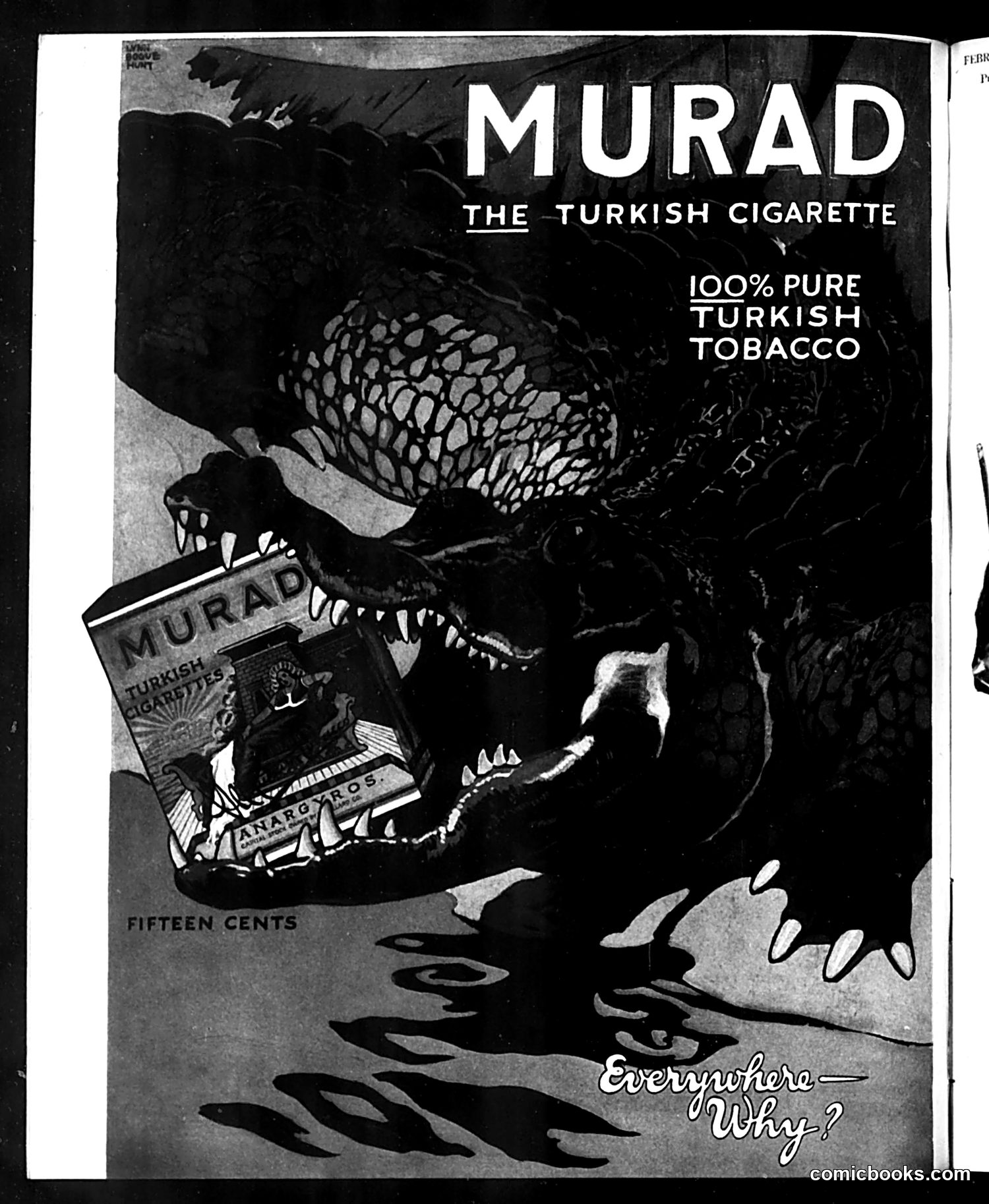
This is a **cigarette advertisement** for Murad brand Turkish cigarettes, priced at fifteen cents. The imagery depicts a fierce, menacing dragon or serpent-like creature—apparently meant to evoke "Turkish" exoticism and danger to appeal to early 20th-century American consumers. The ad's rhetoric emphasizes "100% Pure Turkish Tobacco," capitalizing on the era's fascination with "Oriental" products as luxury goods. The tagline "Everywhere—Why?" suggests the brand's widespread popularity. The exotic, intimidating creature likely reflected period stereotypes associating Turkish/Middle Eastern cultures with mystery and danger—a common advertising trope designed to make the product seem sophisticated and thrilling to American buyers. This reflects both the marketing strategies and casual cultural attitudes of the time.