
Judge, 1915-02-06 · page 15 of 24
Judge — February 6, 1915 — page 15: what you’re looking at
What you’re looking at
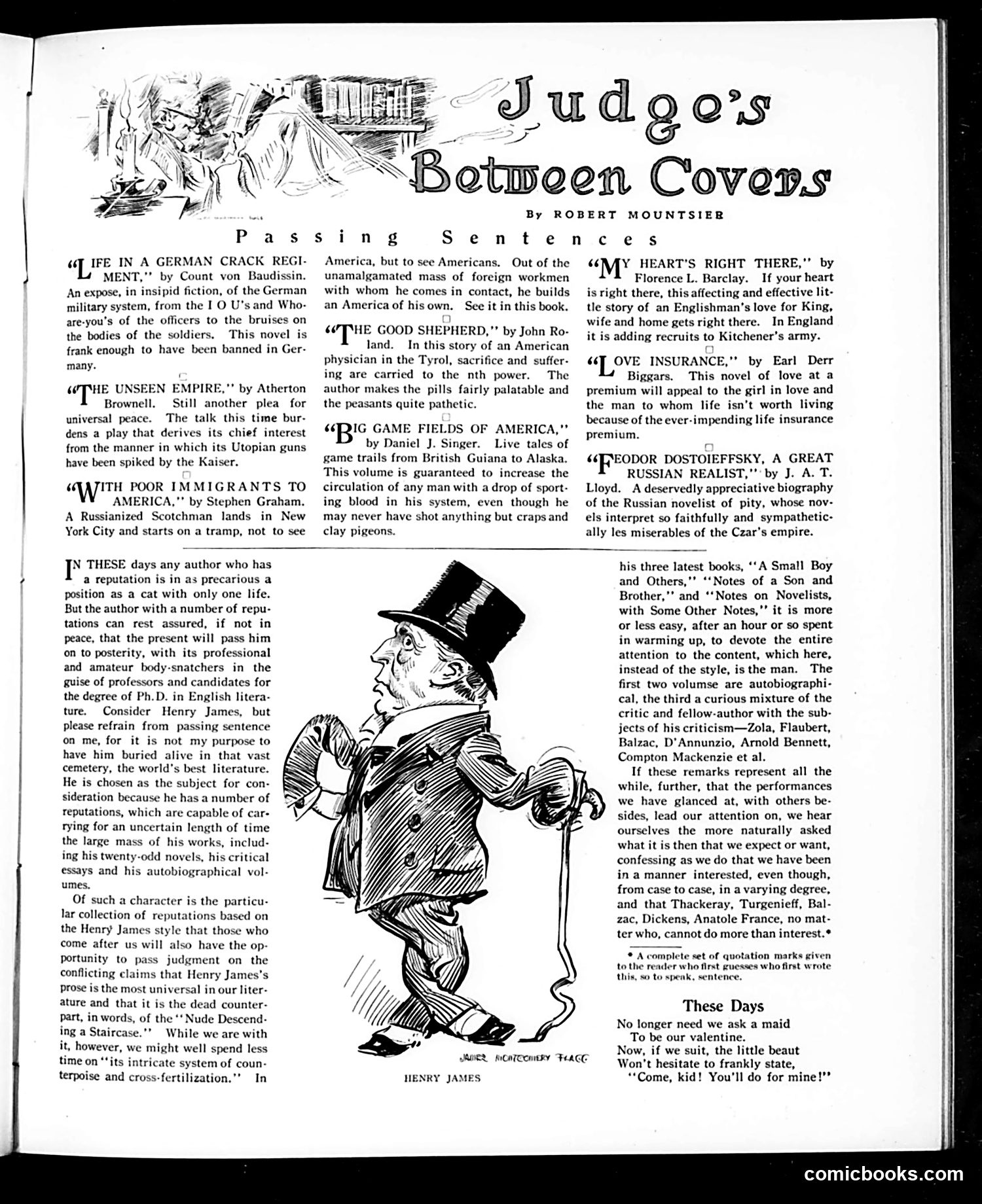
This is a **book review section** titled "Judge's Between Covers," not primarily a political cartoon. The main illustration shows **Henry James** in caricature—identifiable by the caption—depicted as a portly, well-dressed gentleman with a top hat. The text satirizes James's literary reputation and notoriously dense prose style. The reviewer argues that while James has multiple "reputations" that may sustain his work posthumously, his writing is overly complicated—comparing his prose style to Marcel Duchamp's abstract "Nude Descending a Staircase," suggesting it's incomprehensible rather than artistic. The surrounding book notices review contemporary fiction addressing topical concerns: German militarism, pacifism, immigration to America, and World War I recruitment (referencing Kitchener's army). The tone is mildly satirical toward these earnest novels while more sharply mocking James's self-important complexity.
📄 Transcribed text from this page (OCR, searchable)
Machine-transcribed from the original scan — historical spelling and the odd misread are preserved.
MENT," by Count von Baudissi ‘An expose, in insipid fiction, of the German military system, from the I O U's and Who- are-you’s of the officers to the bruises on the bodies of the soldiers. This novel is frank enough to have been banned in Ger- many. (THE UNS Brownell. EN EMPIRE,"’ by Atherton Still another plea for universal peace. The talk this time bur- dens a play that derives its chief interest from the manner in which its Utopian guns have been spiked by the Kaiser, ‘ ITH POOR IMMIGRANTS TO AMERICA,"’ by Stephen Graham. A Russianized Scotchman lands in New York City and starts on a tramp, not to see America, but to see Americans. Out of the unamalgamated mass of foreign workmen with whom he comes in contact, he builds an America of his own. See it in this book. } 6¢PPHE GOOD SHEPHERD,” by John Ro- land. In this story of an American physician in the Tyrol, sacrifice and suffer- ing are carried to the nth power. The author makes the pills fairly palatable and the peasants quite pathetic. 66PRIG GAME FIELDS OF AMERICA," by Daniel J. Singer. Live tales of game trails from British Guiana to Alaska. This volume is guaranteed to increase the circulation of any man with a drop of sport- ing blood in his system, even though he may never have shot anything but craps and clay pigeons. Judgo's etmeen Covon.s By ROBERT MOUNTSIER Sentences 66\AY HEART'S RIGHT THERE,"’ by Florence L. Barclay. If your heart is right there, this affecting and effective lit- tle story of an Englishman's love for King, wife and home gets right there. In England it is adding recruits to Kitchener’s army. «qpove INSURANCE,"’ by Earl Derr iggars. This novel of love at a premium will appeal to the girl in love and the man to whom life isn’t worth living because of the ever-impending life insurance premium. 66FVEODOR DOSTOIEFFSKY, A GREAT RUSSIAN REALIST,""' by J. A. T. Lloyd. A deservedly appreciative biography of the Russian novelist of pity, whose nov- els interpret so faithfully and sympathetic- ally les miserables of the Czar’s empire. N THESE days any author who has a reputation is in as precarious a position as a cat with only one life. But the author with a number of repu- tations can rest assured, if not in peace, that the present will pass him on to posterity, with its professional and amateur body-snatchers in the guise of professors and candidates for the degree of Ph.D. in English litera- ture. Consider Henry James, but please refrain from passing sentence on me, for it is not my purpose to have him buried alive in that vast cemetery, the world’s best literature. He is chosen as the subject for con- sideration because he has a number of reputations, which are capable of car+ tying for an uncertain length of time the large mass of his works, includ- ing his twenty-odd novels, his critical essays and his autobiographical vol- umes. Of such a character is the particu- lar collection of reputations based on the Henry James style that those who. come after us will also have the op- portunity to pass judgment on the conflicting claims that Henry James’s prose is the most universal in our liter- ature and that it is the dead counter- Part, in words, of the ‘‘ Nude Descend- ing a Staircase While we are with it, however, we might well spend less time on “‘its intricate system of coun- terpoise and cross-fertilization."" In HENRY JAMES ROL MONTCCNERY FEACE his three latest books, ‘‘A Small Boy and Others,’* ‘‘Notes of a Son and Brother,’’ and ‘*Notes on Novelists, with Some Other Notes,’’ it is more or less easy, after an hour or so spent in warming up, to devote the entire attention to the content, which here, instead of the style, isthe man. The first two volumse are autobiographi- cal, the third a curious mixture of the critic and fellow-author with the sub- jects of his criticism—Zola, Flaubert, Balzac, D'Annunzio, Arnold Bennett, Compton Mackenzie et al. If these remarks represent all the while, further, that the performances we have glanced at, with others be- sides, lead our attention on, we hear ourselves the more naturally asked what it is then that we expect or want, confessing as we do that we have been in a manner interested, even though, from case to case, in a varying degree, and that Thackeray, Turgenieff, Bal- zac, Dickens, Anatole France, no mat- ter who, cannot do more than interest.* complete set of quotation marks given to the reader who first guesses who first wrote this, so to speak, sentence, These Days No longer need we ask a maid To be our valentine. Now, if we suit, the little beaut Won't hesitate to frankly state, “Come, kid! You'll do for mine!’* comicbooks.com