
Judge, 1915-02-06 · page 4 of 24
Judge — February 6, 1915 — page 4: what you’re looking at
What you’re looking at
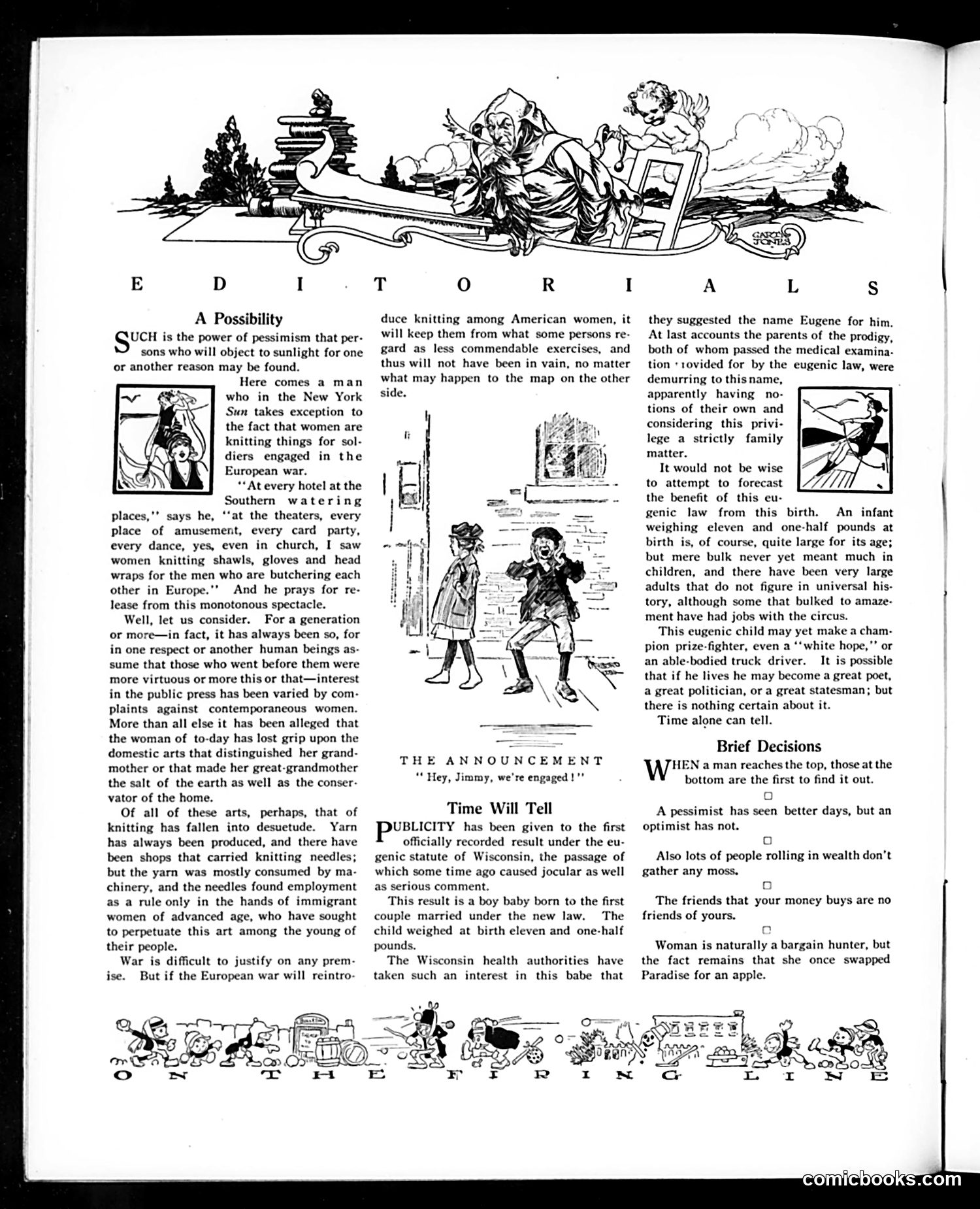
This page satirizes **pessimism** through an article titled "A Possibility," arguing that pessimists unfairly criticize women for knitting during wartime (likely WWI era, given European references). The author defends women's knitting as productive domestic contribution rather than frivolous activity. The central cartoon shows **"The Announcement,"** depicting a baby born under Wisconsin's new eugenic law. The satire targets **eugenics legislation**—contemporary pseudo-scientific policies attempting to improve human heredity through selective breeding. The article questions whether anyone can predict this child's future worth, mocking eugenic claims about predetermining human potential based on birth circumstances. The "Brief Decisions" section offers cynical life observations, maintaining the magazine's satirical tone throughout.
📄 Transcribed text from this page (OCR, searchable)
Machine-transcribed from the original scan — historical spelling and the odd misread are preserved.
E A Possibility UCH is the power of pessimism that per- sons who will object to sunlight for one or another reason may be found. Here comes a man who in the New York Sun takes exception to the fact that women are knitting things for sol- diers engaged in the European war. **At every hotel at the Southern watering places,’’ says he, ‘‘at the theaters, every place of amusement, every card party, every dance, yes, even in church, I saw women knitting shawls, gloves and head wraps for the men who are butchering each other in Europe."? And he prays for re- lease from this monotonous spectacle. Well, let us consider. For a generation or more—in fact, it has always been so, for in one respect or another human beings as- sume that those who went before them were more virtuous or more this or that—interest in the public press has been varied by com- plaints against contemporaneous women. More than all else it has been alleged that the woman of to-day has lost grip upon the domestic arts that distinguished her grand- mother or that made her great-grandmother the salt of the earth as well as the conser- vator of the home. Of all of these arts, perhaps, that of knitting has fallen into desuetude. Yarn has always been produced, and there have been shops that carried knitting needles; but the yarn was mostly consumed by ma- chinery, and the needles found employment as a rule only in the hands of immigrant women of advanced age, who have sought to perpetuate this art among the young of their people. War is difficult to justify on any prem- ise. But if the European war will reintro- “Mm. or Oat o Ww rH duce knitting among American women, it will keep them from what some persons re- gard as less commendable exercises, and thus will not have been in vain, no matter what may happen to the map on the other side. THE ANNOUNCEMENT “ Hey, Jimmy, we're engaged !"" Time Will Tell UBLICITY has been given to the first officially recorded result under the eu- genic statute of Wisconsin, the passage of which some time ago caused jocular as well as serious comment. This result is a boy baby born to the first couple married under the new law. The child weighed at birth eleven and one-half pounds. The Wisconsin health authorities have taken such an interest in this babe that they suggested the name Eugene for him. At last accounts the parents of the prodigy, both of whom passed the medical examina- tion ‘rovided for by the eugenic law, were demurring to thisname, apparently having no- tions of their own and considering this privi- lege a strictly family matter. It would not be wise to attempt to forecast the benefit of this eu- genic law from this birth. weighing eleven and one-half pounds at birth is, of course, quite large for its age; but mere bulk never yet meant much in children, and there have been very large adults that do not figure in universal his- tory, although some that bulked to amaze- ment have had jobs with the circus. This eugenic child may yet make a cham- pion prize-fighter, even a ‘‘white hope,"’ or an able-bodied truck driver. It is possible that if he lives he may become a great poet, a great politician, or a great statesman; but there is nothing certain about it. Time alone can tell. An infant Brief Decisions WEEN a man reaches the top, those at the bottom are the first to find it out. oO A pessimist has seen better days, but an optimist has not. Oo Also lots of people rolling in wealth don’t gather any moss. a The friends that your money buys are no friends of yours. Woman is naturally a bargain hunter, but the fact remains that she once swapped Paradise for an apple.