
Judge, 1915-02-06 · page 16 of 24
Judge — February 6, 1915 — page 16: what you’re looking at
What you’re looking at
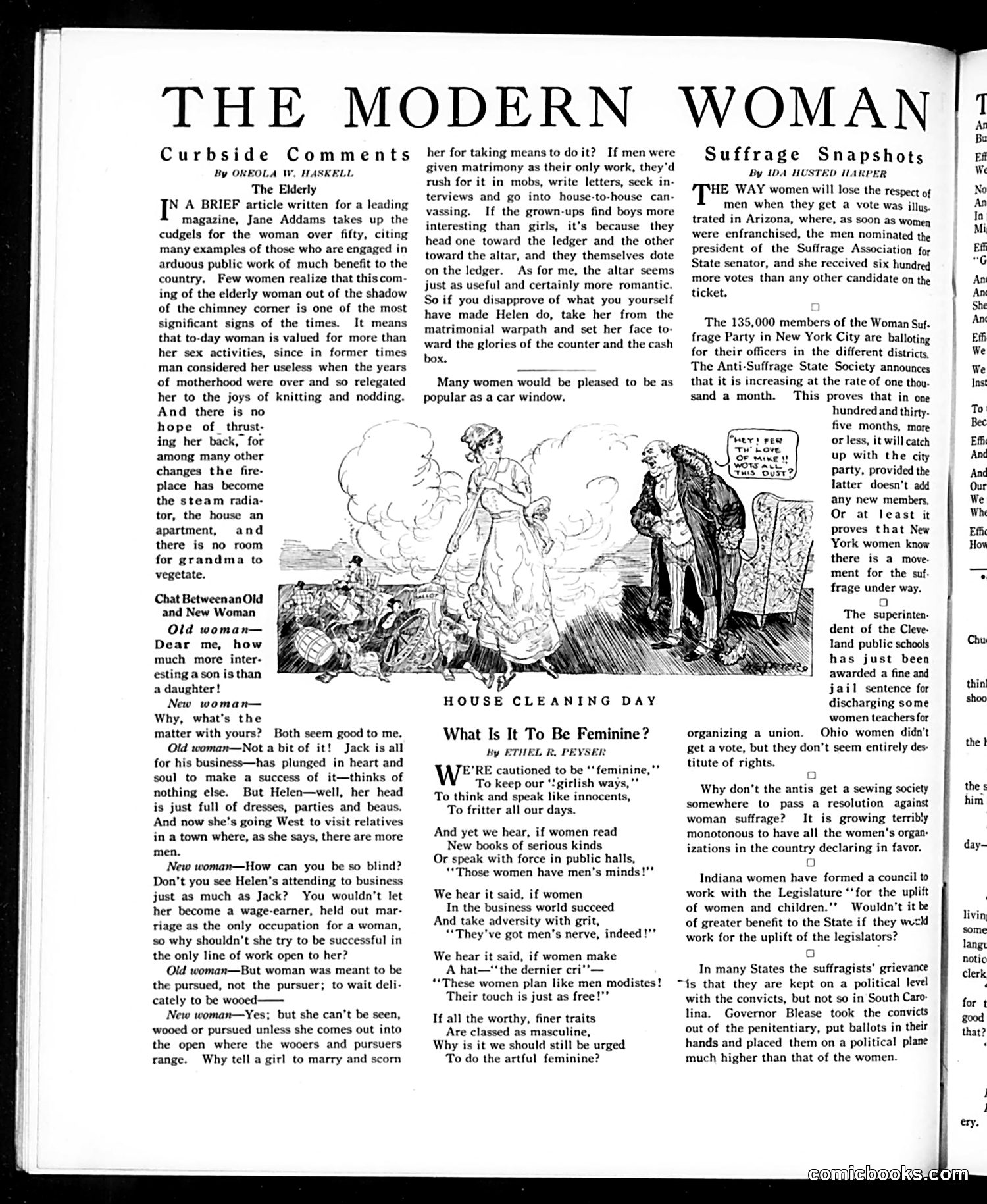
This page contains three satirical pieces on women's changing roles in early 20th-century America: **"House Cleaning Day" (center cartoon):** A woman in modern dress stands amid domestic chaos, illustrating the tension between traditional housework and women's expanding public roles. **"Chat Between an Old and New Woman":** A dialogue contrasts generational attitudes. The older woman views her daughter Helen's pursuit of marriage as proper; the younger woman counters that restricting women to matrimony as their "only occupation" is hypocritical—if men had such limits, they'd actively pursue wives too. She argues Helen is simply doing business intelligently. **"Suffrage Snapshots":** Reports on women's voting impact, including Arizona women nominating a suffragist for State senator who received 600 more votes than other candidates—suggesting women voters mobilized effectively. **Overall theme:** The satire challenges Victorian assumptions that women should remain domestic and passive, presenting the "New Woman" entering business, politics, and public life as logical, not radical.
📄 Transcribed text from this page (OCR, searchable)
Machine-transcribed from the original scan — historical spelling and the odd misread are preserved.
Curbside Comments By OREOLA W. HASKELL The Elderly N A BRIEF article written for a leading magazine, Jane Addams takes up the cudgels for the woman over fifty, citing many examples of those who are engaged in arduous public work of much benefit to the country. Few women realize that thiscom- ing of the elderly woman out of the shadow of the chimney corner is one of the most significant signs of the times. It means that to-day woman is valued for more than her sex activities, since in former times man considered her useless when the years of motherhood were over and so relegated her to the joys of knitting and nodding. And there is no hope of_ thrust- ing her back, for among many other changes the fire- place has become the steam radia- tor, the house an apartment, and there is no room for grandma to vegetate. Chat BetweenanOld and New Woman Old woman— Dear me, how much more inter- esting a son is than a daughter! New woman— Why, what's the matter with yours? Both seem good to me. Old woman—Not a bit of it! Jack is all for his business—has plunged in heart and soul to make a success of it—thinks of nothing else. But Helen—well, her head is just full of dresses, parties and beaus. And now she's going West to visit relatives in a town where, as she says, there are more men. New woman—How can you be so blind? Don’t you see Helen's attending to business just as much as Jack? You wouldn't let her become a wage-earner, held out mar- riage as the only occupation for a woman, so why shouldn’t she try to be successful in the only line of work open to her? Old woman—But woman was meant to be the pursued, not the pursuer; to wait deli- cately to be wooed —— New woman—Yes; but she can’t be seen, wooed or pursued unless she comes out into the open where the wooers and pursuers range. Why tell a girl to marry and scorn THE MODERN WOMAN her for taking means to doit? If men were given matrimony as their only work, they'd rush for it in mobs, write letters, seek in- terviews and go into house-to-house can- vassing. If the grown-ups find boys more interesting than girls, it’s because they head one toward the ledger and the other toward the altar, and they themselves dote on the ledger. As for me, the altar seems just as useful and certainly more romantic. So if you disapprove of what you yourself have made Helen do, take her from the matrimonial warpath and set her face to- ward the glories of the counter and the cash box. Many women would be pleased to be as popular as a car window. HOUSE CLEANING DAY ine? What Is It To Be Fe Ky ETHEL R, PEYSER E’RE cautioned to be ‘*fem To keep our ‘!girlish ways, To think and speak like innocents, To fritter all our days. And yet we hear, if women read New books of serious kinds Or speak with force in public halls, “Those women have men’s minds!"" We hear it said, if women In the business world succeed And take adversity with grit, “They've got men’s nerve, indeed!" We hear it said, if women make A hat—‘‘the dernier “These women plan like men modistes! Their touch is just as free!"’ If all the worthy, finer traits Are classed as masculine, Why is it we should still be urged To do the artful feminine? Suffrage Snapshots By IDA HUSTED HARPER HE WAY women will lose the respect of men when they get a vote was illus. trated in Arizona, where, as soon as women were enfranchised, the men nominated the president of the Suffrage Association for State senator, and she received six hundred more votes than any other candidate on the ticket. The 135,000 members of the Woman Suf. frage Party in New York City are balloting for their officers in the different districts, The Anti-Suffrage State Society announces that it is increasing at the rate of one thou- sand a month. This proves that in one hundred and thirty. five months, more or less, it will catch up with the city Party, provided the latter doesn’t add any new members. Or at least it proves that New York women know there is a move- ment for the suf- frage under way. is} The superinten- dent of the Cleve. land public schools has just been awarded a fine and jail sentence for discharging some women teachers for organizing a union. Ohio women didn’t get a vote, but they don’t seem entirely des- titute of rights. Maer! ree Tw Love OF wane tt pee Tus Cust? Why don’t the antis get a sewing society somewhere to pass a resolution against woman suffrage? It is growing terribly monotonous to have all the women’s organ: izations in the country declaring in favor. Oo Indiana women have formed a council to work with the Legislature ‘‘for the uplift of women and children.’? Wouldn't it be of greater benefit to the State if they wcll work for the uplift of the legislators? is) In many States the suffragists’ grievance “{s that they are kept on a political level with the convicts, but not so in South Caro- lina. Governor Blease took the convicts out of the penitentiary, put ballots in their hands and placed them on a political plane much higher than that of the women. thin shoo the } the s him day- livin some lang notic clerk that?