
A complete issue · 24 pages · 1915
Judge — January 23, 1915
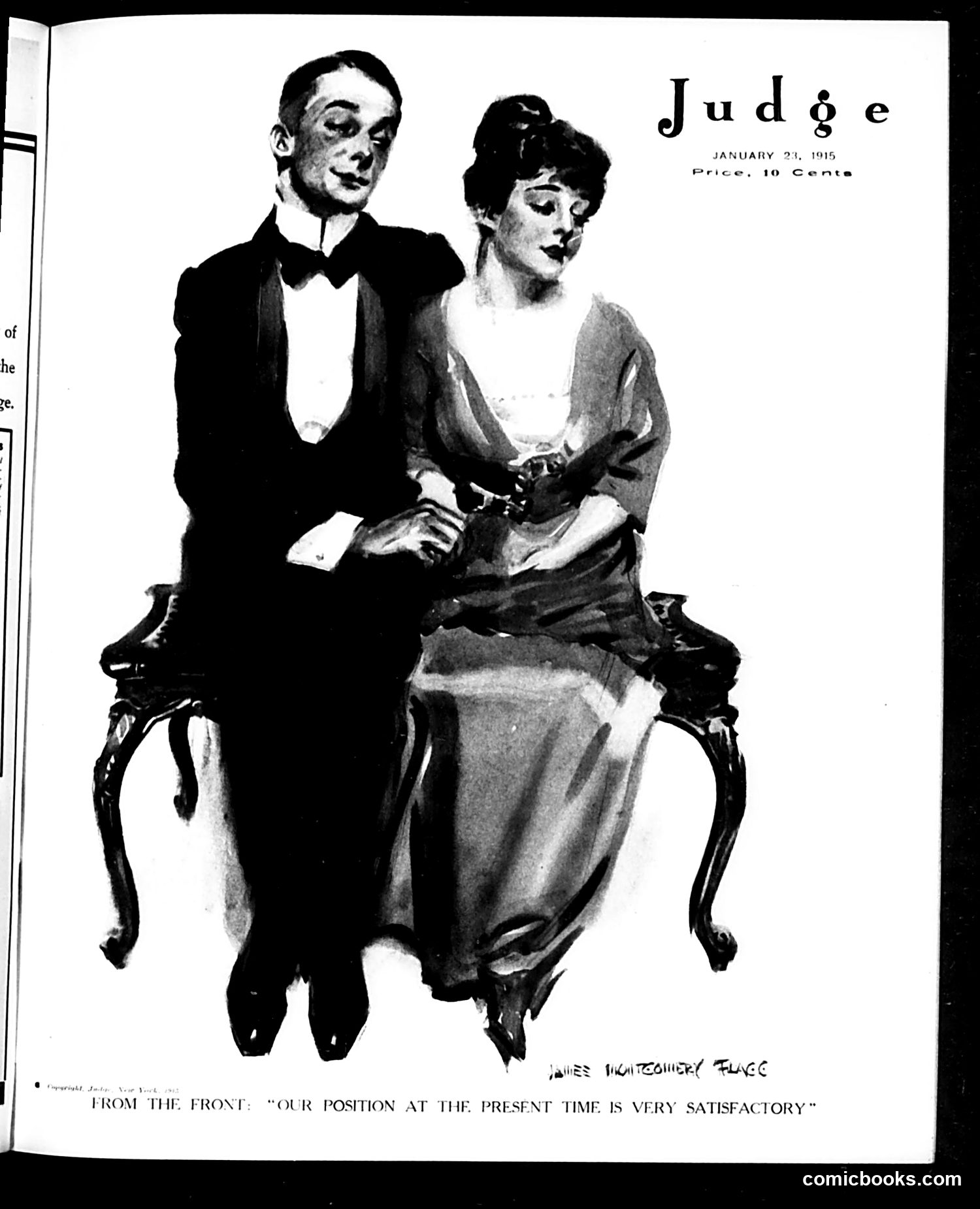
This cartoon depicts a well-dressed man and woman seated together, with the caption quoting: "FROM THE FRONT: 'OUR POSITION AT THE PRESENT TIME IS VERY SATISFACTORY.'" The satire likely comments on World War I, which had begun in Europe in 1914. The couple's comfortable, domestic pose contrasts ironically with the quoted message "from the front"—suggesting either false optimism about the war's progress or the disconnect between those safely at home and the actual conditions soldiers faced in combat. The artist is credited as "James Montgomery Flagg," a prominent American illustrator of the period. The cartoon employs typical Judge magazine satire: using a seemingly pleasant domestic scene to critique political or military leadership's misleading public statements about the war.
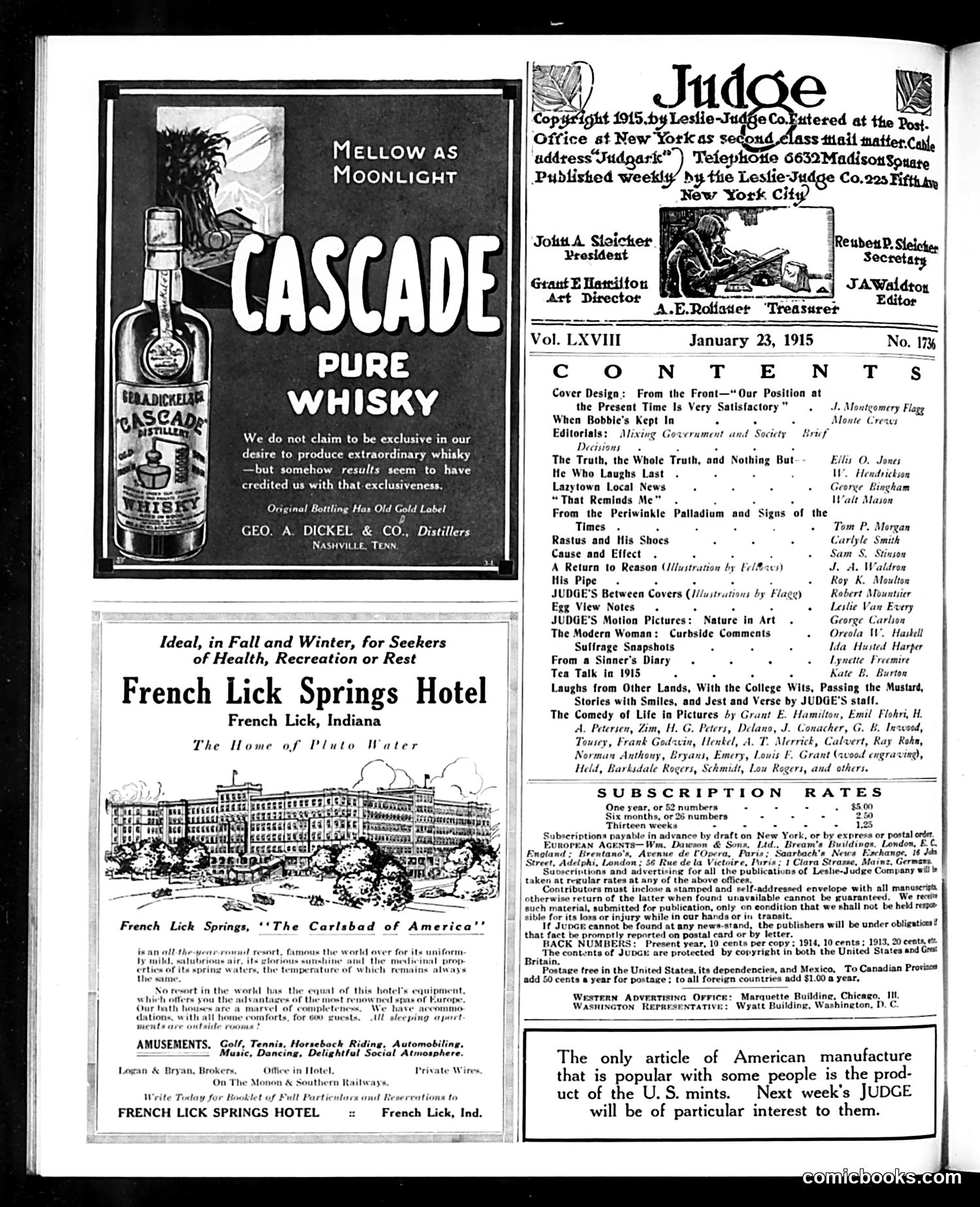
This page is primarily **advertising and editorial content** rather than political cartoons. The main visual elements are: - A **Cascade Pure Whisky advertisement** featuring a bottle labeled "mellow as moonlight" - A **French Lick Springs Hotel advertisement** promoting it as "the Carlsbad of America" The table of contents lists various articles and illustrations, though specific political references aren't clearly visible in these particular advertisements. The bottom note references "the product of the U.S. mints," suggesting next week's issue will address currency or monetary policy—likely relevant to 1915 American economic concerns. The page demonstrates how early 20th-century satirical magazines intermingled advertising with editorial content.
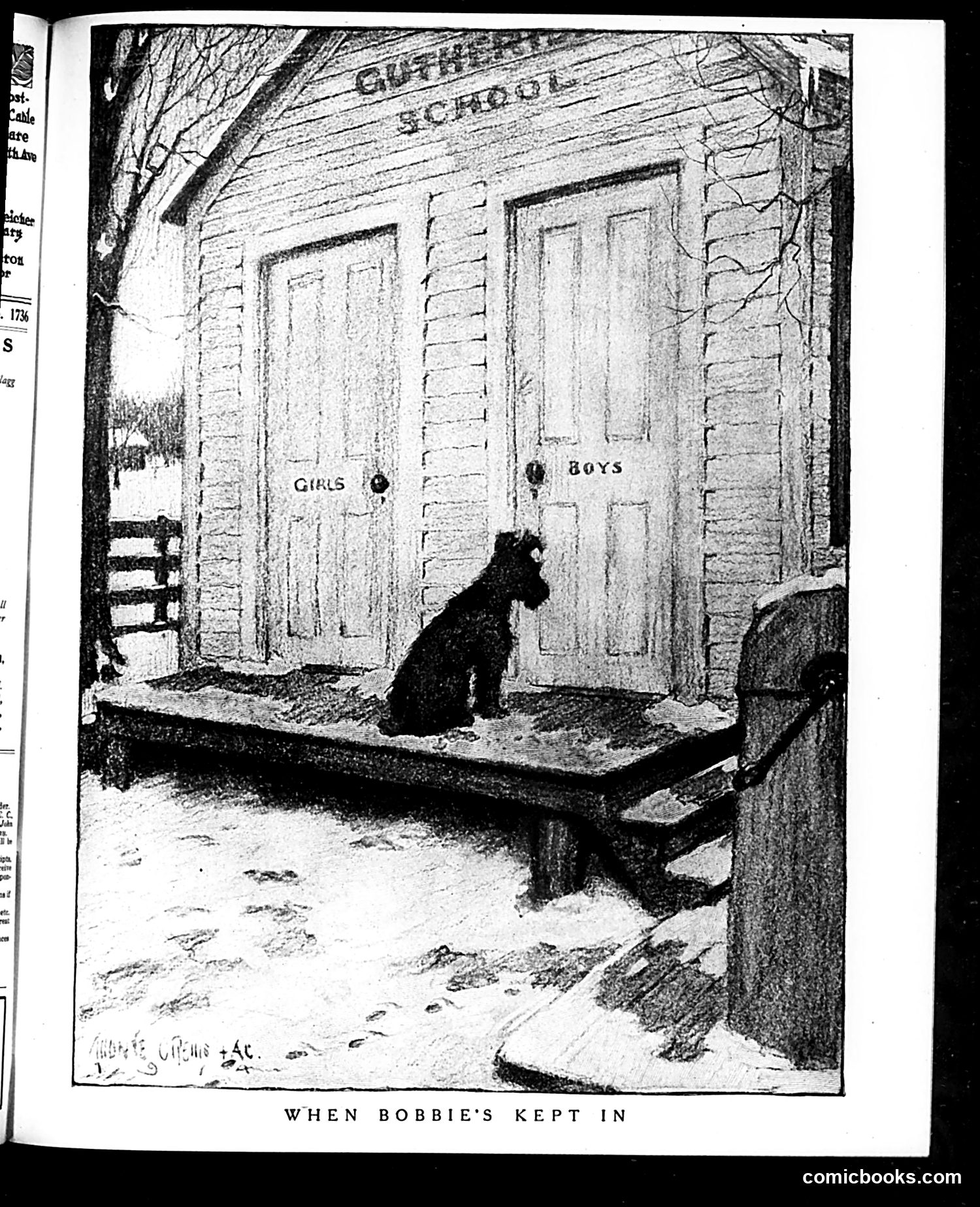
This appears to be a humorous cartoon titled "When Bobbie's Kept In," depicting a dog sitting between two outhouses labeled "Girls" and "Boys" at what's identified as a schoolhouse. The joke plays on the phrase "kept in" — typically meaning a student confined indoors as punishment. The cartoon literalizes this by showing a dog (named Bobbie) physically kept inside the schoolyard, positioned between the gender-segregated facilities common to period schoolhouses. The humor relies on the innocent double meaning: the dog cannot go out to play while "kept in," but is also positioned awkwardly between the segregated toilet facilities — a mildly risqué joke for Judge's adult readership about the constraints placed on the dog (and perhaps students) during school hours.
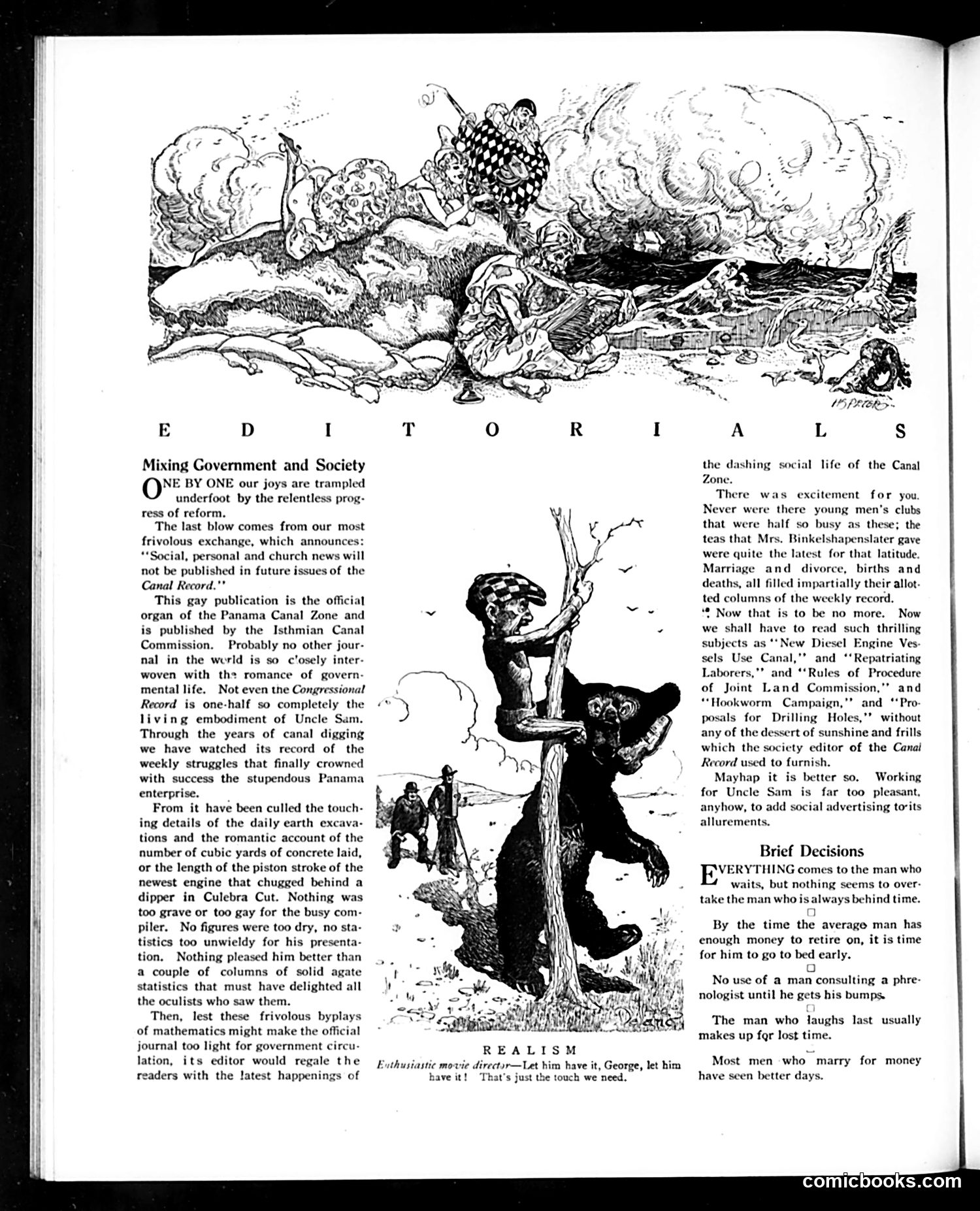
This page satirizes **government oversight of the Panama Canal Zone**. The main article "Mixing Government and Society" criticizes the *Canal Record*, the official publication of the Panama Canal Commission, for publishing frivolous social gossip—club teas, marriages, divorces, births—alongside serious engineering content. The central cartoon depicts a figure climbing a tree labeled "REALISM," with the caption suggesting someone should "have it" while another person says "that's just the touch we need." This likely mocks the tension between the *Record's* romantic social coverage and its role as an official government journal. The satire criticizes mixing governmental communications with entertainment-style content, suggesting the publication lacks appropriate seriousness for official canal administration.
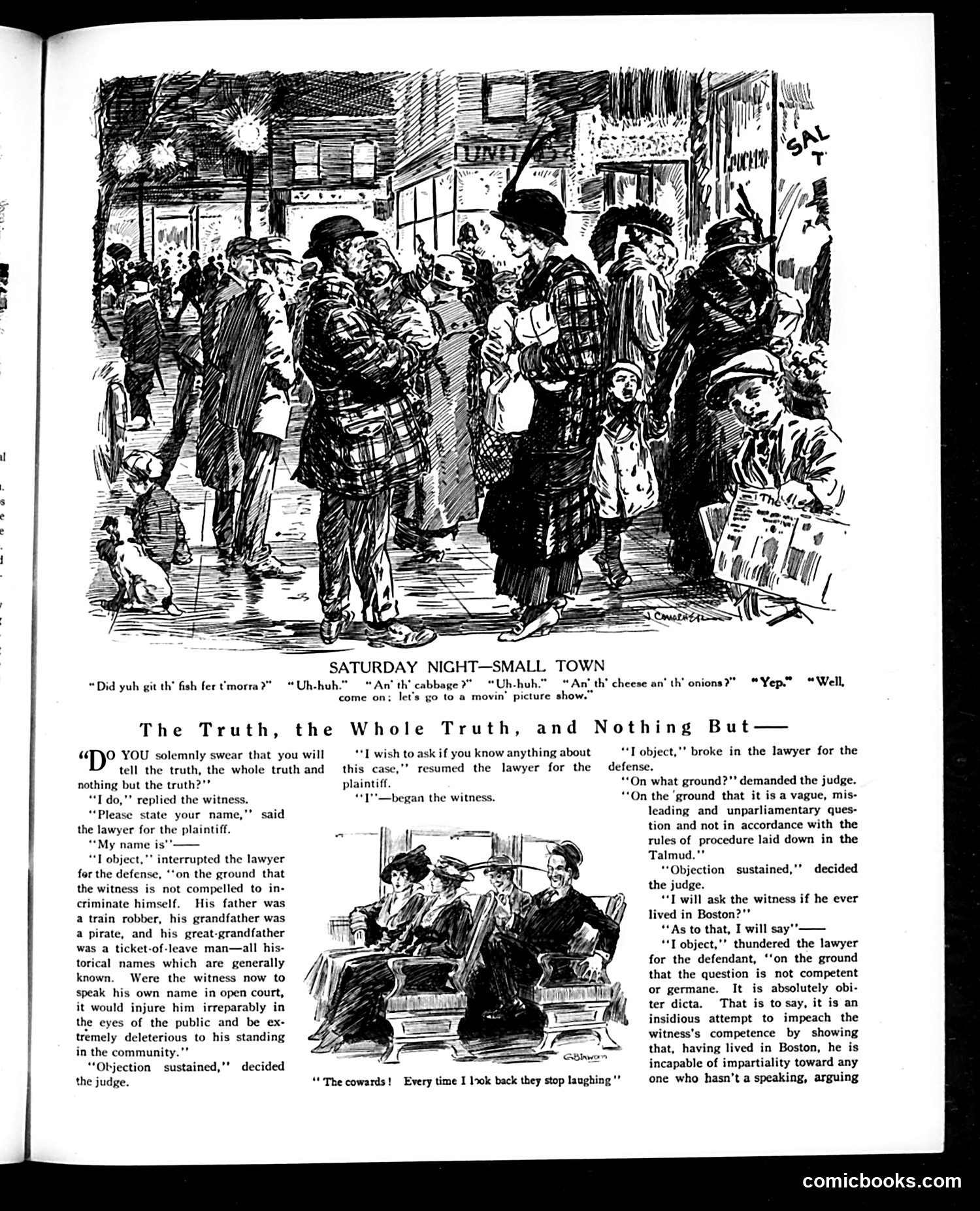
The top cartoon depicts a crowded small-town street scene with working-class figures discussing ordinary matters ("fish," "cabbage," "picture show"). It satirizes small-town gossip and recreation. The larger story below parodies courtroom drama, specifically objections to witness testimony. A lawyer repeatedly objects that questions are "vague, misleading," or "not in accordance with the rules of procedure." The humor comes from the absurd technicality: a witness's own name and genealogy are challenged as "generally known" yet somehow prejudicial to his credibility. This mocks legal procedure's Byzantine rules and how attorneys use technical objections to obstruct justice or truth-telling. The title "The Truth, the Whole Truth, and Nothing But—" ironically undercuts the oath's noble intent through procedural gamesmanship.
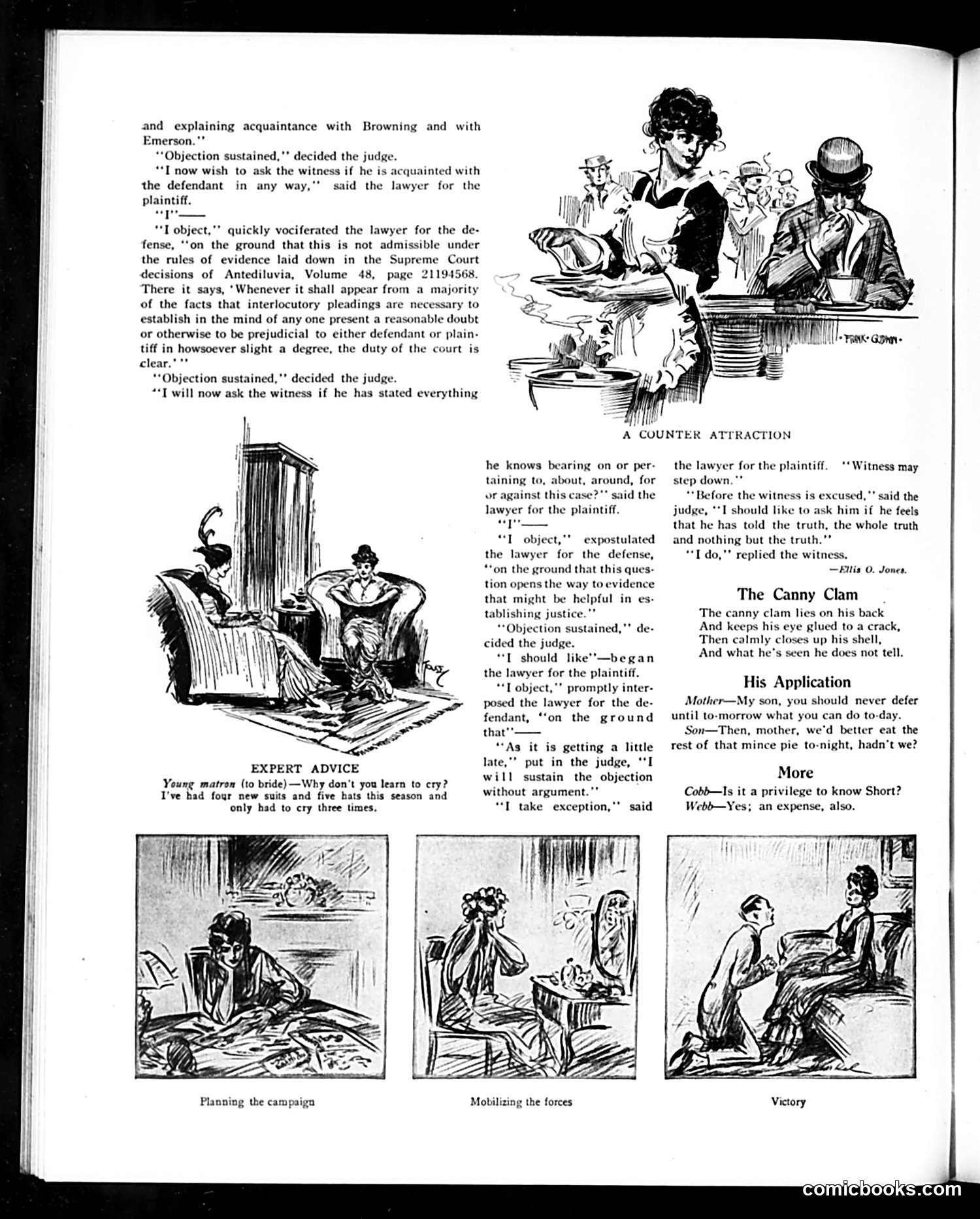
This page satirizes American legal procedure through an absurdist courtroom scene. The main cartoon depicts lawyers filing endless, ridiculous objections based on invented precedents (referencing "Antediluvia, Volume 48")—mocking how legal technicalities can obstruct justice entirely. Every question gets objected to; the judge sustains each objection without hearing evidence. The satire criticizes how procedural rules and lawyerly obstruction can paralyze courts, preventing actual testimony or truth-seeking. The accompanying illustrations ("Expert Advice," "Planning the Campaign," etc.) use similar absurdist humor about social manipulation and strategy. The shorter comic pieces below offer unrelated humor: a bride learning to cry for material gain; a "canny clam" that keeps secrets; domestic jokes about deferring tasks and eating pie. Overall, this is institutional satire targeting legal system dysfunction through exaggeration.
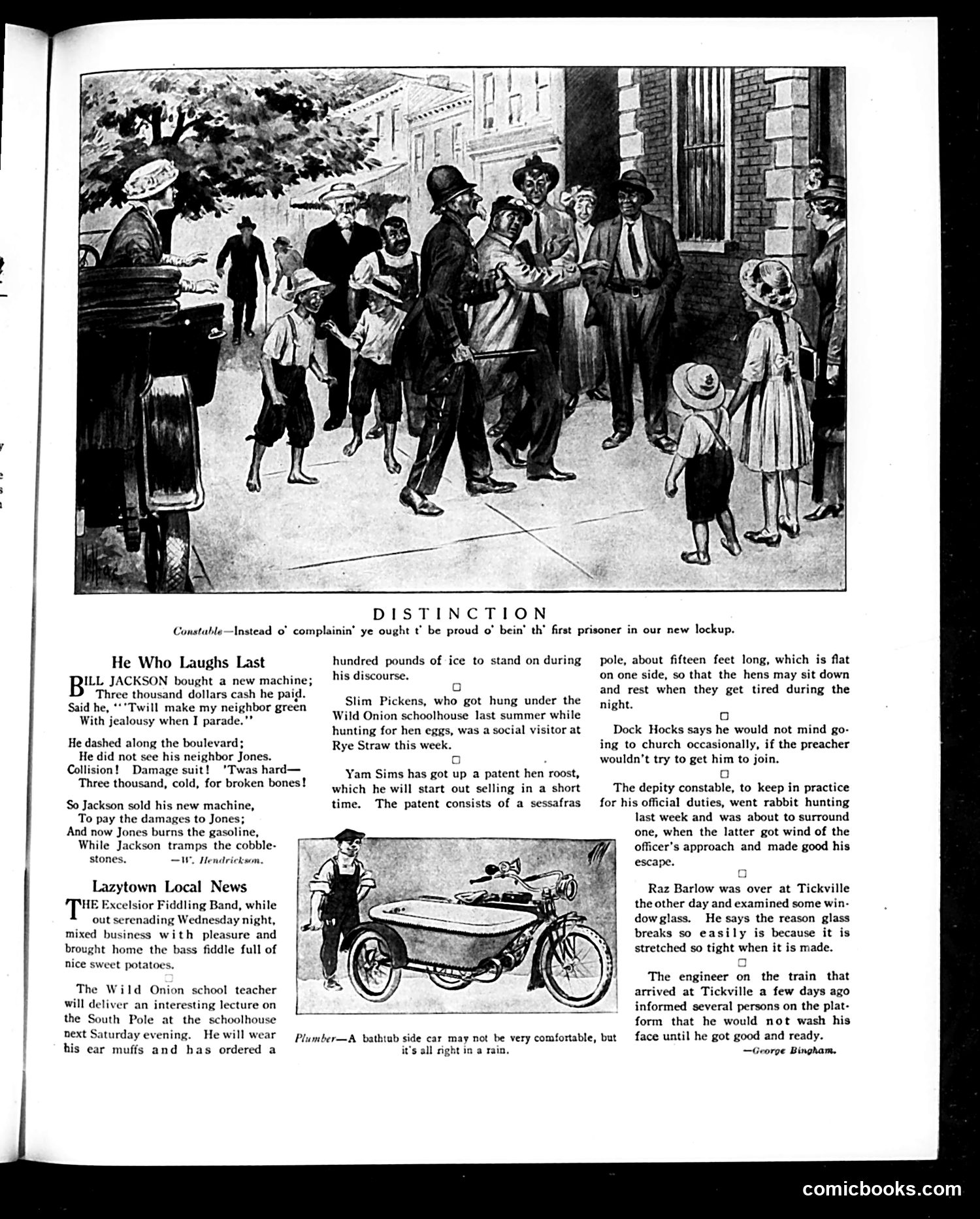
This page from *Judge* magazine contains satirical humor typical of early 20th-century American comedy: **"He Who Laughs Last"** is a cautionary tale mocking materialism: Bill Jackson buys an expensive new machine ($3,000) to impress his neighbor Jones, but crashes it, creating a lawsuit that forces him to sell it. Ironically, Jones ends up enjoying the machine while Jackson walks in poverty. The satire targets vanity and one-upmanship. **"Lazytown Local News"** is a humorous rural gossip column with absurdist jokes about small-town characters—a fiddling band stealing sweet potatoes, a teacher planning a lecture using 100 pounds of ice as a prop, and various eccentric locals with ridiculous schemes. The humor relies on exaggeration and rustic character types. **"Distinction"** is a brief joke about a constable proud of his new jail's first prisoner. The tone throughout is gentle mockery of rural life, greed, and human foibles—typical *Judge* magazine fare mixing moral lessons with absurdist humor.
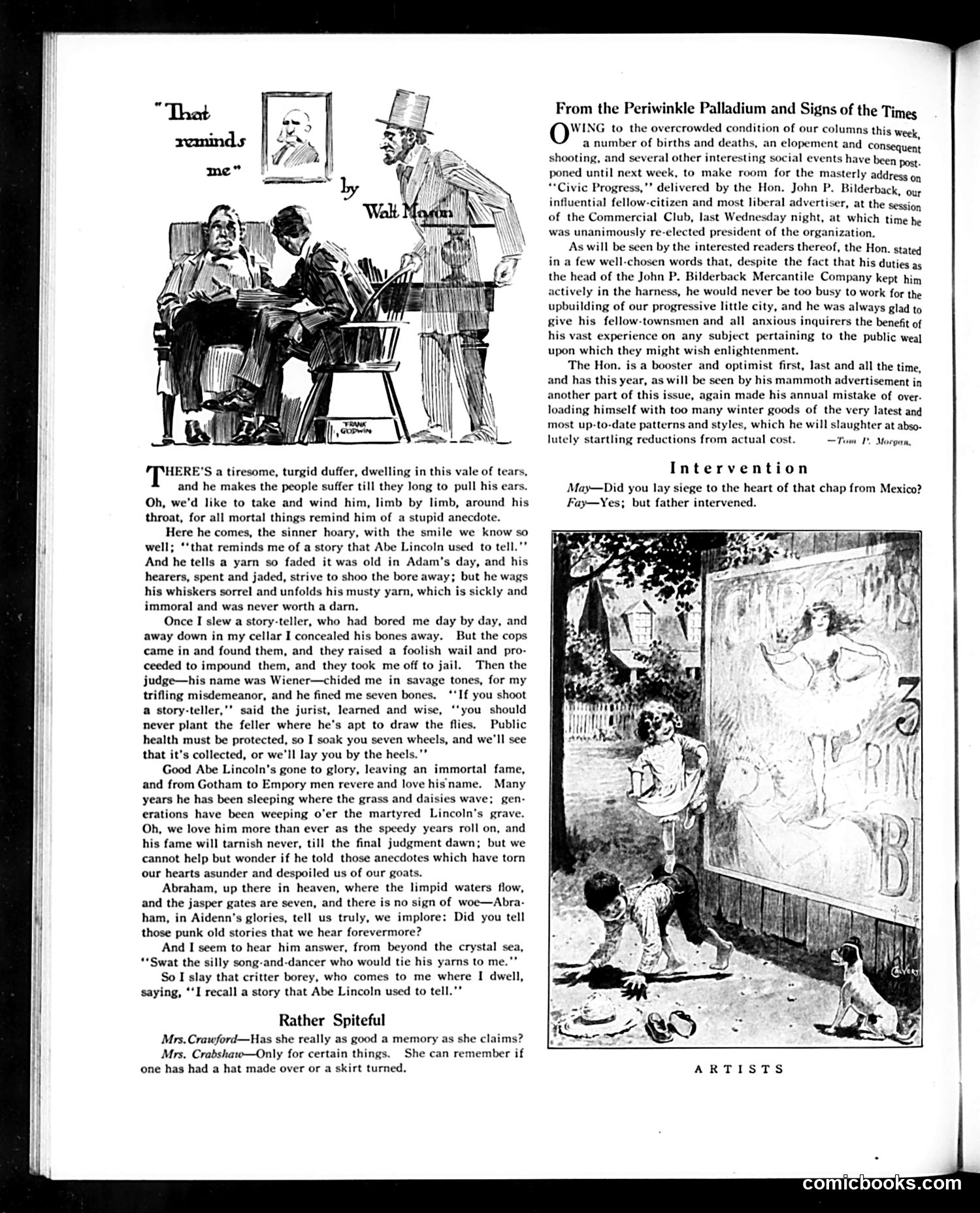
This *Judge* magazine page contains two satirical pieces: **"That Reminds Me"** (main cartoon/poem): A scathing attack on tedious people who constantly tell old, worn-out anecdotes, particularly those attributed to Abraham Lincoln. The cartoon illustrates a boring storyteller annoying his audience. The poem humorously escalates to imagining murdering such a bore, getting arrested, and being fined by a judge named Wiener. The satirist then apostrophizes Lincoln in heaven, asking if he actually told these tiresome stories that circulate endlessly. The joke: repetitive, stale anecdotes—whether Lincoln's or anyone's—are so insufferable they warrant drastic action. **"Rather Spiteful"** (brief joke at bottom): A woman claims excellent memory, but her friend reveals she only remembers petty details about others' clothing—whether hats were remade or skirts altered. It satirizes cattiness and small-minded gossip as "memory." The page reflects early-20th-century frustration with oral culture's repetitive storytelling habits.
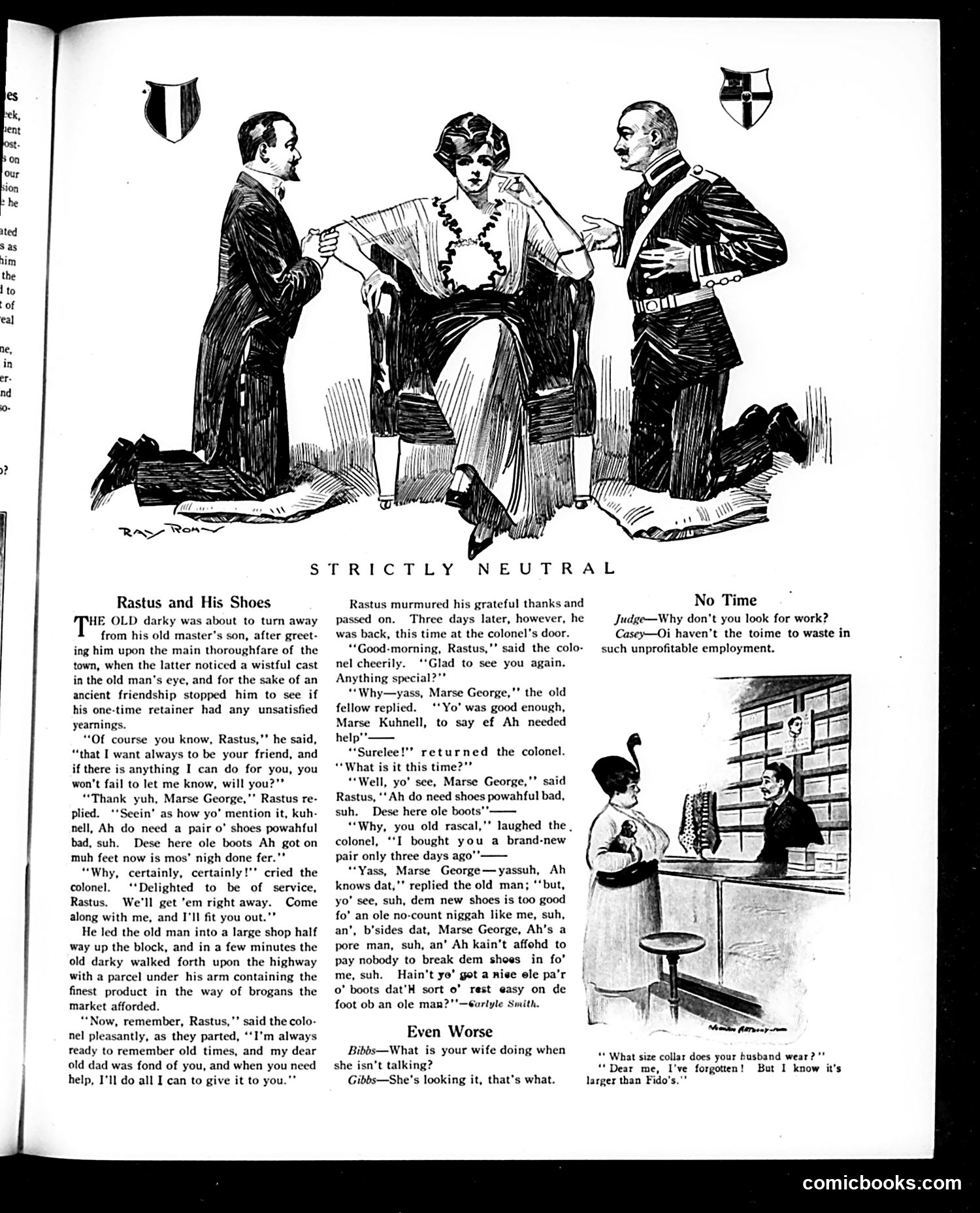
This page contains racist dialect humor typical of early-20th-century American magazines. The main story depicts an exchange between a white "colonel" and an elderly Black man ("Rastus") using offensive period stereotypes and language. The satire works on two levels: First, it mocks the pretense of paternalistic race relations—the colonel offers charity as noblesse oblige, claiming eternal friendship. Second, it portrays the Black character as lazy and manipulative, claiming the new shoes are "too good" for him and requesting worn boots instead, supposedly to avoid breaking them in himself. The joke relies on racist caricatures of Black people as shiftless and ungrateful. The accompanying brief jokes ("No Time," "Even Worse") are unrelated gender humor. The illustration shows three figures in formal dress—likely depicting the colonel, Rastus, and possibly another character from the story. This content reflects the deeply racist attitudes of its era.
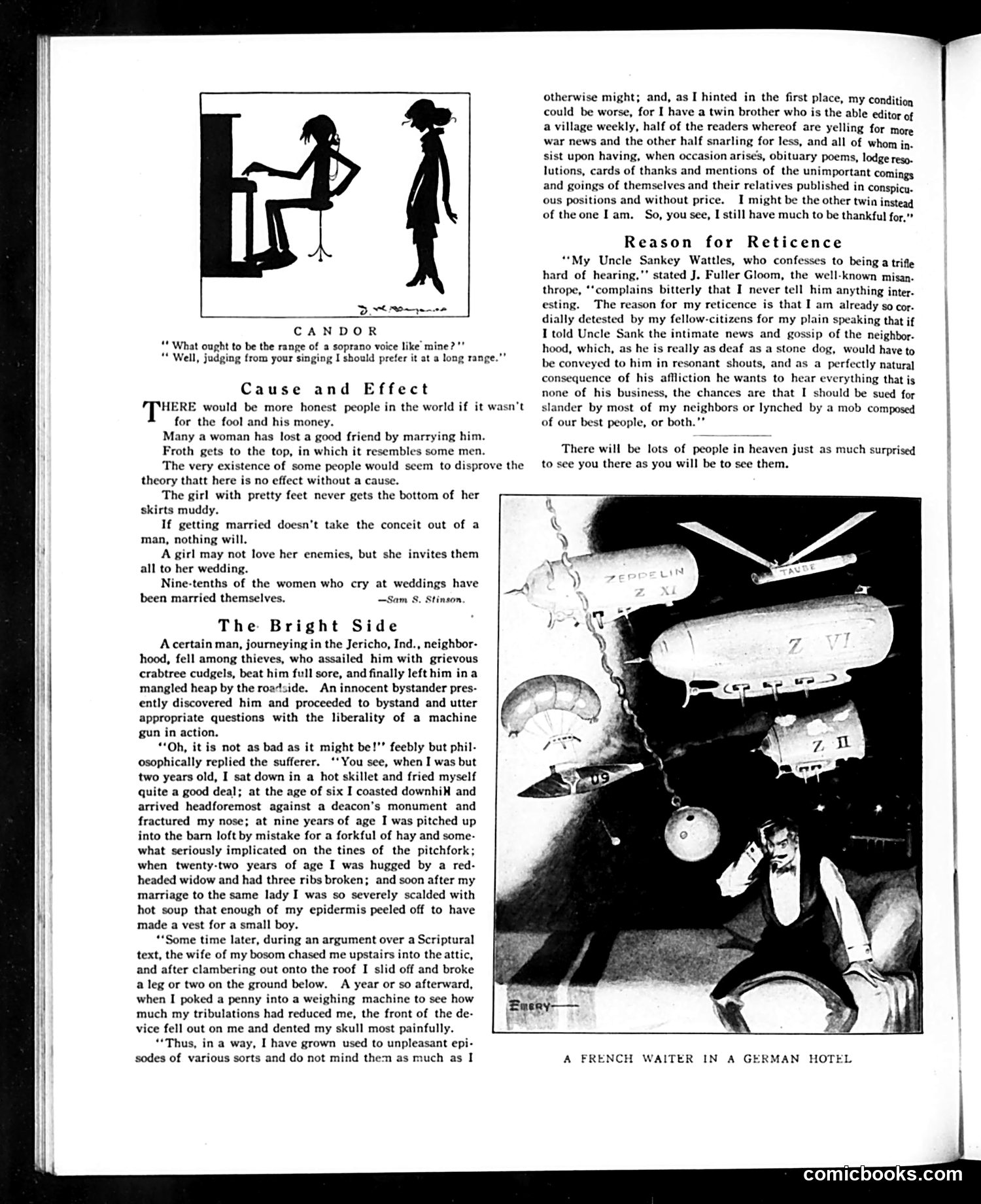
**The Candor cartoon** (top left) depicts a woman at a piano speaking with a man, joking about her soprano voice's "range." He suggests she keep it at a long distance—mocking her poor singing ability. This is straightforward domestic humor about an untalented musician. **"Cause and Effect"** section contains cynical aphorisms about human nature and marriage, typical of Judge's satirical commentary. Lines like "Many a woman has lost a good friend by marrying him" mock matrimonial disappointment. **"The Bright Side"** tells of an injured man who philosophically accepts his beating because he's suffered worse throughout life—including being scalded by his wife's soup and knocked down by her. He concludes he's still luckier than his twin brother, a village newspaper editor tormented by readers demanding war news and free obituary poems. The joke contrasts physical suffering with the editorial aggravation, suggesting newspaper work is worse than actual injury. The page reflects early-20th-century Judge humor: cynical about marriage, editors, and human folly.
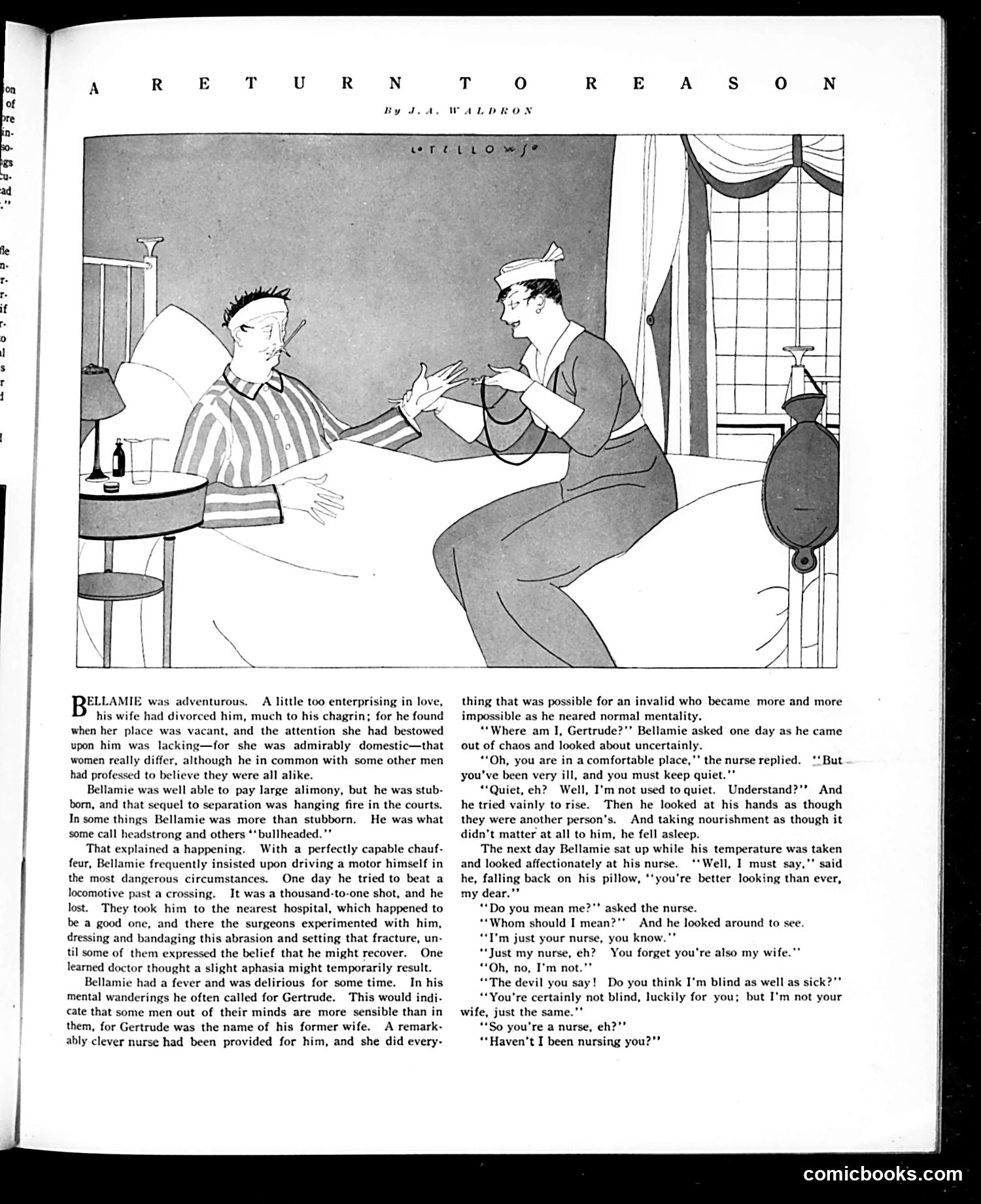
This story-cartoon satirizes male selfishness and the consequences of reckless behavior. Bellamie, a wealthy but stubborn man, ignored his capable chauffeur to drive recklessly himself—a common trope mocking the arrogance of privileged men. His accident lands him in the hospital where a clever nurse tends him. The satire centers on Bellamie's delirious confusion: he mistakes his nurse for his ex-wife Gertrude, whom he'd been calling for during fever. When lucid, he denies this—yet the irony suggests his subconscious recognizes what he consciously rejects: his ex-wife was the competent caregiver he actually needed. The joke satirizes male vanity and the blindness of men who undervalue capable women, especially wives they've discarded. Even hospitalized and dependent, Bellamie resists admitting the nurse's value, embodying the disconnect between male pride and actual need.
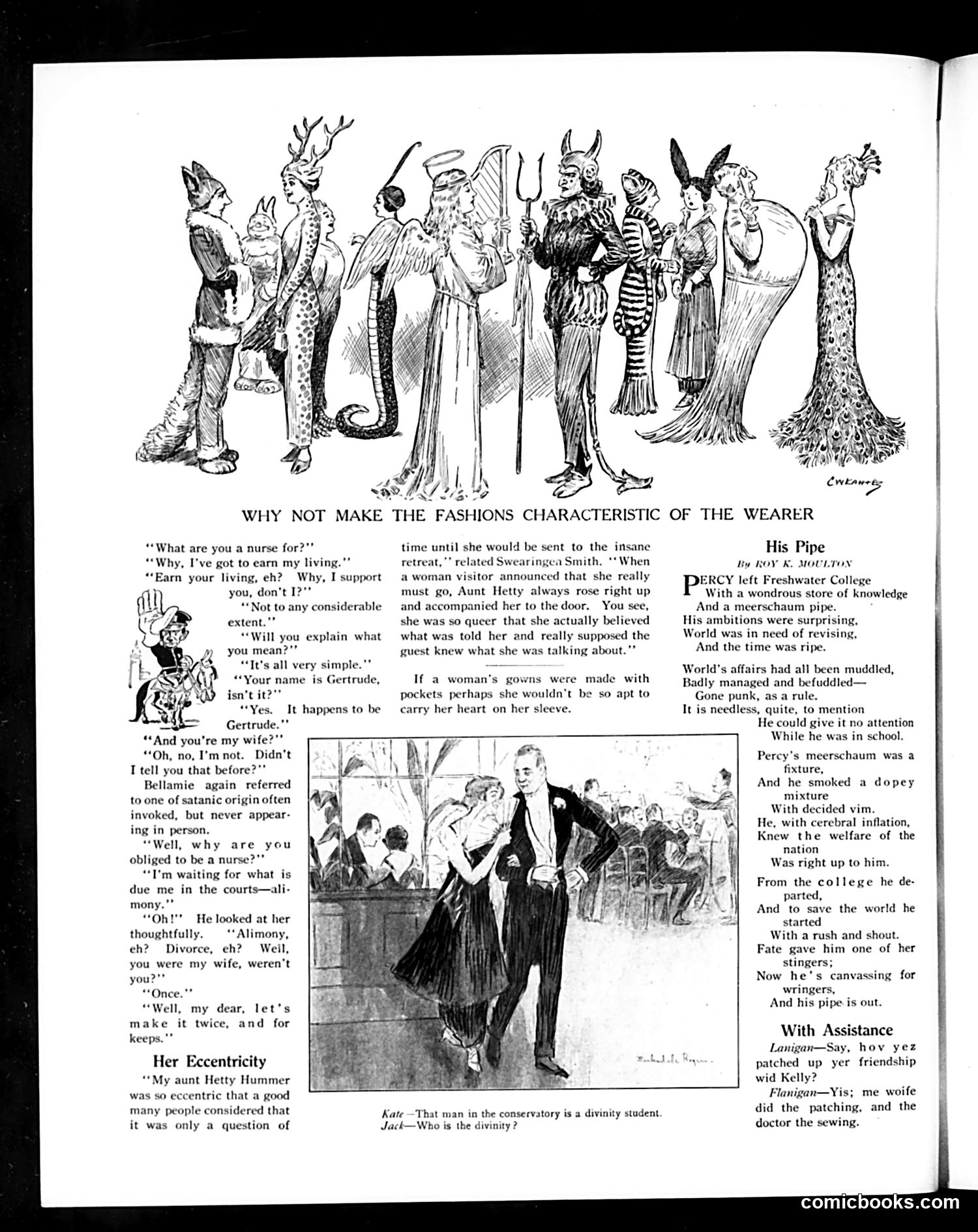
**Top Cartoon**: "Why Not Make the Fashions Characteristic of the Wearer" satirizes 1920s fashion by depicting various supernatural and mythological figures (angels, demons, witches, skeletons) dressed in contemporary women's clothing. The joke is that fashions of the era were so extreme and bizarre that they made normal women look like otherworldly creatures. It's mocking the disconnect between everyday dress and the fantastical silhouettes and styles then in vogue. **"Her Eccentricity"**: A brief anecdote about an eccentric aunt so strange that institutionalization seemed inevitable—poking fun at upper-class eccentricity and family embarrassment. **"His Pipe"**: A poem about Percy, a recent college graduate with grand political ambitions and an affectation (his meerschaum pipe), who attempts to reform the world but ultimately fails and becomes disillusioned—satirizing idealistic youth and pretension. **Bottom dialogue**: An Irish-accented joke about a wife and doctor performing repairs (likely pregnancy-related), using period working-class dialect humor.
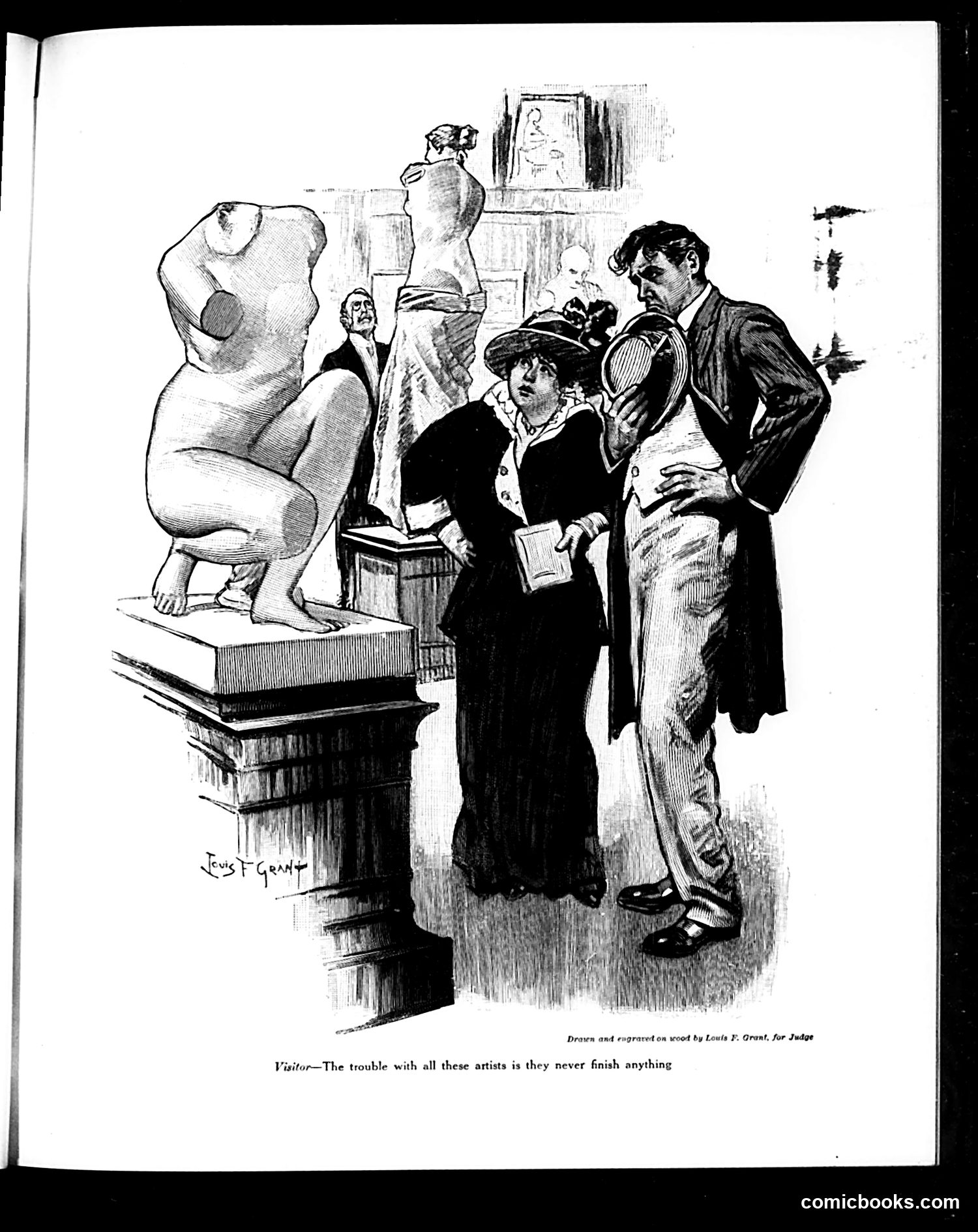
This satirical cartoon from *Judge* magazine depicts a museum or gallery scene where visitors observe an unfinished sculptural torso on a pedestal. The caption's joke—"The trouble with all these artists is they never finish anything"—mocks artists for incompleteness or lack of productivity. The cartoon likely critiques the artistic community of its era (appears to be late 19th or early 20th century based on style and clothing). The "visitor" commenting represents the common viewer's frustration with modern or contemporary artists who leave works incomplete or unpolished. The formal dress of the observers and the museum setting suggest this targets established art institutions and their patrons, using humor to satirize artistic pretension and the gap between artist ambition and actual output.
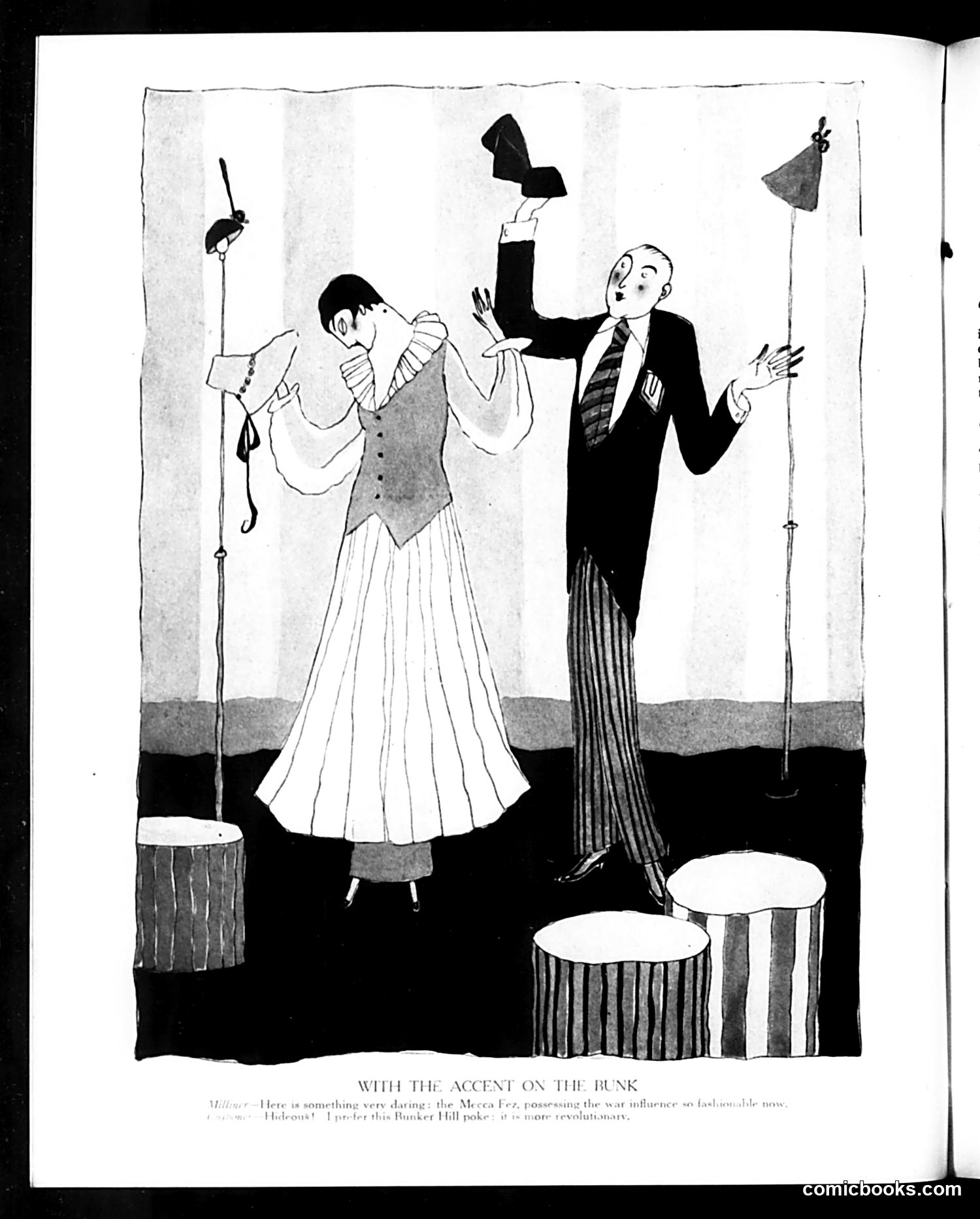
This Judge magazine cartoon satirizes fashion and social pretension. A man in formal attire gestures enthusiastically at a woman wearing a dress with an exaggerated, voluminous runk (likely "rump" or rear emphasis—a fashion detail of the era). The OCR'd caption mentions "the Mecca Fez" and references to "Bunker Hill poke" as fashionable items, suggesting the joke ridicules women adopting absurd or "revolutionary" fashion trends. The cartoon mocks how fashion designers introduce outlandish silhouettes that women eagerly adopt despite their impracticality. The man's animated pose suggests he's promoting or hawking this ridiculous style. The social commentary criticizes both the fashion industry's influence and women's willingness to follow trends that emphasize particular body parts, presented as inherently absurd or undignified.
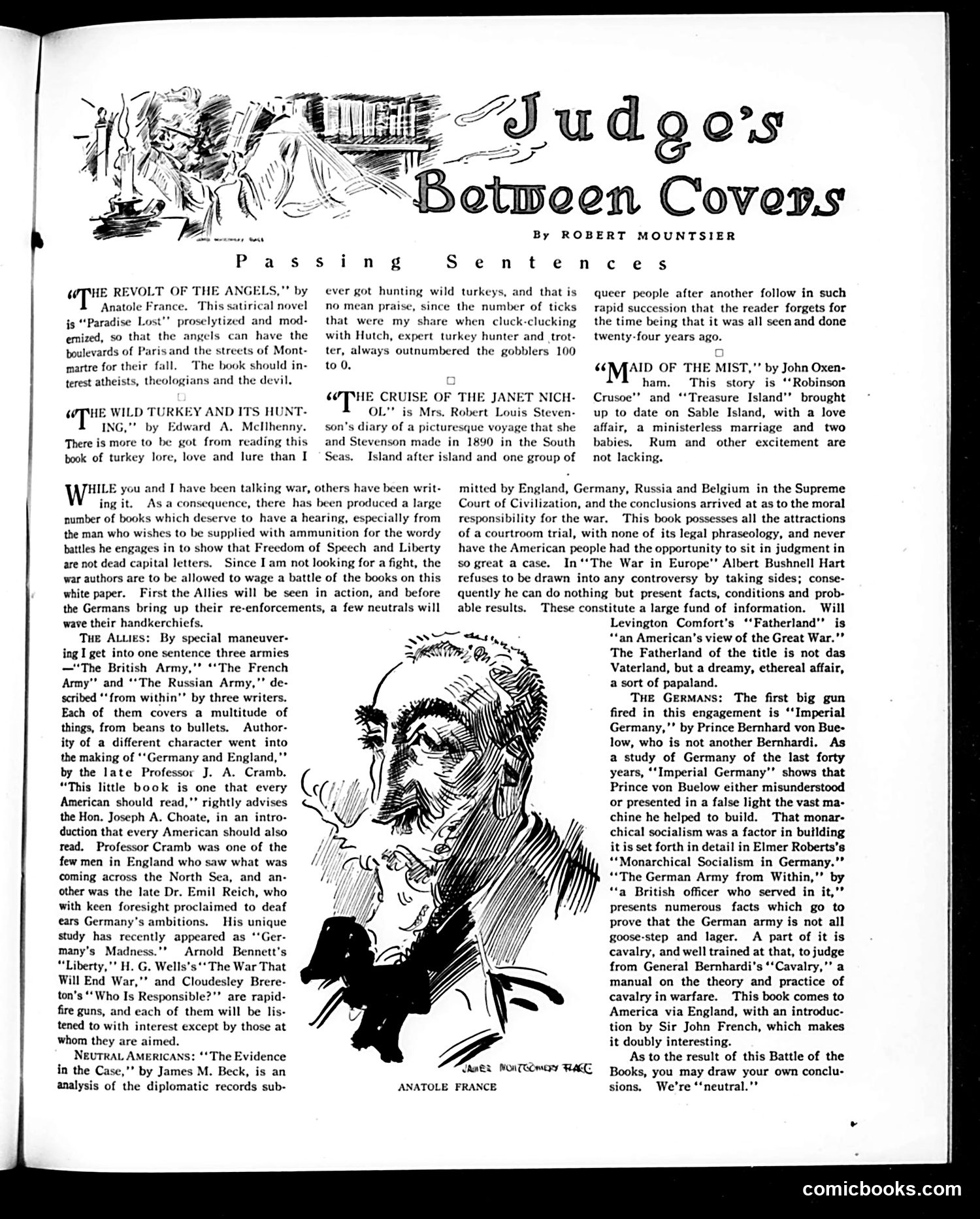
This page reviews wartime books from around WWI era. The central cartoon depicts **Anatole France**, the French writer, whose satirical novel "The Revolt of the Angels" reimagines Paradise Lost with angels inhabiting modern Paris and Montmartre. The reviews showcase **pro-Allied propaganda literature**—books by British, French, and Russian writers describing their armies "from within," plus American analysis of German ambitions. The text emphasizes how these works provide "ammunition for wordy battles" defending "Freedom of Speech and Liberty." Notable is the framing of neutral Americans: James M. Beck's "The Evidence in the Case" presents diplomatic documents as evidence in a "Supreme Court of Civilization" trial determining Germany's moral responsibility for the war. The page presents the conflict as a moral and legal matter requiring public education. The overall tone positions reading as patriotic duty during wartime.
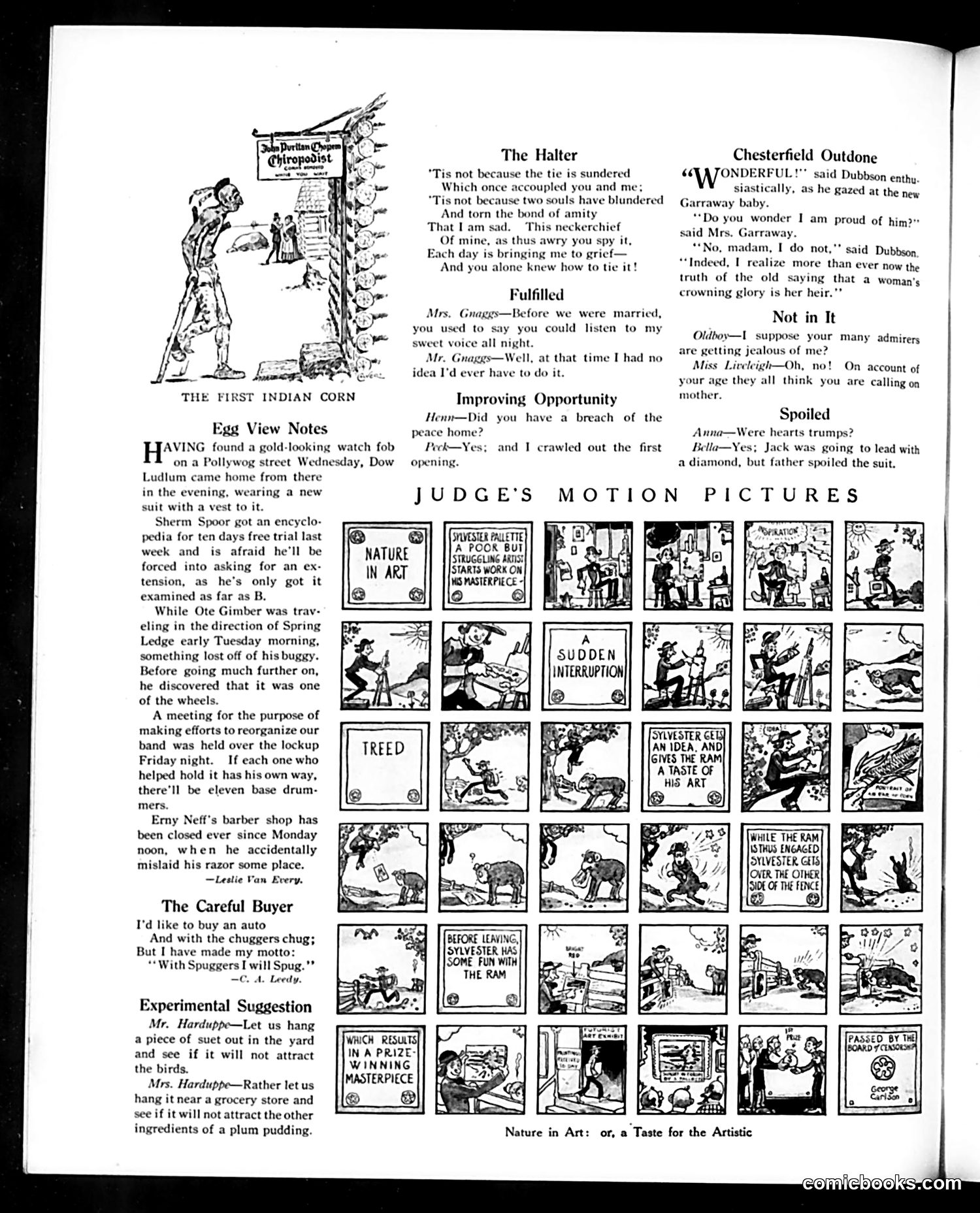
This page from Judge magazine contains several short humorous pieces typical of early-20th-century American satire: **"Egg View Notes"** presents rural/small-town comedy anecdotes about simple folk and minor mishaps—lost watch fobs, detached wagon wheels, and barber shop closures. The humor relies on understated, deadpan delivery of everyday absurdities. **The poetry and short dialogues** ("The Halter," "Fulfilled," "Improving Opportunity") use marital discord and domestic frustration as comedic subjects—common Judge fare mocking both romantic idealization and matrimonial reality. **"Judge's Motion Pictures"** appears to be a proto-comic strip featuring an artist character ("Sylvester Palette") in various scenarios, likely satirizing struggling bohemian artists and slapstick situations. The page reflects Judge's primary approach: gentle social satire targeting middle-class anxieties, marital relations, and urban/rural character types, with no apparent political commentary.
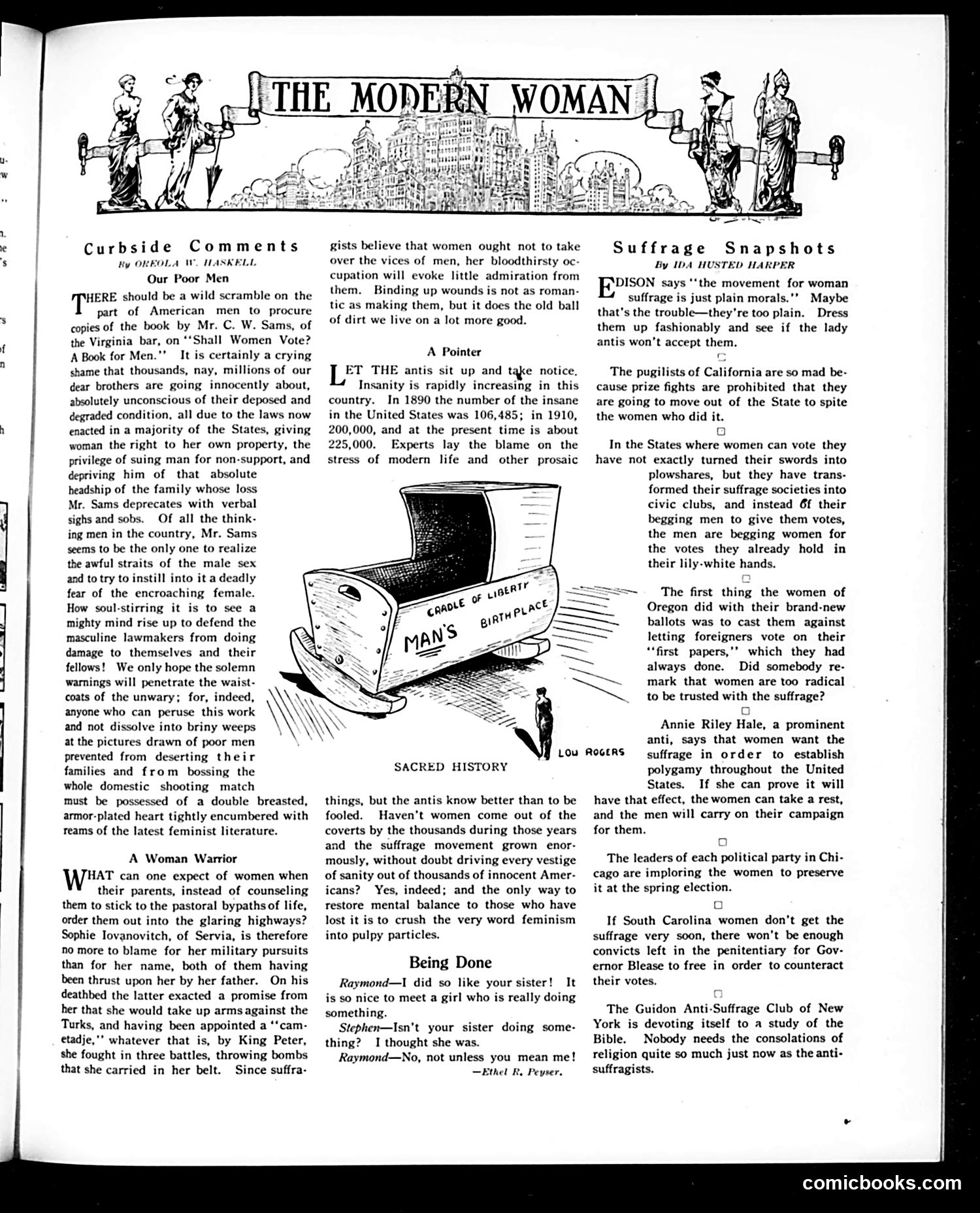
This page satirizes anti-suffrage arguments through mock-serious commentary. The cartoons and articles use irony to ridicule opponents of women's voting rights. **"Our Poor Men"** section mocks C.W. Sams's book defending male authority, sarcastically lamenting how laws granting women property rights and non-support claims have "degraded" men. The satire is obvious: the author exaggerates male victimhood absurdly. **The coffin cartoon** labeled "Man's Cradle of Liberty" by Lou Rogers visualizes the anti-suffrage claim that women's rights threaten male authority—treating this fear as darkly comic. **"A Woman Warrior"** uses Sophie Iovanovitch of Serbia to highlight anti-suffragists' contradiction: they claim women shouldn't adopt "men's vices" like violence, yet praise male soldiers—exposing their inconsistent logic. **"A Pointer"** sarcastically suggests rising insanity correlates with the suffrage movement, mocking anti-suffragists' actual arguments by presenting them as absurd. The page's overall strategy: present anti-suffrage positions sympathetically enough that readers recognize their illogic.
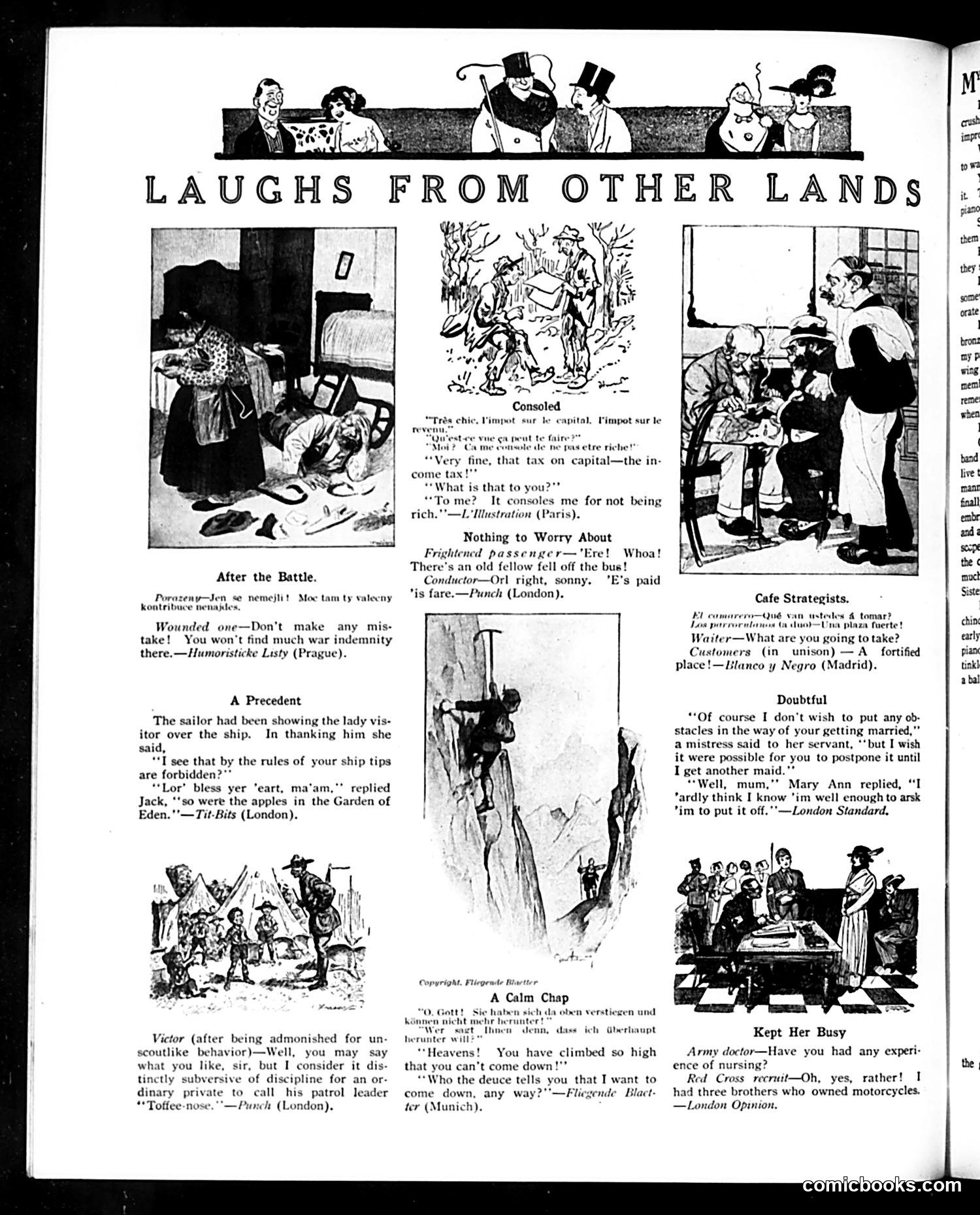
This is a humor compilation page reprinting jokes from international publications (Punch, Fliegende Blätter, L'Illustration, etc.). The cartoons and captions showcase genteel early-20th-century comedy: **Key jokes include:** - A bus conductor unbothered by a passenger falling off—he's paid his fare - A sailor comparing forbidden ship tips to forbidden fruit in Eden - A climber refusing rescue, insisting he never wanted to come down - A mistress trying to delay her servant's marriage for domestic convenience - A Red Cross recruit claiming nursing experience because her brothers owned motorcycles **The satire:** These reflect period attitudes—class hierarchies (servants, sailors), bureaucratic indifference, social pretense, and gender dynamics. The humor relies on wordplay, comebacks, and situational irony rather than political commentary. The page demonstrates Judge's practice of sharing international humor, suggesting cosmopolitan readers who appreciated European wit. The jokes reveal casual acceptance of social inequalities now unthinkable.
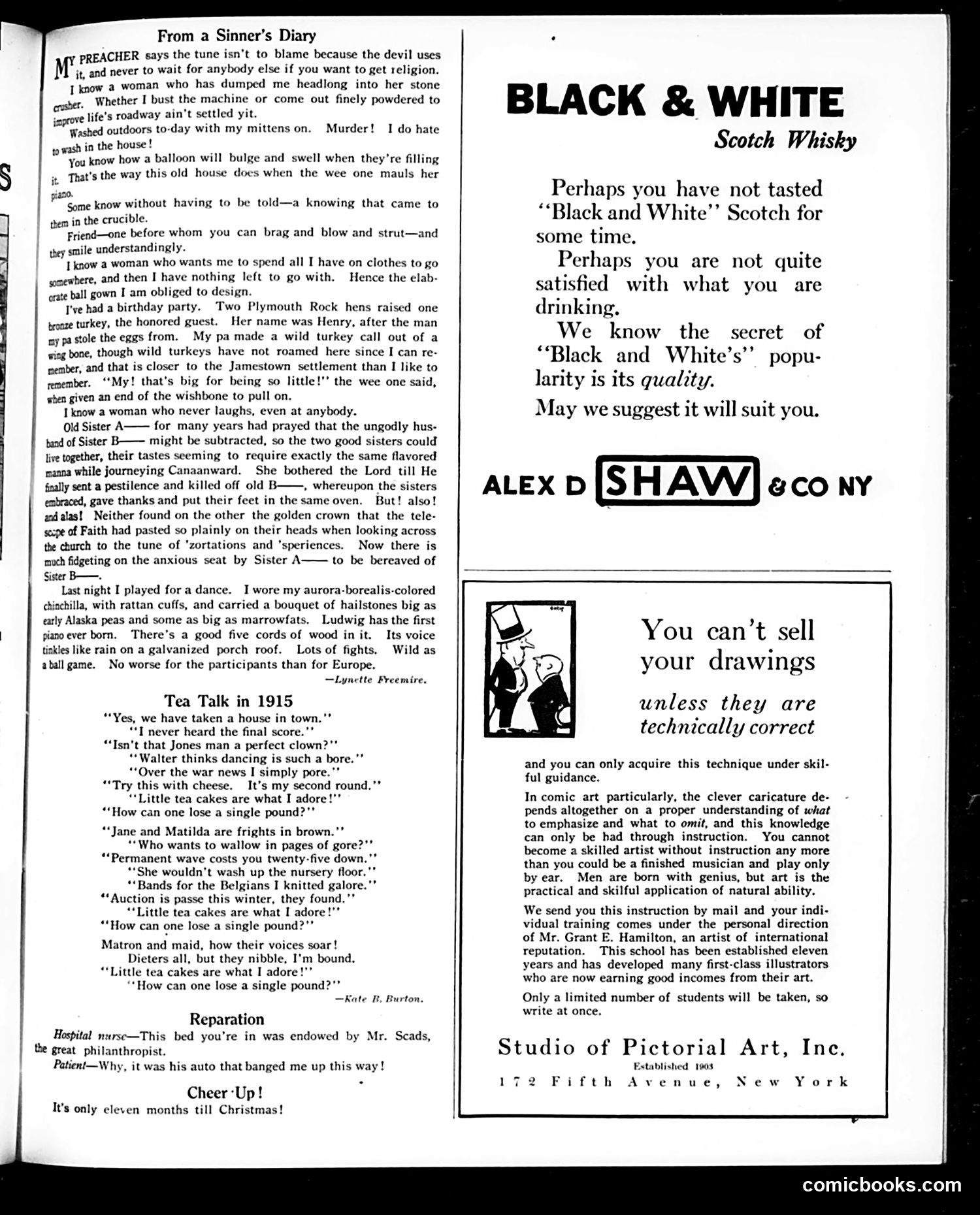
This page contains three separate satirical pieces typical of early 20th-century American humor: **"From a Sinner's Diary"** presents cynical observations on hypocrisy and human weakness—a woman who dumped the narrator, wasteful spouses, and most pointedly, "Old Sister A" who prayed for her companion's husband to die, then was disappointed when reunited with the widow. The satire targets religious self-deception. **"Tea Talk in 1915"** mocks upper-class women's trivial conversation—obsessing over weight ("How can one lose a single pound?"), fashion, gossip, and domestic help while claiming concern for war relief ("Bands for the Belgians"). The repeated refrain about tea cakes satirizes their hypocrisy. **"Reparation"** is a brief joke: a hospital patient learns his bed was endowed by the philanthropist whose car hit him—ironic justice. The advertisements (Black & White Scotch, Shaw's art instruction) occupy the right side. Overall, the page reflects Judge's focus on mocking social pretension and moral inconsistency among the comfortable classes.
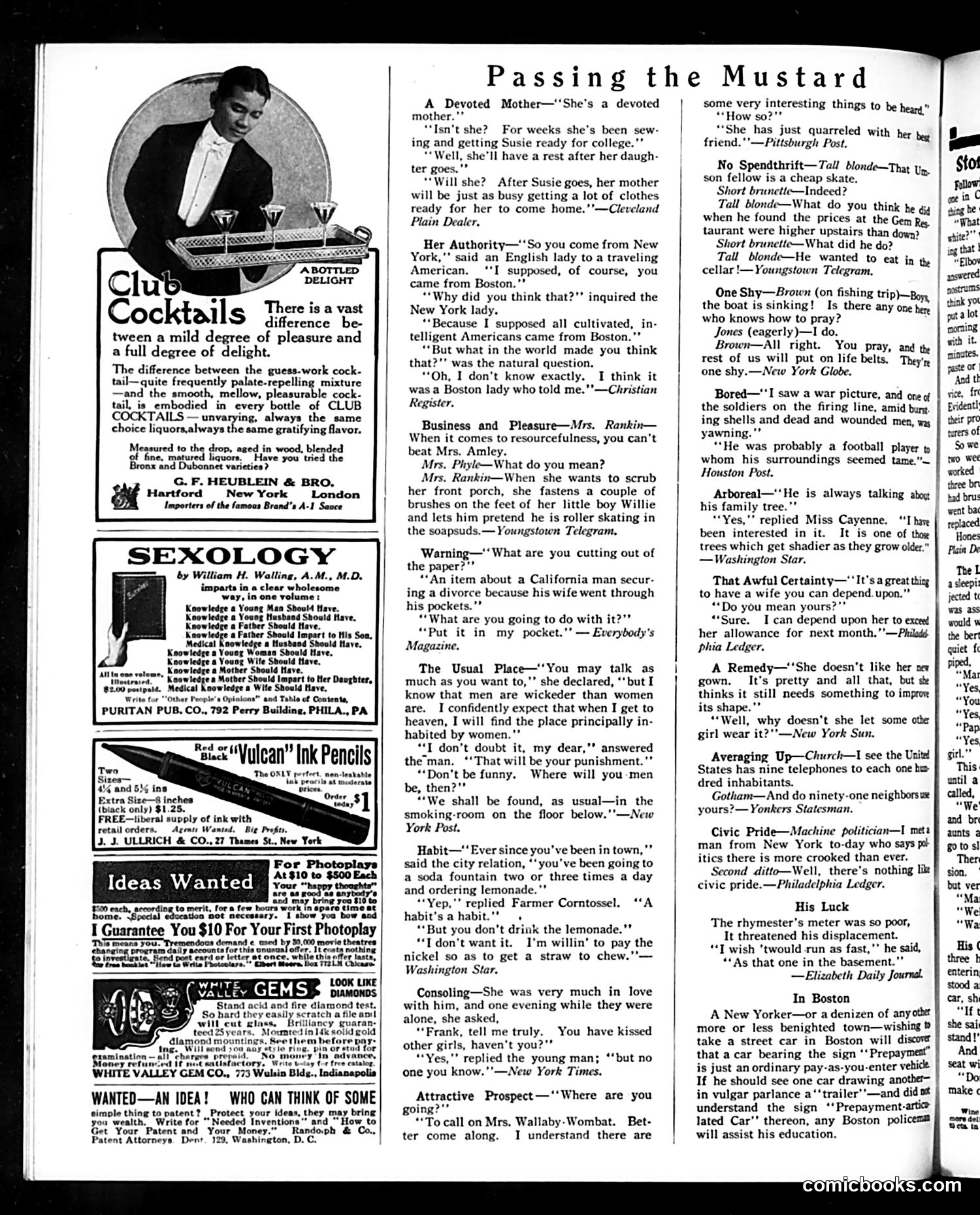
This page from *Judge* magazine contains primarily **short humorous anecdotes** rather than political cartoons. The jokes satirize domestic life and American social pretensions of the era. Key humor themes include: - **Mothers and college**: A devoted mother remains busy preparing clothes for her daughter's return home rather than resting after her departure. - **American regional snobbery**: A New York woman is amused when an English lady assumes all "cultivated" Americans come from Boston—having learned this claim from a Bostonian herself. - **Gender stereotypes**: Women are portrayed as naturally deceptive and morally superior; a man jokes that heaven will be "principally inhabited by women" as punishment, while men will occupy "the smoking-room on the floor below." - **Domestic ingenuity**: A woman cleverly uses her child's roller skates to clean her porch simultaneously. The page also contains period advertisements (cocktails, books on sexology, patent services), reflecting typical *Judge* content mixing satire with commercial pitches.
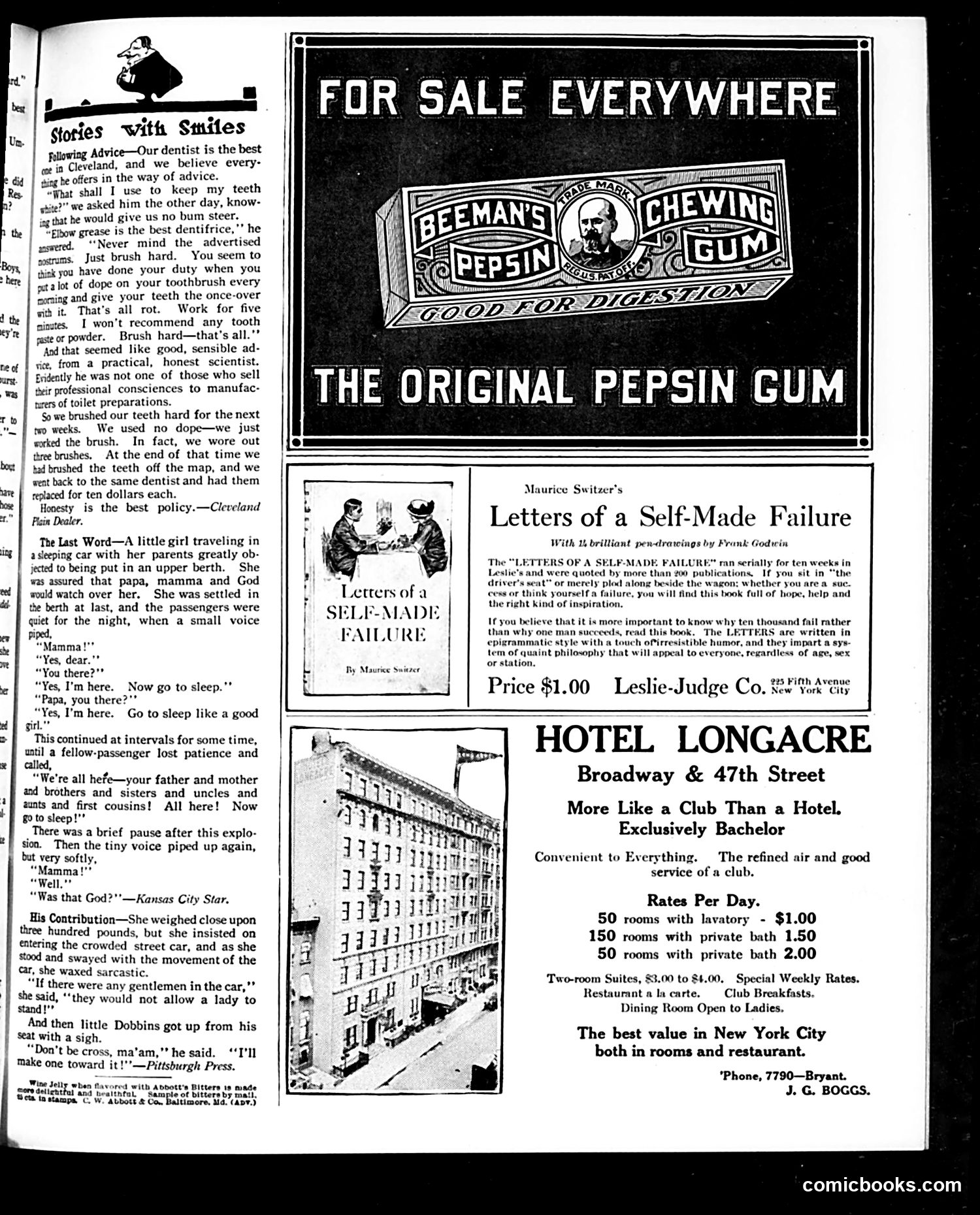
This page is primarily **advertising and filler content** rather than political satire. It contains: **"Stories with Smiles"** section: Humorous anecdotes mocking blind adherence to expert advice. A dentist recommends vigorous brushing without products; the narrator follows instructions so zealously he wears away his teeth entirely, requiring costly replacement. The satire targets both gullible consumers and professionals offering impractical advice. **Book Advertisement**: Maurice Switzer's *Letters of a Self-Made Failure*, presented as inspirational reading about why people fail rather than succeed. **Hotel Longacre Advertisement**: A New York City bachelor hotel promoting affordable lodging ($1-2 per day). **Beeman's Pepsin Gum Advertisement**: Claims the product aids digestion. The page reflects early 20th-century consumer culture and advertising conventions. No specific political figures or events are referenced—this is standard magazine filler content typical of Judge's mixed editorial and advertising format.
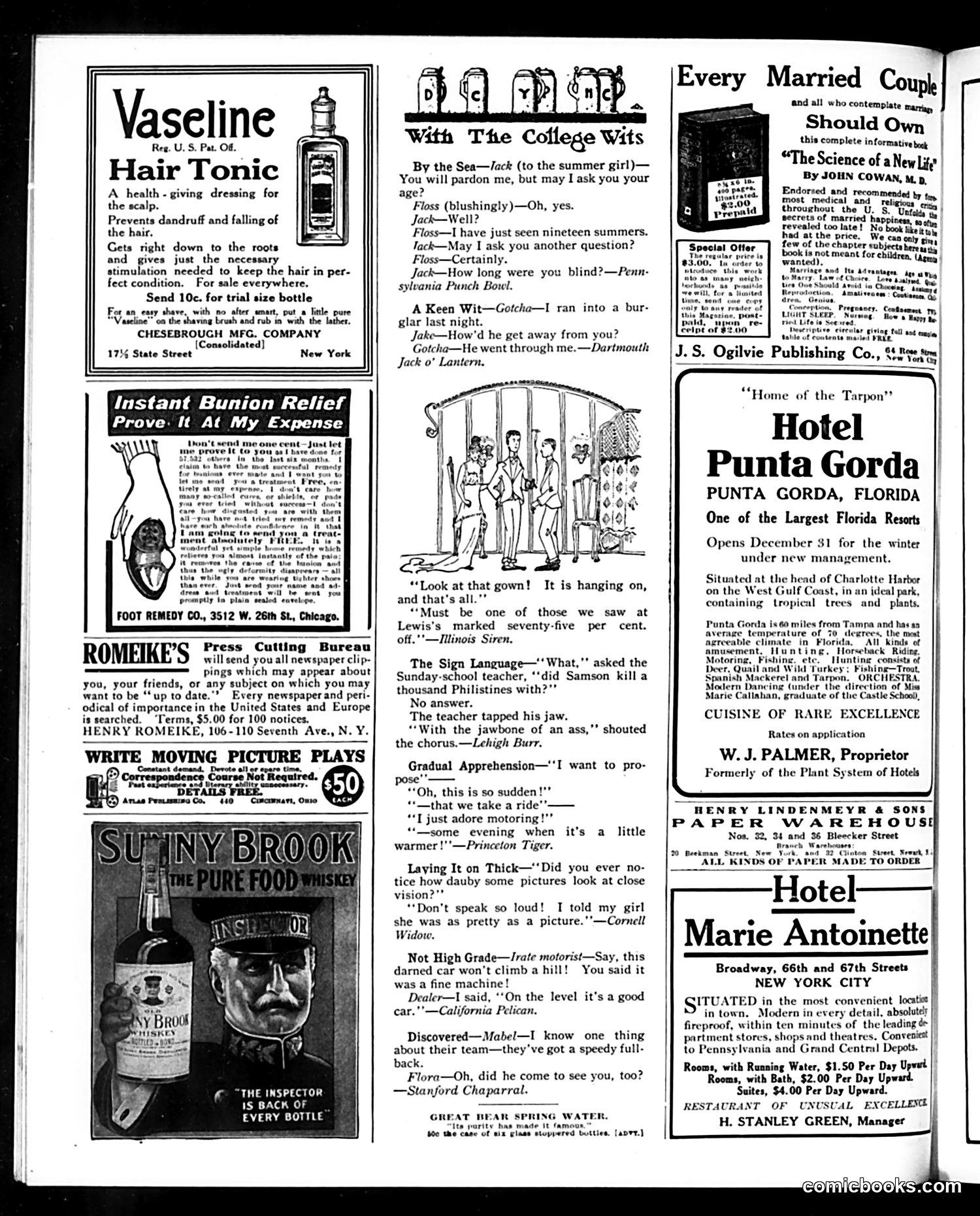
This page is primarily **advertisements and humorous short jokes**, typical of Judge magazine's format. The main satirical content consists of brief, light college humor pieces titled "With The College Wits"—exchanges mocking dating customs, courtship, and social awkwardness. For instance, a young man asks a woman's age; she claims nineteen summers, and he facetiously questions how long she's been "blind" (implying she's older). Another joke involves a Sunday school teacher tapping his jaw to remind students that Samson used a jawbone to kill Philistines. These jokes satirize **young people's vanity, courtship pretense, and romantic anxieties** in a lighthearted manner typical of the era. The remainder of the page consists of product advertisements (Vaseline hair tonic, bunion relief, hotel accommodations) that have no satirical component—they're straightforward commercial notices. The page lacks any significant political commentary or caricature requiring historical context beyond understanding early-20th-century social conventions around dating and propriety.
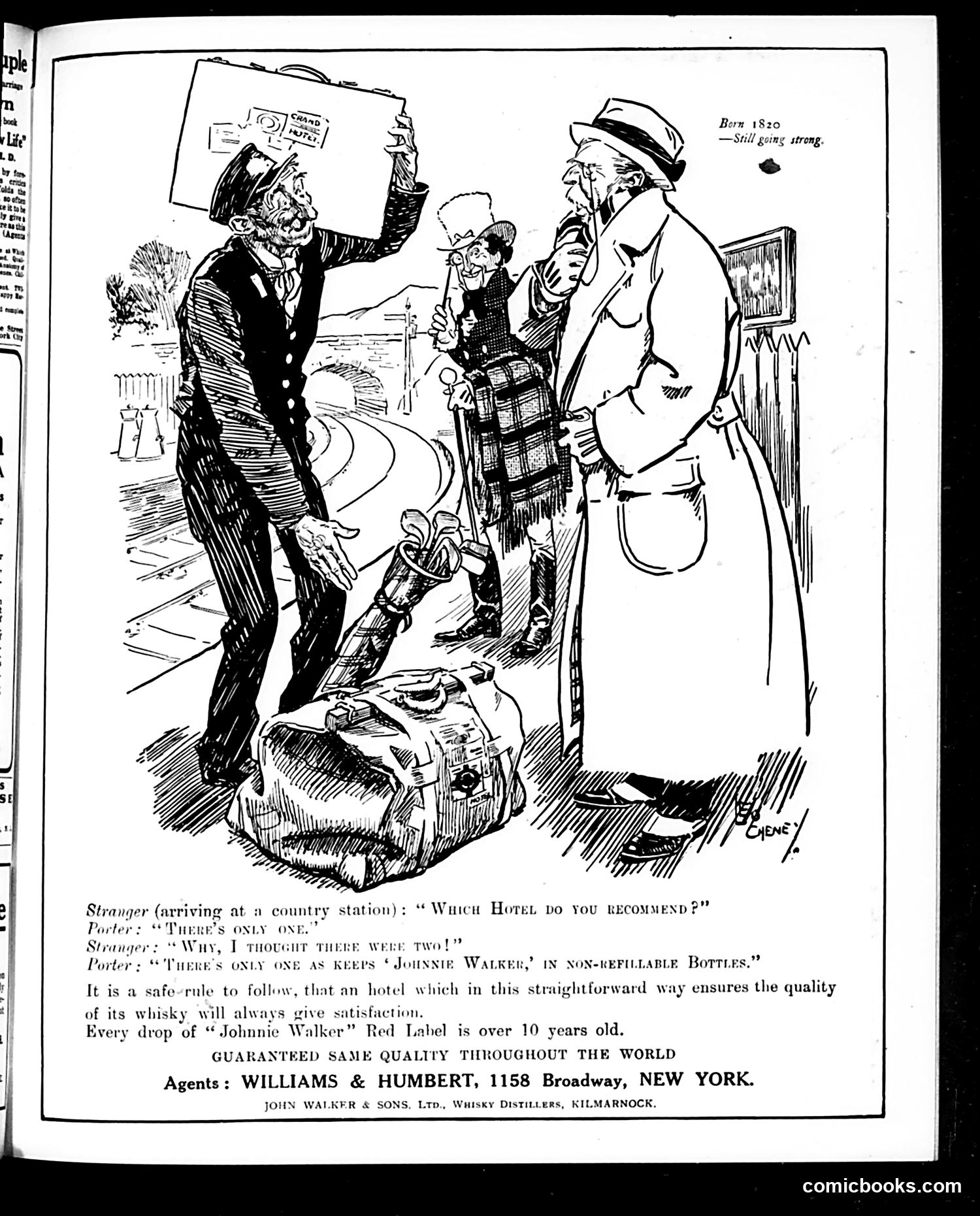
This is a **Johnnie Walker whisky advertisement disguised as humor**, not political satire. The "cartoon" depicts a traveler arriving at a country railway station asking which hotel to recommend. A porter replies there's "only one"—confusing the stranger, who thought there were two hotels. The porter clarifies: there's only one hotel that keeps Johnnie Walker whisky in non-refillable bottles, implying this ensures quality and prevents dilution or refilling with inferior spirits. The ad's message: choose hotels/establishments that stock Johnnie Walker Red Label (over 10 years old) as a guarantee of standards. The "Born 1820—Still going strong" header references the brand's longevity and reliability. This is pure product advertising leveraging a light joke about brand loyalty and quality assurance, with agents Williams & Humbert listed for New York distribution.
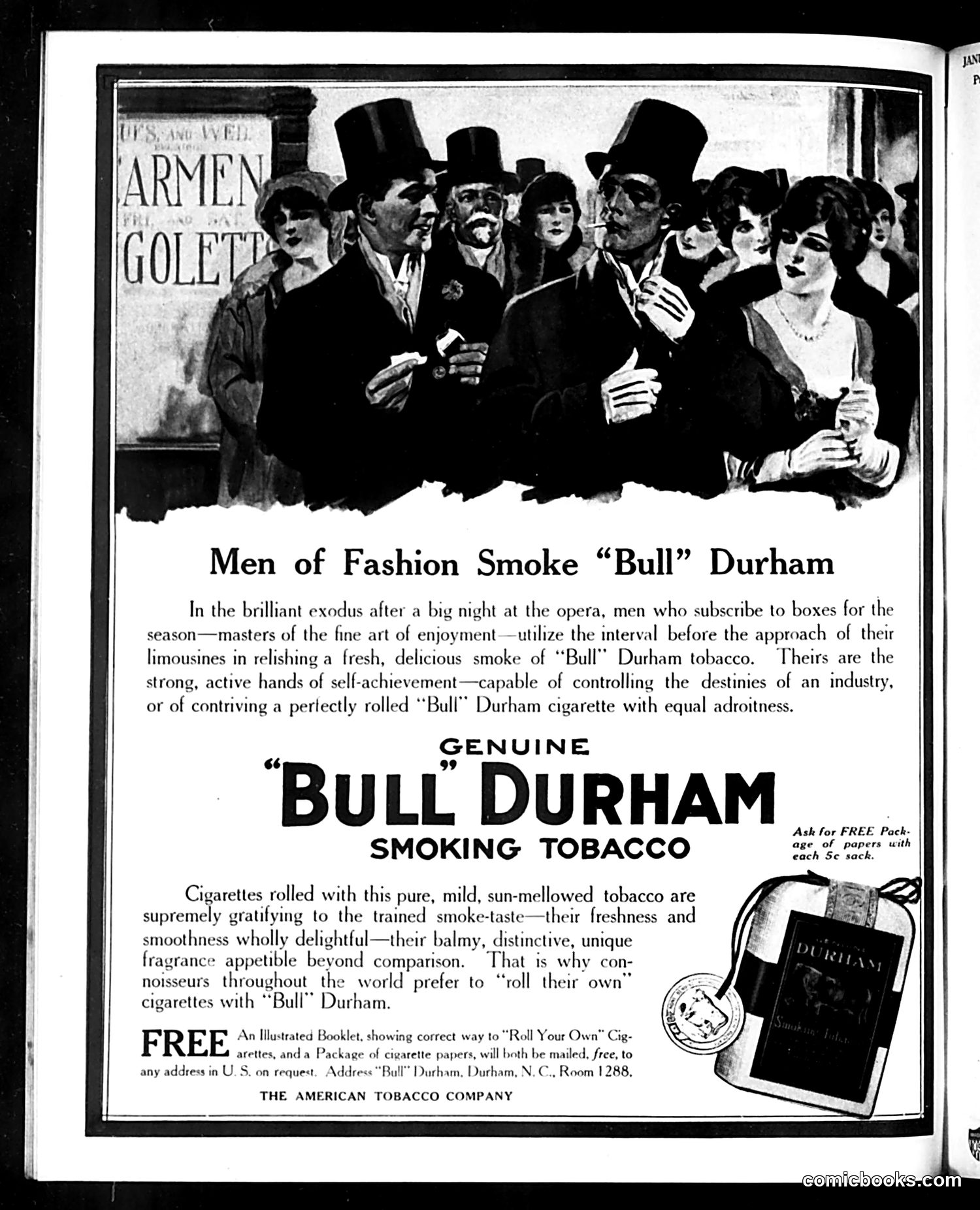
This page is primarily a **tobacco advertisement**, not satirical content. It presents an aspirational image of wealthy opera-goers—"men who subscribe to boxes for the season"—depicted in formal attire (top hats, evening wear) enjoying cigarettes during intermission. The ad conflates tobacco consumption with **upper-class refinement and masculine achievement**, claiming that men capable of "controlling the destinies of an industry" demonstrate equal skill rolling their own cigarettes. This appeals to social aspiration and self-image. The phrase "roll their own" emphasizes the product's versatility and suggests sophistication—connoisseurs worldwide prefer this tobacco for hand-rolling. There is **no apparent satire or political commentary** here; this is straightforward early 20th-century advertising that used class status and masculine identity as marketing tools. Judge magazine's satirical character doesn't apply to this particular page—it's simply a commercial appeal to affluent readers.