
Judge, 1915-01-23 · page 15 of 24
Judge — January 23, 1915 — page 15: what you’re looking at
What you’re looking at
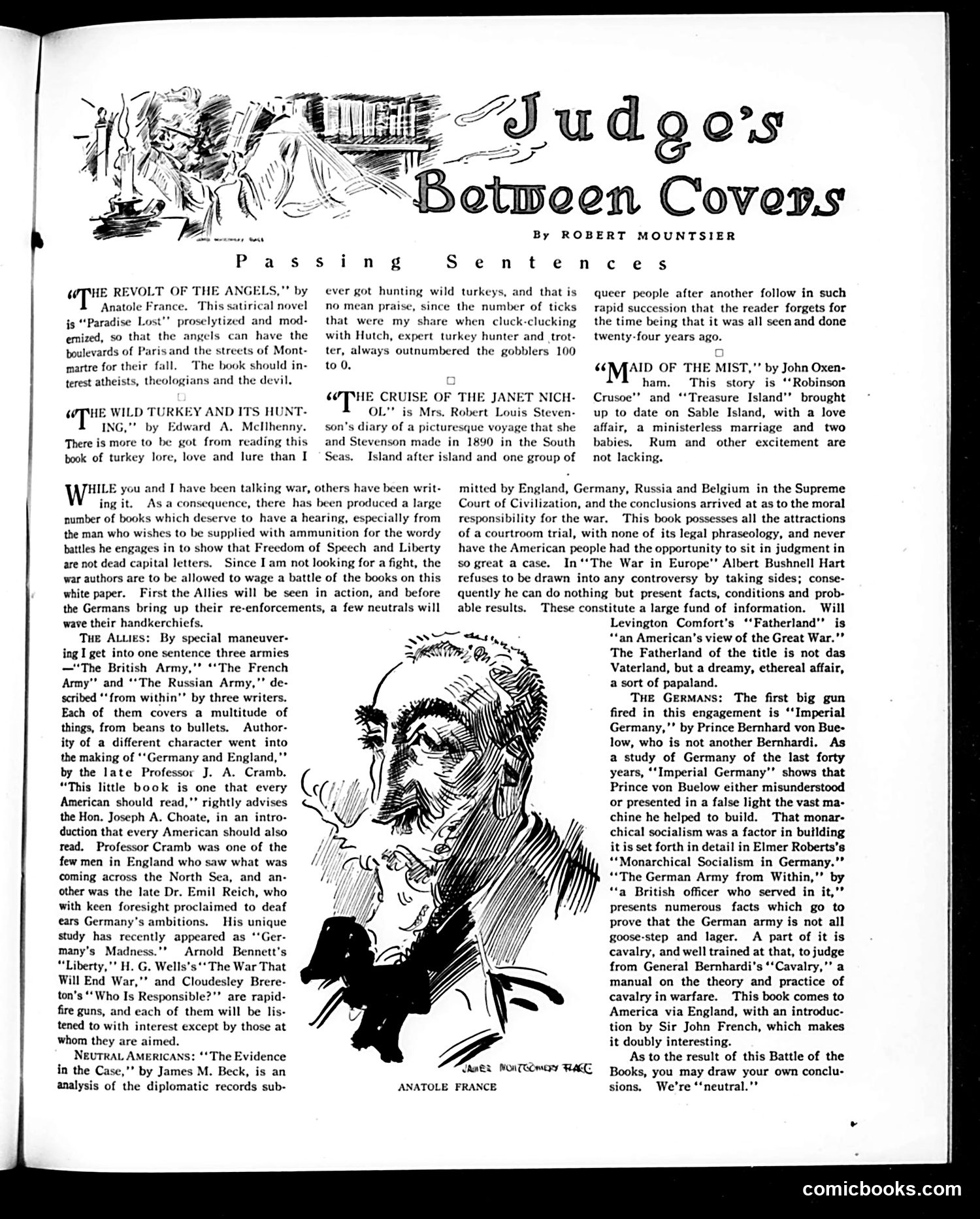
This page reviews wartime books from around WWI era. The central cartoon depicts **Anatole France**, the French writer, whose satirical novel "The Revolt of the Angels" reimagines Paradise Lost with angels inhabiting modern Paris and Montmartre. The reviews showcase **pro-Allied propaganda literature**—books by British, French, and Russian writers describing their armies "from within," plus American analysis of German ambitions. The text emphasizes how these works provide "ammunition for wordy battles" defending "Freedom of Speech and Liberty." Notable is the framing of neutral Americans: James M. Beck's "The Evidence in the Case" presents diplomatic documents as evidence in a "Supreme Court of Civilization" trial determining Germany's moral responsibility for the war. The page presents the conflict as a moral and legal matter requiring public education. The overall tone positions reading as patriotic duty during wartime.
📄 Transcribed text from this page (OCR, searchable)
Machine-transcribed from the original scan — historical spelling and the odd misread are preserved.
Passion g ever got hunting wi sep HE REVOLT OF THE ANGE by Anatole France. This satirical novel js “Paradise Lost"’ proselytized and mod- emized, so that the angels can have the boulevards of Paris and the streets of Mont- martre for their fall. The book should in- terest atheists, theologians and the devil. WILD TURKEY sd baer * by Edward A. Mcllhenny. There is more to be got from reading this book of turkey lore, love and lure than I to 0. 6¢TPHE CRUISE OF THE JANET NICH- OL" is Mrs. son's d and Stevenson made Seas. HILE you and I e been talking war, others have been writ- ing it. Asa consequence, there has been produced a large number of books which deserve to have a hearing, especially from the man who wishes to be supplied with ammunition for the wordy battles he engages in to show that Freedom of Speech and Liberty are not dead capital letters. Since I am not looking for a fight, the war authors are to be allowed to wage a battle of the books on this white paper. First the Allies will be seen in action, and before the Germans bring up their re-enforcements, a few neutrals will wave their handkerchiefs. Tue ALuigs: By special maneuver- ing I get into one sentence three armies —‘The British Army,”’ ‘*The French Army’ and ‘‘The Russian Army,’’ de- scribed ‘*from within’’ by three writers. Each of them covers a multitude of things, from beans to bullets. Author- ity of a different character went into the making of ‘‘Germany and England,"* by the late Professor J. A. Cramb. “This little book is one that every American should read,"’ rightly advises the Hon. Joseph A. Choate, in an intro- duction that every American should also read. Professor Cramb was one of the few men in England who saw what was coming across the North Sea, and an- other was the late Dr. Emil Reich, who with keen foresight proclaimed to deaf ears Germany's ambitions. His unique study has recently appeared as ‘‘Ger- many’s Madness.'’ Arnold Bennett's “Liberty,"’ H. G. Wells's‘‘ The War That Will End War,’’ and Cloudesley Brere- ton’s ‘Who Is Responsible?’ are rapid- fire guns, and each of them will be lis- tened to with interest except by those at whom they are aimed. NEUTRAL AMERICANS: ‘‘The Evidence in the Case,’” by James M. Beck, is an analysis of the diplomatic records sub- no mean praise, since the number of ticks that were my share when cluck-clucking with Hutch, expert turkey hunter and _trot- ter, always outnumbered the gobblers 100 ry of a picturesque voyage that she Island after island and one group of ANATOLE FRANCE go's By ROBERT MOUNTSIER Sentences queer people after another follow in such rapid succession that the reader forgets for the time being that it was all seen and done twenty-four years ago. 6¢\fAID OF THE MIST,"’ by John Oxen- ham. This story is ‘‘Robinson Crusoe’? and ‘‘Treasure Island’’ brought up to date on Sable Island, with a love affair, a ministerless marriage and two babies, Rum and other excitement are not lacking. Id turkeys, and that is Robert Louis Steven- in 1890 in the South mitted by England, Germany, Russia and Belgium in the Supreme Court of Civilization, and the conclusions arrived at as to the moral responsibility for the war. This book possesses all the attractions of a courtroom trial, with none of its legal phraseology, and never have the American people had the opportunity to sit in judgment in so great a case. In‘*The War in Europe’’ Albert Bushnell Hart refuses to be drawn into any controversy by taking sides; conse- quently he can do nothing but present facts, conditions and prob- able results. These constitute a large fund of information. Will Levington Comfort's ‘‘Fatherland"’ is ‘tan American’s view of the Great War.’” The Fatherland of the title is not das Vaterland, but a dreamy, ethereal affair, a sort of papaland. THE GERMANS: The first big gun fired in this engagement is ‘‘Imperial Germany,’’ by Prince Bernhard von Bue- low, who is not another Bernhardi. As a study of Germany of the last forty years, ‘‘Imperial Germany’’ shows that Prince von Buelow either misunderstood or presented in a false light the vast ma- chine he helped to build. That monar- chical socialism was a factor in butlding it is set forth in detail in Elmer Roberts's “*Monarchical Socialism in Germany.’’ “The German Army from Within, “‘a British officer who served in it,’’ Presents numerous facts which go to prove that the German army is not all goose-step and lager. A part of it is cavalry, and well trained at that, to judge from General Bernhardi’s ‘‘Cavalry,"’ a manual on the theory and practice of cavalry in warfare. This book comes to America via England, with an introduc- tion by Sir John French, which makes it doubly interesting. As to the result of this Battle of the Books, you may draw your own conclu- sions, We're ‘‘neutral."’ EL MONTCOMERY RACE comicbooks.com