
Judge, 1915-01-23 · page 8 of 24
Judge — January 23, 1915 — page 8: what you’re looking at
What you’re looking at
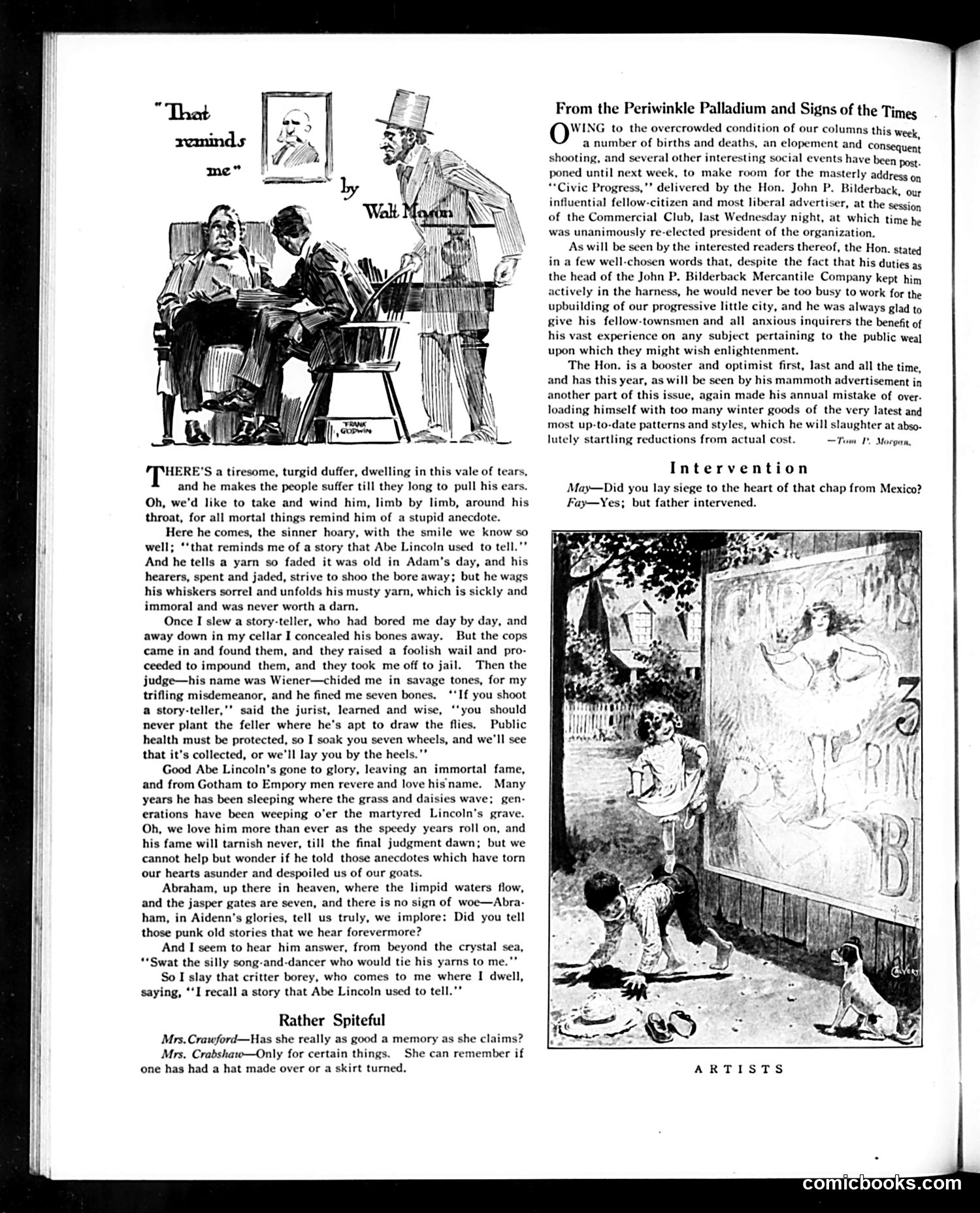
This *Judge* magazine page contains two satirical pieces: **"That Reminds Me"** (main cartoon/poem): A scathing attack on tedious people who constantly tell old, worn-out anecdotes, particularly those attributed to Abraham Lincoln. The cartoon illustrates a boring storyteller annoying his audience. The poem humorously escalates to imagining murdering such a bore, getting arrested, and being fined by a judge named Wiener. The satirist then apostrophizes Lincoln in heaven, asking if he actually told these tiresome stories that circulate endlessly. The joke: repetitive, stale anecdotes—whether Lincoln's or anyone's—are so insufferable they warrant drastic action. **"Rather Spiteful"** (brief joke at bottom): A woman claims excellent memory, but her friend reveals she only remembers petty details about others' clothing—whether hats were remade or skirts altered. It satirizes cattiness and small-minded gossip as "memory." The page reflects early-20th-century frustration with oral culture's repetitive storytelling habits.
📄 Transcribed text from this page (OCR, searchable)
Machine-transcribed from the original scan — historical spelling and the odd misread are preserved.
HERE'S a tiresome, turgid duffer, dwelling in this vale of tears, and he makes the people suffer till they long to pull his ears. Oh, we'd like to take and wind him, limb by limb, around his throat, for all mortal things remind him of a stupid anecdote. Here he comes, the sinner hoary, with the smile we know so well; ‘‘that reminds me of a story that Abe Lincoln used to tell." And he tells a yarn so faded it was old in Adam's day, and his hearers, spent and jaded, strive to shoo the bore away; but he wags his whiskers sorrel and unfolds his musty yarn, which is sickly and immoral and was never worth a darn, Once I slew a story-teller, who had bored me day by day, and away down in my cellar I concealed his bones away. But the cops came in and found them, and they raised a foolish wail and pro- ceeded to impound them, and they took me off to jail. Then the judge—his name was Wiener—chided me in savage tones, for my trifling misdemeanor, and he fined me seven bones. ‘‘If you shoot a story-teller,"’ said the jurist, learned and wise, ‘‘you should never plant the feller where he’s apt to draw the flies, Public health must be protected, so I soak you seven wheels, and we'll see that it’s collected, or we'll lay you by the heels."" Good Abe Lincoln's gone to glory, leaving an immortal fame, and from Gotham to Empory men revere and love hisname. Many years he has been sleeping where the grass and daisies wave; gen- erations have been weeping o'er the martyred Lincoln's grave. Oh, we love him more than ever as the speedy years roll on, and his fame will tarnish never, till the final judgment dawn; but we cannot help but wonder if he told those anecdotes which have torn our hearts asunder and despoiled us of our goat Abraham, up there in heaven, where the limpid waters flow, and the jasper gates are seven, and there is no sign of woe—Abra- ham, in Aidenn’s glories, tell us truly, we implore: Did you tell those punk old stories that we hear forevermore? And I seem to hear him answer, from beyond the crystal se: “*Swat the silly song-and-dancer who would tie his yarns to me." So I slay that critter borey, who comes to me where I dwell, saying, ‘‘I recall a story that Abe Lincoln used to tell.’” Rather Spiteful Mrs.Crawford—Has she really as good a memory as she claims? Mrs. Crabshate—Only for certain things. She can remember if one has had a hat made over or a skirt turned. From the Periwinkle Palladium and Signs of the Times WING to the overcrowded condition of our columns this week a number of births and deaths, an elopement and consequent shooting, and several other interesting social events have been post. poned until next week, to make room for the masterly address on “Civic Progress," delivered by the Hon. John P. Bilderback, our influential fellow-citizen and most liberal advertiser, at the session of the Commercial Club, last Wednesday night, at which time he was unanimously re-elected president of the organization, As will be seen by the interested readers thereof, the Hon. stated in a few well-chosen words that, despite the fact that his duties as of the John P. Bilderback Mercantile Company kept him ely in the harness, he would never be too busy to work for the upbuilding of our progressive little city, and he was always glad to give his fellow-townsmen and all anxious inquirers the benefit of his it experience on any subject pertaining to the public weal upon which they might wish enlightenment. The Hon. is a booster and optimist first, last and all the time, and has this year, as will be seen by his mammoth advertisement in another part of this issue, again made his annual mistake of over. loading himself with too many winter goods of the very latest and most up-to-date patterns and styles, which he will slaughter at abso- lutely startling reductions from actual cost. —Tom P. Morgaa, Intervention May—Did you lay siege to the heart of that chap from Mexico? Fay—Yes; but father intervened. ARTISTS