
A complete issue · 24 pages · 1915
Judge — January 16, 1915
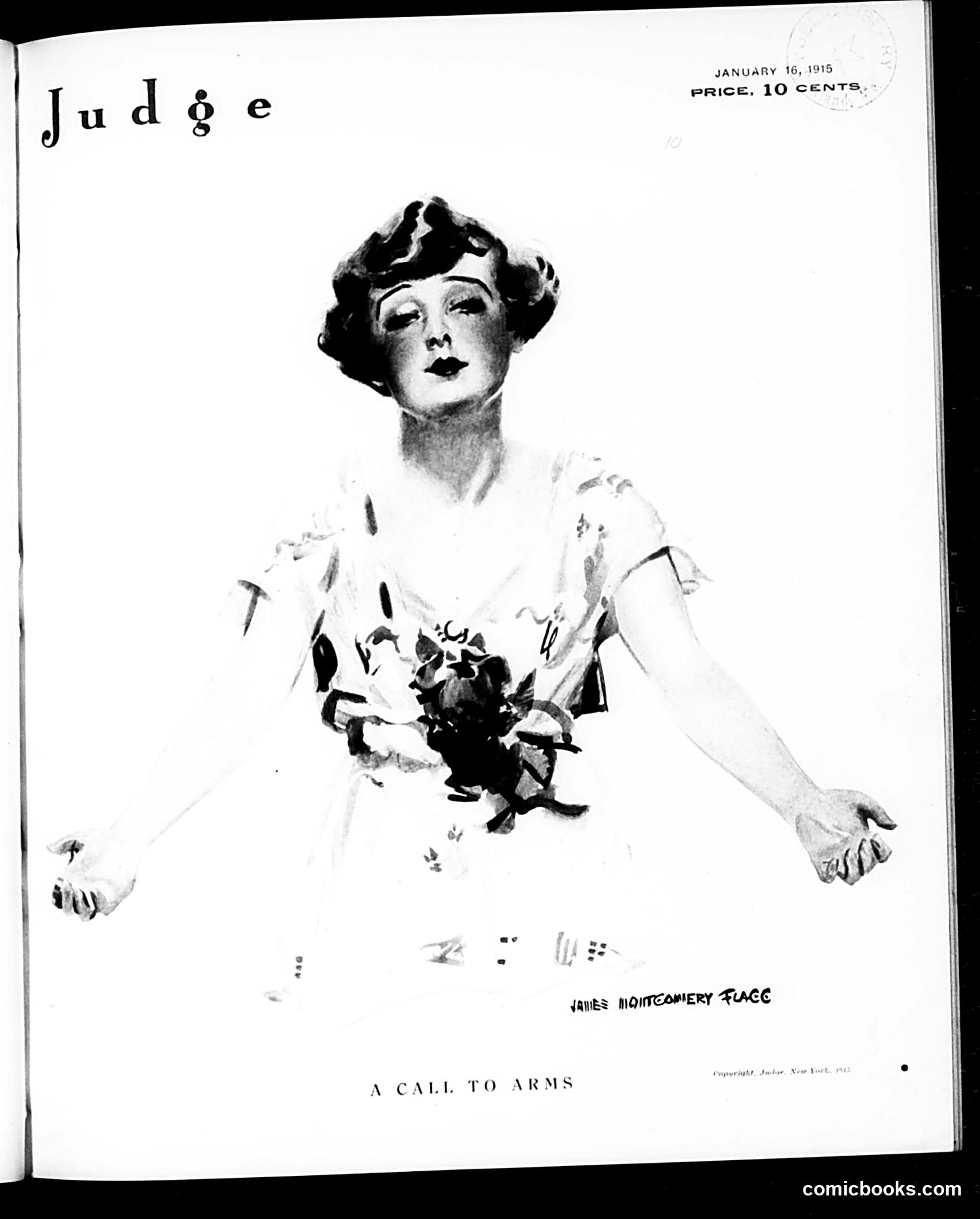
This cover illustration by James Montgomery Flagg depicts a elegantly dressed woman in a white dress holding a bouquet, gazing upward with patriotic resolve. The title "A Call to Arms" suggests this is WWI propaganda imagery. Published in early 1915 (before U.S. entry into WWI in April 1917), this likely encourages American military preparedness or support for the Allied cause. The woman—a common symbolic figure for "Liberty" or the nation itself—represents the emotional appeal of patriotic duty. The composition echoes recruitment poster aesthetics that would become iconic during American involvement. Judge magazine, as a satirical publication, may use this image to comment on wartime sentiment, though the specific satirical angle isn't clear from the image alone.
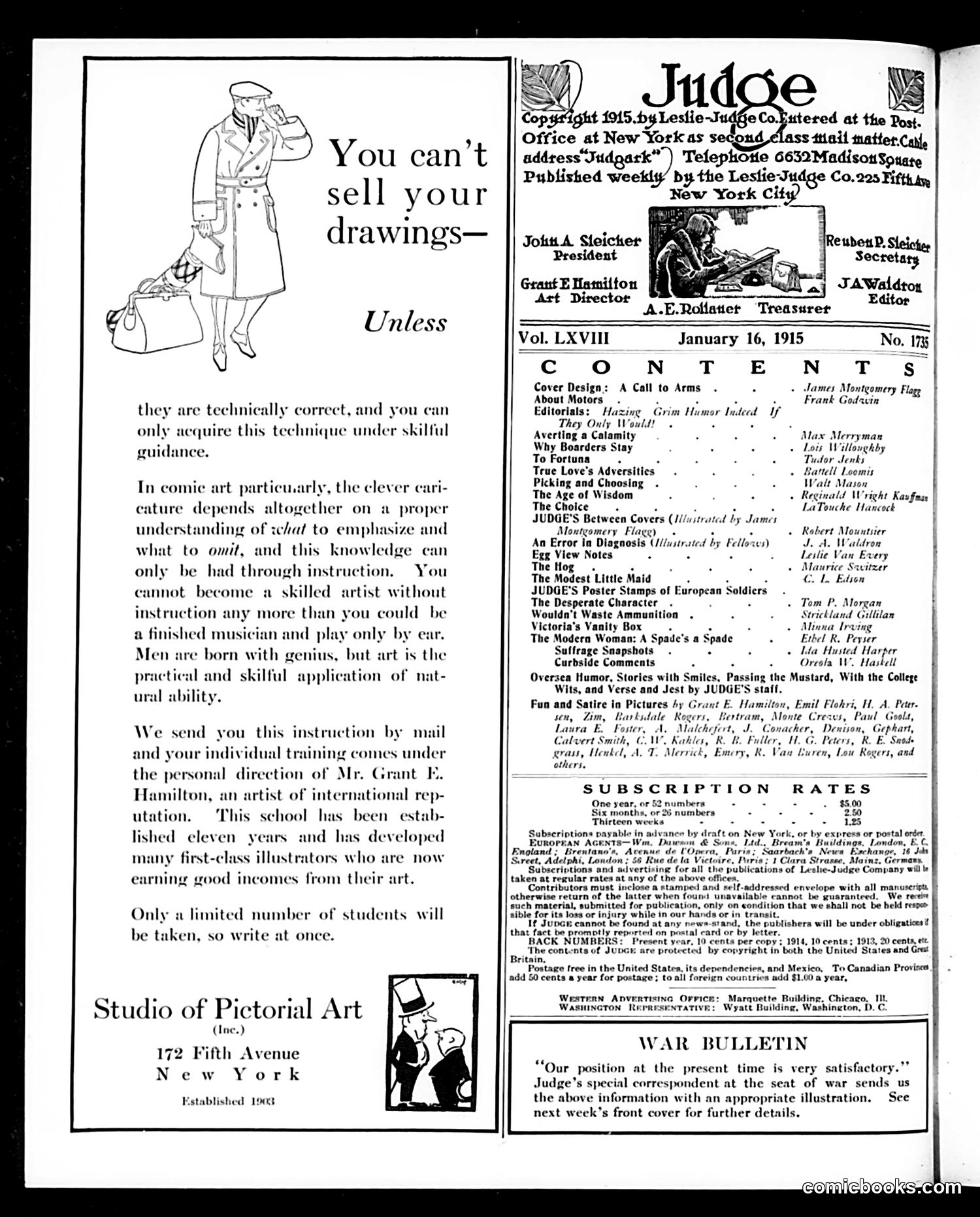
This page is primarily **advertising and masthead content** rather than political satire. The left side features an **ad for the Studio of Pictorial Art**, promoting mail-based art instruction under Grant E. Hamilton. The pitch argues that drawing skills cannot be self-taught—they require "skilled guidance" from professionals. The illustration shows a fashionably dressed woman, likely appealing to prospective students interested in commercial art. The right side displays the magazine's **contents page and subscription information**. The contents list humor pieces, illustrated features, and satirical commentary typical of Judge's format, though specific article titles don't clearly reference major 1915 political events visible here. The small "War Bulletin" at bottom obliquely references World War I, but provides no substantive commentary.
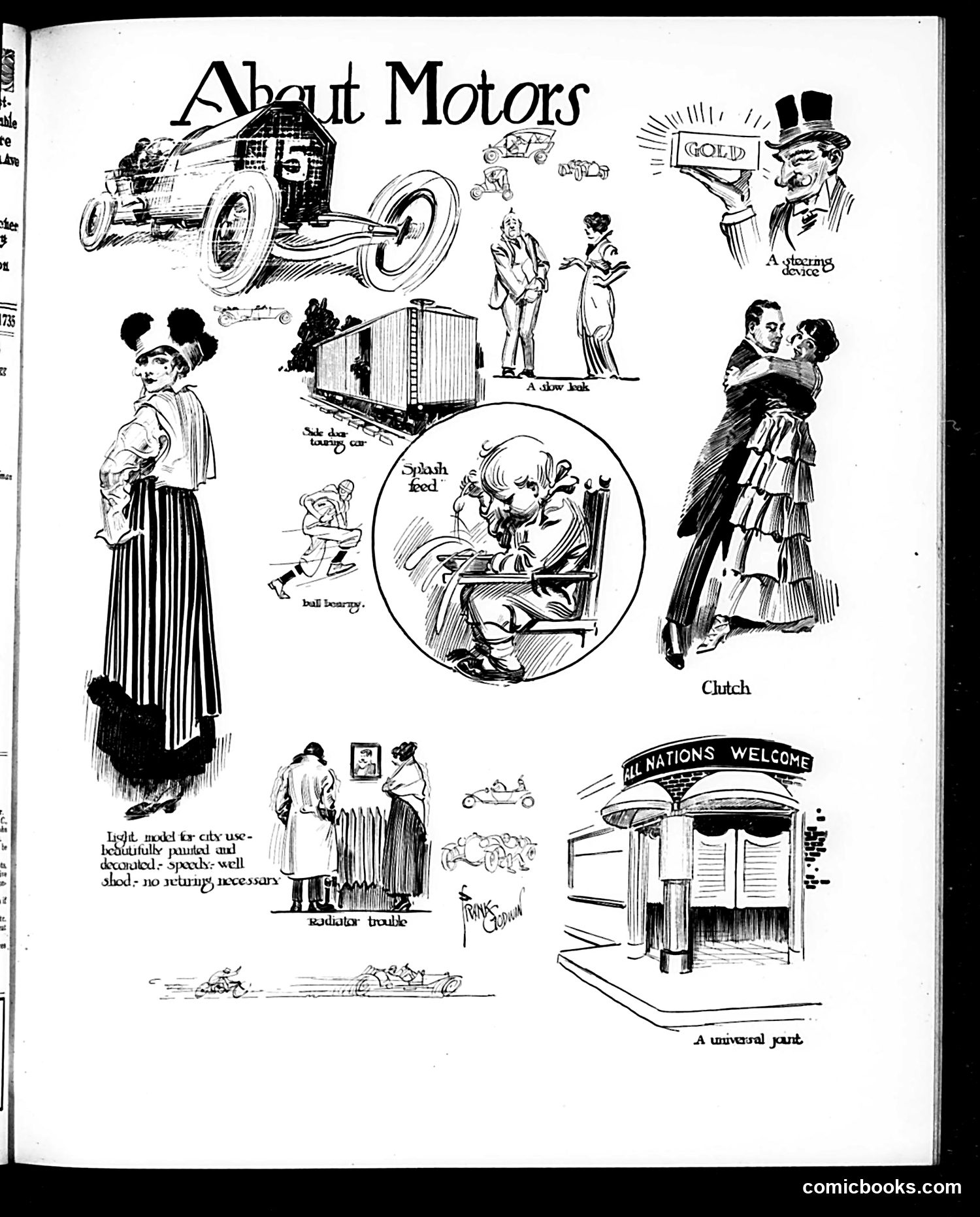
This page presents early automotive-era humor, mocking the emerging car culture and social anxieties around automobiles (likely 1910s-1920s). The satirical sketches include: - **Racing car (#5)**: Represents speed and danger obsessions - **"A steering device"**: Mocks pretentious automotive terminology - **Fashion figures** (women with exaggerated dress/hats): Satirizes how automobiles affected fashion and women's liberation—cars required practical clothing - **"Splash feed," "Ball bearing," "Radiator trouble"**: Double-entendre jokes playing on mechanical terms - **"A universal joint"**: Likely jokes about romance/intimacy enabled by automobiles - **"All Nations Welcome" garage**: Possibly satirizes how cars democratized transportation across class lines The overall tone ridicules both mechanical complexity and how cars were reshaping social conventions, particularly regarding gender and courtship.
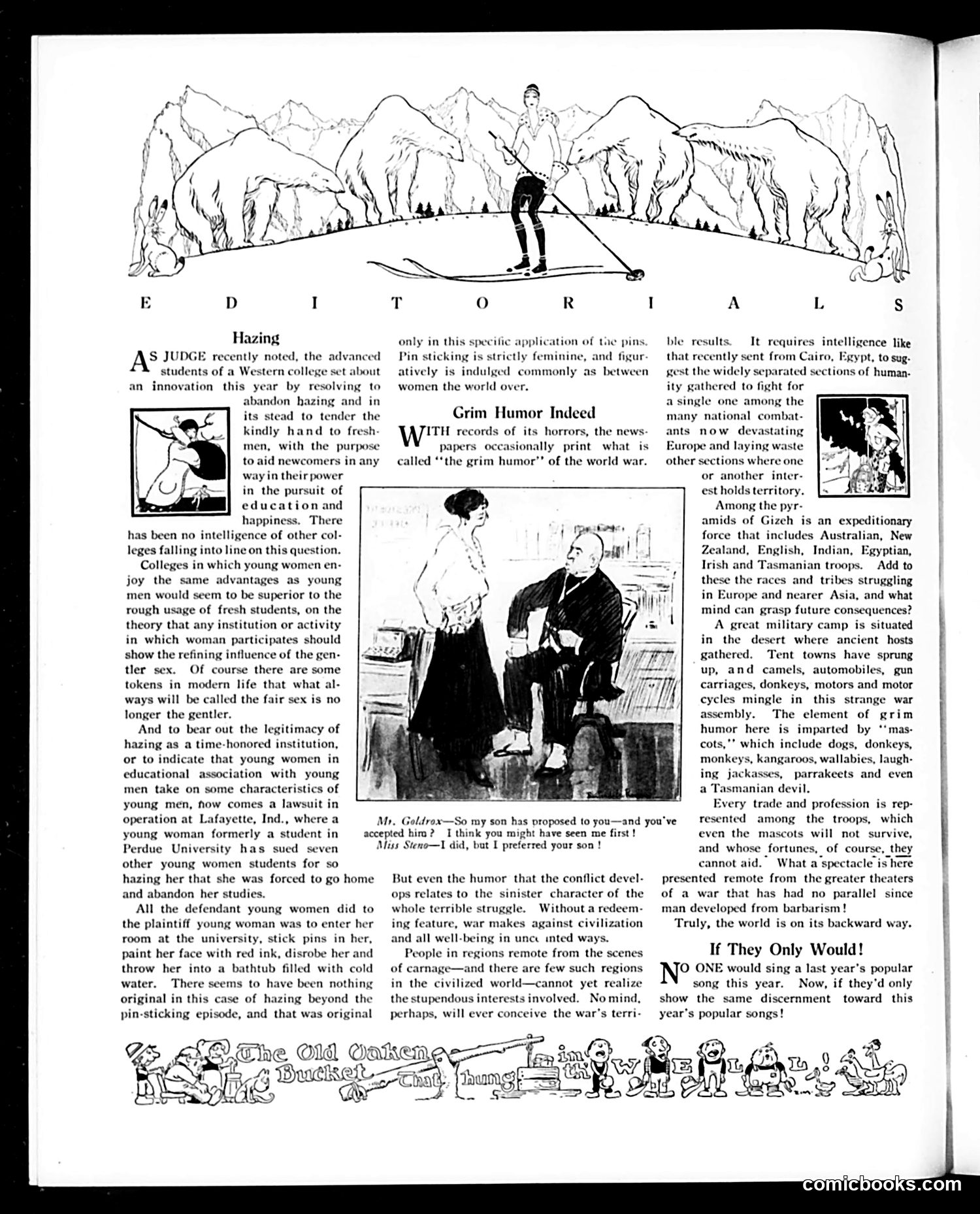
**Main Content: "Hazing"** The top illustration shows a skier labeled "EDITORIAL" performing on slopes, satirizing a college judge's recent ruling against hazing at a Western college. The article argues that abolishing hazing removes a character-building element from male education, suggesting women lack the "roughness" to benefit from such treatment. **Subtext**: The piece reflects early 20th-century gender attitudes, claiming women's "refining influence" makes them unsuitable for hazing's supposed educational value. The author defends hazing as legitimate institutional practice. **Secondary Content**: "Grim Humor Indeed" discusses wartime humor in newspapers, referencing military camps and exotic animals used in WWI operations. **Bottom**: A decorative footer illustration titled "The Old Oaken Bucket" appears to be filler artwork. The page exemplifies period attitudes toward gender, education, and institutional traditions now widely rejected.
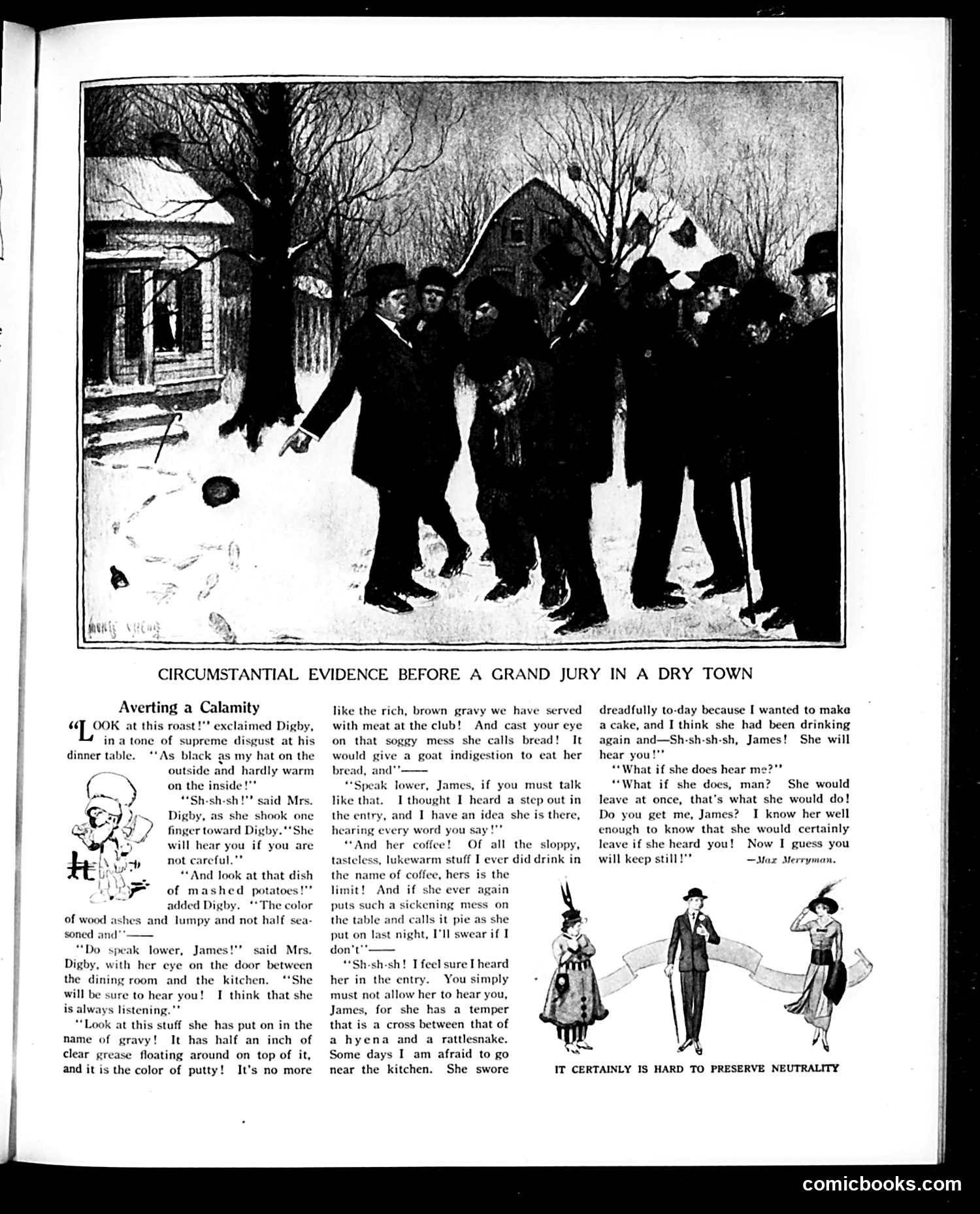
This page satirizes Prohibition-era hypocrisy in a "dry town" (where alcohol is banned). The top image shows men gathered outside a church in winter, apparently as "circumstantial evidence" before a grand jury—likely caught visiting an illegal speakeasy or bootlegger. The story "Averting a Calamity" mocks how people rationalize serving alcohol at home. Mrs. Digby complains about her servant's coffee, gravy, and cooking, then reveals she's worried the servant will hear her discussing serving liquor to guests. The humor targets the absurdity of Prohibition enforcement and the contradiction between public abstinence laws and private drinking. The bottom cartoon, "It Certainly is Hard to Preserve Neutrality," shows three fashionably-dressed women, likely depicting how difficult it was maintaining social appearances during Prohibition's unpopular restrictions.
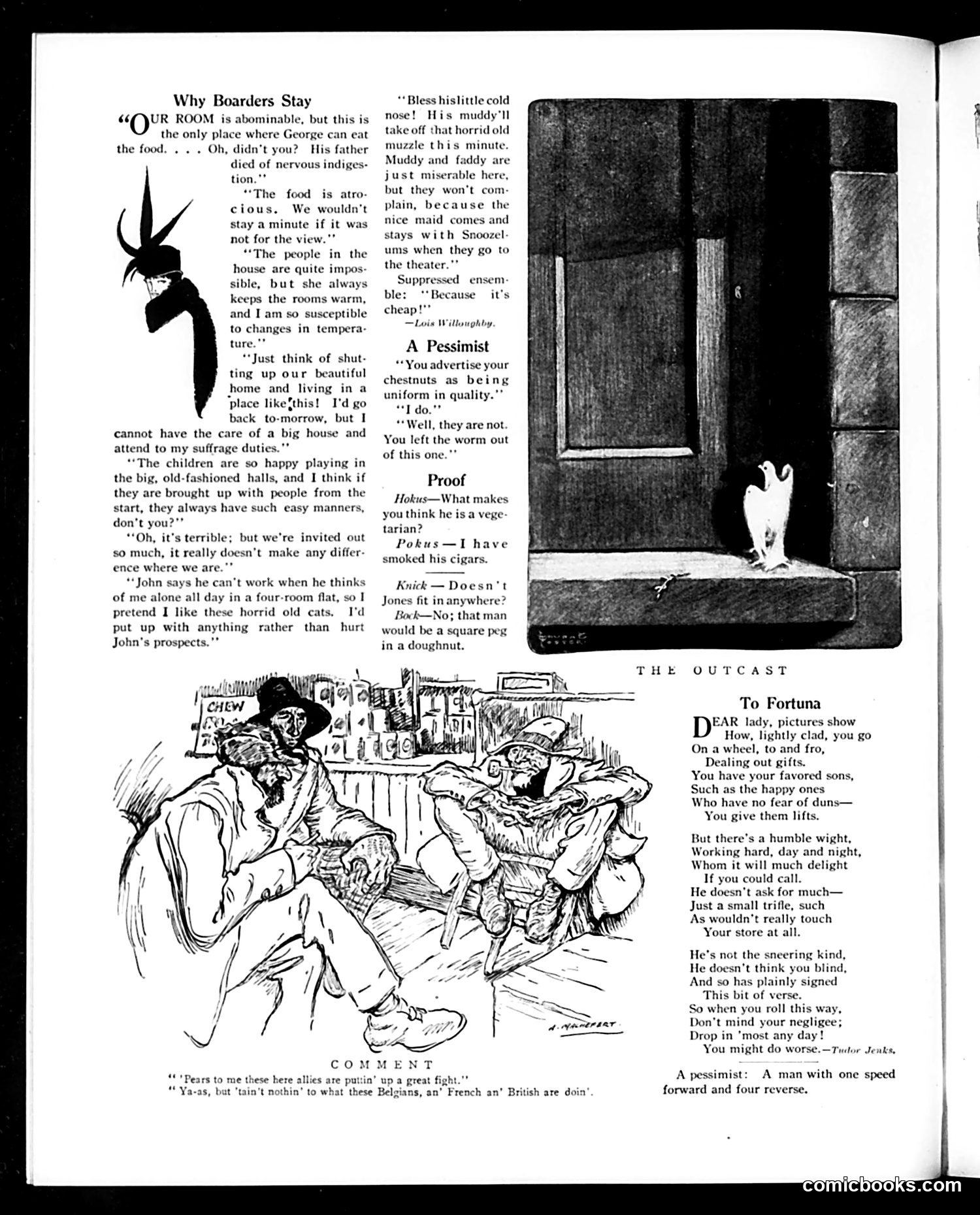
This satirical page critiques boarding-house life and social pretenses circa early 20th century. **"Why Boarders Stay"** (main feature) presents hypocritical excuses from various lodgers. Despite complaining about terrible food, disagreeable people, and cramped quarters, they remain—citing their husband's work prospects, children's manners, social obligations, or suffrage duties. The hidden truth, per "Suppressed ensemble," is simple: **it's cheap**. Lois Willoughby's satire mocks the middle-class tendency to rationalize staying in undesirable circumstances through false nobility. **Lower section** contains brief comic sketches: "A Pessimist" jokes about defective chestnuts; "Proof" uses cigar-smoking as evidence of vegetarianism (unclear logic); and "Comment" references WWI allies—Americans noting the Belgians, French, and British are fighting harder than expected. **"To Fortuna"** (right column) is a poem requesting the goddess of fortune to spare attention for a humble working man, suggesting economic disparity and class anxiety. The page primarily satirizes middle-class self-deception and financial constraint.
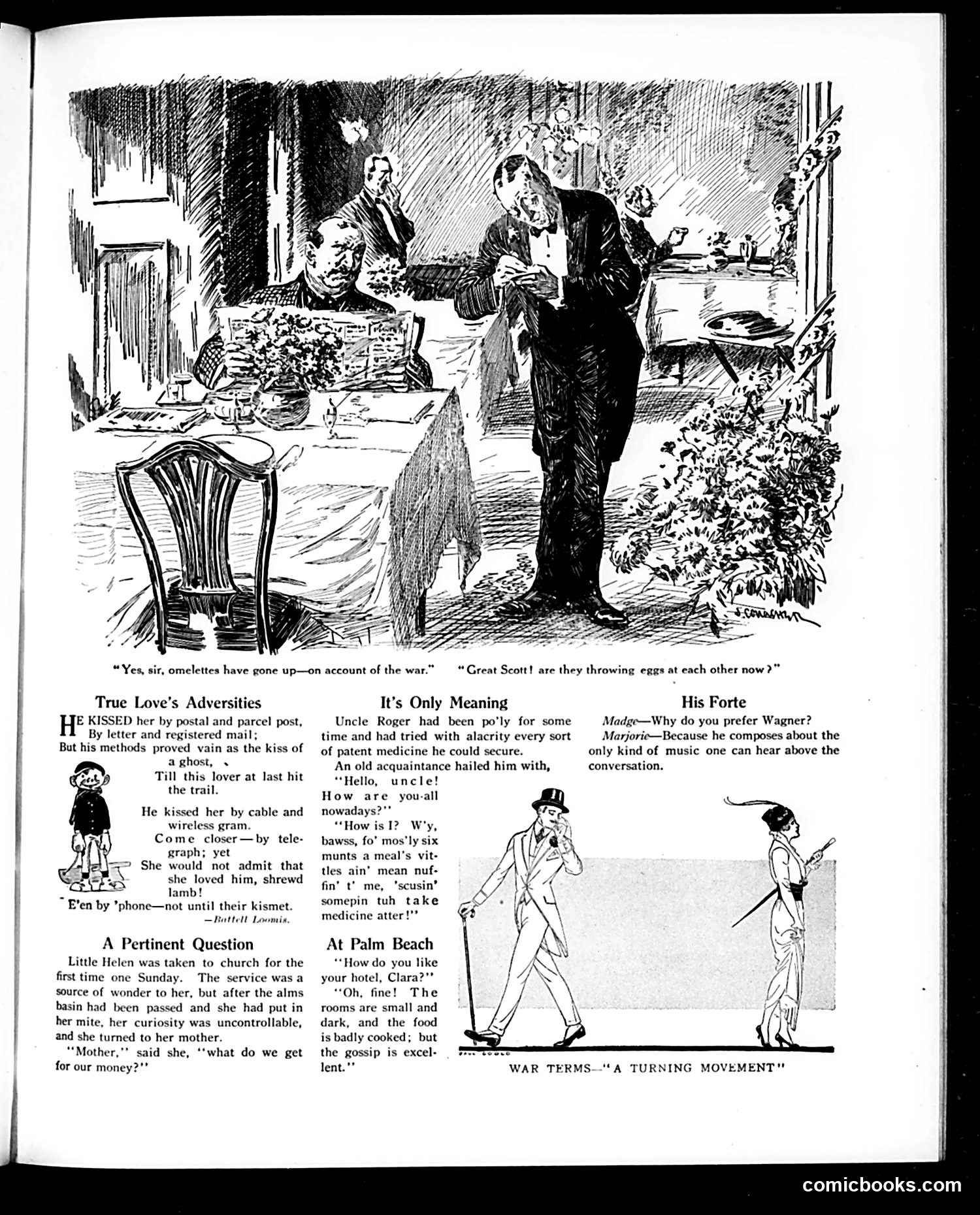
This page contains several humor pieces from Judge, likely WWI-era, reflecting American wartime concerns: **Top cartoon**: A domestic scene where one character mentions "omelettes have gone up—on account of the war," while another asks if people are "throwing eggs at each other now." This satirizes wartime inflation and food rationing affecting everyday prices. **"True Love's Adversities"**: A poem mocking modern long-distance courtship methods (postal mail, cables, wireless, telegraph, telephone), suggesting lovers must finally meet in person ("hit the trail") to truly connect—poking fun at communication technology. **"A Pertinent Question"**: A child's innocent query at church—"what do we get for our money?"—after placing a donation in the collection basket. The joke relies on the child's materialistic misunderstanding of religious giving. **"His Forte"** and **"At Palm Beach"**: Brief jokes about musical preference and hotel amenities, respectively. **Bottom cartoon**: Titled "War Terms—'A Turning Movement,'" it illustrates military terminology through a domestic dispute, likely another wartime reference joke. The page reflects early-20th-century concerns: wartime economics, technological alienation, and social customs.
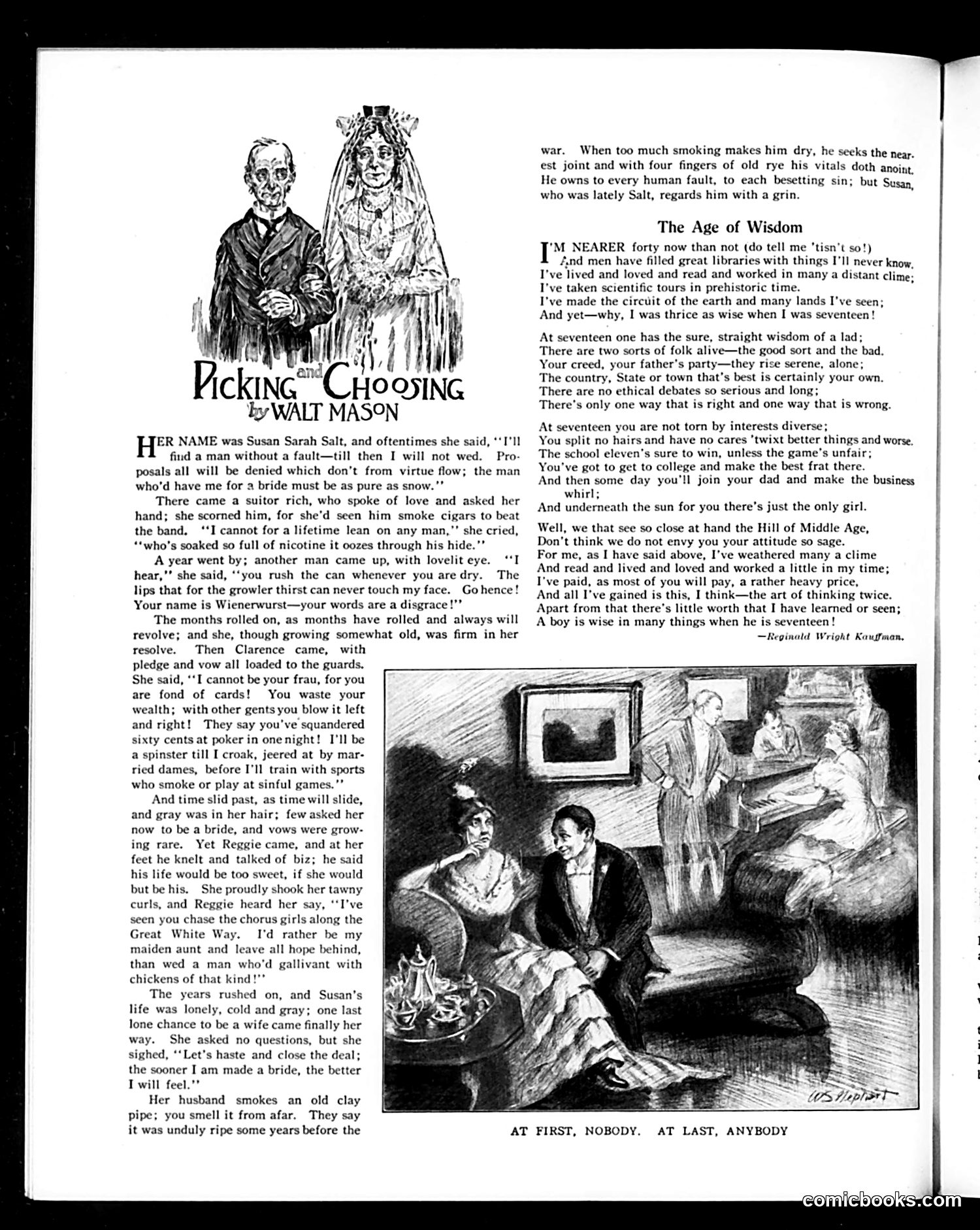
This page contains two distinct pieces of satirical content: **"Picking and Choosing" (top):** A cautionary tale about Susan Sarah Salt, a rigid moralist who rejects suitors for smoking, drinking, and gambling—demanding absolute virtue. The joke: she eventually marries "Clarence," a man with every fault imaginable. The satire mocks unrealistic perfectionism and suggests that strict moral standards, when rigidly applied, lead to lonely spinsterhood until desperation wins out. **"The Age of Wisdom" (right):** Reginald Wright Kipling's poem argues that teenage boys possess clearer moral certainty than educated adults. The satire critiques how life experience and learning create moral complexity and ambiguity—suggesting innocent youth understand right and wrong more simply than worldly adults who've "learned to think twice." Both pieces mock excessive moralism and the gap between youthful idealism and adult compromise, reflecting early 20th-century skepticism about Victorian virtue standards.
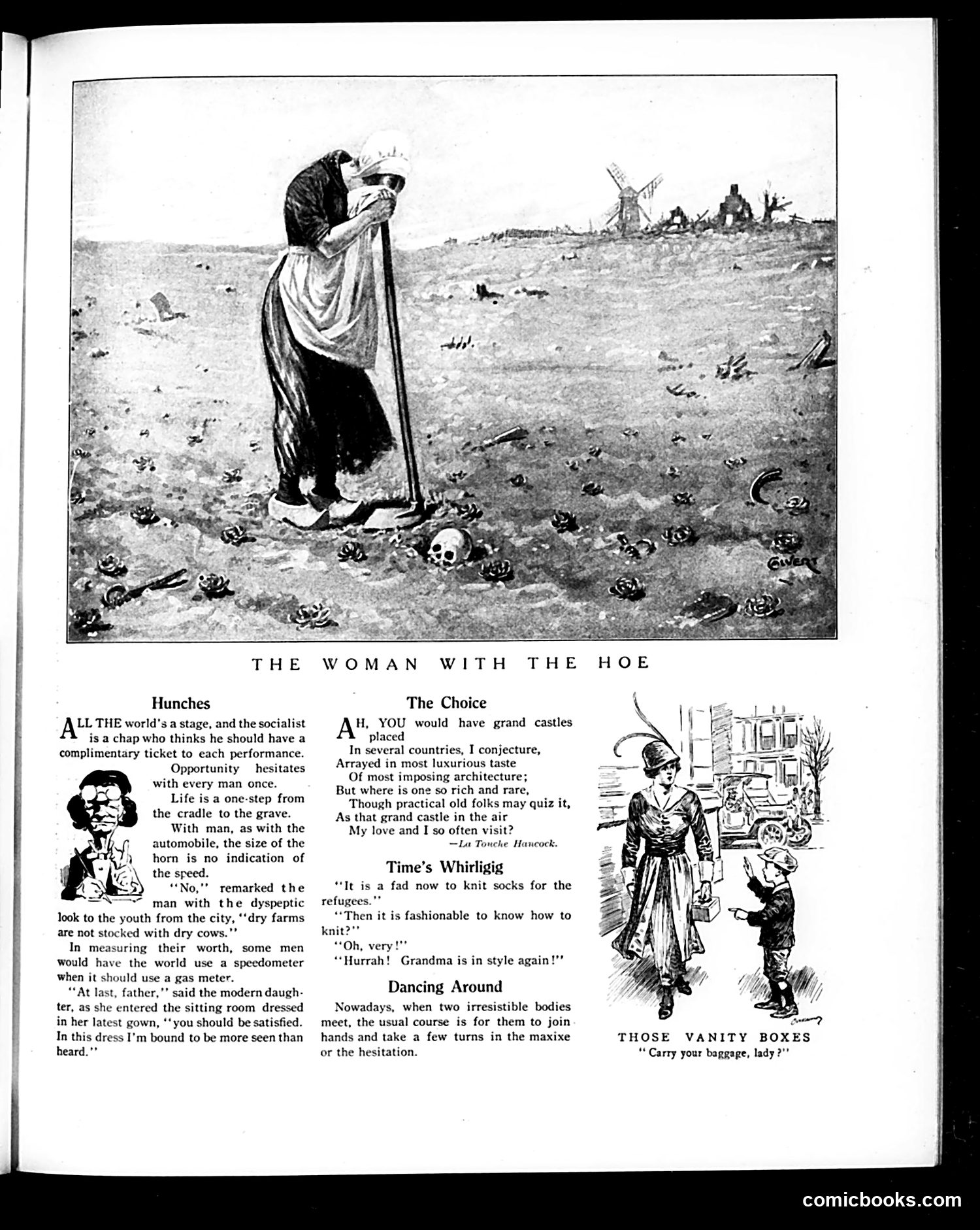
This Judge magazine page combines satirical commentary with lighter social humor. The main image—a woman with a hoe amid scattered skulls and a devastated landscape—references the famous 1889 painting by Jean-François Millet, but inverts its meaning: instead of dignity in rural labor, it depicts the grim reality of war's destruction, likely referencing World War I's agricultural devastation. The text sections mock contemporary social attitudes: "Hunches" ridicules socialists and modern pretension; "The Choice" sentimentalizes romantic poverty over material wealth; "Time's Whirligig" jokes about knitting socks for war refugees becoming fashionable, making even wartime charity trendy; "Dancing Around" references the maxixe (a scandalous dance); "Those Vanity Boxes" depicts a woman asking a man to carry her cosmetics, satirizing female vanity. The overall effect critiques how society romanticizes suffering while indulging shallow concerns.
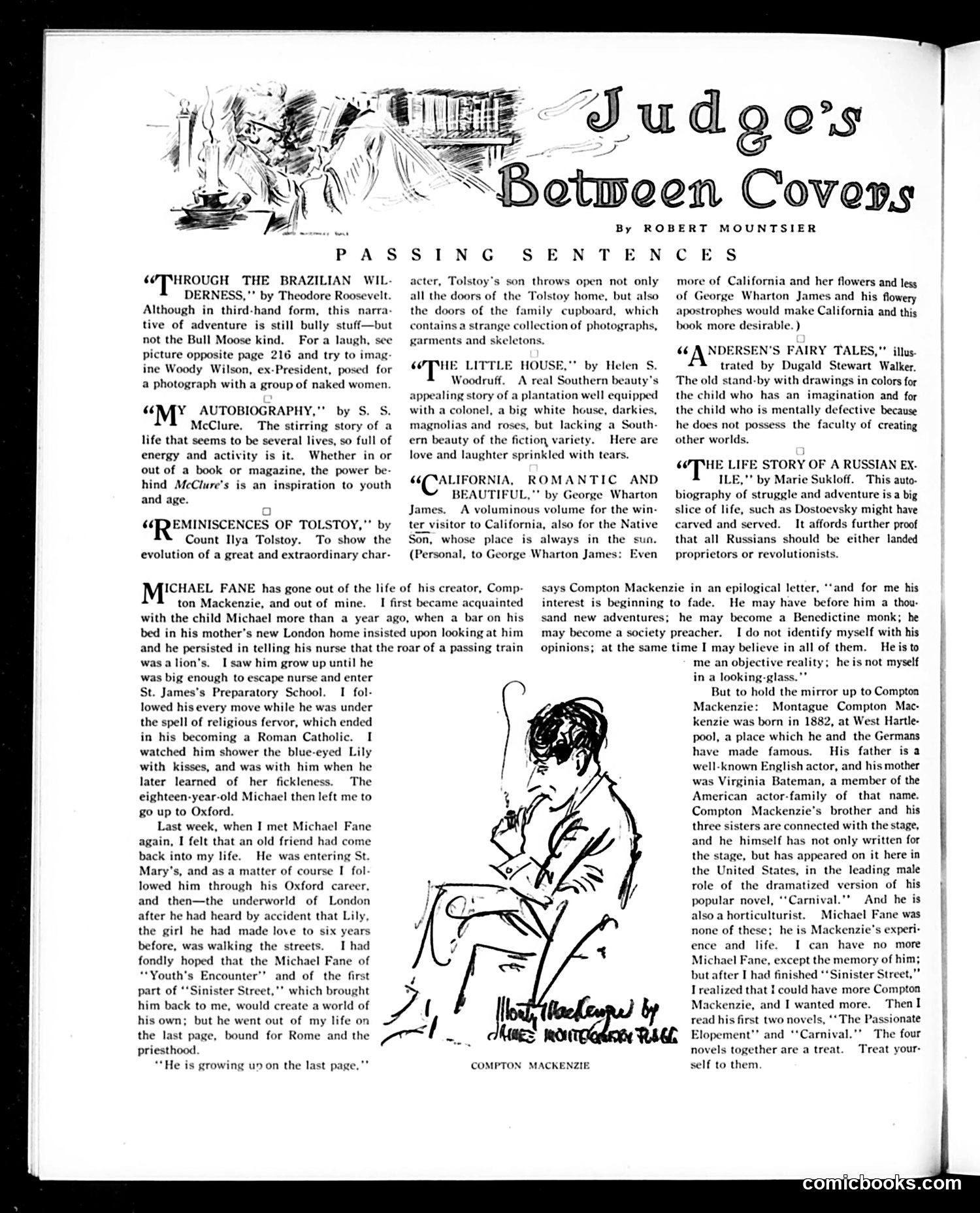
This is a literary review section from Judge magazine featuring brief critiques of newly published books. The page includes: **Book Reviews** covering works by Theodore Roosevelt ("Through the Brazilian Wilderness"), S.S. McClure's autobiography, Tolstoy's reminiscences, and novels by Helen S. Woodruff and George Wharton James on California themes. **A Featured Essay** by Robert Mountsier about Compton Mackenzie's character Michael Fane (from "Youth's Encounter" and "Sinister Street"). Mountsier traces the fictional character's spiritual journey—from childhood religious fervor to Catholicism to London's underworld—concluding he "is growing upon the last page," suggesting the character transcends the author's creation. **The Illustration** shows Compton Mackenzie himself, the British novelist-horticulturist referenced in the text. The reviews employ Judge's characteristic tone: slightly irreverent yet literary, mixing praise with gentle mockery (notably mocking Wharton James's flowery California descriptions as excessive).
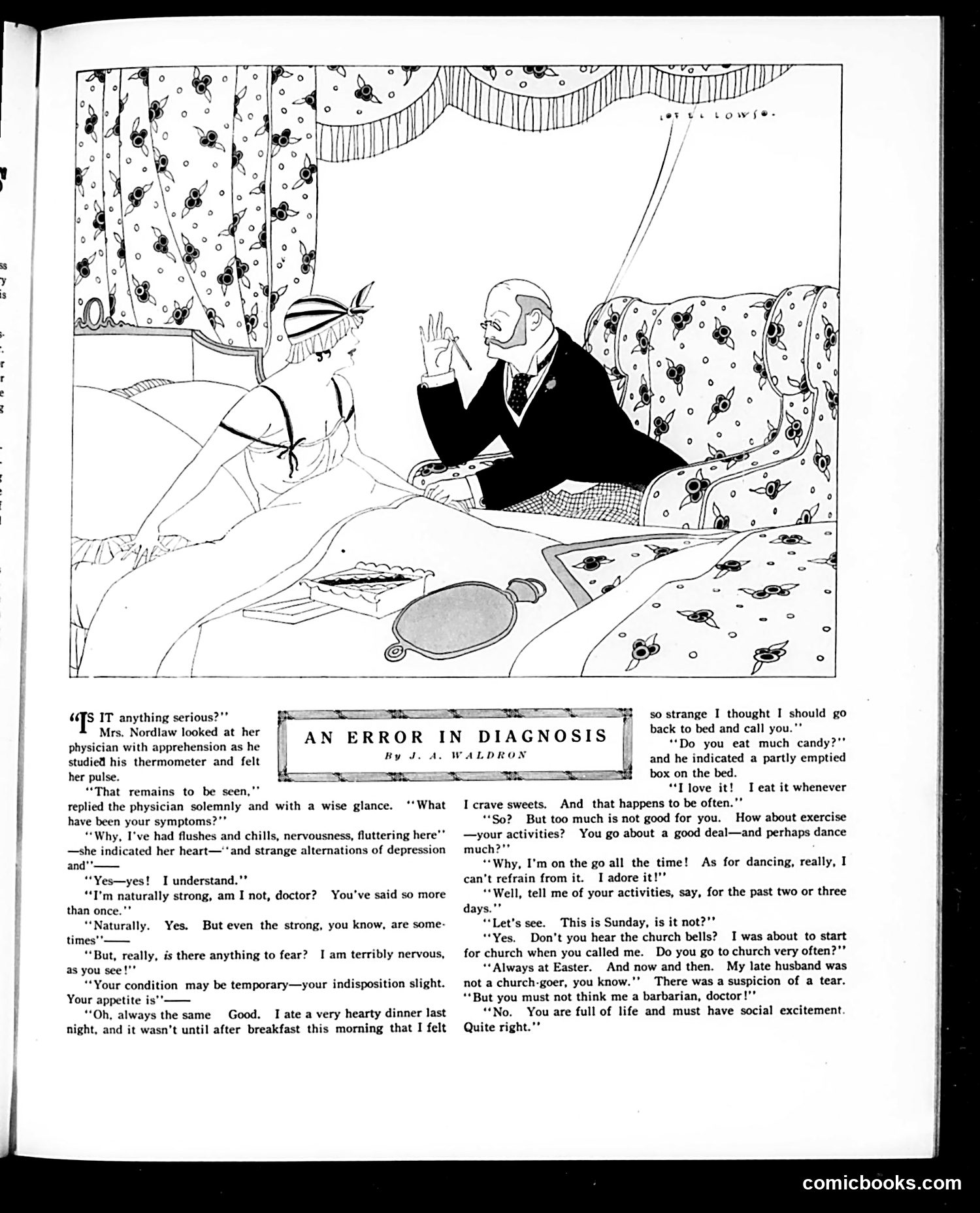
This satirical story depicts a physician's misdiagnosis of a female patient's ailments. Mrs. Nordlaw presents with nervousness, heart palpitations, and depression. The doctor attributes her symptoms to lifestyle—excessive candy consumption, too much social activity, dancing, and insufficient exercise—recommending moderation. The satire targets early-20th-century medical practice: physicians (particularly male) blaming women's "nervous" conditions on moral or behavioral failings rather than investigating genuine medical causes. The irony emerges as the doctor confidently prescribes lifestyle changes while explicitly stating "that remains to be seen" about the actual diagnosis—suggesting he never identifies the real problem. The cartoon mocks both paternalistic medical advice and the era's tendency to pathologize women's social engagement as inherently unhealthy.
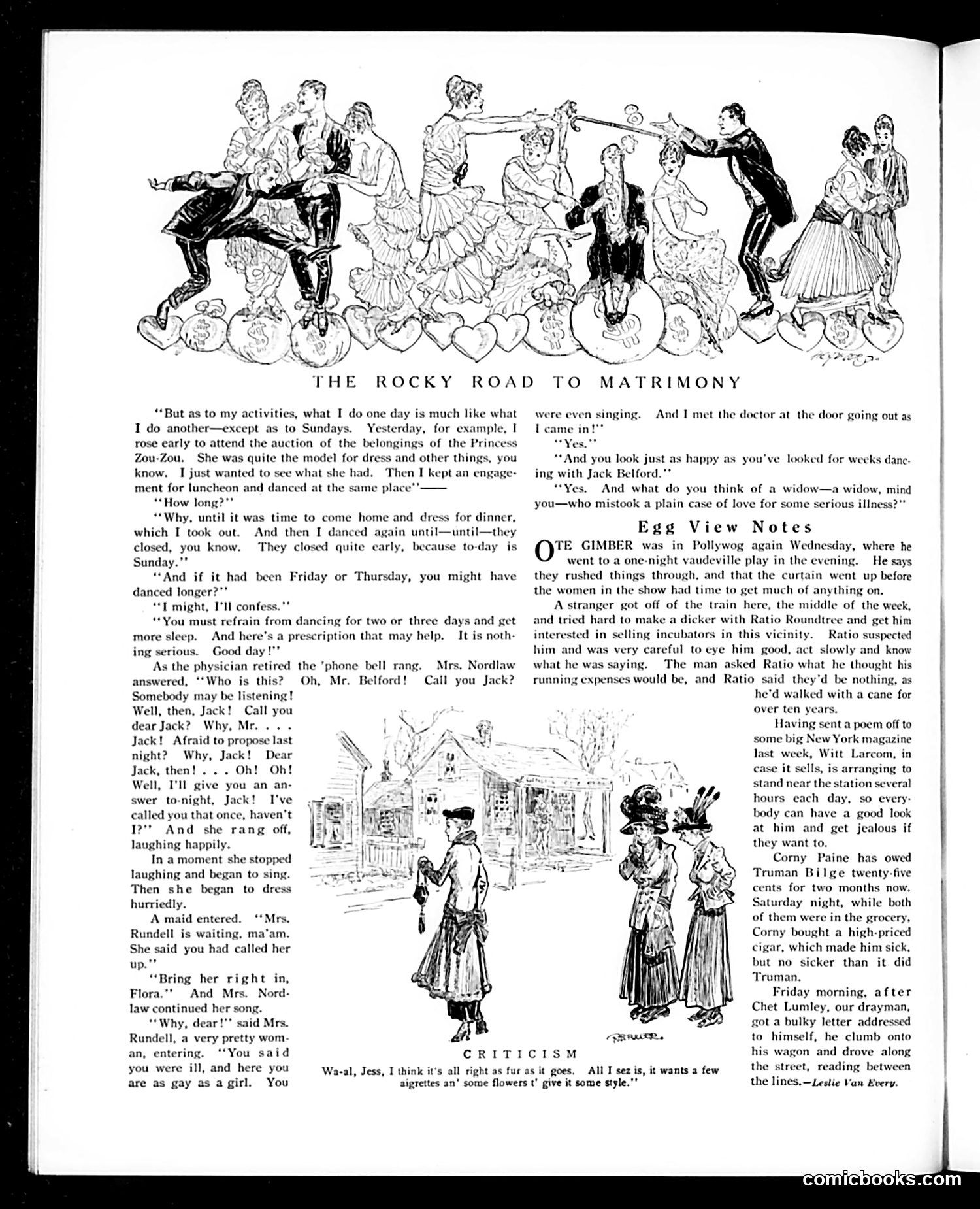
This page contains two distinct pieces of satirical content: **Main Cartoon: "The Rocky Road to Matrimony"** The top illustration depicts couples dancing on heart-shaped platforms, satirizing the frivolous social activities of wealthy urbanites pursuing marriage. The accompanying story mocks a woman who dances constantly—at auctions, dinners, and dance halls until closing—yet claims exhaustion as a medical excuse. The satire targets the shallow, activity-obsessed lifestyle of the leisure class and the performative nature of courtship rituals. A doctor prescribes rest, but she receives a marriage proposal via telephone instead, revealing that her "illness" was lovesickness. **"Egg View Notes"** This rural gossip column parodies small-town life through humorous anecdotes about local characters and their petty concerns—failed business deals, magazine submissions, unpaid debts, and romantic mishaps. It contrasts sharply with the urban sophistication of the main story, satirizing rural simplicity and gossip culture. Together, the page contrasts wealthy urban courtship theatrics with rural provincial life, both portrayed as absurd in different ways.
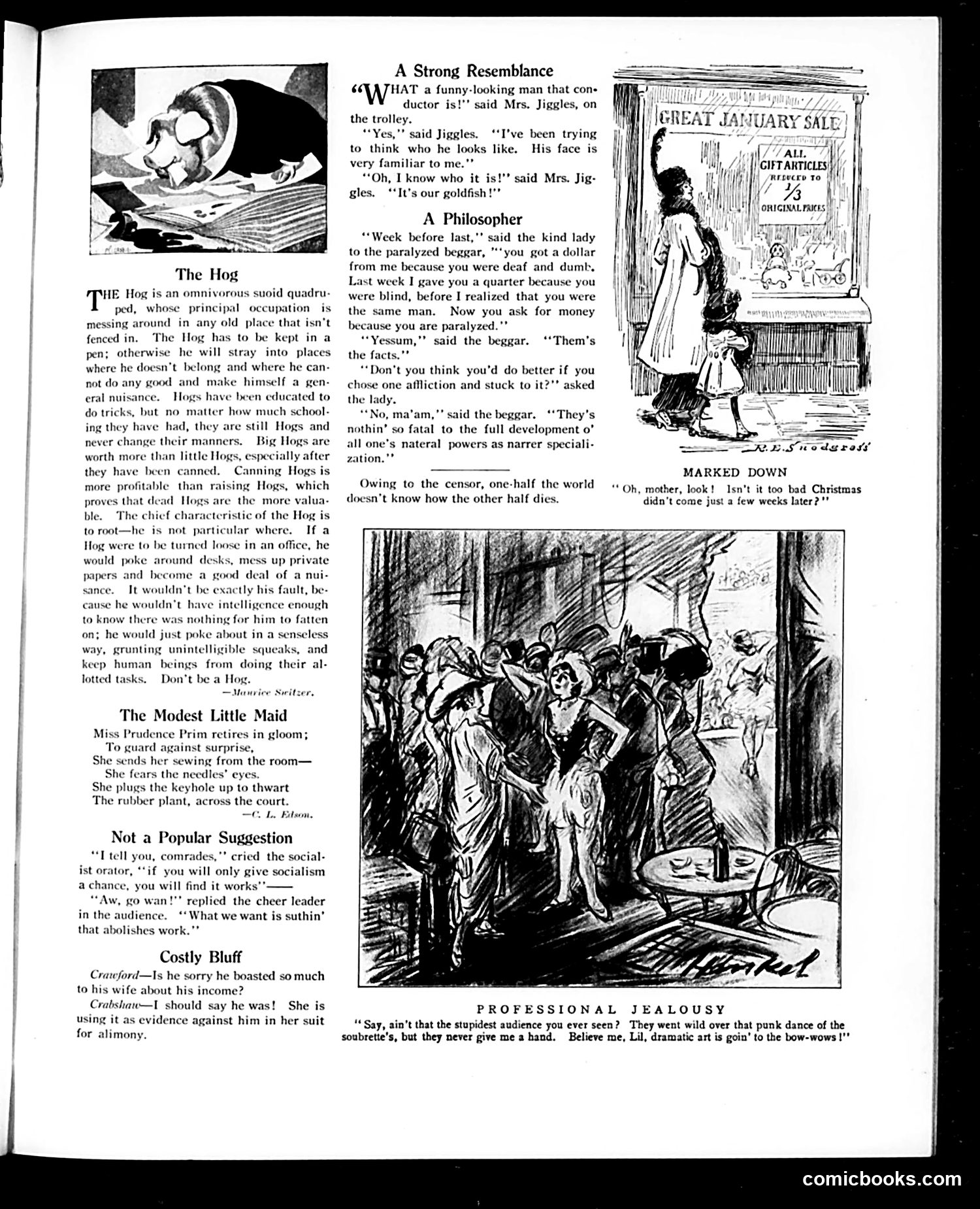
This page contains several satirical pieces typical of early-20th-century American humor: **"The Hog"** is an extended animal allegory comparing hogs to undesirable human types—people who lack discipline, create chaos, and can't be trusted unsupervised. The satire equates hog behavior (rooting around indiscriminately) with disruptive office workers or social nuisances. **"A Strong Resemblance"** is a simple visual joke: a man resembles Mrs. Jiggles' goldfish. **"A Philosopher"** satirizes a beggar who claims a different affliction weekly to solicit money. When challenged, he defends himself by invoking "specialization"—a mock-intellectual justification for his con. This mocks both professional begging and pseudo-philosophical excuses for laziness. **"Not a Popular Suggestion"** ridicules socialist rhetoric: a socialist orator promises socialism will make work succeed, but an audience member responds that what they actually want is abolition of work itself—exposing the contradiction between socialist promises and worker desires. **"Professional Jealousy"** shows a theatrical performer complaining that audiences prefer inferior acts, suggesting envy and declining standards in entertainment.
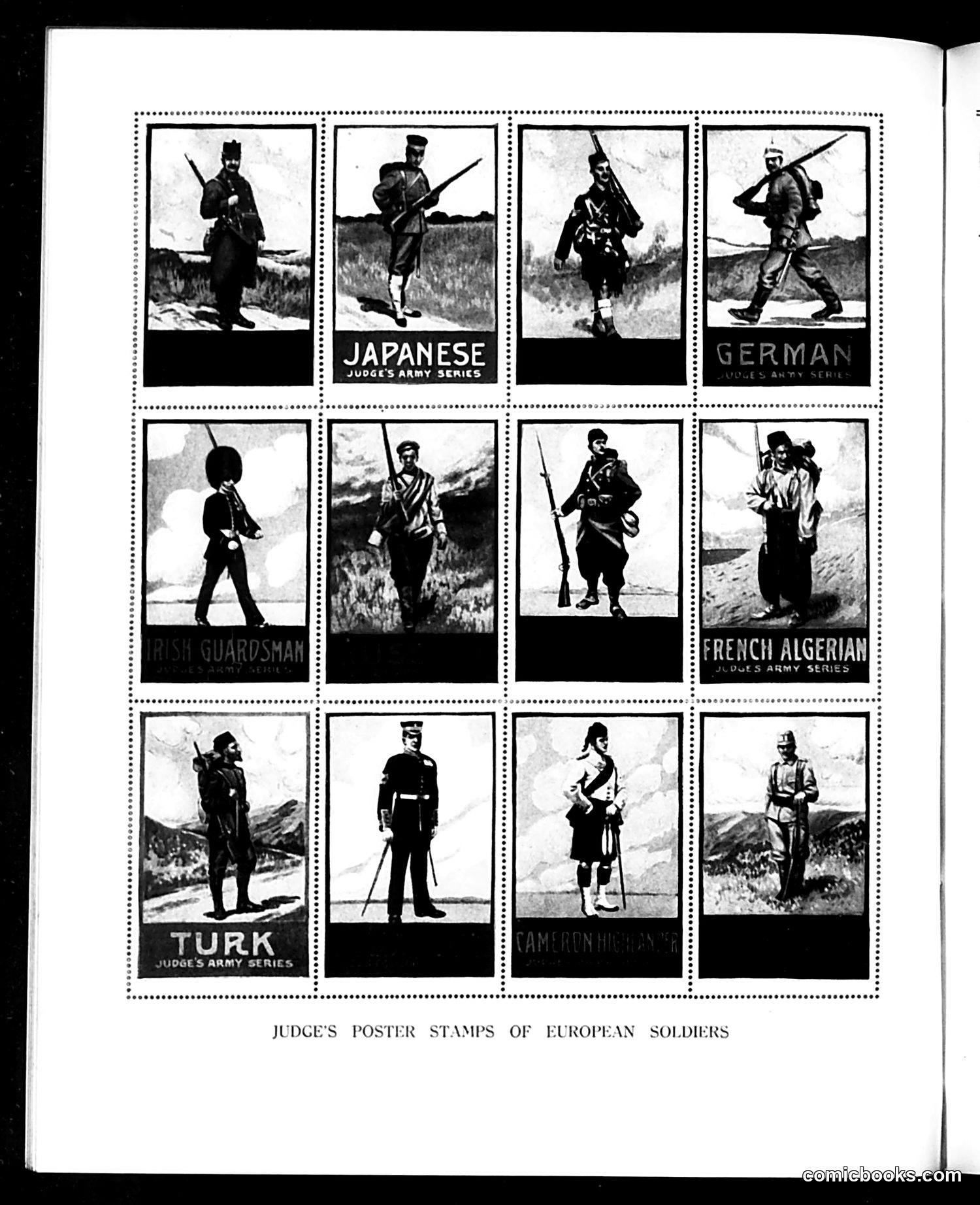
This page displays a collection of twelve illustrated soldier figures representing different nations' militaries, labeled as part of Judge magazine's "Army Series." Visible identifications include Japanese, German, Irish Guardsman, French Algerian, Turk, and Cameron Highlander soldiers. These appear to be collectible stamp-style images showcasing international military uniforms and regalia from the early 20th century. The format—small illustrated cards with national identifications—was typical of period collecting trends. Without additional context about the specific publication date, the satirical intent is unclear, though Judge's generally irreverent approach might have been poking fun at militarism, national stereotypes, or specific geopolitical tensions of the era through exaggerated uniform depictions.
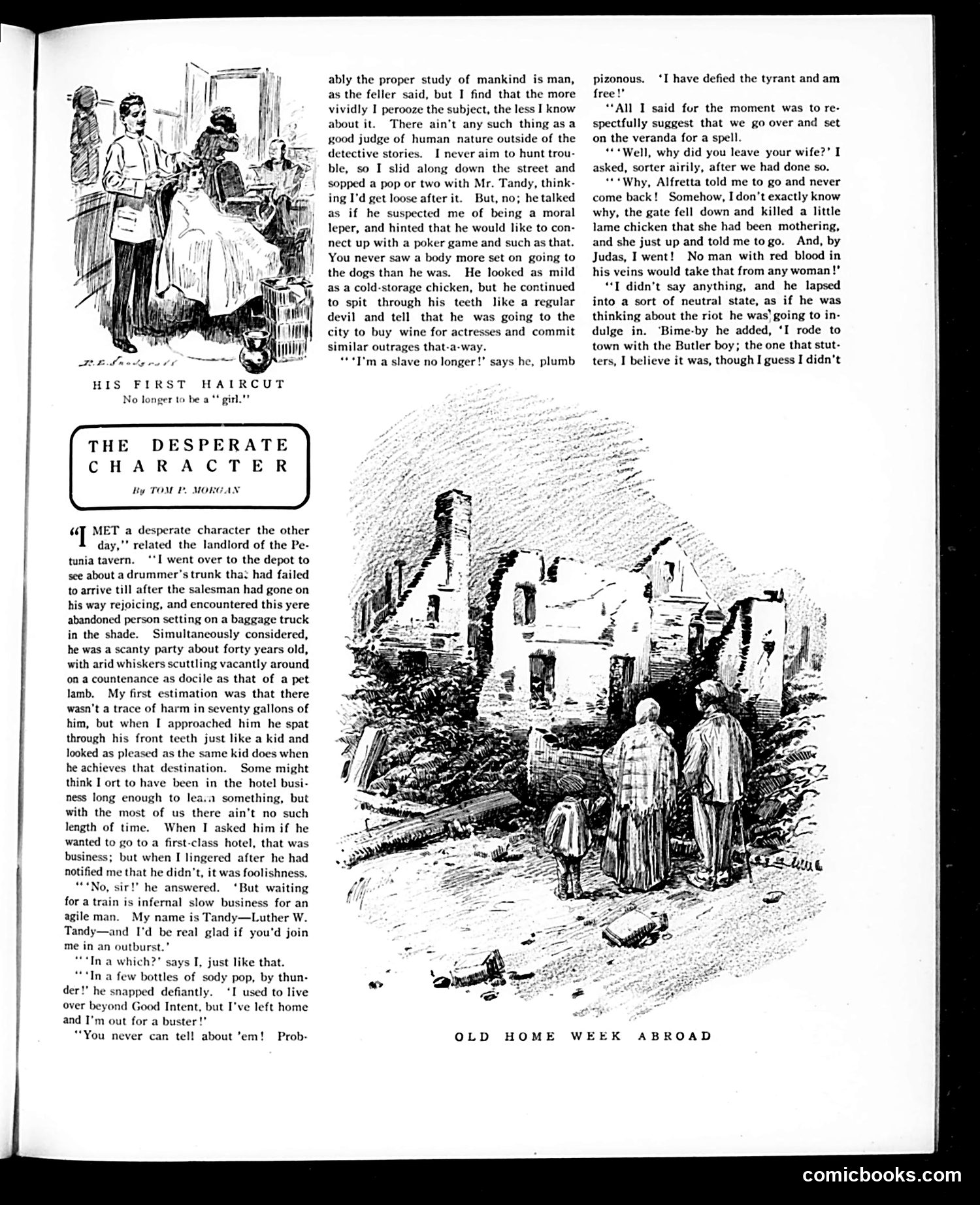
This page contains two separate pieces of satirical fiction rather than political cartoons. **"His First Haircut"** (top) is a brief illustrated story about a boy's first haircut, playing on the social milestone of transitioning from childhood (when boys had longer hair) to boyhood. The satire is gentle—poking fun at the ceremonial importance placed on this grooming rite. **"The Desperate Character"** (main story) is a longer comic narrative by Tom P. Morgan featuring a tavern keeper's account of meeting a shabby forty-year-old man named Luther W. Tandy at the train depot. The satire targets the man's hollow rebelliousness: he claims to have "defied the tyrant" (his wife), left home after a minor accident with a chicken, and boasts of future debauchery (drinking, gambling, consorting with actresses)—yet his mild appearance and docile manner undercut his theatrical villainy. The humor lies in the gap between his desperate posturing and his actual harmlessness, satirizing men who fantasize about rebellion without genuine conviction.
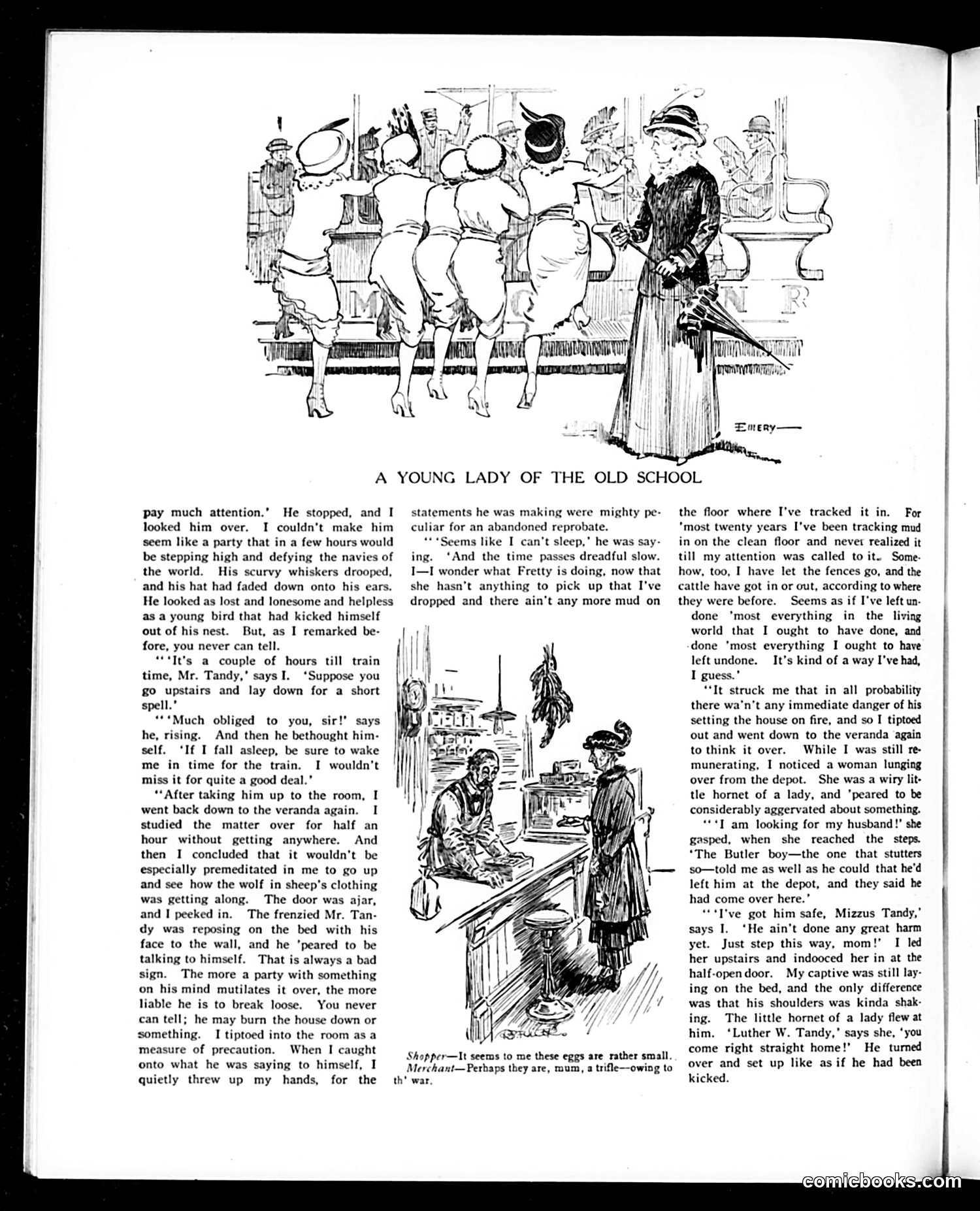
This page combines a short story with social commentary. The main cartoon (top) depicts a woman in Victorian dress observing a group of rowdy men in what appears to be a saloon or public space—satirizing "modern" female behavior that violates contemporary propriety standards. The story itself is a sentimental narrative about Mr. Tandy, a disreputable wanderer who reveals unexpected domestic regret while alone. Upon reflection, he realizes he's been a poor husband, neglecting his home and wife "Fretty" (likely "Pretty"). His remorseful soliloquy contradicts his rough appearance. His wife—described as a "little hornet of a lady" with aggressive energy—arrives and commands him home with military authority. The satire's point: despite her husband's low station and wandering ways, this woman exercises direct domestic control, representing the "old school" of female assertiveness within marriage, possibly mocking both women's independence and marital dynamics of the era. The bottom vignette about undersized wartime eggs is unrelated topical humor.
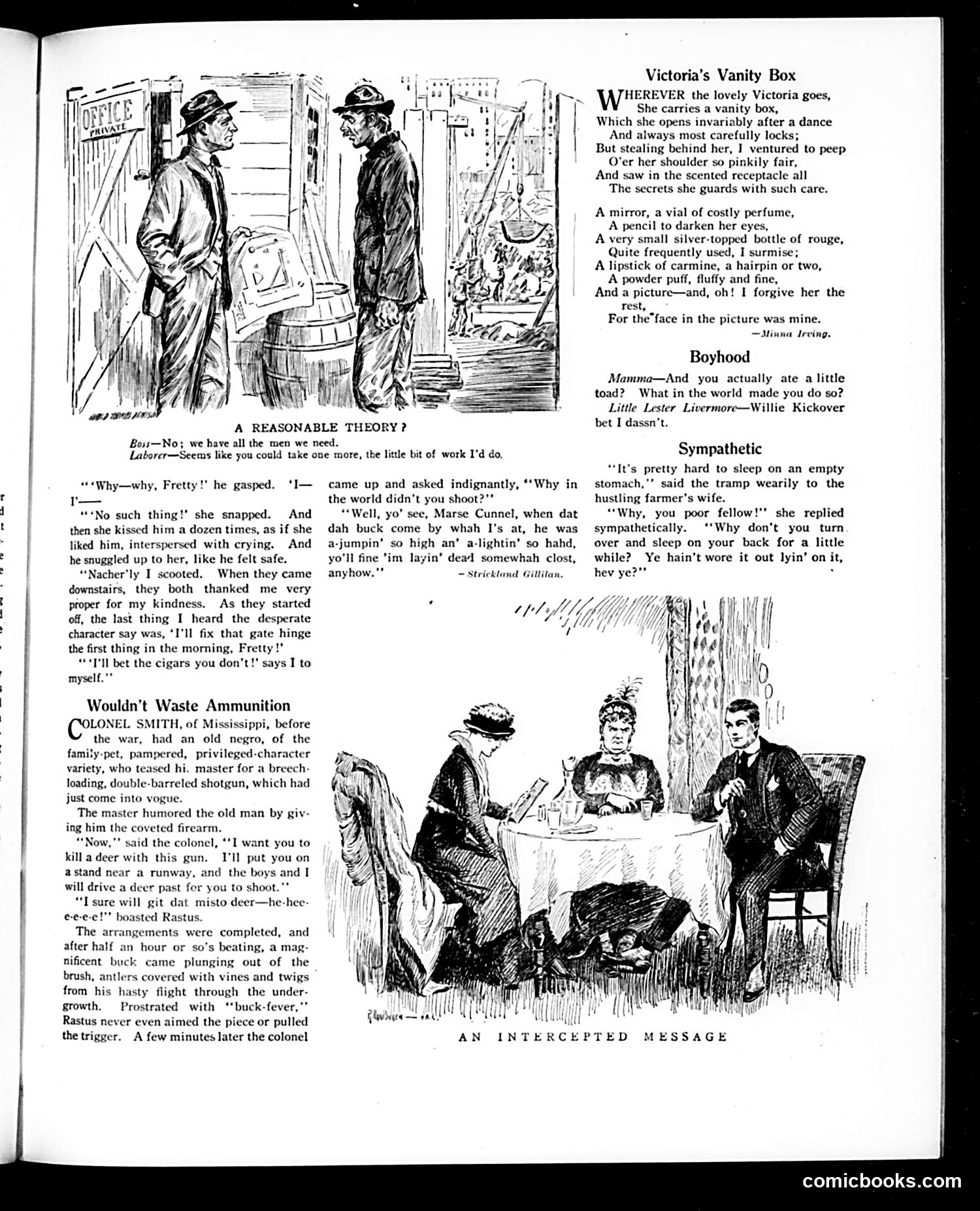
This page contains several short humorous pieces typical of early-to-mid 20th century Judge magazine: **"A Reasonable Theory?"** depicts a labor negotiation where a desperate worker seeks employment; the cartoon satirizes economic hardship and job scarcity. **"Wouldn't Waste Ammunition"** is a racist dialect story featuring "Rastus," a formerly enslaved Black man who fails to shoot a deer, offering an excuse in exaggerated speech. This reflects the magazine's period use of racist caricature and minstrelsy-style humor targeting Black Americans. **"Victoria's Vanity Box"** is a poem about a woman's cosmetics collection, gently mocking female vanity while somewhat indulgently celebrating it. **"Boyhood"** and **"Sympathetic"** are brief anecdotes—one about a child eating a toad on a dare, another about a tramp's interaction with a farm wife—offering mild domestic humor. The illustrations accompany these pieces with period-appropriate pen-and-ink sketches. The content reflects Judge's satirical but often stereotypical approach to working-class life, gender, and race.
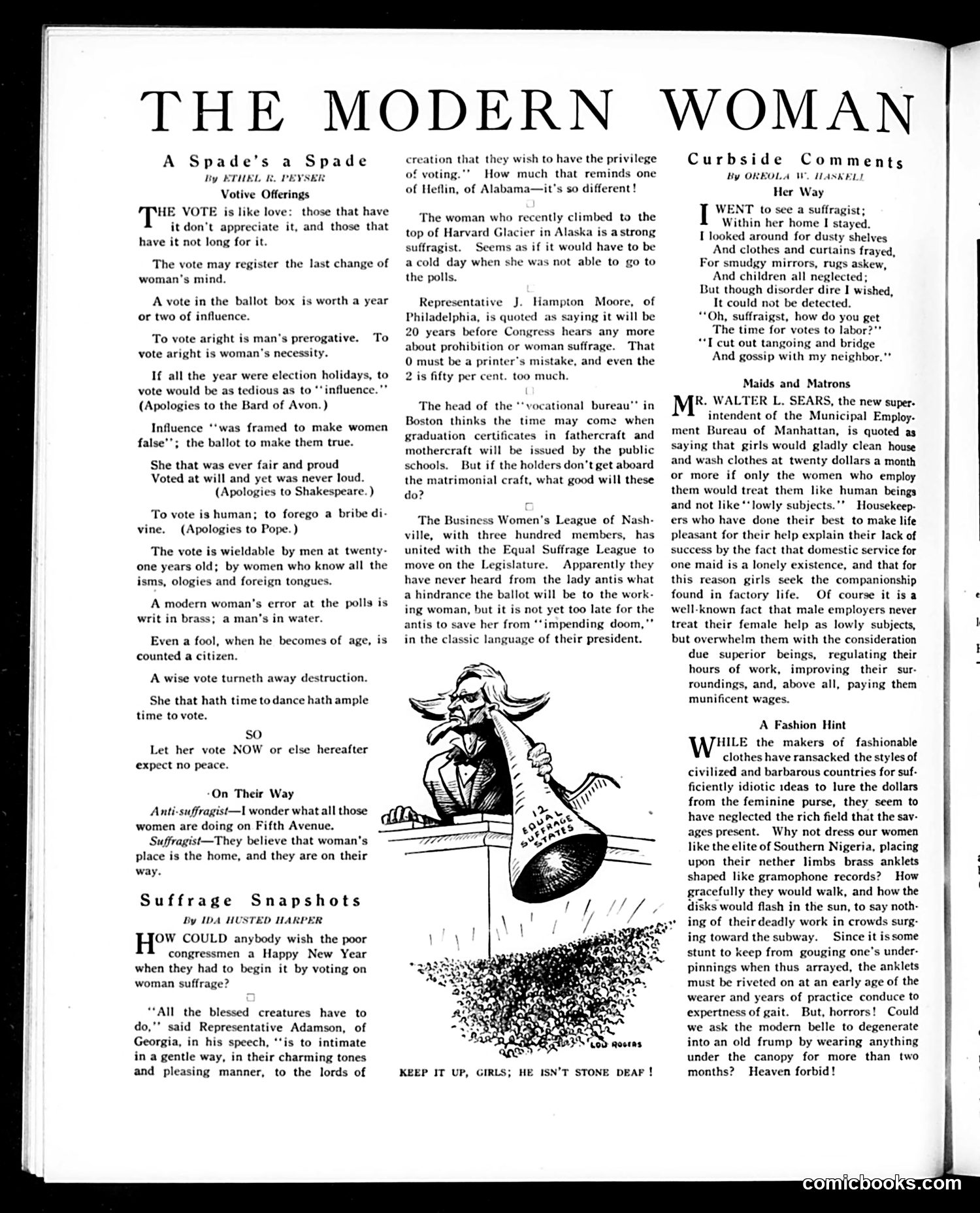
This page satirizes the women's suffrage debate through multiple pieces. The central cartoon depicts a grumpy, caricatured male figure (appearing to represent anti-suffrage men generally, though unclear if specific) being hit by suffragists' arguments—shown as pellets or projectiles labeled "VOTES FOR WOMEN." The text sections mock both anti-suffragists and pro-suffragists. Peyser's "A Spade's a Spade" uses mock-Shakespearean verse to ridicule arguments that women lack political sophistication. "Suffrage Snapshots" by Ida Husted Harper satirizes congressmen's complaints about suffrage debates and anti-suffragists' claims that voting would harm women's domestic duties. Harper's final jab—"KEEP IT UP, GIRLS; HE ISN'T STONE DEAF!"—suggests suffragists must persist since male politicians ignore them. The "Curbside Comments" section ironically portrays a suffragist whose home is actually well-maintained, undermining anti-suffrage claims that voting women neglect their households. Overall, the page supports women's suffrage while mocking opponents' logic.
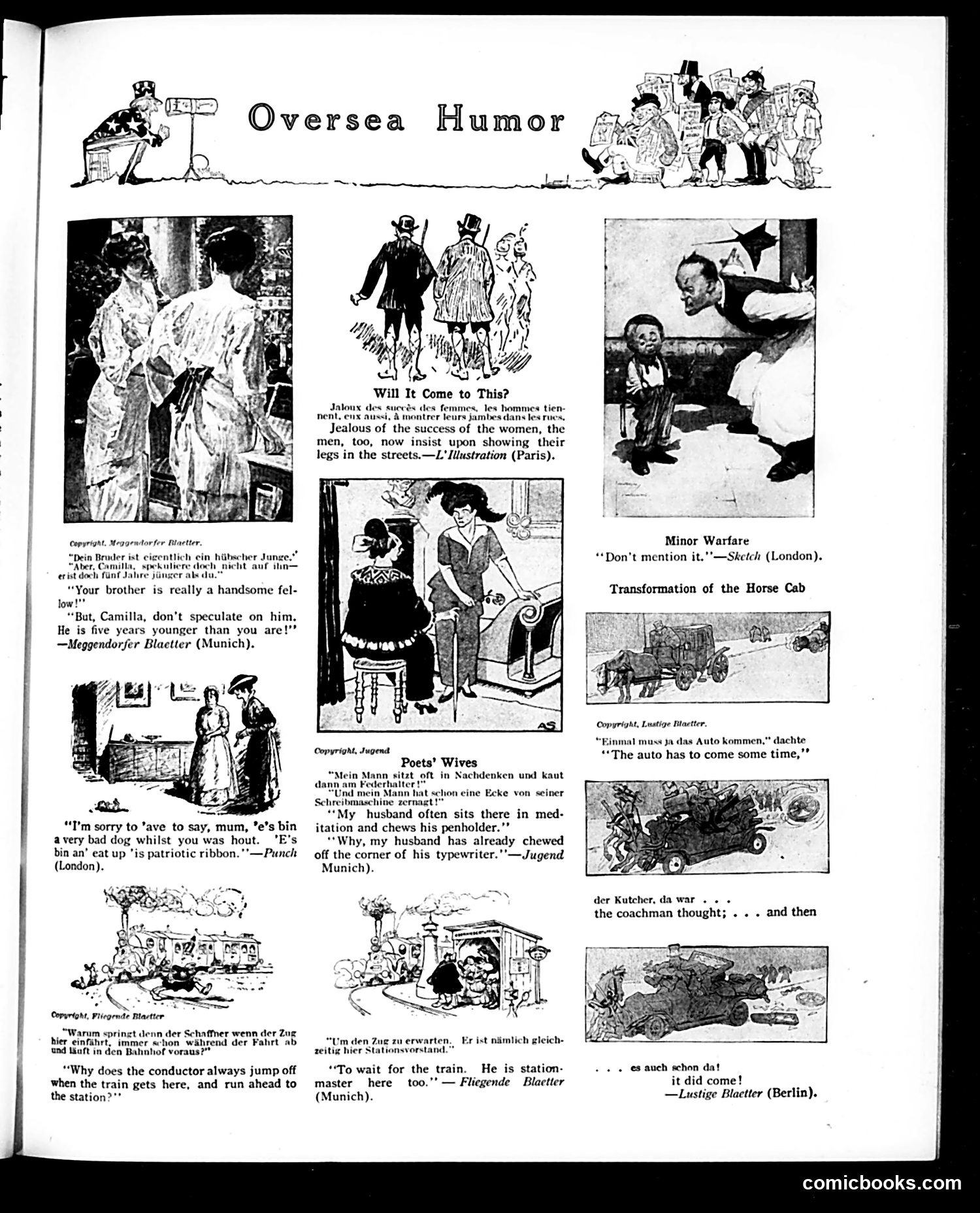
This page compiles humorous cartoons and jokes reprinted from European publications (French, German, and British sources cited). The humor reflects early 20th-century social anxieties: **"Will It Come to This?"** satirizes women's increasing public visibility—the joke warns that men, jealous of women displaying legs in streets, might do the same, implying masculine anxiety about changing gender norms. **"Poets' Wives"** jokes about absent-minded creative men who chew their writing implements (penholder, typewriter corner) while deep in thought—a familiar caricature of the distracted artist. **"Transformation of the Horse Cab"** shows motorized vehicles replacing horse-drawn carriages, with the repeated joke that automobiles will eventually arrive. **"Minor Warfare"** and the conductor joke appear to reference minor domestic or bureaucratic absurdities. The page presents *Judge* magazine's practice of reprinting continental European humor, suggesting American readers' curiosity about how others viewed modernity, gender change, and technology.
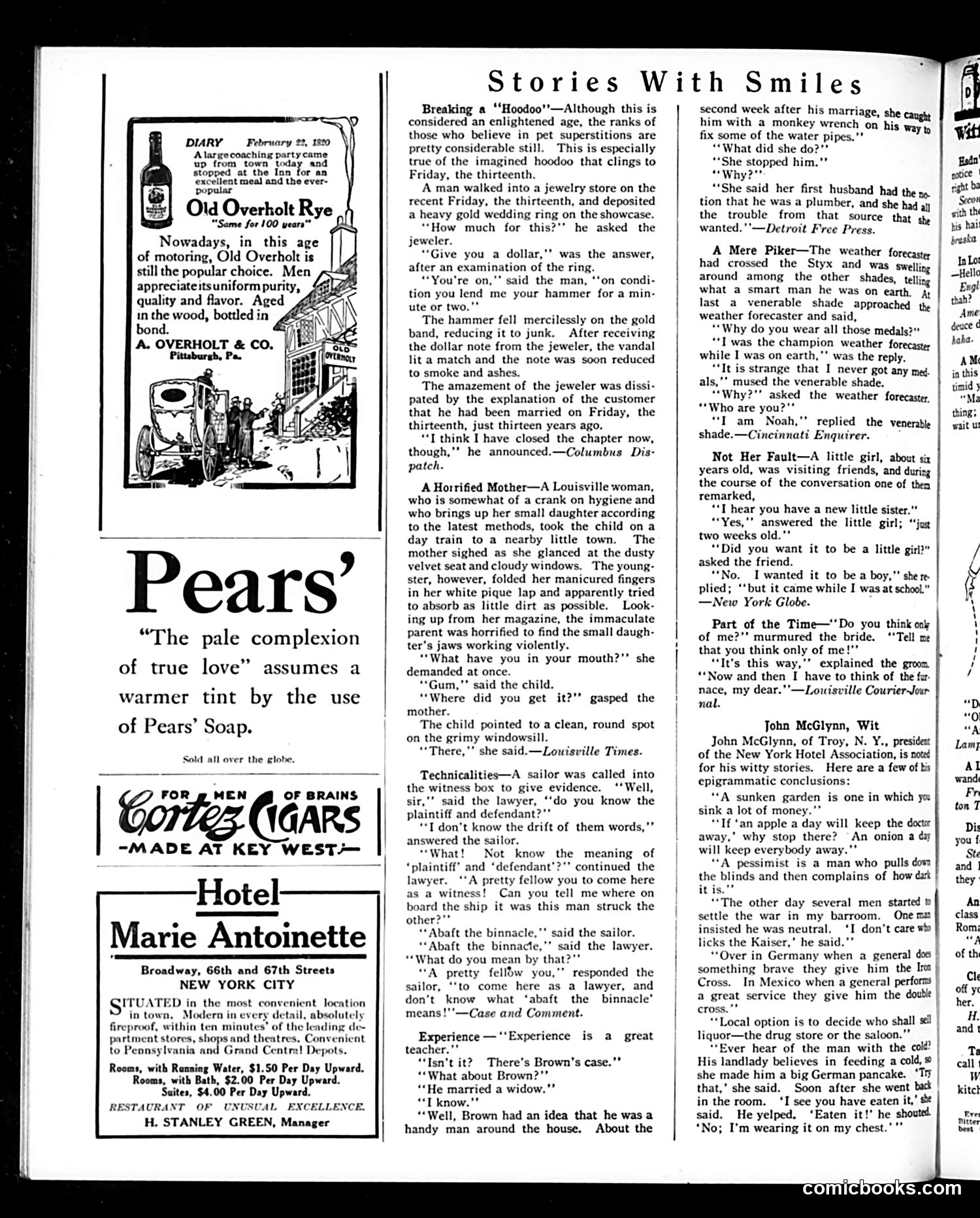
This page consists primarily of **advertisements and humor anecdotes** rather than political cartoons. The main content includes: **Advertisements:** Old Overholt Rye whiskey, Pears' Soap, Cortez Cigars, and the Hotel Marie Antoinette dominate the layout, typical of Judge's commercial revenue model. **Humor Pieces:** The "Stories With Smiles" section contains four brief anecdotes: 1. A man destroys his wedding ring to "break" the Friday the 13th hoodoo—satirizing superstition even among "enlightened" moderns. 2. A hygiene-obsessed mother horrified to find her daughter eating gum picked from a dirty windowsill—mocking excessive sanitation fads. 3. A sailor and lawyer unable to understand each other's vocabulary—poking fun at professional jargon and class differences. 4. A fragment about "experience as a teacher." The satire targets contemporary anxieties (superstition, hygiene crazes, class confusion) through light comedy rather than sharp political critique. This reflects Judge's mixed content of advertising, social humor, and occasional political commentary.
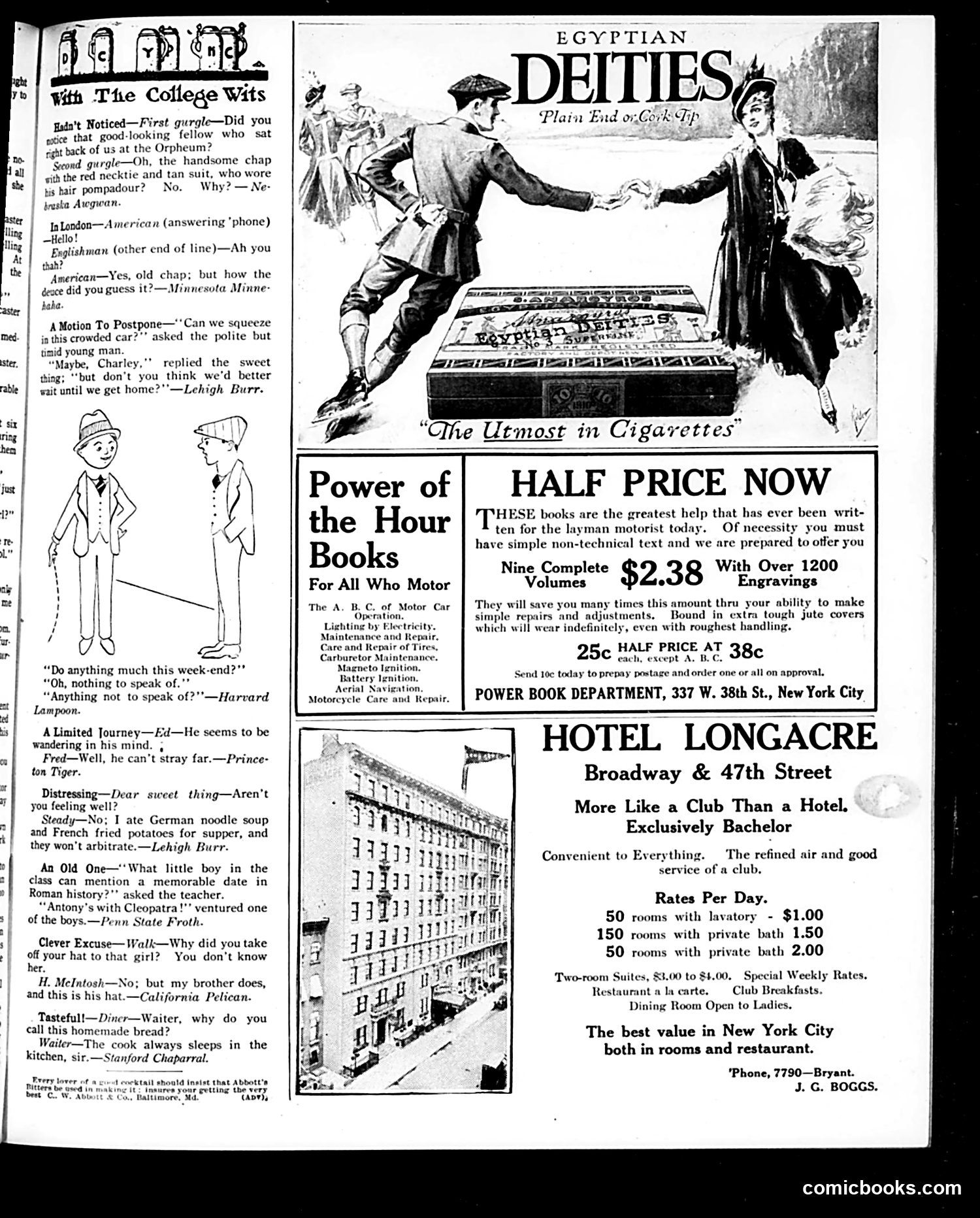
This page combines humor content with period advertising. The left column presents "College Wits"—brief jokes reprinted from university humor magazines (Nebraska Awgwan, Harvard Lampoon, etc.). These jokes reflect early 1900s collegiate humor: misunderstandings about American accents, flirtation mishaps, and wordplay about food and relationships. The centerpiece is an advertisement for "Egyptian Deities" cigarettes, featuring a man and woman in period dress examining a decorated cigarette box—typical advertising imagery associating products with leisure and sophistication. Below are ads for practical items: "Power of the Hour" automotive manuals (appealing to the growing motorist culture), and Hotel Longacre on Broadway, marketed as a bachelor's club-like establishment. The page reflects early 1900s American culture: college life, automobile enthusiasm, urban hospitality, and cigarette smoking as unremarkable social behavior. The humor is gentle, collegiate, and focused on misunderstandings rather than sharp satire.
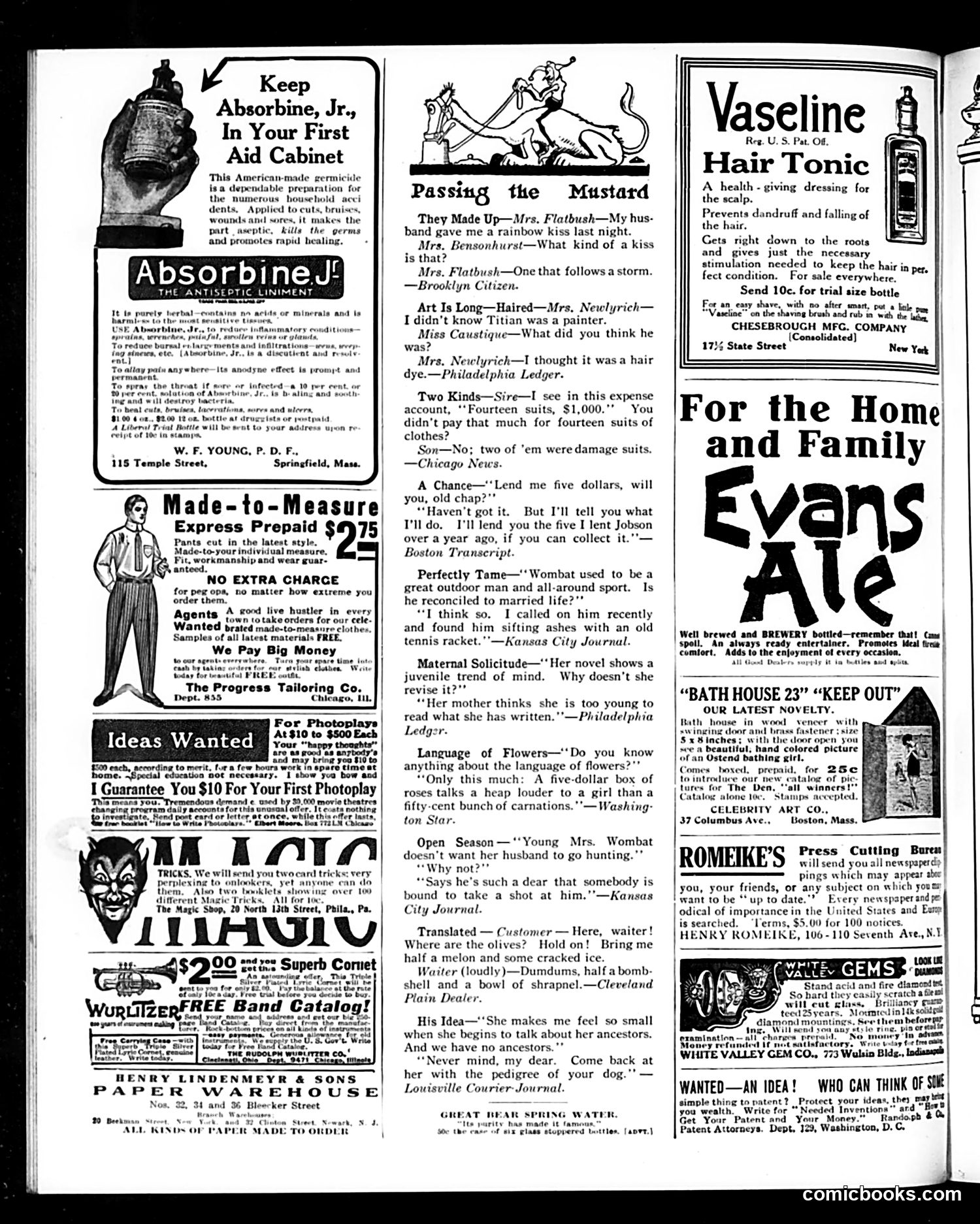
This page is primarily **advertising**, not editorial or cartoon content. The major items are classified ads and product promotions typical of early 20th-century magazines: Absorbine Jr. liniment, made-to-measure pants, "ideas wanted" for photoplay scripts, magic tricks, and paper warehouse services. The only satirical content is a section titled **"Passing the Mustard,"** containing brief humorous anecdotes rather than visual cartoons. These are light domestic jokes: a wife describing a "rainbow kiss" after a storm, a socialite confusing the painter Titian with hair dye, a son claiming "damage suits" as clothing expenses, and similar punchline-driven humor. They reflect early 1900s middle-class life and mild wordplay without political or social commentary. The page appears to be from a later period of Judge when advertising dominated editorial space.
This is not a cartoon but a subscription recruitment advertisement for *Leslie's Illustrated Weekly Newspaper*. The page uses patriotic imagery (an eagle with shield at top) and the famous "We Want You" recruitment rhetoric—echoing American military and civic appeals of the era. The ad targets wealthy, influential readers: bankers, business executives, lawyers, doctors, and prominent citizens. It emphasizes *quality over quantity* in readership, positioning *Leslie's* as essential for the nation's elite decision-makers. The magazine's appeal centers on its war coverage (likely referencing World War I, given the text's emphasis on "the great struggle abroad"), financial advice, and practical content on motoring, investment, and export opportunities. The General Manager's signature adds credibility and personal endorsement. The $5 annual subscription was expensive for the era, further targeting affluent readers. This reflects how magazines strategically cultivated prestige by courting influential subscribers rather than pursuing mass circulation.
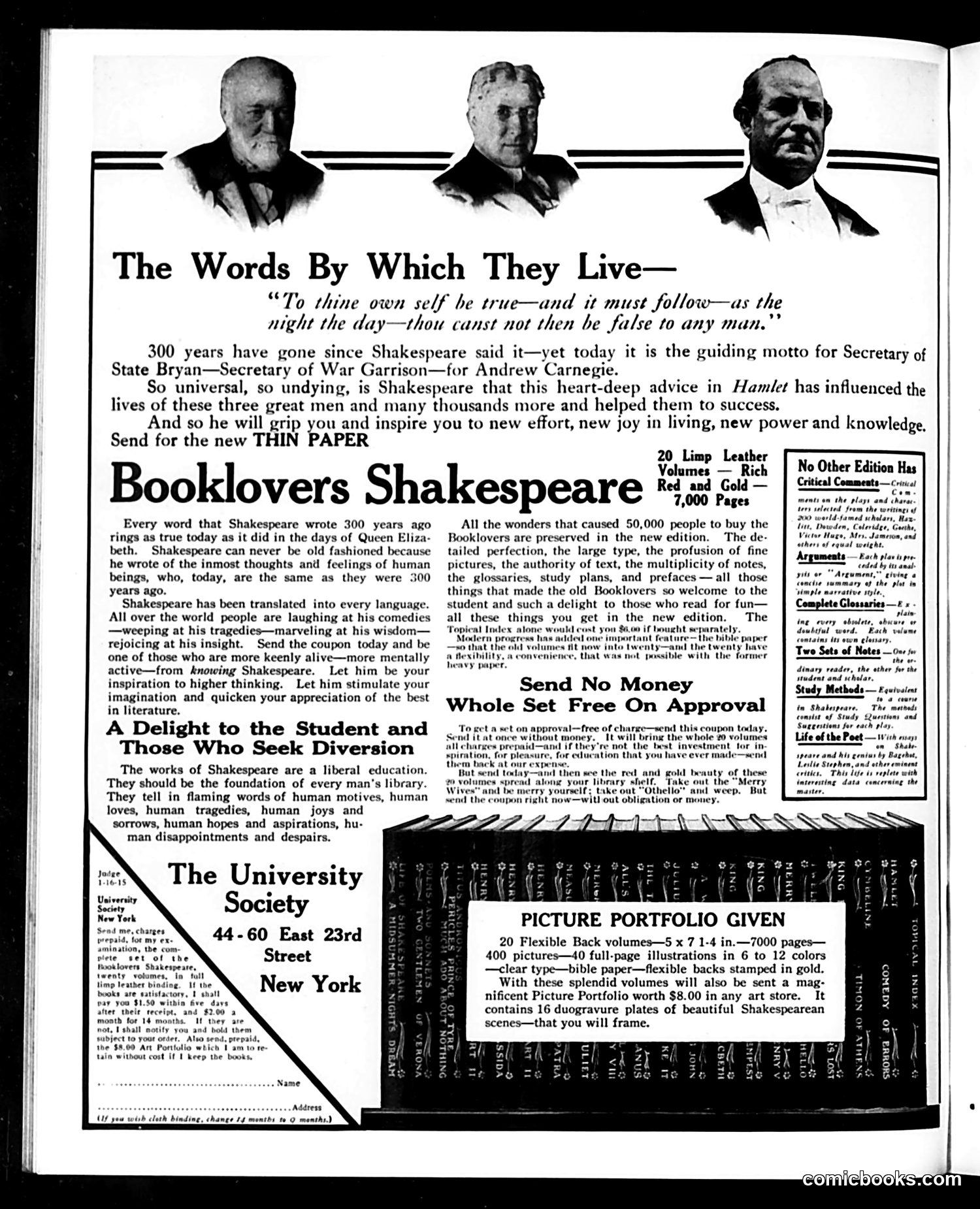
This is primarily a **book advertisement** for the "Booklovers Shakespeare" edition, not a political cartoon. However, it opens with propaganda value by naming three prominent early-20th-century figures—Secretary of State **William Jennings Bryan**, Secretary of War **Lindley M. Garrison**, and industrialist **Andrew Carnegie**—as men guided by Shakespeare's moral philosophy ("To thine own self be true"). The appeal is aspirational: owning this edition will inspire readers toward success and virtue, just as it supposedly has these famous men. The ad emphasizes the edition's quality (20 leather volumes, 7,000 pages, 400 illustrations) and offers a low-barrier entry ("Send No Money—Whole Set Free On Approval"). **The satire is subtle**: Judge implicitly mocks the pretentiousness of associating commercial book sales with moral greatness, and the somewhat absurd claim that Shakespeare's words literally guide Cabinet officials. It's advertising that flatters both the product and the buyer's aspirations.