
Judge, 1915-01-16 · page 6 of 24
Judge — January 16, 1915 — page 6: what you’re looking at
What you’re looking at
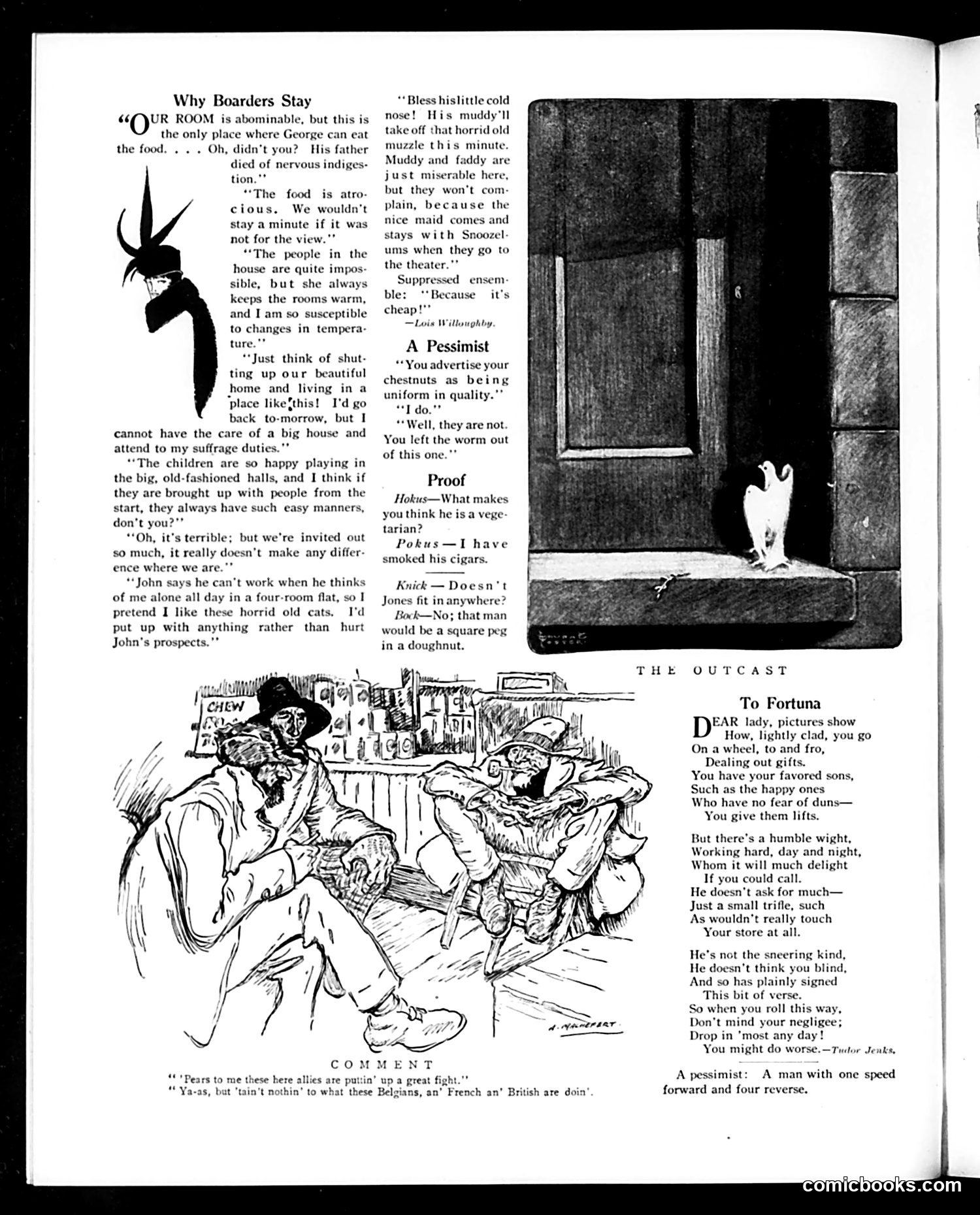
This satirical page critiques boarding-house life and social pretenses circa early 20th century. **"Why Boarders Stay"** (main feature) presents hypocritical excuses from various lodgers. Despite complaining about terrible food, disagreeable people, and cramped quarters, they remain—citing their husband's work prospects, children's manners, social obligations, or suffrage duties. The hidden truth, per "Suppressed ensemble," is simple: **it's cheap**. Lois Willoughby's satire mocks the middle-class tendency to rationalize staying in undesirable circumstances through false nobility. **Lower section** contains brief comic sketches: "A Pessimist" jokes about defective chestnuts; "Proof" uses cigar-smoking as evidence of vegetarianism (unclear logic); and "Comment" references WWI allies—Americans noting the Belgians, French, and British are fighting harder than expected. **"To Fortuna"** (right column) is a poem requesting the goddess of fortune to spare attention for a humble working man, suggesting economic disparity and class anxiety. The page primarily satirizes middle-class self-deception and financial constraint.
📄 Transcribed text from this page (OCR, searchable)
Machine-transcribed from the original scan — historical spelling and the odd misread are preserved.
Why Boarders Stay 66Q)UR ROOM is abominable, but this is the only place where George can eat the food, . . . Oh, didn’t you? His father died of nervous indiges- tion.” The food is atro- cious. We wouldn't stay a minute if it was not for the view.” “The people in the house are quite impo sible, but she always keeps the rooms warm, and Iam so susceptible to changes in tempera- ture."" “Just think of shut- ting up our beautiful home and living in a ‘place likefthis! I'd go back to-morrow, but I cannot have the care of a big house and attend to my suffrage duties."” “The children are so happy playing in the big, old-fashioned halls, and I think if they are brought up with people from the start, they always have such easy manners, don’t you?"’ “Oh, it’s terrible; but we're invited out so much, it really doesn’t make any differ- ence where we are."" “John s he can't work when he thinks of me alone all day in a four-room flat, so I pretend I like these horrid old cats, I'd put up with anything rather than hurt John's prospects."* **Bless hislittle cold nose! His muddy'll take off that horrid old muzzle this minute. Muddy and faddy are just miserable here, but they won't com- plain, because the nice maid comes and stays with Snoozel ums when they go to the theater."" Suppressed ensem- ble: ‘*Because it’s cheap!" Lois Willoughby. A Pessimist **You advertise your chestnuts as being uniform in quality."” “*I.do.’* “Well, they are not. You left the worm out of this one."* Proof Hokus—What mal you think he is a vege- tarian? Pokus—I have smoked his cigars. Knick — Doesn't Jones fit in anywhere? Bock—No; that man would be a square peg in a doughnut. COMMENT ** *Pears to me these here allies are puttin’ up a great fight."” “Ya-as, but ‘tain’t m in’ to what these Belgians, an’ French an’ British are doin’ A pessimist: forward and four reverse. OUTCAST To Fortuna EAR lady, pictures show How, lightly clad, you go On a wheel, to and fro, Dealing out gifts. You have your favored sons, he happy ones Who have no fear of duns— You give them lifts. But there’: If you could call. He doesn't ask for much— Just a small trifle, such As wouldn’t really touch Your store at all. He's not the sneering kind, He doesn’t think you blind, And so has plainly signed This bit of verse. So when you roll this way, Don't mind your ne; ee; Drop in most any day! You might do worse.—Twtu sa humble wight, Working hard, day and night, Whom it will much delight A man with one speed '