
A complete issue · 24 pages · 1914
Judge — September 26, 1914
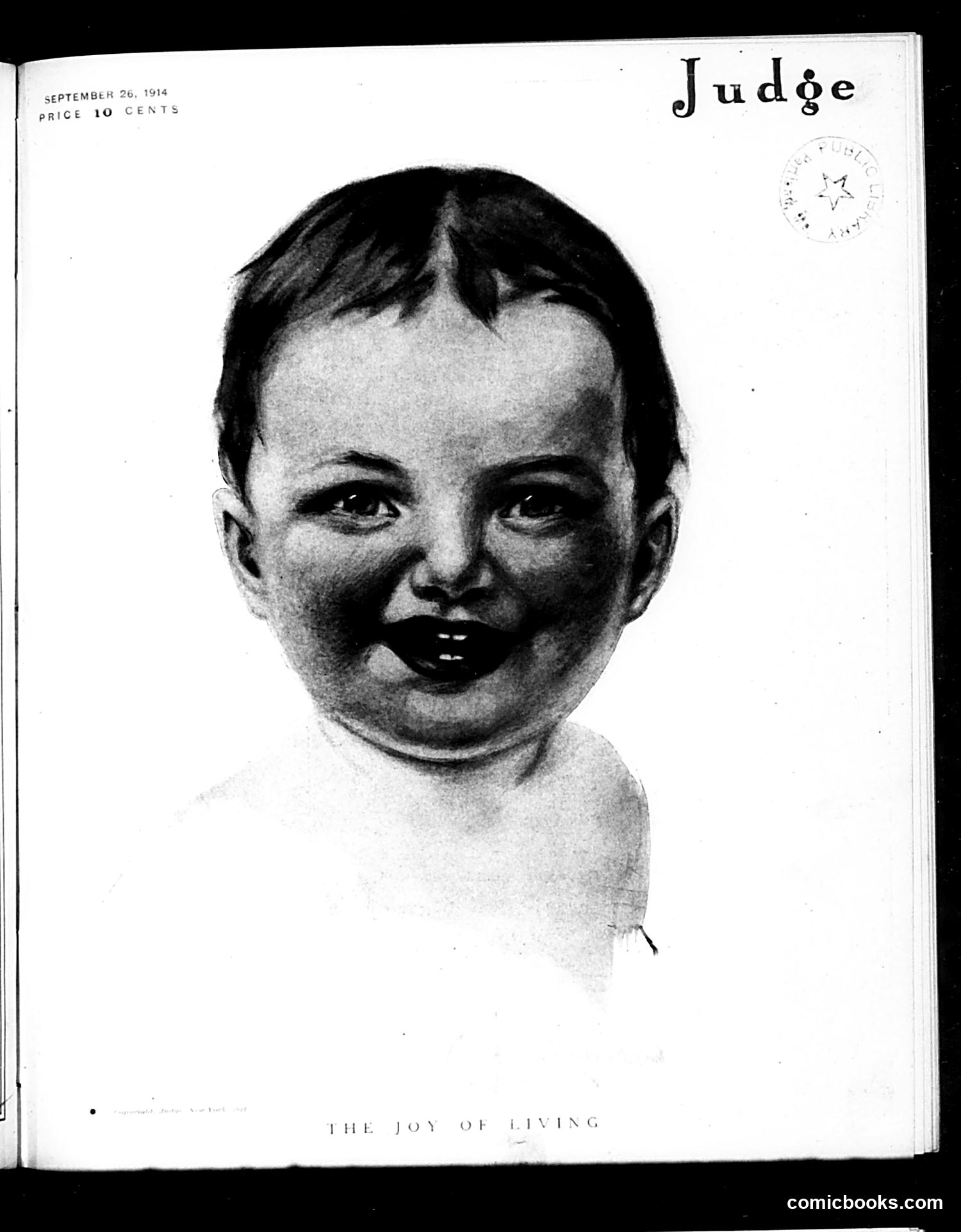
This page from Judge magazine features a portrait illustration titled "The Joy of Living" with the heading "Judge" at the top. The image shows a baby's face with an exaggerated, gleeful expression—wide eyes and open-mouthed smile. Given the September 1914 date, this likely reflects American attitudes during early World War I, when the U.S. remained officially neutral but debates about the conflict dominated public discourse. The satirical intent appears to be commentary on innocence or blissful ignorance, possibly mocking those who remained cheerfully detached from the war's gravity. The exaggerated baby expression could suggest naiveté or willful blindness to serious contemporary events. Without additional text visible, the precise satirical target remains unclear.
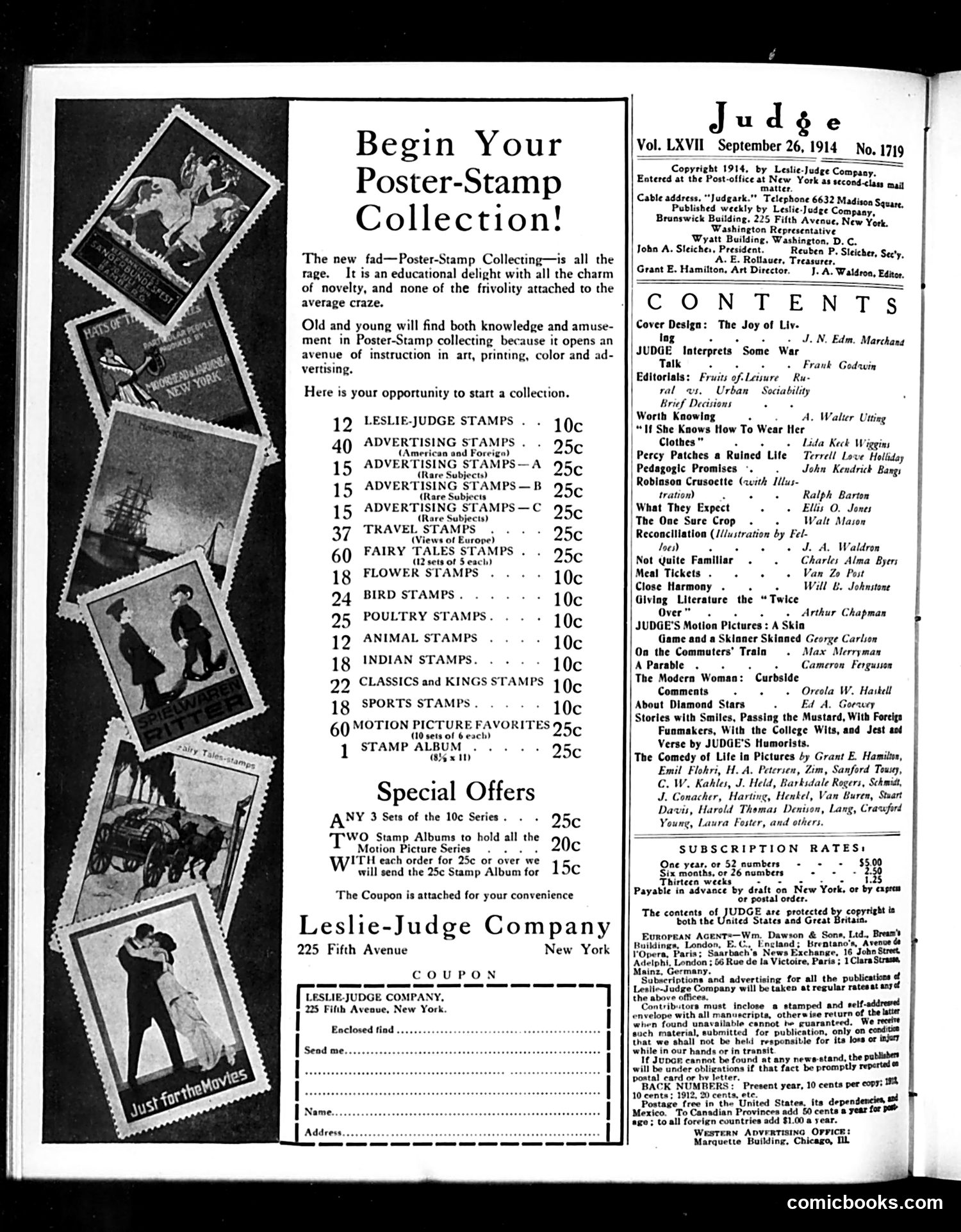
This page is primarily **advertising for Leslie-Judge stamp collecting**, a new fad of the era. The left side displays sample stamp sheets with decorative borders showing various categories: Leslie-Judge stamps, advertising stamps, travel stamps, fairy tale stamps, flower stamps, bird stamps, and others priced from 10-25 cents. The accompanying text promotes stamp collecting as educational and entertaining for "old and young," offering instruction in "art, printing, color and advertising." **The actual satirical content is minimal on this page.** The right side contains the magazine's table of contents and subscription information. No specific political cartoons or caricatures are visible—this appears to be primarily a commercial advertisement disguised as editorial content, typical of early 20th-century magazine publishing.
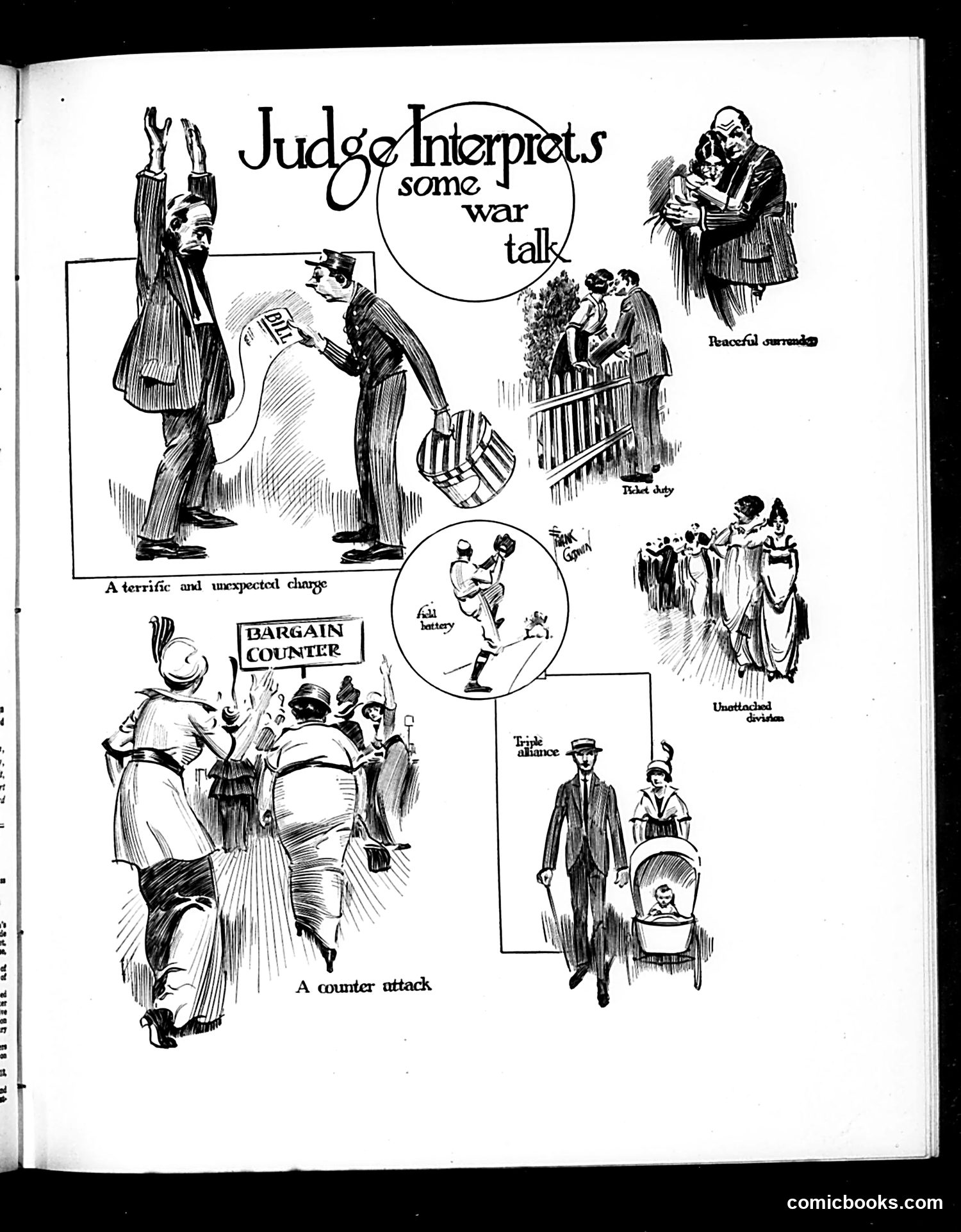
This cartoon satirizes judicial interpretations of WWI-related rhetoric and policy. The central theme shows a judge reinterpreting various military/political terms into civilian concepts: - **"A terrific and unexpected charge"** becomes a legal indictment - **"Bargain counter" / "A counter attack"** depicts commerce rather than military strategy - **"Gill battery"** transforms combat into boxing - **"Peaceful surrender,"** **"Ticket duty,"** **"Unattached division,"** and **"Triple alliance"** are reframed as civilian activities (family scenes, caregiving, social gatherings) The satire mocks how judges and legal institutions might neutralize or domesticate wartime language into ordinary legal and social meanings, undercutting the gravity of actual military conflict. It's commentary on how institutional authority could trivialize war discourse through legalistic reinterpretation.
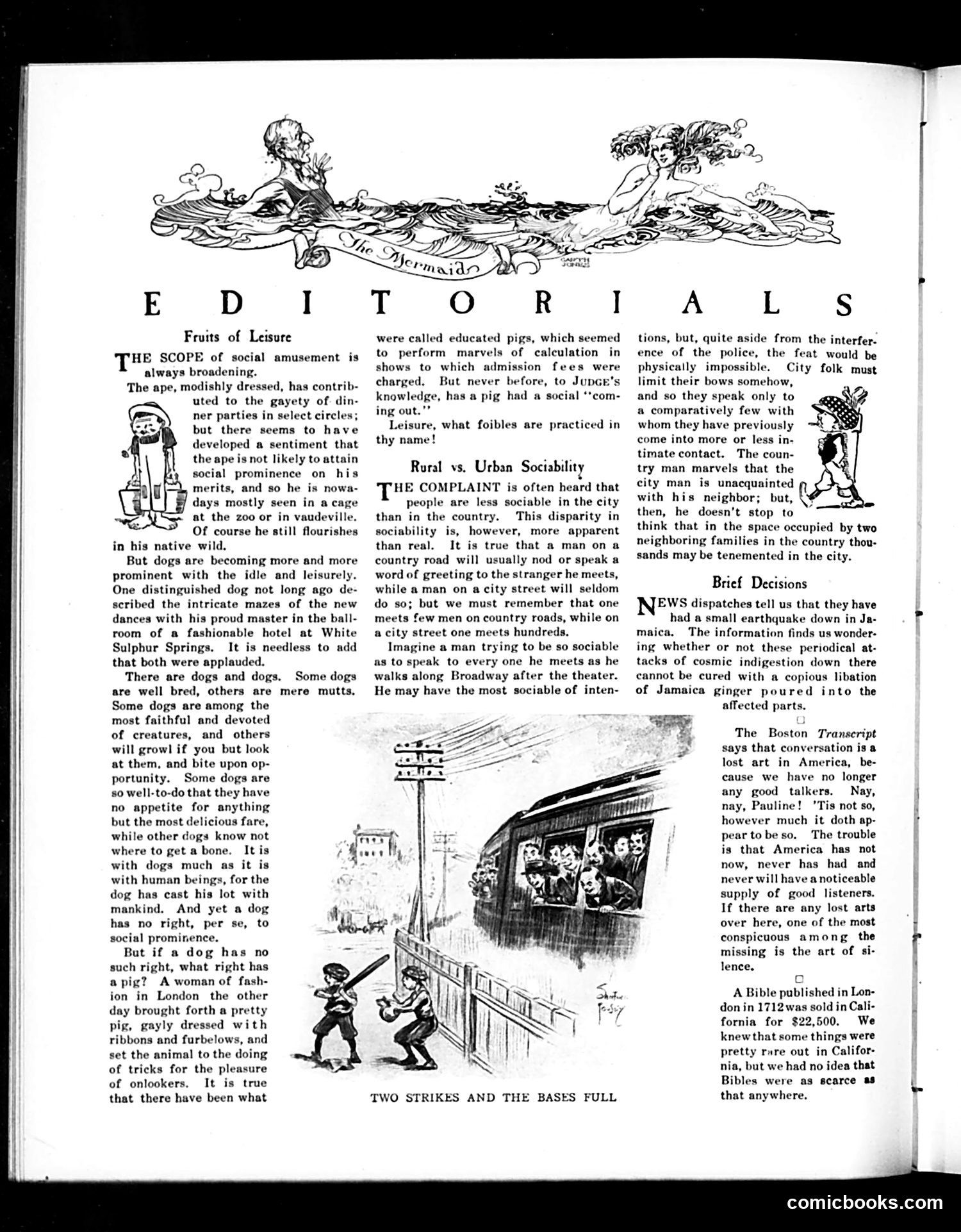
This page contains editorial commentary on social topics rather than political cartoons. The main articles discuss: 1. **"Fruits of Leisure"** — critiques upper-class amusement, mentioning "educated pigs" performing at admission-fee shows, apparently satirizing frivolous entertainment for the wealthy. 2. **"Rural vs. Urban Sociability"** — compares country and city social behavior, noting rural people are less talkative with strangers while city dwellers are more interactive. The piece questions whether urbanites are genuinely more social or simply encounter more people. 3. **"Brief Decisions"** — short news commentary on topics including an earthquake in Japan, conversation as a lost American art, and a 1712 Bible sale in California. The illustration "Two Strikes and the Bases Full" depicts a baseball scene, likely reflecting the sport's popularity during this period.
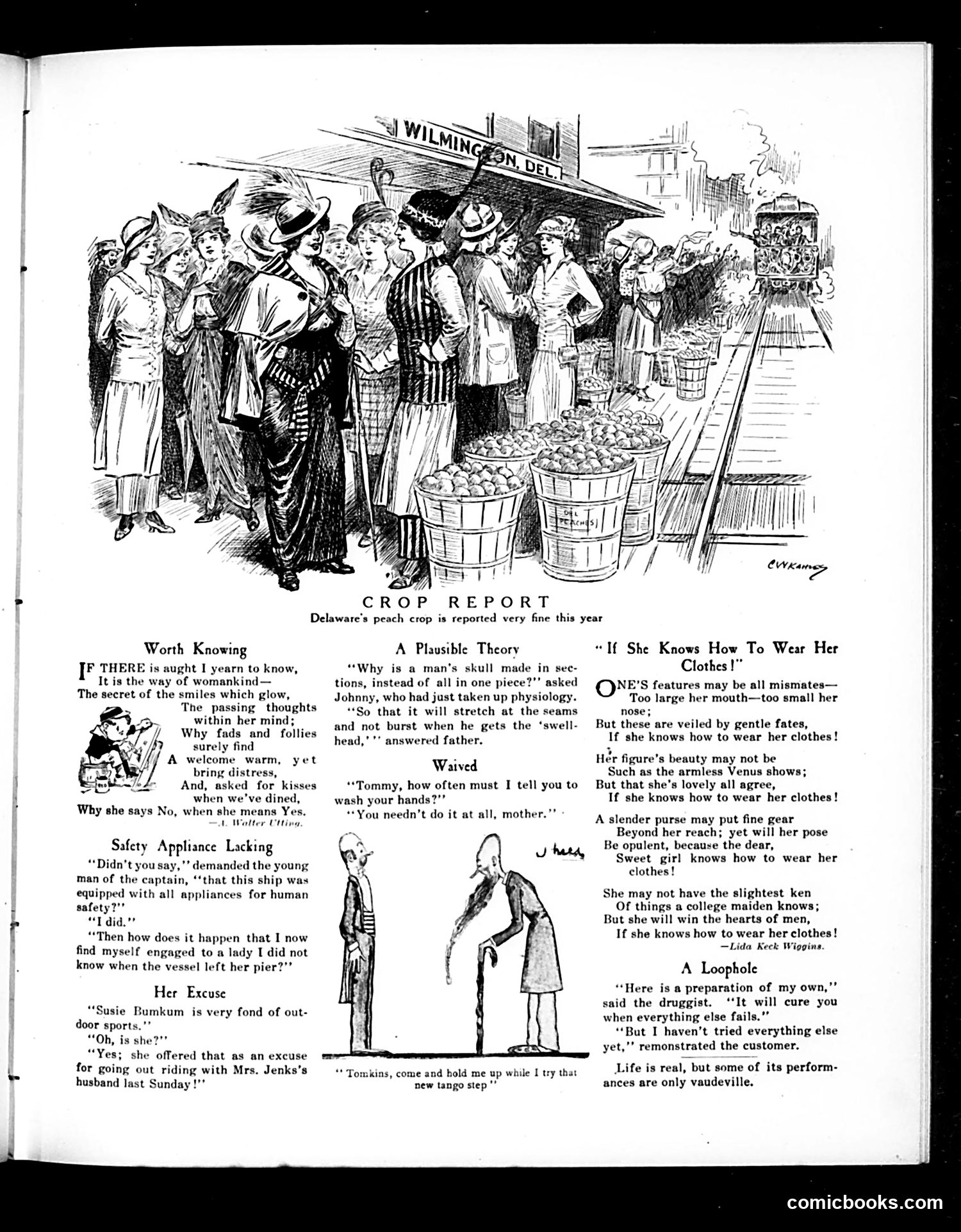
The top illustration depicts a farmer's market or produce stand in Wilmington, Delaware, with well-dressed early 20th-century shoppers examining baskets of peaches. The caption "CROP REPORT: Delaware's peach crop is reported very fine this year" suggests this is satirizing agricultural commerce or market conditions of that era. The lower section contains unrelated humorous sketches and short comedic pieces about domestic life—including jokes about women's behavior, dating customs, and shopping. These appear to be typical light satirical content Judge magazine regularly published, poking fun at social conventions and gender dynamics of the period rather than addressing specific political events or figures.
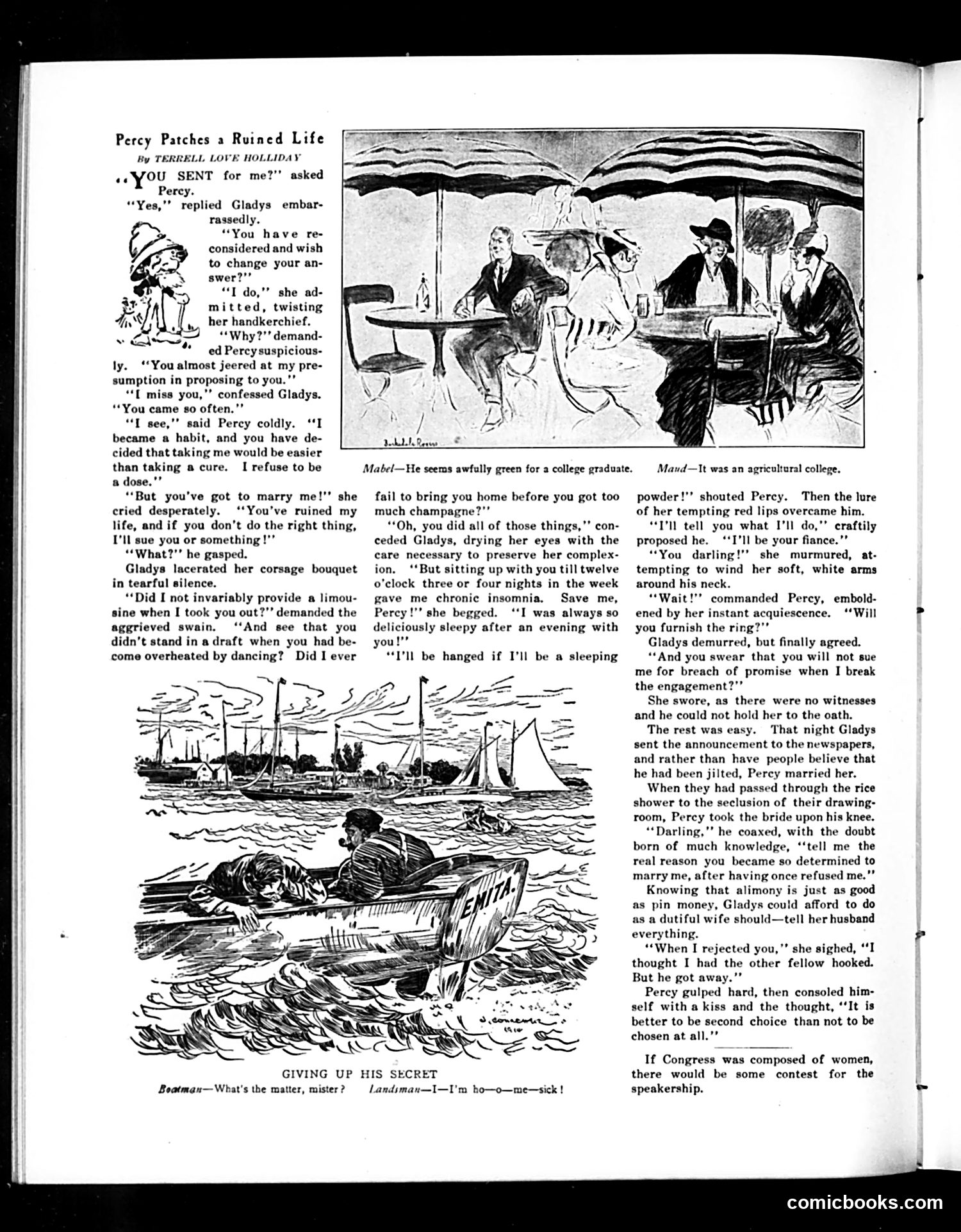
This is a satirical romantic comedy about courtship and manipulation. Percy, a persistent suitor, finally wins Gladys's agreement to marry—but only after she admits she's using him as a substitute for another man who "got away." Her real motivation, revealed at the end, is financial: she wants alimony. The satire targets female gold-diggers and mercenary marriage tactics of the era. Percy, initially portrayed as overly attentive (providing limousines, preventing drafts), becomes the dupe who marries knowing he's a "second choice." The final panel's political joke references women's suffrage debates: if women voted in Congress, there'd be competition for speaker—implying women are inherently competitive and self-interested, playing into anti-suffrage rhetoric of the period. The bottom illustrations show a seasick "landlsman" and agricultural college stereotypes, providing additional comic relief unrelated to the main narrative.
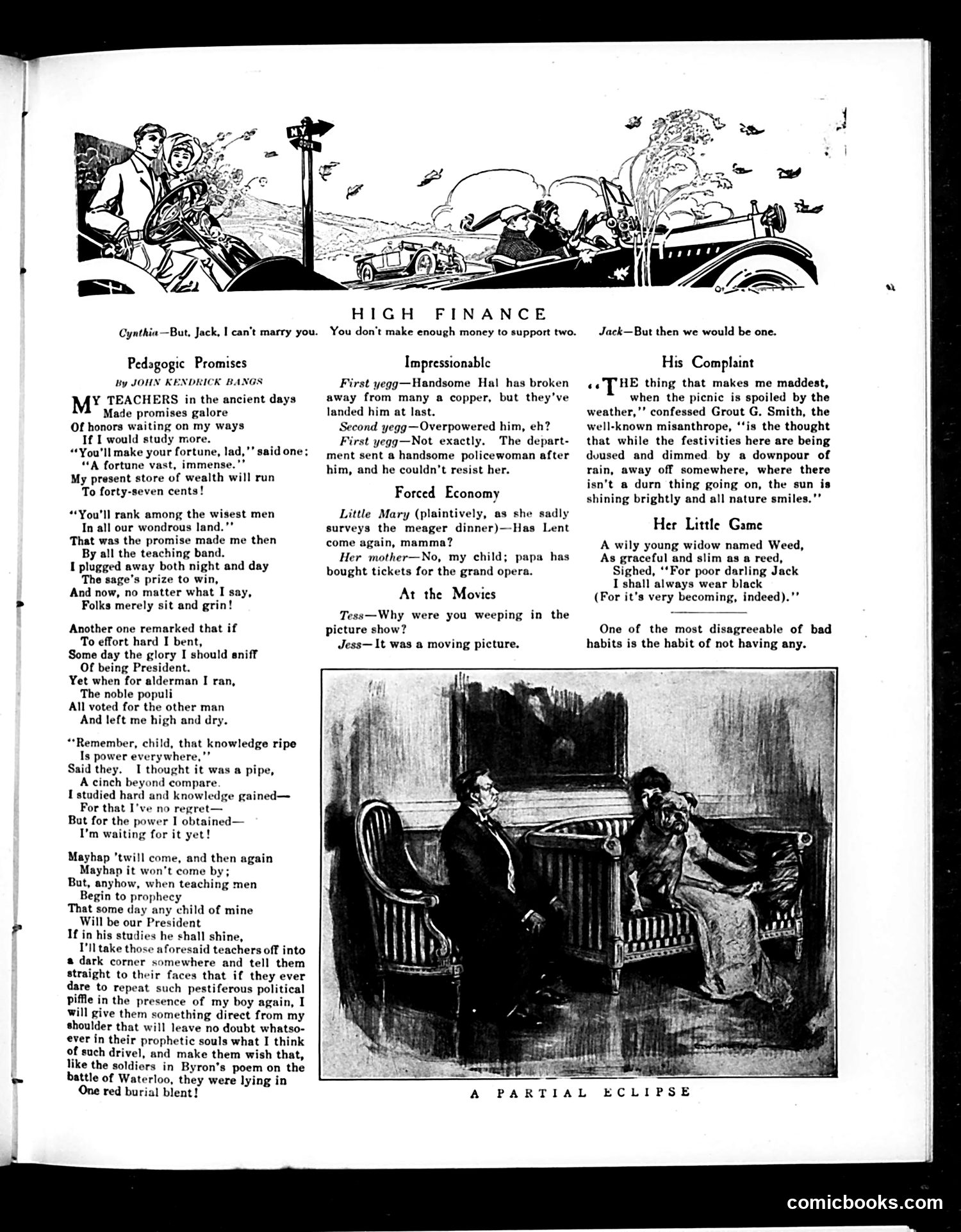
This page contains multiple satirical pieces typical of early 20th-century Judge magazine: **"High Finance"** presents a romantic joke about marriage economics—a common theme mocking both wealth inequality and courtship. **"Pedagogic Promises"** is a cynical poem by John Kendrick Bangs attacking teachers who promise students that education guarantees success and wealth. The speaker describes studying diligently but gaining no power or position—even losing an election for alderman. He concludes by threatening to tell teachers to stop feeding such lies to children, viewing their "prophecies" as destructive political nonsense. **Other vignettes** mock daily absurdities: a woman mourning spoiled picnics while sunshine exists elsewhere, a child's widow costume joke, and the observation that having no bad habits is itself disagreeable. **"A Partial Eclipse"** (illustration) appears to show an interior social scene, though its specific satirical point isn't clear from available text. The overall tone reflects Progressive-era skepticism about American meritocratic promises and institutional claims.
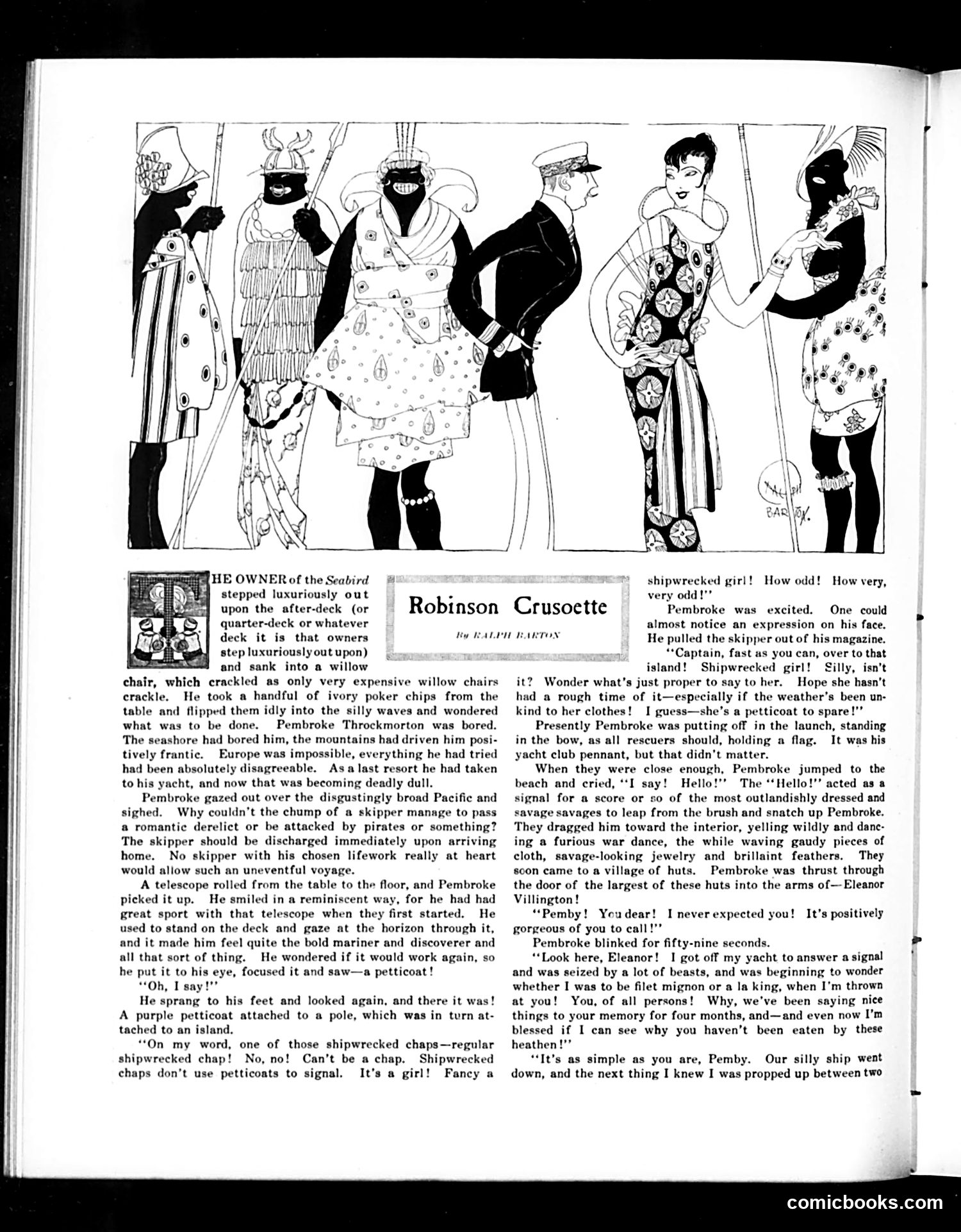
This is a humorous short story illustrated by Ralph Barton, a celebrated cartoonist of the 1920s-30s. The narrative parodies *Robinson Crusoe*—the classic survival tale—by replacing the resourceful castaway with Eleanor Villington, a wealthy socialite. The satire mocks the idle rich: Pembroke Throckmorton, a bored yacht owner, finds even exotic travel tedious until he spots a "shipwrecked girl" signaling with a purple petticoat. His rescue fantasy collapses when he discovers it's Eleanor, his ex-romantic interest, who apparently survived shipwreck through pure accident rather than ingenuity. The joke exploits the contrast between literary adventure (serious survival) and frivolous upper-class life (two wealthy people casually encountering each other on a remote island). The savage "rescuers" and elaborate setup add comedic absurdity to what should be a dramatic moment.
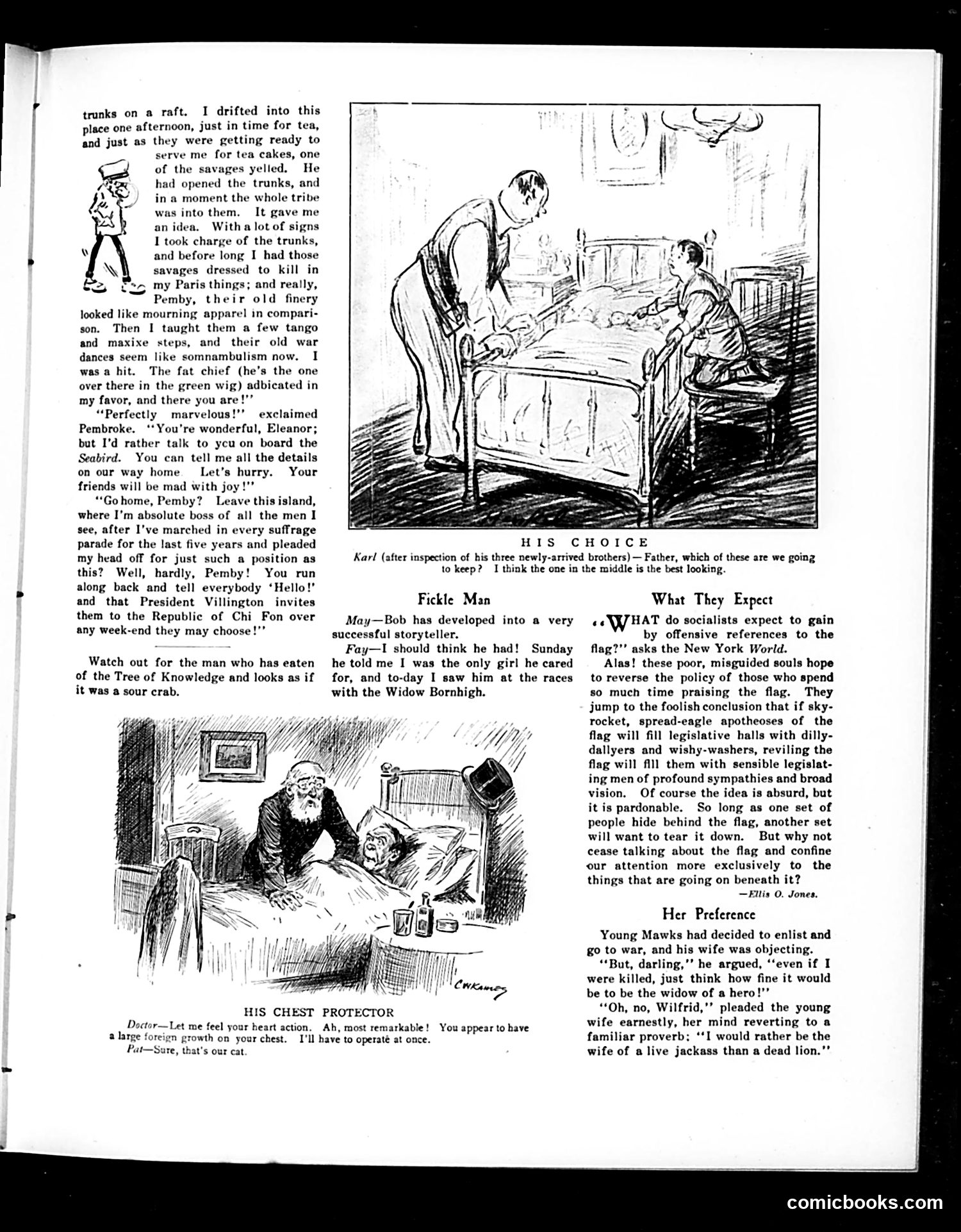
This page contains several satirical pieces reflecting early 20th-century American concerns: **"His Choice"** (top): A woman explorer describes ruling a Pacific island tribe after civilizing them with Paris fashions and dance lessons. When invited home, she refuses—preferring her newfound power over men to her suffrage activism back home. The satire targets both female ambition and the period's imperialist attitudes, mocking both "civilizing mission" rhetoric and women's political aspirations as inherently self-serving. **"Fickle Man"** (middle): A brief joke about male inconsistency in romance—a man tells different women contradictory things. **"What They Expect"** (right): Commentary on socialists criticizing the American flag, dismissing their logic as absurd while suggesting flag-wavers are equally irrational. Appears skeptical of both patriotic excess and anti-flag sentiment. **"Her Preference"** (bottom): A wife prefers her husband alive but foolish to dead but heroic—practical over romantic idealism about military sacrifice. The page satirizes suffragism, male infidelity, patriotism debates, and wartime attitudes.
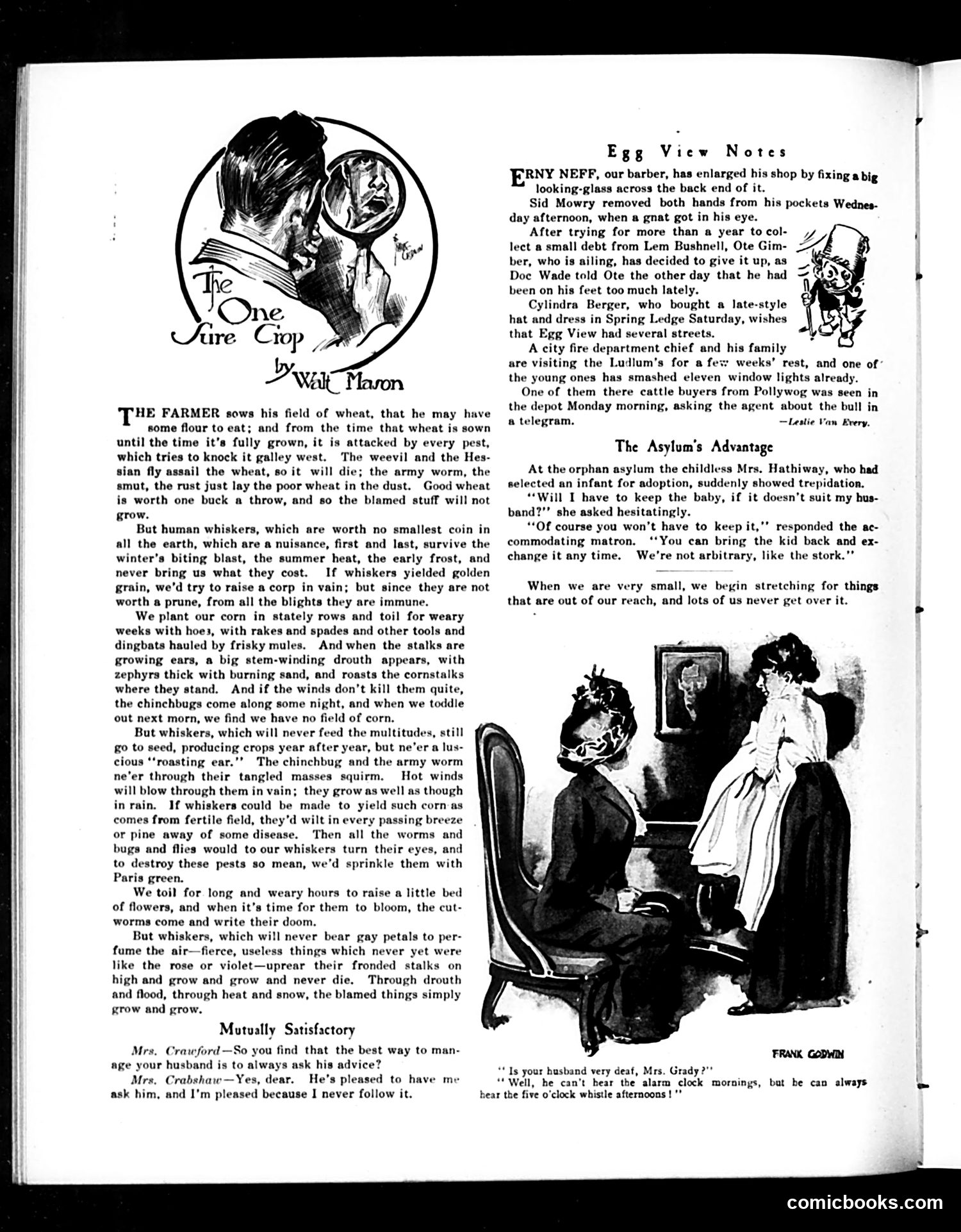
This humorous poem contrasts the farmer's struggle with cultivated crops—constantly attacked by weevils, Hessian flies, army worms, and drought—against the effortless, unstoppable growth of human facial hair (whiskers). The satire's point: worthless whiskers thrive despite all conditions, while valuable wheat and corn are perpetually destroyed by pests and weather. The joke relies on exaggeration and irony—the one "crop" worth nothing grows reliably, while those requiring tremendous labor yield nothing. The page also includes "Egg View Notes" (rural gossip items) and "The Asylum's Advantage" (a brief joke about adoption), plus a domestic cartoon about marital advice. These represent typical Judge magazine content: rural humor, satirical commentary on farming life, and light social comedy reflecting early 20th-century American concerns.
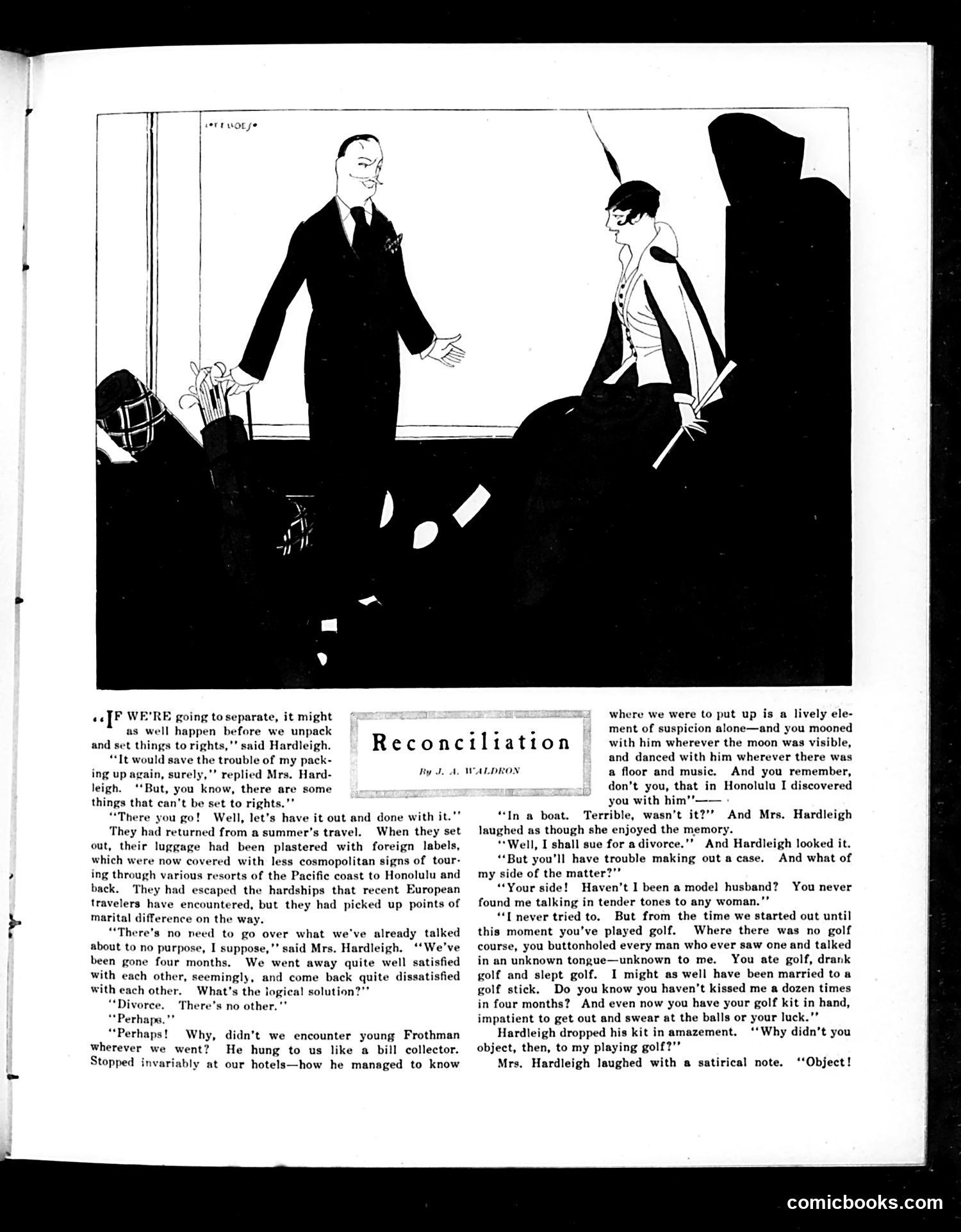
This domestic comedy depicts a married couple, the Hardleighs, returning from a four-month Pacific tour and threatening divorce. The satire targets both spouses' behavior: Mrs. Hardleigh flirted constantly with a persistent acquaintance named Frothman, while Mr. Hardleigh obsessively played golf at every opportunity, neglecting his wife entirely. The joke hinges on marital hypocrisy and miscommunication. Each accuses the other of infidelity or neglect, yet neither openly objected at the time. Mrs. Hardleigh's final laugh suggests the absurdity of their grievances—his golf obsession is presented as equally damaging as her romantic dalliance. The cartoon satirizes how couples can drift apart through mutual avoidance rather than confrontation, and how leisure activities (golf being a leisure pursuit of the wealthy) can become destructive to marriage.
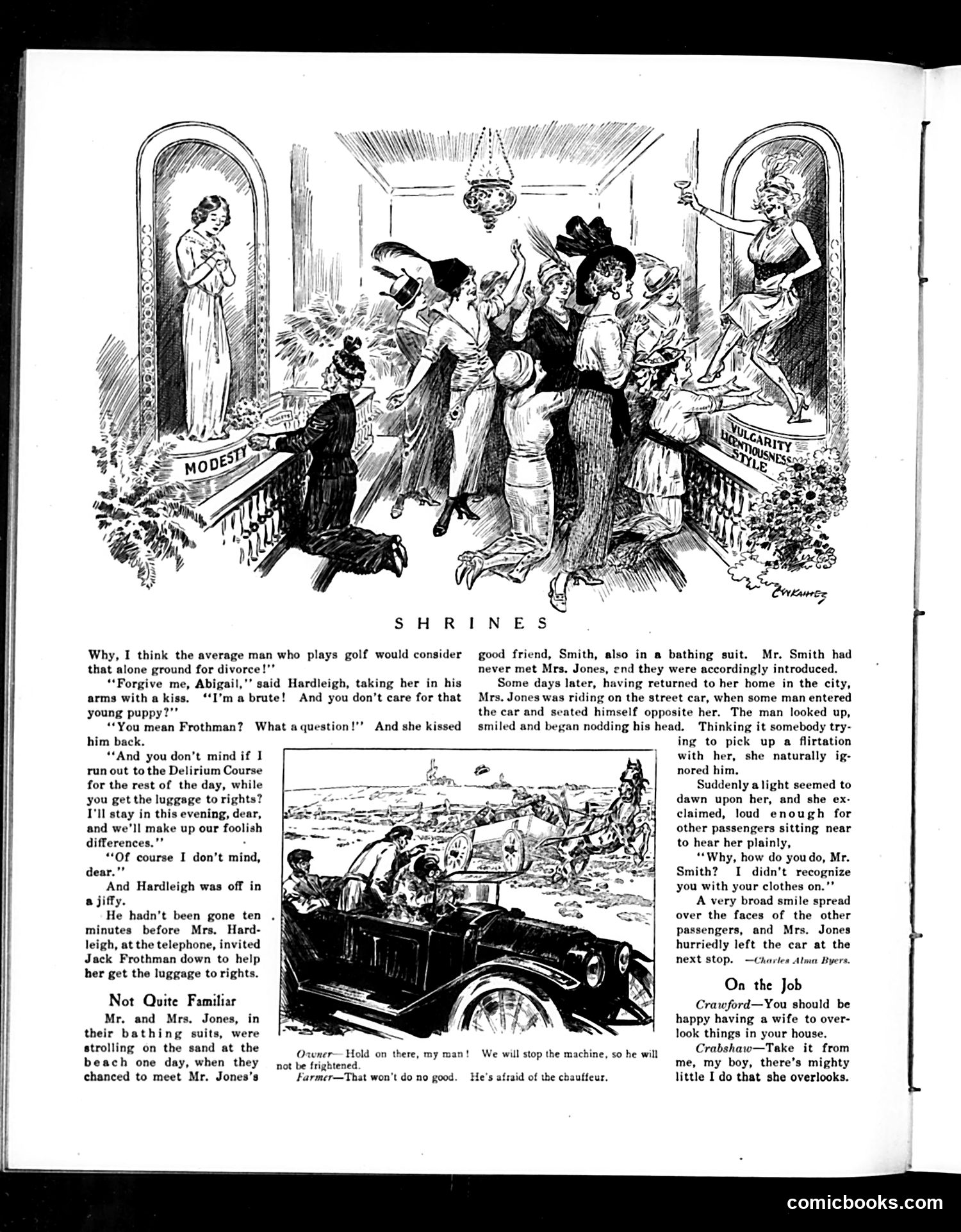
This page contains three separate humor pieces satirizing early 20th-century social conventions: **"Shrines"** (top illustration): Shows women entering through doors labeled "Modesty" and "The Charity of Conscience," depicting how women navigated conflicting social expectations around propriety while pursuing infidelity. The cartoon mocks the hypocrisy of maintaining a respectable public facade. **"Not Quite Familiar"** (middle): A woman encounters a man on a streetcar and loudly greets him as "Mr. Smith," remarking she didn't recognize him "with your clothes on"—implying they'd met in a bathing suit. The humor derives from her accidentally publicizing an improper acquaintance, causing embarrassment to other passengers. It satirizes how easily social discretion could unravel. **"On the Job"** (bottom): A brief joke about wives overseeing their husbands' behavior, suggesting matrimonial surveillance was considered normal and expected. Overall, these pieces satirize marriage, infidelity, and the gap between Victorian propriety and actual behavior among the leisure class.
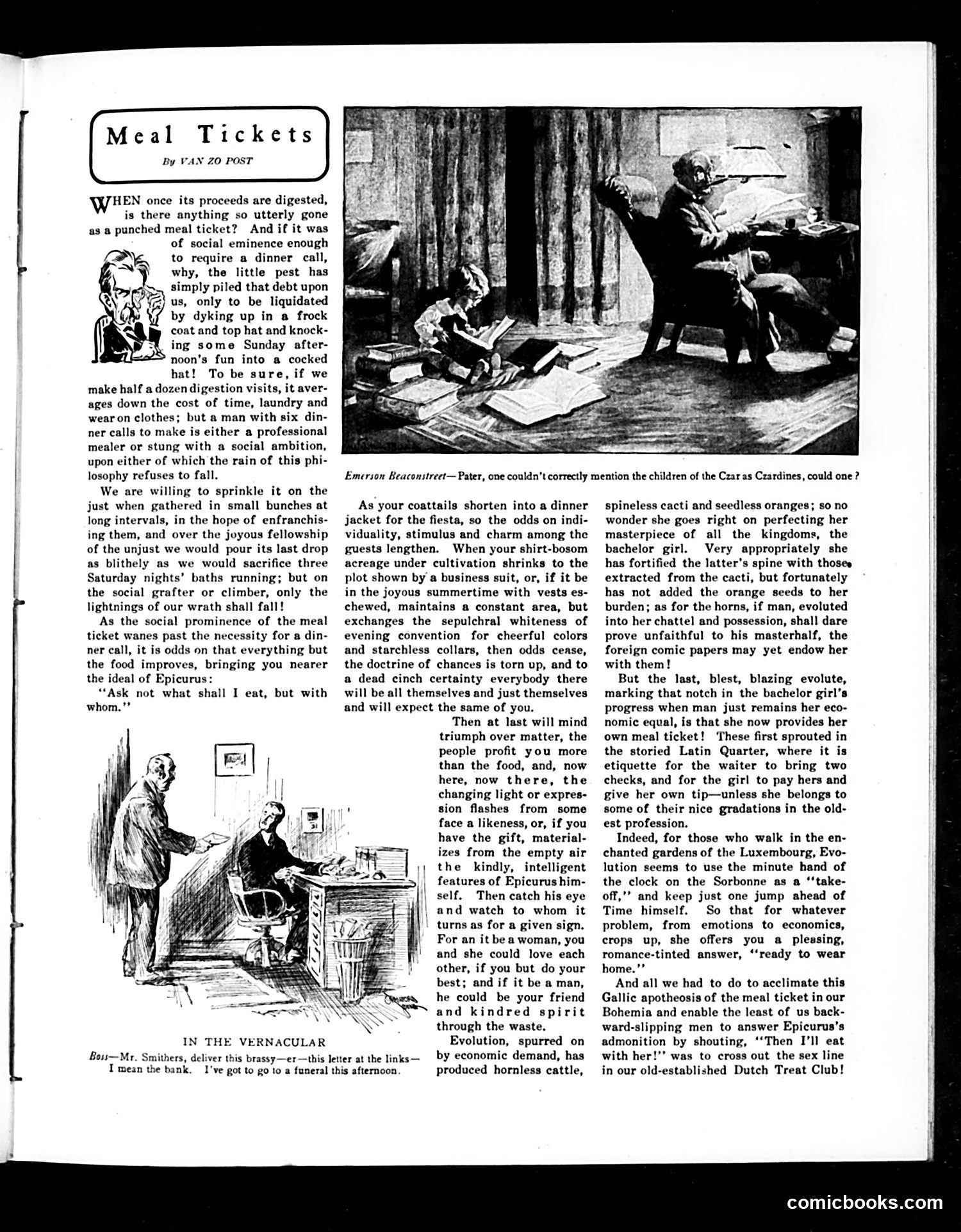
This piece by Van Zo Post satirizes the social convention of formal dinner invitations ("meal tickets") in early 20th-century society. The article mocks how accepting dinner invitations creates social debts and obligations—particularly for ambitious social climbers seeking status. The satire argues that formal dinners are burdensome: they require expensive clothing, create false social bonds, and obligate guests to reciprocate. The author's ideal, attributed to Epicurus, is eating with genuine companions rather than formal acquaintances. The cartoons illustrate social pretense: one shows someone shooting game (implying wealthy leisure), another depicts a gentleman presumably making an awkward social call. The "vernacular" joke at bottom references a man confusing a bank errand with a funeral—suggesting the tedium of obligatory social appearances. The final section celebrates the "bachelor girl" who now provides her own meals, achieving economic independence and escaping these social rituals—presented as progress in women's liberation through financial autonomy.
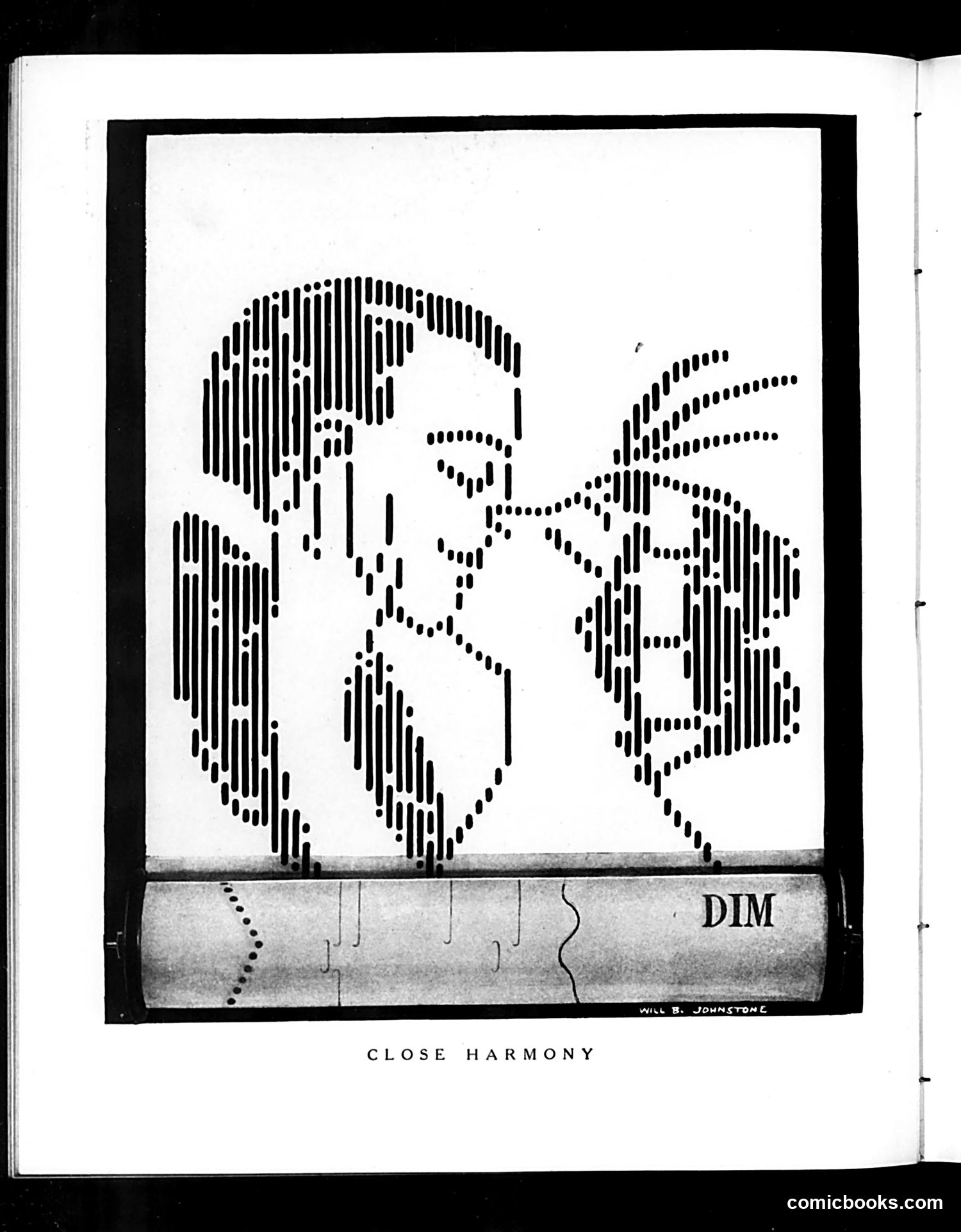
This is a stippled/dotted illustration technique artwork titled "Close Harmony," credited to cartoonist Will B. Johnstone. The image depicts what appears to be two figures rendered in a distinctive pointillist style, with a "DIM" label visible at the bottom right of the illustration frame. Without additional context from the magazine issue, the specific satirical target is unclear. The title "Close Harmony" suggests the satire concerns musical or political agreement/alignment between two parties or figures. The dotted artistic technique and the "DIM" reference may carry period-specific meaning related to Judge magazine's typical subjects (politics, social commentary, entertainment), but the exact identities of the caricatured figures and the intended joke cannot be determined from the image alone.
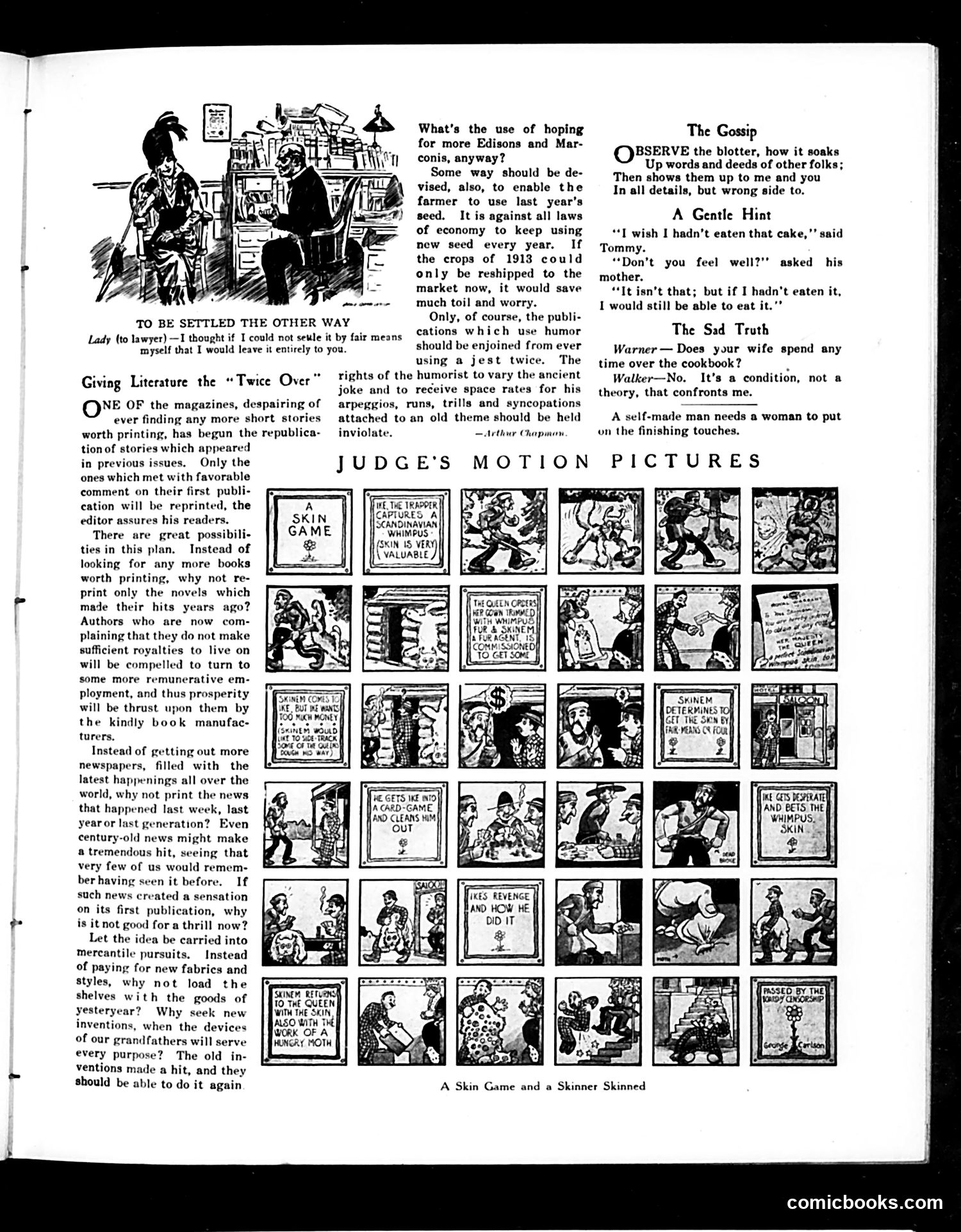
This page contains satirical commentary and humorous observations typical of early 20th-century Judge magazine. The main article "Giving Literature the 'Twice Over'" mocks a magazine's decision to reprint only previously successful stories rather than publishing new work. The author sarcastically extends this logic to absurd conclusions: newspapers reprinting old news, stores selling outdated merchandise, farmers reusing old seeds, and inventors abandoning innovation. The satire critiques both editorial laziness and the broader notion that past success guarantees present relevance. The final paragraph humorously carves out an exception for humor writers—they must always create new jokes, never repeat old ones. Below are unrelated brief jokes and observations ("The Gossip," "A Gentle Hint," "The Sad Truth"), and "Judge's Motion Pictures"—a comic strip series with no clear overarching narrative, typical of the magazine's format. The top cartoon depicts a woman instructing her lawyer to settle a dispute "the other way"—implying she'll use underhanded means if fair settlement fails.
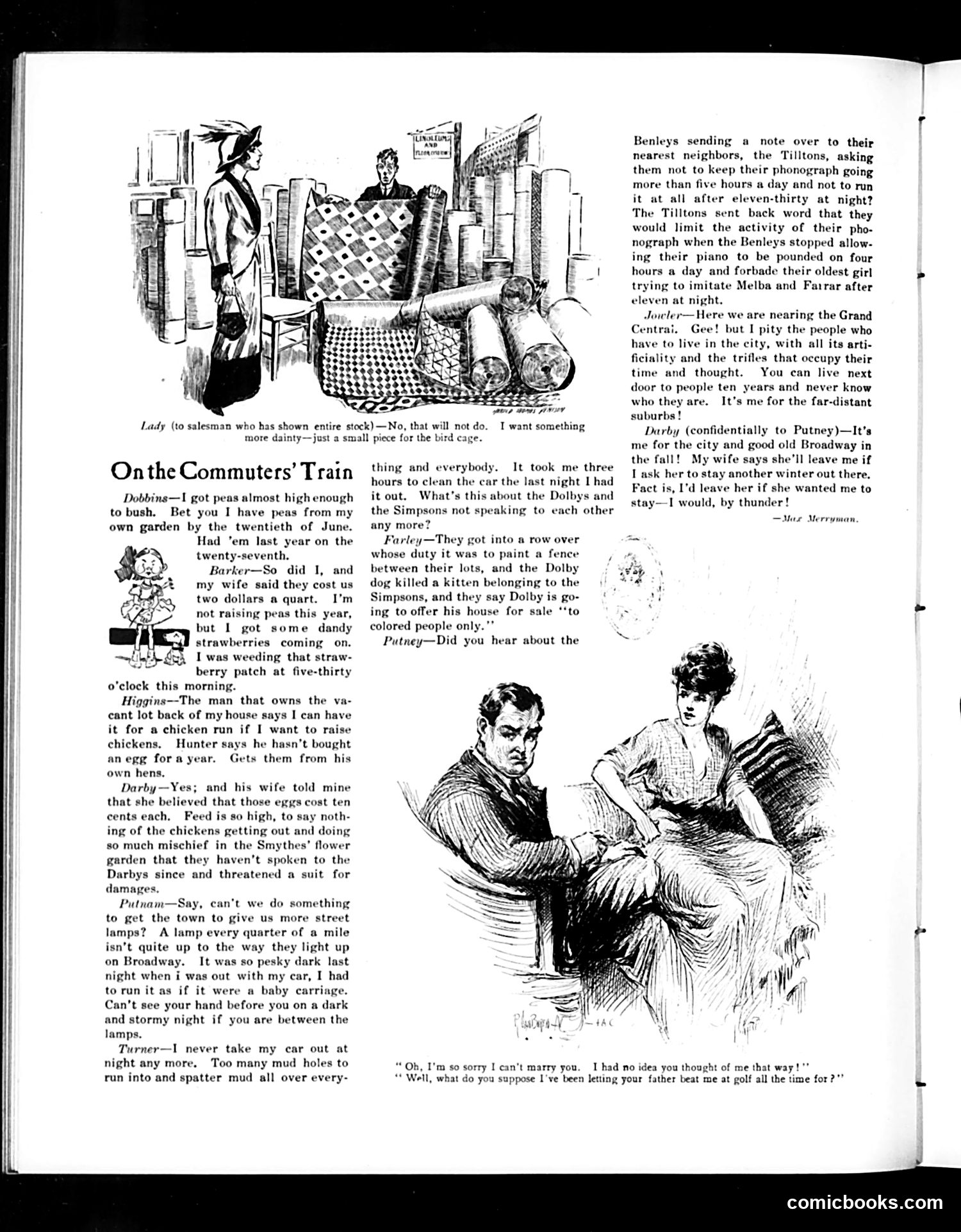
This page satirizes the petty complaints and social anxieties of suburban commuters in the early 20th century. A group of men on a train discuss their lives in what appears to be a newly developed suburb near a major city (Grand Central is mentioned). The satire targets their obsessions: homegrown vegetables and their costs, neighbor disputes over fences and property boundaries, a dog killing a kitten escalating into racial prejudice ("colored people only"), noise complaints about pianos and phonographs, and inadequate street lighting for automobiles. The final joke—a man tolerating golf losses from his girlfriend's father merely to access her—underscores how transactional and loveless these suburban relationships have become. Throughout, the commuters express contradictory desires: praising suburban life while simultaneously envying city living. The satire suggests suburbs attracted aspirational middle-class people preoccupied with status, property disputes, and social convention rather than genuine community or happiness.
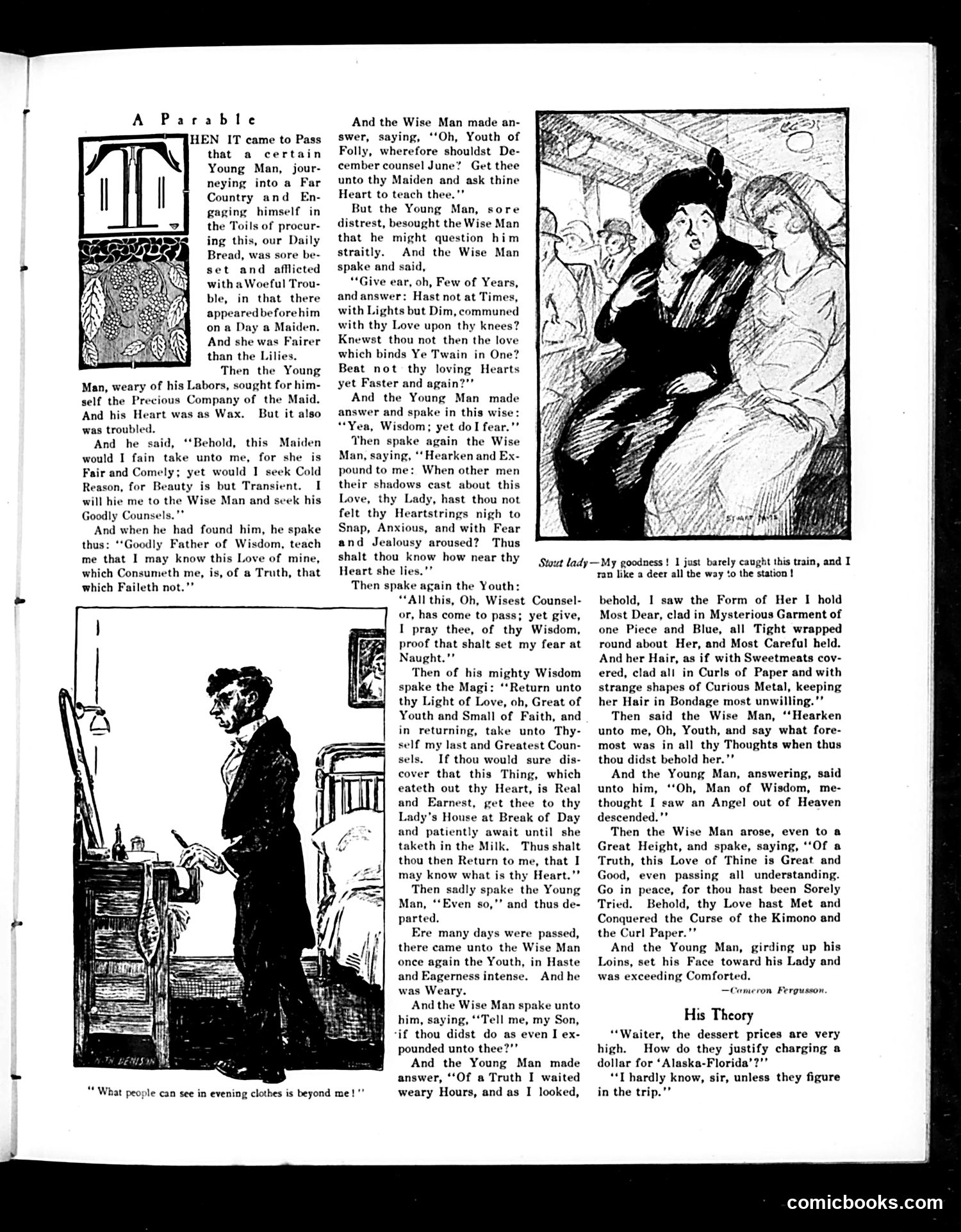
This is a mock-biblical parable satirizing young men's romantic idealization versus reality. A young man seeks a "Wise Man's" counsel about whether his love for a beautiful maiden is genuine. The wise man's test: watch her at dawn when she takes in the milk. When the youth returns, he describes seeing her in unflattering morning reality—wrapped in a shapeless blue garment, hair pinned up in curlers and metal contraptions. Despite this unglamorous appearance, he felt she was angelic. **The satire's point**: The story mocks both romantic delusion and—implicitly—the artifice of female beauty standards. Women's "evening clothes" and carefully arranged appearances create illusions; the real test of love is accepting their natural, undressed state. The final caption about evening clothes underscores this theme of deceptive presentation versus authentic reality.
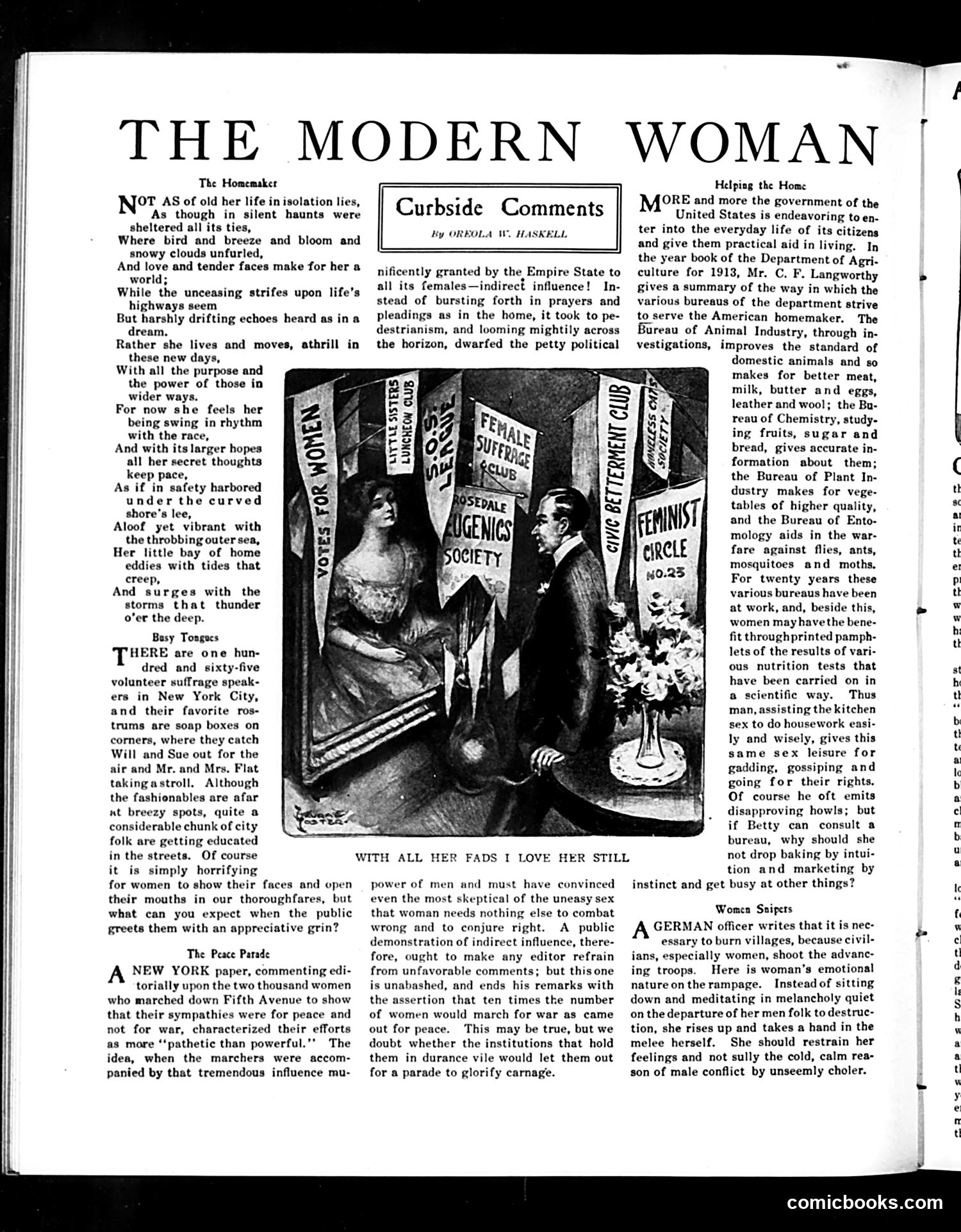
This page satirizes the women's suffrage and peace movements of the early 1910s. The central cartoon depicts a woman at a suffrage rally surrounded by signs reading "Female Suffrage," "Eugenics Society," and "Feminist Circle No. 25"—representing the various reform causes women were championing beyond traditional domesticity. The accompanying commentary is **sarcastically sympathetic**. The editor mocks a newspaper that dismissed a women's peace march as "pathetic" rather than "powerful," while also ridiculing the notion that women possessed only "indirect influence" through the home. The satire cuts both ways: the piece critiques male condescension toward female activism while also gently mocking women for needing government validation and scientific "proof" (via agricultural bureaus) to manage basic homemaking. The overall message appears to be: women are increasingly visible in public life and activism, which mainstream society finds simultaneously threatening and ridiculous.
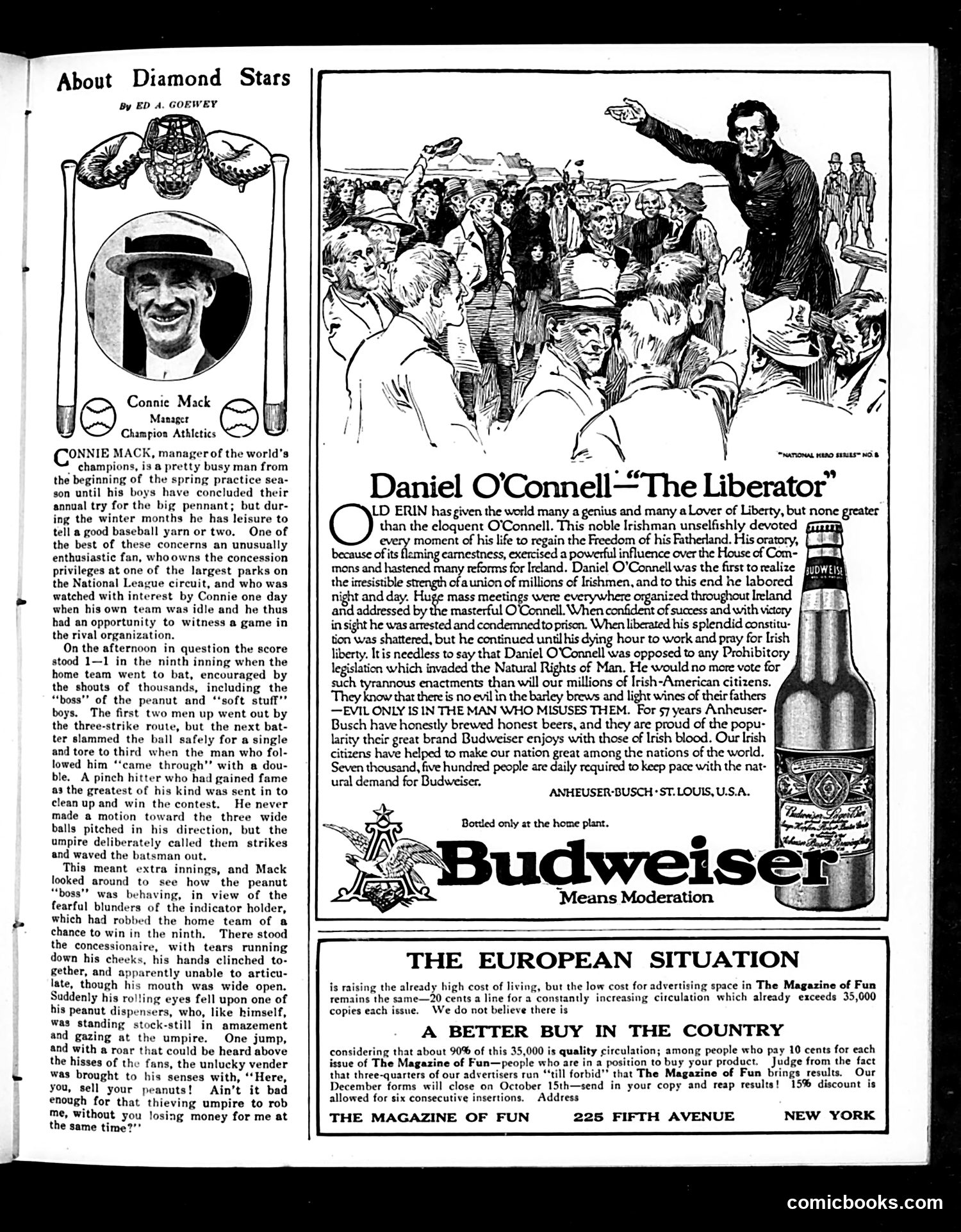
This page combines a baseball anecdote with Irish-American political messaging disguised as history. **"About Diamond Stars"** is a lighthearted story about baseball manager Connie Mack, featuring a peanut vendor so distracted by an umpire's bad call that he forgets to sell concessions—illustrating how emotion can override business sense. **The main content** is a Budweiser advertisement exploiting Daniel O'Connell (1775-1847), the famous Irish independence leader, to argue *against* Prohibition. The ad claims O'Connell opposed laws restricting "natural rights," therefore Irish-Americans should oppose Prohibition too. This conflates O'Connell's 19th-century fight for Irish freedom with 1920s American alcohol policy. The advertisement essentially uses O'Connell's legacy as propaganda, suggesting that supporting Prohibition betrays Irish heritage. This reflects the real political battle over Prohibition in America, where breweries (many German and Irish-owned) fiercely opposed it, and ethnic communities were targeted with such messaging.
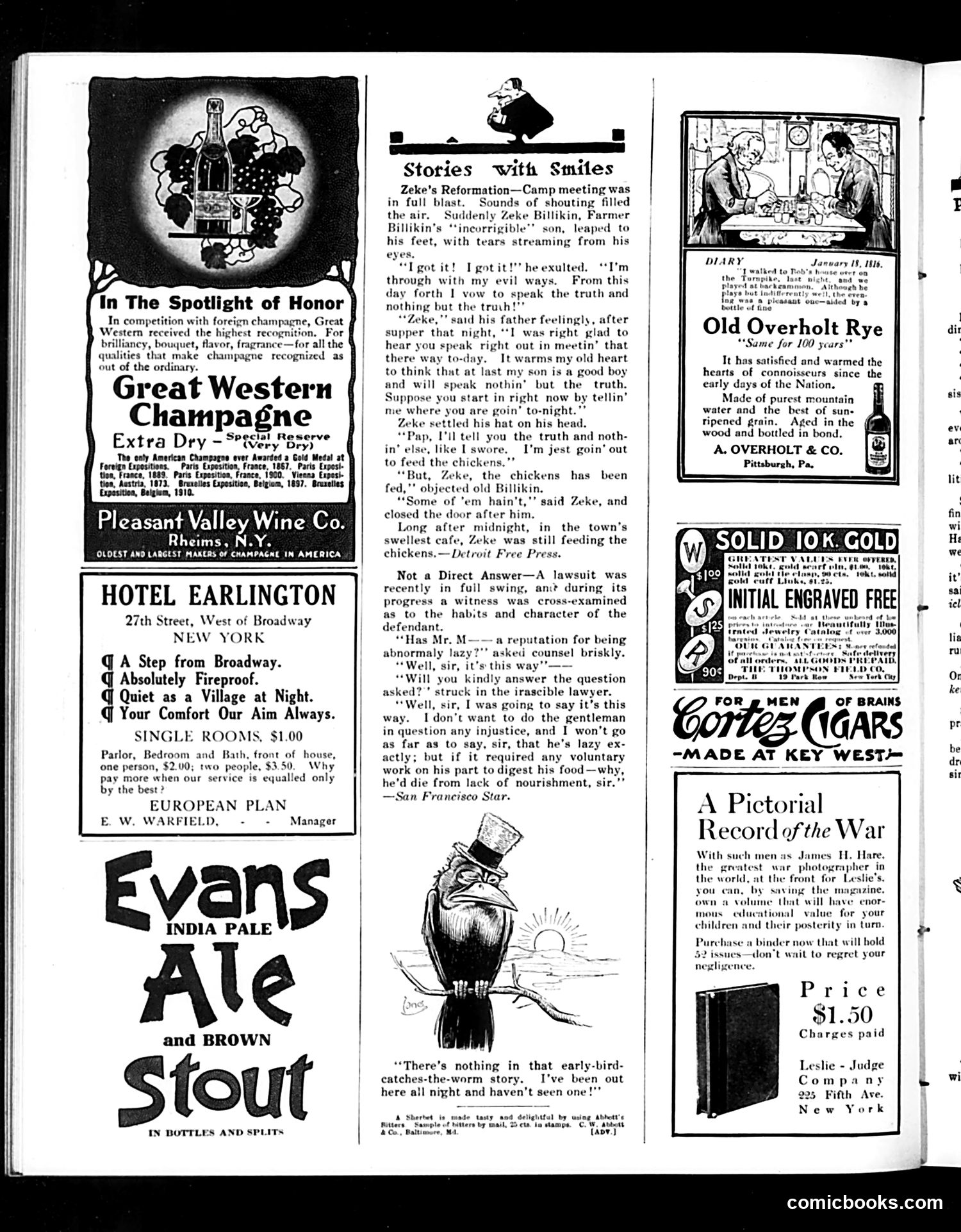
This page is primarily **advertisements** interspersed with humor pieces, typical of early 20th-century magazines. **The main humor pieces** are two brief anecdotes titled "Stories with Smiles": 1. **"Zeke's Reformation"** satirizes religious conversion hypocrisy. A farmer's son, Zeke, experiences a camp-meeting conversion and vows to speak only truth. When his father tests this immediately—asking where he's going—Zeke truthfully admits he's stealing chickens. The joke exposes how revival-meeting sincerity evaporates instantly when tested. 2. **"Not a Direct Answer"** presents a courtroom witness being cross-examined about a defendant's laziness. The witness frustratingly refuses to give a simple yes/no answer, instead offering rambling explanations. The lawyer demands directness, but the witness continues evasively. This mocks verbose, evasive courtroom testimony. Both pieces represent common Judge humor: satirizing human weakness (religious hypocrisy, lawyerly obstruction) through rural or everyday scenarios. The cartoons are period advertisements for champagne, hotels, ale, cigars, and WWI war records.
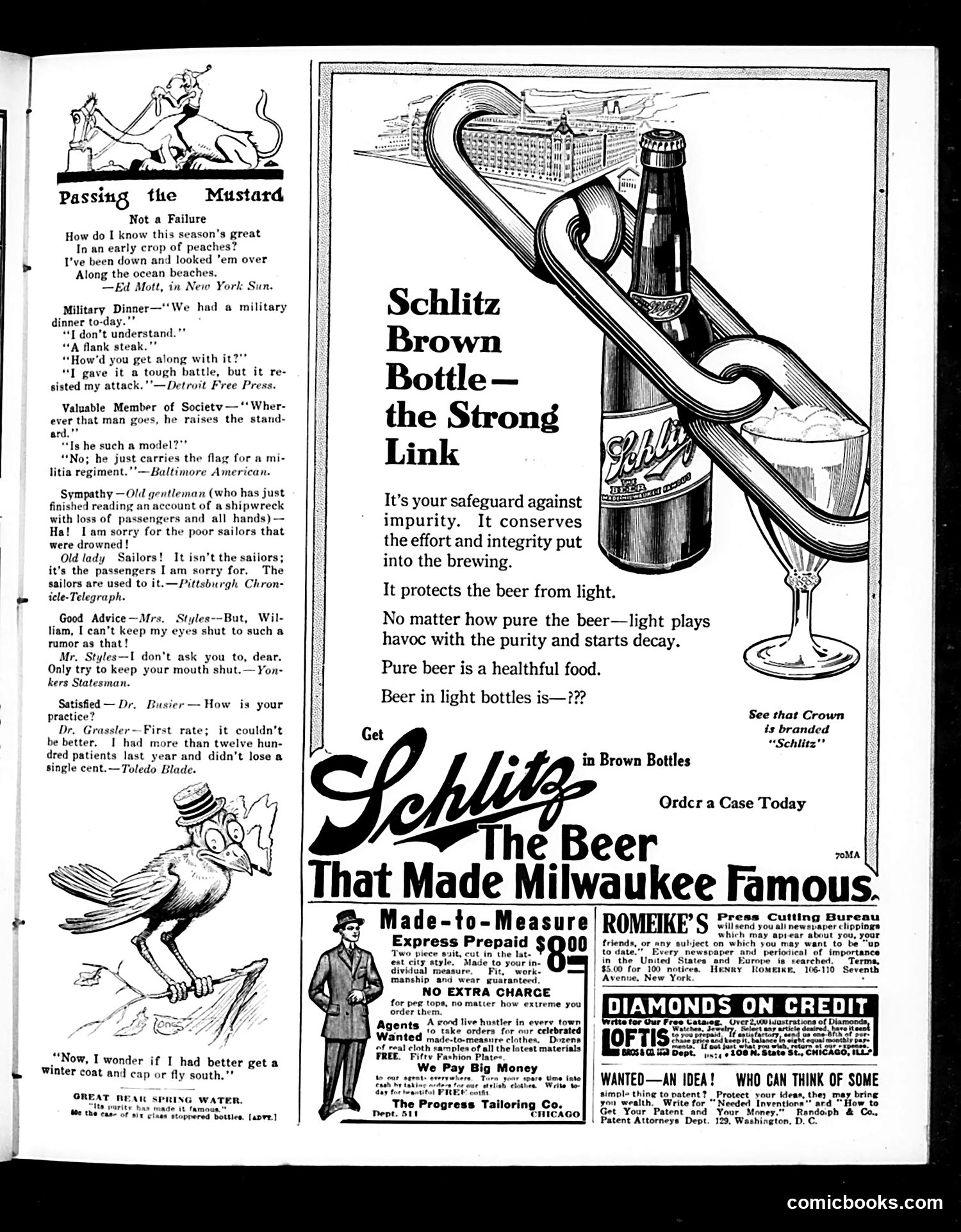
This page mixes **short humorous anecdotes** (left column) with **advertising** (right side and bottom). The anecdotes are light social humor: a man confused by military terminology ("flank steak"), someone who raises militia regiment flags being called "valuable," and a doctor pleased he lost no patients (implying they paid him regardless of outcome). The dominant content is a **Schlitz beer advertisement** promoting brown bottles as superior to clear/light ones because they protect beer from light degradation. This references a genuine brewing concern—UV light causes "skunky" flavor in beer—making brown bottles a practical selling point. The page also advertises **tailor-made clothing, press clipping services, and patent attorney services**, typical early 20th-century Judge magazine fare. **No political satire is evident here.** This appears to be a standard issue mixing light humor columns with commercial advertising, common in American satirical magazines of this era.
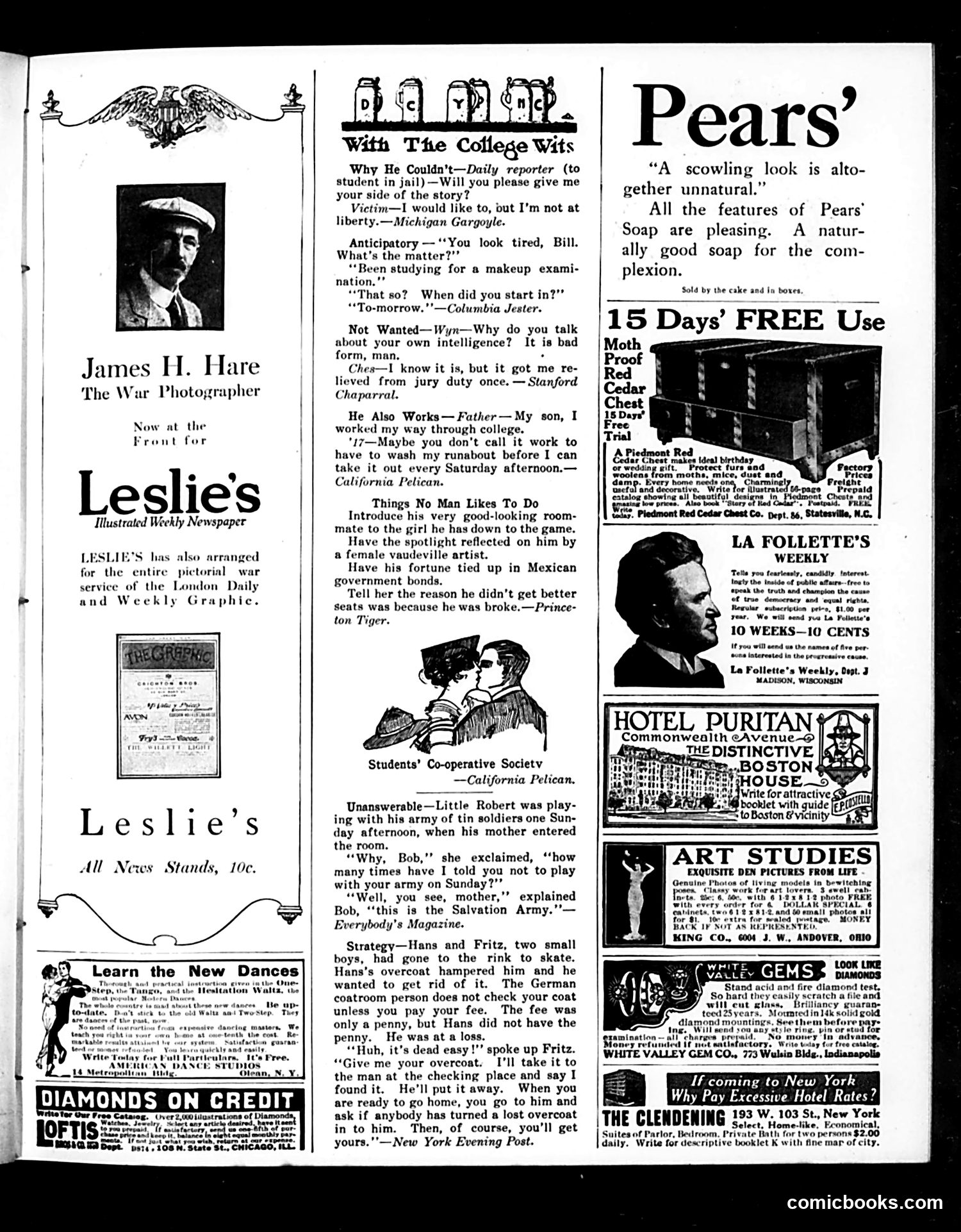
This page from *Judge* combines editorial content with period advertising. The main material consists of college humor reprints—jokes from university publications like *Michigan Gargoyle*, *Columbia Jester*, and *Stanford Chaparral*—poking fun at student life: procrastination, feigned intelligence to escape jury duty, wealthy students pretending to work their way through college, and romantic rivalries. One notable piece, "Strategy," depicts two boys (Hans and Fritz—German names reflecting WWI-era sensibilities) scheming to check an overcoat without paying by pretending to find it later, satirizing petty dishonesty. The advertisements reflect early 20th-century consumer goods: Pears' Soap, a Piedmont Red Cedar Chest, La Follette's Progressive Weekly magazine, and diamond rings sold on credit. These ads reveal contemporary commerce and values rather than satirical content. **Context for modern readers:** This represents how *Judge* mixed collegiate satire with consumer advertising—typical magazine structure of the era.
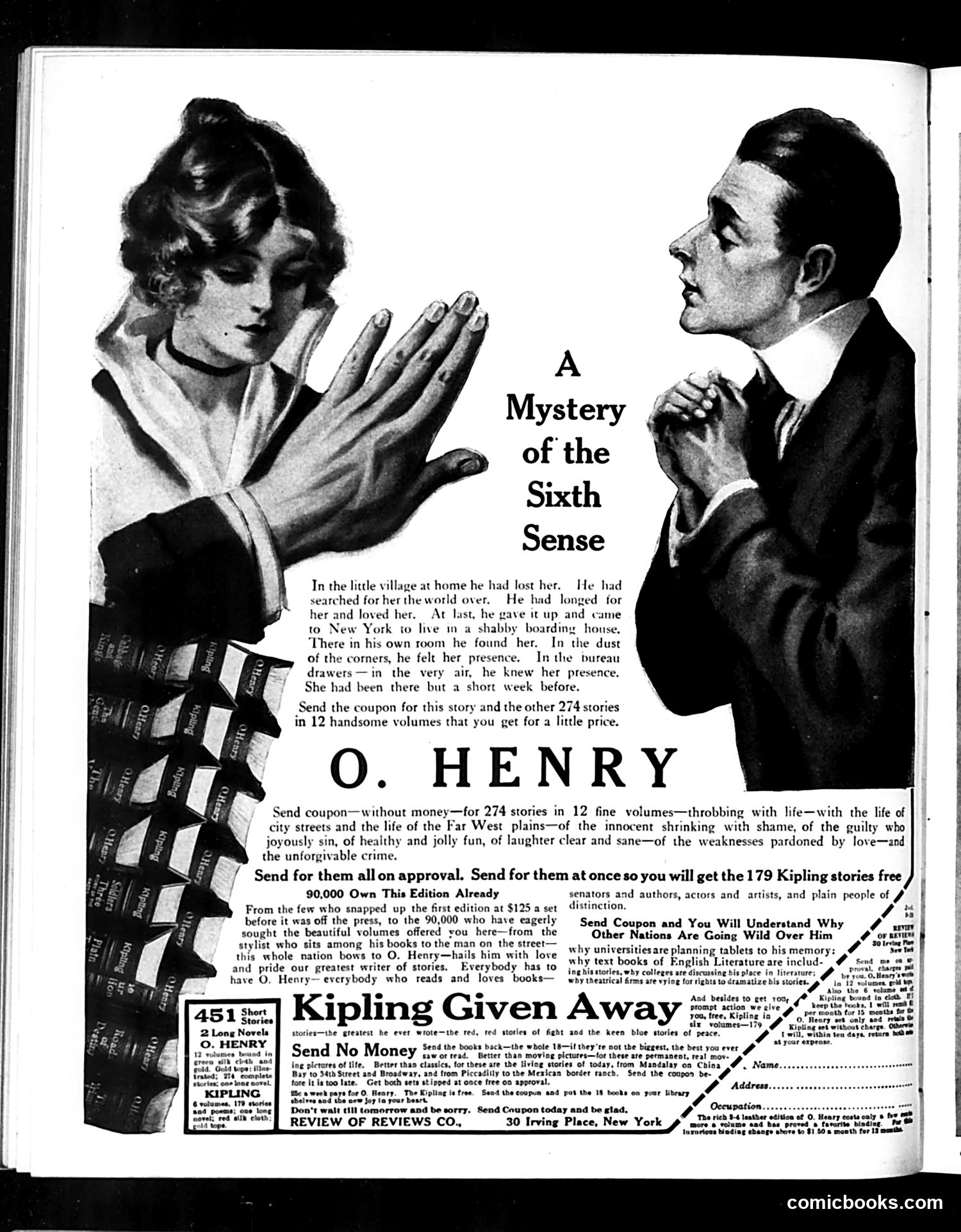
This is primarily a **book advertisement**, not satirical content. It promotes a mail-order collection of O. Henry's 274 short stories in 12 volumes, plus free Kipling stories as a bonus incentive. The illustration depicts a **romantic/supernatural narrative**: a man and woman separated by distance, with the woman appearing as a ghostly presence—he senses her in his boarding house room despite her physical absence. This illustrates O. Henry's thematic preoccupations with urban longing and emotional connection. The marketing emphasizes O. Henry's popularity (claiming 90,000 sets already sold) and his status as "our greatest writer of stories." It notes other nations' academic interest in his work and positions the volumes as prestigious cultural artifacts. The "send no money" offer—approval-based sales with free return—was a common early 20th-century direct-mail sales tactic to reduce purchase resistance.