
Judge, 1914-09-26 · page 16 of 24
Judge — September 26, 1914 — page 16: what you’re looking at
What you’re looking at
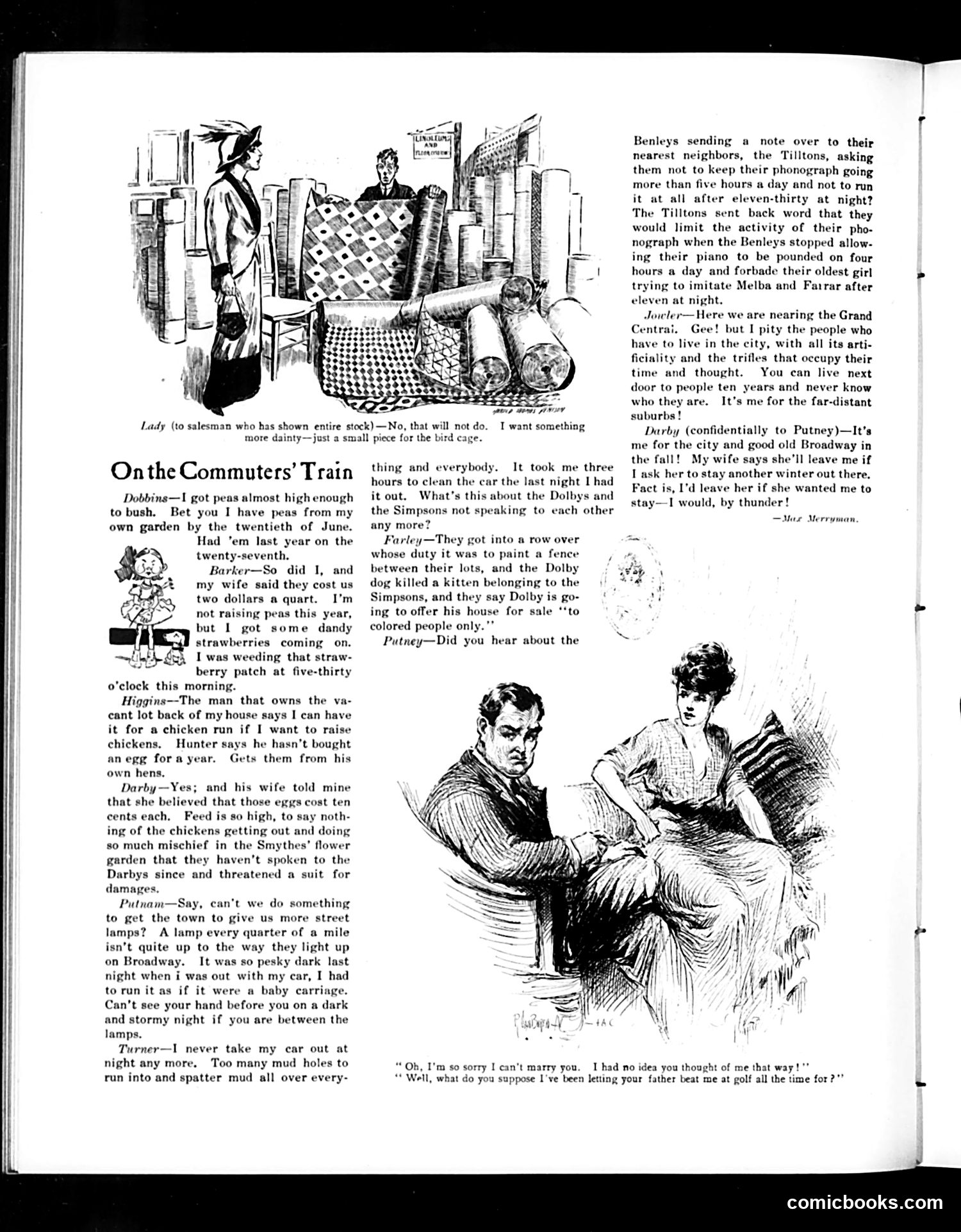
This page satirizes the petty complaints and social anxieties of suburban commuters in the early 20th century. A group of men on a train discuss their lives in what appears to be a newly developed suburb near a major city (Grand Central is mentioned). The satire targets their obsessions: homegrown vegetables and their costs, neighbor disputes over fences and property boundaries, a dog killing a kitten escalating into racial prejudice ("colored people only"), noise complaints about pianos and phonographs, and inadequate street lighting for automobiles. The final joke—a man tolerating golf losses from his girlfriend's father merely to access her—underscores how transactional and loveless these suburban relationships have become. Throughout, the commuters express contradictory desires: praising suburban life while simultaneously envying city living. The satire suggests suburbs attracted aspirational middle-class people preoccupied with status, property disputes, and social convention rather than genuine community or happiness.
📄 Transcribed text from this page (OCR, searchable)
Machine-transcribed from the original scan — historical spelling and the odd misread are preserved.
Lady (to salesman who has shown entire stock) —No, that will not do. T want something more dainty—just a small piece for the bird cage. On the Commuters’ Train Dobbins—I got peas almost high enough to bush. Bet you I have peas from my own garden by the twentieth of June. Had 'em last year on the » and my wife said they cost us two dollars a quart. I’m not raising peas this year, but I got some dandy strawberries coming on. I was weeding that straw- berry patch at five-thirty o'clock this morning. Higgins—The man that owns the va- cant lot back of my house says I can have it for a chicken run if I want to raise chickens. Hunter says he hasn't bought anegg fora year. Gets them from his own hens, Darby—Yes; and his wife told mine that she believed that those eggs cost ten cents each, Feed is so high, to say noth- ing of the chickens getting out and doing so much mischief in the Smythes’ flower garden that they haven't spoken to the Darbys since and threatened a suit for damages, Putnam—Say, can't we do something to get the town to give us more street lamps? A lamp every quarter of a mile isn’t quite up to the way they light up on Broadway. It was so pesky dark last night when i was out with my car, I had to run itas if it were a baby carriage. Can’t see your hand before you on a dark and stormy night if you are between the lamps. Turner—I never take my car out at night any more. Too many mud holes to run into and spatter mud all over every- thing and everybody. It took me three hours to clean the car the last night I had it out. What's this about the Dolbys and the Simpsons not speaking to each other any more? Farley—They got into a row over whose duty it was to paint a fence between their lots, and the Dolby dog killed a kitten belonging to the Simpsons, and they say Dolby is go- ing to offer his house for sale ‘‘to colored people only."’ Putney—Did you hear about the Benleys sending a note over to their nearest neighbors, the Tilltons, asking them not to keep their phonograph going more than five hours a day and not to run it at all after eleven-thirty at night? The Tilltons sent back word that they would limit the activity of their pho- nograph when the Benleys stopped allow- ing their piano to be pounded on four hours a day and forbade their oldest girl trying to imitate Melba and Farrar after eleven at night. Jowler—Here we are nearing the Grand Centrai. Gee! but I pity the people who have to live in the city, with all its arti- ficiality and the trifles that occupy their time and thought. You can live next door to people ten years and never know who they are. It’s me for the far-distant suburbs! Darby (confidentially to Putney)—It’s me for the city and good old Broadway in the fall! My wife says she’ll leave me if I ask her to stay another winter out there, Fact is, I'd leave her if she wanted me to stay—I would, by thunder! —Maz Merruman. “Oh, I'm so sorry I can't marry you. Thad no idea you thought of me that way!" “* Well, what do you suppose I've been letting your father beat me at golf all the time for?” comicbooks.com