
Judge, 1914-09-26 · page 13 of 24
Judge — September 26, 1914 — page 13: what you’re looking at
What you’re looking at
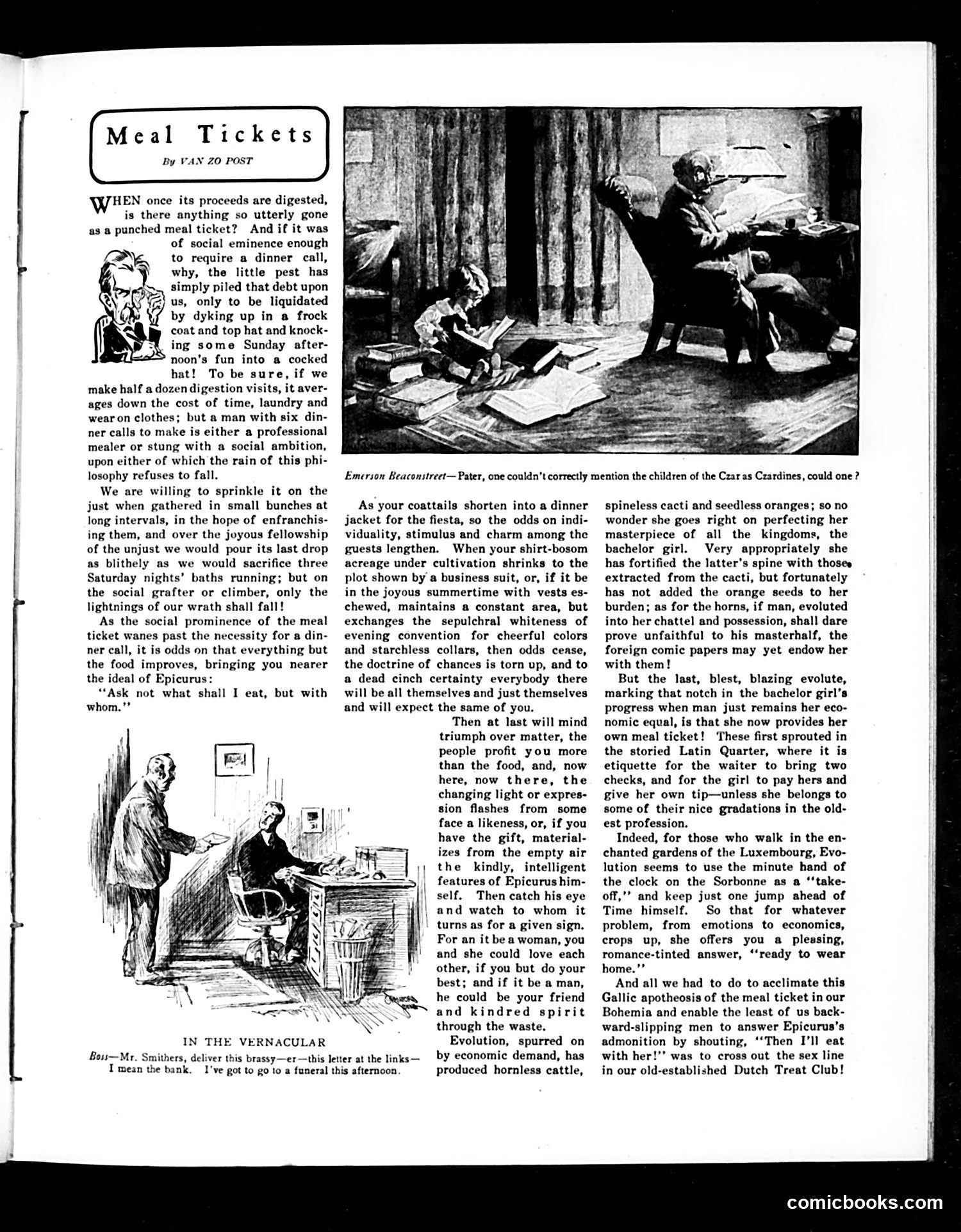
This piece by Van Zo Post satirizes the social convention of formal dinner invitations ("meal tickets") in early 20th-century society. The article mocks how accepting dinner invitations creates social debts and obligations—particularly for ambitious social climbers seeking status. The satire argues that formal dinners are burdensome: they require expensive clothing, create false social bonds, and obligate guests to reciprocate. The author's ideal, attributed to Epicurus, is eating with genuine companions rather than formal acquaintances. The cartoons illustrate social pretense: one shows someone shooting game (implying wealthy leisure), another depicts a gentleman presumably making an awkward social call. The "vernacular" joke at bottom references a man confusing a bank errand with a funeral—suggesting the tedium of obligatory social appearances. The final section celebrates the "bachelor girl" who now provides her own meals, achieving economic independence and escaping these social rituals—presented as progress in women's liberation through financial autonomy.
📄 Transcribed text from this page (OCR, searchable)
Machine-transcribed from the original scan — historical spelling and the odd misread are preserved.
Tickets By VAN ZO POST Meal HEN once its proceeds are digested, is there anything so utterly gone as a punched meal ticket? And if it was of social eminence enough ZH to require a dinner call, ~ why, the little pest has ., simply piled that debt upon § ‘A us, only to be liquidated Y by dyking up in a frock coat and top hat and knock- ing some Sunday after- noon’s fun into a cocked hat! To be sure, if we make half a dozen digestion visits, it aver- ages down the cost of time, laundry and wearon clothes; but a man with six din- ner calls to make is either a professional mealer or stung with a social ambition, upon either of which the rain of this phi- losophy refuses to fall. We are willing to sprinkle it on the just when gathered in small bunches at long intervals, in the hope of enfranchis- ing them, and over the joyous fellowship of the unjust we would pour its last drop as blithely as we would sacrifice three Saturday nights’ baths running; but on the social grafter or climber, only the lightnings of our wrath shall fall! As the social prominence of the meal ticket wanes past the necessity for a din- ner call, it is odds on that everything but the food improves, bringing you nearer the ideal of Epicurus: “Ask not what shall I eat, but with whom.’’ IN THE VERNACULAR Bois—Mr. Smithers, deliver this brassy—er—this letter at the links— Imean the bank. I've got to go to a funeral this afternoon. Emerson Beaconstreet— Pater, one couldn't correctly mention the children of the Czar as Czardines, could one ? As your coattails shorten into a dinner jacket for the fiesta, so the odds on indi- viduality, stimulus and charm among the guests lengthen. When your shirt-bosom acreage under cultivation shrinks to the plot shown by a business suit, or, if it be in the joyous summertime with vests es- chewed, maintains a constant area, but exchanges the sepulchral whiteness of evening convention for cheerful colors and starchless collars, then odds cease, the doctrine of chances is torn up, and to a dead cinch certainty everybody there will be all themselves and just themselves and will expect the same of you. Then at last will mind triumph over matter, the people profit you more than the food, and, now here, now there, the changing light or expres- sion flashes from some face a likeness, or, if you have the gift, material- izes from the empty air the kindly, intelligent features of Epicurus him- | self. Then catch his eye ‘ and watch to whom it turns as for a given sign. For an it be a woman, you and she could love each other, if you but do your best; and if it be a man, he could be your friend and kindred spirit through the waste. Evolution, spurred on by economic demand, has produced hornless cattle, spineless cacti and seedless oranges; so no wonder she goes right on perfecting her masterpiece of all the kingdoms, the bachelor girl. Very appropriately she has fortified the latter’s spine with thosee extracted from the cacti, but fortunately has not added the orange seeds to her burden; as for the horns, if man, evoluted into her chattel and possession, shall dare prove unfaithful to his masterhalf, the foreign comic papers may yet endow her with them! But the last, blest, blazing evolute, marking that notch in the bachelor girl’s progress when man just remains her eco- nomic equal, is that she now provides her own meal ticket! These first sprouted in the storied Latin Quarter, where it is etiquette for the waiter to bring two checks, and for the girl to pay hers and give her own tip—unless she belongs to some of their nice gradations in the old- est profession. Indeed, for those who walk in the en- chanted gardens of the Luxembourg, Evo- lution seems to use the minute hand of the clock on the Sorbonne as a ‘‘take- off,’’ and keep just one jump ahead of Time himself. So that for whatever problem, from emotions to economics, crops up, she offers you a pleasing, romance-tinted answer, ‘‘ready to wear home.’ And all we had to do to acclimate this Gallic apotheosis of the meal ticket in our Bohemia and enable the least of us back- ward-slipping men to answer Epicurus’s admonition by shouting, ‘‘Then I'll eat with her!’’ was to cross out the sex line in our old-established Dutch Treat Club! comicbooks.com