
Judge, 1914-09-26 · page 10 of 24
Judge — September 26, 1914 — page 10: what you’re looking at
What you’re looking at
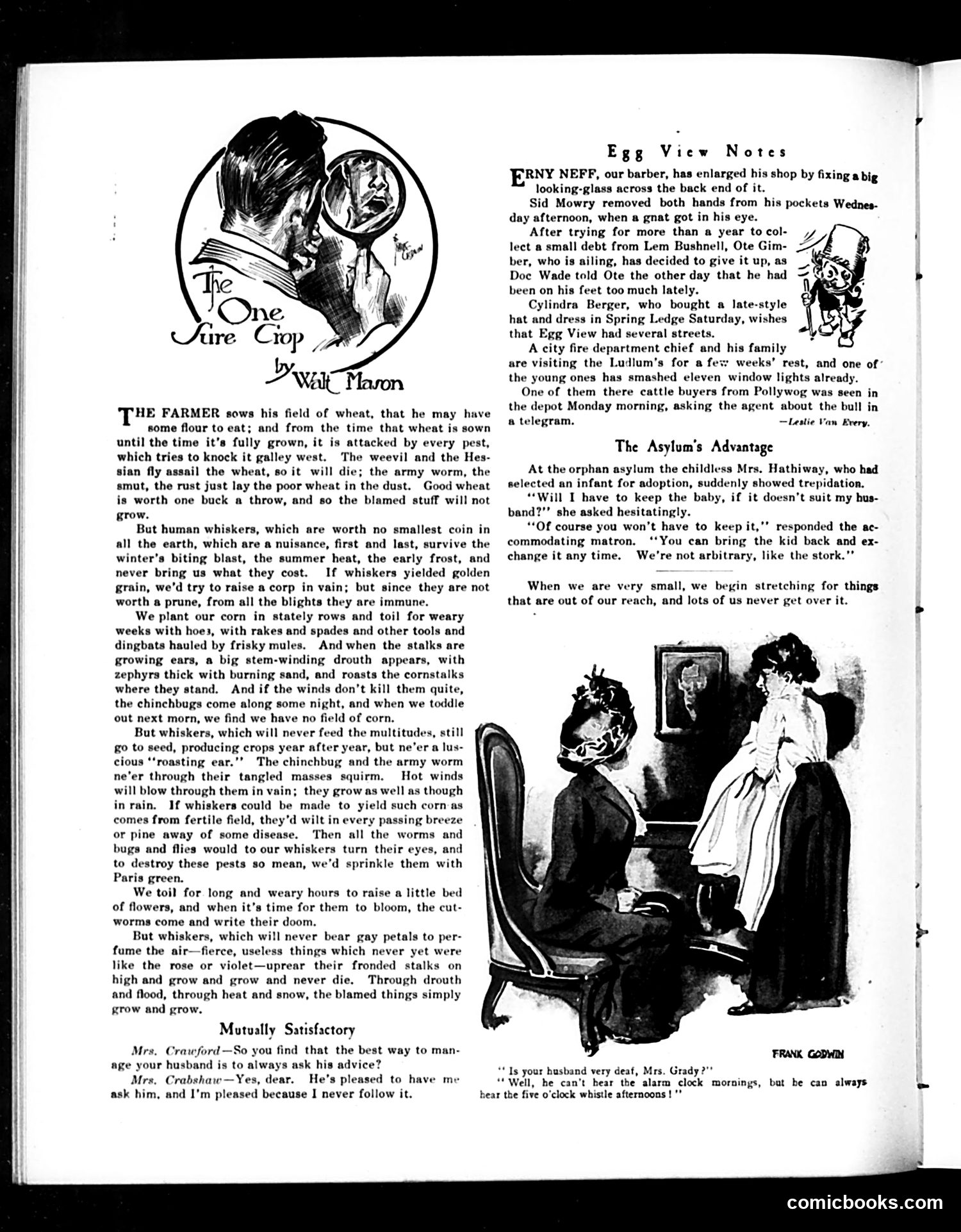
This humorous poem contrasts the farmer's struggle with cultivated crops—constantly attacked by weevils, Hessian flies, army worms, and drought—against the effortless, unstoppable growth of human facial hair (whiskers). The satire's point: worthless whiskers thrive despite all conditions, while valuable wheat and corn are perpetually destroyed by pests and weather. The joke relies on exaggeration and irony—the one "crop" worth nothing grows reliably, while those requiring tremendous labor yield nothing. The page also includes "Egg View Notes" (rural gossip items) and "The Asylum's Advantage" (a brief joke about adoption), plus a domestic cartoon about marital advice. These represent typical Judge magazine content: rural humor, satirical commentary on farming life, and light social comedy reflecting early 20th-century American concerns.
📄 Transcribed text from this page (OCR, searchable)
Machine-transcribed from the original scan — historical spelling and the odd misread are preserved.
“a Aire Ciop THE FARMER sows his field of wheat, that he may have some flour to eat; and from the time that wheat is sown until the time it’s fully grown, it is attacked by every pest, which tries to knock it galley west. The weevil and the Hes- sian fly assail the wheat, so it will die; the army worm, the smut, the rust just lay the poor wheat in the dust. Good wheat is worth one buck a throw, and so the blamed stuff will not grow. But human whiskers, which are worth no smallest coin in all the earth, which are a nuisance, first and last, survive the winter's biting blast, the summer heat, the early frost, and never bring us what they cost. If whiskers yielded golden grain, we'd try to raise a corp in vain; but since they are not worth a prune, from all the blights they are immune. We plant our corn in stately rows and toil for weary weeks with hoes, with rakes and spades and other tools and dingbats hauled by frisky mules. And when the stalks are growing ears, a big stem-winding drouth appears, with zephyrs thick with burning sand, and roasts the cornstalks where they stand. And if the winds don’t kill them quite, the chinchbugs come along some night, and when we toddle out next morn, we find we have no field of corn. But whiskers, which will never feed the multitudes, still go to seed, producing crops year after year, but ne’er a lus- cious ‘roasting ear.’ The chinchbug and the army worm ne'er through their tangled masses squirm. Hot winds will blow through them in vain; they grow as well as though in rain. If whiskers could be made to yield such corn as | comes from fertile field, they’d wilt in every passing breeze } or pine away of some disease. Then all the worms and } bugs and flies would to our whiskers turn their eyes, and I to destroy these pests so mean, we'd sprinkle them with Paris green. We toil for long and weary hours to raise a little bed f of flowers, and when it’s time for them to bloom, the cut- | worms come and write their doom. But whiskers, which will never bear gay petals to per- fume the air—fierce, useless things which never yet were like the rose or violet-—uprear their fronded stalks on high and grow and grow and never die. Through drouth and flood, through heat and snow, the blamed things simply grow and grow. Mutually Satisfactory Mrs. Crawford—So you find that the best way to man- age your husband is to always ask his advice? Mrs, Crabshaw—Yes, dear. He's pleased to have me Egg View Notes ERNY NEFF, our barber, has enlarged his shop by fixing abig looking-glass across the back end of it. Sid Mowry removed both hands from his pockets Wednes- day afternoon, when a gnat got in his eye. After trying for more than a year to col- lect a small debt from Lem Bushnell, Ote Gim- ber, who is ailing, has decided to give it up, as Doc Wade told Ote the other day that he had been on his feet too much lately. Cylindra Berger, who bought a late-style hat and dress in Spring Ledge Saturday, wishes that Egg View had several streets. A city fire department chief and his family are visiting the Ludlum's for a few weeks’ rest, and one of’ the young ones has smashed eleven window lights already. One of them there cattle buyers from Pollywog was seen in the depot Monday morning, asking the agent about the bull in a telegram. —Lealie Van Every. The Asylum’s Advantage At the orphan asylum the childless Mrs. Hathiway, who had selected an infant for adoption, suddenly showed trepidation. “Will I have to keep the baby, if it doesn’t suit my bus- band?’’ she asked hesitatingly. “Of course you won't have to keep it,’’ responded the ac- commodating matron. ‘‘You can bring the kid back and ex- change it any time. We're not arbitrary, like the stork." When we are very small, we begin stretching for things that are out of our reach, and lots of us never get over it. FRANK GODWIN “Is your husband very deaf, Mrs. Grady ?"* 7 ) “* Well, he can't hear the alarm clock mornings, but be can always + ask him, and I'm pleased because I never follow it. hear the five o'clock whistle afternoons ! '" comicbooks.com