
Judge, 1914-09-26 · page 4 of 24
Judge — September 26, 1914 — page 4: what you’re looking at
What you’re looking at
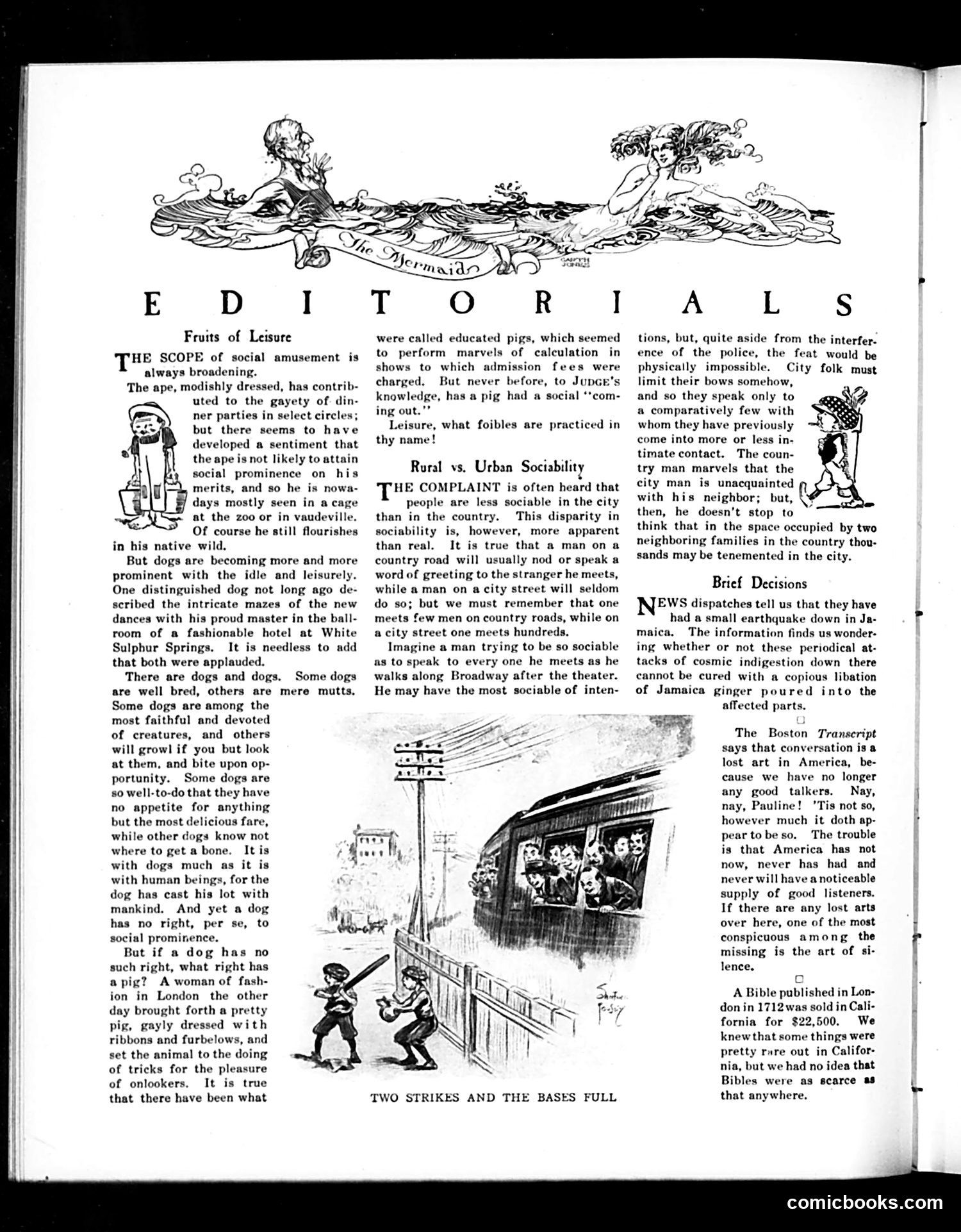
This page contains editorial commentary on social topics rather than political cartoons. The main articles discuss: 1. **"Fruits of Leisure"** — critiques upper-class amusement, mentioning "educated pigs" performing at admission-fee shows, apparently satirizing frivolous entertainment for the wealthy. 2. **"Rural vs. Urban Sociability"** — compares country and city social behavior, noting rural people are less talkative with strangers while city dwellers are more interactive. The piece questions whether urbanites are genuinely more social or simply encounter more people. 3. **"Brief Decisions"** — short news commentary on topics including an earthquake in Japan, conversation as a lost American art, and a 1712 Bible sale in California. The illustration "Two Strikes and the Bases Full" depicts a baseball scene, likely reflecting the sport's popularity during this period.
📄 Transcribed text from this page (OCR, searchable)
Machine-transcribed from the original scan — historical spelling and the odd misread are preserved.
Fruits of Leisure HE SCOPE of social amusement is always broadening. The ape, modishly dressed, has contrib- uted to the gayety of di ner parties in select cire but there seems to have developed a sentiment that the ape is not likely to attain social prominence on his merits, and so he is nowa- days mostly seen in a cage at the zoo or in vaudeville. Of course he still flourishes in his native wild. But dogs are becoming more and more prominent h the idle and leisurely. One distinguished dog not long ago de- scribed the intricate mazes of the new dances with his proud master in the ball- room of a fashionable hotel at White Sulphur Springs. It is needless to add that both were applauded. There are dogs and dogs. Some dogs are well bred, others are mere mutts, Some dogs are among the most faithful and devoted of creatures, and others will growl if you but look at them, and bite upon op- portunity. Some dogs are so well-to-do that they have no appetite for anything but the most delicious fare, while other dogs know not where to get a bone. It is with dogs much as it is with human beings, for the dog has cast his lot with mankind. And yet a dog has no right, per se, to social prominence. But if a dog has no such right, what right has a pig? A woman of fash- ion in London the other day brought forth a pretty pig, gayly dressed with ribbons and furbelows, and set the animal to the doing of tricks for the pleasure of onlookers. It is true that there have been what TWO STRIKES AND THE BASES FULL were called educated pigs, which seemed to perform marvels of calculation in shows to which admission fees were charged. But never before, to Jupce's knowledge, has a pig had a social ‘*com- ing out.” Leisure, what foibles are practiced in thy name! Rural vs. Urban Soctability THE COMPLAINT is often heard that people are less sociable in the city than in the country. This disparity in sociability is, however, more apparent than real. It is true that a man on a country road will usually nod or speak a word of greeting to the stranger he meets, while a man on a city street will seldom do so; but we must remember that one meets few men on country roads, while on acity street one meets hundreds. Imagine a man trying to be so sociable as to speak to every one he meets as he walks along Broadway after the theater. He may have the most sociable of inten- tions, but, quite aside from the interfer- ence of the police, the feat would be physically impossible. City folk must limit their bows somehow, and so they speak only to a comparatively few with whom they have previously come into more or less in- timate contact. The coun- try man marvels that the city man is unacquainted with his neighbor; but, then, he doesn’t stop to think that in the space occupied by two neighboring families in the country thou- sands may be tenemented in the city. Brief Decisions NEws dispatches tell us that they have had a small earthquake down in Ja- maica, The information finds us wonder- ing whether or not these periodical at- tacks of cosmic indigestion down there cannot be cured with a copious libation of Jamaica ginger poured into the affected parts. The Boston Transcript a says that conversation is a lost art in America, be- cause we have no longer any good talkers. Nay, nay, Pauline! ‘Tis not so, however much it doth ap- pear to be so. The trouble is that America has not now, never has had and never will have a noticeable supply of good listeners. If there are any lost arts over here, one of the most conspicuous among the missing is the art of si- lence. a A Bible published in Lon- don in 1712was sold in Cali- fornia for $22,500. We knew that some things were pretty rare out in Califor- nia, but we had no idea that Bibles were as scarce a8 that anywhere. w = gee comicbooks.com