
Judge, 1914-09-26 · page 18 of 24
Judge — September 26, 1914 — page 18: what you’re looking at
What you’re looking at
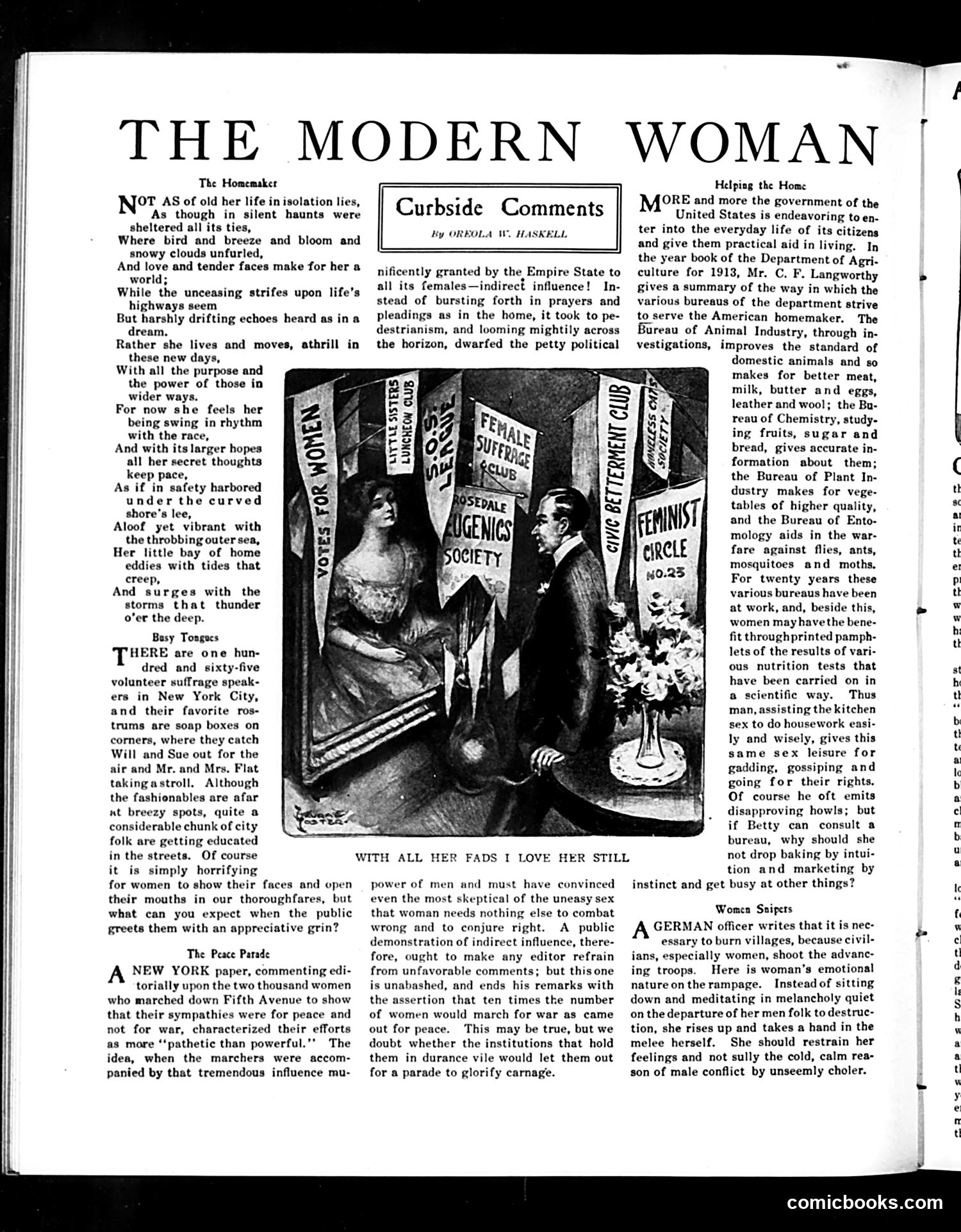
This page satirizes the women's suffrage and peace movements of the early 1910s. The central cartoon depicts a woman at a suffrage rally surrounded by signs reading "Female Suffrage," "Eugenics Society," and "Feminist Circle No. 25"—representing the various reform causes women were championing beyond traditional domesticity. The accompanying commentary is **sarcastically sympathetic**. The editor mocks a newspaper that dismissed a women's peace march as "pathetic" rather than "powerful," while also ridiculing the notion that women possessed only "indirect influence" through the home. The satire cuts both ways: the piece critiques male condescension toward female activism while also gently mocking women for needing government validation and scientific "proof" (via agricultural bureaus) to manage basic homemaking. The overall message appears to be: women are increasingly visible in public life and activism, which mainstream society finds simultaneously threatening and ridiculous.
📄 Transcribed text from this page (OCR, searchable)
Machine-transcribed from the original scan — historical spelling and the odd misread are preserved.
The Homemaker OT AS of old her life in isolation lies, As though in silent haunts were sheltered all its ties, Where bird and breeze and bloom and snowy clouds unfurled, And love and tender faces make for her a world; While the unceasing strifes upon life’s highways seem But harshly drifting echoes heard as ina dream. Rather she lives and moves, athrill in these new days, With all the purpose and the power of those in wider ways. For now she feels her being swing in rhythm with the race, And with its larger hopes all her secret thoughts keep pace, As if in safety harbored under the curved shore’s lee, Aloof yet vibrant with the throbbing outer sea, Her little bay of home eddies with tides that creep, And surges with the storms that thunder o’er the deep. Busy Tongues HERE are one hun- dred and sixty-five volunteer suffrage speak- ers in New York City, and their favorite ros- trums are soap boxes on corners, where they catch Will and Sue out for the air and Mr. and Mrs, Flat takingastroll. Although the fashionables are afar nt breezy spots, quite a considerable chunk of city folk are getting educated in the streets. Of course it is simply horrifying for women to show their faces and open their mouths in our thoroughfares, but what can you expect when the public greets them with an appreciative grin? The Peace Parade NEW YORK paper, commenting edi- torially upon the two thousand women who marched down Fifth Avenue to show that their sympathies were for peace and not for war, characterized their efforts as more ‘‘pathetic than powerful.’’ The idea, when the marchers were accom- panied by that tremendous influence mu- Curbside Comments Ky OREOLA W. HASKELL nificently granted by the Empire State to all its females—indirect influence! In- stead of bursting forth in prayers and pleadings as in the home, it took to pe- destrianism, and looming mightily across the horizon, dwarfed the petty political WITH ALL HER FADS I LOVE HER STILL power of men and must have convinced even the most skeptical of the uneasy sex that woman needs nothing else to combat wrong and to conjure right. A public demonstration of indirect influence, there- fore, ought to make any editor refrain from unfavorable comments; but thisone is unabashed, and ends his remarks with the assertion that ten times the number of women would march for war as came out for peace. This may be true, but we doubt whether the institutions that hold them in durance vile would let them out for a parade to glorify carnage. THE MODERN WOMAN J Helping the Home MORE and more the government of the United States is endeavoring to en- ter into the everyday life of its citizens and give them practical aid in living. In the year book of the Department of Agri- culture for 1913, Mr. C. F. Langworthy gives a summary of the way in which the various bureaus of the department strive to serve the American homemaker. The Bureau of Animal Industry, through in- vestigations, improves the standard of domestic animals and so makes for better meat, milk, butter and eggs, leather and wool; the Bu- reau of Chemistry, study- ing frui sugar and bread, gives accurate in- formation about them; the Bureau of Plant In- dustry makes for vege- tables of higher quality, and the Bureau of Ento- mology aids in the war- fare against flies, ants, mosquitoes and moths. For twenty years these various bureaus have been at work, and, beside this, women may have the bene- fit throughprinted pamph- lets of the results of vari- ous nutrition tests that have been carried on in a scientific way. Thus man, assisting the kitchen sex to do housework easi- ly and wisely, gives this same sex leisure for gadding, gossiping and going for their rights. Of course he oft emits disapproving howls; but if Betty can consult a bureau, why should she not drop baking by intui- tion and marketing by instinct and get busy at other things? HOMELESS CH; SOCUTY ®. Women Snipers GERMAN officer writes that it is nec- essary to burn villages, because c’ ians, especially women, shoot the advanc- ing troops. Here is woman's emotional nature onthe rampage. Instead of sitting down and meditating in melancholy quiet on the departure of her men folk to destruc- tion, she rises up and takes a hand in the melee herself. She should restrain her feelings and not sully the cold, calm rea- son of male conflict by unseemly choler. comicbooks.com ow eee were ea