
A complete issue · 24 pages · 1914
Judge — September 12, 1914
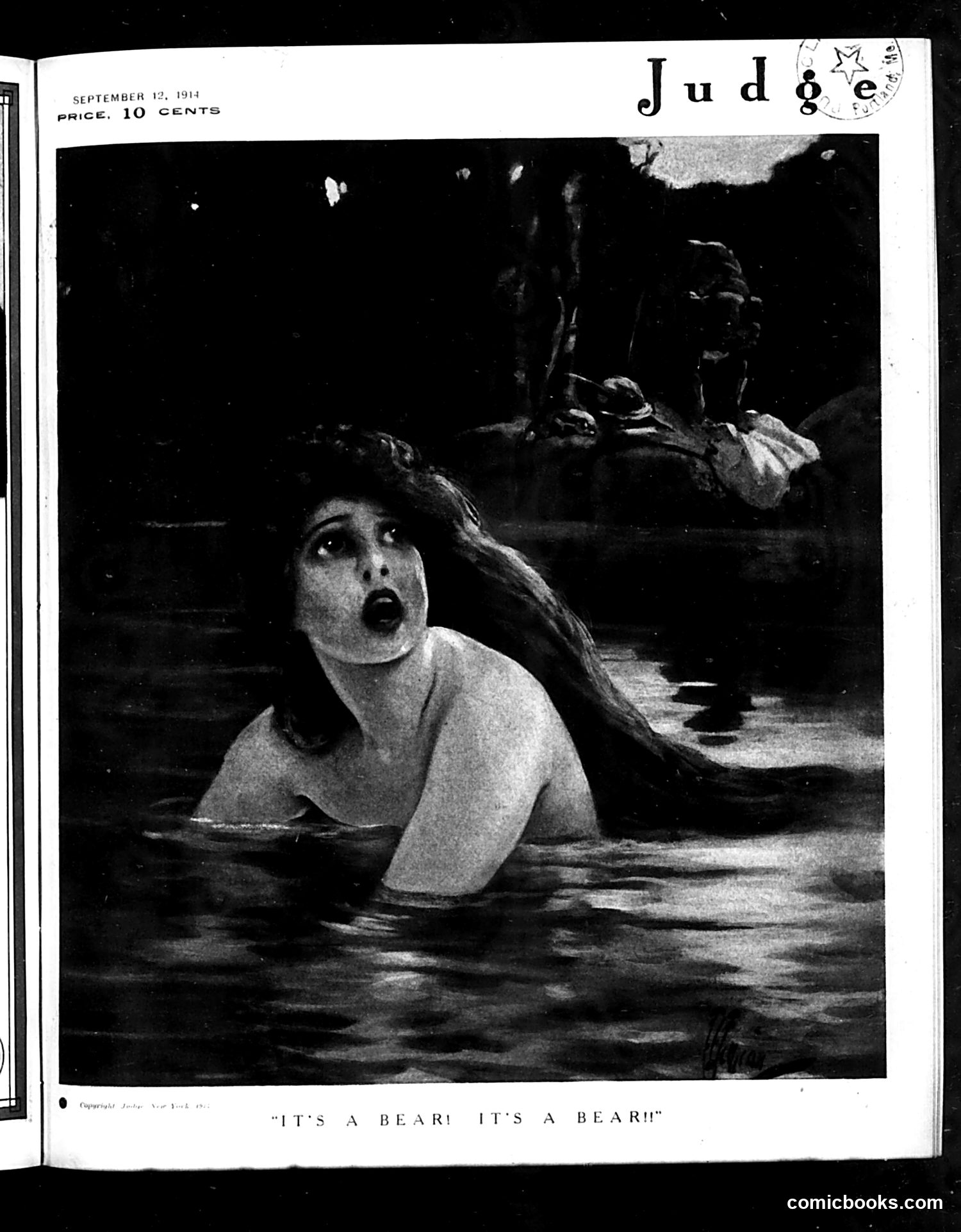
This page shows a dramatic scene captioned "IT'S A BEAR! IT'S A BEAR!" The image depicts a woman in water, appearing terrified and looking upward with an expression of alarm. The caption likely refers to a financial/stock market "bear"—a common metaphor in early 20th-century publications for market downturns or financial loss. However, without additional context or visible figures, the specific satirical target remains unclear. It could reference anxieties about economic conditions in 1914, or possibly a particular financial scandal or market event from that period. The dramatic, theatrical composition suggests this is satirizing public panic or investor fear rather than depicting an actual animal threat.
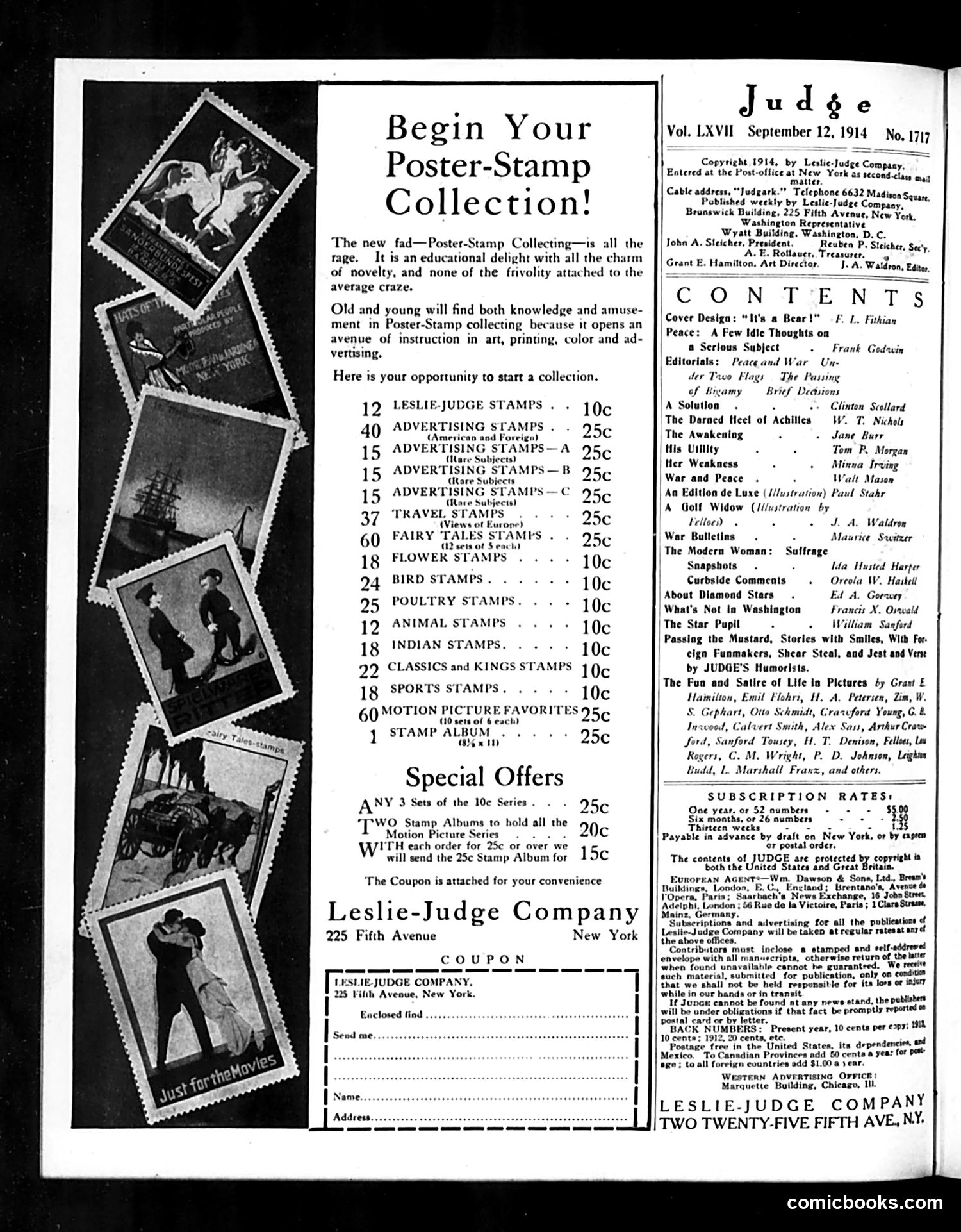
This page is primarily **advertising**, not political satire. It promotes Leslie-Judge Company's postal stamp collecting products—a popular early 20th-century hobby. The left side displays sample stamps arranged vertically, showing the variety available: Leslie-Judge Stamps (12 for 10¢), Advertising Stamps (40 for 25¢), Travel Stamps, Fairy Tales Stamps, Flower Stamps, and others. The center advertises the stamp-collecting craze as "educational" and suitable for "old and young," emphasizing instruction in art, printing, color, and advertising. The coupon at bottom allows customers to order collections. This represents a commercial opportunity capitalizing on the contemporary collecting fad rather than political commentary. The magazine content itself appears standard editorial material about war, politics, and social topics typical of 1914.
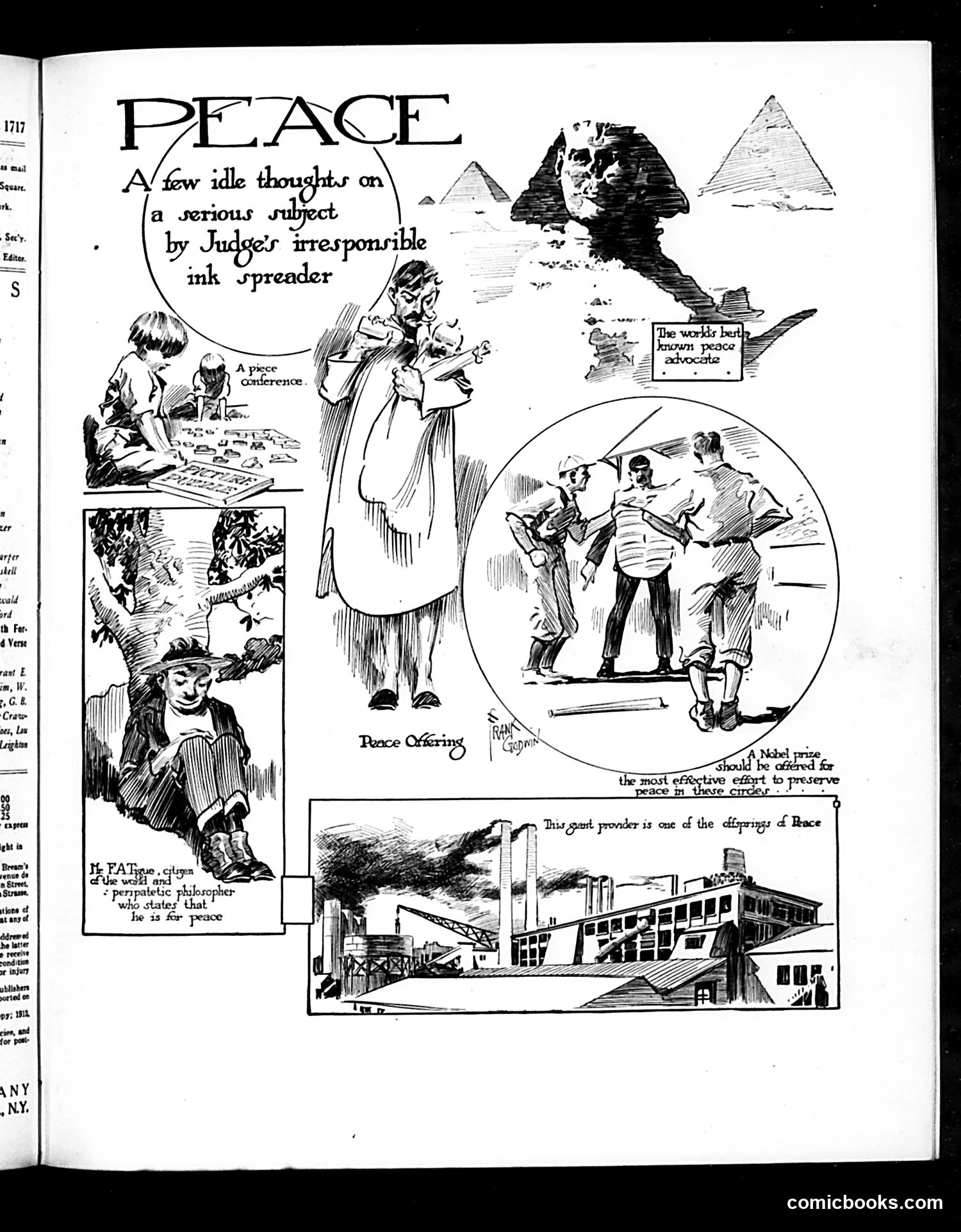
This satirical cartoon critiques peace efforts through multiple panels. The subtitle describes it as "A few idle thoughts on a serious subject by Judge's irresponsible ink spreader." The central figure ("Peace Offering") appears to be a caricatured politician or diplomat attempting to broker peace. The surrounding vignettes mock various peace initiatives: - Upper left shows diplomats at a conference table - Lower left depicts a ragged figure representing "HATE," suggesting hatred persists despite peace efforts - The circular panel shows officials shaking hands while conflict continues - The bottom panel shows an industrial factory, implying war profiteering undermines genuine peace The satire suggests that peace conferences and diplomatic gestures are performative, while underlying economic interests and human hatred make lasting peace impossible. The magazine questions whether sincere peace-making is genuinely possible.
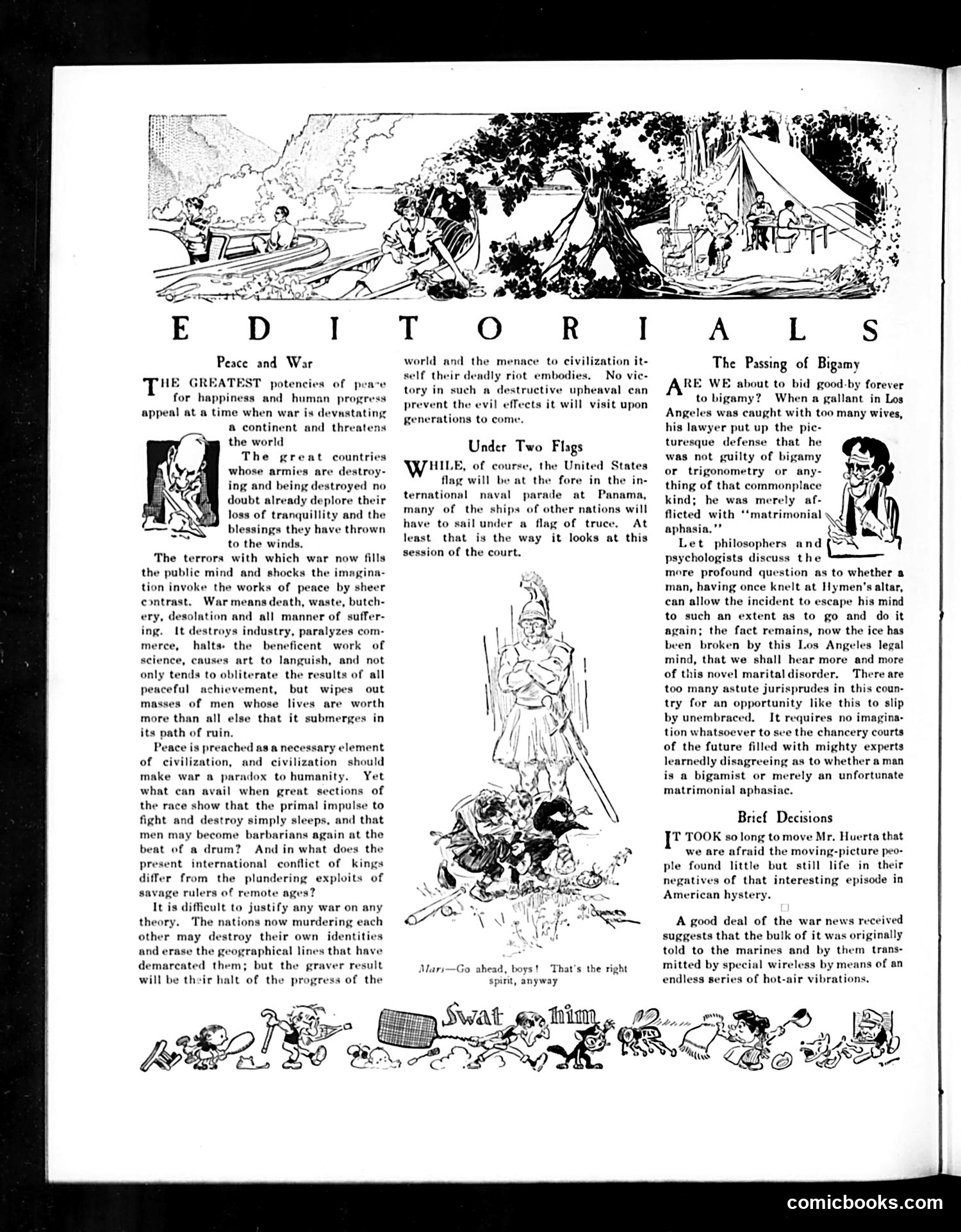
This page contains three distinct editorial pieces critiquing early 20th-century social and legal issues: **"Peace and War"** argues that despite war's devastation, nations continue destructing themselves, undermining civilization's progress. **"Under Two Flags"** discusses the upcoming Panama Canal naval parade, noting various nations' ships will participate under truce flags rather than national flags—a diplomatic arrangement. **"The Passing of Bigamy"** satirizes a Los Angeles court case where a man's bigamy conviction was overturned on technical grounds. The author questions whether legal loopholes should allow such escapes from moral accountability, suggesting future courts will better address marital misconduct. The illustration labeled "Mars—Go ahead, boys!" depicts a skeleton figure encouraging warfare, visually reinforcing the peace-versus-war theme.
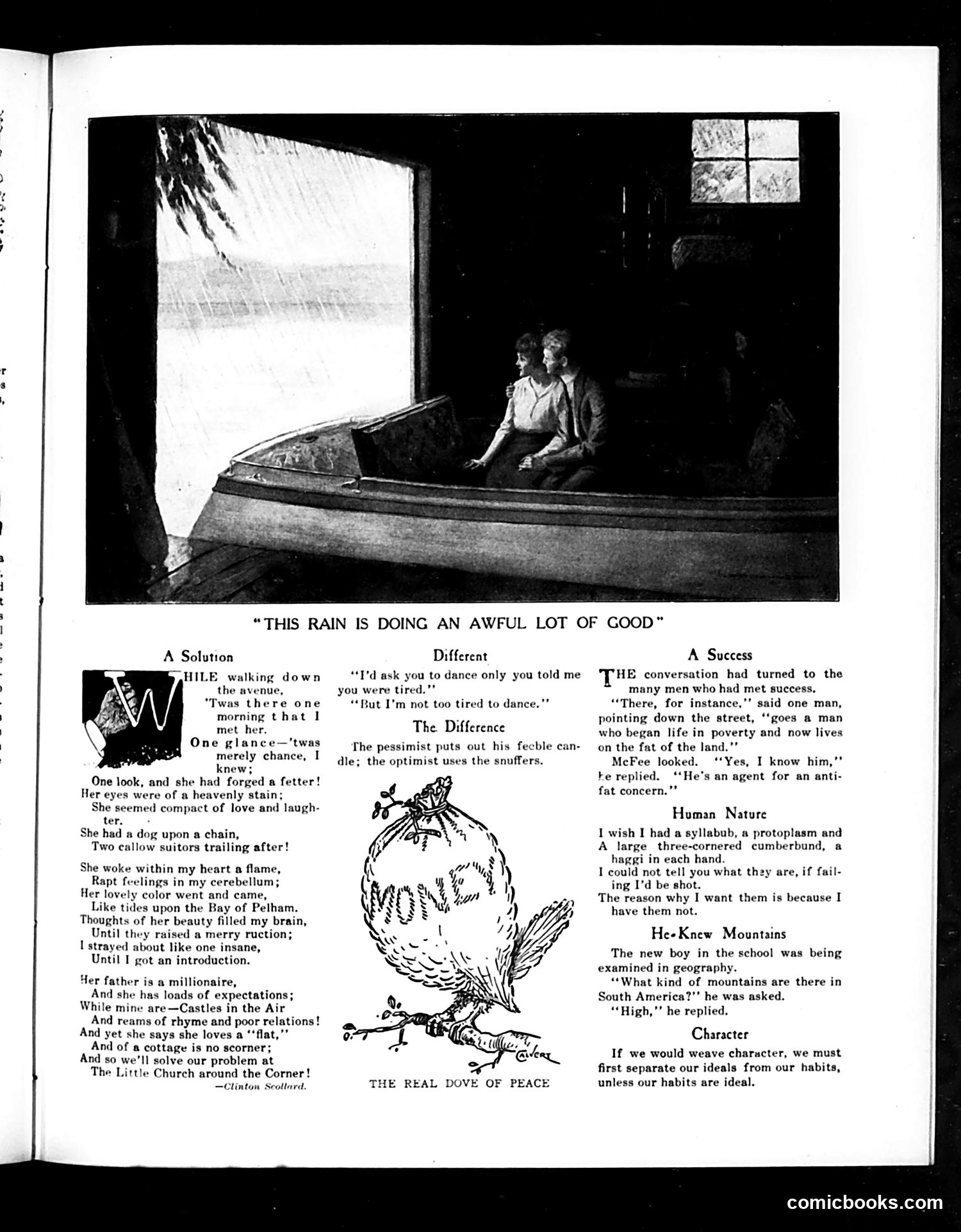
This page contains miscellaneous humor and poetry rather than political satire. The main image shows two people in a boat during rain, captioned "This Rain Is Doing an Awful Lot of Good"—a joke about optimistic reinterpretation of bad weather. Below are several short pieces: "A Solution" (a poem about chance meeting a woman), "Different" (contrasting pessimist and optimist attitudes), and "A Success" (a conversation about social mobility). An illustration labeled "The Real Dove of Peace" depicts a dove or bird. The page also includes sections on "Human Nature," "He Knew Mountains" (a geography mishap joke), and "Character" (brief philosophical observation). This appears to be filler content—lighthearted humor and verse—rather than satirical commentary on specific political events or figures.
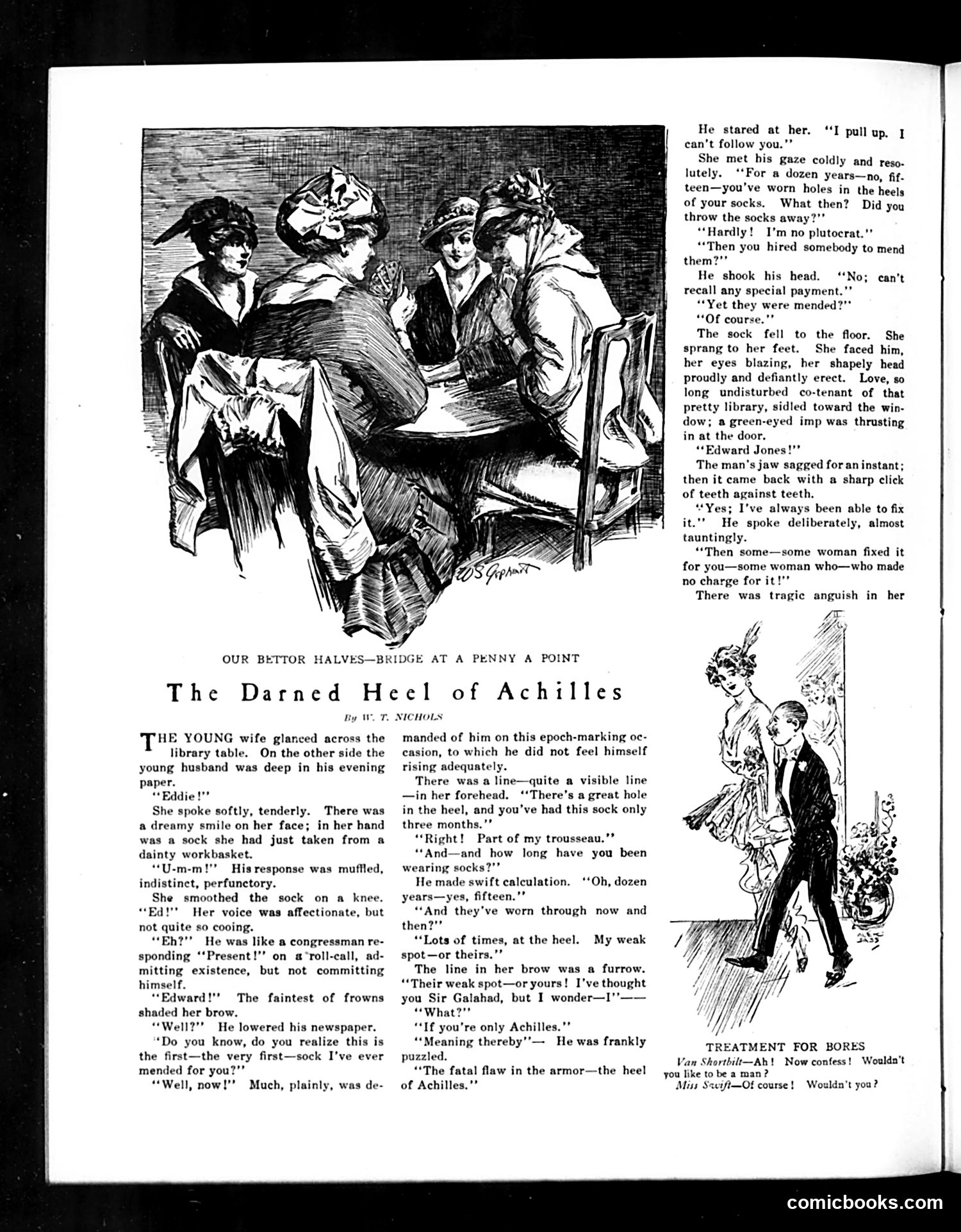
This story satirizes marital discord through a domestic misunderstanding. A young wife discovers her husband has been having another woman mend his socks for years—without payment—a revelation implying an inappropriate relationship. The "Achilles' heel" reference is the story's ironic centerpiece: the husband, whom the wife imagined as heroic (Sir Galahad), reveals a fatal weakness—his willingness to accept free domestic service from another woman, suggesting infidelity or at minimum emotional entanglement. The satire targets both spouses: the husband's obliviousness and the wife's wounded pride. The accompanying illustration shows the dramatic confrontation in their library, with "Love" departing and "a green-eyed imp" (jealousy) entering. The companion advertisement "Treatment for Bores" reinforces the page's marital theme, mocking relationships through a woman's retort about wanting to be a man.
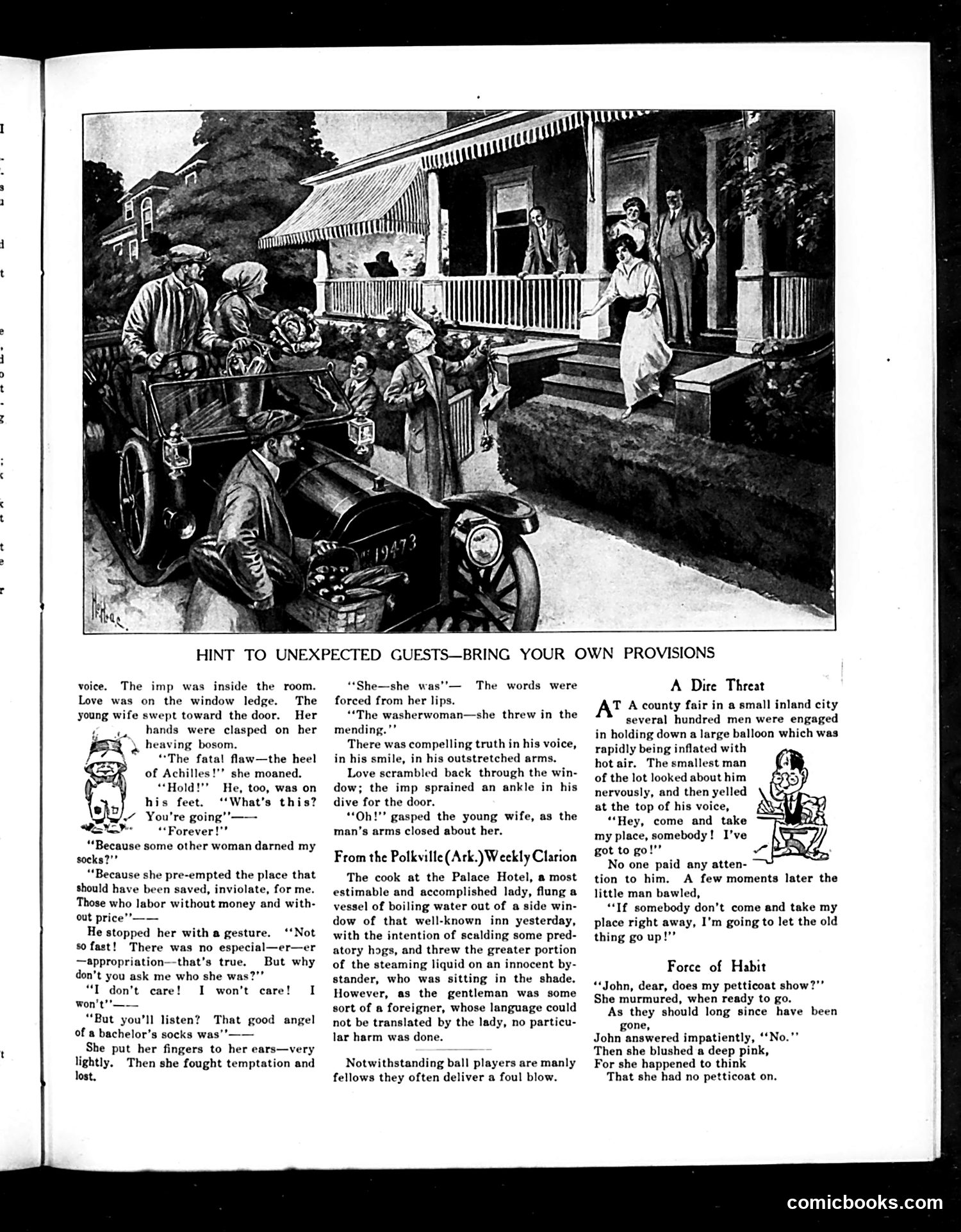
This page contains three distinct humorous pieces typical of early 20th-century Judge magazine: **Top Cartoon:** "Hint to Unexpected Guests—Bring Your Own Provisions" satirizes uninvited visitors by showing a chaotic domestic scene where unexpected guests arrive with their own belongings, creating household disruption. **Middle Story:** A brief anecdote from Polkville, Arkansas, humorously documents a cook accidentally scalding a foreign visitor with boiling water. The joke relies on the premise that since he's a foreigner who can't communicate complaints, "no particular harm was done"—satirizing indifference to immigrant mistreatment. **Bottom Section:** Two short pieces—"A Dire Threat" (about a small man threatening to release a hot-air balloon), and "Force of Habit" (a poem about a woman asking if her petticoat shows when she's wearing none). These exploit slapstick logic and Victorian modesty conventions for humor. The page exemplifies Judge's satirical approach: poking fun at social situations, domestic life, and human behavior through exaggeration and irony.
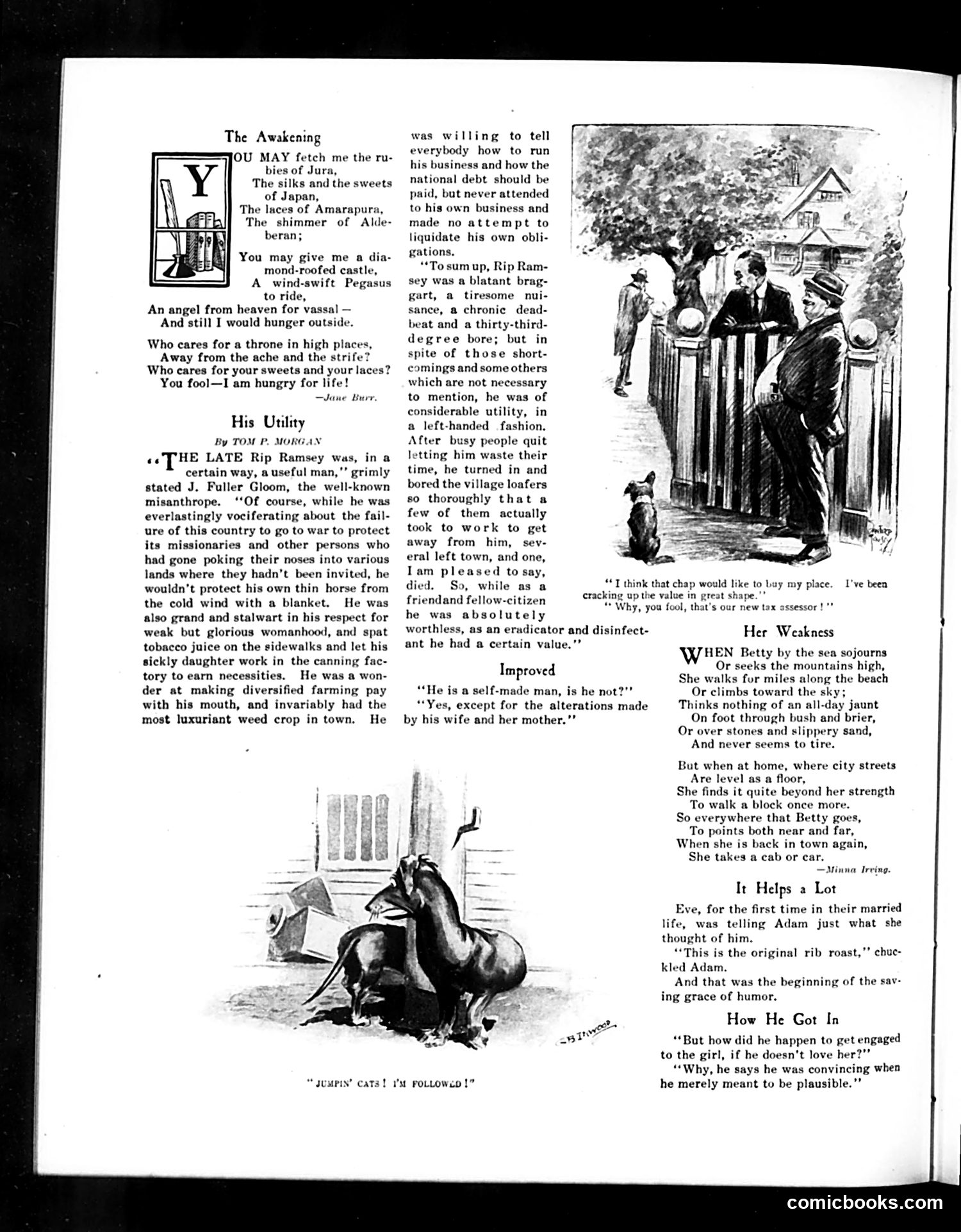
This page contains several short satirical pieces typical of early 20th-century American humor magazines: **"His Utility"** offers biting social satire. The deceased Rip Ramsey exemplifies hypocritical middle-class pretension: he loudly advocated for military intervention abroad while neglecting his own family and debts, lectured others on business while mismanaging his own affairs, and spat tobacco on public sidewalks. The satire's point: such blowhards inadvertently serve society by boring village idlers into leaving town or finding work—they're "useful" only as negative examples. **"Her Weakness"** humorously inverts gender expectations. Betty displays remarkable physical endurance hiking and climbing outdoors but becomes mysteriously exhausted walking city blocks—the joke being her sudden reliance on cabs suggests affectation rather than genuine fatigue. The remaining pieces ("The Awakening," "Improved," "It Helps a Lot," "How He Got In") are brief comic verses or quips mocking pretension, marital dynamics, and self-deception—common Judge themes targeting urban, educated audiences.
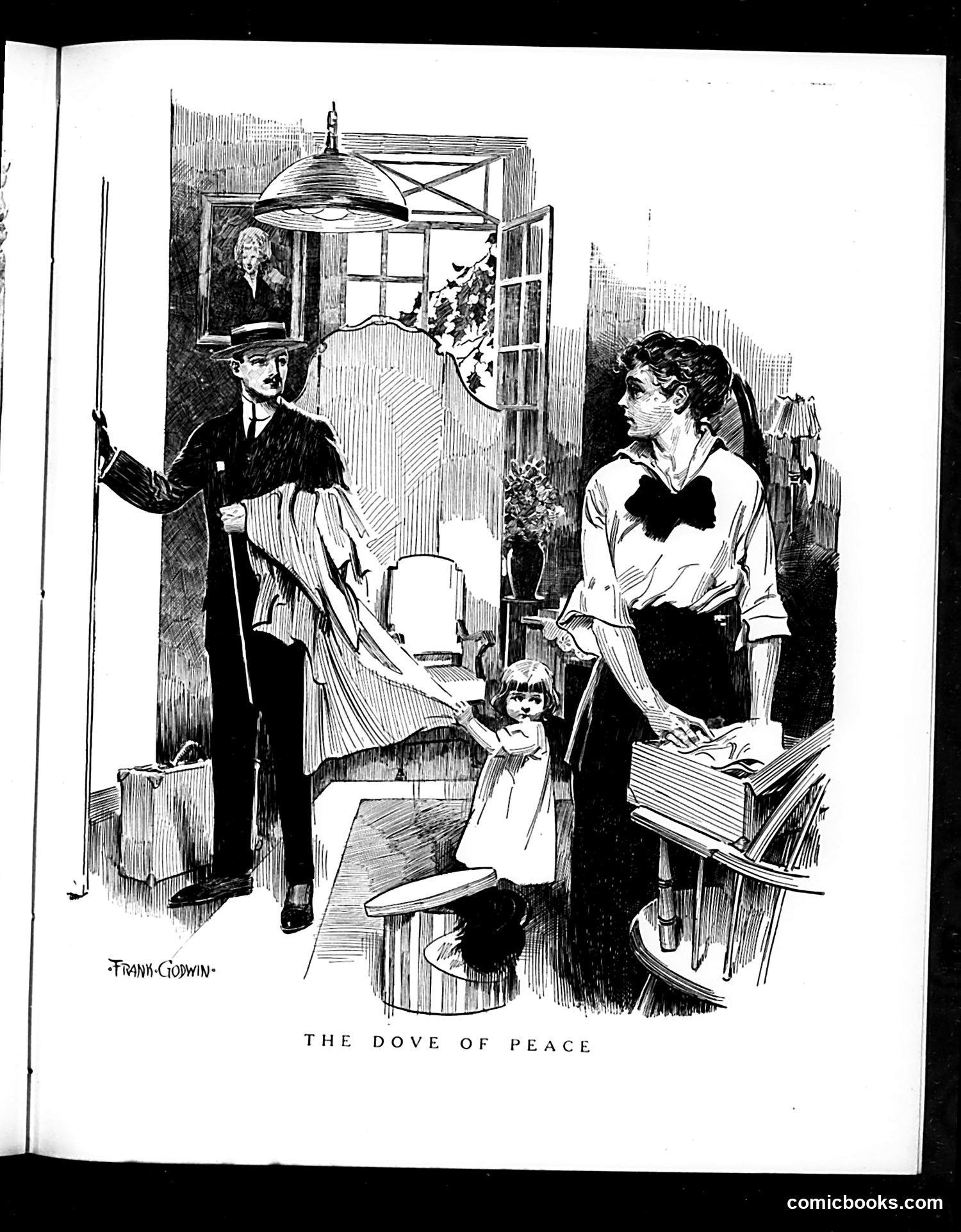
This illustration depicts a domestic interior scene titled "The Dove of Peace." A man in formal attire (left) appears to be departing or arriving at a home, while a woman and child greet him inside. The woman wears a bow at her neck, and a child sits between them. An older woman is visible in the background near a window. The title suggests irony about domestic harmony. Without specific dating or additional context from *Judge* magazine's publication, the exact political reference remains unclear. However, the formal composition and the symbolic "dove" likely comment on either: domestic peace as contrasting with external conflict, or possibly broader peace negotiations of the era. The satirical intent appears to focus on the contrast between domestic life and wider social/political matters, though the specific historical reference requires additional context.
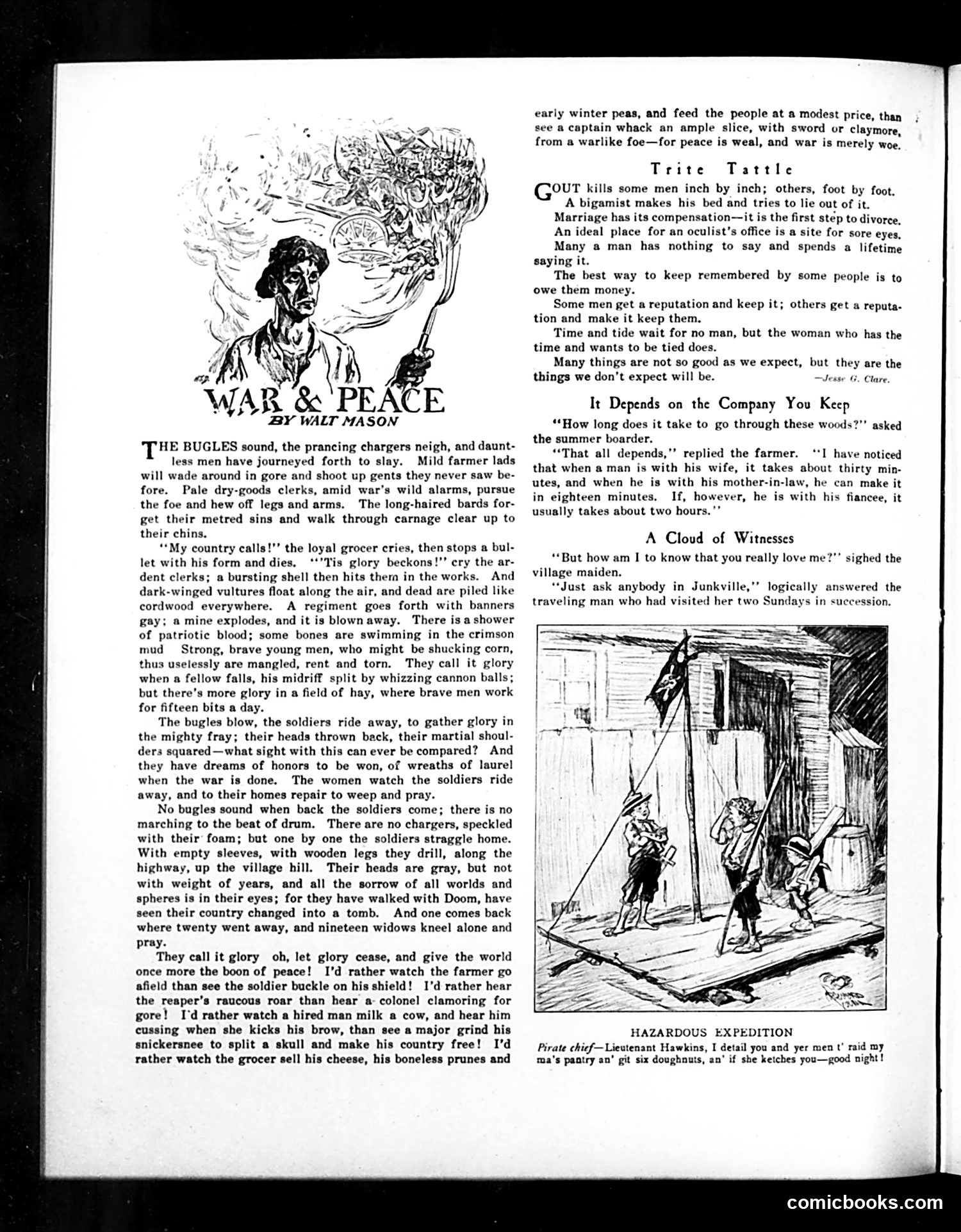
This page presents **anti-war propaganda** through Walt Mason's poem "War & Peace." The piece is a sustained critique of military glorification, contrasting romantic depictions of soldiers with the brutal reality of combat and its aftermath. The poem mocks patriotic rhetoric—farmers and clerks answering "My country calls!"—only to be killed or maimed. Mason emphasizes the disconnect between how society celebrates war ("they call it glory") and its actual consequences: soldiers returning with missing limbs ("empty sleeves, with wooden legs"), psychological trauma ("all the sorrow of all worlds and spheres is in their eyes"), and bereaved families ("nineteen widows kneel alone and pray"). The satire's punch lies in Mason's repeated assertion that **peaceful labor is superior to military service**—he'd rather see a hired man milk a cow or a grocer sell cheese than witness soldiers in combat. The accompanying illustrations and "Trite Tattle" section provide lighter satirical commentary on social foibles, but the main piece reflects early-20th-century American pacifism and working-class skepticism toward military adventure.
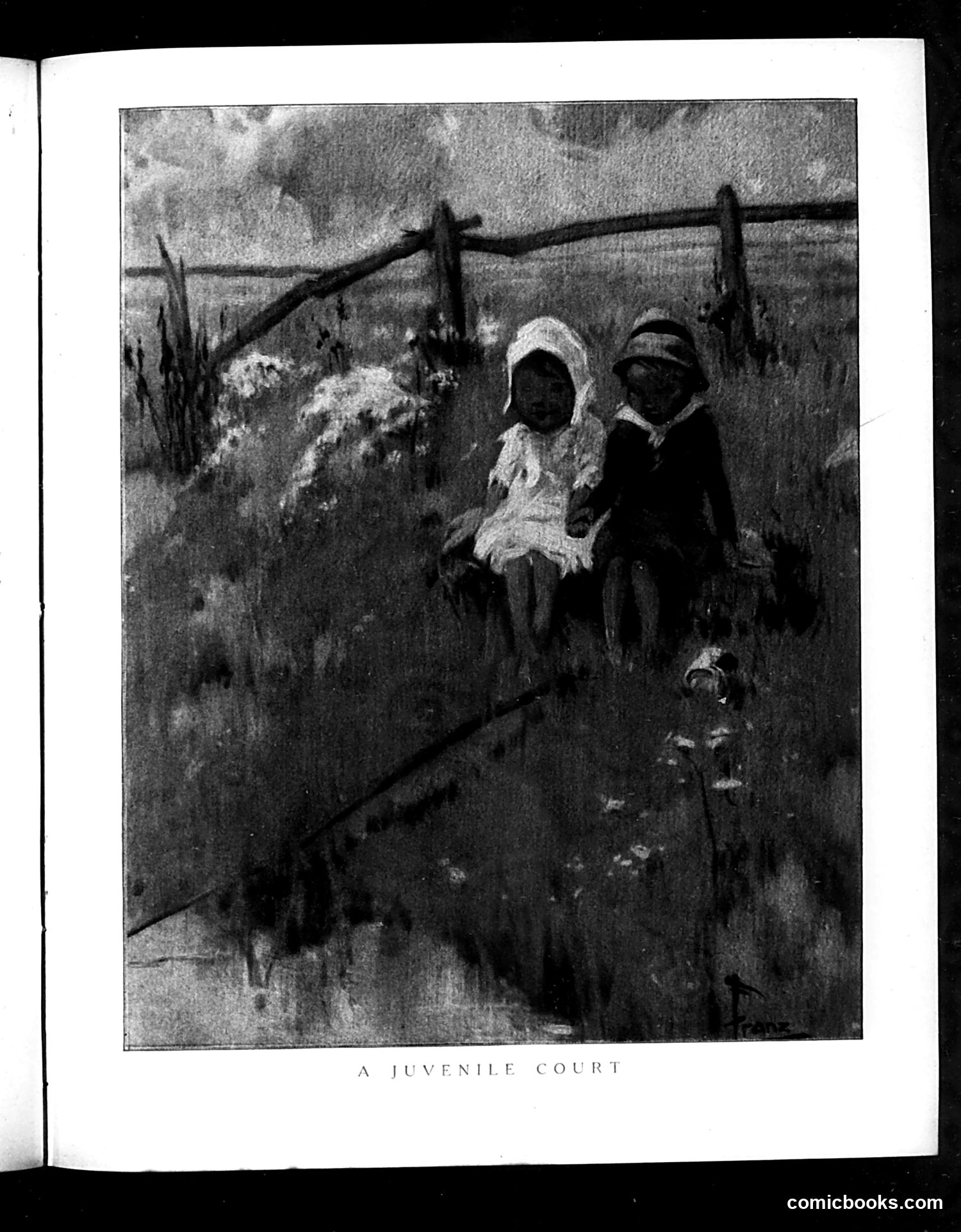
This illustration depicts two young children standing in what appears to be a rural or swampy setting with a broken fence. The caption "A Juvenile Court" is satirical — the children are literally in nature rather than a courtroom, suggesting commentary on the actual state of juvenile justice or child welfare systems. The image likely critiques how poor or marginalized children were treated by the legal system during the era when *Judge* magazine was published. Rather than receiving proper judicial proceedings or protection, such children were left to fend for themselves in harsh conditions. The satire contrasts the formal concept of a "juvenile court" with the grim reality of neglect or inadequate legal protection for vulnerable youth.
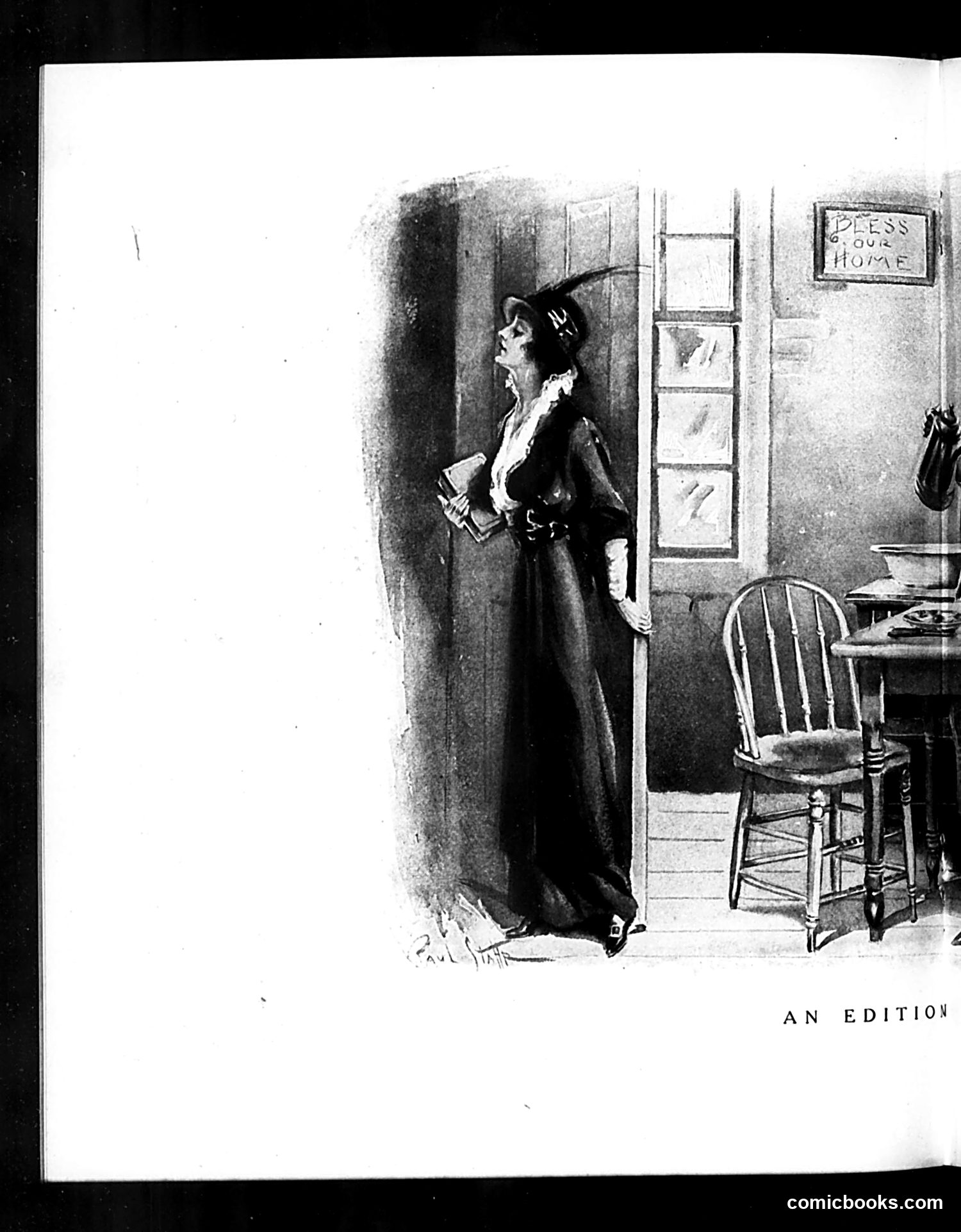
This appears to be a cartoon from *Judge* magazine depicting a domestic scene. A woman in formal attire stands in a doorway holding papers, while a Windsor chair sits empty in the foreground. A sign reading "BLESS OUR HOME" hangs on the wall. The cartoon likely satirizes early 20th-century domestic tensions, possibly addressing women's independence or marital discord. The woman's formal dress and papers suggest she may be serving notice or making an important declaration. The empty chair and blessing sign create ironic contrast—the "blessed home" appears to be in crisis. Without clearer textual context or publication date visible, the specific political or social reference remains unclear, though it likely comments on changing gender dynamics or marriage law of its era.
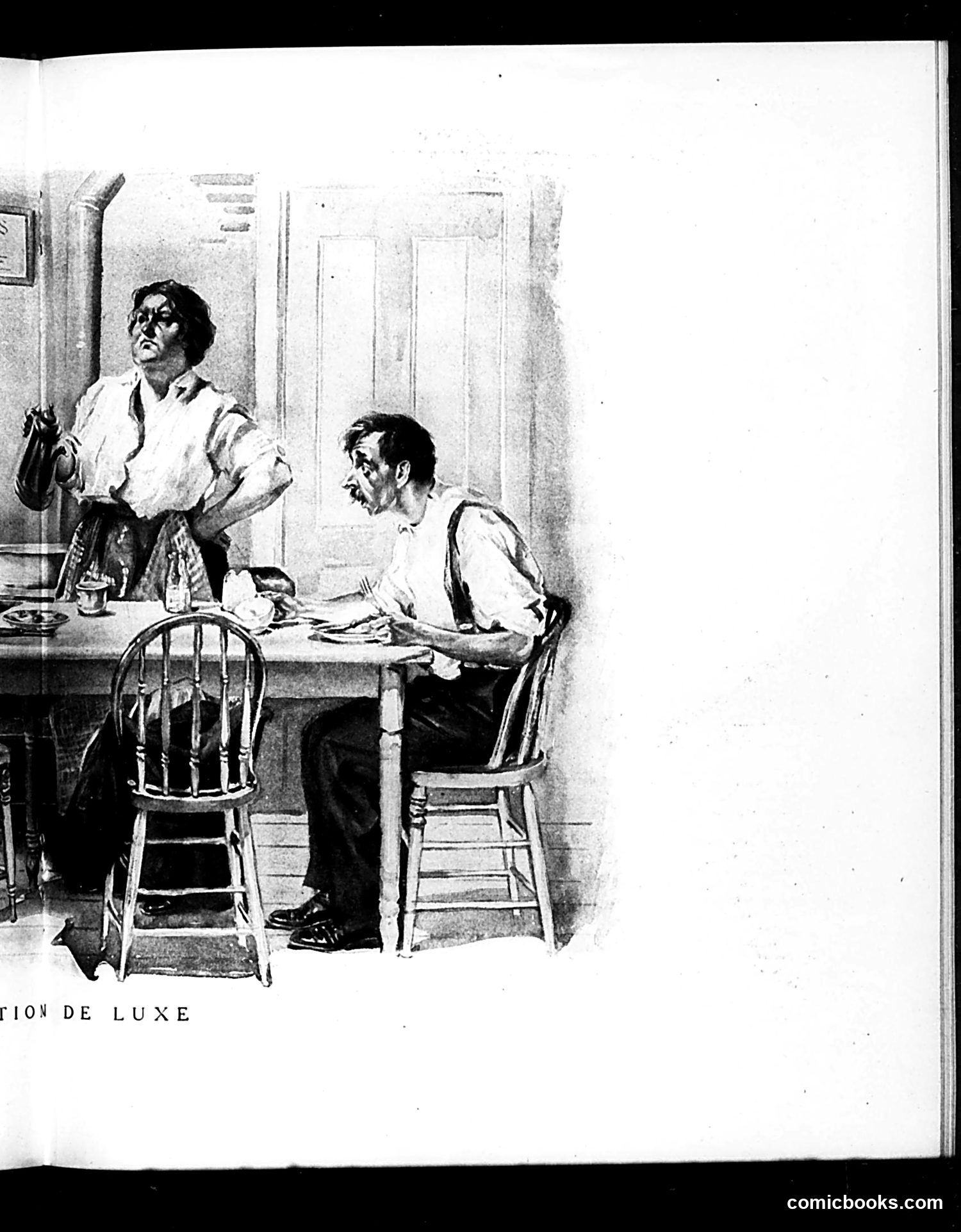
This appears to be a satirical illustration titled "tion de Luxe" (likely "Edition de Luxe," referencing a luxury edition). The cartoon depicts two men at a desk in what seems to be an office or institutional setting. One man stands aggressively while the other sits, appearing confrontational or tense. Without additional context or caption text visible in the image, the specific political or social reference remains unclear. The "de Luxe" title suggests satire about luxury or pretense, possibly mocking elevated or fancy versions of something ordinary. The body language and setting suggest conflict or uncomfortable workplace dynamics, but the precise target of Judge magazine's satire cannot be determined from the image alone.
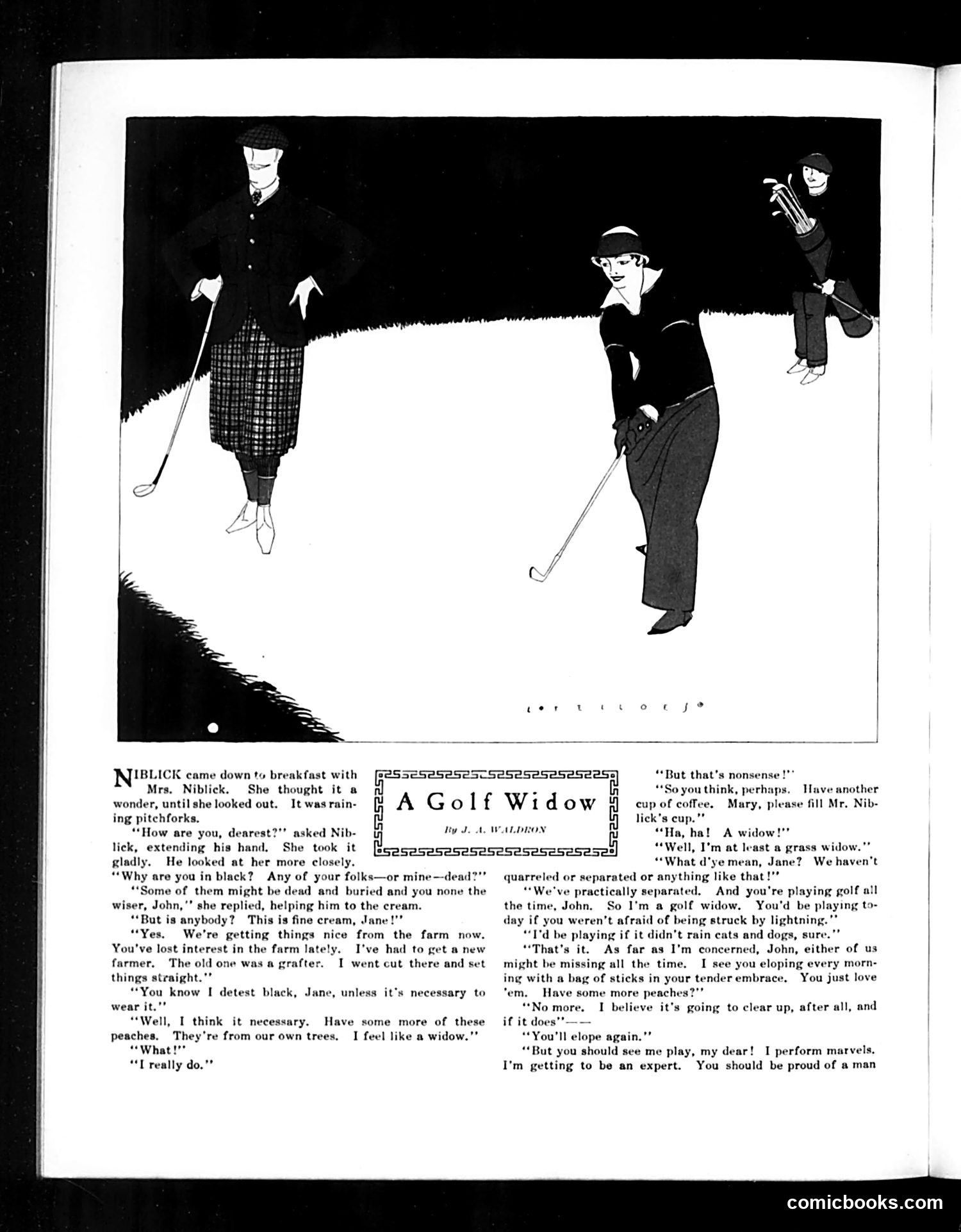
This story satirizes the social phenomenon of wives neglected due to husbands' obsession with golf. The term "golf widow" describes a married woman whose spouse is absent pursuing the sport. The narrative shows Mrs. Niblick wearing black mourning clothes despite her husband being alive—she's dressed as a "widow" because Mr. Niblick spends all his time golfing rather than with her. When she mentions "practically separated," she means emotionally distant due to his golf addiction. The joke hinges on the husband's obliviousness: he notices her black outfit but doesn't connect it to his neglect until she explicitly explains it. His response—bragging about becoming an "expert" golfer—shows he's missed the point entirely, remaining absorbed in the sport rather than recognizing his wife's legitimate complaint. This reflects early 20th-century concerns about golf becoming a consuming middle-class leisure activity that disrupted family life.
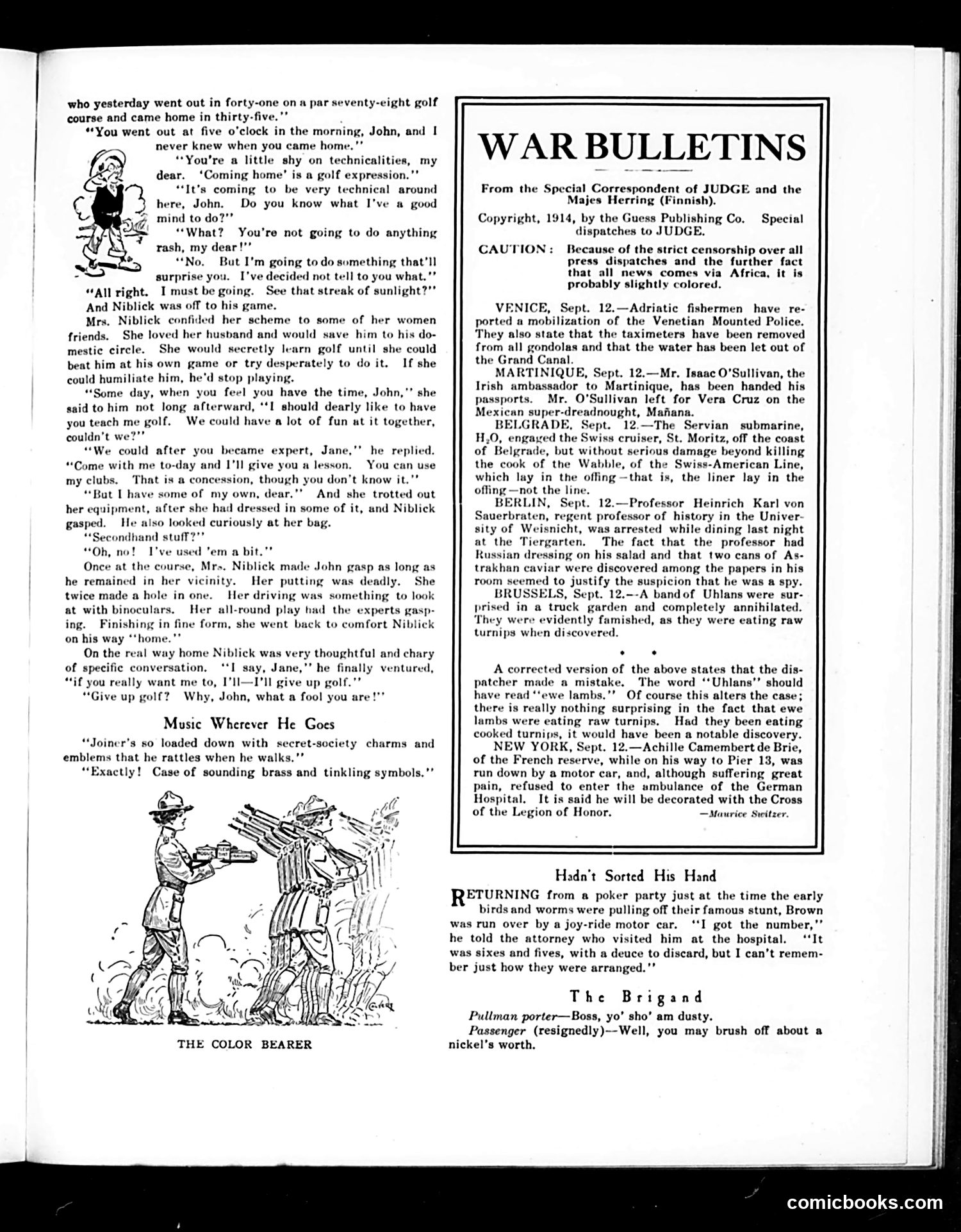
The left cartoon satirizes fraternal organizations popular in early 20th-century America. A man ("Joiner") is so laden with emblems and charms from secret societies (Masons, Odd Fellows, etc.) that he literally rattles when walking. The joke mocks men who accumulated multiple memberships and proudly displayed their pins and badges—treating it as pretentious or excessive. The title reference to "sounding brass and tinkling symbols" is biblical, suggesting hollow ostentation. The "War Bulletins" section parodies war reporting from World War I (1914). It's absurdist satire: the dispatches contain obvious fabrications and jokes (Venice removing water from the Grand Canal, a submarine labeled "H₂O," a professor arrested for having Russian dressing on salad). The disclaimer warns readers these reports are "probably slightly colored"—a tongue-in-cheek admission that actual wartime press censorship made all news suspect and likely propagandistic.
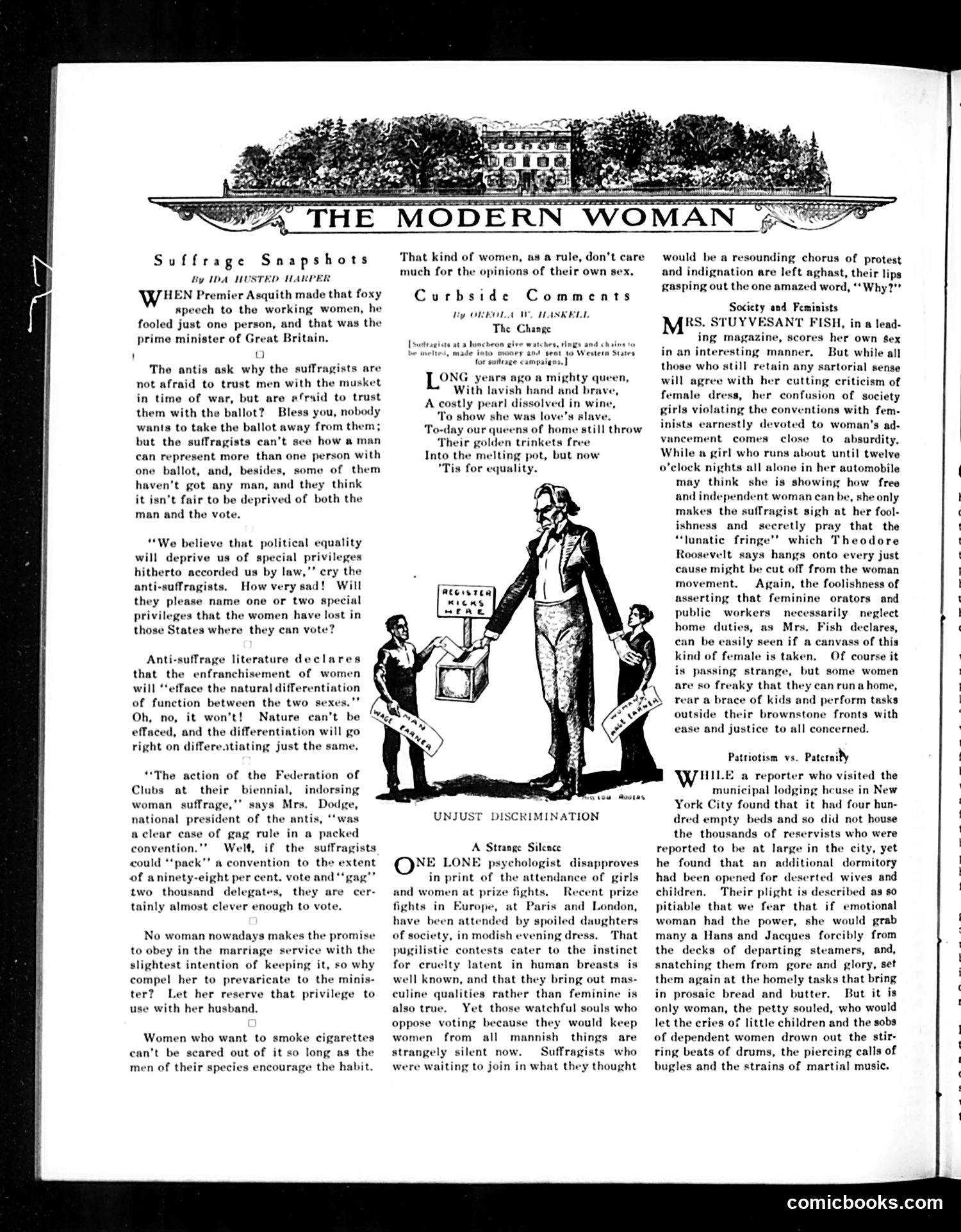
This page mocks opponents of women's suffrage through multiple satirical pieces. The central cartoon "Unjust Discrimination" depicts anti-suffragists as hypocrites: they claim women attending prize fights proves they're unsuited to vote, yet remain silent about this behavior—contradicting their paternalistic arguments about protecting women's "delicate" nature. The "Suffrage Snapshots" column by Ida Husted Harper counters anti-suffrage arguments with pointed logic: opponents claim voting will "efface natural differences" between sexes, yet nature remains unchanged. The piece ridicules the claim that suffrage would strip women of "special privileges." "Curbside Comments" uses a poem comparing a queen dissolving pearls in wine to show love versus modern women melting down valuables for equality—suggesting suffragists are sacrificing personal luxury for political principle. The satire's core message: anti-suffragists hold contradictory positions, fearing women's political power while tolerating their social freedoms, exposing that opposition to voting rights stems from desire for political control, not genuine concern for women's welfare.
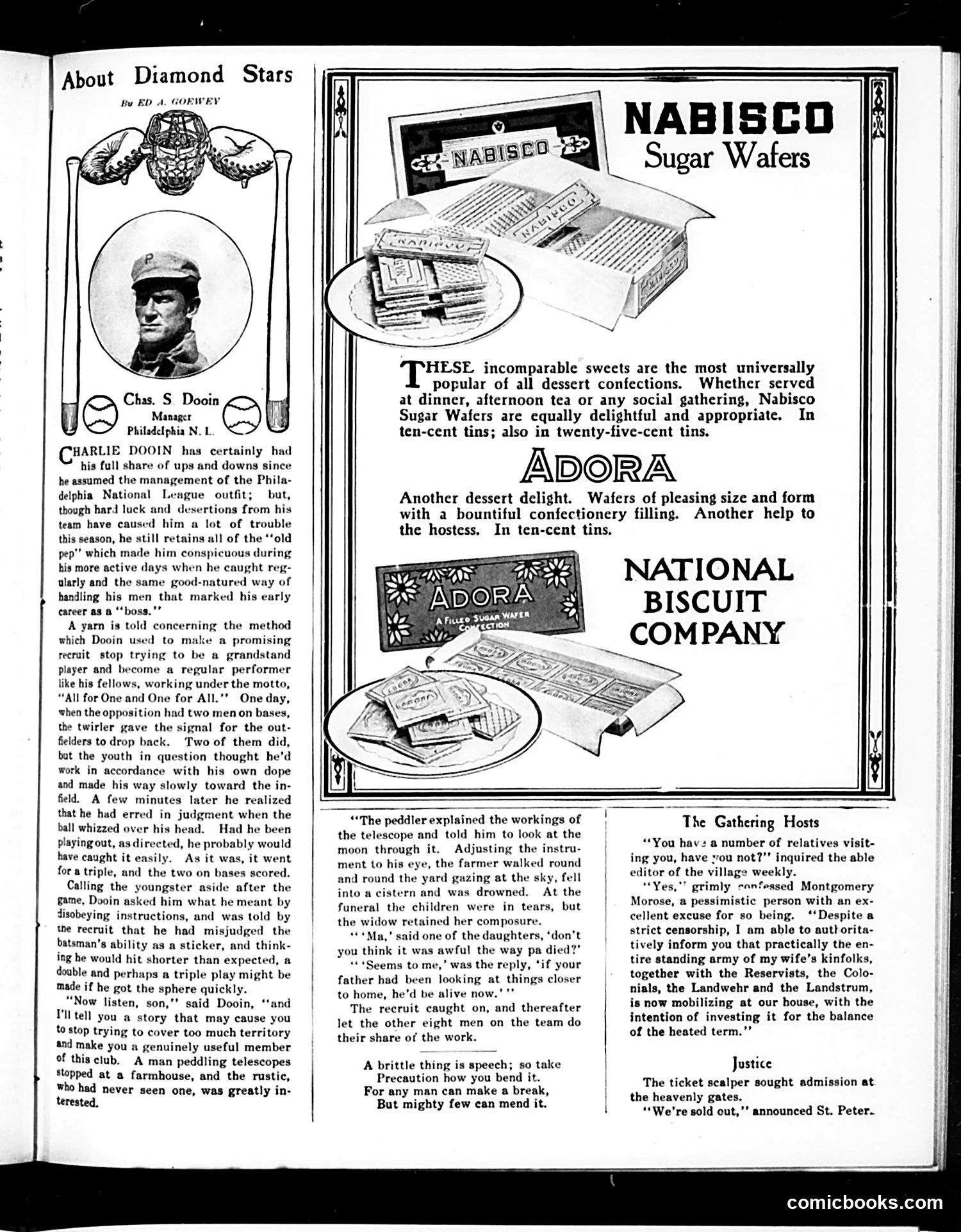
This page combines sports commentary with advertising and humor columns. **"About Diamond Stars"** profiles Charlie Dooin, manager of the Philadelphia National League baseball team. The article describes his management style through an anecdote: Dooin taught a young player to follow team strategy by telling him a story about a farmer who drowned looking through a telescope because he wasn't paying attention to his surroundings—a metaphor for the recruit's failure to follow defensive positioning instructions. **Right side:** The page is dominated by advertisements for Nabisco Sugar Wafers and Adora wafers from the National Biscuit Company, typical of period magazine advertising. **Bottom columns:** "The Gathering Hosts" satirizes a pessimistic man overwhelmed by visiting relatives (using military terminology—"standing army," "Reservists," "Landwehr"—to humorously exaggerate the invasion). "Justice" appears to be a brief humorous anecdote about heaven's gates. The page reflects early 20th-century magazine conventions: mixing sports news, light humor, and commercial advertising.
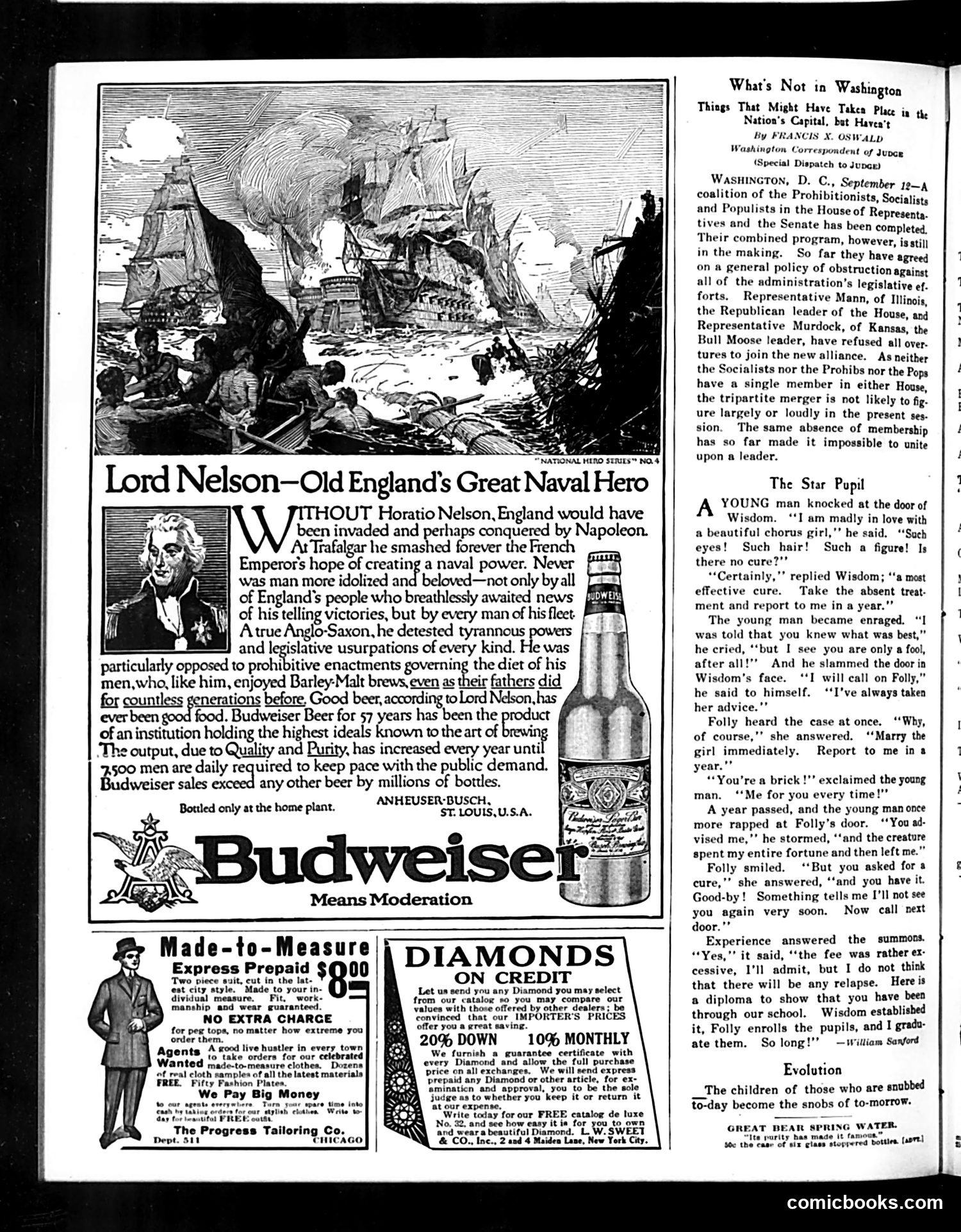
This page primarily contains **advertising disguised as editorial commentary**. The main illustrated article about "Lord Nelson—Old England's Great Naval Hero" is actually a **Budweiser beer advertisement** attempting to legitimize alcohol consumption by associating it with British naval heroism and tradition. The satire works through false equivalence: the text claims Admiral Nelson opposed "prohibitive enactments" restricting soldiers' beer consumption, implying that opposing Prohibition is patriotic and historically justified. This is propaganda responding to the growing Temperance movement, which was gaining political power (referenced in the sidebar article about Prohibition coalitions in Congress). The page also includes typical period advertising for tailored suits, diamonds on credit, and other goods. The two short humorous pieces ("The Star Pupil" and "Evolution") are filler content typical of Judge magazine's format. **The context:** This reflects early 1910s tensions between Prohibitionists and the alcohol industry, with Judge magazine (a humor publication with conservative leanings) publishing anti-Prohibition messaging wrapped in entertainment.
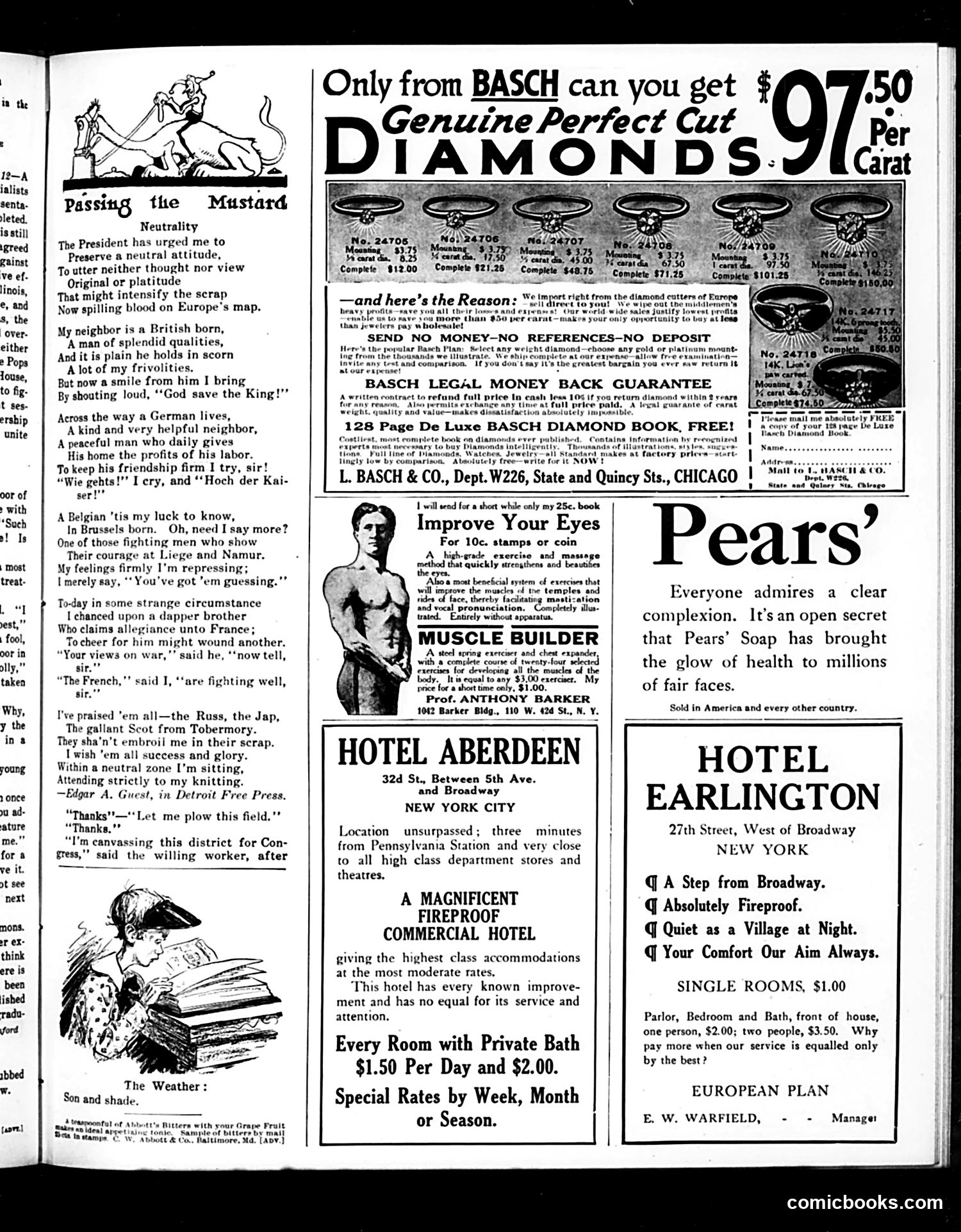
This cartoon satirizes the difficulty of maintaining American neutrality during World War I (the conflict is referenced as ongoing in Europe). The poem, attributed to Edgar A. Guest, presents a narrator who claims to remain neutral while living among neighbors of different nationalities—British, German, Belgian, French, Russian, Japanese, and Scottish. The satire's point: true neutrality is impossible. The narrator must constantly perform verbal gymnastics, praising each nation's war efforts to avoid offending his neighbors. He "passes the mustard"—performs small appeasing gestures—to all sides. The cartoon mocks both the absurdity of claiming neutrality while surrounded by belligerents' sympathizers, and the hypocrisy of Americans who claim neutrality while tacitly supporting various allied nations. This reflects genuine American anxiety circa 1914-1917 about ethnic communities and divided loyalties during the war.
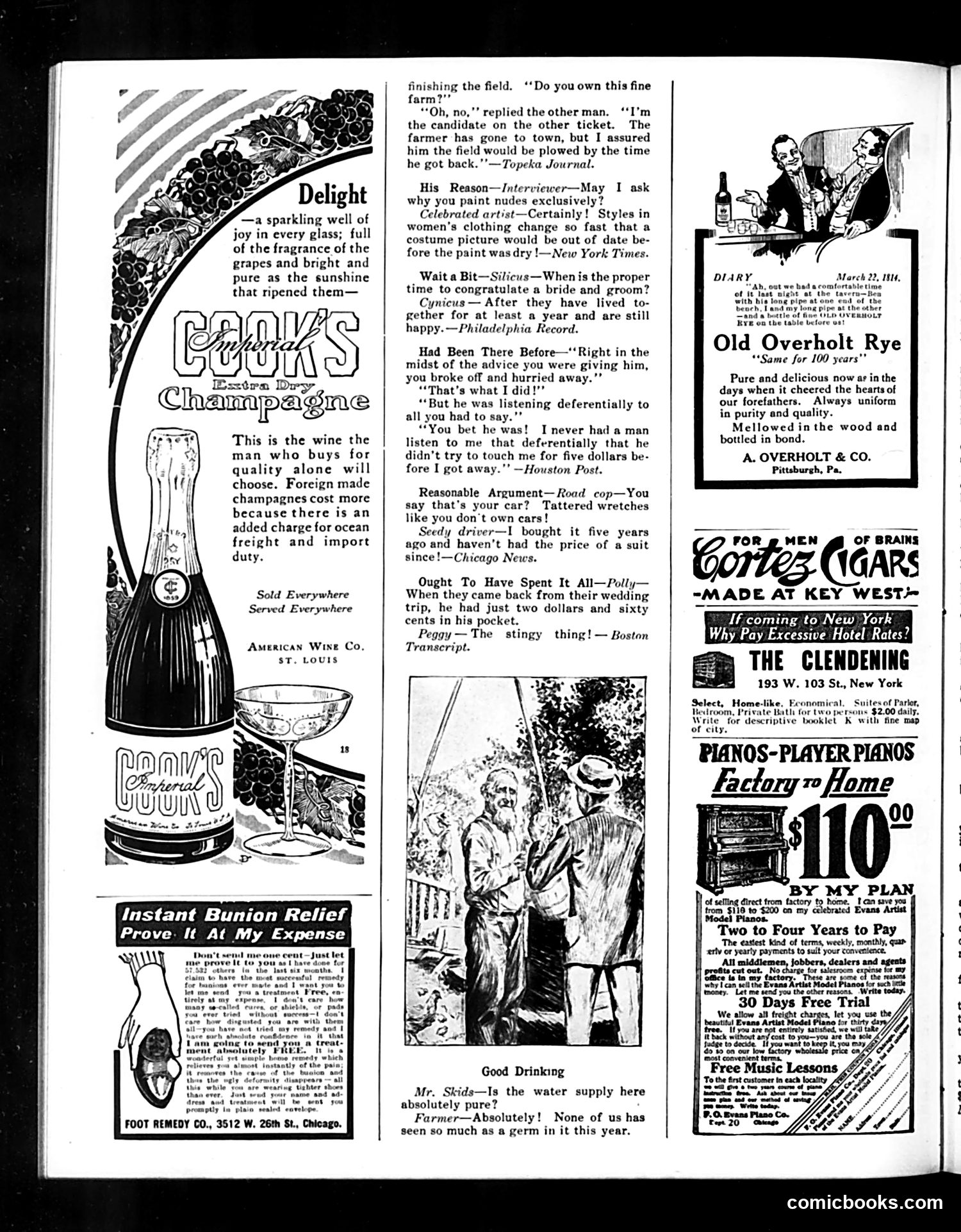
This page is primarily **advertisements and brief humorous anecdotes** rather than political satire. The small jokes mock everyday situations: a political candidate falsely promising to plow a farmer's field; an artist justifying nude paintings because fashion changes too quickly to keep costume paintings current; cynicism about when to congratulate newlyweds (after they've proven the marriage lasts); a beggar's shabby car; stinginess on a honeymoon. The advertisements dominate—champagne, foot remedy, whiskey, cigars, player pianos, and a hotel—typical of Judge's revenue model. **Political content is minimal.** One anecdote references "the candidate on the other ticket," but provides no specific political commentary—it's merely a joke about empty campaign promises to rural voters, a timeless theme rather than satire of particular politicians or events. The page reflects early 20th-century concerns: fashion obsolescence, class mockery, marital skepticism, and consumer goods culture, but lacks the pointed political edge one might expect from a dedicated satirical publication.
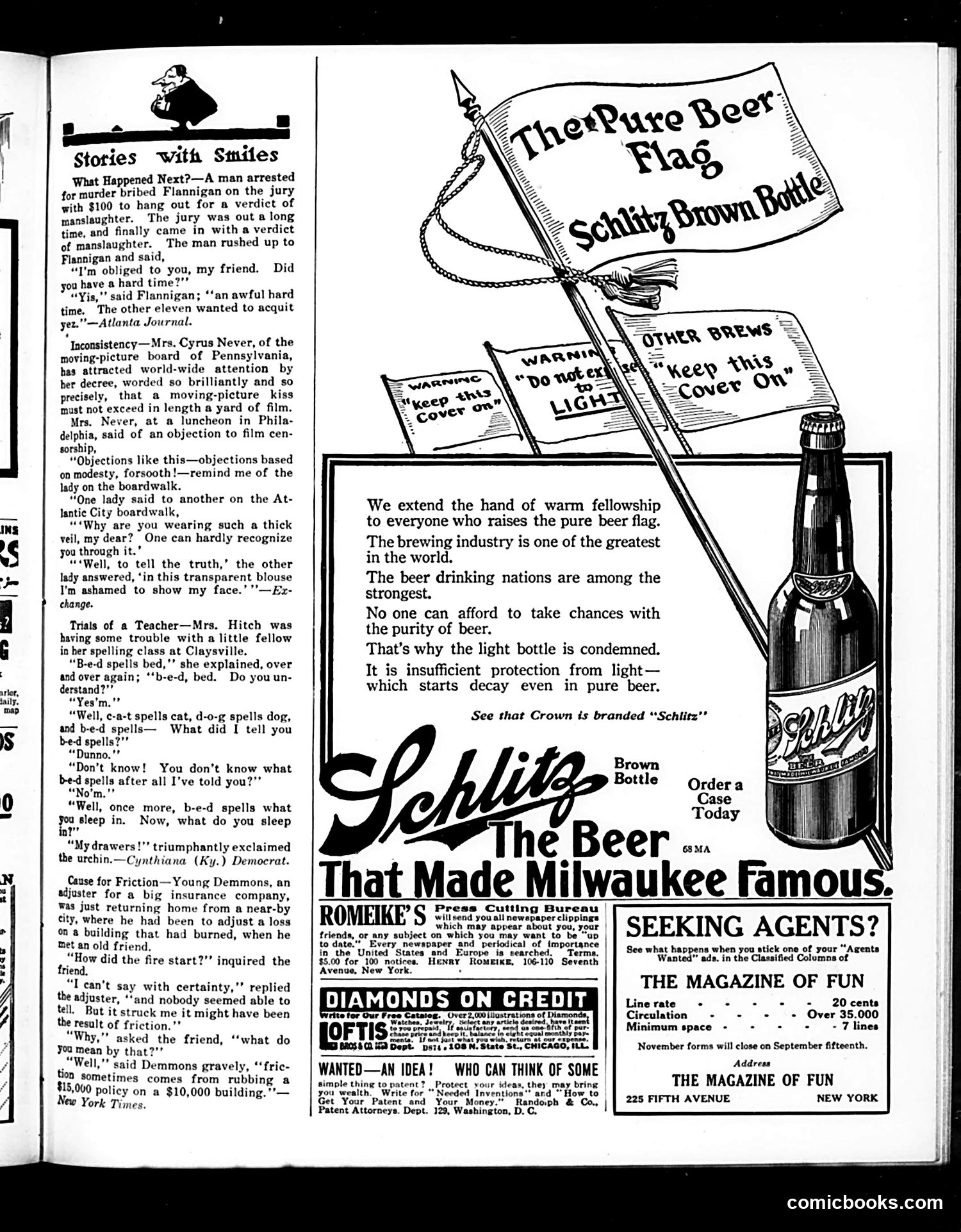
This page primarily contains **short humorous anecdotes** ("Stories with Smiles") typical of Judge magazine's satirical content. The jokes mock human behavior: a corrupt juror, a hypocritical film censor, a struggling teacher, and insurance fraud rationalized as "friction." The dominant feature is a **Schlitz beer advertisement** promoting their brown bottle. The ad argues that light bottles expose beer to decay, making Schlitz's brown bottle superior for "purity." This reflects early 20th-century concerns about product preservation before modern refrigeration—beer in clear bottles genuinely degraded faster from light exposure. The ad's messaging about "beer drinking nations are among the strongest" reflects contemporary attitudes linking national vigor to beer consumption, common in German-American advertising of the era. The page also includes classified ads for patent attorneys and magazine subscriptions—standard magazine filler of the period. There is **no political cartoon** per se on this page; it's primarily advertising and humor content typical of Judge's format.
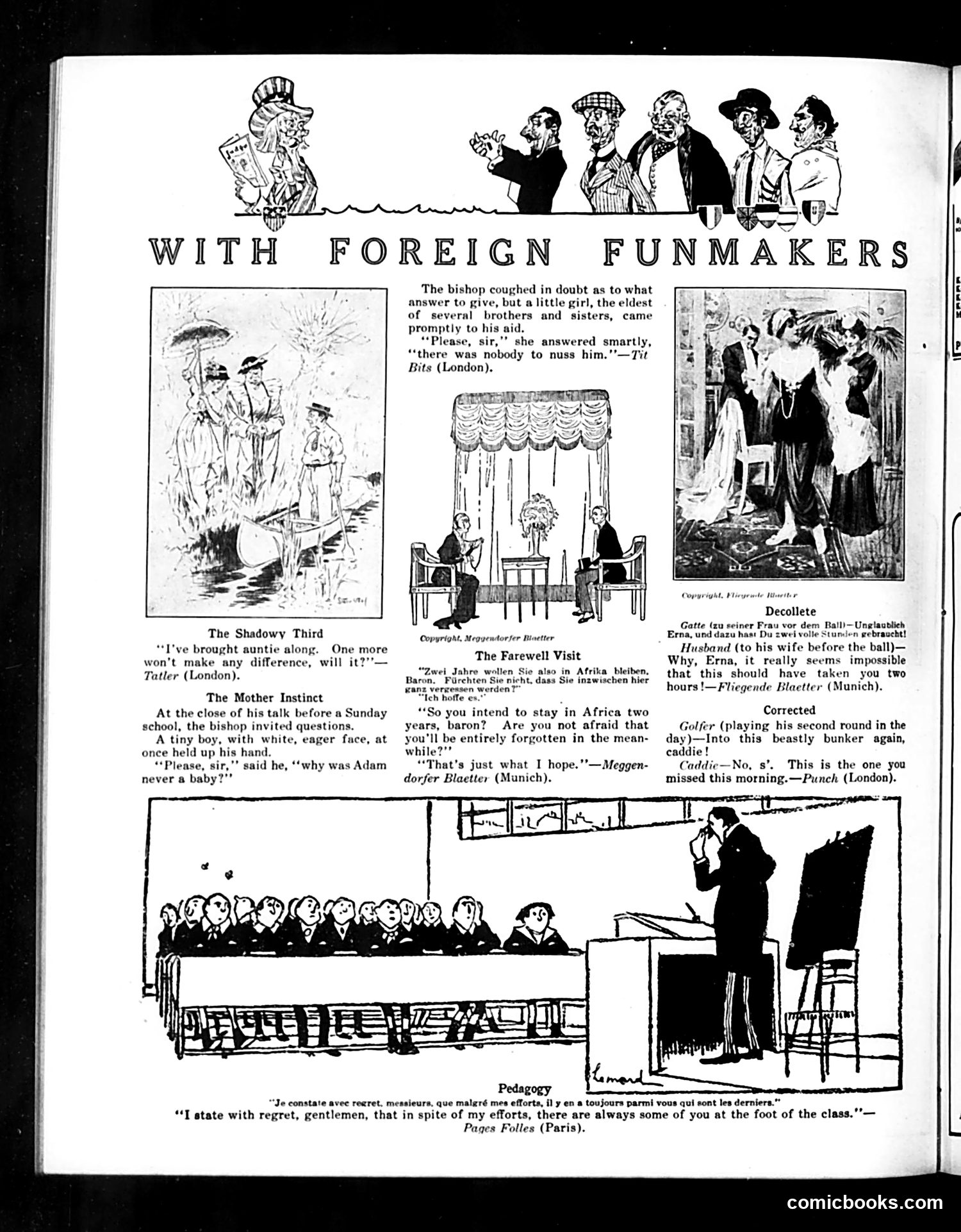
This page collects humorous anecdotes and cartoons reprinted from European satirical publications (London's *Tatler* and *Punch*, Munich's *Meggendorfer Blätter*, Paris's *Pages Folles*, etc.). The material reflects early 20th-century humor standards. The jokes target familiar domestic situations: a woman sneaking an extra guest ("The Shadowy Third"), a child's innocent theological question about Adam ("The Mother Instinct"), a husband's jealous concerns about a wife's African absence, a woman's lengthy grooming before a ball, a golfer's repeated mistakes, and a teacher's frustration with perpetually failing students. The "Pedagogy" cartoon depicts a classroom scene illustrating the teacher's point about consistent underperformers. For modern readers, the significance lies in understanding that *Judge* presented itself as cosmopolitan by showcasing European wit, suggesting shared Anglo-European middle-class values and comedic sensibilities across the Atlantic during this period.
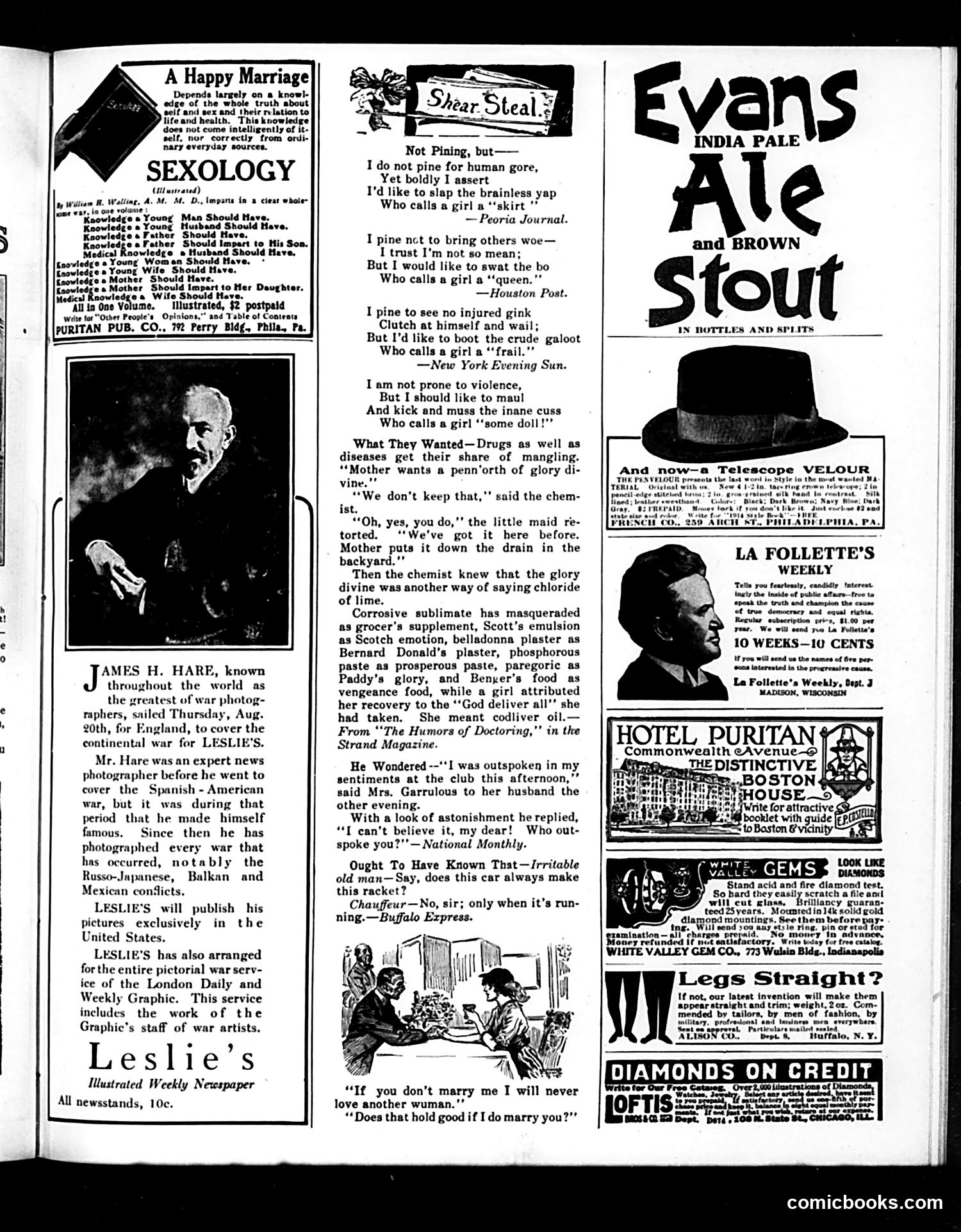
This page mixes editorial content with advertisements typical of early 1910s Judge magazine. **Main Editorial Content:** The "Shear Steal" section features humorous poetry satirizing how men derogatorily nickname women ("skirt," "queen," "frail," "doll"). The verses express exasperation with such crude terminology—the humor lies in the contrast between claiming not to want violence while humorously threatening it against men using these terms. A secondary piece, "The Humors of Doctoring," uses wordplay showing how medicine names get corrupted in household speech (chloride of lime becomes "glory divine"), illustrating domestic confusion and malapropisms. Brief comedic anecdotes follow about outspoken wives and car noise. **Advertisements:** The page includes ads for sexology books (marriage advice), war photographer James H. Hare's coverage for Leslie's magazine, Evans Ale, Hotel Puritan, diamonds, gems, leg straighteners, and La Follette's Weekly (a progressive political magazine). The content reflects early 20th-century middle-class concerns: marriage advice, respectability, and progressive politics.

This is a **tire company advertisement**, not a political cartoon. The page features Kelly-Springfield automobile tires and tubes, prominent products during the early automobile era. The advertisement emphasizes that despite wartime or economic pressures causing price increases across industries, Kelly-Springfield is maintaining stable pricing. The company argues their limited high-quality output and need to properly season raw materials justifies keeping prices unchanged rather than exploiting their market position. The image shows a woman's face framed within a tire—a common advertising device of the era to make industrial products more appealing and personable to consumers. The text appeals to customers' sense of fair dealing, positioning the company as ethical and customer-focused during a period when inflation and supply constraints were likely driving competitors to raise prices.