
Judge, 1914-09-12 · page 16 of 24
Judge — September 12, 1914 — page 16: what you’re looking at
What you’re looking at
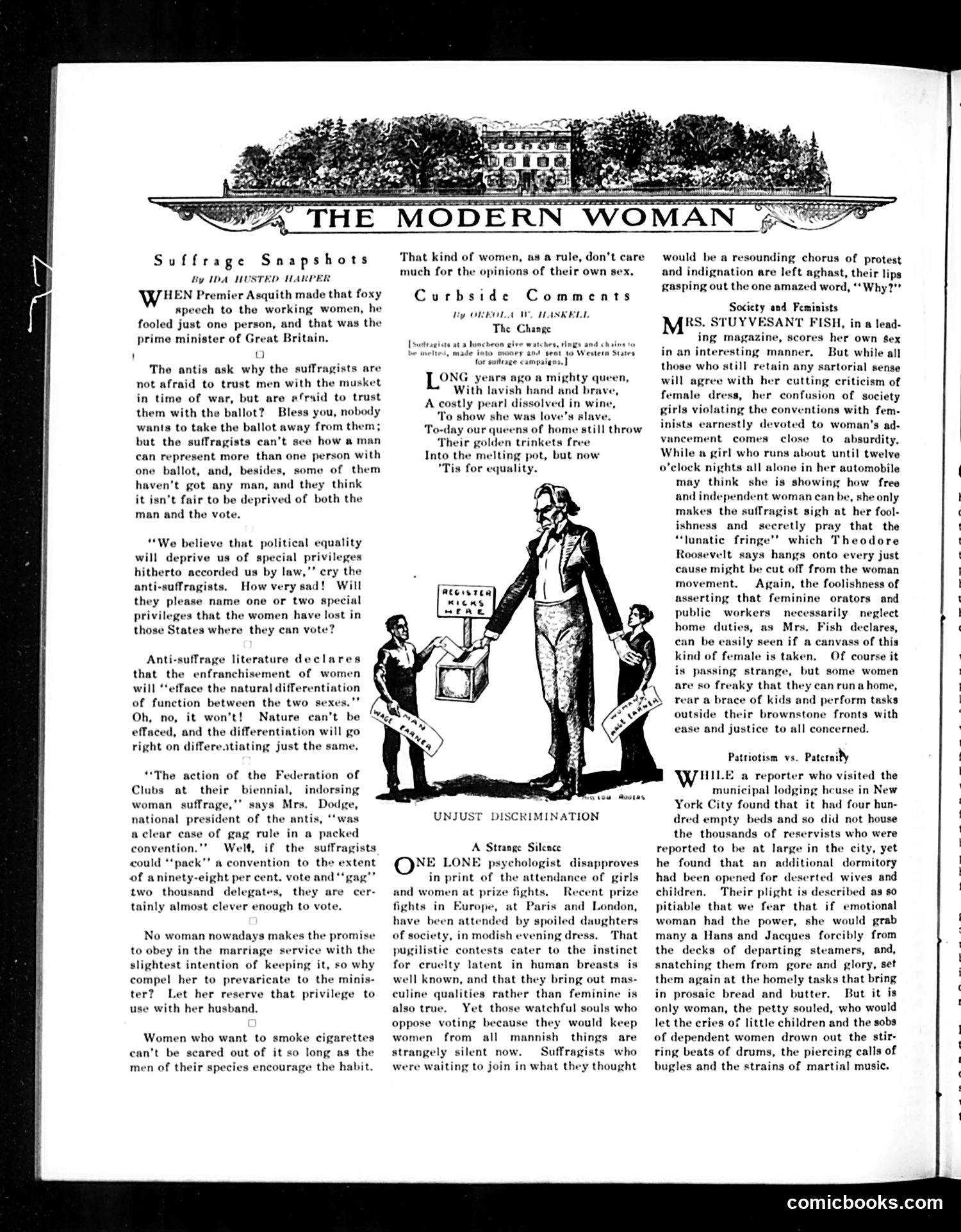
This page mocks opponents of women's suffrage through multiple satirical pieces. The central cartoon "Unjust Discrimination" depicts anti-suffragists as hypocrites: they claim women attending prize fights proves they're unsuited to vote, yet remain silent about this behavior—contradicting their paternalistic arguments about protecting women's "delicate" nature. The "Suffrage Snapshots" column by Ida Husted Harper counters anti-suffrage arguments with pointed logic: opponents claim voting will "efface natural differences" between sexes, yet nature remains unchanged. The piece ridicules the claim that suffrage would strip women of "special privileges." "Curbside Comments" uses a poem comparing a queen dissolving pearls in wine to show love versus modern women melting down valuables for equality—suggesting suffragists are sacrificing personal luxury for political principle. The satire's core message: anti-suffragists hold contradictory positions, fearing women's political power while tolerating their social freedoms, exposing that opposition to voting rights stems from desire for political control, not genuine concern for women's welfare.
📄 Transcribed text from this page (OCR, searchable)
Machine-transcribed from the original scan — historical spelling and the odd misread are preserved.
Suffrage Snapshots By IDA HUSTED HAKPER HEN Premier Asquith made that foxy speech to the working women, he fooled just one person, and that was the prime minister of Great Britain, a The antis ask why the suffragists are not afraid to trust men with the musket in time of war, but are afraid to trust them with the ballot? Bless you, nobody wants to take the ballot away from them; but the suffragists can’t see how a man can represent more than one person with one ballot, and, bes' some of them haven't got any man, and they think it isn’t fair to be deprived of both the man and the vote. “We believe that political equality will deprive us of special privileges hitherto accorded us by law," ery the anti-suffragists. How very sad! Will they please name one or two special privileges that the women have lost in those States where they can vote Anti-suffrage literature declares that the enfranchisement of women will “‘efface the natural differentiation of function between the two sexes.'" Oh, no, it won't! Nature can't be effaced, and the differentiation will go right on differeatiating just the same, “The action of the Federation of Clubs at their biennial, indorsing woman suffrage,"’ says Mrs. Dodge, national president of the antis, ‘‘was aclear case of gag rule in a packed Welt, if the suffragists pack’’ a convention to the extent nt. vote and **gag’ they are cer- could of aninety-eight per c two thousand delegates, tainly almost clever enough to vote. No woman nowadays makes the promise to obey in the marriage s slightest intention of keeping it, so why compel her to prevaricate to the minis- ter? Let her reserve that privilege to use with her husband. Women who want to smoke cigarettes can’t be scared out of it so long as the men of their species encourage the habit. ‘That kind of women, as a rule, don’t care much for the opinions of their own sex. Curbside Comments Ry ORKOLA W. HASKELL The Change ata luncheon giv J. Hinge and chaing ro made into y and sent to Wester States fot suitrage campaigns, ars ago a mighty qu With lavish hand and brave, A costly pearl dissolved in wi ‘To show she was love's slave To-day our queens of home still throw Their golden trinkets free Into the melting pot, but now ‘Tis for equality. Atcrsteal HICKS UNJUST DISCRIMINATION A Strange Silence CONE LONE psychologist disapproves in print of the attendance of girls and women at prize fight Recent prize fights in Europe, at Paris and London, have been attended by spoiled daughters of society, in modish evening dress. That pugilistic contests cater to the instinct for cruelty latent in human breasts is well known, and that they bring out mas- culine qualities rather than feminine is also true. Yet those watchful souls who oppose voting because they would keep women from all mannish t strangely silent now. Suffragists who were waiting to join in what they thought would be a resounding chorus of protest and indignation are left aghast, their lips gasping out the one amazed word, ‘*‘ Why?” Society and Feminists MES. UYVESANT FISH, in a lead- ing magazine, scores her own gex in an interesting manner, But while all those who still retain any sartorial sense th her cutting criticism of » her confusion of society girls violating the conventions with fem- inists earnestly devoted to woman's ad- vancement comes close to absurdity, While a girl who runs about until twelve o'clock nights all alone in her automobile may think she is showing how free dependent woman can be, she only the suffragist sigh at her fool- 8 and etly pray that the “lunatic fringe’? which Theodore Roosevelt says hangs onto every just cause might be cut off from the woman movement. Again, the foolishness of asserting that feminine orators and public workers necessarily neglect home duties, as Mrs, Fish declares, can be easily seen if a canvass of this kind of female is taken. Of course it is passing strange, but some women o freaky that they can runa home, ra brace of kids and perform tasks outside their brownstone fronts with ease and justice to all concerned. sec! Patriotism vs. Paternity HILE a reporter who vi ited the municipal lodging heuse in New York City found that it had four hun- dred empty beds and so did not house the thousands of reservists who were reported to be at large in the city, yet he found that an additional dormitory had been opened for deserted wives and children. Their plight is described as so pitiable that we fear that if emotional woman had the power, she would grab many a Hans and Jacques forcibly from the decks of departing steamers, and, snatching them from gore and glory, set them again at the homely tasks that bring in prosaic bread and butter. But it is only woman, the petty souled, who would let the cries of little children and the sobs of dependent women drown out the stir- ring beats of drums, the piercing calls of bugles and the strains of martial music. comicbooks.com