
Judge, 1914-09-12 · page 10 of 24
Judge — September 12, 1914 — page 10: what you’re looking at
What you’re looking at
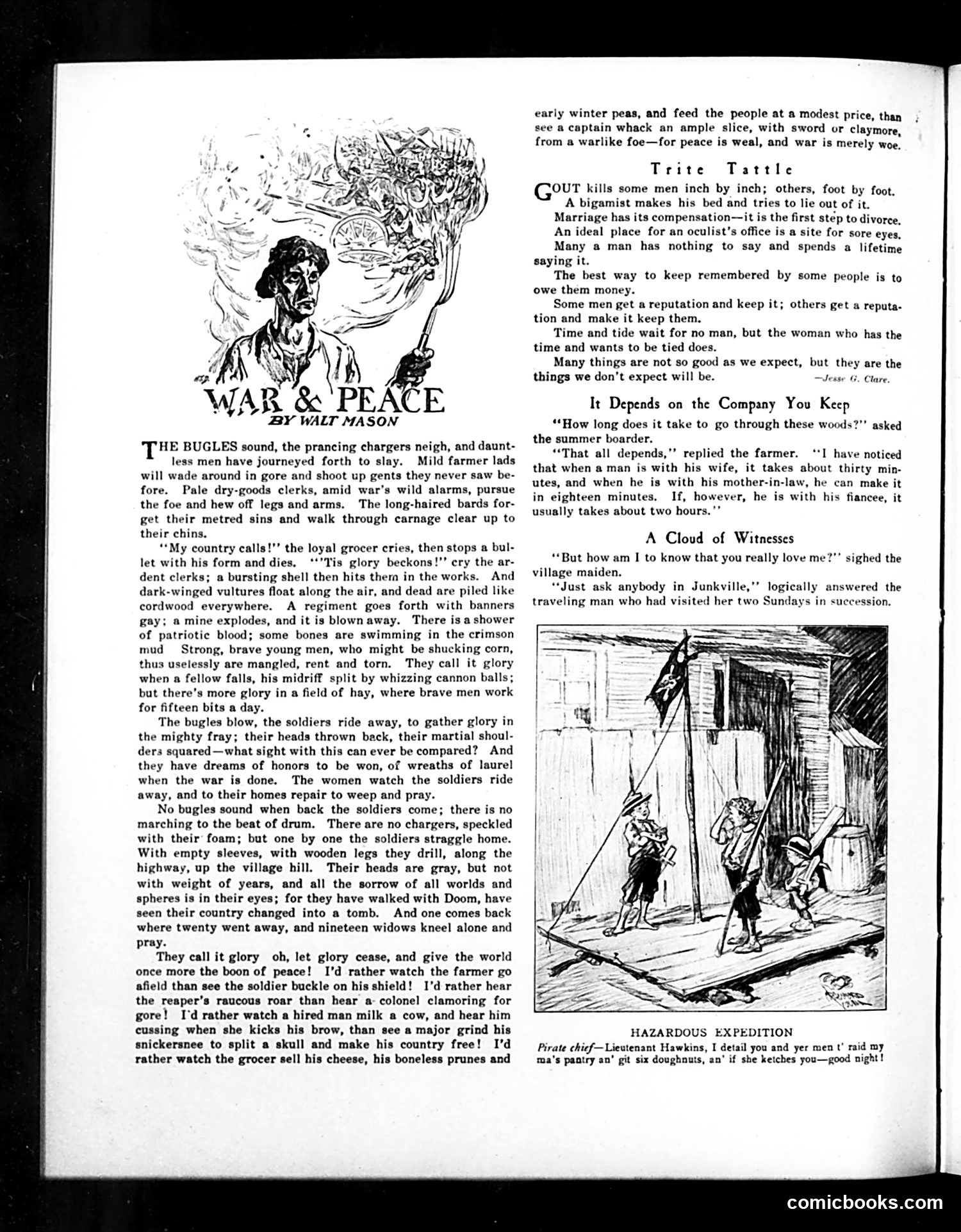
This page presents **anti-war propaganda** through Walt Mason's poem "War & Peace." The piece is a sustained critique of military glorification, contrasting romantic depictions of soldiers with the brutal reality of combat and its aftermath. The poem mocks patriotic rhetoric—farmers and clerks answering "My country calls!"—only to be killed or maimed. Mason emphasizes the disconnect between how society celebrates war ("they call it glory") and its actual consequences: soldiers returning with missing limbs ("empty sleeves, with wooden legs"), psychological trauma ("all the sorrow of all worlds and spheres is in their eyes"), and bereaved families ("nineteen widows kneel alone and pray"). The satire's punch lies in Mason's repeated assertion that **peaceful labor is superior to military service**—he'd rather see a hired man milk a cow or a grocer sell cheese than witness soldiers in combat. The accompanying illustrations and "Trite Tattle" section provide lighter satirical commentary on social foibles, but the main piece reflects early-20th-century American pacifism and working-class skepticism toward military adventure.
📄 Transcribed text from this page (OCR, searchable)
Machine-transcribed from the original scan — historical spelling and the odd misread are preserved.
sd BY WALT MASON THE BUGLES sound, the prancing chargers neigh, and daunt- less men have journeyed forth to slay. Mild farmer lads will wade around in gore and shoot up gents they never saw be- fore. Pale dry-goods clerks, amid war's wild alarms, pursue the foe and hew off legs and arms. The long-haired bards for- get their metred sins and walk through carnage clear up to their chins, “*My country calls!’’ the loyal grocer cries, then stops a bul- let with his form and dies, ‘‘’Tis glory beckons!’’ cry the ar- dent clerks; a bursting shell then hits them in the wot And dark-winged vultures float along the air, and dead are piled like cordwood everywhere. A regiment goes forth with banners gay; a mine explodes, and it is blown away. There is a shower of patriotic blood; some bones are swimming in the crimson mud Strong, brave young men, who might be shucking corn, thus uselessly are mangled, rent and torn. They call it glory when a fellow falls, his midriff split by whizzing cannon balls; but there’s more glory in a field of hay, where brave men work for fifteen bits a day. The bugles blow, the soldiers ride away, to gather glory in the mighty fray; their heads thrown back, their martial shoul- ders squared—what sight with this can ever be compared? And they have dreams of honors to be won, of wreaths of laurel when the war is done. The women watch the soldiers ride away, and to their homes repair to weep and pray. No bugles sound when back the soldiers come; there is no marching to the beat of drum. There are no chargers, speckled with their foam; but one by one the soldiers straggle home. With empty sleeves, with wooden legs they drill, along the highway, up the village hill. Their heads are gray, but not with weight of years, and all the sorrow of all worlds and spheres is in their eyes; for they have walked with Doom, have seen their country changed into a tomb. And one comes back where twenty went away, and nineteen widows kneel alone and pray. They call it glory oh, let glory cease, and give the world once more the boon of peace! I'd rather watch the farmer go afield than see the soldier buckle on his shield! I'd rather hear the reaper’s raucous roar than hear a- colonel clamoring for gore! I'd rather watch a hired man milk a cow, and hear him cussing when she kicks his brow, than see a major grind his snickersnee to split a skull and make his country free! I’d rather watch the grocer sell his cheese, his boneless prunes and early winter peas, and feed the people at a modest price, than see a captain whack an ample slice, with sword or claymore, from a warlike foe—for peace is weal, and war is merely woe. Trite Tattle OUT kills some men inch by inch; others, foot by foot. A bigamist makes his bed and tries to lie out of it. Marriage has its compensation—it is the first step to divorce, An ideal place for an oculist’s office is a site for sore eyes, Many a man has nothing to say and spends a lifetime saying it. The best way to keep remembered by some people is to owe them money. Some men get a reputation and keep it; others get a reputa- tion and make it keep them, Time and tide wait for no man, but the woman who has the time and wants to be tied does. Many things are not so good as we expect, but they are the things we don’t expect will be. —Jesse G. Clare. It Depends on the Company You Keep “How long does it take to go through these woods?” asked the summer boarder. “That all depends,’’ replied the farmer. ‘‘l have noticed that when a man is with his wife, it takes about thirty min- utes, and when he is with his mother-in-law, he can make it in eighteen minutes, If, however, he is with his fiancee, it usually takes about two hours.’’ A Cloud of Witnesses “But how am I to know that you really love me?’ village maiden. “Just ask anybody traveling man who had v sighed the Junkville,’” logically answered the ited her two Sundays in succession. HAZARDOUS EXPEDITION Pirate chief—Liewtenant Hawkins, I detail you and yer men t' raid my ma's pantry an’ git six doughnuts, an’ if she ketches you—good night! comicbooks.com