
A complete issue · 24 pages · 1914
Judge — July 4, 1914
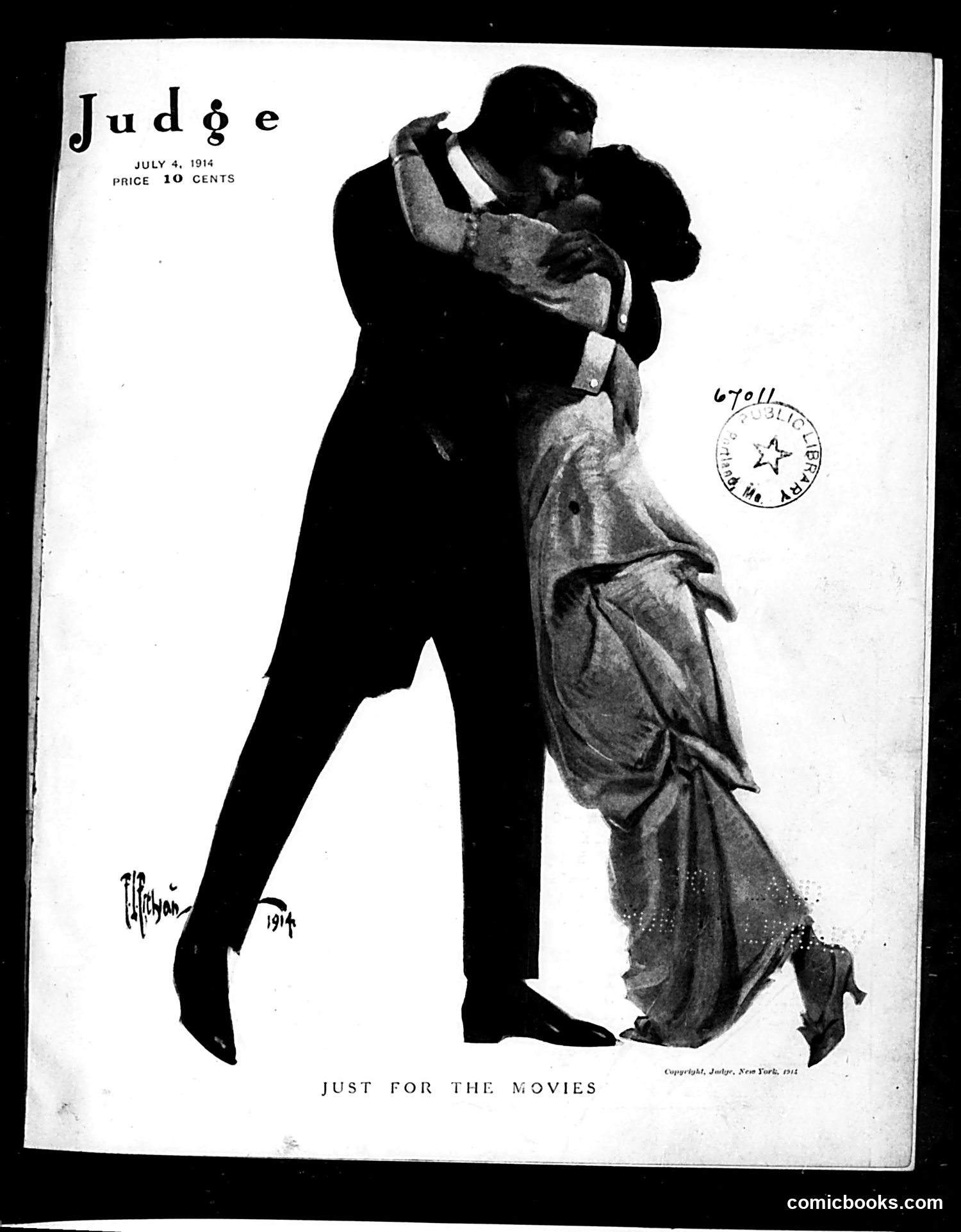
This cover illustration titled "Just for the Movies" depicts a man in formal attire dramatically lifting a woman in an exaggerated romantic pose. The image appears to satirize silent film conventions of the era, particularly the overwrought, theatrical acting styles popular in early cinema. The dramatic staging and emphatic body language parody how movie actors performed exaggerated emotions for the camera—movements that would read as absurdly hammy to live audiences but appeared suitably dramatic on screen. The "Judge" magazine logo and 10-cent price reflect this as an early 20th-century American satirical publication. The cartoonist's signature (appears to be "Hayman") dates it 1914, when silent film was still relatively new and such theatrical exaggeration was standard practice in the medium.
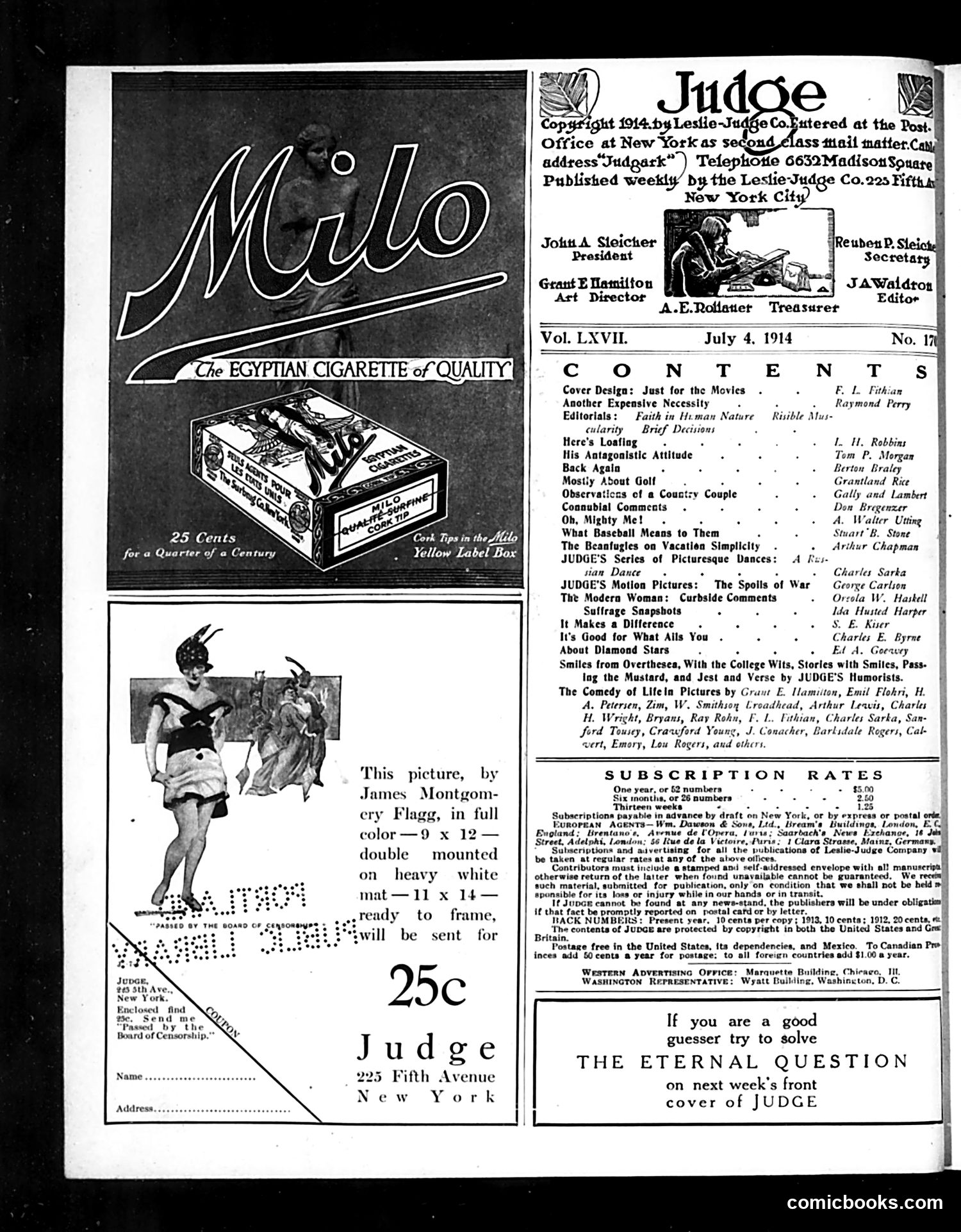
This page is primarily **advertising and table of contents**, not political satire. The left side features a Millo Egyptian cigarette ad (25 cents) and below it a colorful illustration offering a framed picture by James Montgomery Flagg for the same price. The right side lists the magazine's contents and masthead. Notable article titles suggest typical Judge humor: "Here's Loafing," "Mostly About Golf," and "What Baseball Means to Them." The only potentially satirical element is a small teaser at bottom: "THE ETERNAL QUESTION on next week's front cover of JUDGE"—which suggests upcoming commentary on contemporary issues, though specifics aren't revealed here. Overall, this is a standard magazine cover/contents page from 1914.
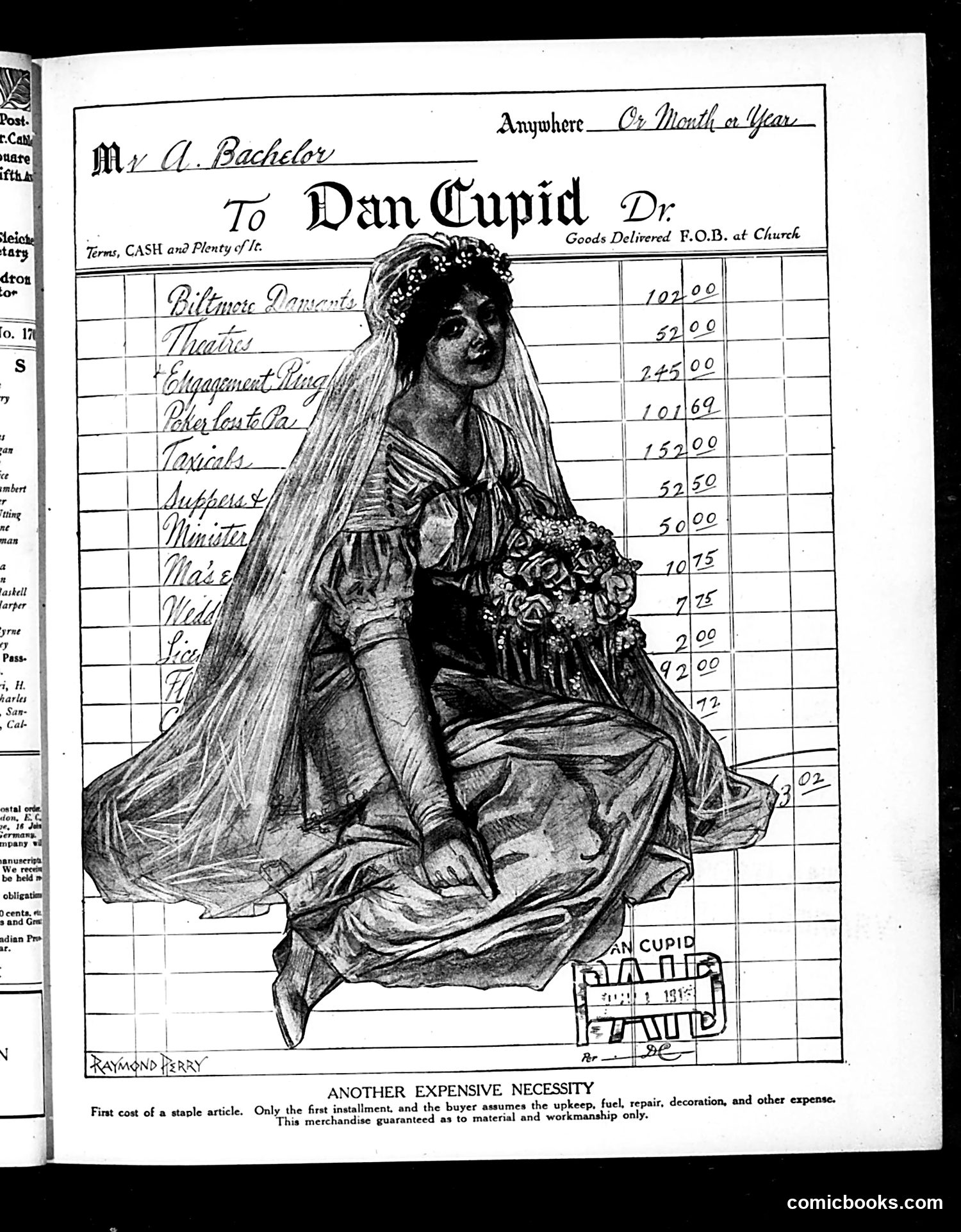
This is a satirical advertisement disguised as a mock invoice or prescription. A bride figure labeled "Dan Cupid Dr" presents an itemized bill for wedding expenses—"Bilimere Presents," "Theatres," "Engagement Ring," "Parker Pen," etc.—with escalating costs totaling hundreds of dollars. The satire targets the commercial exploitation of romance and marriage. "Dan Cupid" (playing on Cupid, the god of love) bills customers for the various "necessities" of courtship and weddings, suggesting that romantic love has become merely an expensive transaction. The figure signed "Raymond Perry" uses the visual pun of treating love itself as a medical service requiring expensive treatments—mocking how capitalism commodifies even intimate human experiences like marriage and courtship.
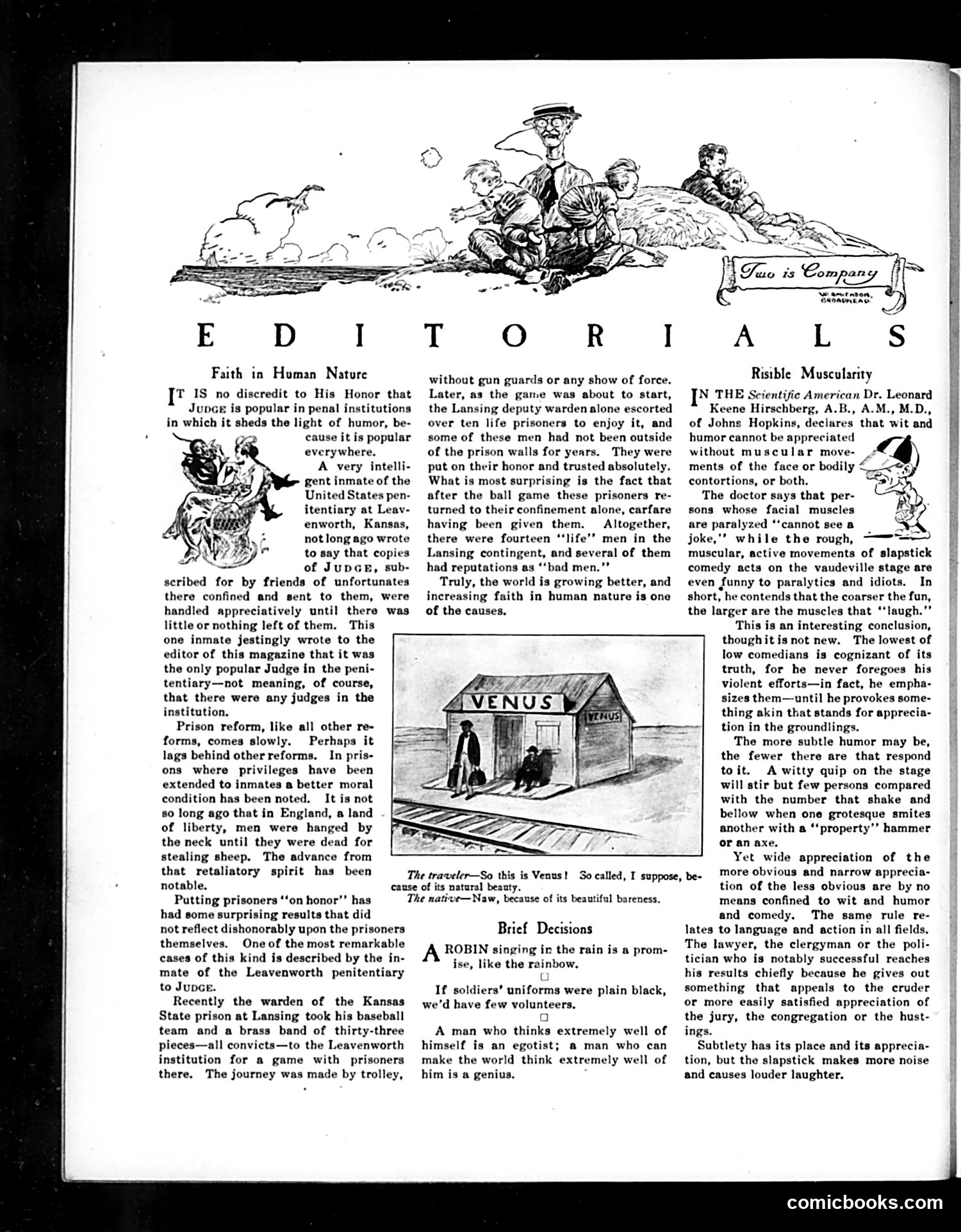
This page from *Judge* magazine contains three distinct pieces: 1. **"Faith in Human Nature"** (left): Satirizes the Leavenworth penitentiary's decision to allow 33 convicted prisoners—including some with "bad" reputations—to play baseball unsupervised. The editorial mocks this trust-based reform approach, suggesting it's naive to expect criminals to behave honorably without guards. The illustration shows prisoners being escorted by staff. 2. **"Venus" illustration** (center): A simple joke about a shelter labeled "Venus," with the warden explaining it's so-named for its "beautiful bareness." 3. **"Risible Muscularity"** (right): References Dr. Leonard Keene Hirschfeld's claims that facial muscles cannot produce slackstick comedy. The piece argues subtle humor requires appreciation of physical comedy's subtlety—that low comedians overestimate their craft's effectiveness compared to sophisticated wit. The page reflects Gilded Age debates about prison reform and entertainment standards.
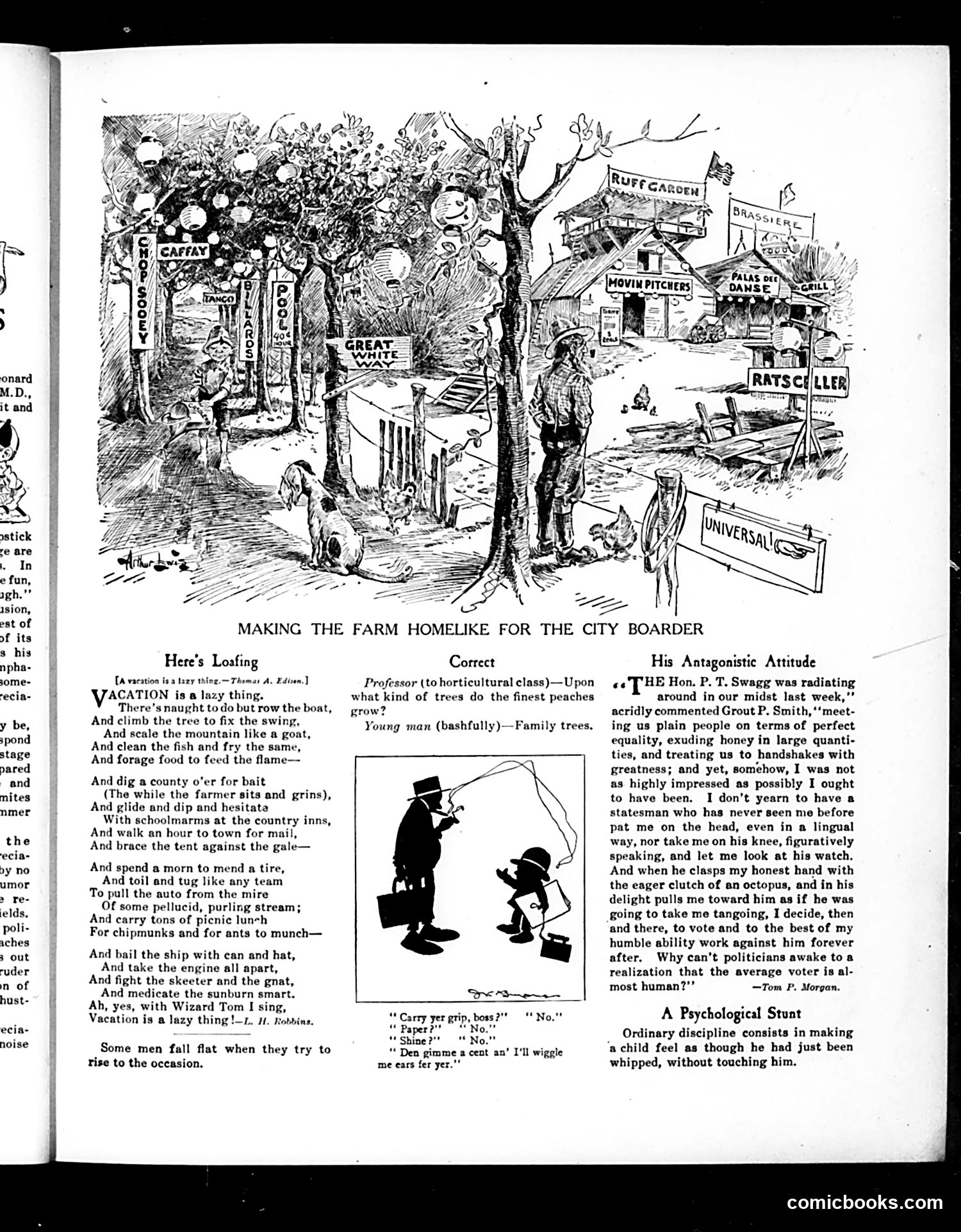
The top illustration satirizes efforts to make farms attractive to city visitors, showing various commercial establishments (cafes, dance halls, etc.) cluttering a rural landscape—mocking the commercialization and artificial "improvement" of authentic farm life. Below that, "Here's Loafing" is a poem romanticizing vacation idleness, contrasted with "Correct" advice from a professor recommending productive family tree-planting. The silhouette cartoon shows a parent disciplining a child while asking "Carry yet grin, boss?" and "No"—illustrating psychological child-rearing theory about "moral discipline" achieved through non-physical punishment (emotional distance rather than corporal contact). "His Antagonistic Attitude" appears to be a political anecdote about an unnamed Hon. P.T. Swagg, criticizing populist rhetoric about "perfect equality" as inappropriately familiar from politicians toward ordinary citizens.
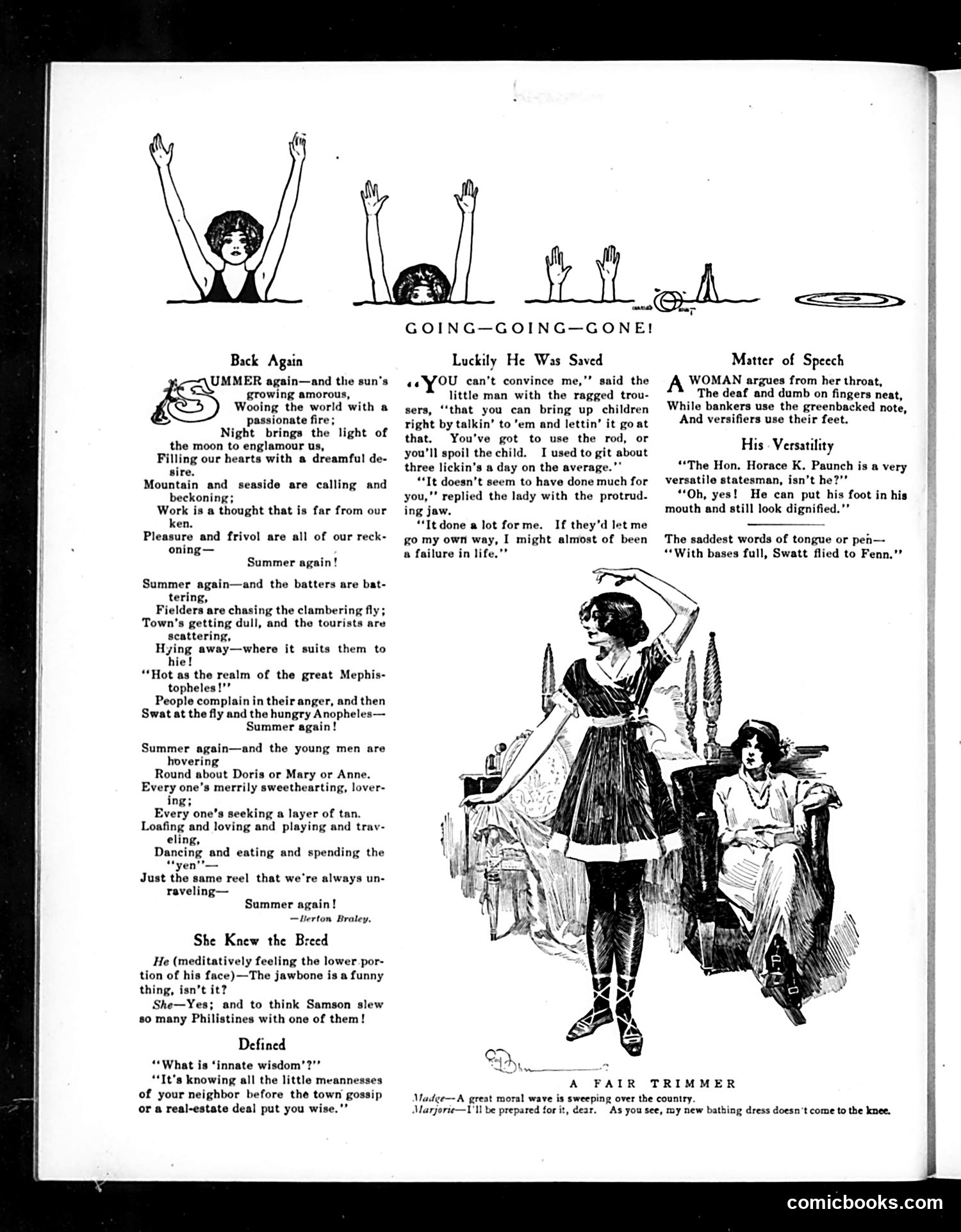
This page contains multiple satirical pieces typical of early 20th-century American humor: **"Back Again"** and **"Summer Again"** poems mock the predictable seasonal rituals—tourists fleeing cities, young men courting girls, complaints about heat and insects (notably "Anopheles," the malaria mosquito). **"Luckily He Was Saved"** satirizes working-class attitudes toward corporal punishment. A poorly-dressed man argues that beatings helped him avoid failure, while a woman with a prominent jaw (a common period caricature trait suggesting lower-class status) skeptically suggests they haven't improved him much. **"A Fair Trimmer"** jokes about women's hemlines, referencing contemporary moral anxiety about bathing suits. "Madge" boasts her new suit doesn't reach the knee—scandalous by period standards—presenting this as a response to a "moral wave." The shorter pieces ("She Knew the Breed," "Defined," "His Versatility") are typical one-liner gags about jawbones, gossip, and political hypocrisy. The page reflects Judge's focus on middle-class social commentary and light satire rather than serious political critique.
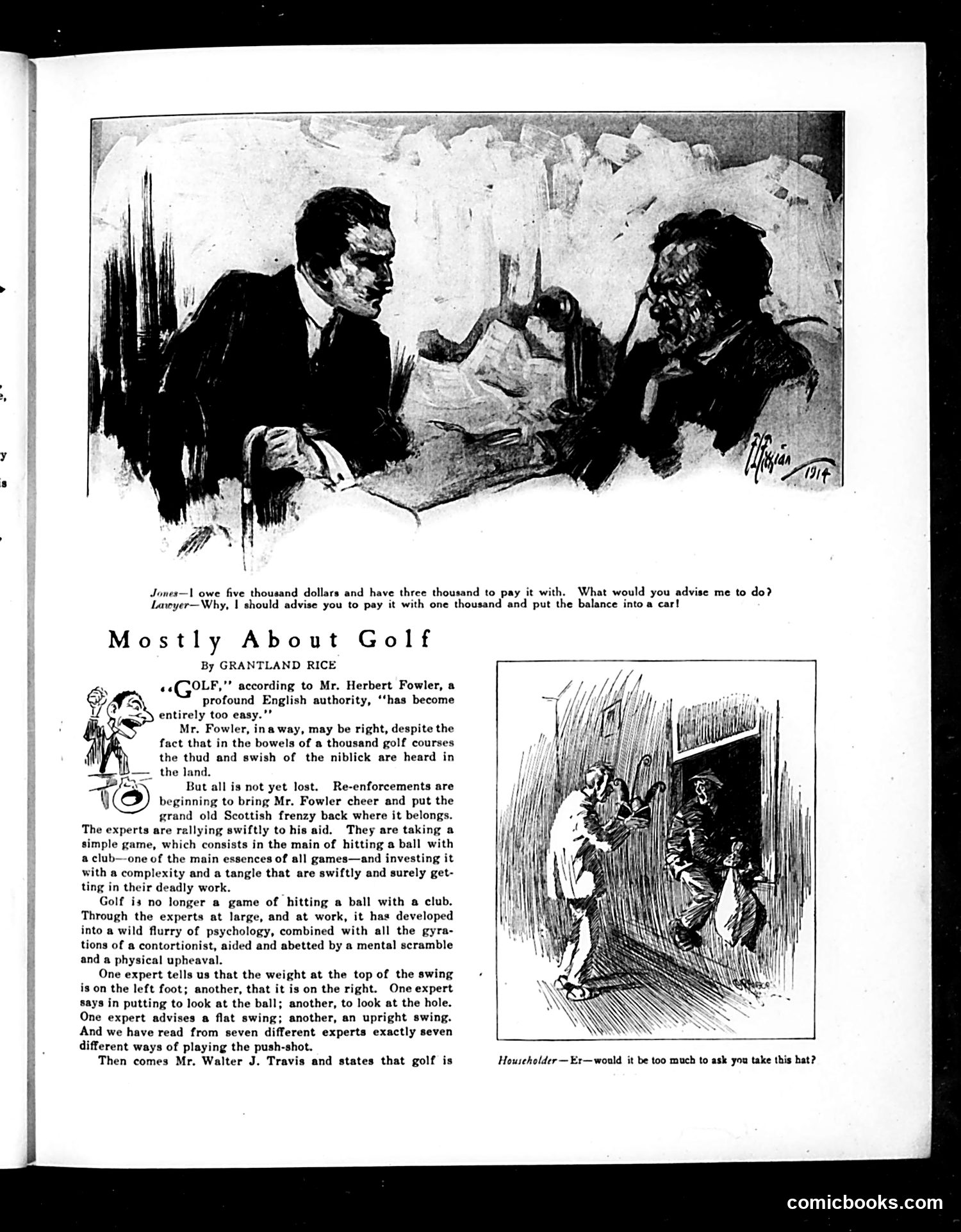
This *Judge* magazine page satirizes golf's transformation from a simple sport into an absurdly complicated pursuit. Columnist Grantland Rice notes that English authority Herbert Fowler claims golf "has become entirely too easy," yet ironically, golf experts have made it impossibly complex by contradicting each other on fundamentals—where weight belongs during a swing, whether to look at the ball or hole when putting, which swing style to use. Rice's point: experts have turned an easy game into a "wild flurry of psychology" full of conflicting advice and physical contortions. The top cartoon jokes about financial desperation—a man owing $5,000 with only $3,000 to pay gets absurd legal advice to buy a car instead, satirizing poor financial decision-making during this prosperous era. The bottom cartoon's meaning is unclear from the visible caption fragment.
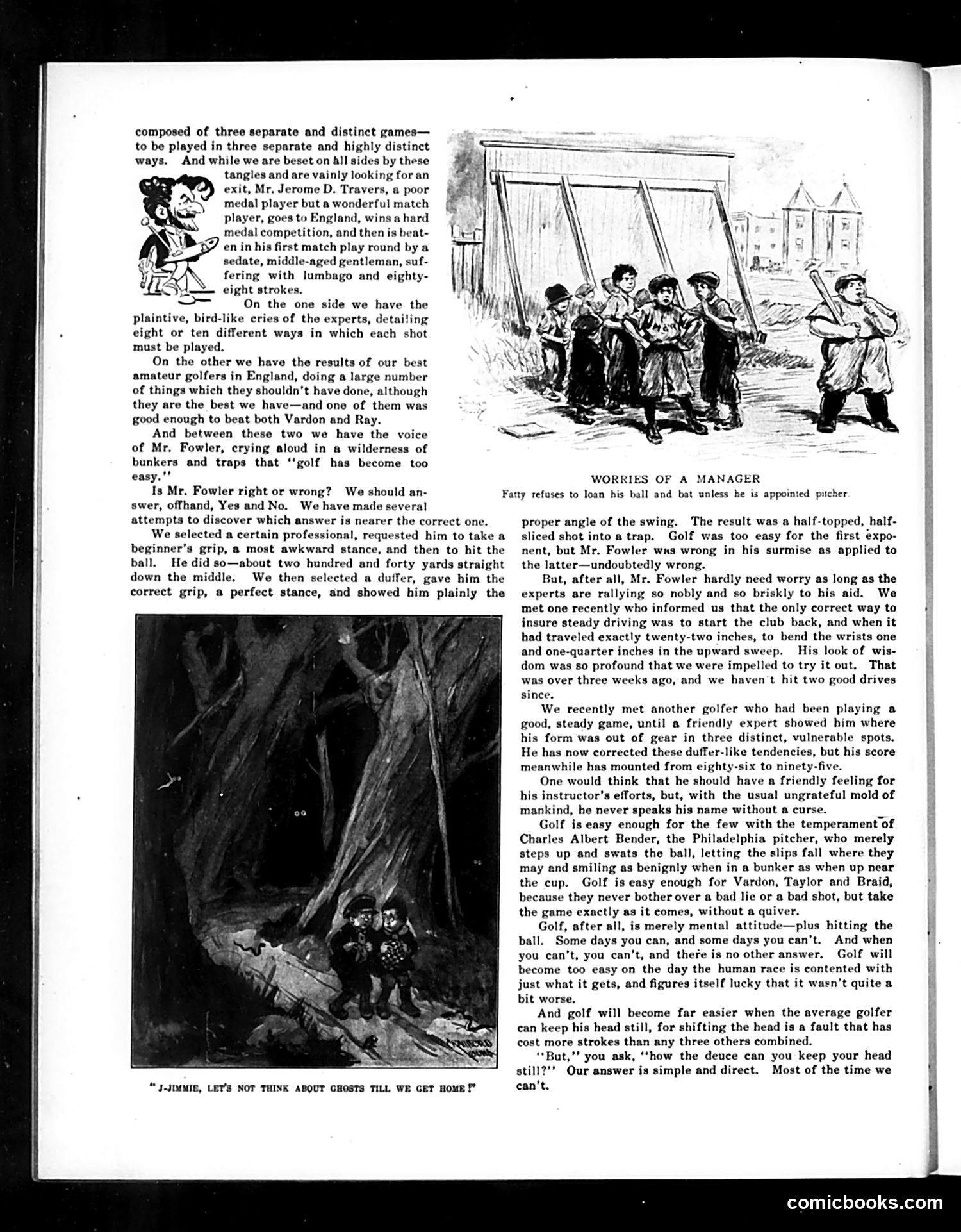
This page satirizes debates among American golfers circa 1910s about whether golf has become too easy. The article references Jerome D. Travers (a prominent amateur golfer of the era) and critiques expert instruction's contradictory advice. The cartoons illustrate the satire's central joke: golf is simultaneously "too easy" and "too hard" depending on who plays it. The top illustration shows children playing casually ("Worries of a Manager"), mocking how experts overcomplicate the game. The bottom cartoon ("Let's not think about ghosts till we get home") appears to use supernatural anxiety as metaphor for golfers' mental obstacles. The article's target: golf professionals and "experts" who paralyze amateur players with contradictory technical instruction—so precise (bend wrists "one and one-quarter inches") that following their advice actually worsens performance. The piece argues golf's true difficulty is psychological, not mechanical, exemplified by legendary hitters like Charles Albert Bender who succeed through simplicity and indifference.
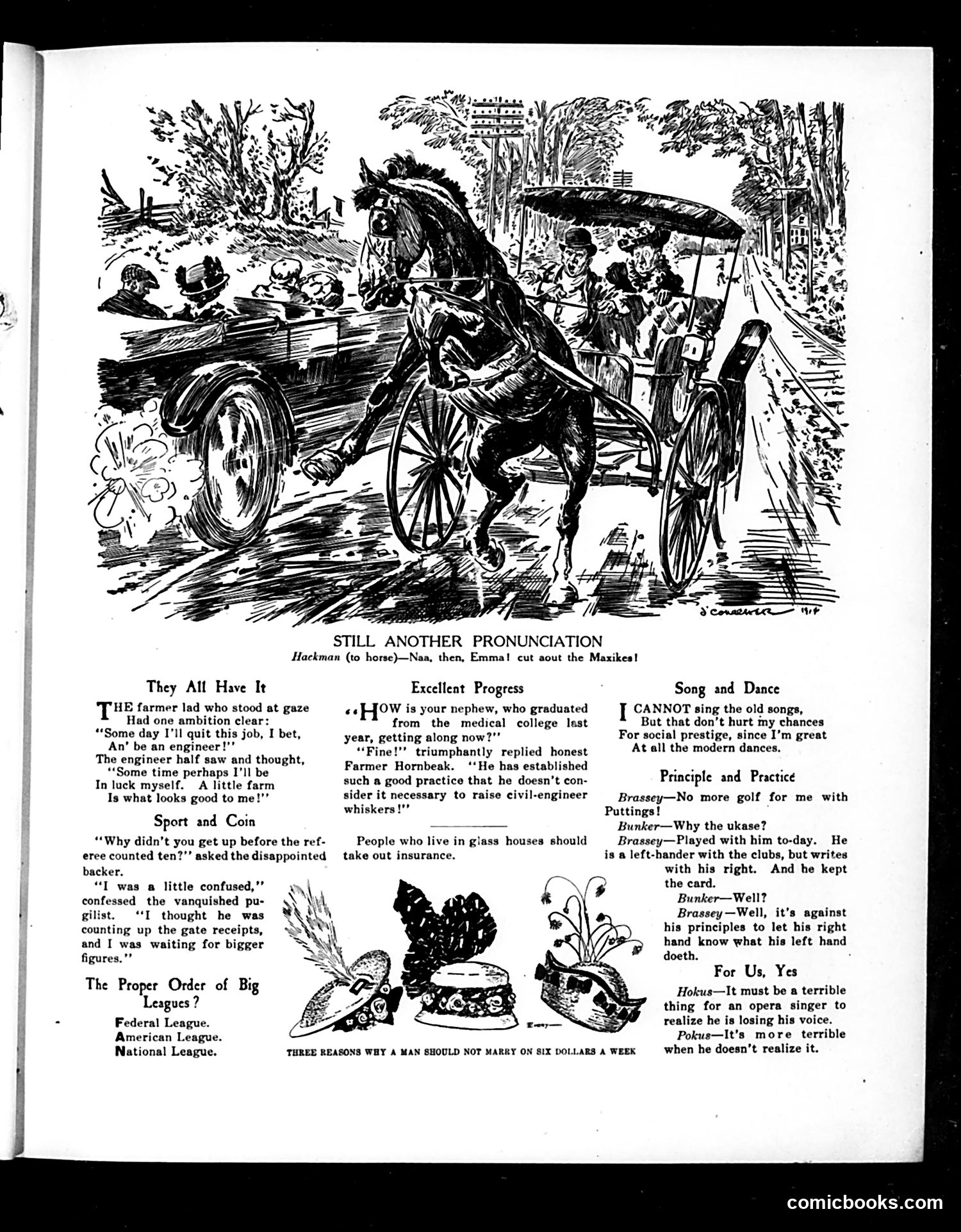
This is a humor page containing multiple unrelated jokes and satirical pieces typical of early 20th-century Judge magazine. The top cartoon depicts a London hackman (cab driver) commanding his horse "Emma" to stop making "Maxikes" (likely a mispronunciation or reference to some behavior)—satirizing working-class dialect and horse-drawn cab culture. The jokes below mock various social pretensions and ironies: - **"They All Have It"** and **"Excellent Progress"** play on class aspiration—farmers want to be engineers and vice versa; a doctor becomes successful enough to abandon the appearance of hard work ("civil-engineer whiskers"). - **"Sport and Coin"** satirizes boxing culture and corrupt fight promoters focused on gate receipts rather than the sport. - **"The Proper Order of Big Leagues"** appears to rank professional baseball leagues, likely commentary on the short-lived Federal League (1914-1915). - Later pieces joke about modern social dancing replacing singing ability, golf etiquette, and operatic decline—all targeting upper-middle-class pretension and hypocrisy.
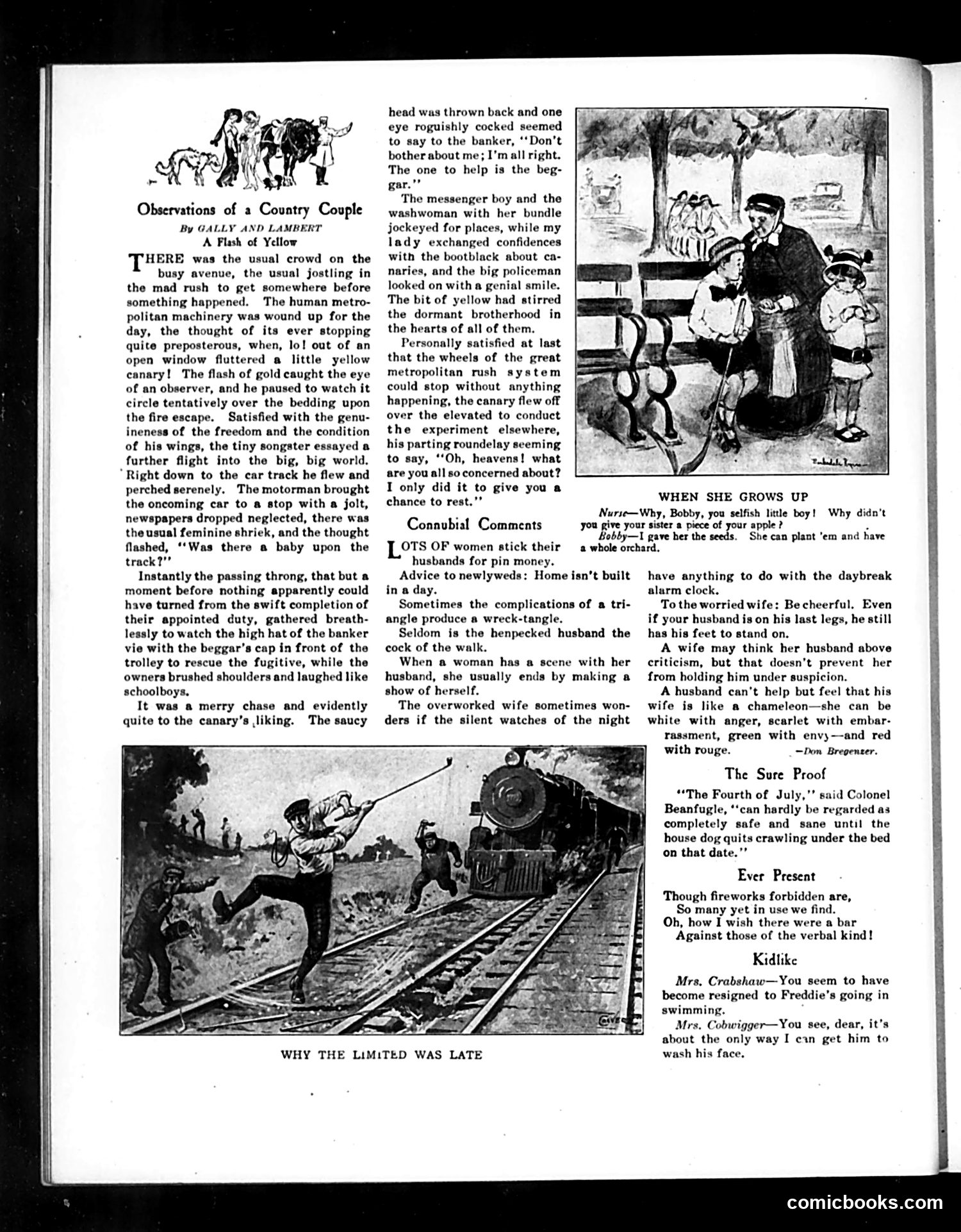
This page from Judge contains satirical commentary on urban life and marriage, typical of early 20th-century American humor. **"A Flash of Yellow"** depicts a canary escaping from a city apartment, causing a momentary pause in metropolitan rush-hour chaos. The satire mocks the frenetic pace of urban life—bankers, beggars, messenger boys, and washerwomen all stop their daily routines. The humor lies in the irony that a tiny bird can unite disparate social classes ("stirred the dormant brotherhood") and halt the relentless machinery of city life. The canary's cocky attitude ("Don't bother about me") and final message about "giving you a chance to rest" satirize how modern life desperately needs such interruptions. **"Connubial Comments"** and **"Kidlike"** offer brief jokes about marriage and domestic life—wives' behavior, husbands' inadequacies, and child-rearing—reflecting period stereotypes about gender roles and family dynamics. **"Why the Limited Was Late"** cartoon (bottom) appears to depict a train accident or delay caused by street-level chaos, likely satirizing the conflict between modern transportation and urban congestion.
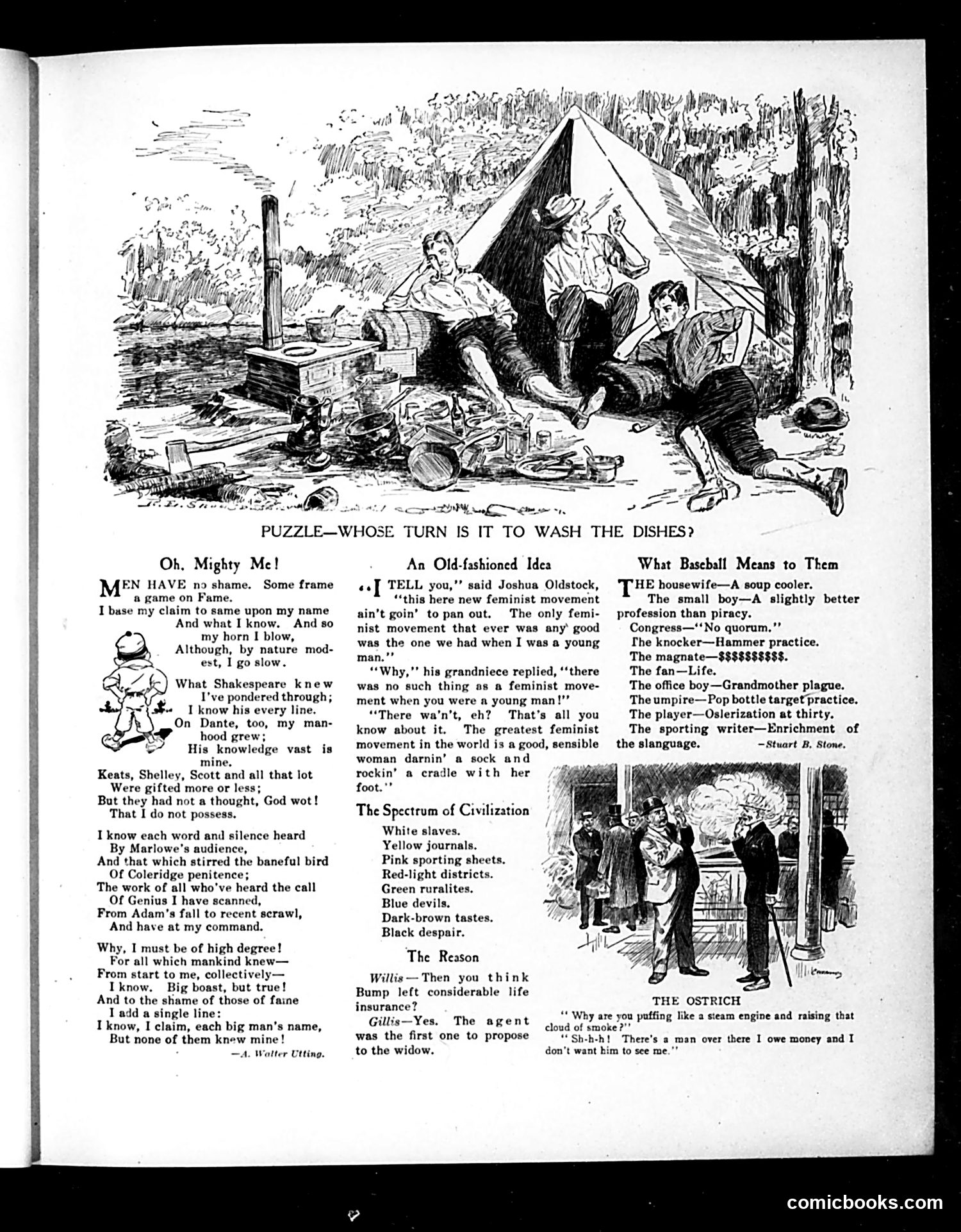
This page contains several satirical pieces typical of early 20th-century American humor: **Top cartoon ("Puzzle—Whose Turn Is It to Wash the Dishes?")**: Shows camping scenes illustrating domestic role confusion—likely satirizing the emerging feminist movement by suggesting women's traditional household duties (dishwashing) are unavoidable even in leisure settings. **"Oh, Mighty Me!"**: A poem mocking intellectual pretension and name-dropping—the speaker boasts of knowing all great literature and famous people, yet ironically nobody knows *him*. It's satire of self-important bluffing. **"An Old-fashioned Idea"**: Joshua Oldstock claims the best feminism is a woman "darnin' a sock and rockin' a cradle"—conservative mockery of the "new feminist movement" by romanticizing traditional domesticity. **"The Spectrum of Civilization"** and **"The Reason"**: Brief satirical lists and jokes about contemporary society and human nature. **"The Ostrich"**: A man hiding to avoid a creditor, illustrating debt avoidance through cowardice. Overall, the page reflects Judge's satirical stance on feminism, pretension, and social change circa 1910s-1920s.
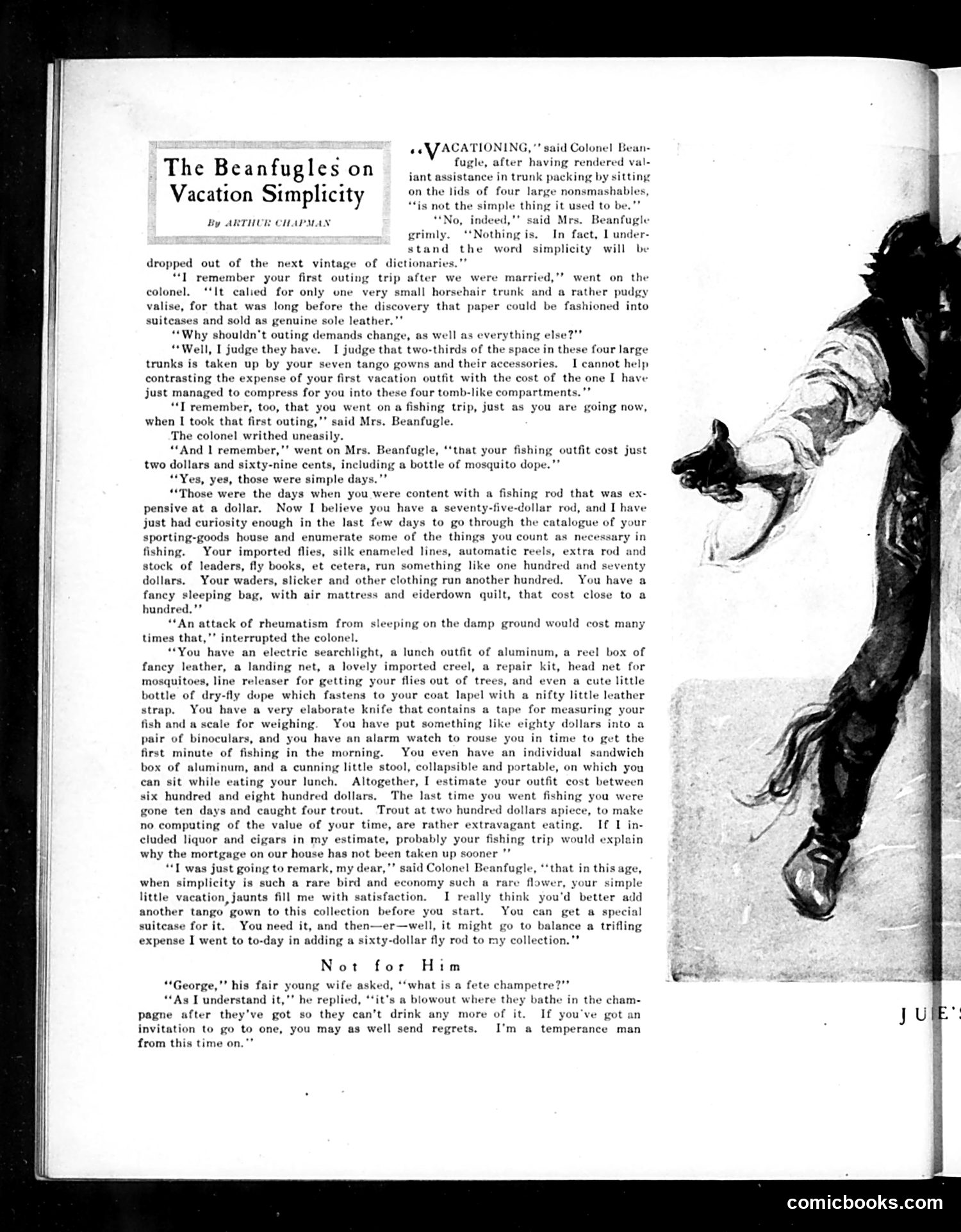
This is a humorous domestic dialogue by Arthur Chapman satirizing modern consumer excess disguised as simplicity. Colonel Beanfugle claims to value "simplicity," but Mrs. Beanfugle systematically catalogs how his actual vacation expenses have ballooned absurdly. The satire targets early 20th-century leisure culture: whereas his first fishing trip cost under $3 with a dollar rod, his current outfit totals $600-800, including $75 rods, $80 binoculars, electric searchlights, and elaborate aluminum accessories. He caught four trout in ten days—costing $200 per fish. The joke exposes the contradiction between professed values and actual behavior. Modern readers should note the era's emerging consumer goods marketed as "necessities" for genteel leisure activities. The cartoon (right side, shows a couple with luggage) and text together mock how vacationing had become an expensive status display, not genuine simplicity.
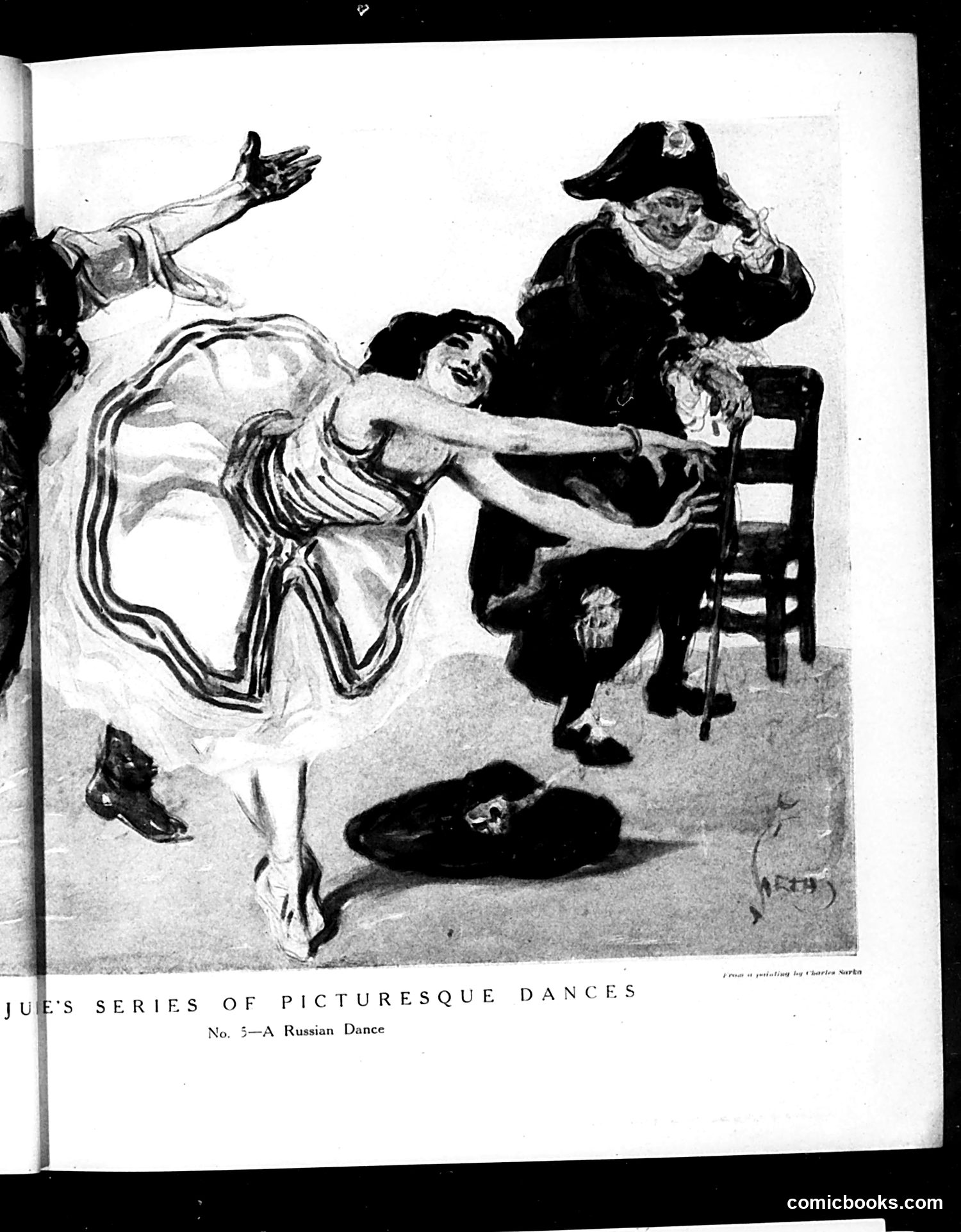
This is part of Judge's "Series of Picturesque Dances," specifically depicting "A Russian Dance." The cartoon shows a male dancer in an exaggerated pose—contorted and acrobatic—while an older woman (likely representing a Russian or Eastern European character, suggested by her headwear and clothing style) watches from a chair with apparent amusement or approval. The satire likely plays on American stereotypes about Russian or Eastern European cultural practices and dance styles, portraying them as exotic, physically extreme, or comedically unfamiliar to American audiences. The series format suggests Judge was creating entertainment through ethnic or national caricatures, a common satirical approach in early American magazines. The specific joke hinges on the contrast between the performer's contorted athleticism and the onlooker's reaction.
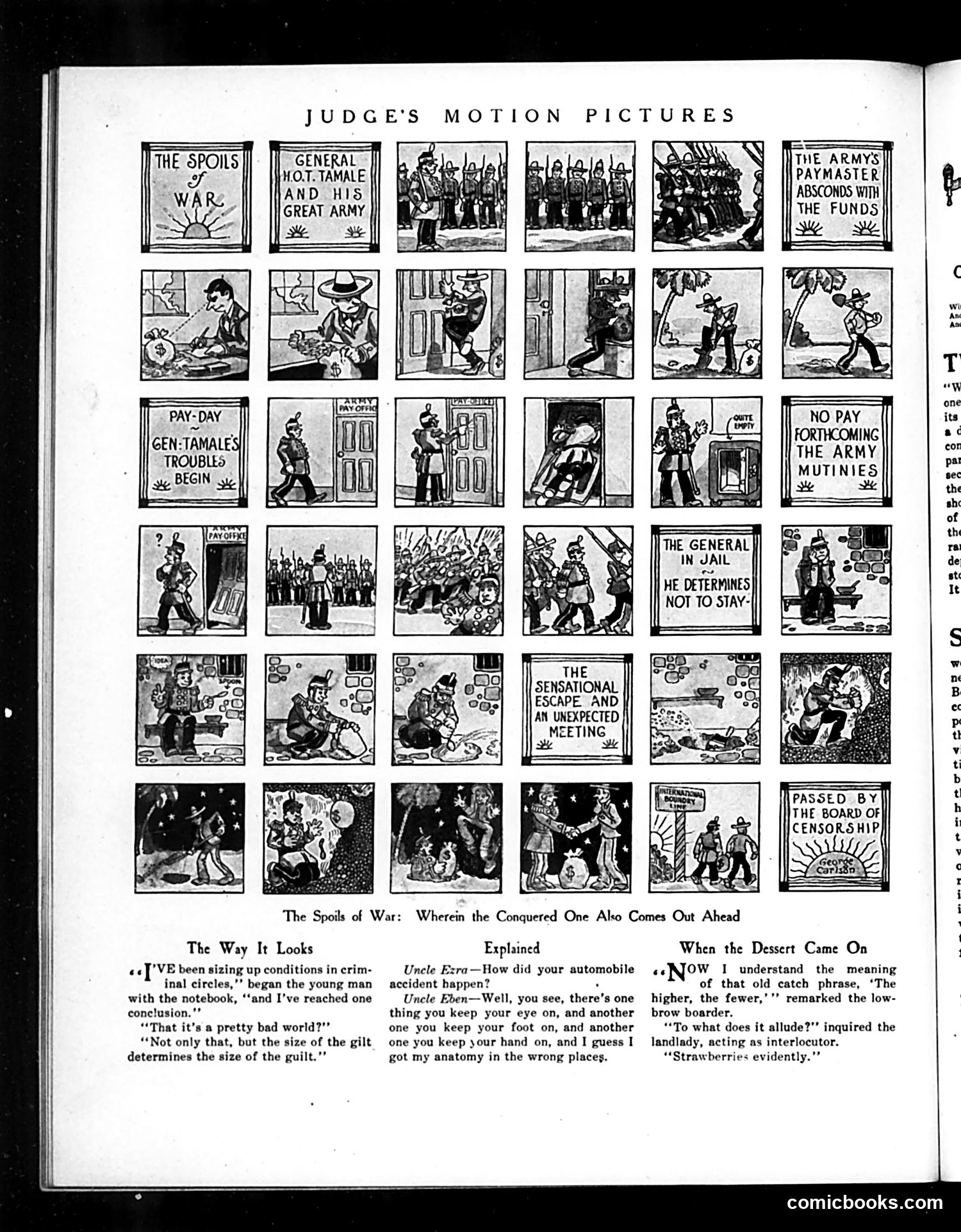
This page presents a multi-panel comic strip about military corruption during wartime. The narrative follows a general (labeled "H.O.T. Tamale") whose army experiences financial scandal: the paymaster absconds with funds, triggering a mutiny. The general is imprisoned but escapes dramatically. The satire targets military mismanagement and corruption—the title "Wherein the Conquered One Also Comes Out Ahead" suggests that despite the chaos, corrupt officials profit while soldiers suffer. The three captioned dialogues below offer unrelated comic relief: jokes about crime and guilt, a confused dialogue between "Uncle Ezra" and "Uncle Eben" about a car accident caused by anatomical confusion, and a pun about strawberries being "higher" and "fewer" (smaller/more expensive) desserts. The page satirizes institutional breakdown and graft common to wartime administration.
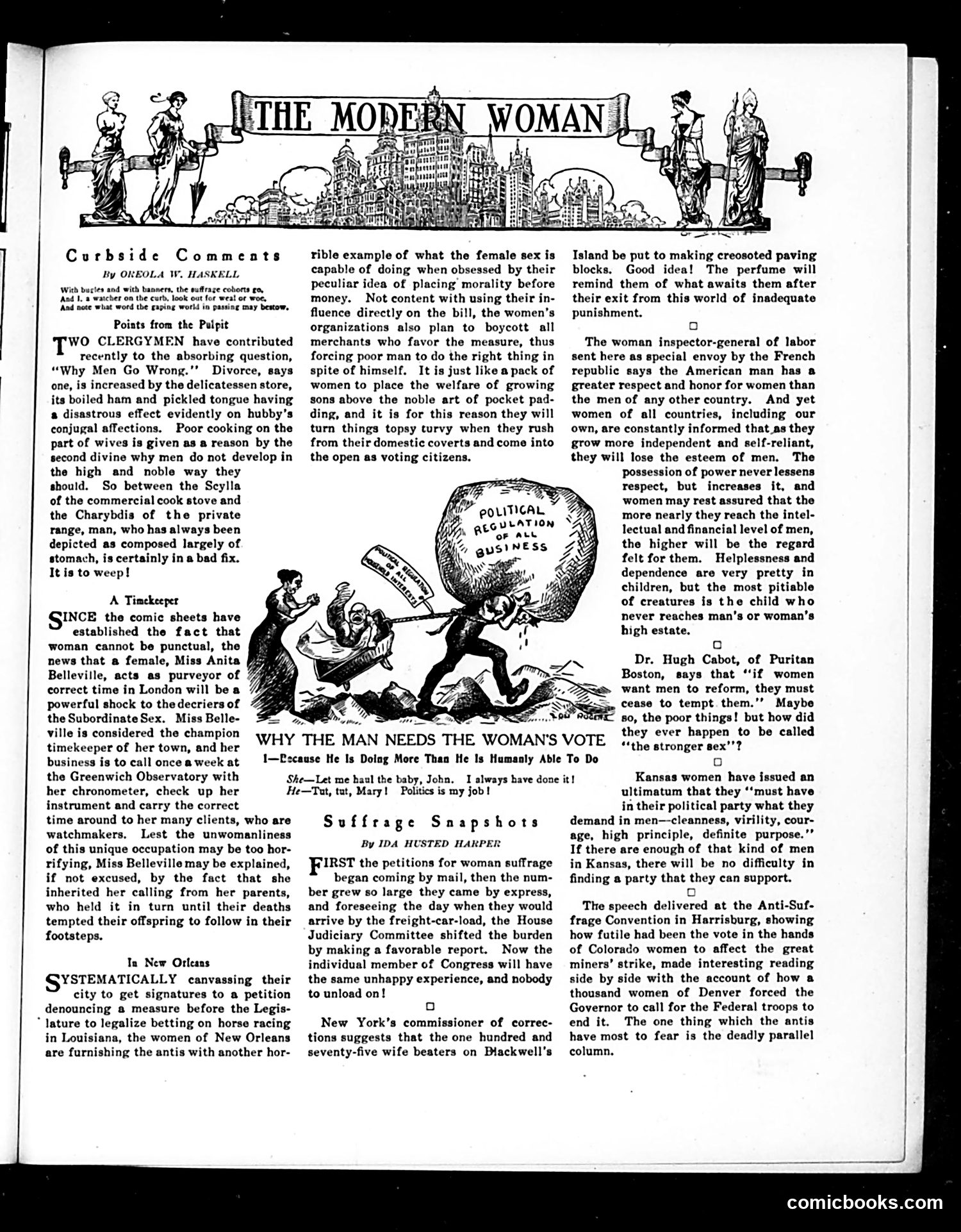
This page contains multiple satirical pieces opposing women's suffrage, circa early 1900s. The main cartoon "Why the Man Needs the Woman's Vote" depicts a man overwhelmed with work, refusing his wife's help because "Politics is my job"—sarcastically suggesting men already handle too much. The text sections mock women activists: clergy blame wives' cooking for men "going wrong"; a female timekeeper in London is presented as shockingly "unfeminine"; New Orleans women opposing legalized horse-racing betting are ridiculed for placing "morality before money" and threatening boycotts. The author portrays suffragettes as meddlesome busybodies who will "turn things topsy turvy" if given voting rights. "Suffrage Snapshots" by Ida Husted Harper sarcastically criticizes the volume of suffrage petitions and notes a French labor inspector praised American men's respect for women—yet women still demand equality. The satire assumes women are inherently unsuited for political participation and overstepping proper domestic roles.
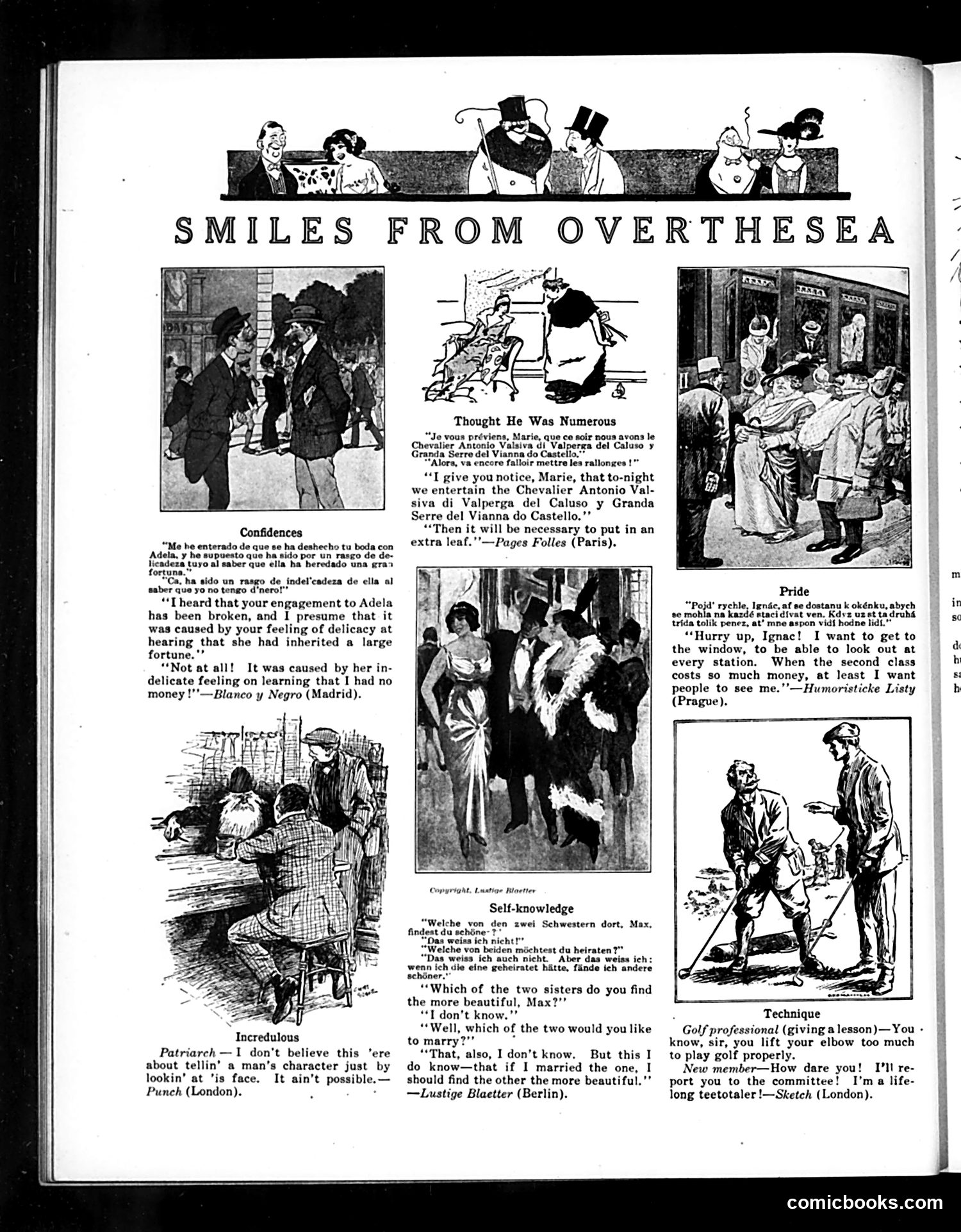
This page compiles brief satirical anecdotes translated from European publications (Madrid, Paris, Berlin, Prague, London). Each cartoon illustrates a social or character observation: **"Confidences"** mocks romantic fortune-hunting: a man assumes his fiancée broke their engagement out of delicacy upon learning she was wealthy—when actually *she* broke it upon learning *he* was poor. **"Thought He Was Numerous"** jokes about a lengthy aristocratic name: a French hostess must add an extra leaf to her dinner table, misunderstanding that the "Chevalier Antonio Valsiva di Valperga..." is one man, not multiple guests. **"Pride"** satirizes working-class pretension: a passenger insists on sitting by the window of an expensive second-class train car specifically so observers will see her traveling in style. **"Self-knowledge"** presents male indecision: a man cannot choose between two sisters, admitting only that whichever he married, he'd find the other more beautiful—a commentary on masculine fickleness. **"Technique"** offers wordplay: a golf instructor's complaint about the student's "elbow" is misheard as criticism of drinking ("teetotaler").
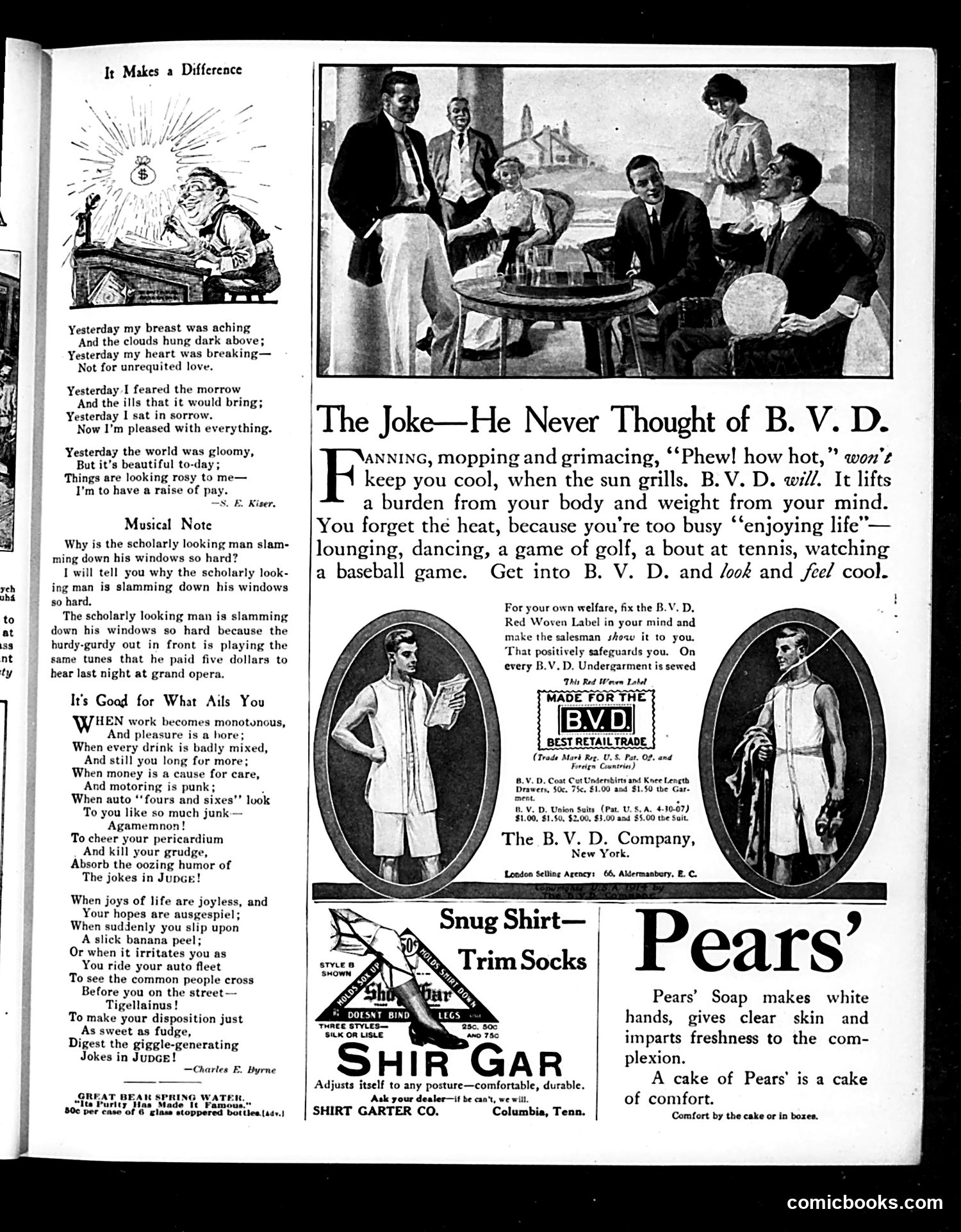
This is primarily an **advertising page** with modest editorial content. The main satire is a brief advertisement for **B.V.D. undergarments** (a real brand), positioned as "The Joke—He Never Thought of B.V.D." The humor is straightforward product marketing: a man complains about summer heat ruining his social activities (golfing, tennis, dancing), until he discovers B.V.D. underwear keeps him cool and comfortable. The "joke" is that this simple solution to his problem never occurred to him. The page also includes: - A sentimental poem about emotional recovery - A "Musical Note" joke about a scholarly man slamming windows (apparently annoyed by street music) - Humorous verses about life's frustrations by Charles E. Byrne - Standard advertisements for **Pears' Soap** and **Shirt Garter** products There are no political cartoons or caricatures. This appears to be a typical early-20th-century magazine layout mixing light humor with commercial advertising.
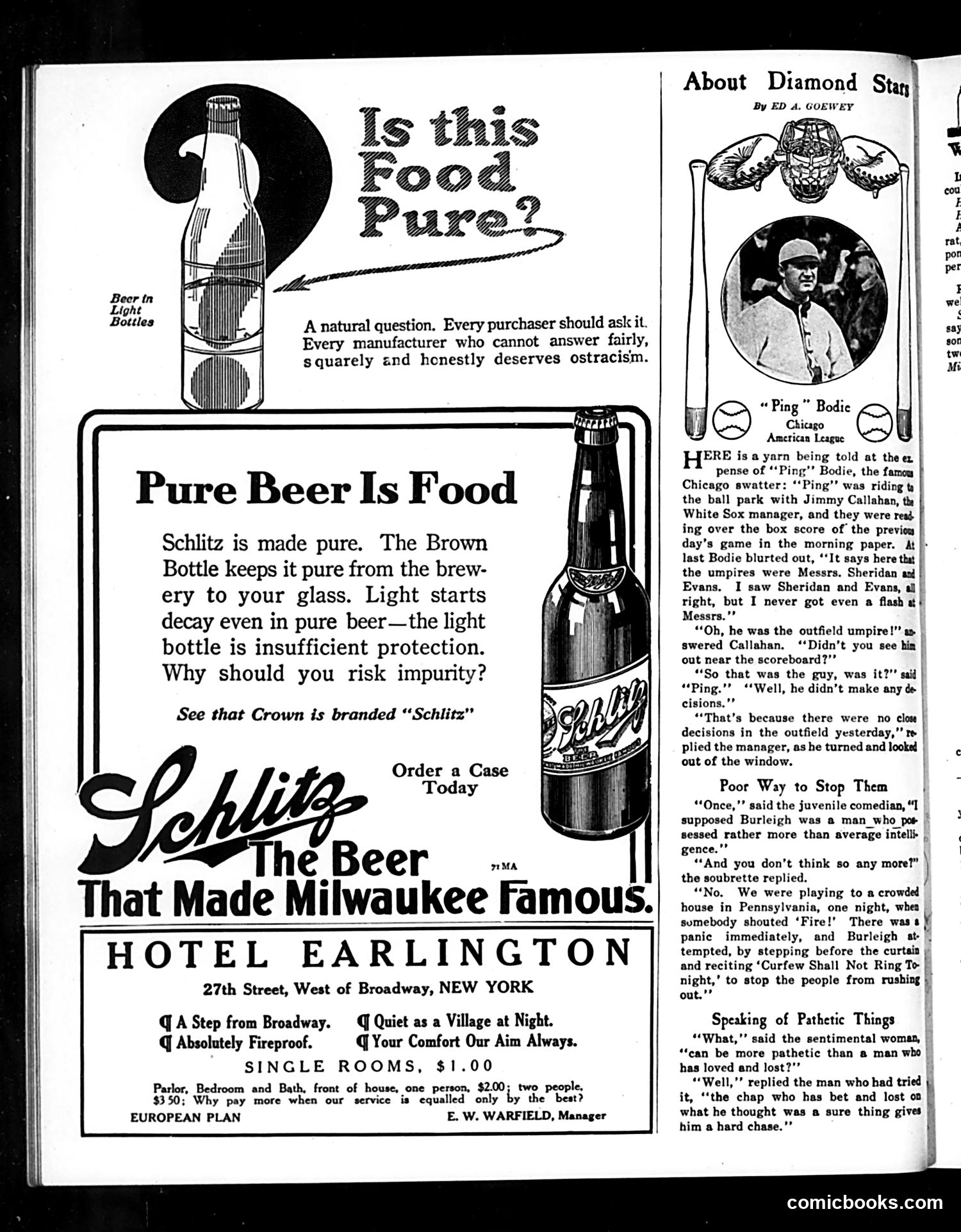
This page contains **primarily advertising** for Schlitz beer and Hotel Earlington, with smaller comic anecdotes in the right column. The **main advertisement** ("Is this Food Pure?") addresses early 20th-century concerns about food purity and adulteration—a genuine public anxiety before modern FDA regulations. Schlitz emphasizes its brown bottle protects beer from light decay, positioning purity as a selling point. The **right column** contains three brief humorous anecdotes: 1. **"Ping" Bodie** (Chicago White Sox player): A joke about a player so inattentive he didn't notice the outfield umpire during a game. 2. **Burleigh theatrical story**: An actor foolishly tries reciting poetry to stop a theater fire panic—mocking his poor judgment. 3. **Pathetic things**: A cynical exchange about romantic loss versus financial loss, suggesting gambling losses are worse than heartbreak. These are typical light comedic filler for Judge magazine—workplace humor, baseball gossip, and vaudeville-style jokes with no apparent political content.
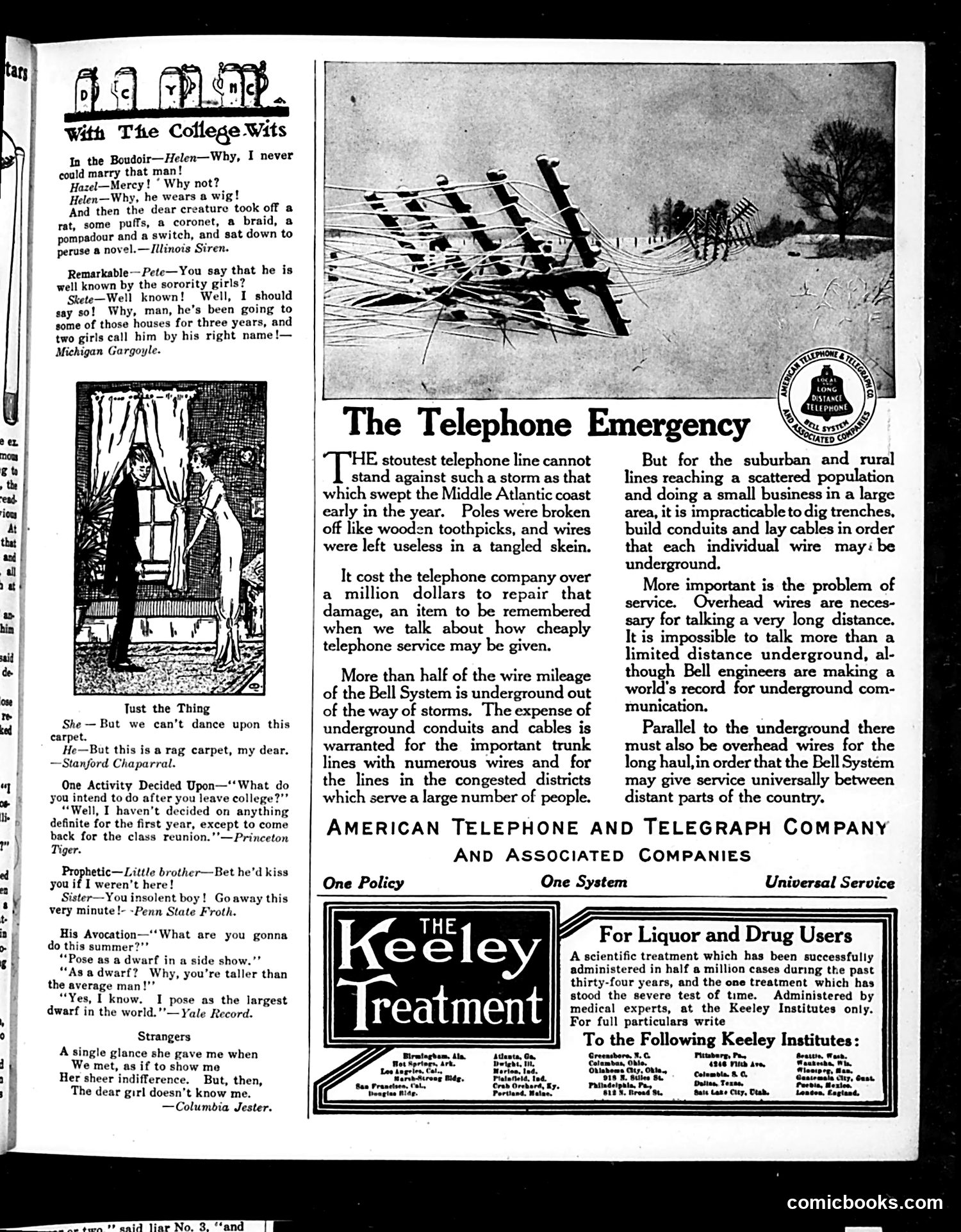
This Judge page contains two unrelated sections: **"With The College Wits"** is a humor section featuring brief jokes from various college publications. The jokes mock college students' pretensions and romantic mishaps—particularly women's elaborate hairstyles (wigs, rats, switches), a man's reputation at sorority houses, and misunderstandings about dancing on "rag" carpets. **"The Telephone Emergency"** is a substantial article justifying AT&T's infrastructure costs. It explains that while underground cables protect telephone lines from storms (citing a million-dollar repair bill from recent Atlantic coast damage), rural and suburban areas cannot afford such infrastructure. The piece argues overhead wires remain necessary for long-distance service across the country. The page also includes period advertisements, notably the Keeley Treatment for alcoholism and drug addiction. The satire here is gentle collegiate humor, while the telephone article serves as corporate messaging defending service rates.
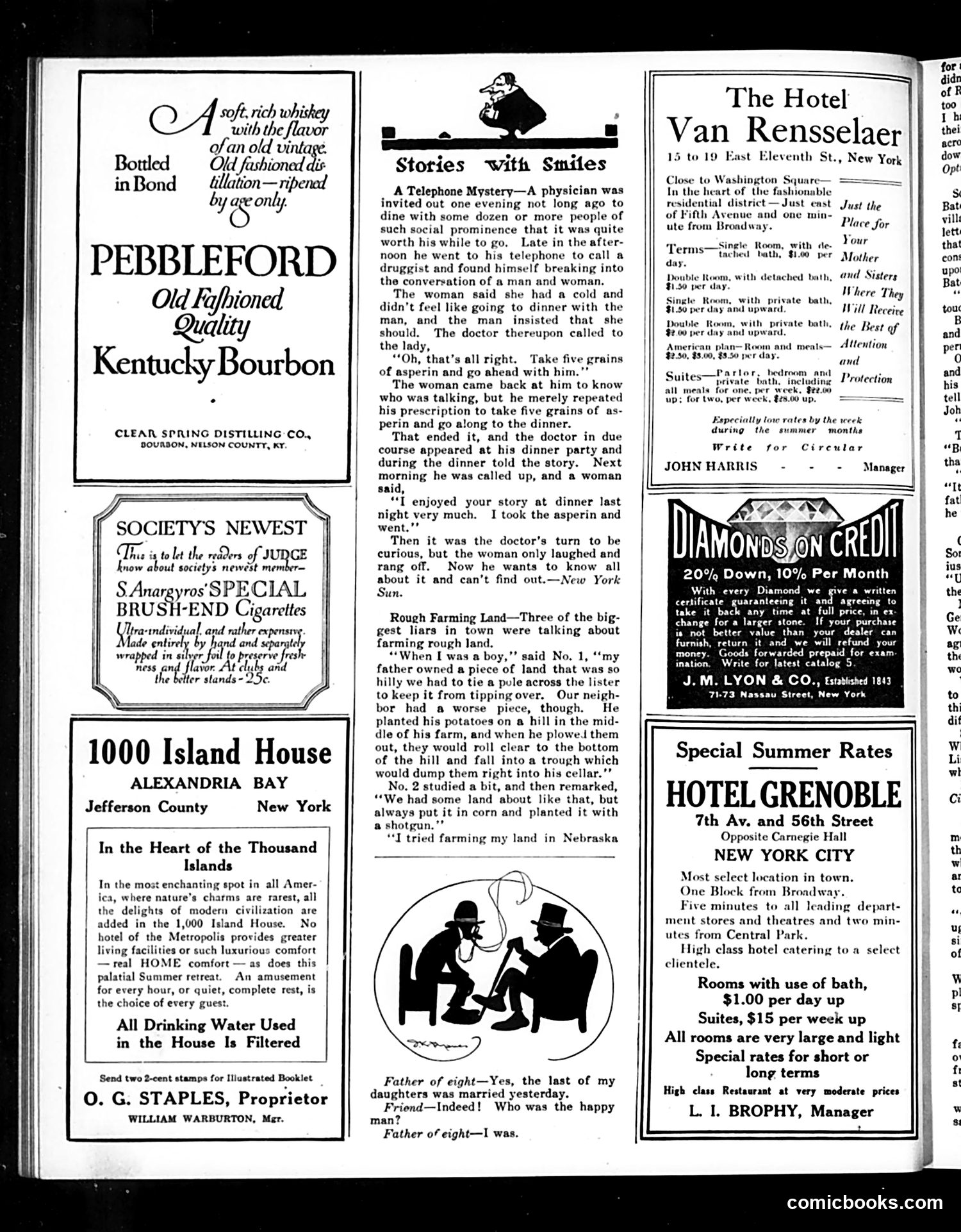
This page is primarily **advertising**, with two brief humorous anecdotes ("Stories with Smiles") embedded among hotel and luxury product ads typical of early 20th-century Judge magazine. The two jokes are: 1. **"A Telephone Mystery"**: A doctor overhears a couple arguing about dinner plans, prescribes aspirin to the woman unseen, then discovers she actually took his advice. The humor lies in the absurdity of practicing medicine through crossed telephone wires and the woman's willingness to follow a stranger's medical advice. 2. **"Rough Farming Land"**: Three farmers competitively exaggerate tales of impossibly steep terrain—potatoes rolling downhill into cellars, corn planted with shotguns. The final punchline, where a man with eight daughters says he was "the happy man" at the last daughter's wedding, plays on the stereotype of fathers relieved to marry off daughters (reducing family burden). Both anecdotes rely on early 1900s sensibilities: casual phone party-line eavesdropping, parental authority over daughters' lives, and tall-tale humor conventions. The cartoonish illustration shows two men in conversation, typical visual support for the stories.
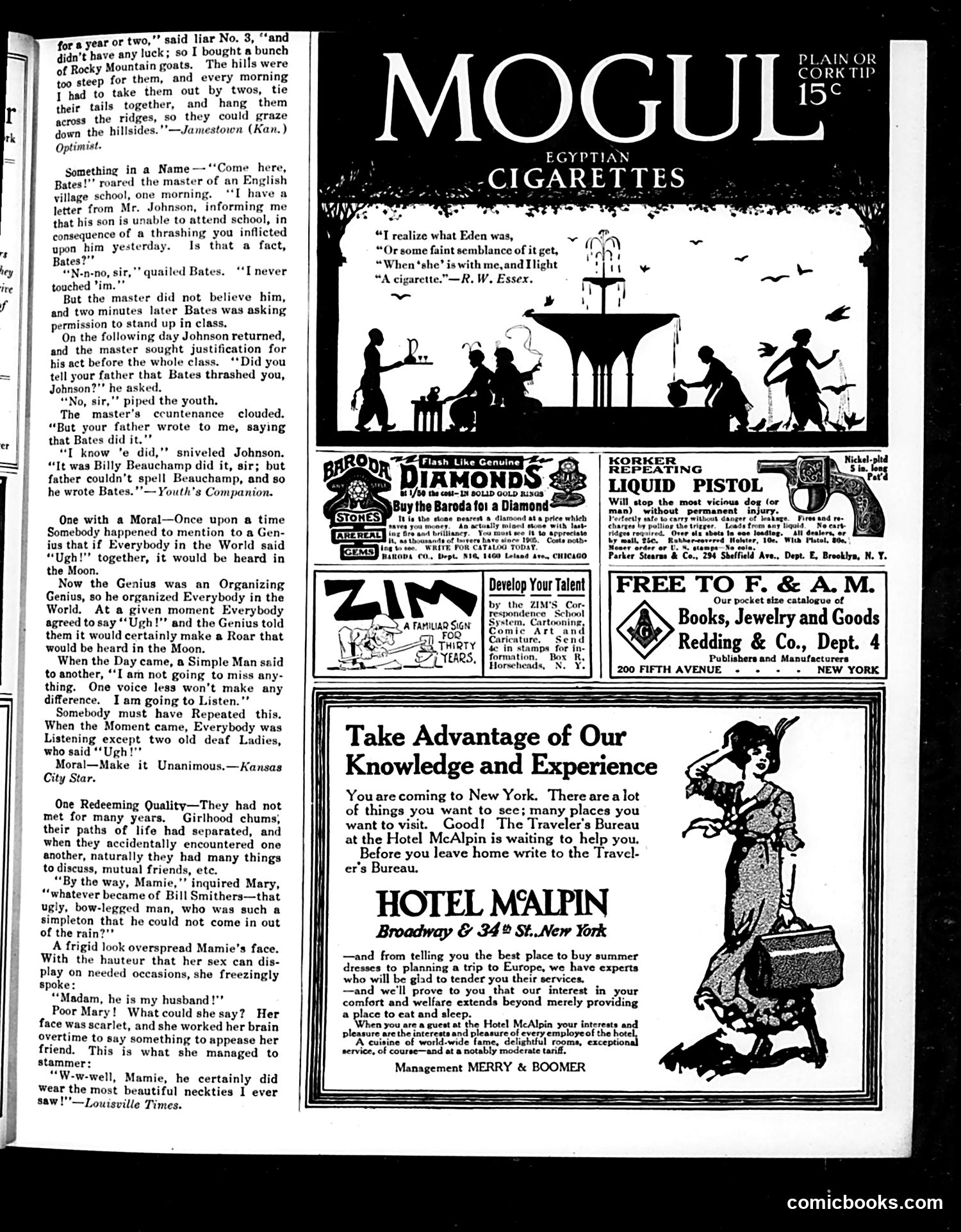
This page contains **primarily text stories and advertisements rather than political cartoons**. The satirical content consists of humorous anecdotes: 1. **"Something in a Name"** — A schoolmaster punishes the wrong boy (Bates) because a father misspelled "Beauchamp" as "Bates" in a complaint letter. The joke mocks bureaucratic bungling and hasty justice based on incomplete information. 2. **"One with a Moral"** — A fable about organizing "Everybody in the World" to say "Ugh!" simultaneously to reach the moon. Two deaf ladies say it anyway, ruining the experiment. The satire criticizes herd mentality and the failure of grand organizing schemes when individuals don't conform. 3. **"One Redeeming Quality"** — A woman insults her old friend's husband, then desperately salvages the situation by complimenting his neckties. Social satire on tactlessness and female etiquette. The advertisements include Egyptian Mogul cigarettes, Hotel McAlpin, and various novelty items. No identifiable political figures appear.
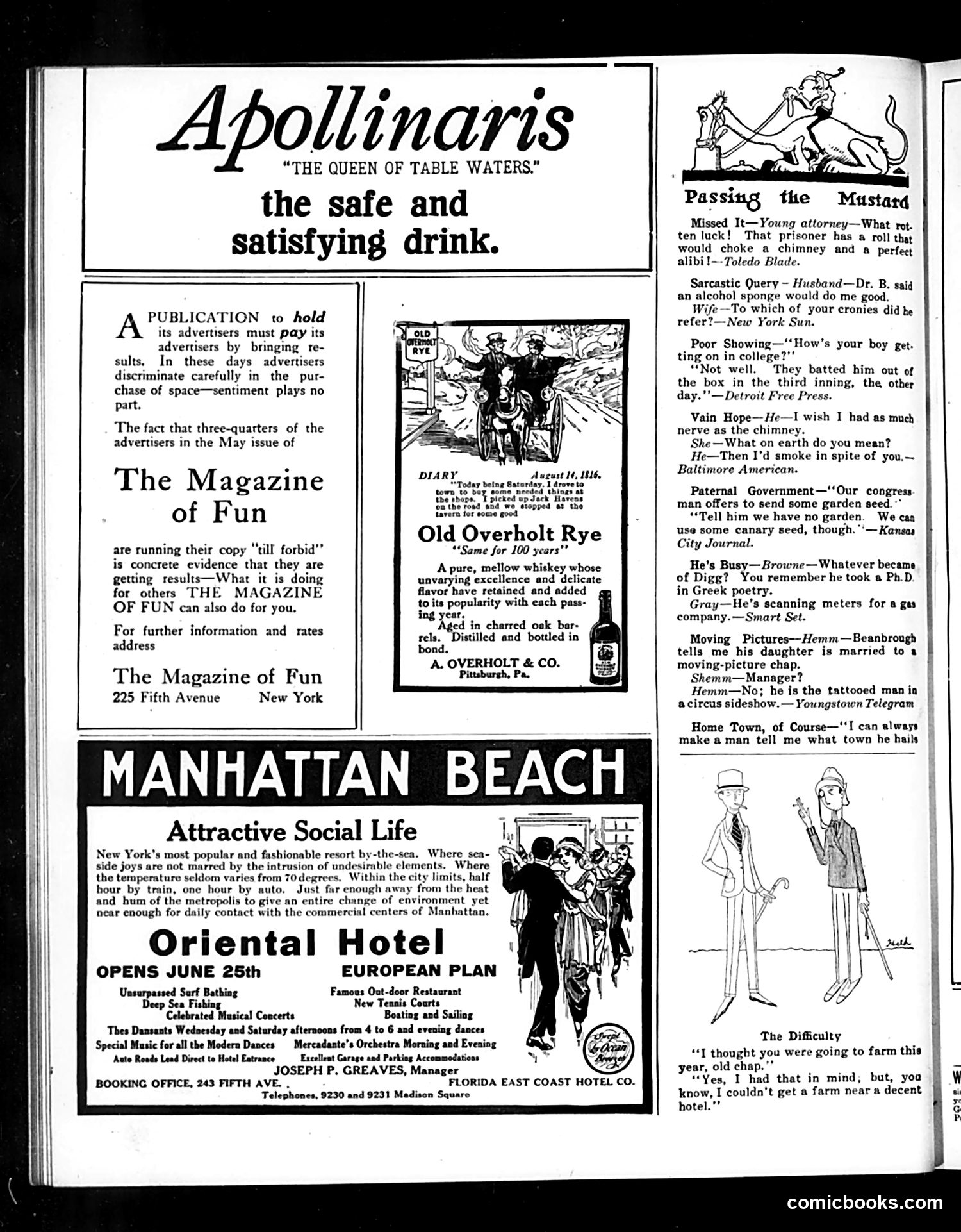
This page is primarily **advertising with brief joke content**. The dominant features are ads for Apollinaris water, Old Overholt Rye whiskey, Manhattan Beach resort, and the Oriental Hotel, interspersed with short satirical jokes typical of Judge magazine's humor section. The jokes reflect early 20th-century American concerns: a lawyer frustrated by a defendant's alibi, marital banter about alcohol, a college student's poor athletic performance, romantic mishaps, and class commentary (a Ph.D. in Greek poetry forced into manual labor for a gas company). One cartoon depicts two men in conversation, illustrating "The Difficulty"—a wealthy gentleman unable to locate a farm near decent lodging, satirizing the leisure class's disconnect from actual rural life. The overall tone reflects Judge's satirical stance on urban American society, combining gentle domestic humor with mild social critique of contemporary mores and class pretensions.
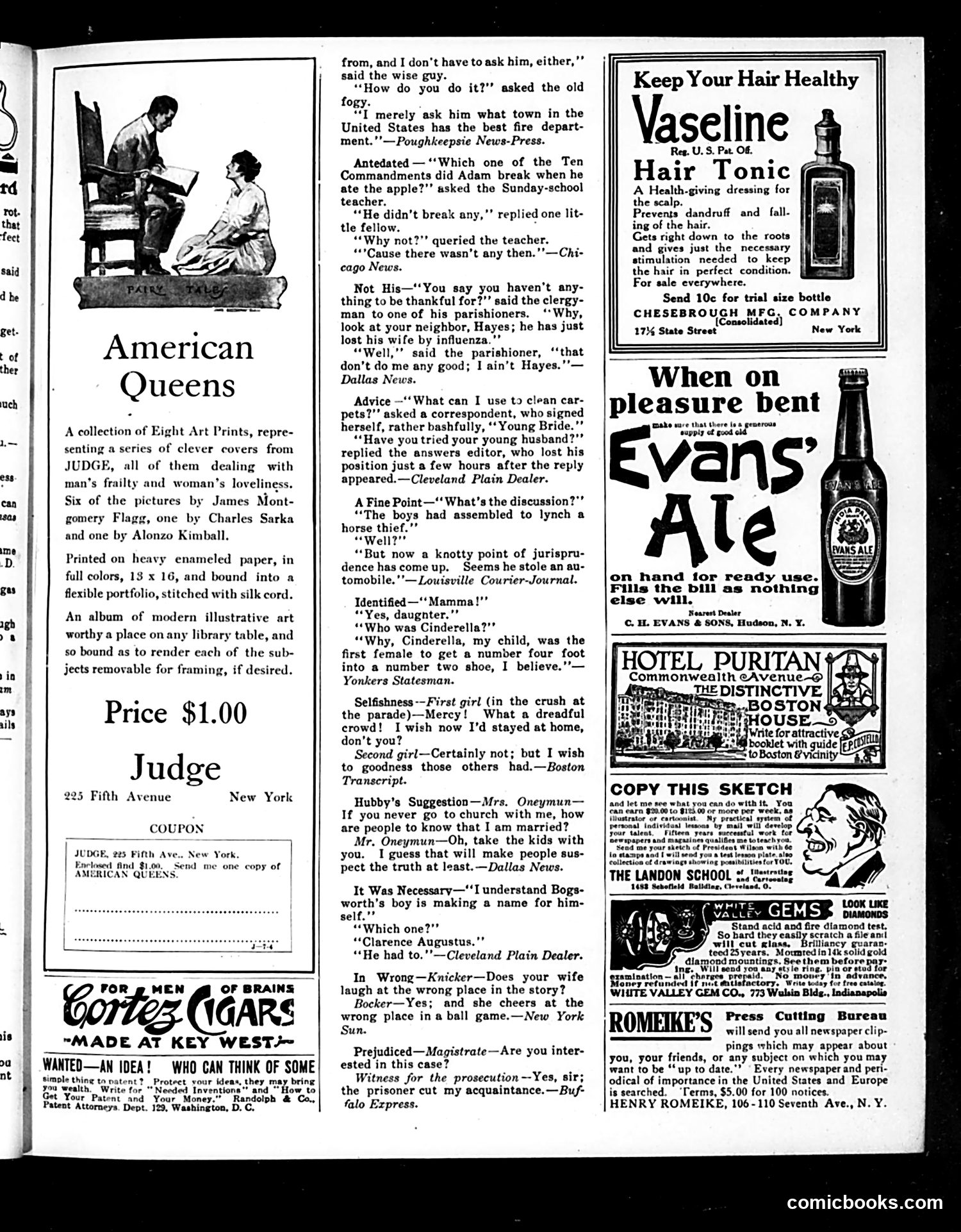
This page from *Judge* magazine consists primarily of **humorous anecdotes and advertising** rather than political cartoons. The anecdotes are short jokes playing on wordplay, logic, and social situations typical of early 20th-century American humor. They mock clergymen, wives, husbands, and social pretension. For example, one joke involves a clergyman trying to console a parishioner about his neighbor's misfortune—the parishioner replies the loss doesn't benefit him personally. Another jokes about a "Young Bride" asking how to clean carpets, with an editor's cheeky reply that costs him his job. The main advertisement is for "American Queens"—an art portfolio ($1.00) featuring eight prints by prominent illustrators like James Montgomery Flagg, depicting romantic or domestic situations. Other ads promote Vaseline Hair Tonic, Evans' Ale, the Hotel Puritan in Boston, and patent services. The page reflects popular humor emphasizing domestic comedy and mild social satire rather than serious political commentary.
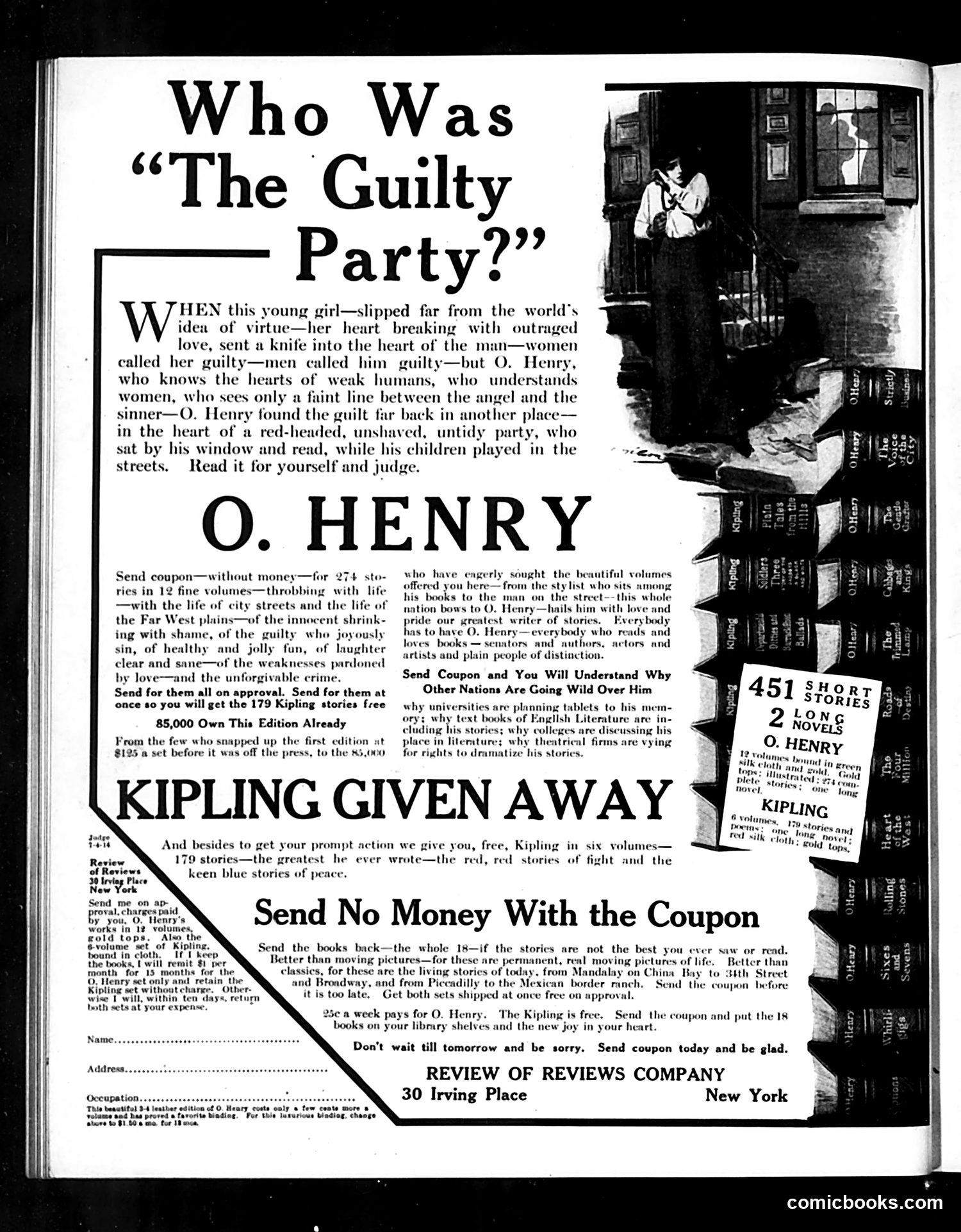
This page is primarily a **book advertisement** for O. Henry's collected stories (274 stories in 12 volumes) and a bonus offer of Kipling's works. The framing story describes O. Henry's moral vision: a young woman who kills a man in a crime of passion is conventionally deemed "guilty," but O. Henry—understanding human nature—traces the *real* guilt elsewhere: to an idle, negligent man who sits reading while his children play unsupervised in the streets. The implication is that moral responsibility is complex and often falls on unexpected parties. This pitch appeals to readers by positioning O. Henry as a profound observer of human weakness and virtue, capable of finding "guilt" in unexpected places—exactly the kind of moral nuance that made his fiction popular. The advertisement emphasizes that O. Henry's stories capture authentic urban and frontier life, superior to both sentimental classics and moving pictures. The coupon allows readers to examine all 18 volumes free before committing payment.