
Judge, 1914-07-04 · page 8 of 24
Judge — July 4, 1914 — page 8: what you’re looking at
What you’re looking at
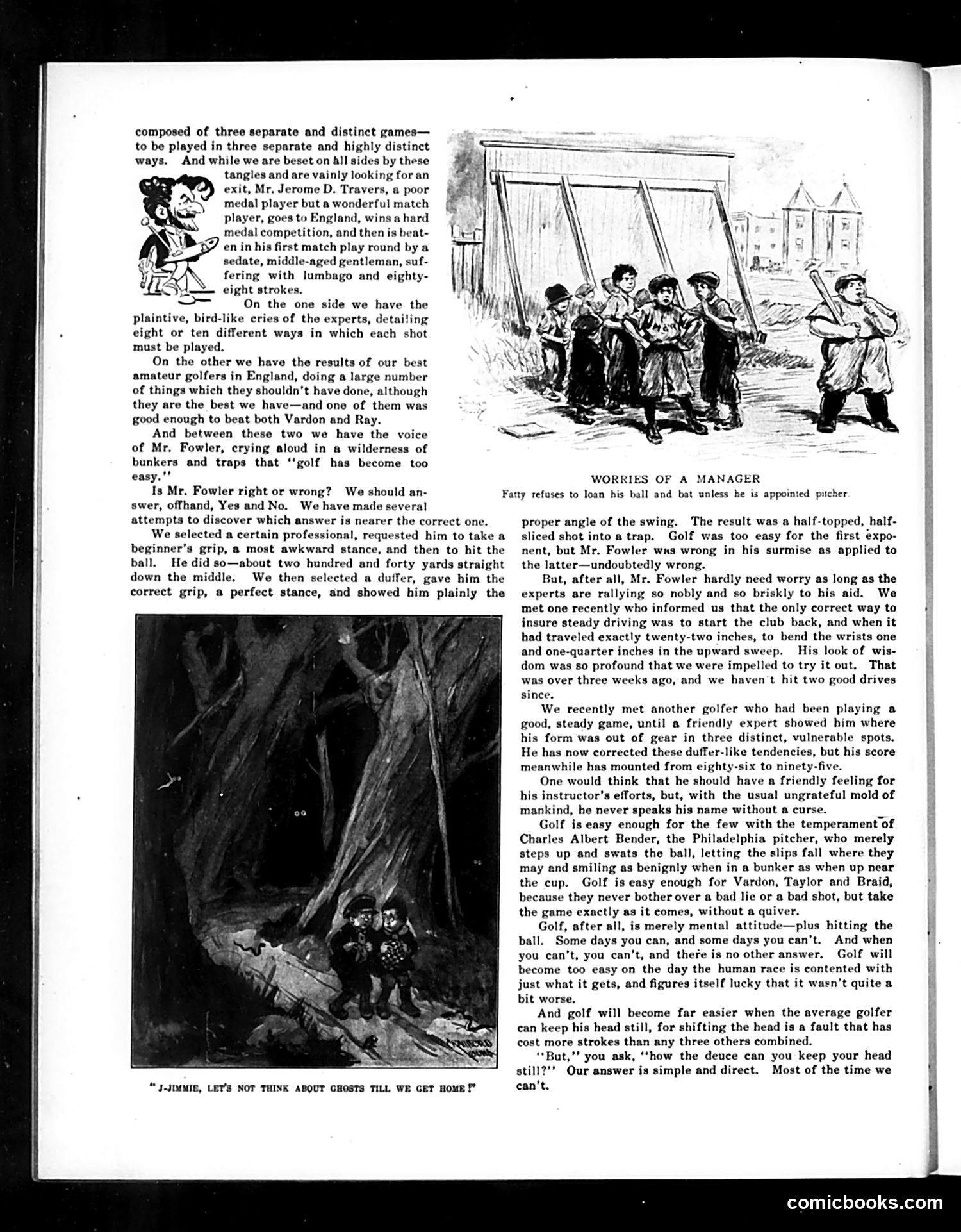
This page satirizes debates among American golfers circa 1910s about whether golf has become too easy. The article references Jerome D. Travers (a prominent amateur golfer of the era) and critiques expert instruction's contradictory advice. The cartoons illustrate the satire's central joke: golf is simultaneously "too easy" and "too hard" depending on who plays it. The top illustration shows children playing casually ("Worries of a Manager"), mocking how experts overcomplicate the game. The bottom cartoon ("Let's not think about ghosts till we get home") appears to use supernatural anxiety as metaphor for golfers' mental obstacles. The article's target: golf professionals and "experts" who paralyze amateur players with contradictory technical instruction—so precise (bend wrists "one and one-quarter inches") that following their advice actually worsens performance. The piece argues golf's true difficulty is psychological, not mechanical, exemplified by legendary hitters like Charles Albert Bender who succeed through simplicity and indifference.
📄 Transcribed text from this page (OCR, searchable)
Machine-transcribed from the original scan — historical spelling and the odd misread are preserved.
composed of three separate and distinct games— to be played in three separate and highly distinct ways. And while we are beset on All sides by these tangles and are vainly looking for an exit, Mr. Jerome D. Travers, a poor medal player but a wonderful match player, goes to England, wins a hard medal competition, and then is beat- en in his first match play round by a en sedate, middle-aged gentleman, suf- in fering with lumbago and eighty- eye 41S eight strokes. -— On the one side we have the plaintive, bird-like cries of the experts, detailing eight or ten different ways in which each shot must be played. On the other we have the results of our best amateur golfers in England, doing a large number of things which they shouldn’t have done, although they are the best we have—and one of them was good enough to beat both Vardon and Ray. And between these two we have the voice of Mr. Fowler, crying aloud in a wilderness of bunkers and traps that ‘‘golf has become too easy.” Is Mr. Fowler right or wrong? We should an- swer, offhand, Yes and No. We have made several attempts to discover which answer is nearer the correct one. We selected a certain professional, requested him to take a beginner’s grip, 8 most awkward stance, and then to hit the ball. He did so—about two hundred and forty yards straight down the middle. We then selected a duffer, gave him the correct grip, a perfect stance, and showed him plainly the “ J-JIMMIE, LET'S NOT THINK ABOUT GHOSTS TILL WE GET HOME!” MANAGER Fatty refuses to loan his ball and bat unless he is appointed pitcher WORRIES OF A proper angle of the swing. The result was a half-topped, half- sliced shot into a trap. Golf was too easy for the first expo- nent, but Mr. Fowler was wrong in his surmise as applied to the latter—undoubtedly wrong. But, after all, Mr. Fowler hardly need worry as long as the experts are rallying so nobly and so briskly to his aid. We met one recently who informed us that the only correct way to insure steady driving was to start the club back, and when it had traveled exactly twenty-two inches, to bend the wrists one and one-quarter inches in the upward sweep. His look of wis- dom was so profound that we were impelled to try it out. That was over three weeks ago, and we haven t hit two good drives since, We recently met another golfer who had been playing a good, steady game, until a friendly expert showed him where his form was out of gear in three distinct, vulnerable spots. He has now corrected these duffer-like tendencies, but his score meanwhile has mounted from eighty-six to ninety-five. One would think that he should have a friendly feeling for his instructor's efforts, but, with the usual ungrateful mold of mankind, he never speaks his name without a curse. Golf is easy enough for the few with the temperament of Charles Albert Bender, the Philadelphia pitcher, who merely steps up and swats the ball, letting the slips fall where they may and smiling as benignly when in a bunker as when up near the cup. Golf is easy enough for Vardon, Taylor and Braid, because they never bother over a bad lie or a bad shot, but take the game exactly as it comes, without a quiver. Golf, after all, is merely mental attitude—plus hitting the ball. Some days you can, and some days you can't. And when you can’t, you can’t, and there is no other answer. Golf will become too easy on the day the human race is contented with just what it gets, and figures itself lucky that it wasn’t quite a bit worse. And golf will become far easier when the average golfer can keep his head still, for shifting the head is a fault that has cost more strokes than any three others combined. “*But,’? you ask, ‘‘how the deuce can you keep your head still?’’ Our answer is simple and direct. Most of the time we can’t. comicbooks.com