
Judge, 1914-07-04 · page 4 of 24
Judge — July 4, 1914 — page 4: what you’re looking at
What you’re looking at
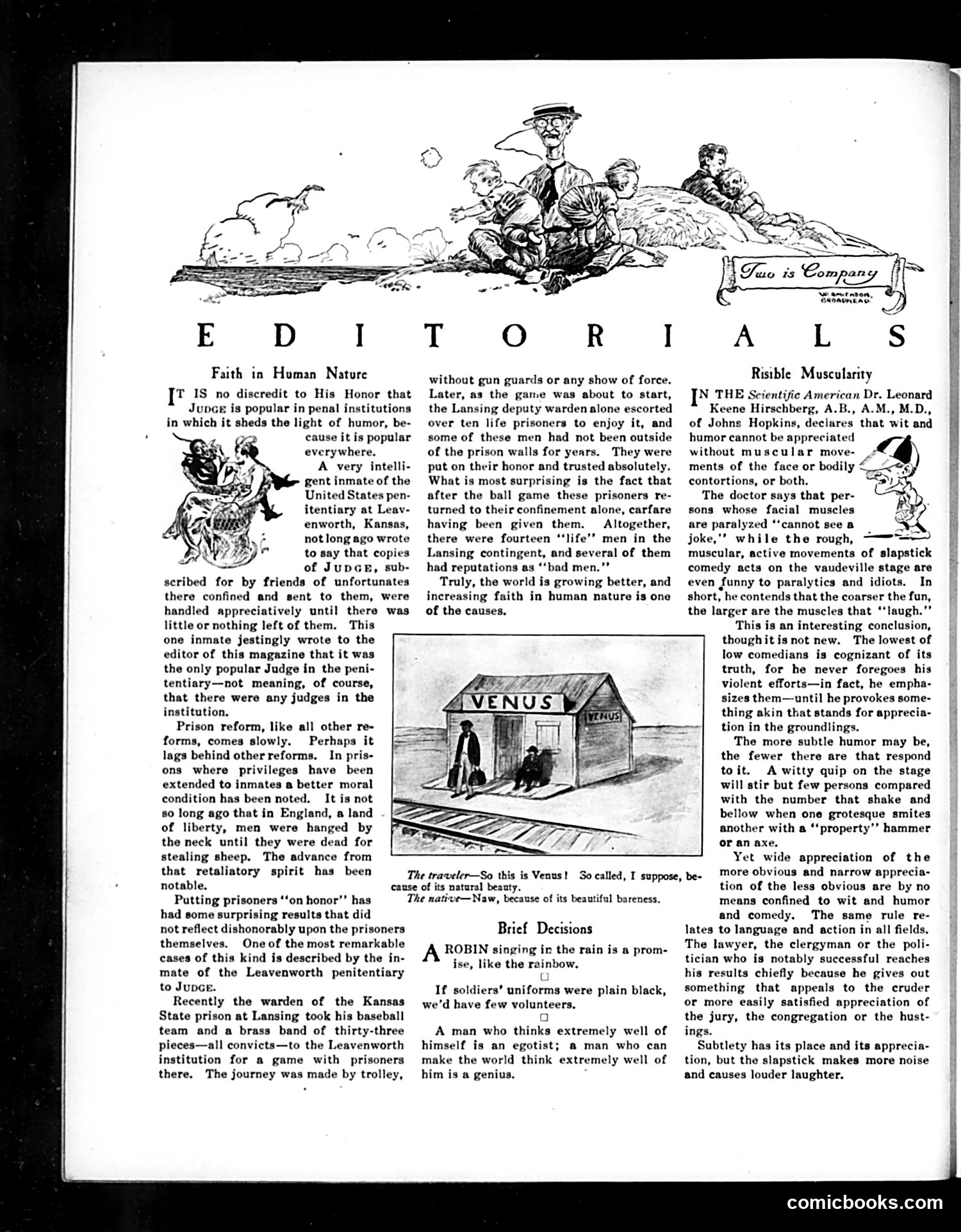
This page from *Judge* magazine contains three distinct pieces: 1. **"Faith in Human Nature"** (left): Satirizes the Leavenworth penitentiary's decision to allow 33 convicted prisoners—including some with "bad" reputations—to play baseball unsupervised. The editorial mocks this trust-based reform approach, suggesting it's naive to expect criminals to behave honorably without guards. The illustration shows prisoners being escorted by staff. 2. **"Venus" illustration** (center): A simple joke about a shelter labeled "Venus," with the warden explaining it's so-named for its "beautiful bareness." 3. **"Risible Muscularity"** (right): References Dr. Leonard Keene Hirschfeld's claims that facial muscles cannot produce slackstick comedy. The piece argues subtle humor requires appreciation of physical comedy's subtlety—that low comedians overestimate their craft's effectiveness compared to sophisticated wit. The page reflects Gilded Age debates about prison reform and entertainment standards.
📄 Transcribed text from this page (OCR, searchable)
Machine-transcribed from the original scan — historical spelling and the odd misread are preserved.
Faith in Human Nature T IS no discredit to His Honor that Jupce is popular in penal institutions in which it sheds the light of humor, be- everywhere. United States pen- itentiary at Leav- enworth, Kansas, not long ago wrote to say that copies of JupGE, sub- scribed for by friends of unfortunates there confined and sent to them, were handled appreciatively until there was little or nothing left of them. This one inmate jestingly wrote to the editor of this magazine that it was the only popular Judge in the peni- tentiary—not meaning, of course, that there were any judges in the institution, Prison reform, like all other re- forms, comes slowly. Perhaps it lags behind other reforms. In pris- ons where privileges have been extended to inmates a better moral condition has been noted. It is not so long ago that in England, a land of liberty, men were hanged by the neck until they were dead for stealing sheep. The advance from that retaliatory spirit has been notable. Putting prisoners ‘‘on honor’’ has had some surprising results that did not reflect dishonorably upon the prisoners themselves. One of the most remarkable cases of this kind is described by the in- mate of the Leavenworth penitentiary to Jupce. Recently the warden of the Kansas State prison at Lansing took his baseball team and a brass band of thirty-three pieces—all convicts—to the Leavenworth institution for a game with prisoners there. The journey was made by trolley, cause it is popular A very intelli- gent inmate of the cause of i without gun guards or any show of force. Later, as the game was about to start, the Lansing deputy warden alone escorted over ten life prisoners to enjoy it, and some of these men had not been outside of the prison walls for years. They were put on their honor and trusted absolutely. What is most surprising is the fact that after the ball game these prisoners re- turned to their confinement alone, carfare having been given them. Altogether, there were fourteen ‘‘life’’ men in the Lansing contingent, and several of them had reputations ‘bad men.’ Truly, the world is growing better, and increasing faith in human nature is one of the causes, The traveler—So this is Venus! natural beauty. The native—Naw, because of its beautiful bareness, Brief Decisions ROBIN singing ir the rain is a prom- ise, like the rainbows If soldiers’ anttorme were plain black, we'd have few volunteers, [s} A man who thinks extremely well of himself is an egotist; a man who can make the world think extremely well of him is a genius. So called, I suppose, be- Beoatneac: A oL Ristble Muscularity N THE Scientific American Dr. Leonard Keene Hirschberg, A.B., A.M., M.D., of Johns Hopkins, deciares that wit and humor cannot be appreciated without muscular move- y. ments of the face or bodily ES contortions, or both. > The doctor says that per- sons whose facial muscles are paralyzed ‘‘cannot see a joke,"’ while the rough, muscular, active movements of slapstick comedy acts on the vaudeville stage are even funny to paralytics and idiots. In short, he contends that the coarser the fun, the larger are the muscles that ‘‘laugh."’ This is an interesting conclusion, thoughitis not new. The lowest of low comedians is cognizant of its truth, for he never foregoes his violent efforts—in fact, he empha- sizes them—until he provokes some- thing akin that stands for apprecia- tion in the groundlings. The more subtle humor may be, the fewer there are that respond toit. A-witty quip on the stage will stir but few persons compared with the number that shake and bellow when one grotesque smites another with a “‘property’’ hammer or an axe. Yet wide appreciation of the more obvious and narrow apprecia- tion of the less obvious are by no means confined to wit and humor and comedy. The same rule re- lates to language and action in all fields. The lawyer, the clergyman or the poli- tician who is notably successful reaches his results chiefly because he gives out something that appeals to the cruder or more easily satisfied appreciation of the jury, the congregation or the hust- ings. Subtlety has its place and its apprecia- tion, but the slapstick makes more noise and causes louder laughter. comicbooks.com