
A complete issue · 24 pages · 1914
Judge — June 20, 1914
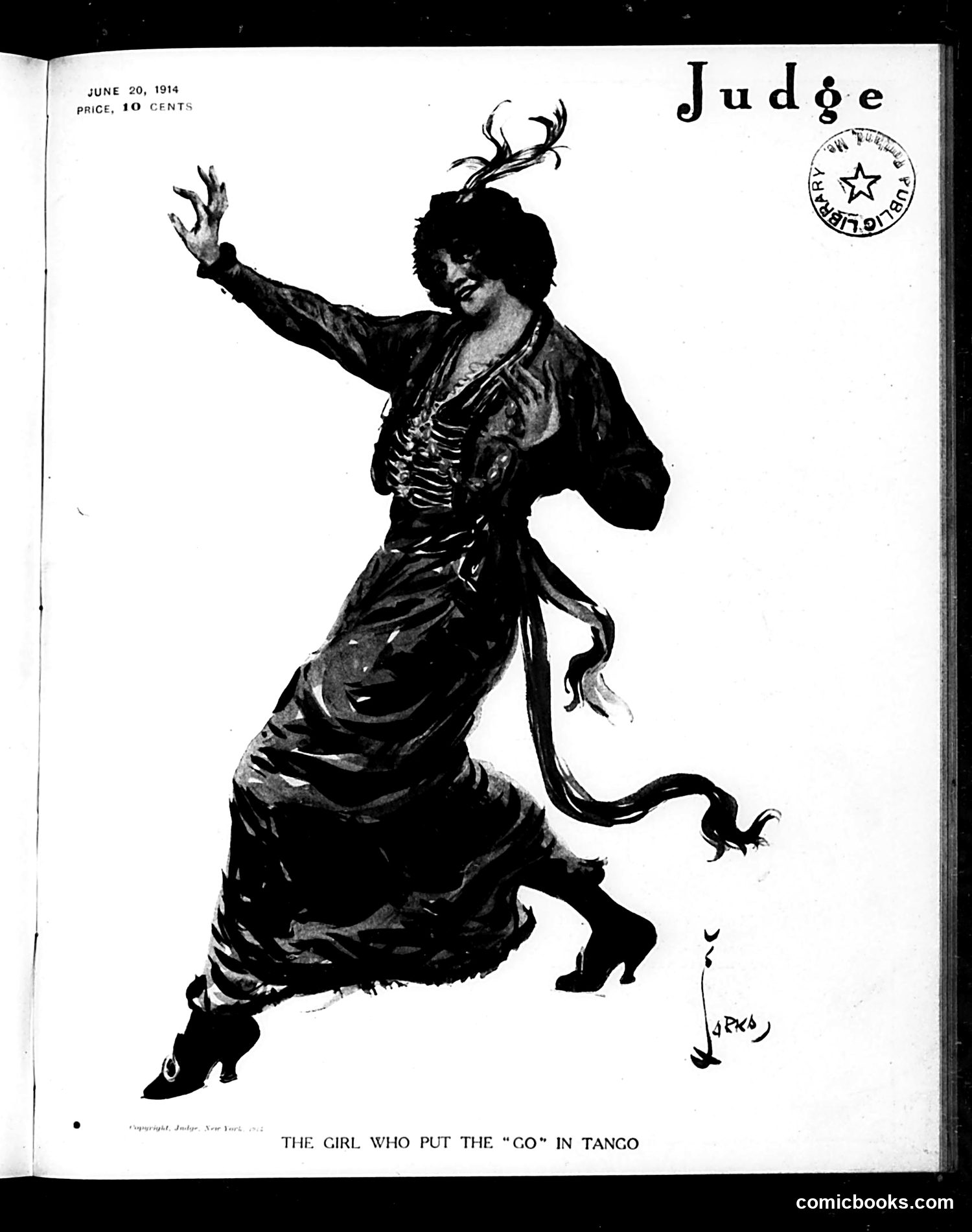
This Judge magazine cover from June 20, 1914 satirizes the tango craze sweeping America during that era. The illustration depicts a woman in an exaggerated, dynamic tango pose—one arm thrust upward, her body in dramatic motion, with her dress flowing dramatically. The figure's wild hair and theatrical energy suggest she embodies the tango's reputation for being scandalous and uninhibited. The caption's pun ("go" in tango) mocks both the dance's popularity and anxieties about its supposedly immoral nature. The tango, imported from Argentina, was controversial among American moralists who viewed it as sexually suggestive and improper. This cartoon satirizes the enthusiasm young women had adopted for the dance despite—or because of—its disreputable reputation.
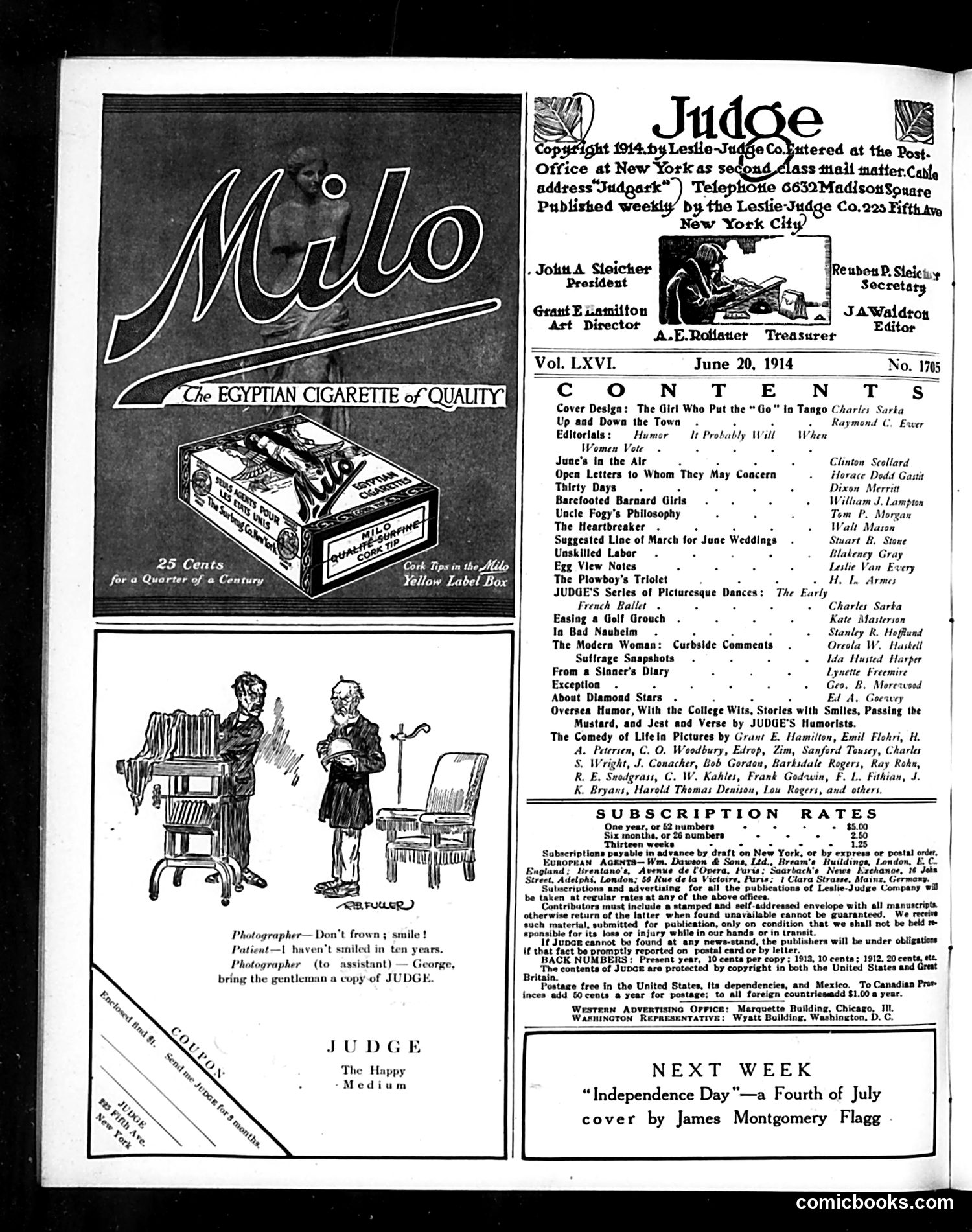
The main cartoon shows a photographer and patient in a medical setting. The caption reads: "Photographer—Don't frown; smile! / Patient—I haven't smiled in years. / Photographer—(to assistant) Hurries. Come, bring the gentleman a copy of JUDGE." The joke relies on a common premise: that Judge magazine is so humorous it can make even the most persistently unhappy person smile. This was a standard self-promotional gag in satirical magazines of the era—asserting that their comedic content possessed almost medicinal value. The Millo cigarette advertisement below occupies substantial space, typical of magazine funding practices in 1914. The overall page emphasizes Judge's humor as entertainment with therapeutic properties.
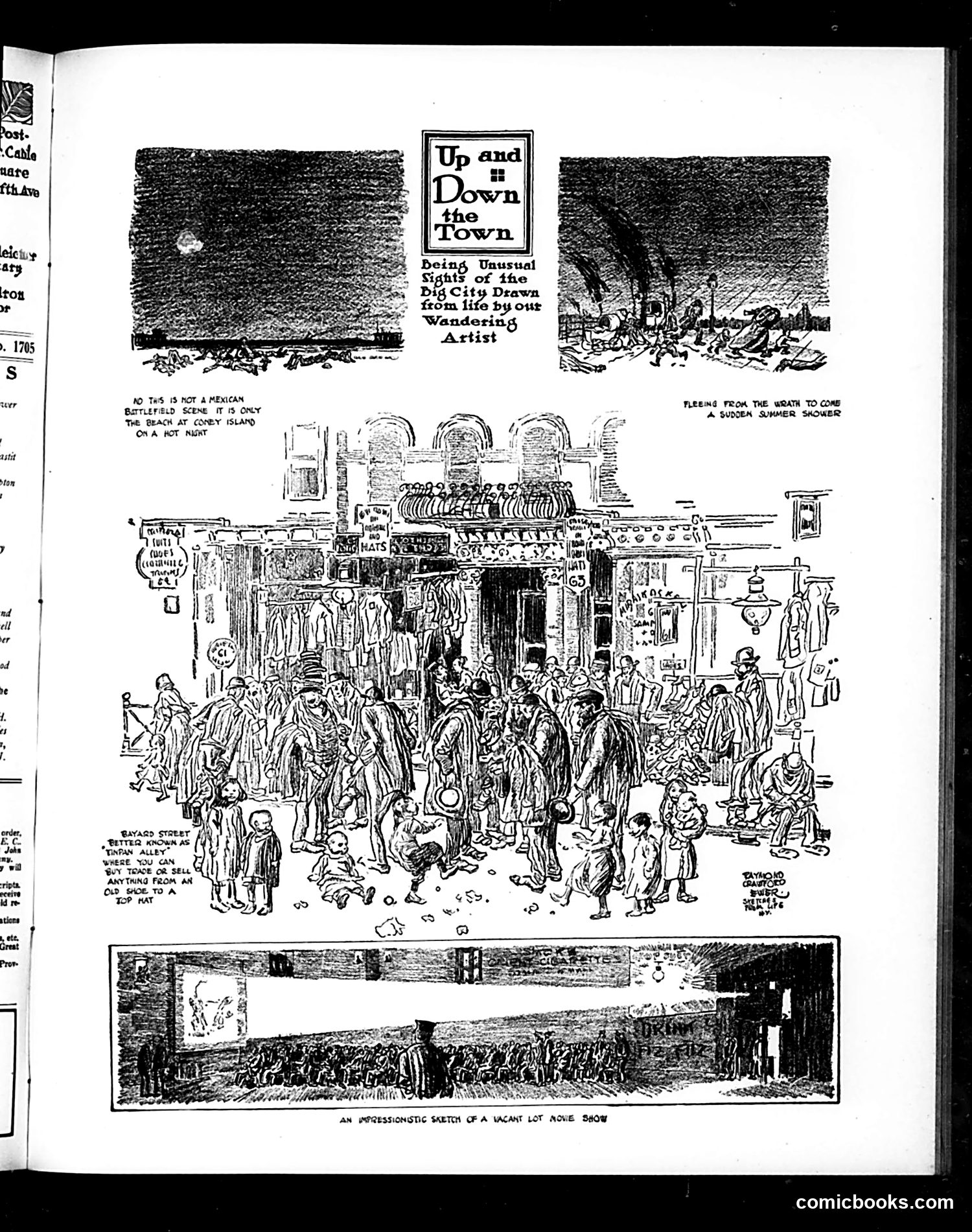
This is a satirical sketch series titled "Up and Down the Town: Being Unusual Sights of the Big City Drawn from Life by our Wandering Artist." The central large illustration depicts a crowded urban street scene, likely depicting lower Manhattan or a similar immigrant neighborhood. The detailed annotations and captions indicate specific social observations: "Bayard Street Better Known as Rag Alley Where One Can Buy All Trade of Sell Anything From A Cent to $5 Hat." The smaller sketches at top show nighttime beach scenes and summer activities. The bottom panel shows "An Impressionistic Sketch of a Vacant Lot Bone Show"—likely a street market or secondhand goods vendor scene. Overall, this appears to be *Judge* magazine's humorous documentation of quirky urban immigrant life and street commerce in early 1900s New York City.
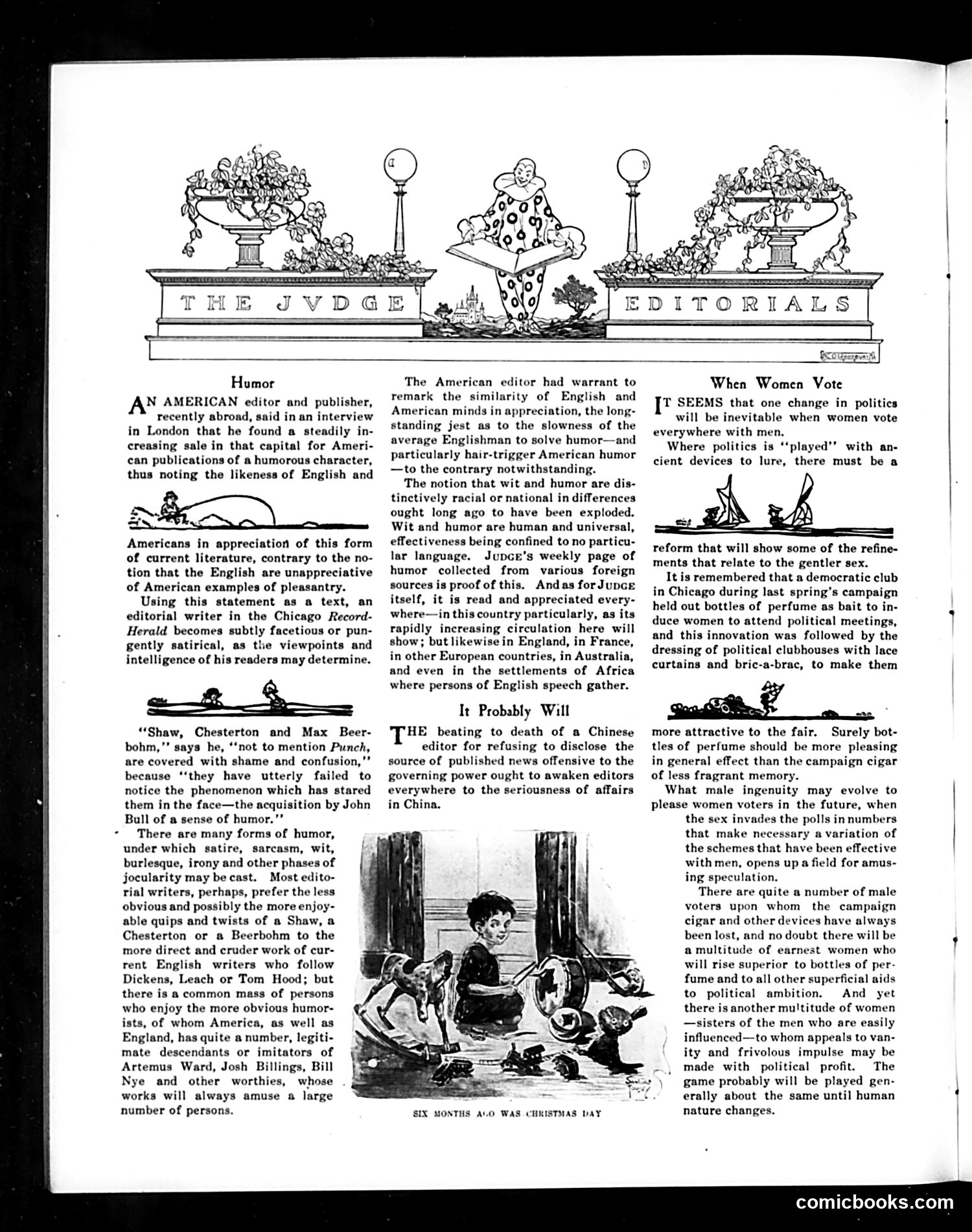
This page contains three distinct articles about humor and politics, framed by decorative "Judge" and "Editorials" mastheads. **Left column ("Humor"):** Discusses English versus American humor appreciation, noting Americans find steadily increasing sales for American humorous publications in London. It praises American humorists like Artemus Ward, Josh Billings, and Bill Nye. **Center:** Contains a small illustration captioned "SIX MONTHS AGO WAS CHRISTMAS DAY" showing a child playing with toys. **Right column ("When Women Vote"):** Satirizes women's potential entry into politics, predicting changes to political campaigning—particularly concerns about female voters being influenced by superficial appeals like "lace curtains and bric-a-brac" rather than serious issues. The satire suggests male politicians will need to adjust their strategies. The page represents Judge's typical approach: mixing cultural commentary with gentle mockery of contemporary social debates.
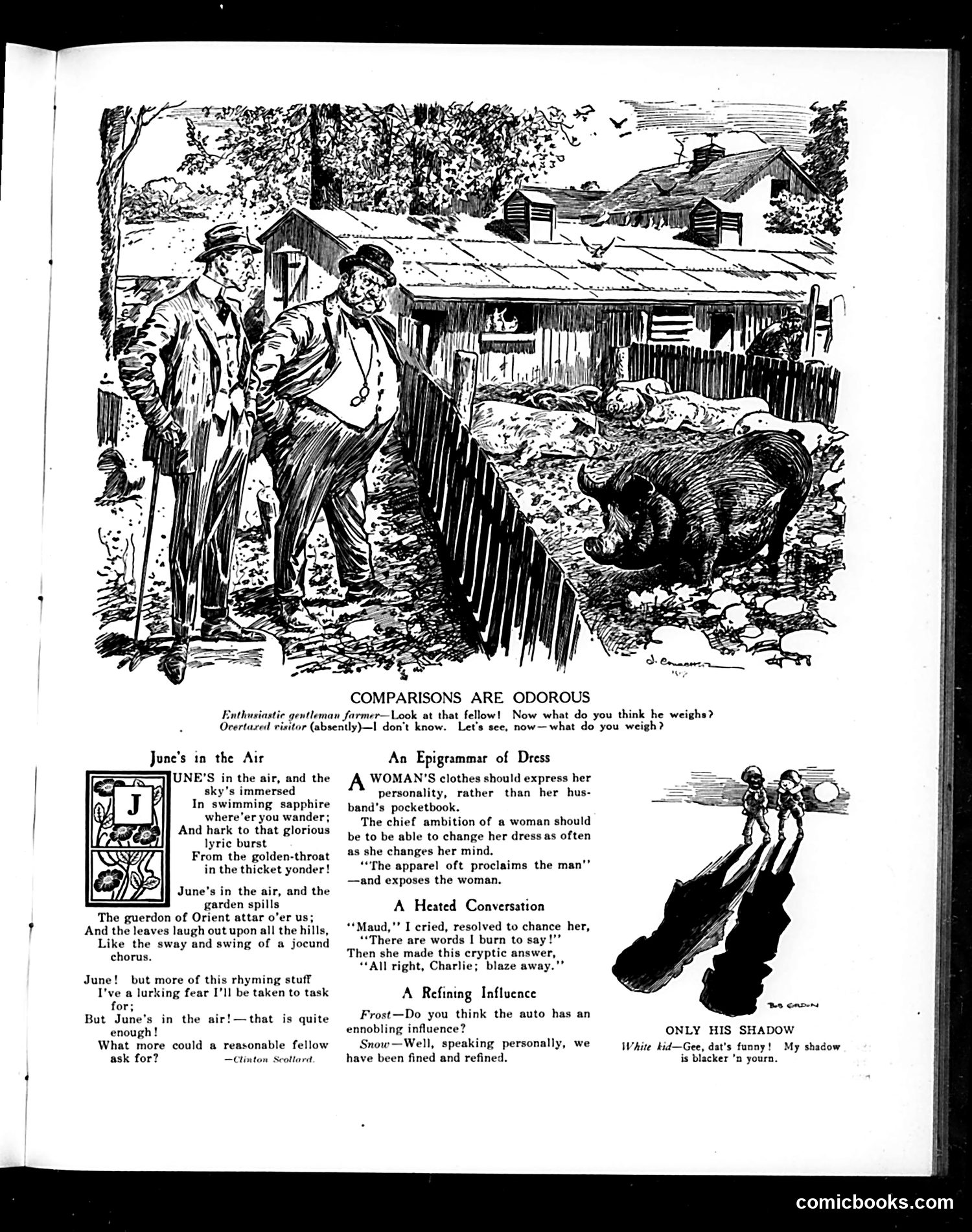
The main cartoon "COMPARISONS ARE ODOROUS" depicts two gentlemen examining livestock at a farm. One asks the other to guess the pig's weight—a setup for an insult joke about appearance. The humor relies on the implication that the person being addressed resembles the animal. The page also contains several short humorous pieces: poetry about June, witty observations on women's fashion and automobiles, and brief comedic dialogues. "Only His Shadow" features silhouettes of a couple, with a joke about the woman's shadow being "blacker" than the man's—likely a racial or social commentary typical of early 20th-century satirical humor. The content represents Judge's trademark style: visual gags, puns, and social commentary through brief comedic vignettes.
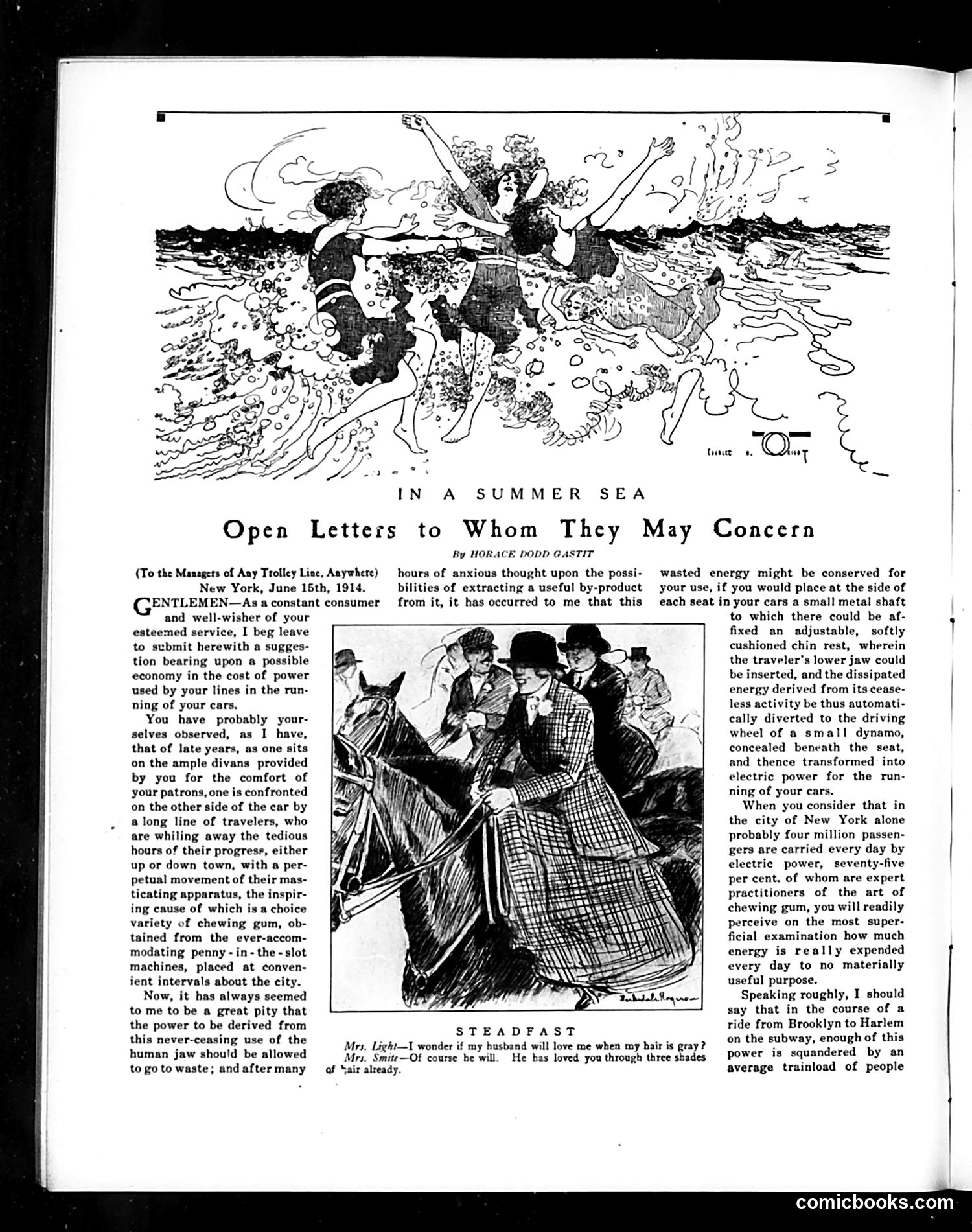
This 1914 Judge magazine page satirizes industrial-age efficiency obsession. Author Horace Dodd Gastit proposes a humorous "solution" to urban energy waste: installing mechanical chin rests on trolley cars that would harness the jaw-motion energy of chewing-gum-chewing passengers via hidden dynamos beneath seats, converting this wasted kinetic energy into electrical power. The satire targets the era's obsession with extracting maximum productivity from everyday activities—a backlash against the mechanical efficiency movement gaining prominence in factories and cities. By proposing to literally harvest energy from passengers' mindless chewing, Gastit mocks how far rationalization logic could extend. The accompanying illustration and "Steadfast" dialogue joke about marital relationships and aging, likely filler content typical of Judge's mixed editorial format. The top illustration appears decorative, depicting carefree summer leisure—ironic contrast to the letter's mechanistic worldview.
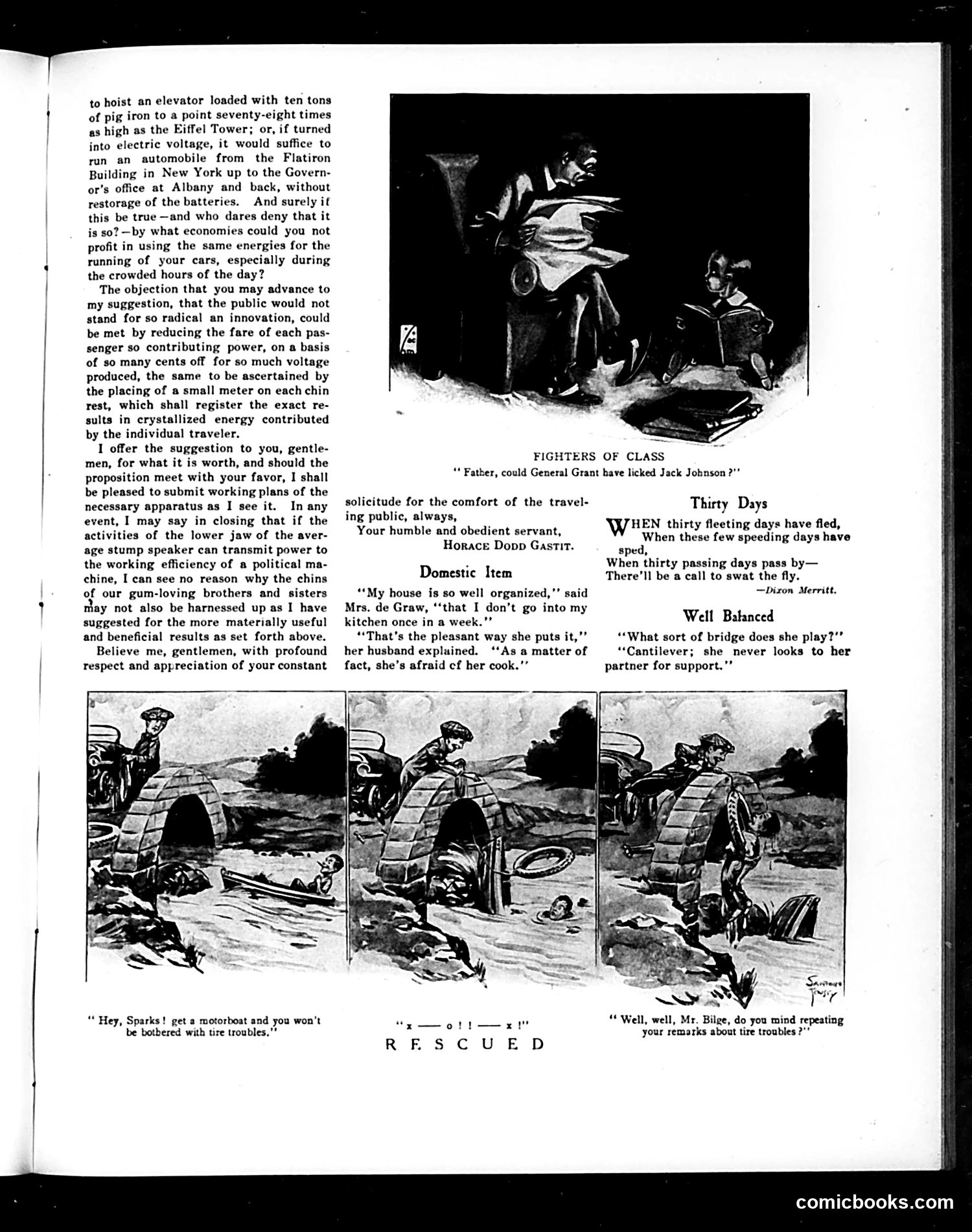
**Main Satire (top text):** A humorous proposal suggesting that passengers' jaw movements while chewing gum or talking could generate electrical power for streetcars—with fares reduced based on "voltage contributed" measured by chin-rest meters. It's mocking both the era's enthusiasm for electrical technology and people's constant chewing/talking, suggesting politicians' jaw-flapping could actually be useful if harnessed. **"Fighters of Class" cartoon:** References the famous 1910 heavyweight boxing match between Jack Johnson (African American champion) and Jim Jeffries. The child's question asking if General Grant could beat Johnson reflects contemporary racial tensions—white Americans wanted Jeffries ("The Great White Hope") to reclaim the title from Johnson. **Bottom comic strip ("Rescued"):** A three-panel gag where a motorboat owner brags about avoiding tire troubles, then gets rescued from the water and is mocked by the same person he'd lectured about tire problems. The page blends technological satire with contemporary racial commentary and simple comic humor.
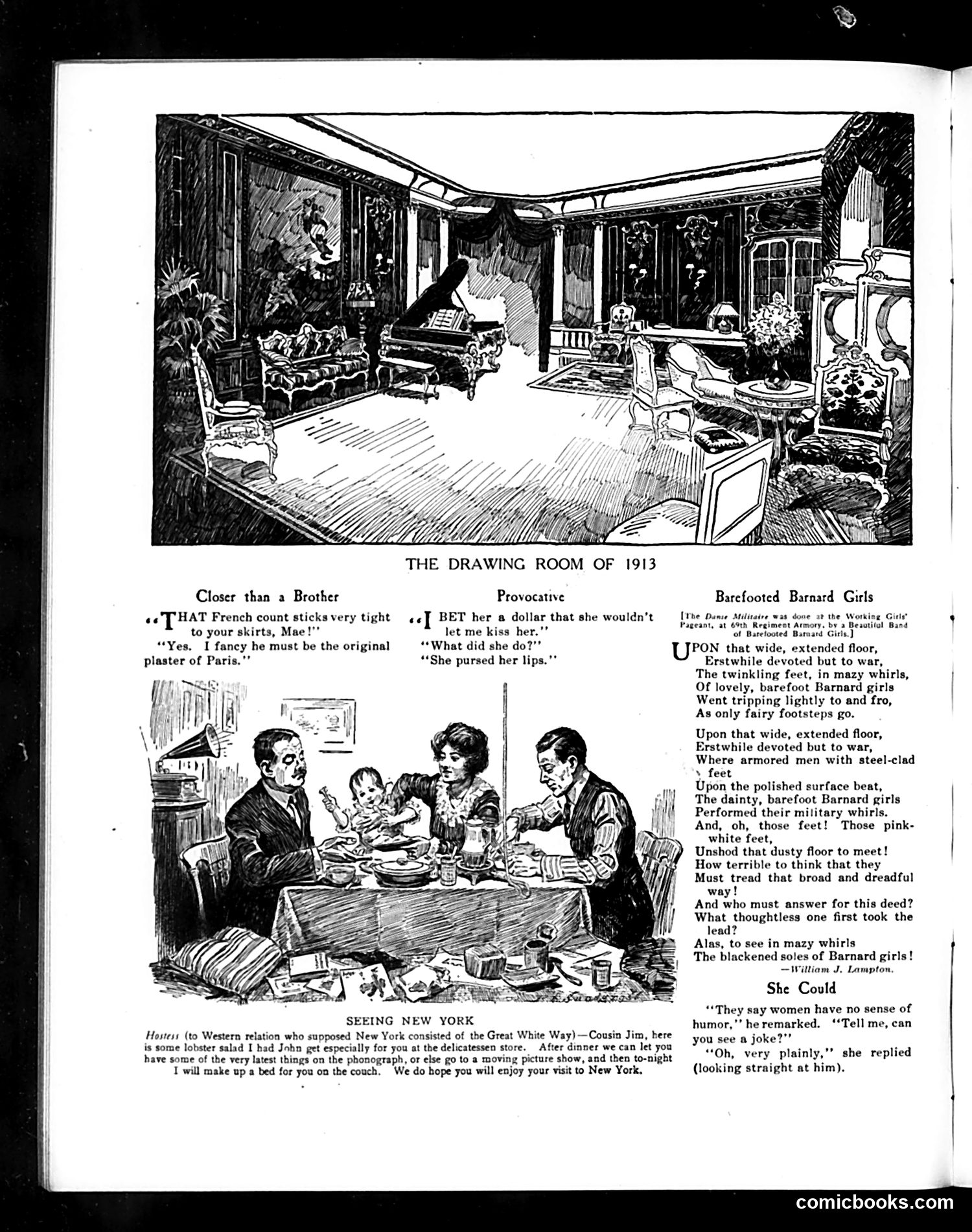
This page contains three satirical pieces reflecting 1913 social attitudes: **"Closer than a Brother" and "Provocative"** mock romantic/flirtation dynamics. The French count joke plays on stereotypes of Continental men as overly familiar; the second jokes about women's resistance to kissing. **"Seeing New York"** satirizes a provincial Western visitor's limited expectations—he apparently believed New York consisted only of Broadway ("Great White Way"), so the hostess must convince him the city offers more: delicatessen food, phonographs, moving pictures, and even a couch to sleep on. **"Barefooted Barnard Girls"** is mock-outrage poetry about female Barnard College students performing barefoot in a military pageant at an armory. The satire feigns scandal—women's delicate feet touching a "dusty floor"—while actually celebrating their daring modernity and athleticism. The concluding joke about women lacking humor subverts itself: the woman's deadpan response demonstrates wit. All three pieces gently mock contemporary social conventions and changing gender roles.
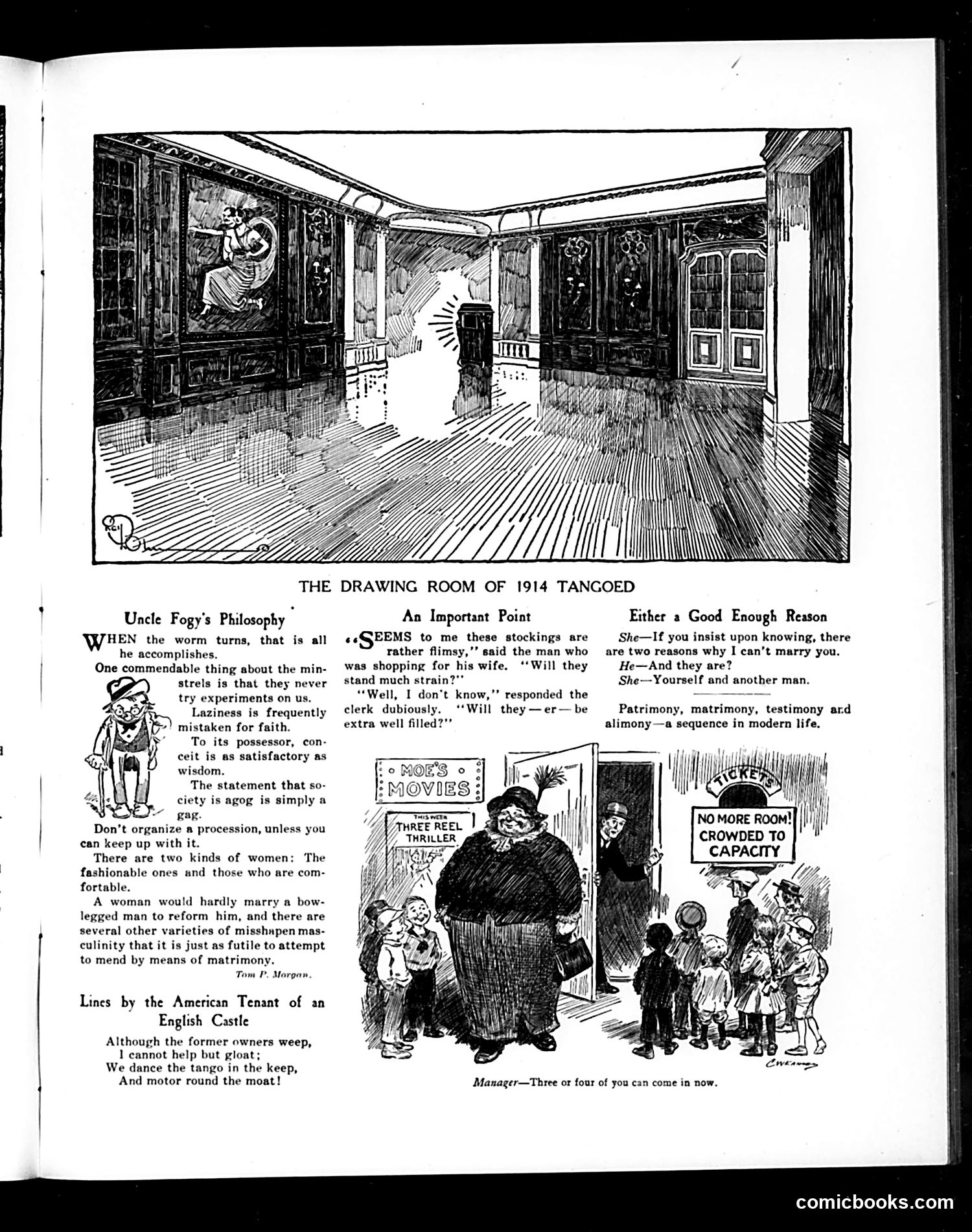
This page from Judge presents multiple brief satirical pieces reflecting early 20th-century American attitudes: **"Uncle Fogy's Philosophy"** offers cynical observations on human nature—laziness mistaken for faith, society's obsession with fads, the futility of reforming spouses through marriage. **"Lines by the American Tenant of an English Castle"** satirizes wealthy Americans purchasing English estates, boasting of modernizing ("We dance the tango in the keep") formerly dignified ancestral homes—poking fun at American nouveau riche displacing British aristocracy. **The cartoon vignettes** mock contemporary concerns: a shopper's confusion about hosiery durability (with crude double entendre about "filling"), a woman's sardonic rejection citing "yourself and another man" (humor at male ego's expense), and wordplay linking patrimony→matrimony→testimony→alimony (suggesting marriage inevitably leads to divorce litigation). **"The Drawing Room of 1914 Tangoed"** (top illustration) likely critiques the era's dance crazes disrupting formal society spaces. The overall tone reflects period cynicism about marriage, wealth, modernization, and social pretension.
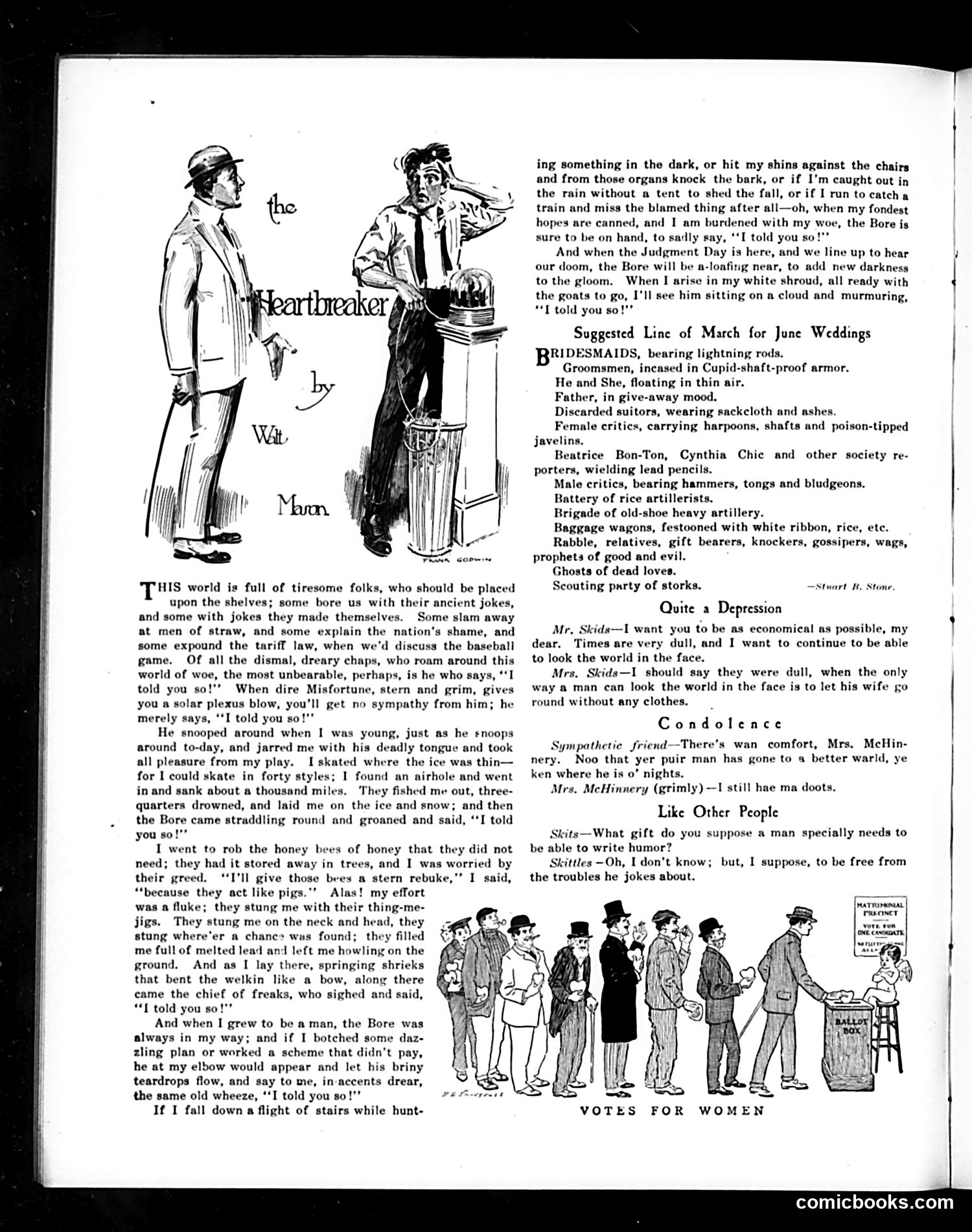
**"The Heartbreaker" (top left):** A satirical poem about the archetypal bore who constantly says "I told you so!" The cartoon illustrates two figures—a smug man and a disheveled victim—embodying this annoying personality type. The humor targets people who take vindictive pleasure in others' misfortunes, offering no sympathy while repeatedly reminding them of warnings they ignored. **"Suggested Line of March for June Weddings":** A humorous list mocking wedding ceremony conventions through absurdist weaponry. Bridesmaids carry "lightning rods," critics wield "harpoons" and "hammers," old shoes become "heavy artillery"—satirizing how weddings attract unwanted commentary and criticism from society reporters and various hangers-on. **"Quite a Depression":** A brief domestic dialogue where Mr. Skids requests economy during hard times to "look the world in the face," while Mrs. Skids sardonically notes economic depression has already stripped men of dignity. The page targets social pretension, tiresome personality types, and economic anxiety—typical Judge magazine satire of the early 20th century.
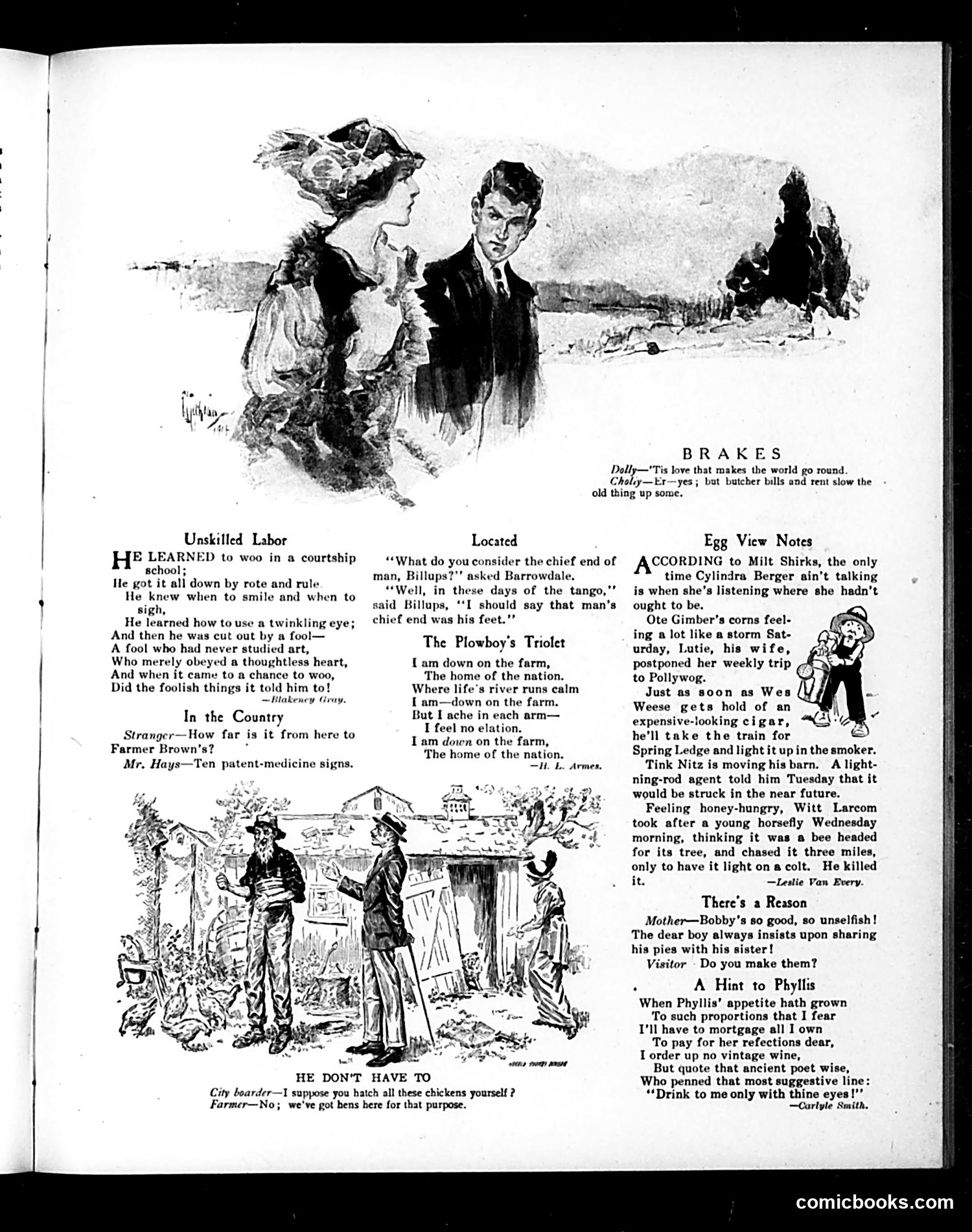
This page contains several brief humorous sketches and poems typical of early 20th-century American satirical magazines: **"Unskilled Labor"**: A poem satirizing courtship etiquette—a man trained in formal wooing techniques loses to an emotionally genuine fool, mocking artificial social conventions. **"In the Country"**: A joke about rural America, where distance is measured by patent-medicine advertisements (common roadside signs of the era), poking fun at both rural life and the ubiquity of dubious medical marketing. **"The Plowboy's Triolet"**: A poem romanticizing farm life as "the home of the nation" while ironically revealing physical exhaustion and emotional emptiness—social commentary on agrarian idealization. **"Brakes" & "He Don't Have To"**: Brief jokes about love versus practical expenses, and a city person's ignorance of farm life. **"Egg View Notes"**: Rural gossip column with small-town humor about neighbors' foibles. **"A Hint to Phyllis"**: A poem about controlling a woman's appetites through romantic quotation rather than spending money—somewhat sexist humor typical of the period.
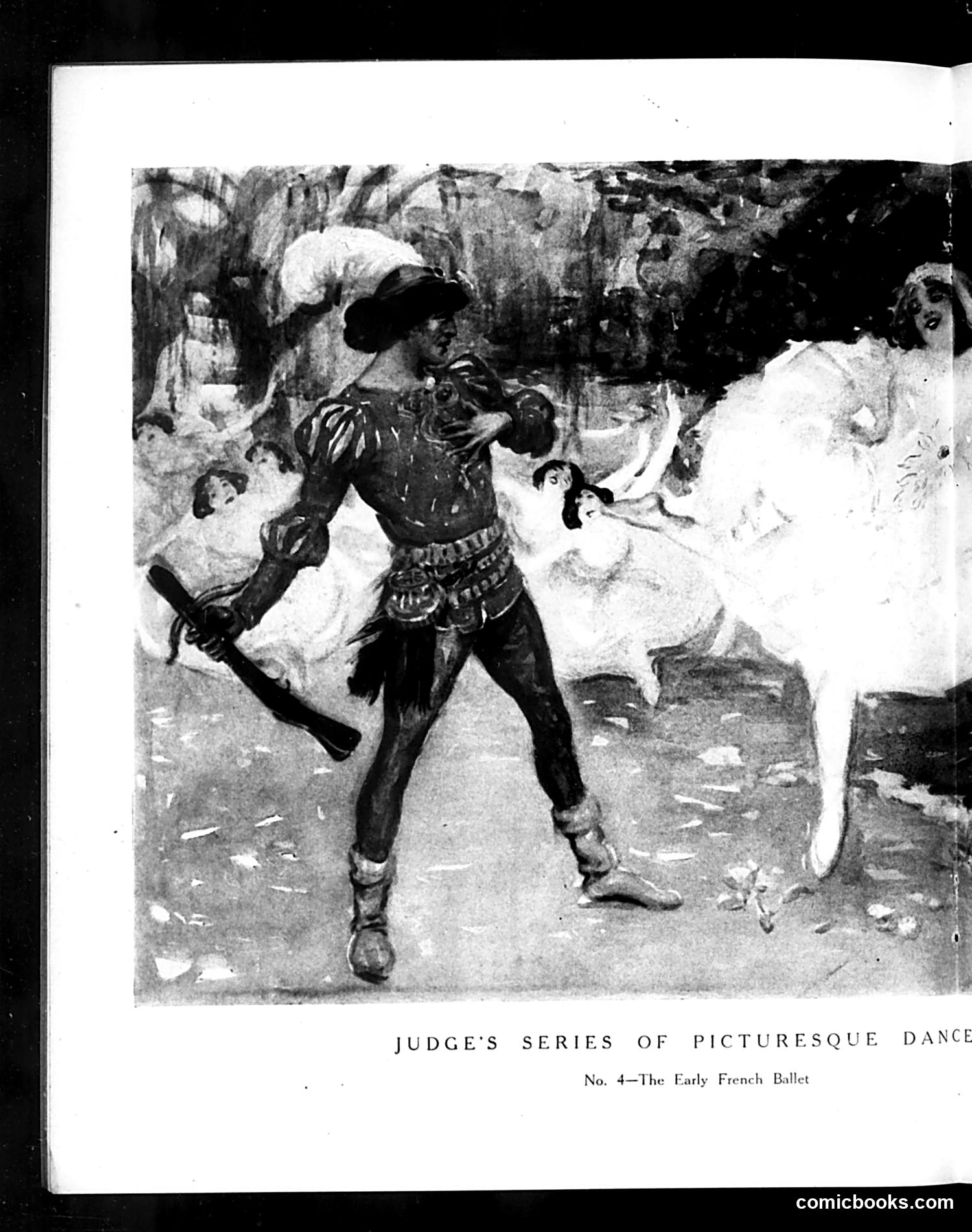
This page is part of Judge magazine's "Series of Picturesque Dance," specifically depicting "The Early French Ballet" (No. 4). Rather than political satire, this appears to be an illustrated feature showcasing dance history. The image shows a male dancer in elaborate Renaissance-style costume with ornate dark clothing, feathered hat, and decorative belt, performing a dynamic leap or jump. He's surrounded by other figures in period dress, likely representing the court setting of early French ballet. The satire likely mocks either the exaggerated artificiality of early ballet conventions, the pretension of historical court dances, or the absurdity of male performers in such elaborate, ornate costumes. Without additional context about Judge's editorial stance on dance or fashion of the era, the specific satirical target remains somewhat unclear, though the theatrical exaggeration suggests gentle mockery of period ballet aesthetics.
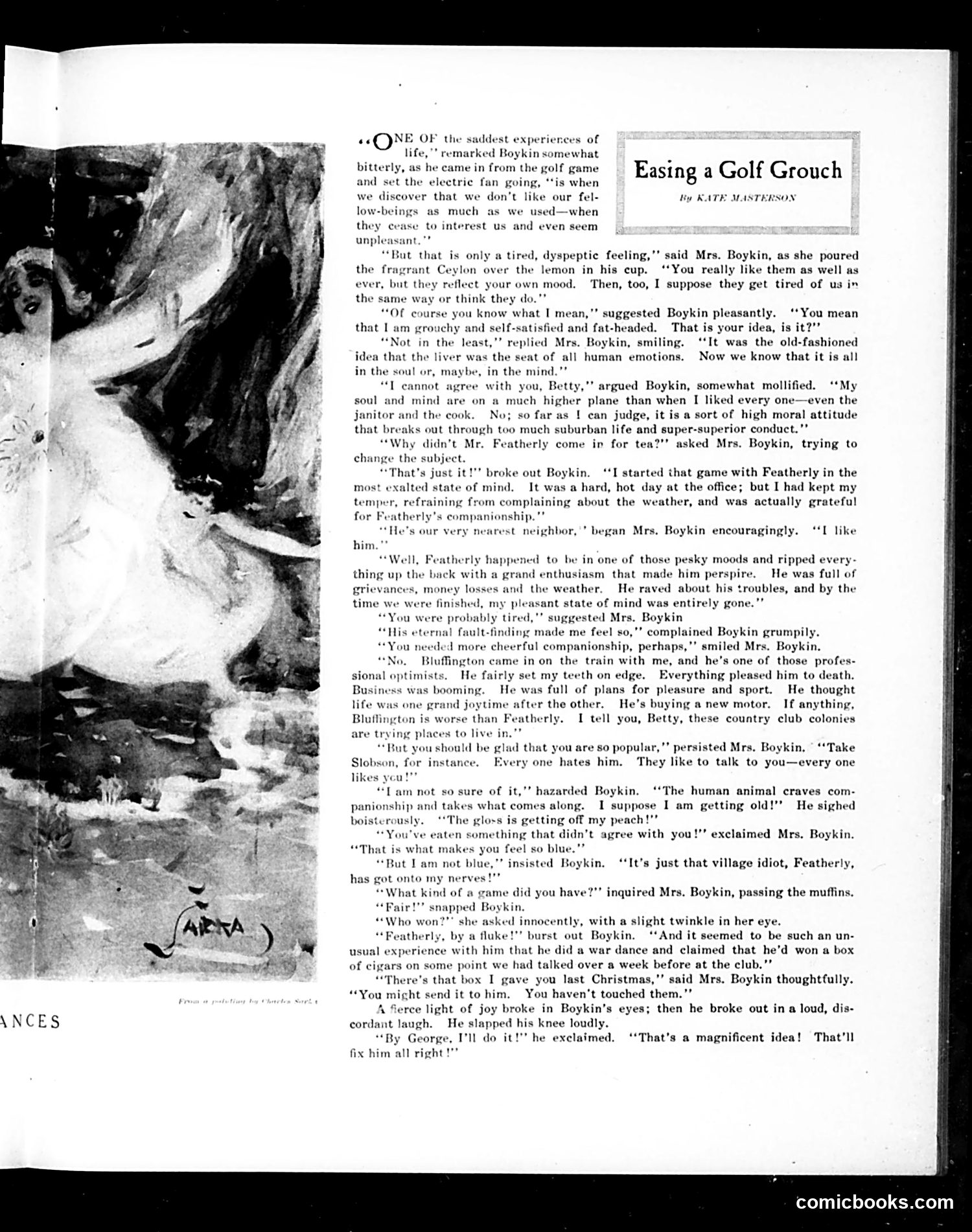
This page presents a short story (not a political cartoon) about Mr. Boykin, a suburban golfer whose mood has soured after a frustrating golf game. The narrative explores early 20th-century attitudes about temperament and masculinity. **The Setup:** Boykin complains that people become unpleasant when he loses interest in them. His wife, Mrs. Boykin, suggests his grouchiness reflects his own mood rather than others' failings—a psychological insight for the era. **The Point:** The story satirizes suburban male entitlement and emotional immaturity. Boykin expects cheerful companionship from neighbors (Featherly, Bluffington, Slobson) while remaining irritable himself. He blames his bad mood on *them*—their pessimism or excessive optimism—rather than acknowledging his own fatigue or poor sportsmanship (he lost at golf to Featherly). **Social Context:** This reflects Jazz Age anxiety about leisure-class masculinity and the growing middle-class obsession with golf clubs as status markers. The humor lies in recognizing Boykin's self-deception about his own character.
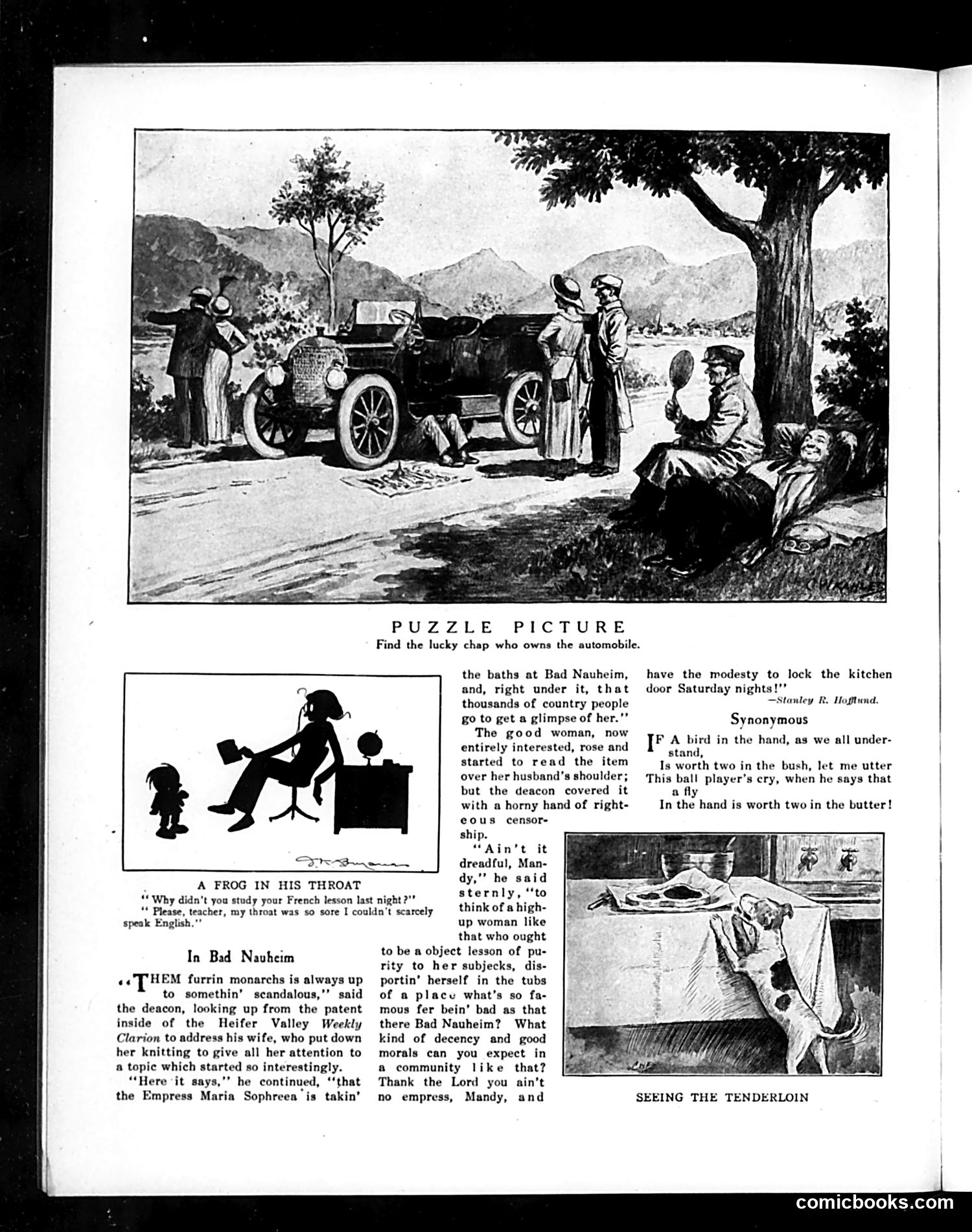
This page satirizes small-town American hypocrisy circa early 1900s. **"A Frog in His Throat"** is a simple pun joke about a student's excuse. **"In Bad Nauheim"** is the main satire. A self-righteous deacon reads gossip about Empress Maria Sophia bathing at Bad Nauheim (a German spa town), then censors his wife from reading it—while simultaneously lecturing about the empress's lack of morality. The humor targets his transparent double standard: he's scandalized by a royal woman's public bathing, yet gratified by the juicy gossip itself. He congratulates his wife for being modest enough to lock the kitchen door on Saturday nights, implying rural Americans possess superior virtue to decadent European royalty. Judge mocks this provincial moralizing and the deacon's obvious hypocrisy. **"Puzzle Picture"** asks readers to identify who owns the automobile in the top illustration—a class-commentary game popular in the era. The overall tone satirizes rural American sanctimoniousness and fascination with European scandal.
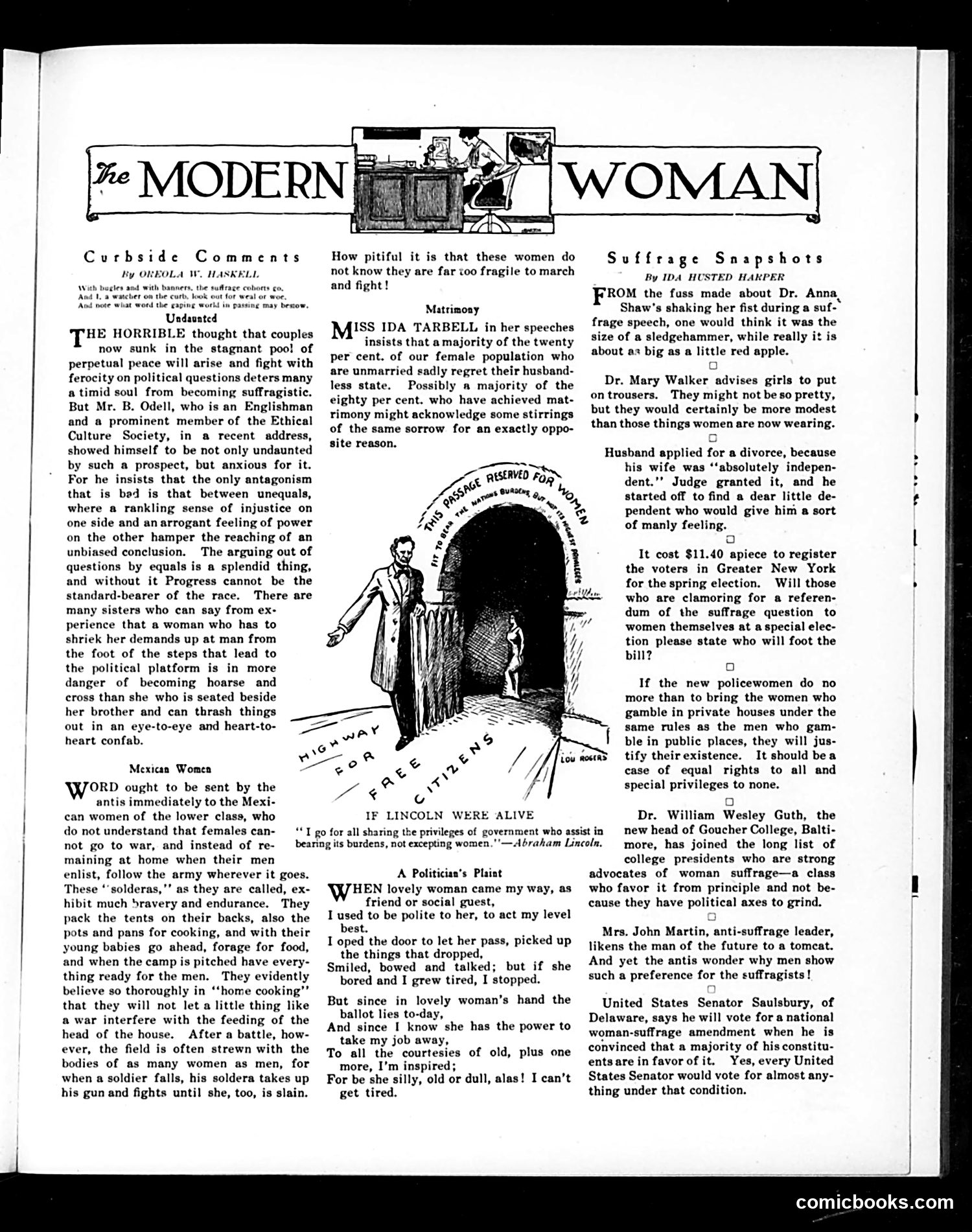
This *Judge* magazine page satirizes women's suffrage through multiple angles, reflecting early 20th-century anti-suffrage arguments. **The central cartoon** shows a woman at a doorway labeled "Suffrage Reserved for Women," depicting suffrage as exclusive territory—likely mocking suffragists' arguments. **"Curbside Comments"** ridicules B. Odell's claim that equal political debate between men and women strengthens society. The author sarcastically suggests women already argue fiercely with men over politics, contradicting the "fragile" stereotype. **"Mexican Women"** section uses irony: it mocks anti-suffrage claims that women are too delicate for public life by highlighting Mexican solderas (camp followers) who fight alongside soldiers, proving women *can* endure hardship—yet implying this shouldn't grant them political rights. **"A Politician's Plaint"** directly addresses male anxiety: now that women vote, politicians must flatter even "silly" women rather than ignore them, showing suffrage's practical political consequences. The page's throughline: suffragists and critics both acknowledge women's actual capabilities, yet opponents still resist granting political equality.
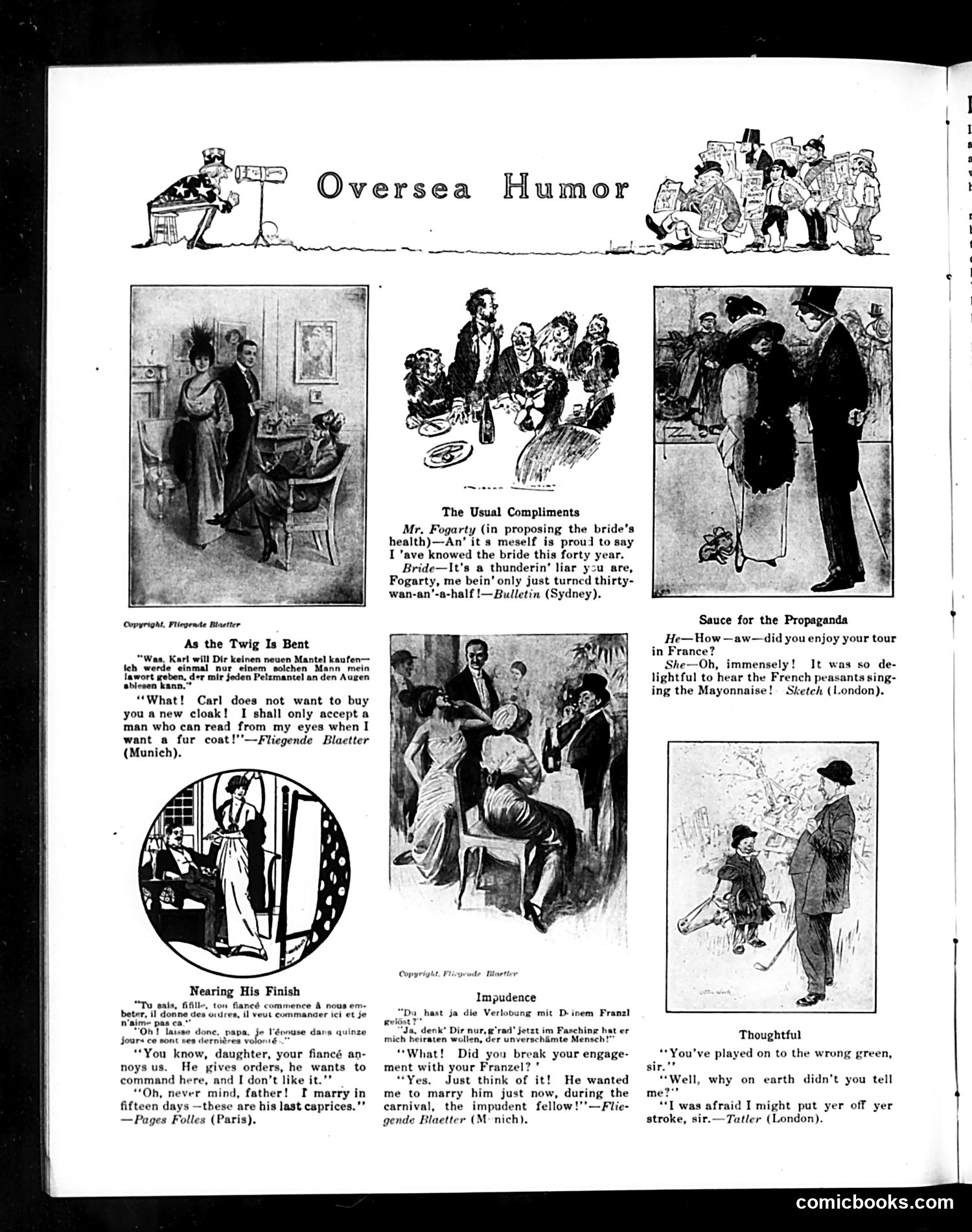
This page collects humorous anecdotes translated from European satirical publications, representing early 20th-century cross-cultural comedy exchanges. The jokes lampoon predictable social situations: a woman exposing a man's flattery about knowing her for "forty years" when she's only thirty; a materialistic woman demanding a suitor who can read her desires; a couple enjoying France but mishearing "Mayonnaise" for the actual French song (likely "La Marseillaise," the national anthem—mocking tourists' ignorance). The German-sourced "As the Twig Is Bent" criticizes materialistic women prioritizing fur coats. "Impudence" depicts a woman breaking her engagement because her French fiancé inconveniently wanted to marry *during* carnival season. The recurring theme: satirizing bourgeois vanity, female materialism, and international romantic misunderstandings. These are genteel, domestic comedies reflecting period attitudes toward courtship, class pretension, and the continental sophistication valued by Judge's middle-class readership.
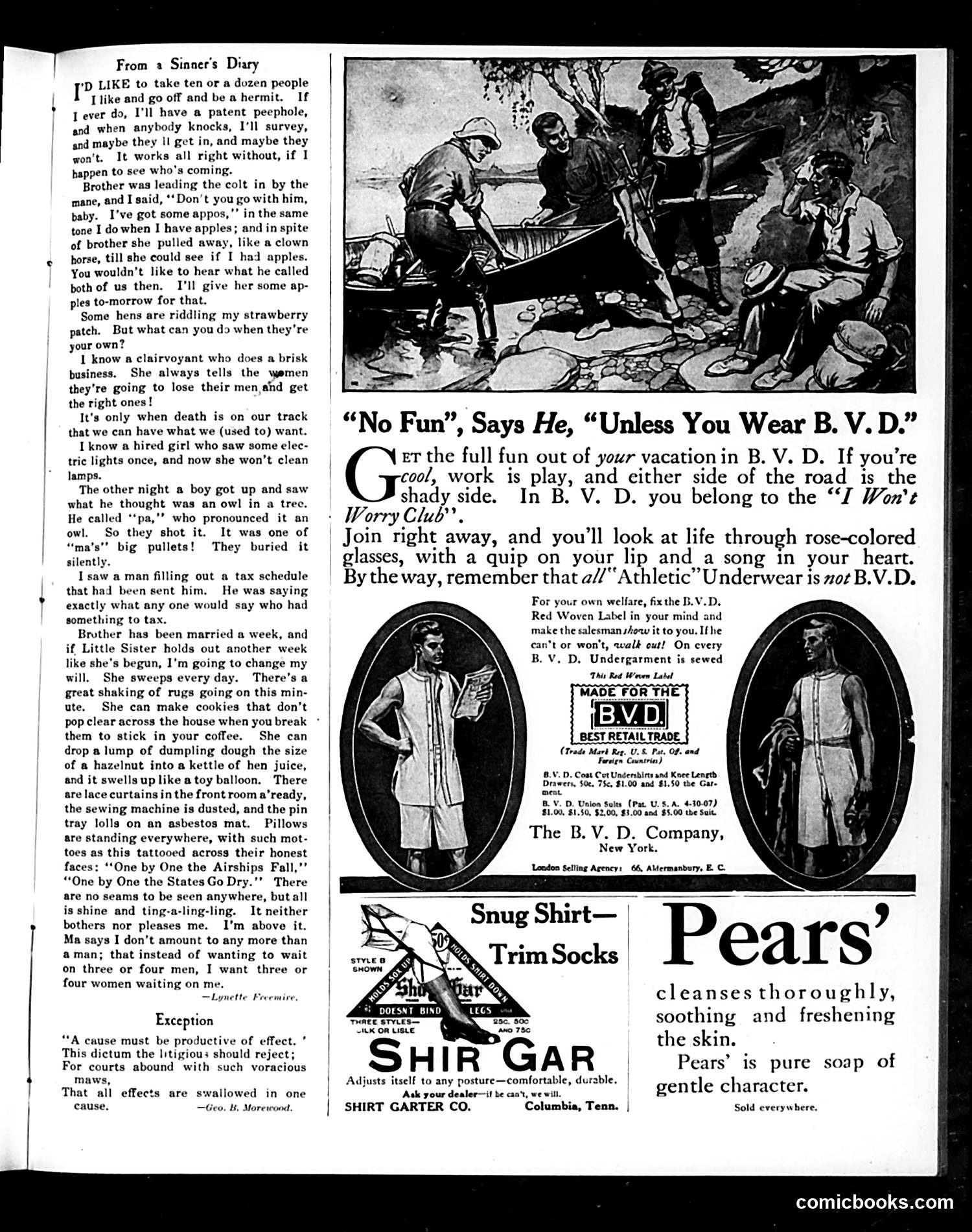
This page contains a personal essay titled "From a Sinner's Diary" and advertisements—not political cartoons. **The Essay**: Written by Lynette Freemire, it offers humorous observations about domestic life and human nature. Notable details include: a woman who pulls away from her brother to check if he actually has apples (showing human skepticism), a hired girl who refuses to clean oil lamps after seeing electric lights (social commentary on technological progress changing attitudes), and praise for the author's new sister-in-law's housekeeping skills, delivered with deadpan sarcasm about gender roles. **The Advertisements**: The B.V.D. underwear ad uses vacation imagery and promises relaxation through proper undergarments—typical early 20th-century advertising claiming products improve mood and lifestyle. Also featured: Shir-Gar trim socks and Pears' soap, standard period personal care products. No political satire is present; this is lifestyle content typical of Judge magazine's mix of humor and commercial messaging.
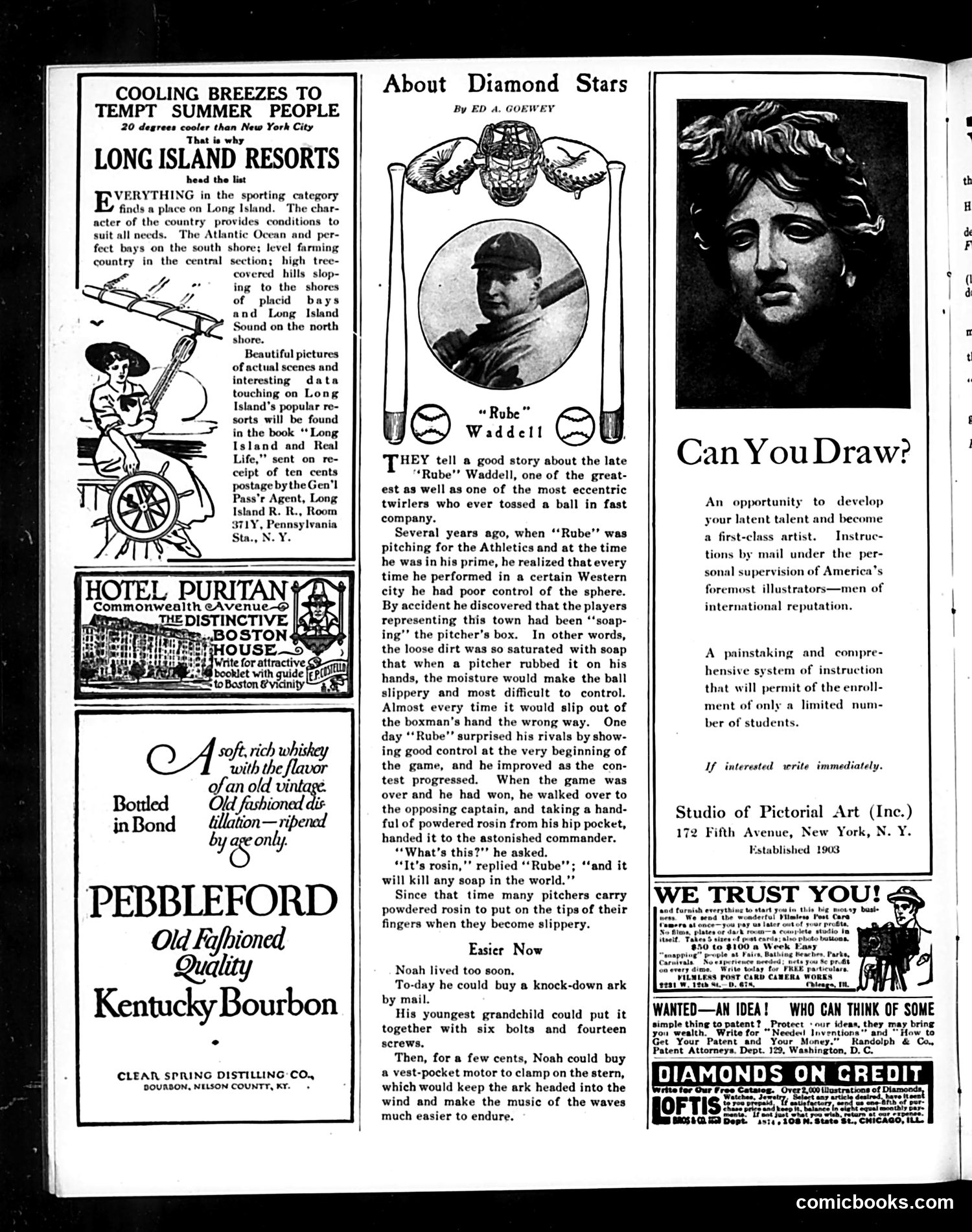
This page is primarily **advertising and filler content** rather than political satire. The main feature, "About Diamond Stars" by Ed A. Goewey, is a sports anecdote about **"Rube" Waddell**, a real early-20th-century baseball pitcher known for eccentric behavior. The story—about opposing teams sabotaging the pitcher's mound with soap, which Waddell counters with rosin powder—appears to be a humorous (likely apocryphal) baseball legend meant to entertain readers. The page contains numerous advertisements: Long Island resorts, Pebbleford Kentucky bourbon, a "Can You Draw?" art instruction service, patent services, and diamond credit offers. A brief humorous filler, "Easier Now," makes light of modern mail-order convenience by contrasting Noah's ark-building with contemporary knock-down kits and motors. **No clear political satire or social commentary is evident.** This appears to be a typical Judge magazine interior page blending sports nostalgia, humor, and commercial advertisements for early-1900s readers.
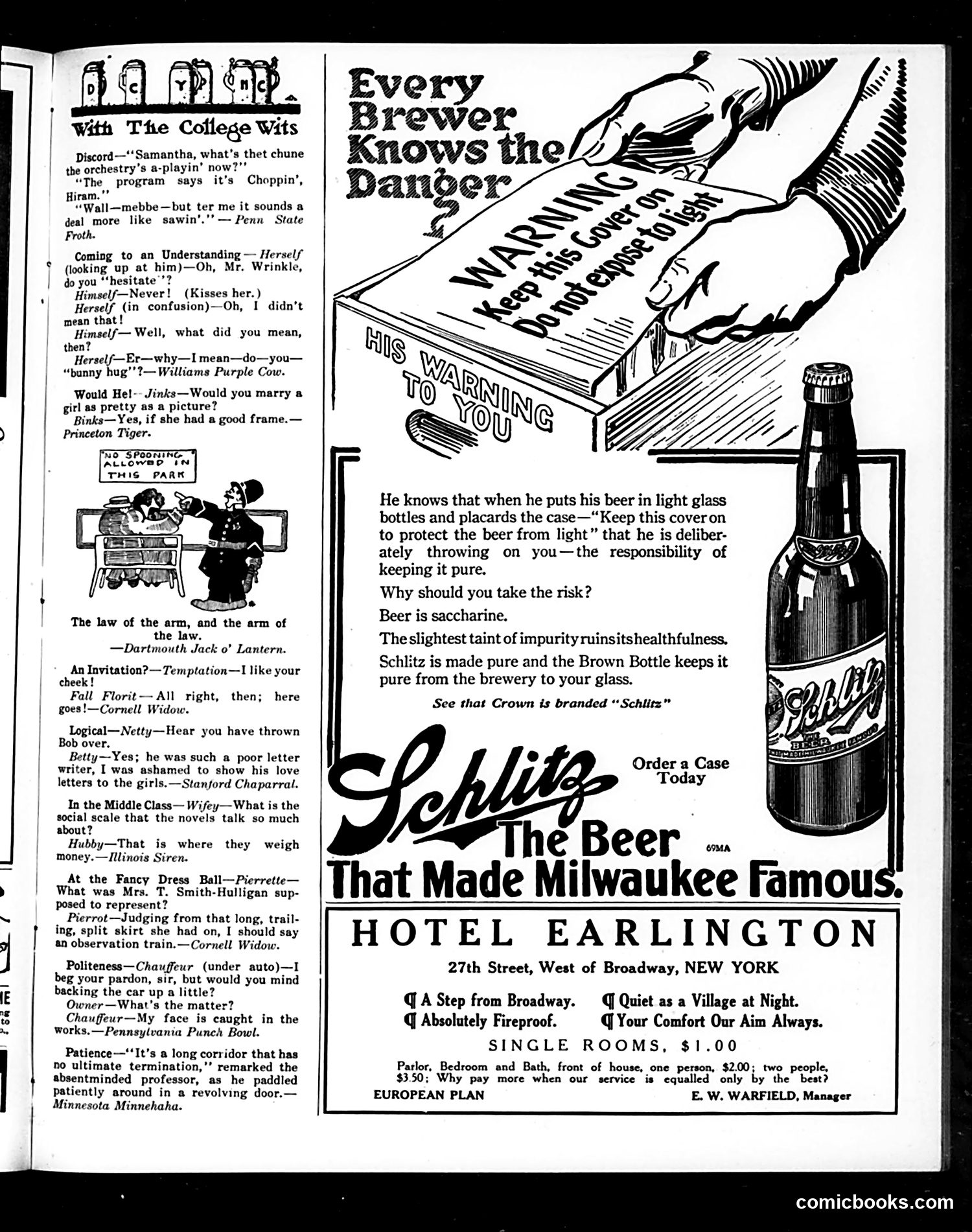
This page comprises two distinct sections: **college humor jokes** (left side) and **advertising** (right side). The "College Wits" section collects brief jokes from various university humor magazines (Penn State Froth, Princeton Tiger, Cornell Widow, etc.). These are mild puns and romantic misunderstandings typical of early 20th-century collegiate humor—plays on words about music, courtship hesitation, and social situations. The dominant content is a **Schlitz beer advertisement** warning brewers about protecting beer from light exposure. The ad uses fear-based messaging: it claims competitors deliberately expose beer to light, risking impurity, while Schlitz uses brown bottles to keep beer pure "from the brewery to your glass." This references the real chemistry of "skunky" beer caused by light exposure—Schlitz positions itself as the responsible, health-conscious choice. Below is a hotel advertisement for the Earlington in New York. The page reflects early advertising's use of pseudo-scientific purity claims and competitive accusations to market consumer products.
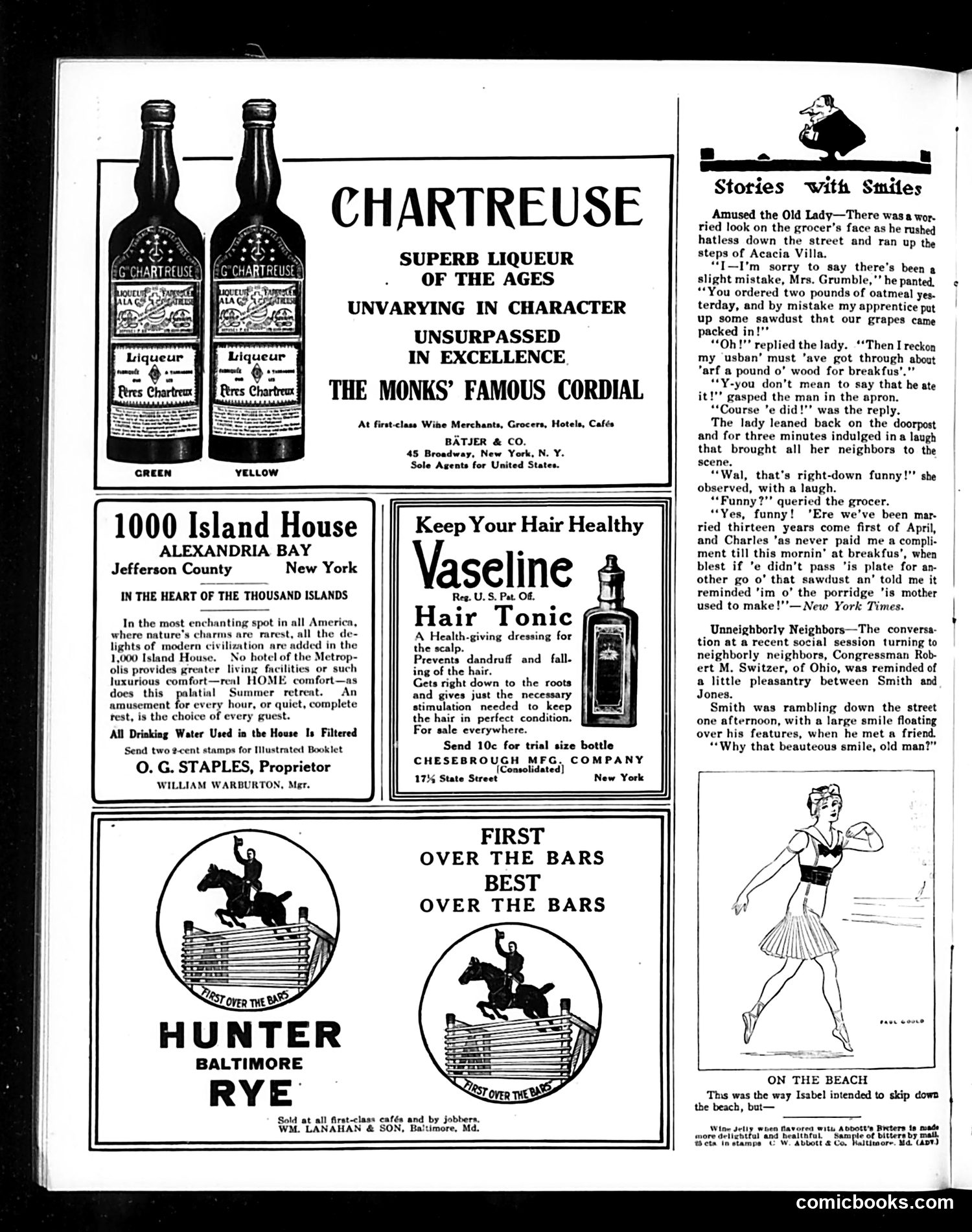
This is primarily an **advertising page** from Judge magazine, with brief humorous anecdotes in the "Stories with Smiles" column. ## Advertisements: The page features liqueur, hotel, hair tonic, and whiskey ads—typical luxury goods marketed to Judge's affluent readership. ## Humor Content: The three short comic stories use **working-class dialect and domestic situations** for humor: 1. **"Amused the Old Lady"**: A grocer accidentally delivers sawdust instead of oatmeal. The joke: the husband unknowingly eats it and compliments it—his first compliment in thirteen years of marriage. Satire of marital indifference. 2. **"Unneighborly Neighbors"**: Congressman Switzer recalls a story about neighbors Smith and Jones (text cuts off). Appears to mock neighborly relations or social hypocrisy. 3. **"On the Beach"**: About a woman named Isabel attempting to skip down a beach. Incomplete, but the illustration suggests physical comedy about feminine deportment. These jokes rely on **period class attitudes**, broken English dialects, and domestic/romantic situations typical of early 20th-century magazine humor—content that reads as dated and somewhat condescending today.
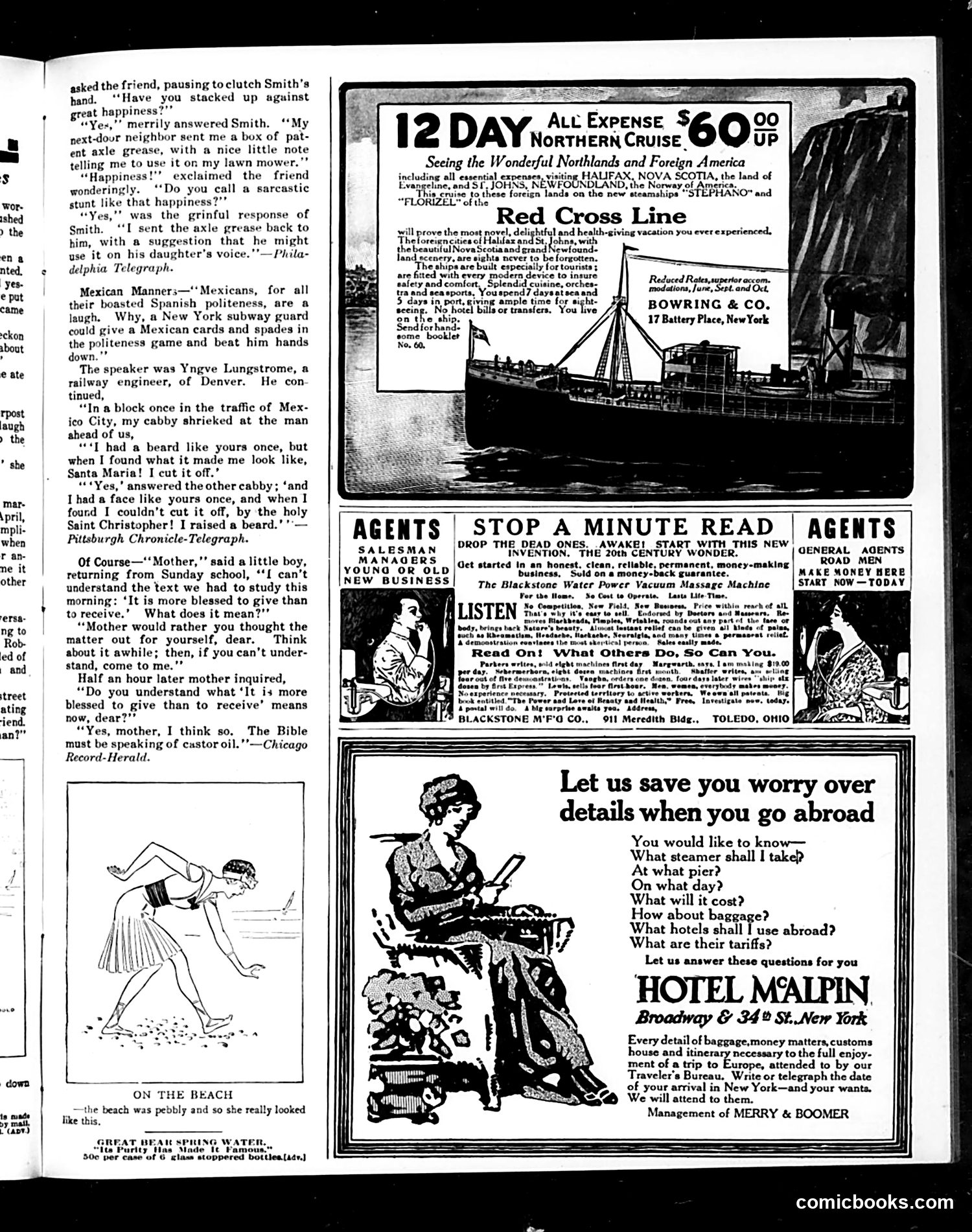
This page contains primarily **humorous anecdotes and advertisements** rather than political cartoons. The humor pieces satirize everyday social situations: 1. **The anecdotes** mock polite society through sarcasm—a man exchanges insulting "gifts" (axle grease) with a neighbor; Mexican cabbies trade crude insults; a child innocently applies Biblical wisdom about giving to castor oil (a laxative). 2. **The small cartoon** "On the Beach" shows a woman in an exaggerated pose, captioned to suggest beach pebbles caused her awkward posture—gentle physical humor. 3. **Advertisements dominate the right side**: cruise ship vacations, the "Blackstone Water Power Vacuum Massage Machine" (a dubious health device sold to "salesmen, young or old"), and Hotel McAlpin's travel services—typical of early 20th-century magazine advertising claiming miraculous results. The page reflects period attitudes toward tourism, quack remedies, and genteel comedy based on social mishaps rather than political commentary.
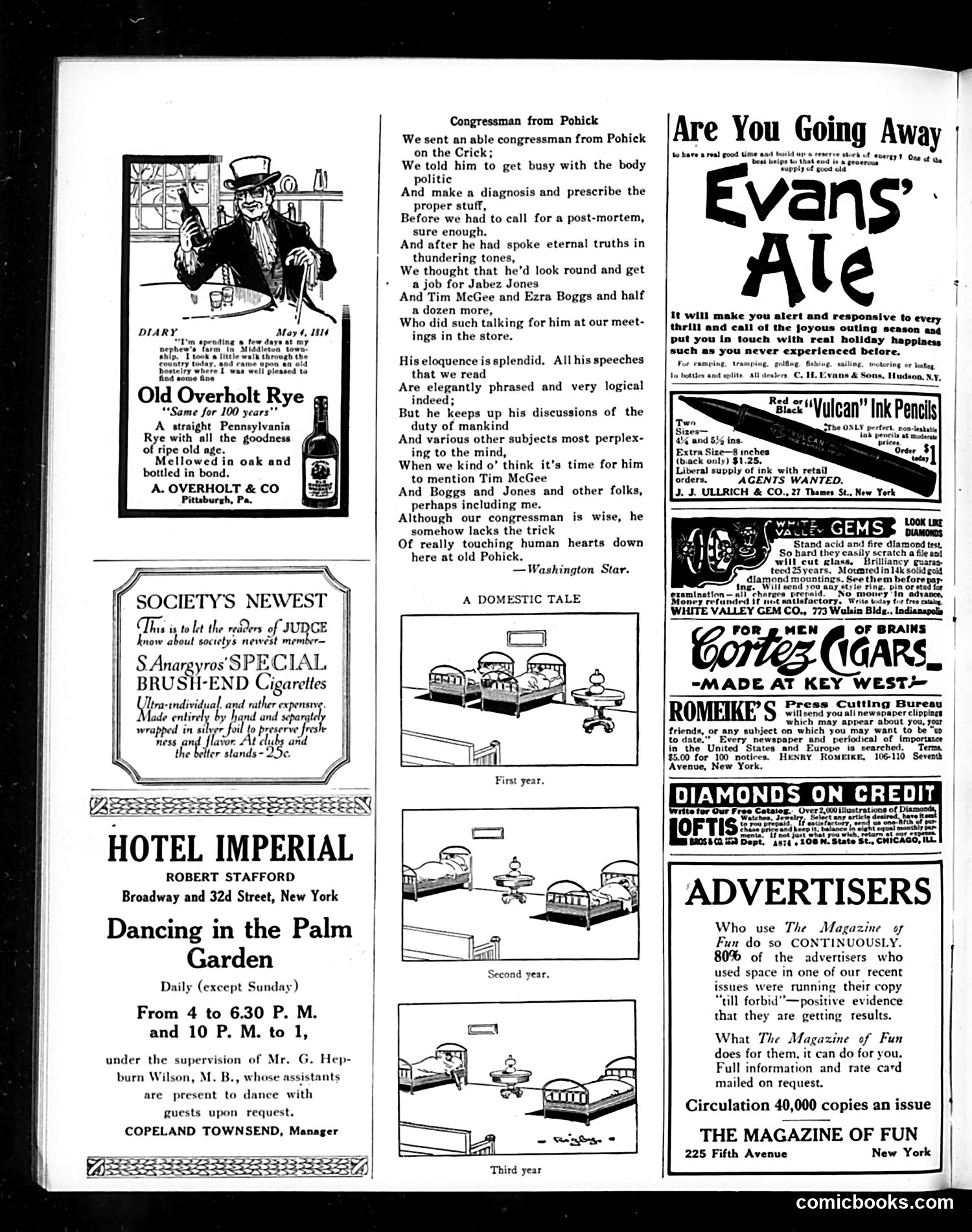
This cartoon satirizes a rural congressman who delivers eloquent speeches about abstract principles ("eternal truths," "duty of mankind") but fails to deliver practical patronage to his constituents. The joke centers on the disconnect between political rhetoric and constituent expectations. The people of Pohick sent him to "get busy with the body politic" and expected him to secure government jobs for local supporters like "Tim McGee and Ezra Boggs." Instead, he gives flowery, logical speeches on lofty subjects that perplex the townspeople. The satirical point: despite his "splendid eloquence" and "elegantly phrased" addresses, the congressman "lacks the trick of really touching human hearts" because he ignores what actually matters to voters—securing jobs and patronage for them. It's a critique of politicians who substitute idealistic rhetoric for the practical patronage politics that rural communities expected, lampooning the gap between high-minded political speech and ground-level political realities.
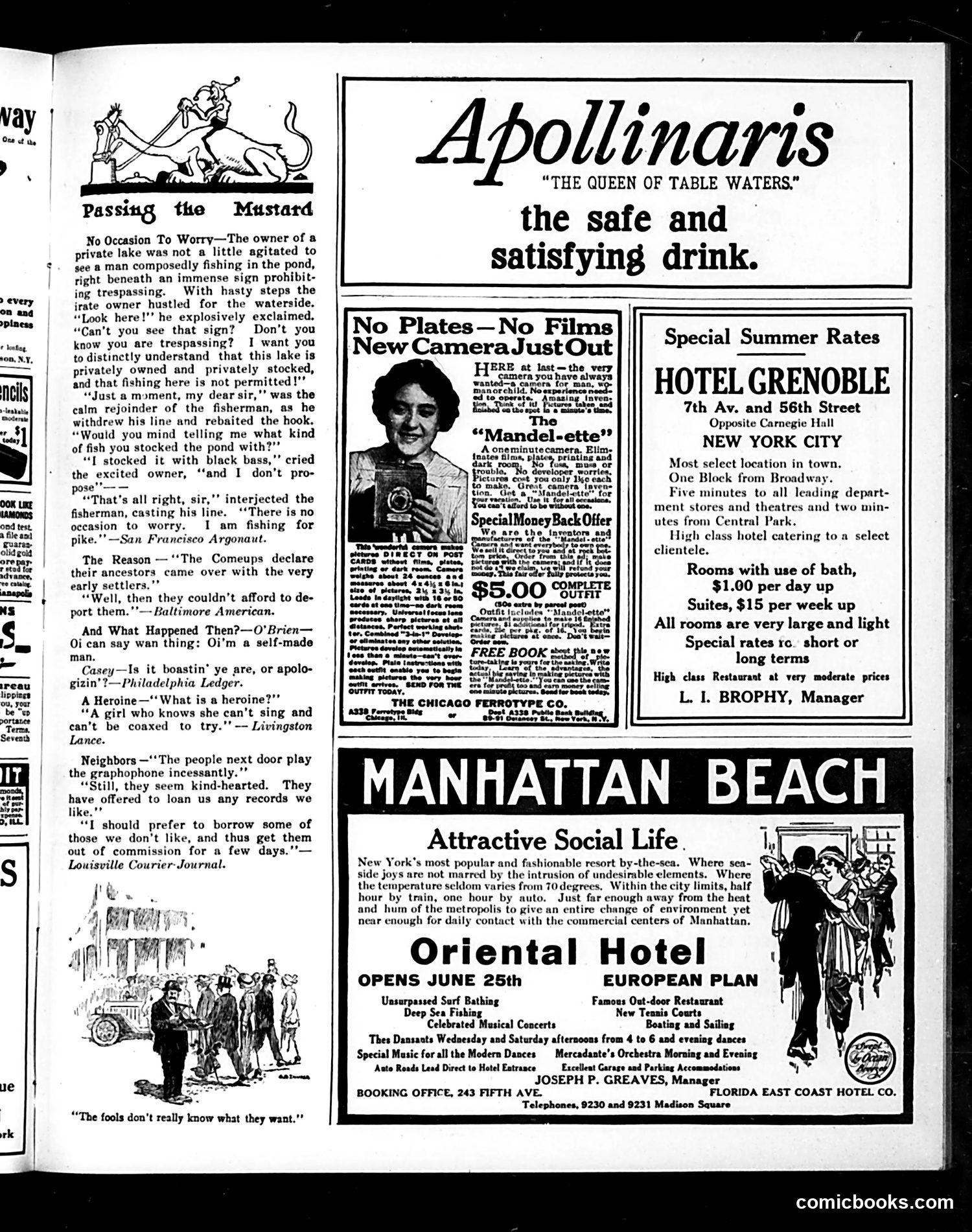
This is a humor page from *Judge* magazine, mostly containing brief jokes and advertisements rather than political cartoons. **"Passing the Mustard"** (the main story) is a classic joke about a fisherman caught trespassing on a private, stocked pond. When the angry owner demands he leave, the fisherman calmly replies he's fishing for *pike*—not the black bass the owner stocked. The joke's premise: the trespasser cleverly reframes his violation as harmless since he's after different prey than what the owner invested in. The surrounding short jokes mock class pretensions ("The Comeups" claiming early settler ancestry), self-made men, and neighbors' gramophones. These satirize everyday American social behaviors—boasting, snobbery, noise complaints—rather than specific political figures. The page is primarily filled with period advertisements for Apollinaris water, cameras, and hotels, typical of magazine content from this era.

This is a **Grape-Nuts breakfast cereal advertisement**, not political satire. The page uses an exotic visual hook—a photograph of a camel train in Australia carrying provisions—to advertise the food's nutritional density and shelf-stability. The ad's argument: Grape-Nuts is so nutritionally concentrated that a camel could carry enough to feed an army for weeks in harsh desert conditions. This "stern test" demonstrates superior food value compared to competitors. The tagline "There's a Reason" references Grape-Nuts' famous advertising slogan from the era. The appeal to exotic colonial imagery (Australian desert, camels, military logistics) was typical early-20th-century marketing, suggesting adventure and reliability through association with extreme conditions. This is **pure product advertising**, not editorial content or satire.