
Judge, 1914-06-20 · page 13 of 24
Judge — June 20, 1914 — page 13: what you’re looking at
What you’re looking at
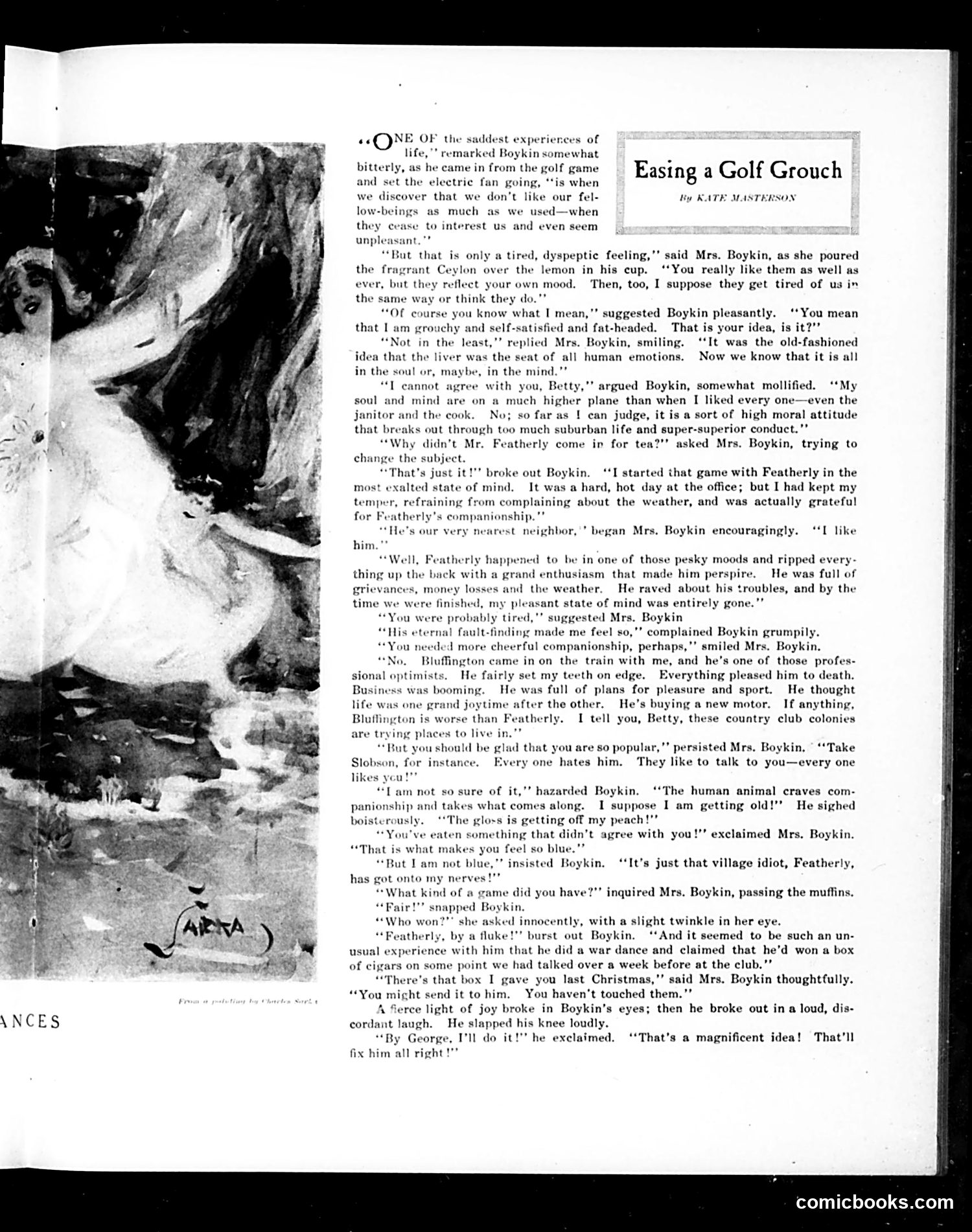
This page presents a short story (not a political cartoon) about Mr. Boykin, a suburban golfer whose mood has soured after a frustrating golf game. The narrative explores early 20th-century attitudes about temperament and masculinity. **The Setup:** Boykin complains that people become unpleasant when he loses interest in them. His wife, Mrs. Boykin, suggests his grouchiness reflects his own mood rather than others' failings—a psychological insight for the era. **The Point:** The story satirizes suburban male entitlement and emotional immaturity. Boykin expects cheerful companionship from neighbors (Featherly, Bluffington, Slobson) while remaining irritable himself. He blames his bad mood on *them*—their pessimism or excessive optimism—rather than acknowledging his own fatigue or poor sportsmanship (he lost at golf to Featherly). **Social Context:** This reflects Jazz Age anxiety about leisure-class masculinity and the growing middle-class obsession with golf clubs as status markers. The humor lies in recognizing Boykin's self-deception about his own character.
📄 Transcribed text from this page (OCR, searchable)
Machine-transcribed from the original scan — historical spelling and the odd misread are preserved.
66 QNE OF the saddest experiences of life,’ remarked Boykin somewhat bitterly, as he came in from the golf game Easing a Golf Grouch and set the electric fan going, ‘is when we discover that we don’t like our fel- By KATE MASTERSON low-beings as much as we used—when they cease to interest us and even seem unples % “But that is only a tired, dyspeptic feeling,’ said Mrs. Boykin, as she poured the fragrant Ceylon over the lemon in his cup. ‘You really like them as well as lect your own mood. Then, too, I suppose they get tired of us in ay or think they do." “Of course you know what Im suggested Boykin pleasantly. ‘*You mean that I am grouchy and self-satisfied and fat-headed. That is your idea, is it?” t in the least,’ replied Mrs. Boykin, smiling. ‘It was the old-fashioned idea that the liver was the seat of all human emotions. Now we know that it is all in the soul or, maybe, in the mind."” “T cannot agree with you, Betty," argued Boykin, somewhat mollified. ‘My soul and mind on a much higher plane than when I liked every one—even the janitor and the co No; so far as ! can judge, it is a sort of high moral attitude that breaks out through too much suburban life and super-superior conduct. “Why didn’t Mr. Featherly come ip for tea?’? asked Mrs. Boykin, trying to change the subject. ‘That's just it!’ broke out Boykin. ‘‘I started that game with Featherly in the exalted state of mind It was a hard, hot day at the office; but I had kept my aining from complaining about the weather, and was actually grateful y's companionship. st neighbor,’ began Mrs, Boykin encouragingly. ‘I like i to be in one of those pesky moods and ripped every- asm that made him perspire. He was full of grievances, money ather. He raved about his troubles, and by the were finished, m -asant state of mind was entirely gone * suggested Mrs. Boykin | fault-findingy made me feel complained Boykin grumpily. heerful companionship, perhaps,’? smiled Mrs. Boykin. Bluffington came in on the train with me, and he’s one of those profes- sional optimists. He fairly set my teeth on edge. Everything pleased him to death. Business booming. He was full of plans for pleasure and sport. He thought life was one grand joytime after the other. He's buying a new motor. If anything, Bluflington is worse than Featherly. I tell you, Betty, these country club colonies are trying 7 es to live ir “But you should be glad that you are so popular,” persisted Mrs. Boykin, © ‘Take Slobson, for instance. ry one hates him. They like to talk to you—every one likes yeu!"” um not so sure of it,’ hazarded Boykin. ‘*The human animal craves com- ionship and takes what comes along. I suppose I am getting old!’ He sighed erously. ‘The gloss is getting off my peach!"’ You've eaten something that didn’t agree with you!’’ exclaimed Mrs, Boykin. “That is what makes you feel so blue.”” “But Lam not blue,” insisted Boykin. ‘It’s just that village idiot, Featherly, has got onto my nerves!" “What kind of a game did you have?" inquired Mrs. Boykin, passing the muffins. “Pair!” snapped Boykin. “Who won?’ she asked innocently, with a slight twinkle in her eye. “Peatherly, by burst out Boykin. ‘‘And it seemed to be such an un- usual experience with him that he did a war dance and claimed that he’d won a box ‘3 on some point we had talked over a week before at the club.”” “There's that box I gave you last Christmas," said Mrs. Boykin thoughtfully. “You might send it tohim, You haven't touched them." A flerce light of joy broke in Boykin’s eyes; then he broke out ina loud, dis- cordant laugh. He slapped his knee loudly. “By George, I'll do it!" he exclaimed. ‘That's a magnificent idea! That'll fix him all right !"" comicbooks.com