
Judge, 1914-06-20 · page 11 of 24
Judge — June 20, 1914 — page 11: what you’re looking at
What you’re looking at
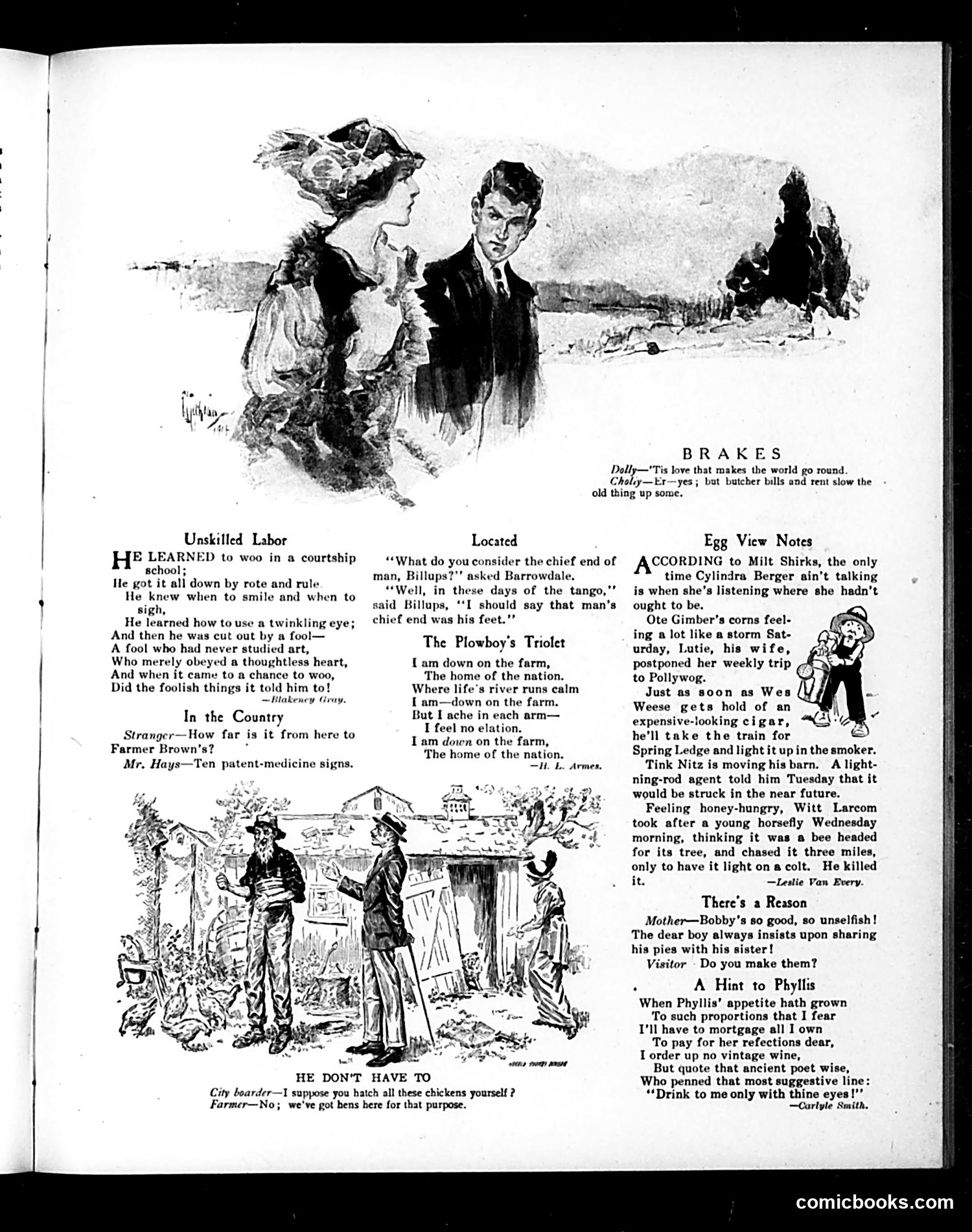
This page contains several brief humorous sketches and poems typical of early 20th-century American satirical magazines: **"Unskilled Labor"**: A poem satirizing courtship etiquette—a man trained in formal wooing techniques loses to an emotionally genuine fool, mocking artificial social conventions. **"In the Country"**: A joke about rural America, where distance is measured by patent-medicine advertisements (common roadside signs of the era), poking fun at both rural life and the ubiquity of dubious medical marketing. **"The Plowboy's Triolet"**: A poem romanticizing farm life as "the home of the nation" while ironically revealing physical exhaustion and emotional emptiness—social commentary on agrarian idealization. **"Brakes" & "He Don't Have To"**: Brief jokes about love versus practical expenses, and a city person's ignorance of farm life. **"Egg View Notes"**: Rural gossip column with small-town humor about neighbors' foibles. **"A Hint to Phyllis"**: A poem about controlling a woman's appetites through romantic quotation rather than spending money—somewhat sexist humor typical of the period.
📄 Transcribed text from this page (OCR, searchable)
Machine-transcribed from the original scan — historical spelling and the odd misread are preserved.
Unskilled Labor LEARNED to woo in a courtship H® school ; He got it all down by rote and rule He knew when to smile and when to sigh, He learned how to use a twinkling eye; And then he was cut out by a fool— A fool who had never studied art, Who merely obeyed a thoughtless heart, And when it came to a chance to woo, Did the foolish things it told him to! —Blakency Gray. In the Country Stranger—How far is it from here to Farmer Brown's? Mr. Hays—Ten patent-medicine signs. Doll; Located “What do you consider the chief end of man, Billups?’ asked Barrowdale. “Well, in these days of the tango,'’ said Billups, ‘‘I should say that man’s chief end was his feet.’” The Plowboy’s Triolet { am down on the farm, The home of the nation. Where life's river runs calm I am—down on the farm, But I ache in each arm— I feel no elation, Iam down on the farm, The home of the nation. —H. b. Armes, HE DON’T HAVE TO City boarder—1 suppose you hatch all these chickens yourself ? Farmer—No; we've got hens here for that purpose. BRAKES "Tis love that makes the world go round. Choliy—Ex—yes ; but butcher bills and rent slow the old thing up some. Egg View Notes ACCORDING to Milt Shirks, the only time Cylindra Berger ain’t talking is when she’s listening where she hadn't ought to be. Ote Gimber's corns feel- ing a lot like a storm Sat- urday, Lutie, his wife, postponed her weekly trip to Pollywog. Just as soon as Wes Weese gets hold of an expensive-looking cigar, he'll take the train for Spring Ledge and light it up in the smoker. Tink Nitz is moving his barn. A light- ning-rod agent told him Tuesday that it would be struck in the near future. Feeling honey-hungry, Witt Larcom took after a young horsefly Wednesday morning, thinking it was a bee headed for its tree, and chased it three miles, only to have it light on a colt. He killed it. —Leslie Van Every. There’s a Reason Mother—Bobby's so good, so unselfish! The dear boy always insists upon sharing his pies with his sister! Visitor Do you make them? . A Hint to Phyllis When Phyllis’ appetite hath grown To such proportions that I fear I'll have to mortgage all I own To pay for her refections dear, I order up no vintage wine, But quote that ancient poet wise, Who penned that most suggestive li: “Drink to me only with thine eyes —Carlyle Smith. comicbooks.com