
Judge, 1914-06-20 · page 4 of 24
Judge — June 20, 1914 — page 4: what you’re looking at
What you’re looking at
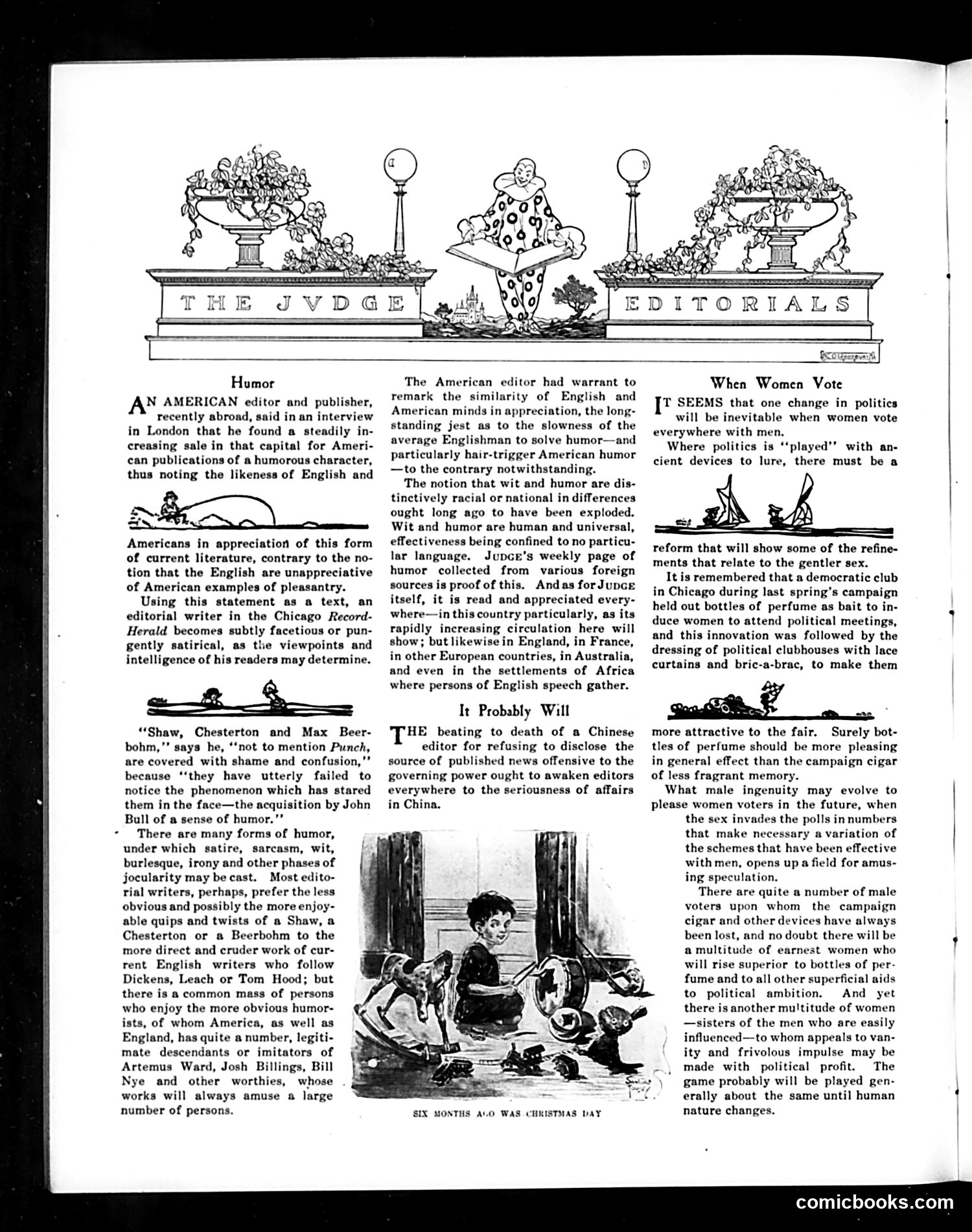
This page contains three distinct articles about humor and politics, framed by decorative "Judge" and "Editorials" mastheads. **Left column ("Humor"):** Discusses English versus American humor appreciation, noting Americans find steadily increasing sales for American humorous publications in London. It praises American humorists like Artemus Ward, Josh Billings, and Bill Nye. **Center:** Contains a small illustration captioned "SIX MONTHS AGO WAS CHRISTMAS DAY" showing a child playing with toys. **Right column ("When Women Vote"):** Satirizes women's potential entry into politics, predicting changes to political campaigning—particularly concerns about female voters being influenced by superficial appeals like "lace curtains and bric-a-brac" rather than serious issues. The satire suggests male politicians will need to adjust their strategies. The page represents Judge's typical approach: mixing cultural commentary with gentle mockery of contemporary social debates.
📄 Transcribed text from this page (OCR, searchable)
Machine-transcribed from the original scan — historical spelling and the odd misread are preserved.
Humor AN AMERICAN editor and publisher, recently abroad, said in an interview in London that he found a steadily in- creasing sale in that capital for Ameri- can publications of a humorous character, thus noting the likeness of English and =, Americans in appreciation of this form of current literature, contrary to the no- tion that the English are unappreciative of American examples of pleasantry. Using this statement as a text, an editorial writer in the Chicago Record- Herald becomes subtly facetious or pun- gently satirical, as the viewpoints and intelligence of his readers may determine. os 4 “Shaw, Chesterton and Max Beer- bohm,"’ says he, ‘‘not to mention Punch, are covered with shame and confusion,”’ because ‘‘they have utterly failed to notice the phenomenon which has stared them in the face—the acquisition by John Bull of a sense of humor.”’ There are many forms of humor, under which satire, sarcasm, wit, burlesque, irony and other phases of jocularity may be cast. Most edito- rial writers, perhaps, prefer the less obvious and possibly the more enjoy- able quips and twists of a Shaw, a Chesterton or a Beerbohm to the more direct and cruder work of cur- rent English writers who follow Dickens, Leach or Tom Hood; but there is a common mass of persons who enjoy the more obvious humor- ists, of whom America, as well as England, has quite a number, legiti- mate descendants or imitators of Artemus Ward, Josh Billings, Bill Nye and other worthies, whose works will always amuse a large number of persons. The American editor had warrant to remark the similarity of English and American minds in appreciation, the long- standing jest as to the slowness of the average Englishman to solve humor—and particularly hair-trigger American humor —to the contrary notwithstanding. The notion that wit and humor are dis- tinctively racial or national in differences ought long ago to have been exploded. Wit and humor are human and universal, effectiveness being confined to no particu- lar language. Jupce’s weekly page of humor collected from various foreign sources is proof of this. Andas forJupce itself, it is read and appreciated every- where—in this country particularly, as its rapidly increasing circulation here will show; but likewise in England, in France, in other European countries, in Australia, and even in the settlements of Africa where persons of English speech gather. Tt Probably Will HE beating to death of a Chinese editor for refusing to disclose the source of published news offensive to the governing power ought to awaken editors everywhere to the seriousness of affairs in China. SIX MONTHS A‘.O WAS CHRISTMAS DAY When Women Vote I‘ SEEMS that one change in politics will be inevitable when women vote everywhere with men. Where politics is ‘‘played’’ with an- cient devices to lure, there must be a e; reform that will show some of the refine- ments that relate to the gentler sex. It is remembered that a democratic club in Chicago during last spring’s campaign held out bottles of perfume as bait to in- duce women to attend political meetings, and this innovation was followed by the dressing of political clubhouses with lace curtains and bric-a-brac, to make them pr more attractive to the fair. Surely bot- tles of perfume should be more pleasing in general effect than the campaign cigar of less fragrant memory. What male ingenuity may evolve to please women voters in the future, when the sex invades the polls in numbers that make necessary a variation of the schemes that have been effective with men, opens up a field for amus- ing speculation. There are quite a number of male voters upon whom the campaign cigar and other devices have always been lost, and no doubt there will be a multitude of earnest women who will rise superior to bottles of per- fume and to all other superficial aids to political ambition. And yet there is another multitude of women —sisters of the men who are easily influenced—to whom appeals to van- ity and frivolous impulse may be made with political profit. The game probably will be played gen- erally about the same until human nature changes. comicbooks.com