
Judge, 1914-06-20 · page 15 of 24
Judge — June 20, 1914 — page 15: what you’re looking at
What you’re looking at
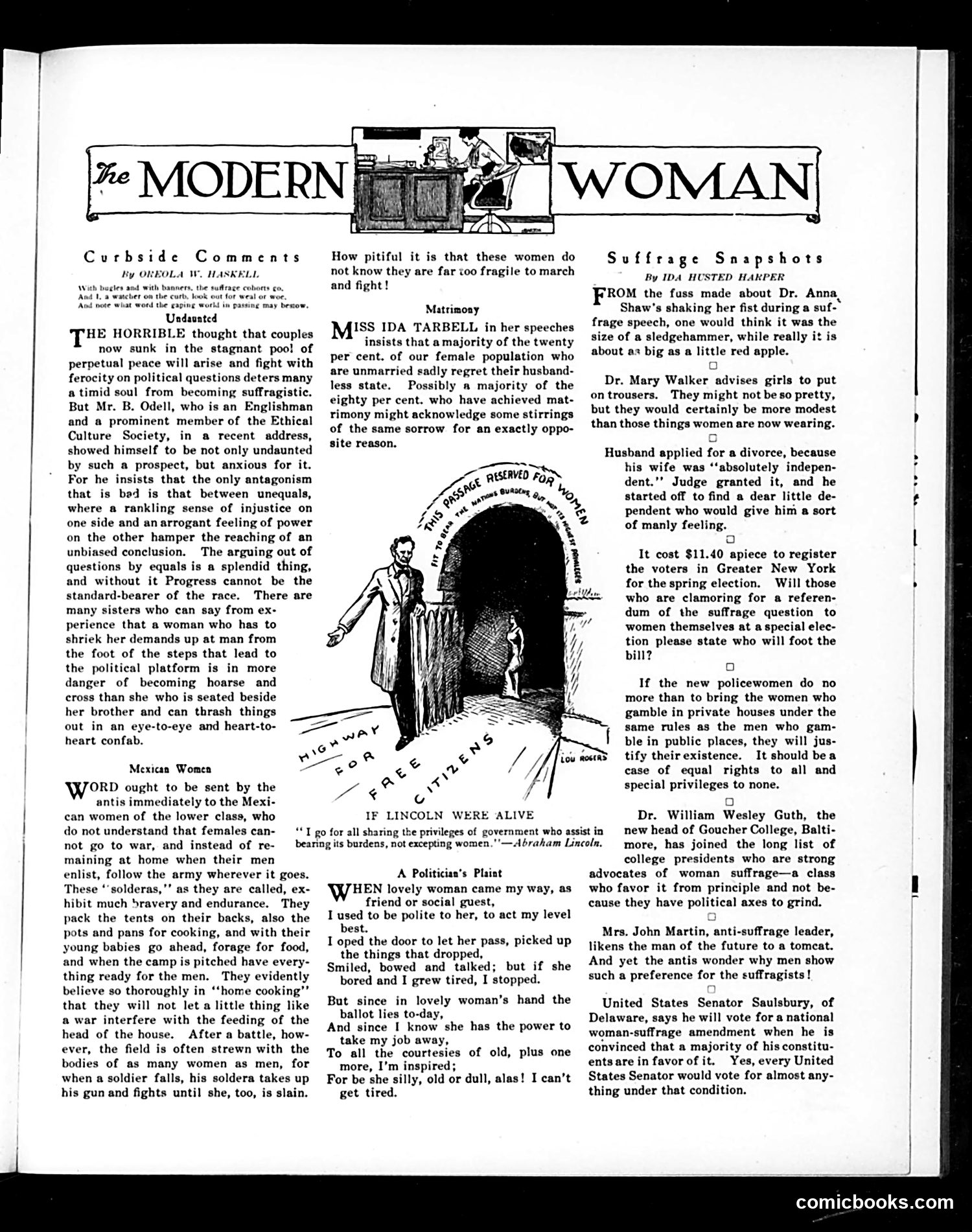
This *Judge* magazine page satirizes women's suffrage through multiple angles, reflecting early 20th-century anti-suffrage arguments. **The central cartoon** shows a woman at a doorway labeled "Suffrage Reserved for Women," depicting suffrage as exclusive territory—likely mocking suffragists' arguments. **"Curbside Comments"** ridicules B. Odell's claim that equal political debate between men and women strengthens society. The author sarcastically suggests women already argue fiercely with men over politics, contradicting the "fragile" stereotype. **"Mexican Women"** section uses irony: it mocks anti-suffrage claims that women are too delicate for public life by highlighting Mexican solderas (camp followers) who fight alongside soldiers, proving women *can* endure hardship—yet implying this shouldn't grant them political rights. **"A Politician's Plaint"** directly addresses male anxiety: now that women vote, politicians must flatter even "silly" women rather than ignore them, showing suffrage's practical political consequences. The page's throughline: suffragists and critics both acknowledge women's actual capabilities, yet opponents still resist granting political equality.
📄 Transcribed text from this page (OCR, searchable)
Machine-transcribed from the original scan — historical spelling and the odd misread are preserved.
Curbside Comments ". HASKELL in passing may becow, Undaunted HE HORRIBLE thought that couples now sunk in the stagnant poo! of perpetual peace will arise and fight with ferocity on political questions deters many a timid soul from becoming suffragistic. But Mr. B. Odell, who is an Englishman and a prominent member of the Ethical Culture Society, in a recent address, showed himself to be not only undaunted by such a prospect, but anxious for it. For he insists that the only antagonism that is bed is that between unequals, where a rankling sense of injustice on one side and an arrogant feeling of power on the other hamper the reaching of an unbiased conclusion. The arguing out of questions by equals is a splendid thing, and without it Progress cannot be the standard-bearer of the race. There are many sisters who can say from ex- perience that a woman who has to shriek her demands up at man from the foot of the steps that lead to the political platform is in more danger of becoming hoarse and cross than she who is seated beside her brother and can thrash things out in an eye-to-eye and heart-to- heart confab. Mexican Women Word ought to be sent by the antis immediately to the Mexi- can women of the lower class, who do not understand that females can- not go to war, and instead of re- maining at home when their men enlist, follow the army wherever it goes. These ‘‘solderas,’’ as they are called, e: hibit much bravery and endurance. They pack the tents on their backs, also the pots and pans for cooking, and with their young babies go ahead, forage for food, and when the camp is pitched have every- thing ready for the men. They evidently believe so thoroughly in ‘thome cooking”’ that they will not let a little thing like a war interfere with the feeding of the head of the house. After a battle, how- ever, the field is often strewn with the bodies of as many women as men, for when a soldier falls, his soldera takes up his gun and fights until she, too, is slain. How pitiful it is that these women do not know they are far ioo fragile to march and fight! Matrimony Miss IDA TARBELL in her speeches insists that a majority of the twenty per cent. of our female population who are unmarried sadly regret their husband- less state. Possibly a majority of the eighty per cent. who have achieved mat- rimony might acknowledge some stirrings of the same sorrow for an exactly oppo- site reason. LS AISERVED FSS S& eet Oy he a : * IF LINCOLN WERE ALIVE A Politician’s Plaint HEN lovely woman came my way, as friend or social guest, I used to be polite to her, to act my level best. I oped the door to let her pass, picked up the things that dropped, Smiled, bowed and talked; but if she bored and I grew tired, I stopped. But since in lovely woman’s hand the ballot lies to-day, And since I know she has the power to take my job away, To all the courtesies of old, plus one more, I’m inspired; For be she silly, old or dull, alas! I can’t get tired. ““T go for all sharing the privileges of government who assist in bearing its burdens, not excepting women." —Abraham Lincoln, Suffrage Snapshots By IDA HUSTED HAKPER ROM the fuss made about Dr. Anna, Shaw's shaking her fist during a suf- frage speech, one would think it was the size of a sledgehammer, while really it is about as big as a little red apple. ie} Dr. Mary Walker advises girls to put ontrousers. They might not beso pretty, but they would certainly be more modest than those things women are now wearing. Husband applied for a divorce, because his wife was ‘‘absolutely indepen- dent.’’ Judge granted it, and he started off to find a dear little de- pendent who would give him a sort of manly feeling. a It cost $11.40 apiece to register the voters in Greater New York for the spring election. Will those who are clamoring for a referen- dum of the suffrage question to women themselves at a special elec- tion please state who will foot the bill? o If the new policewomen do no more than to bring the women who gamble in private houses under the same rules as the men who gam- ble in public places, they will jus- tify theirexistence. It should bea case of equal rights to all and special privileges to none. o Dr. William Wesley Guth, the new head of Goucher College, Balti- more, has joined the long list of college presidents who are strong advocates of woman suffrage—a class who favor it from principle and not be- cause they have political axes to grind. Mrs. John Martin, anti-suffrage leader, likens the man of the future to a tomcat. And yet the antis wonder why men show such a preference for the suffragists! United States Senator Saulsbury, of Delaware, says he will vote for a national woman-suffrage amendment when he is convinced that a majority of his constitu- entsare in favor of it. Yes, every United States Senator would vote for almost any- thing under that condition. comicbooks.com ¢