
A complete issue · 24 pages · 1914
Judge — June 6, 1914
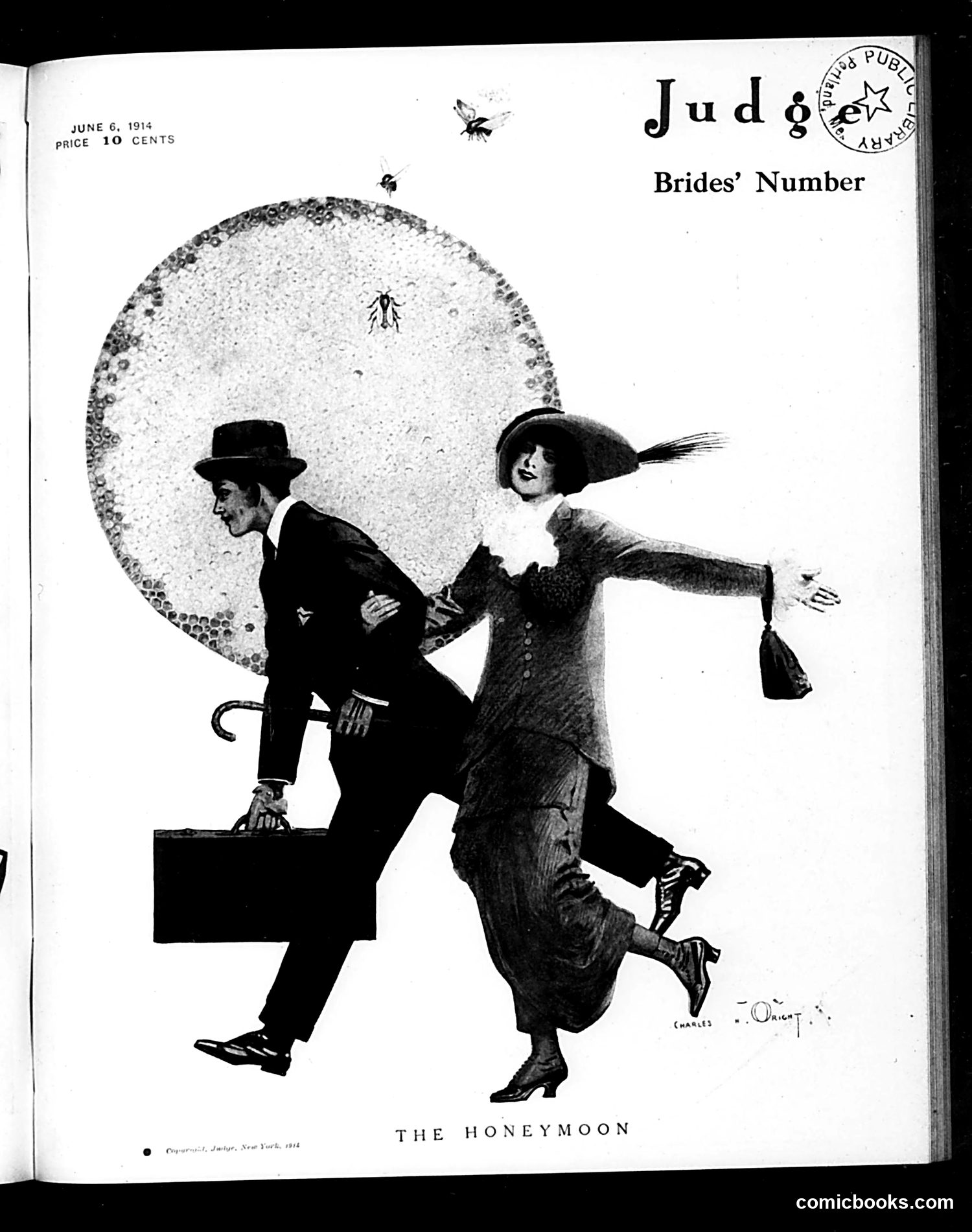
This cartoon satirizes newlyweds on their honeymoon. A well-dressed groom sits uncomfortably beside an exuberant bride who gestures wildly with her purse, appearing to drag him along against his will. The large moon in the background reinforces the honeymoon theme. The joke targets the common marital dynamic where wives dominate husbands immediately after marriage. The groom's stiff posture and closed expression contrast sharply with the bride's animated enthusiasm and controlling gesture. Flies buzzing around the moon add to the chaotic atmosphere. This reflects early 20th-century humor about marriage: the satirical notion that men lose their independence and agency once married, becoming subordinate to their wives' demands and spending.
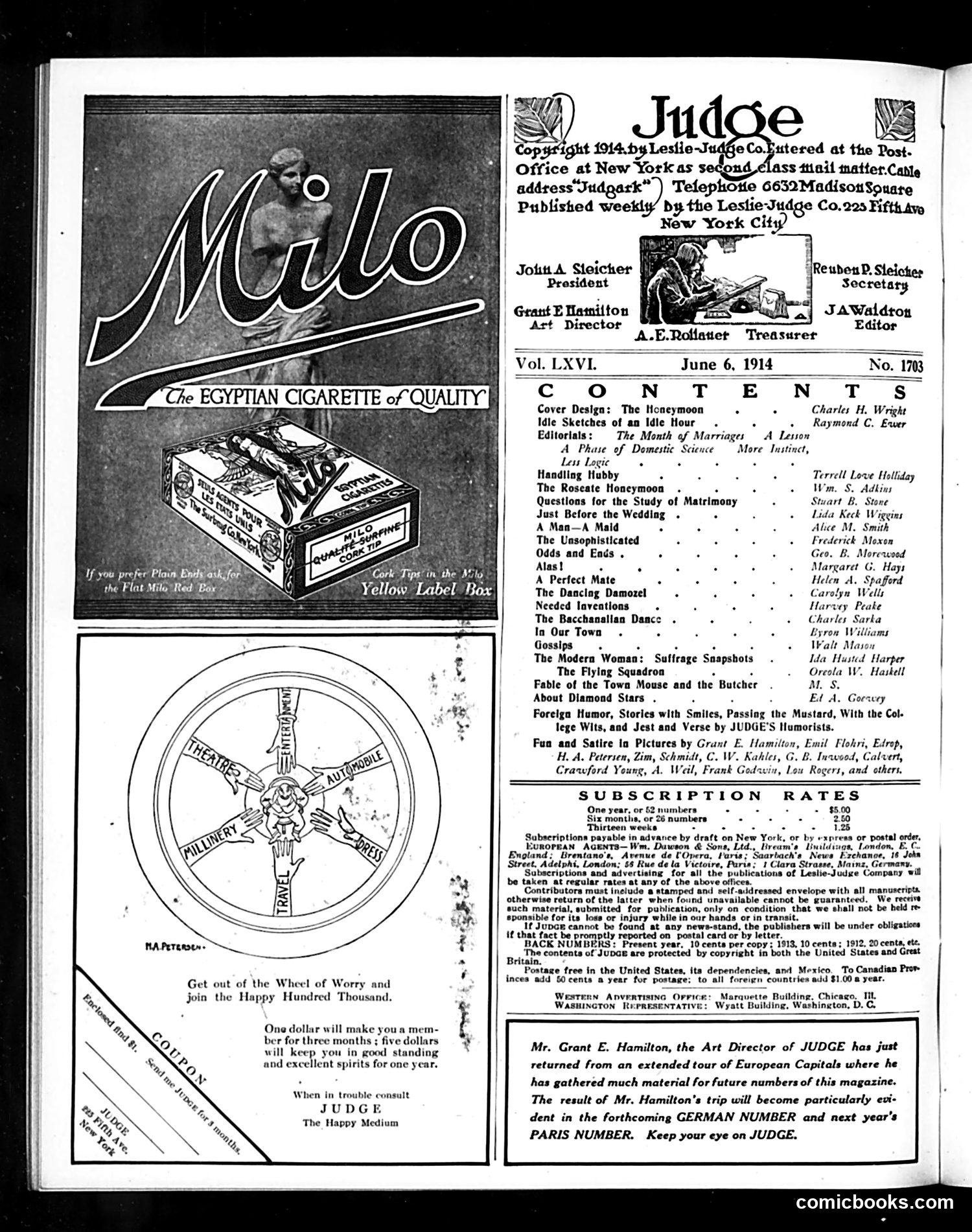
This page is primarily **advertising and magazine masthead**, not political satire. The left side features a **Milo cigarette advertisement** ("The Egyptian Cigarette of Quality") with product packaging imagery. Below that is a "Wheel of Worry" promotional device encouraging subscriptions. The right side lists the magazine's **table of contents** and **subscription information**. A brief editorial note mentions Art Director Grant E. Hamilton's recent European tour gathering material for forthcoming issues, particularly a "German Number" and "Paris Number." The page contains **no political cartoons or satirical commentary**—it's primarily commercial and administrative content typical of early 20th-century magazine layouts, where editorial and advertising pages were heavily integrated.
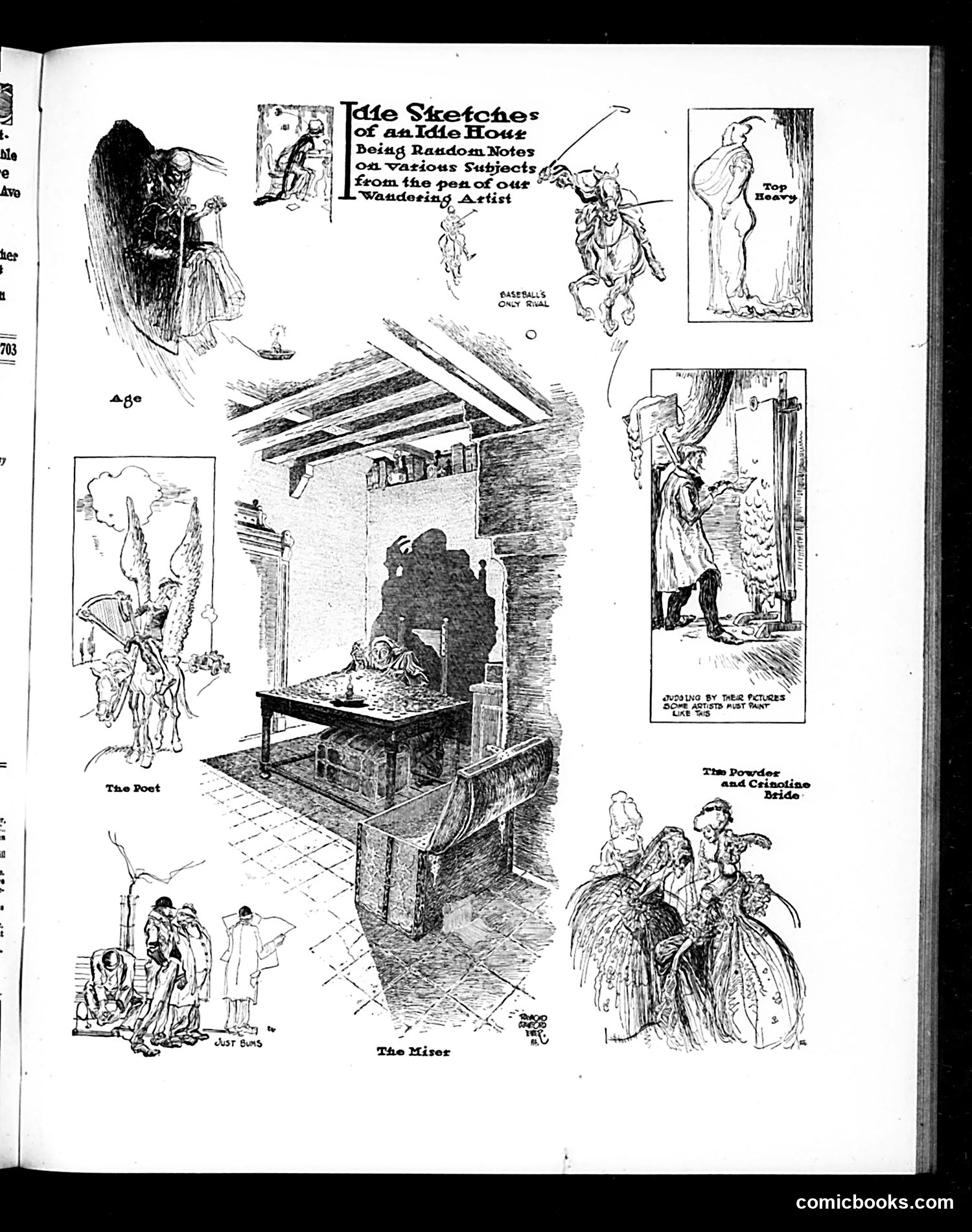
This page presents a collection of satirical character sketches titled "Idle Sketches of an Idle Hour: Being Random Notes on Various Subjects from the pen of our Wandering Artist." The sketches appear to depict various character types and social archetypes of the era—including "Age," "The Poet," "The Miser," "Top Heavy," and "The Powder and Crimoline Bride." Each drawing is a brief comedic observation of human behavior and social pretension, rendered in the magazine's characteristic satirical style. Rather than addressing specific political figures or events, these appear to be general social commentary—mocking vanity, eccentricity, pretentiousness, and the absurdities of contemporary fashion and behavior. The humor relies on visual caricature and type-casting of recognizable social characters that readers would find familiar in everyday life.
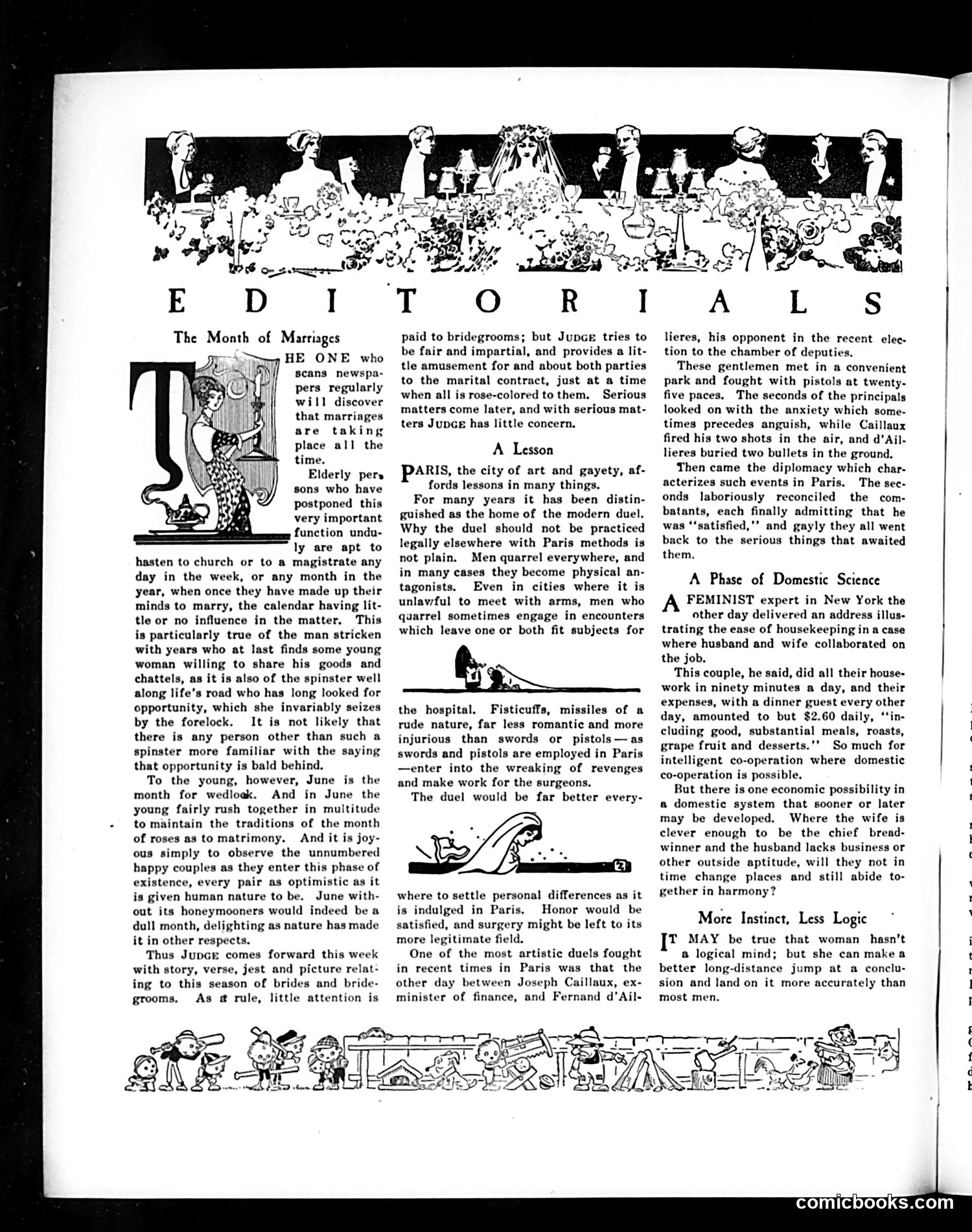
This Judge magazine page contains three opinion pieces satirizing early 20th-century social issues: **"The Month of Marriages"** mocks the June wedding season, suggesting judges spend considerable time settling marital disputes. The satire implies marriages are hastily entered and frequently troubled, requiring legal intervention. **"A Lesson"** references a recent Parisian duel between Joseph Caillaux (finance minister) and Ferdinand d'Aillieres, satirizing how Europeans resolve disputes through violence rather than law—contrasting with the American legal system. **"A Phase of Domestic Science"** critiques a feminist lecture about household efficiency. The satire suggests that while wives might mathematically optimize housework, practical harmony requires less logic and more genuine cooperation between spouses—implying feminist "science" oversimplifies marriage dynamics.
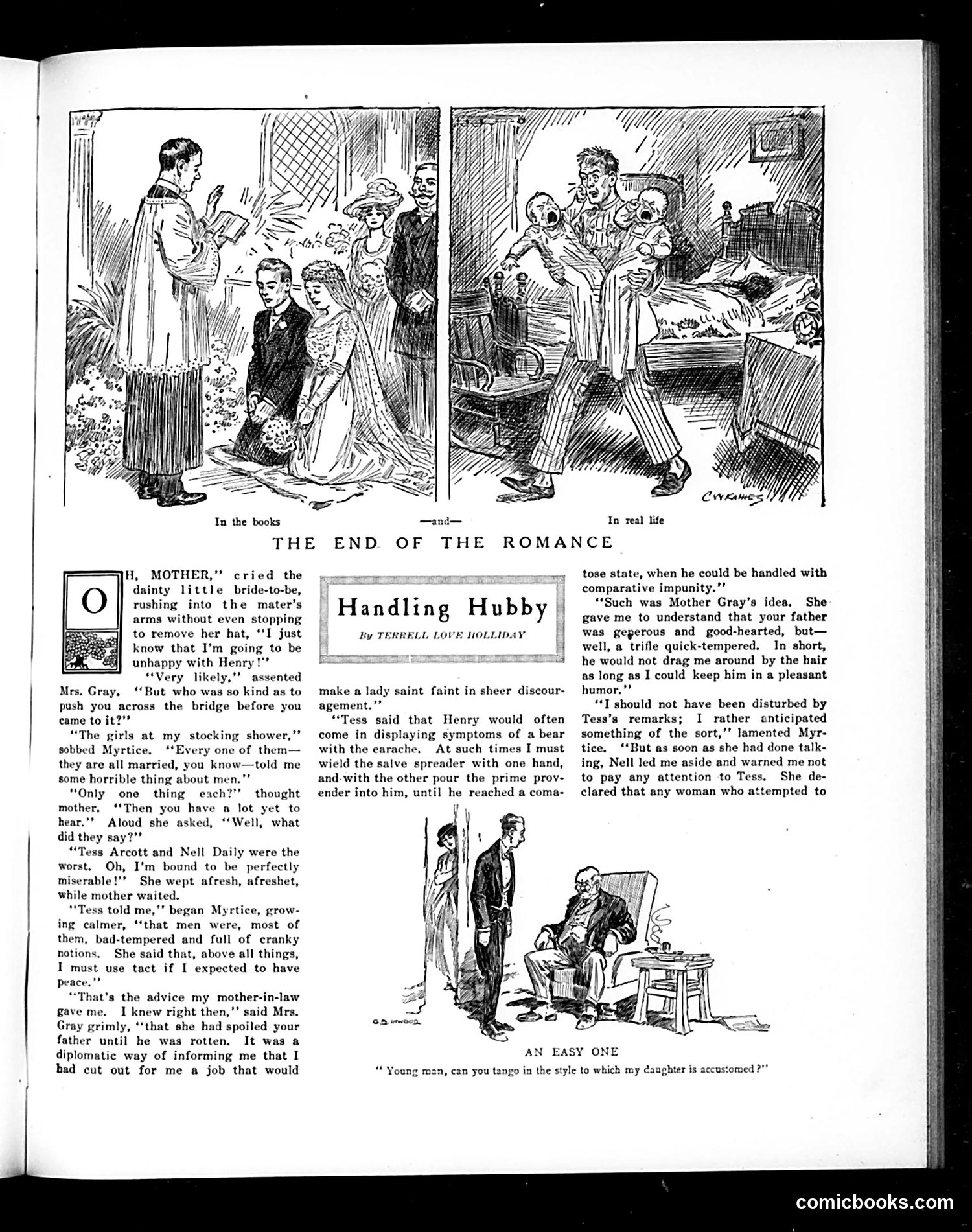
This satirical piece contrasts romantic ideals with marital reality. The top two panels show "In the books" versus "In real life"—comparing literary depictions of weddings to actual domestic chaos. The article features Mrs. Gray advising on managing difficult husbands. The humor centers on the gap between romantic expectations and practical marriage: wives must employ psychological tactics ("salve spreader") to handle temperamental, bear-like husbands displaying "symptoms of a bear with the toothache." The lower cartoon, "An Easy One," shows an elderly gentleman dismissing a young couple's concerns about dancing ability with sardonic ease—suggesting that managing spouses' worries requires simple deflection. The satire targets early 20th-century marriage dynamics, presenting women as strategic managers of men's moods rather than romantic equals.
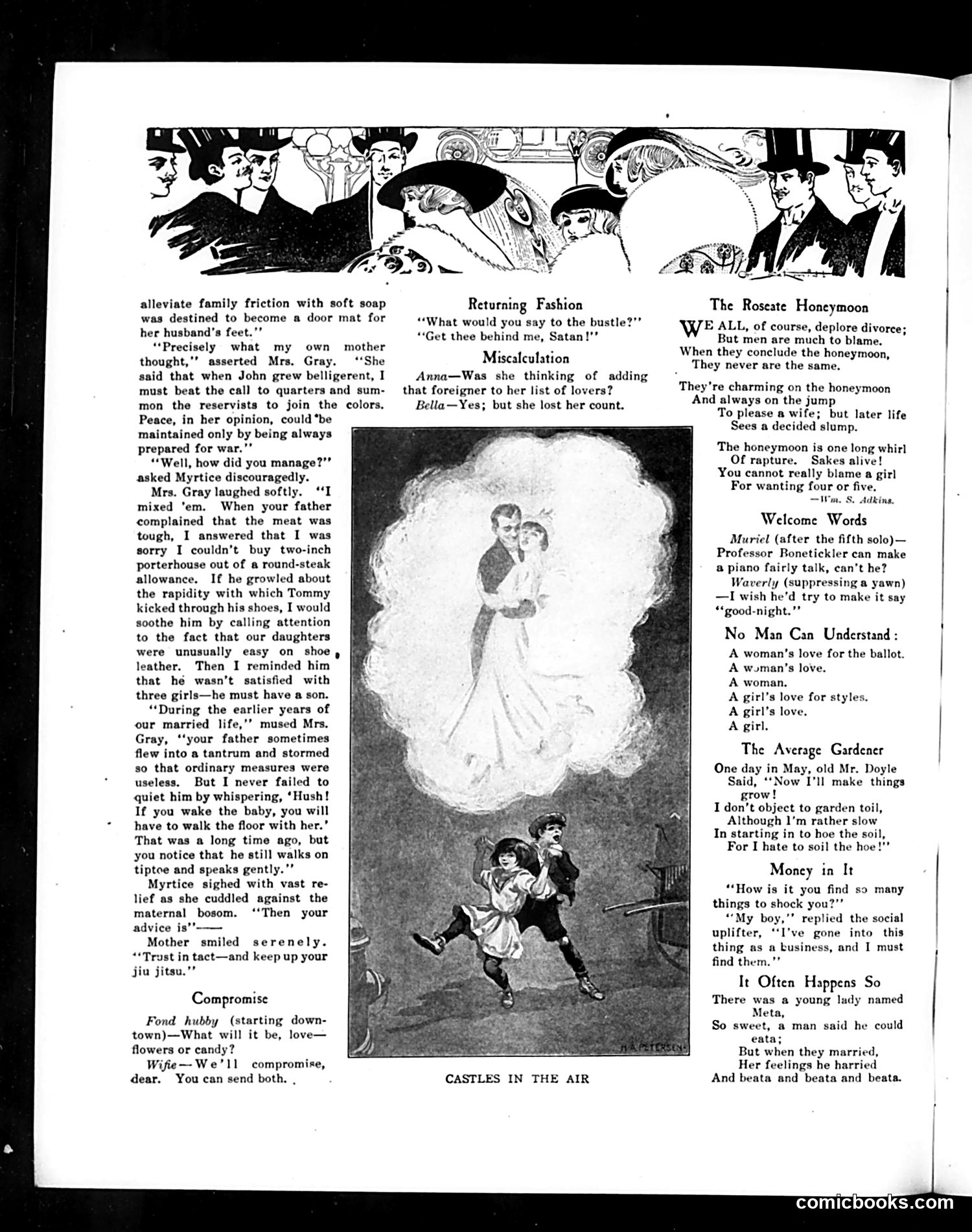
This page contains several satirical humor pieces and verses typical of Judge magazine's social commentary. The main cartoon, "Castles in the Air," depicts a couple in romantic fantasy—likely commenting on idealized versus reality in marriage. The text pieces mock gender relations and marriage dynamics of the era. "The Roseate Honeymoon" criticizes men for losing romantic effort after marriage, while "Compromise" jokes about husbands indulging wives' demands. "Returning Fashion" references the bustle's cyclical reappearance in women's fashion. "Miscalculation" satirizes women collecting romantic conquests. Other brief pieces mock women's political ambitions ("No Man Can Understand"), social reformers' sanctimoniousness, and disappointed romantic expectations ("It Often Happens So"). The largest text section appears to be domestic advice about managing marital conflict through strategic manipulation—presenting a cynical view of marriage as requiring "jiu jitsu" tactics rather than genuine harmony. Overall, the page reflects early-20th-century satirical attitudes toward marriage, women's roles, and social change.
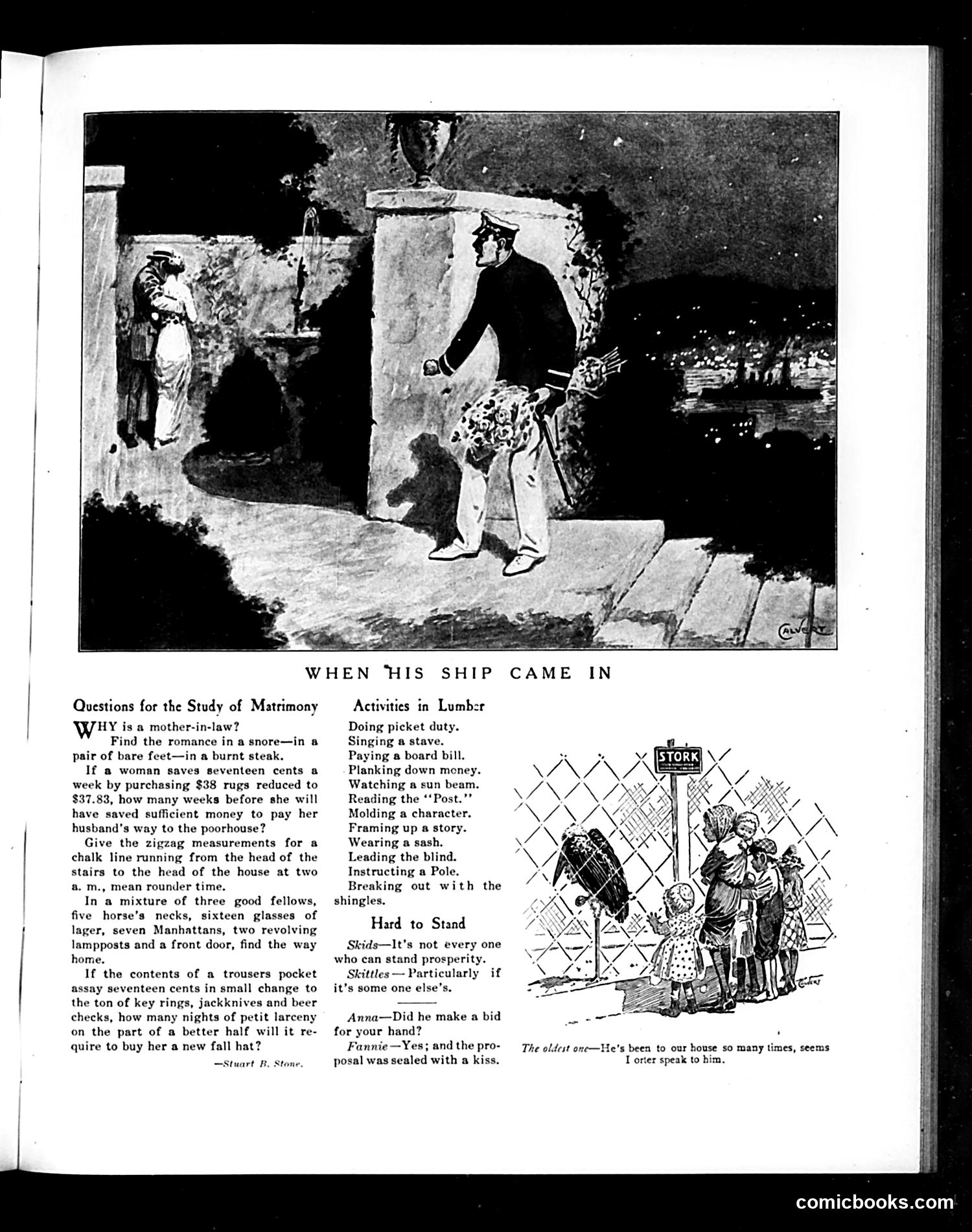
This page satirizes middle-class married life and domestic economy through absurdist "study questions." The main cartoon depicts a sailor returning home, likely the visual punchline to the title. The left column mocks wives' financial contradictions—saving pennies while buying expensive rugs, or the husband ending up "in the poorhouse" despite her economizing. The math problems are deliberately nonsensical (mixing cocktails, lampposts, and larceny to "find the way home"), ridiculing the period's obsession with quantifying domestic matters. The right column's "Activities in Lumber" and "Hard to Stand" sections contain working-class vignettes—picket duty, lodging payments, lumber work—contrasting with upper-middle-class concerns above. The brief dialogue between Anna and Fannie about a marriage proposal mocks romantic conventions. Overall, this attacks both domestic economy obsession and class pretensions through absurdist humor typical of Judge's satirical style.
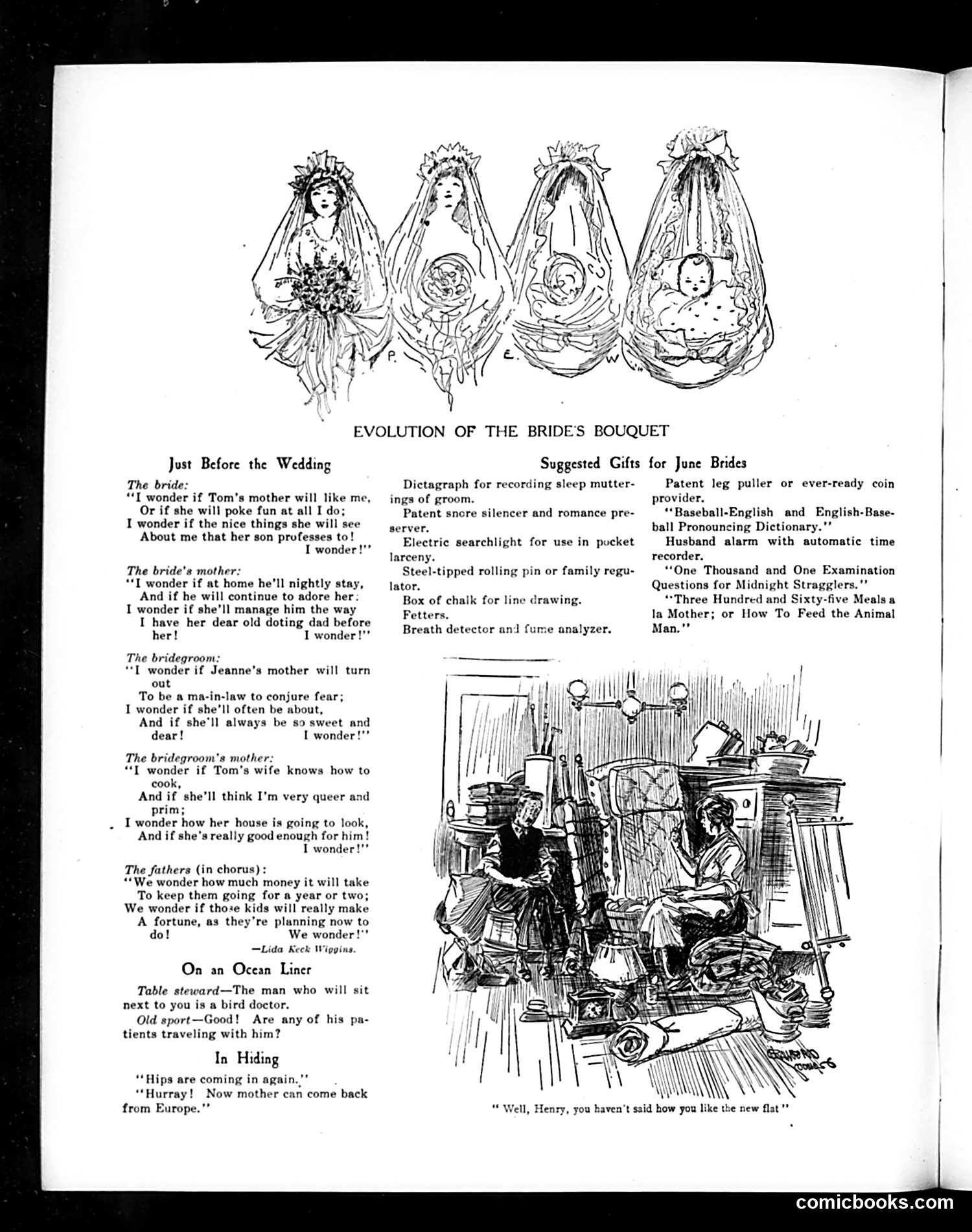
This page offers satirical commentary on marriage through multiple short pieces: **"Just Before the Wedding"** presents the anxieties of engaged couples and their parents—all wondering if the marriage will succeed. The humor lies in the universal pre-wedding jitters: mothers-in-law questioning domestic skills, financial concerns, and compatibility. The poem by Lida Keck Wiggins treats these worries as equally absurd regardless of which family member voices them. **"Evolution of the Bride's Bouquet"** (top illustration) humorously traces how a bride's bouquet transforms across four stages—from flowers to baby—mocking the assumption that marriage leads inevitably to motherhood. **"Suggested Gifts for June Brides"** parodies typical wedding gifts by offering sarcastically "practical" items: a "snore silencer," "rolling pin or family regulator," and "husband alarm"—all jokes about marital discord, wives' domestic roles, and husbands' misbehavior. The smaller jokes target fashion ("Hips are coming in again") and ocean travel etiquette. The final cartoon shows a wife's pointed silence about a new apartment, suggesting wives' dissatisfaction was an expected marital constant worth mocking.
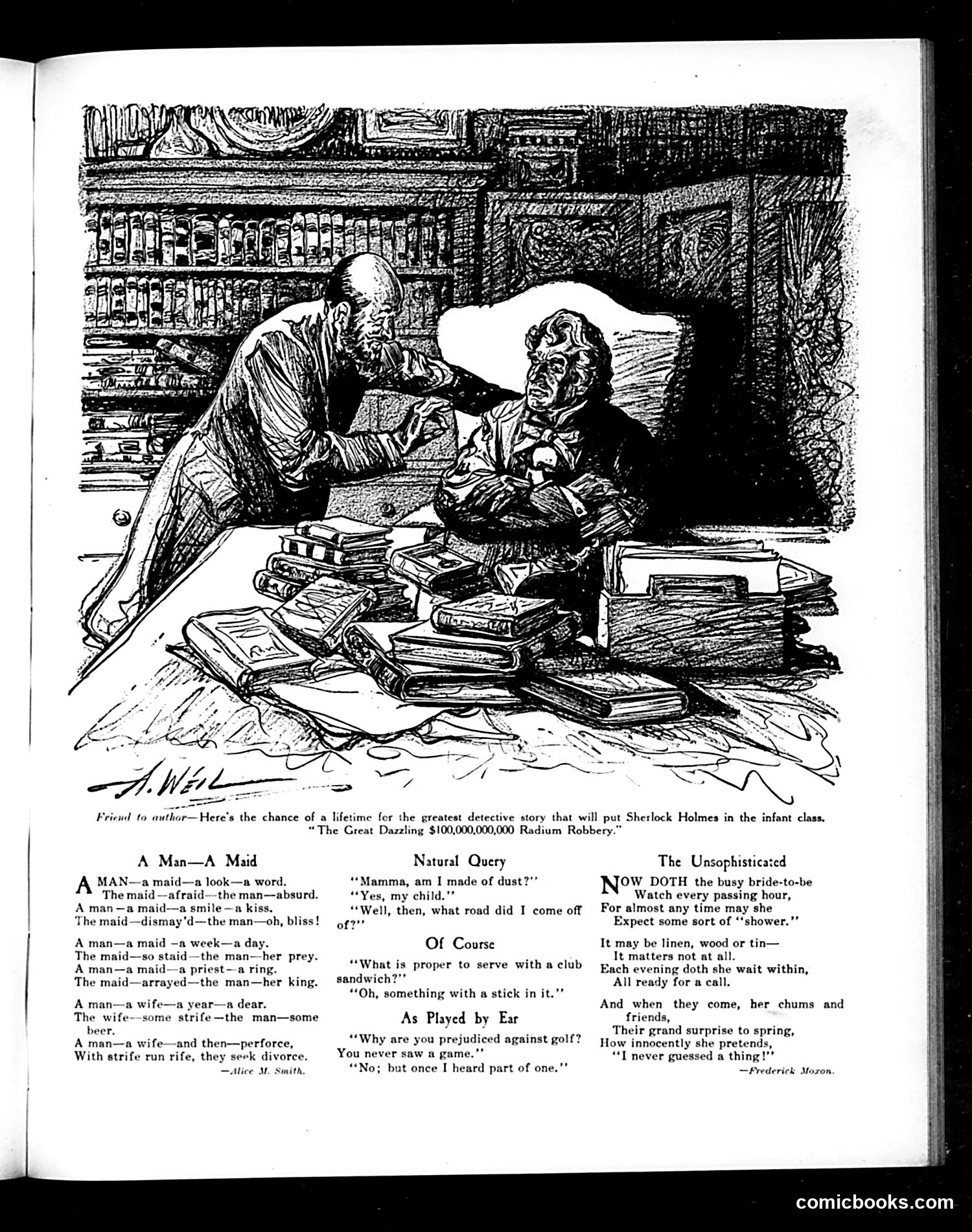
This is a **mixed-content satirical page** from Judge magazine featuring humor pieces and verse rather than political cartoons. The **illustration** shows a publisher pitching a detective story to an author, referencing the contemporary popularity of Sherlock Holmes by suggesting a "Great Dazzling $100,000,000,000 Radium Robbery"—playing on both Holmes' fame and the public's fascination with radium (a newly-discovered element that was then considered miraculous and valuable). The **text sections** are humorous verses poking fun at: - **"A Man—A Maid"**: Satirizes romantic relationships' progression from courtship to marriage to mundane domesticity and divorce - **"Natural Query"** and **"Of Course"**: Simple wordplay jokes - **"As Played by Ear"**: Jokes about golf's tedious nature - **"The Unsophisticated"**: Gently mocks bride-to-be conventions, suggesting women pretend surprise at bridal showers they obviously anticipated The page targets middle-class social rituals and relationship dynamics with light, observational humor typical of Judge's approach to American domestic life.
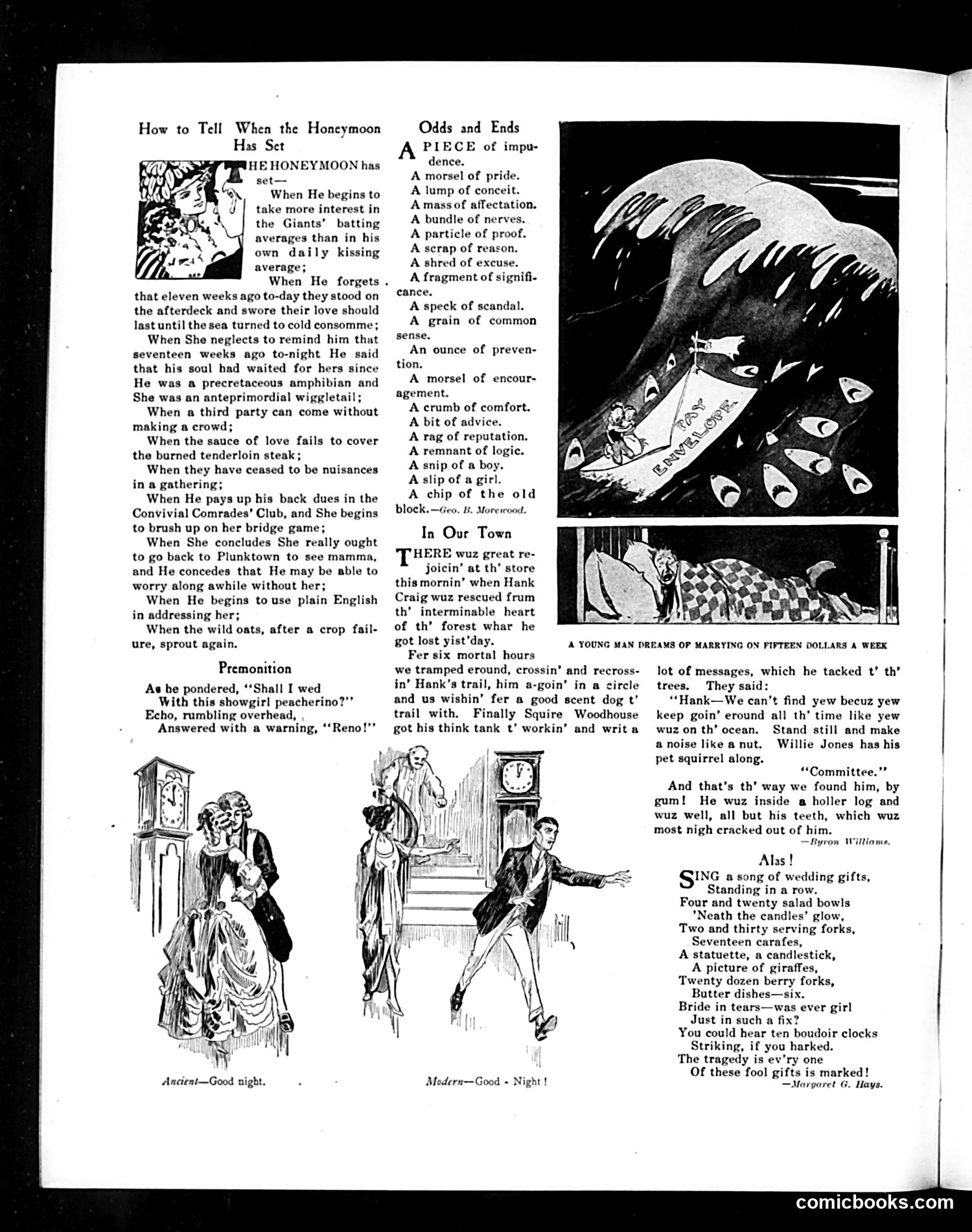
This page contains three satirical pieces about marriage and domesticity: **"How to Tell When the Honeymoon Has Set"** humorously catalogs the decline of newlywed romance—he ignores her for baseball statistics, they stop romanticizing their love, burned dinners replace fancy meals, and he returns to everyday speech and club obligations. The satire targets how quickly marital passion evaporates into mundane reality. **"Premonition"** is a brief joke: a man considering marrying a "showgirl" hears "Reno!" echoed back—referencing Reno, Nevada, then famous as a divorce destination. The joke predicts inevitable divorce. **"In Our Town"** presents rural dialect humor about a man lost in circles in the forest, rescued by leaving written messages on trees. It's gentle small-town satire. **"Alas!"** satirizes the impracticality of wedding gifts—the bride receives duplicate, useless items (ten clocks, multiple sets of forks, salad bowls) that clutter rather than help. The final line jokes that all being marked makes returning them impossible, trapping the bride with unwanted gifts.
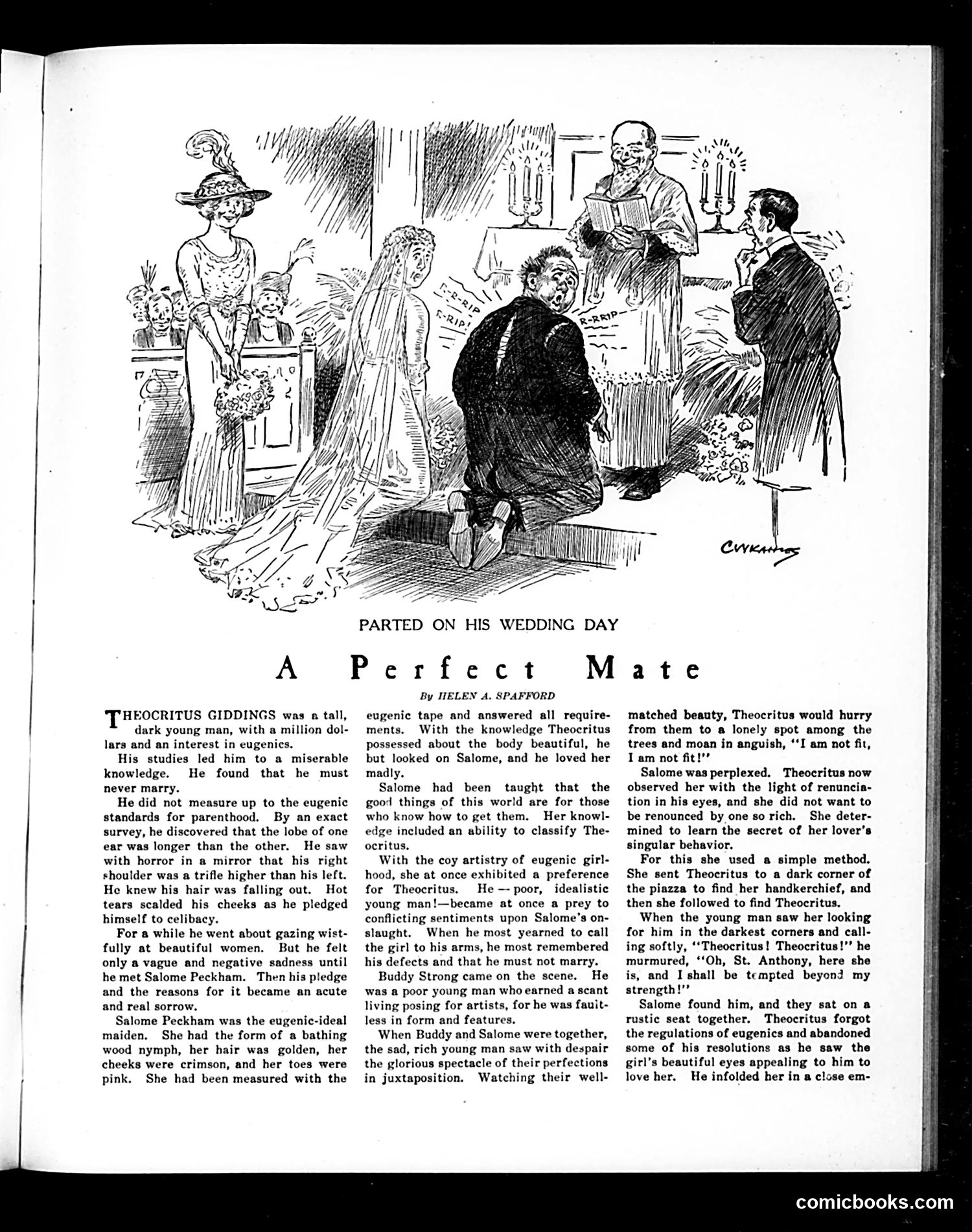
This story satirizes the early 20th-century eugenics craze—the pseudoscientific belief that human breeding should be controlled to "improve" the population. **The setup:** Theocritus Giddings, a wealthy man obsessed with eugenics, discovers he has minor physical imperfections (uneven ears, asymmetrical shoulders, hair loss) that disqualify him from parenthood by eugenic "standards." He vows celibacy. **The satire:** He falls for Salome Peckham, who is "eugenically ideal"—measured and deemed physically perfect. Meanwhile, Buddy Strong, a poor but physically flawless artist's model, appears to be the eugenic match. **The point:** The story mocks eugenics as absurdly rigid pseudoscience that conflicts with human emotion and love. Theocritus ultimately abandons his eugenic principles when actually confronted with romance, suggesting the ideology's impracticality and the irrationality of reducing human worth to physical measurements.
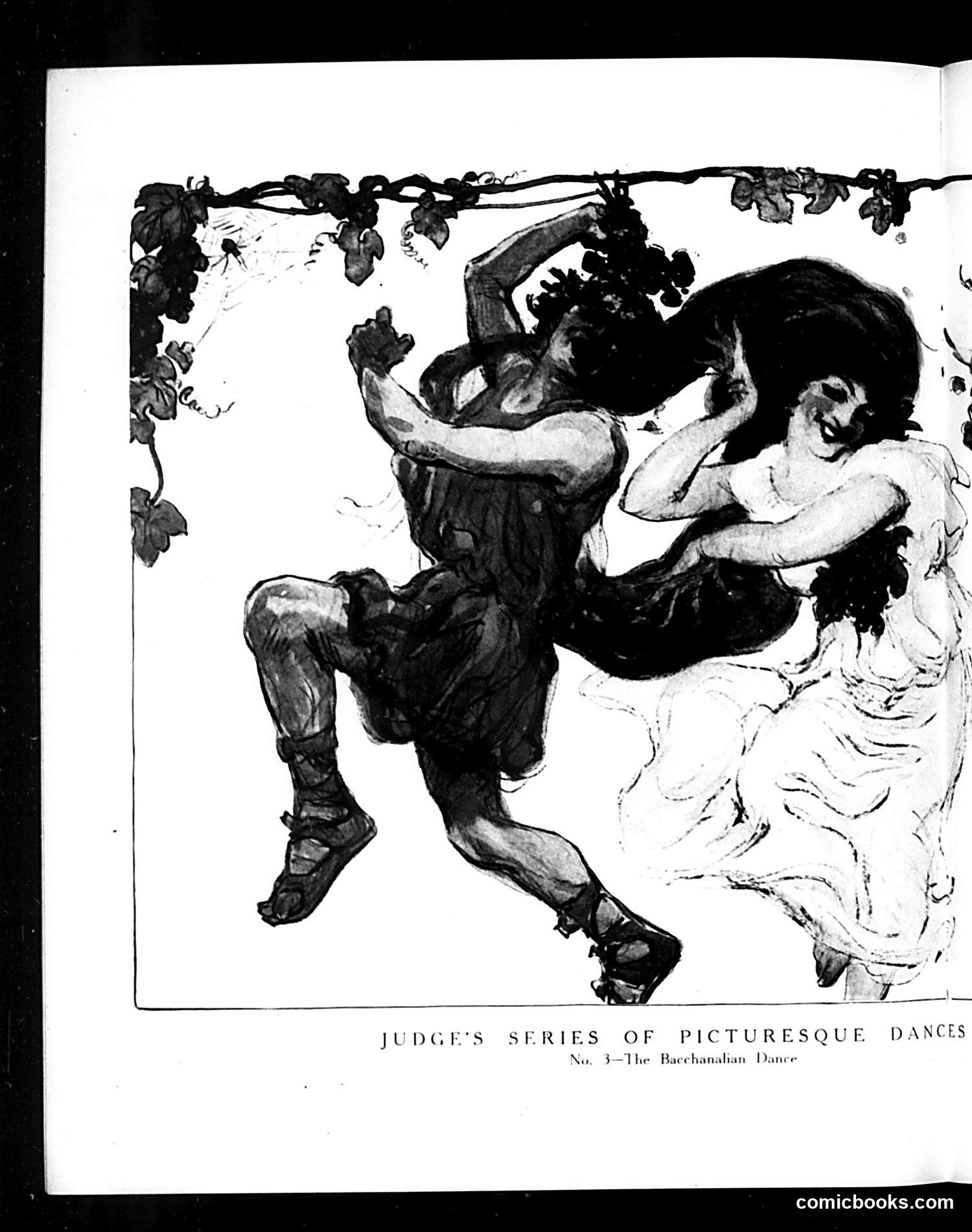
This is part of Judge magazine's "Series of Picturesque Dances," No. 3. The illustration depicts two figures in a revelrous, intoxicated state—a man in dark clothing kicking wildly while a woman in a light dress supports or steadies him. Grapevines frame the composition, reinforcing the wine/alcohol theme. "Bacchanalian" refers to unrestrained, drunken revelry associated with Bacchus, the Roman god of wine. The satire likely mocks excessive drinking and loss of dignity through intoxication. The style and composition suggest this is social commentary on contemporary leisure activities or moral behavior, typical of Judge's satirical approach. The precise historical context—whether critiquing a specific trend or general vice—remains unclear without additional publication date information.
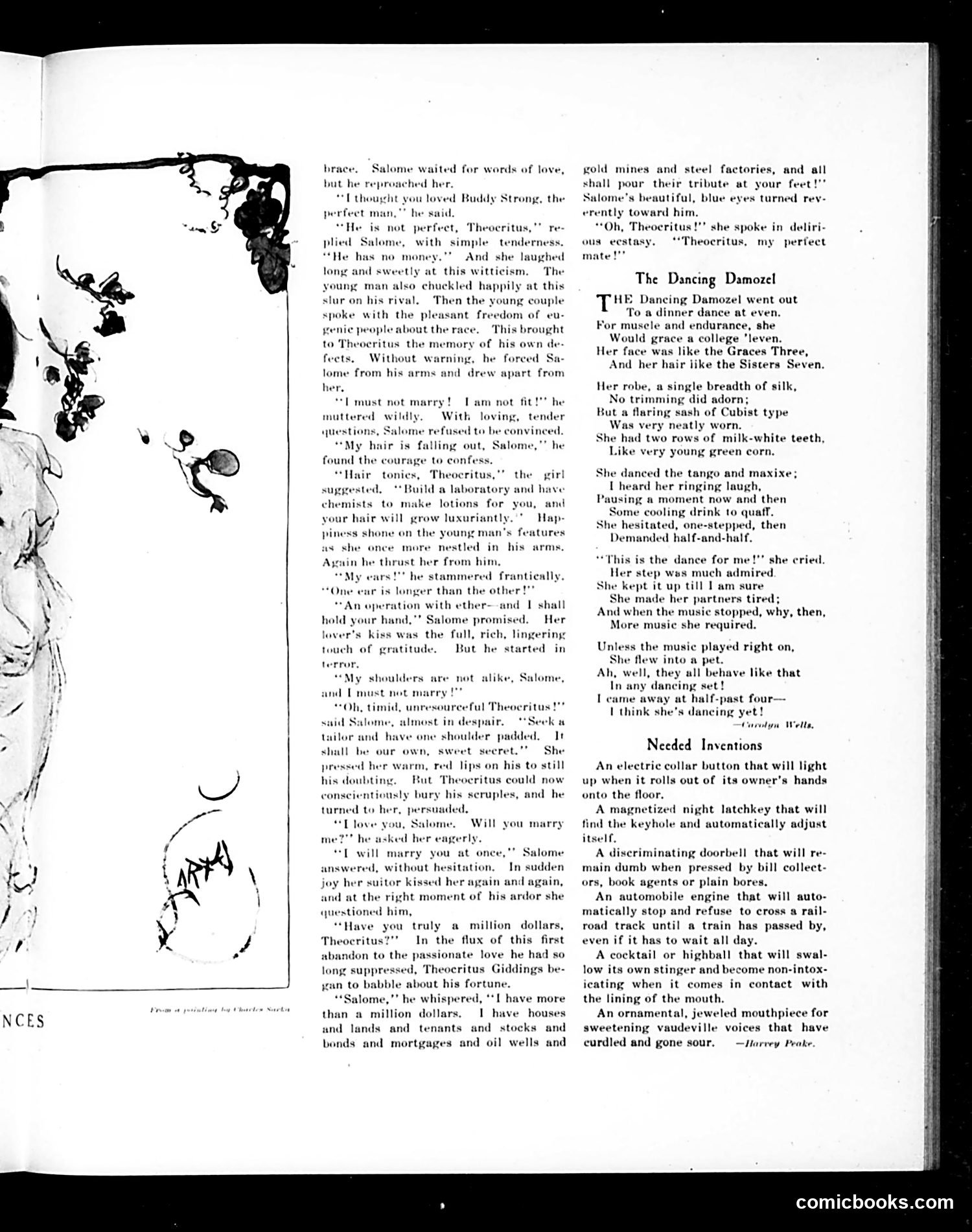
This page contains two satirical pieces mocking early 20th-century romance and social behavior: **"The Dancing Damozel"** poem ridicules the modern "dancing set"—young women obsessed with fashionable dances (tango, maxixe) and increasingly independent social behavior. The figure is depicted as tireless, demanding, and exhausting to her male partners, embodying anxieties about women's changing roles and the "new woman" lifestyle. **The prose narrative** satirizes gold-digger romance: a wealthy suitor (Theocritus) constantly invents physical excuses to avoid marriage, but when Salome learns of his fortune, he suddenly becomes her "perfect mate." The joke exposes mercenary courtship and the transparent nature of romance motivated by wealth rather than genuine affection. **"Needed Inventions"** uses humorous wish-list format to mock everyday modern frustrations—lost buttons, lockouts, unwanted visitors, and mechanical failures—reflecting the era's technological optimism mixed with practical skepticism. The cartoons and verses target contemporary dating customs, women's increased social freedom, and wealth-obsessed materialism—concerns typical of Judge's satirical commentary.
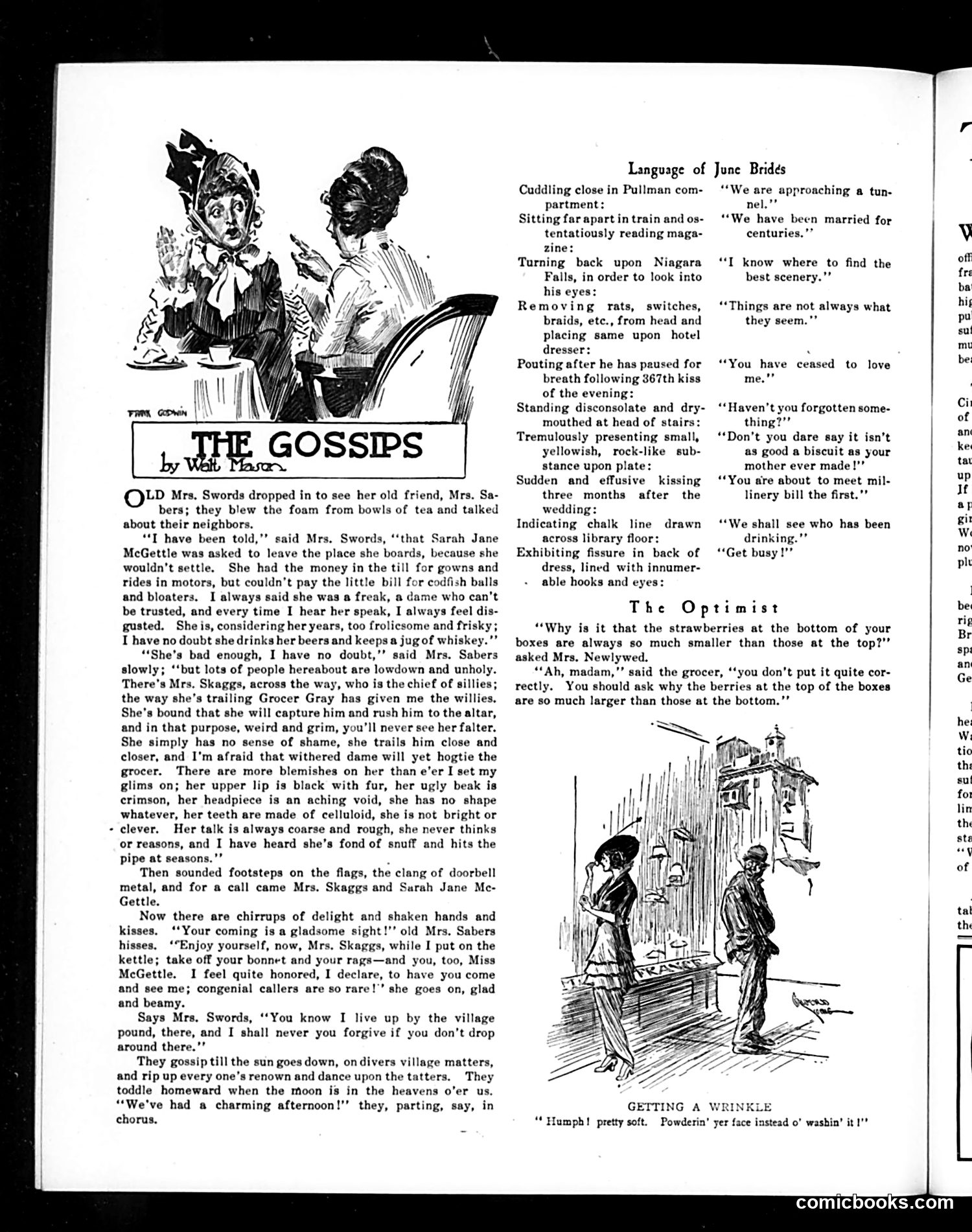
This page satirizes female gossip and newlywed behavior in early 20th-century American middle-class life. **"The Gossips"** depicts two women (Mrs. Swords and Mrs. Sabers) viciously slandering their neighbors—particularly Sarah Jane McGettle (irresponsible with money) and Mrs. Skaggs (desperately pursuing the grocer). The joke: when these same women unexpectedly arrive for tea, the gossips instantly become saccharine and welcoming, revealing their hypocrisy. The text explicitly notes they spend the evening tearing apart "every one's renown" while pretending friendship. **"Language of June Brides"** humorously catalogs newlywed clichés—honeymoon affectations ("We are approaching a tunnel"), post-honeymoon disillusionment ("We have been married for centuries"), and domestic disappointments (burned biscuits, mounting bills). The illustrations show awkward marital moments. Both pieces mock female social dishonesty and the gap between romantic expectations and matrimonial reality—common satirical targets in Judge magazine's commentary on American society.
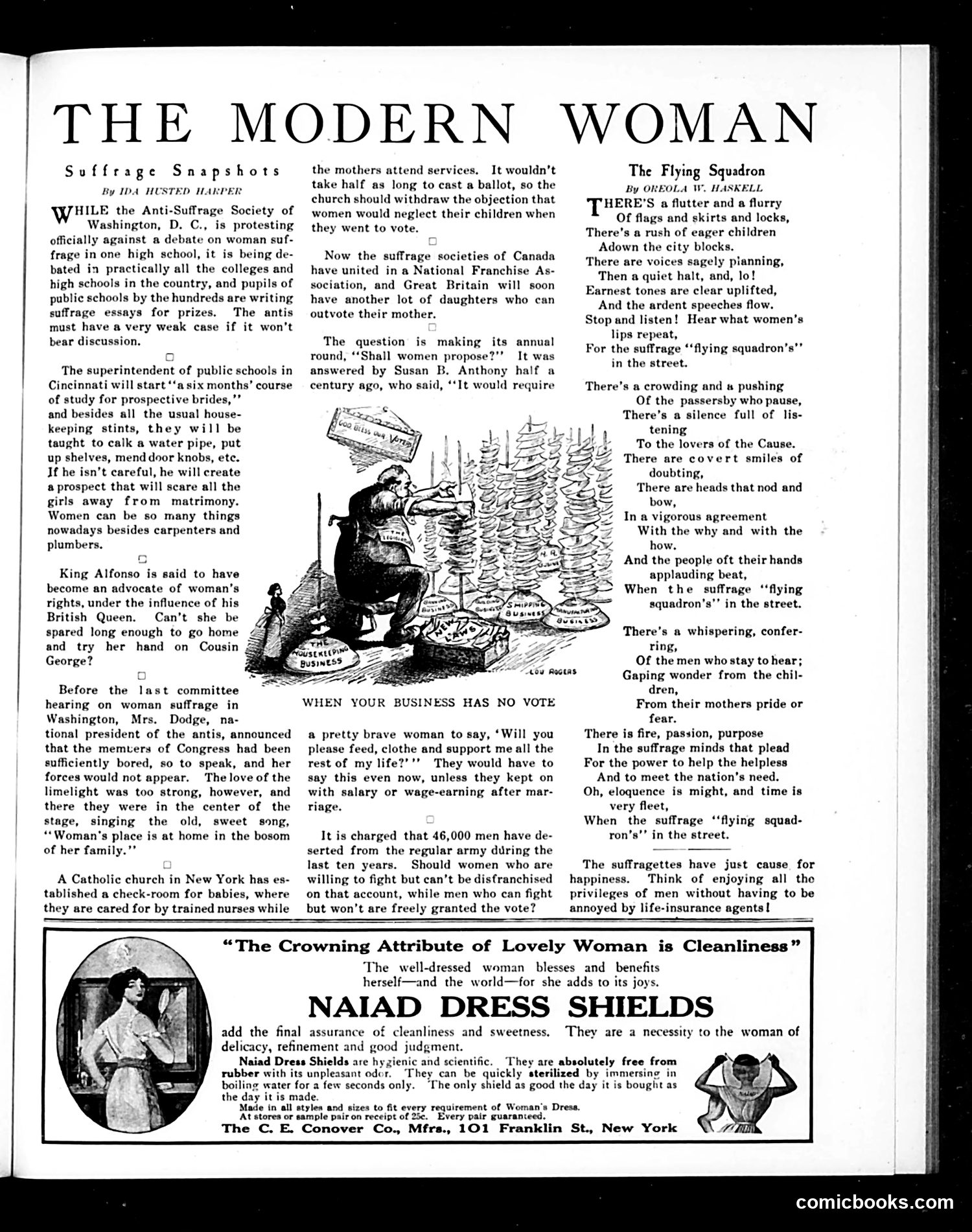
This page satirizes opposition to women's voting rights through Ida Husted Harper's "Suffrage Snapshots" column. The central cartoon depicts a woman buried under stacks of paperwork labeled "WHEN YOUR BUSINESS HAS NO VOTE"—illustrating the absurdity that women manage households and businesses yet cannot vote on laws affecting them. Harper's commentary mocks anti-suffrage arguments: she notes that even the Anti-Suffrage Society's weak case requires suppression of debate; that Cincinnati's "bride training course" in home repair inadvertently proves women's capability; and that men deserting the army should logically lose voting rights while voting-seeking women retain eligibility. The accompanying poem celebrates suffrage "flying squadrons"—mobile groups of women public speakers campaigning door-to-door—portraying them as energetic, persuasive, and increasingly popular with crowds. The satire's point: anti-suffrage positions collapse under scrutiny, while women's competence and activism are undeniable.
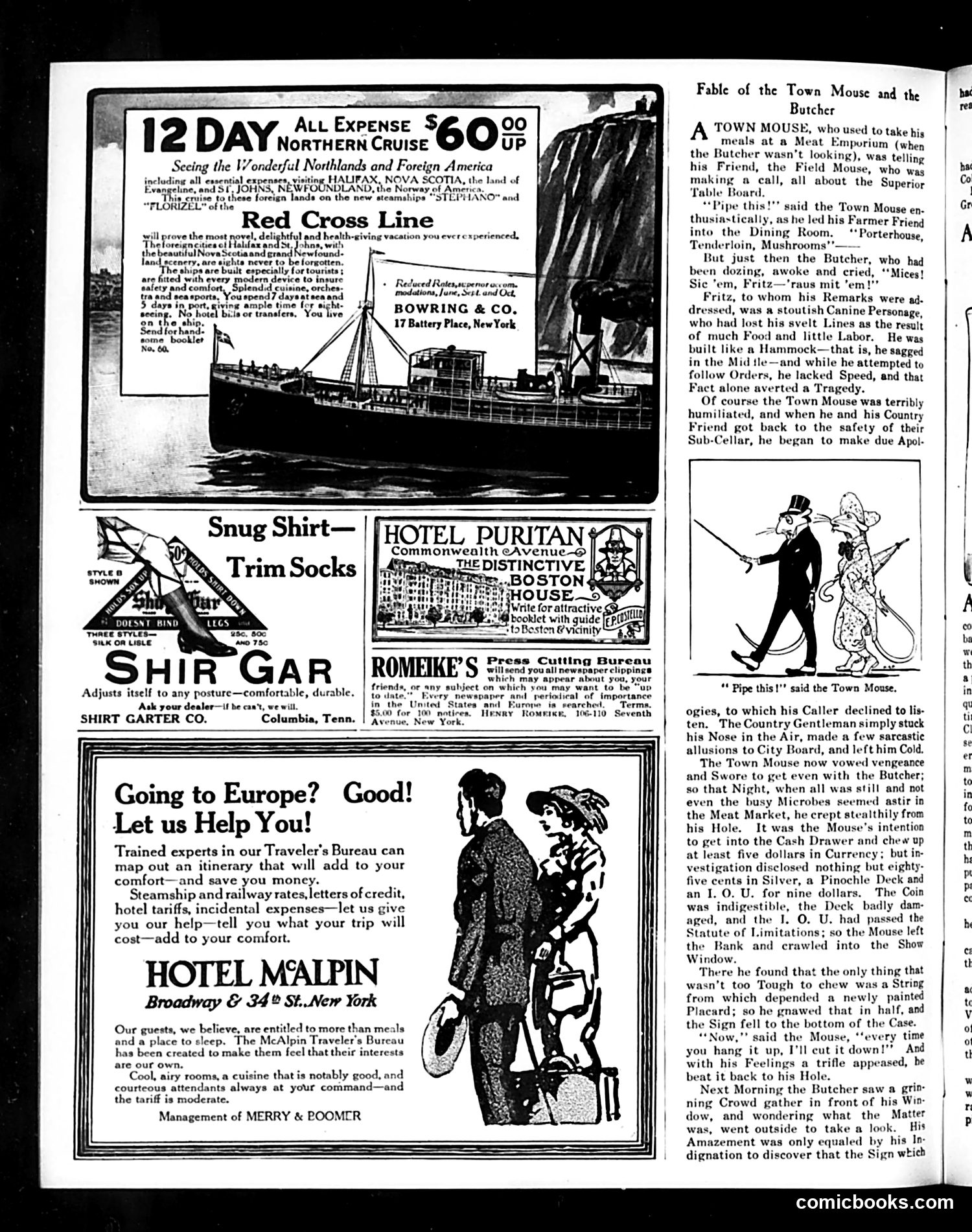
This is a moral fable in the tradition of Aesop, depicting a snobbish urban mouse who boasts to his country cousin about stealing meals from a fancy meat market. When discovered by the butcher and his dog Fritz, the town mouse is humiliated and must apologize. The country mouse, offended by the city mouse's pretentiousness, refuses reconciliation. The satire targets urban vanity and false status. The town mouse's pride in his "superior" stolen goods masks a precarious, dangerous existence—he must constantly steal and hide. The story mocks those who flaunt dubious advantages while remaining vulnerable. The moral: country simplicity trumps city sophistication built on deception and theft. It's a classic Judge magazine critique of urban affectation versus honest rural life, dressed in animal fable form for comic effect.
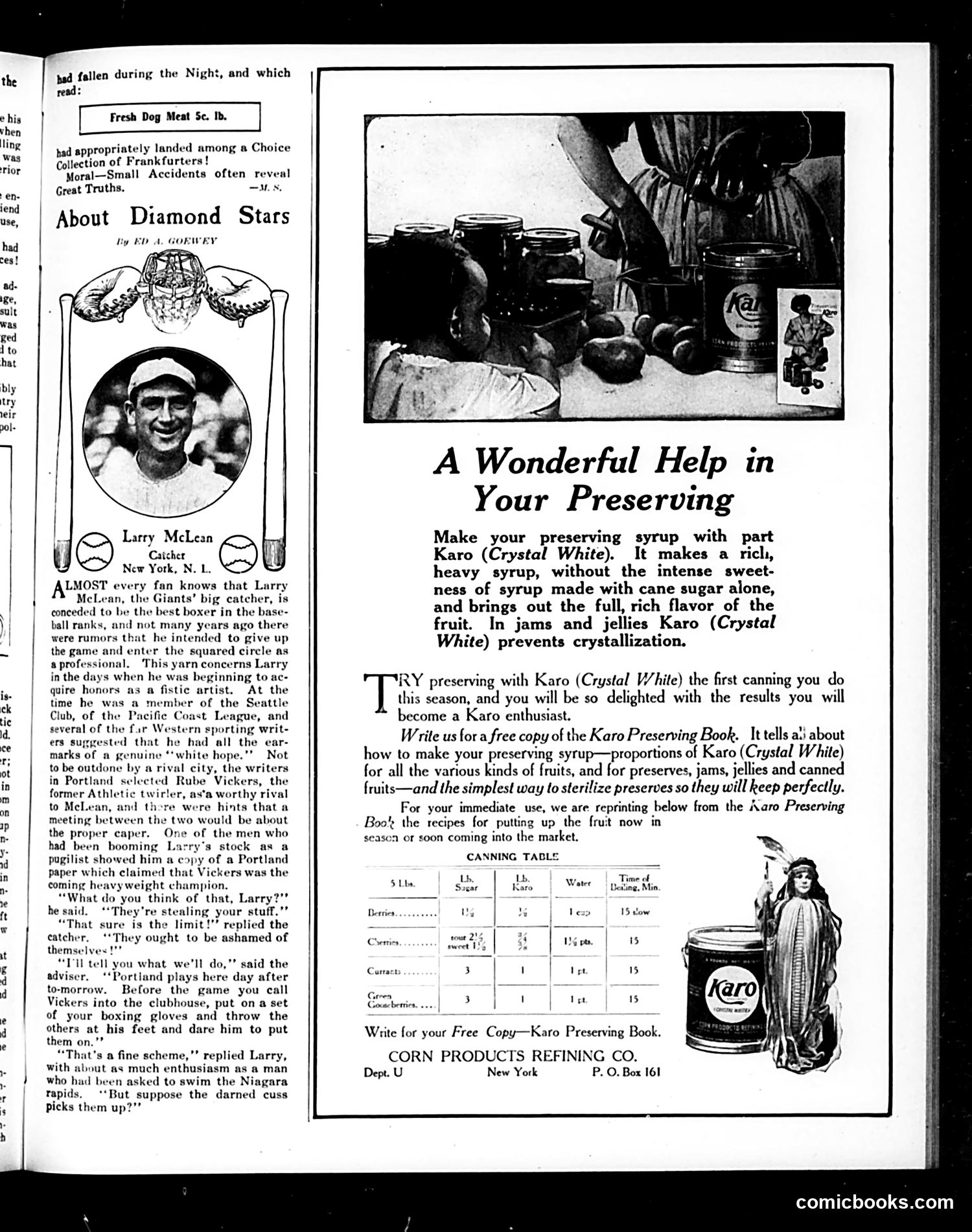
This page contains two unrelated items: a sports anecdote and an advertisement. **"About Diamond Stars" (Left):** A humorous story about Larry McLean, catcher for the New York Giants baseball team. The joke involves McLean's reputation as both a skilled boxer and baseball player. A sportswriter attempts to provoke McLean by showing him a newspaper claiming rival boxer Vickers is the "coming heavyweight champion," suggesting Vickers is stealing McLean's fame. The adviser suggests McLean challenge Vickers by throwing boxing gloves at his feet during a Portland game visit. McLean's deadpan response—worrying that Vickers might actually accept the challenge—provides the punchline: the bluff wouldn't work because Vickers might call it. **Right side:** A Karo corn syrup advertisement promoting its use in home canning and preserving, with a canning table and offer for a free "Karo Preserving Book." The page reflects early 20th-century baseball celebrity culture and wartime-era domestic economy messaging.
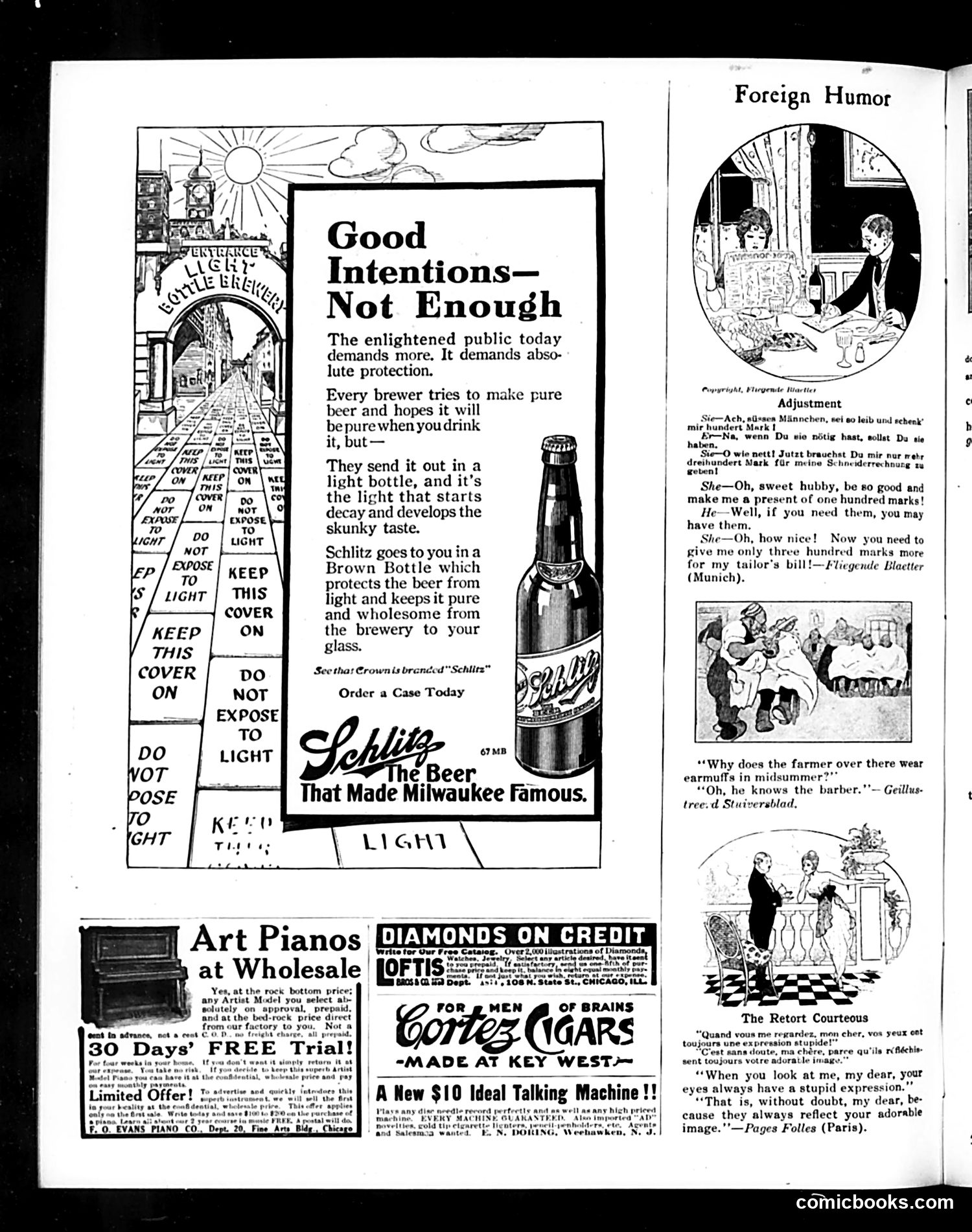
This page is primarily **advertising** rather than political satire. The dominant content is a Schlitz beer advertisement arguing that brown bottles protect beer from light damage that causes "skunky taste"—a genuine concern in early 20th-century brewing before modern pasteurization. The right side contains **"Foreign Humor"**: translated jokes from European publications (Munich's *Fliegende Blaetter*, Dutch *Stuiversblad*, Paris's *Pages Folles*). These depict domestic humor: a German couple negotiating a wife's tailor bills, a farmer wearing earmuffs (because he "knows the barber"), and a witty French comeback about unintelligent expressions. The other ads promote art pianos at wholesale, diamonds on credit, Cordoba cigars, and a talking machine—typical period merchandise. **Modern context needed**: These jokes rely on stereotypes about European domesticity and marital dynamics common to early 1900s satire magazines. The "Foreign Humor" section represents how American publications presented European culture as quaint and comedic to readers.
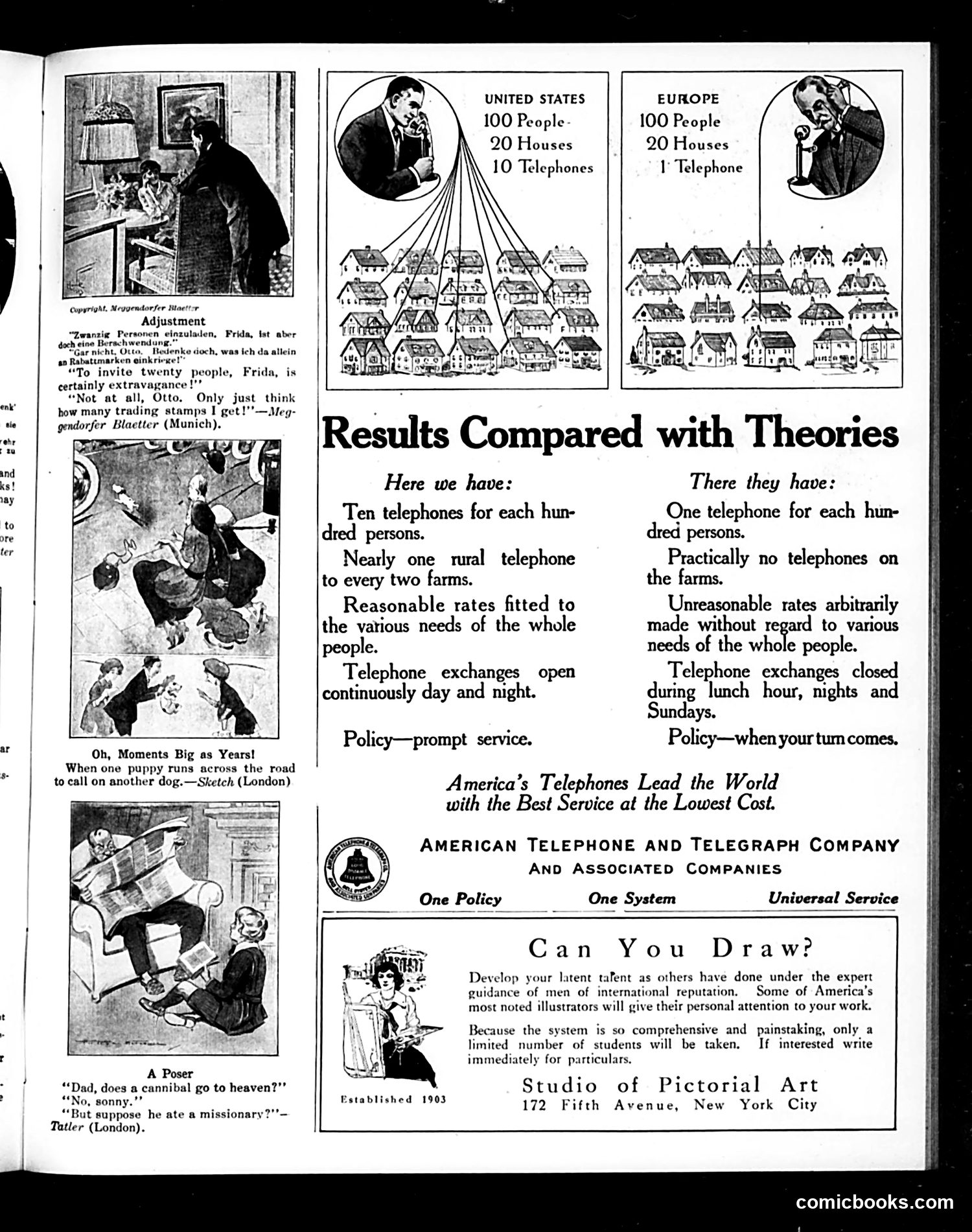
This Judge magazine page is primarily a **propaganda advertisement** for AT&T disguised as comparative satire. The central image contrasts American and European telephone infrastructure, claiming the U.S. has 10 phones per 100 people versus Europe's 1 per 100—promoting American technological superiority and capitalism's efficiency. The surrounding content is padding: jokes about trading stamps, puppies, and cannibals (typical period humor with little satirical bite). An ad for the "Studio of Pictorial Art" seeks student illustrators. **The satire's point**: AT&T implicitly mocks European systems as unreliable (closed during lunch/Sundays, "when your turn comes") while touting American "prompt service" and "reasonable rates." This reflects 1920s-era corporate boosterism—using comparative nationalism to justify monopoly control. Modern readers should note: this represents how corporations embedded advertising within entertainment media, framing commercial advantage as national/technological superiority.
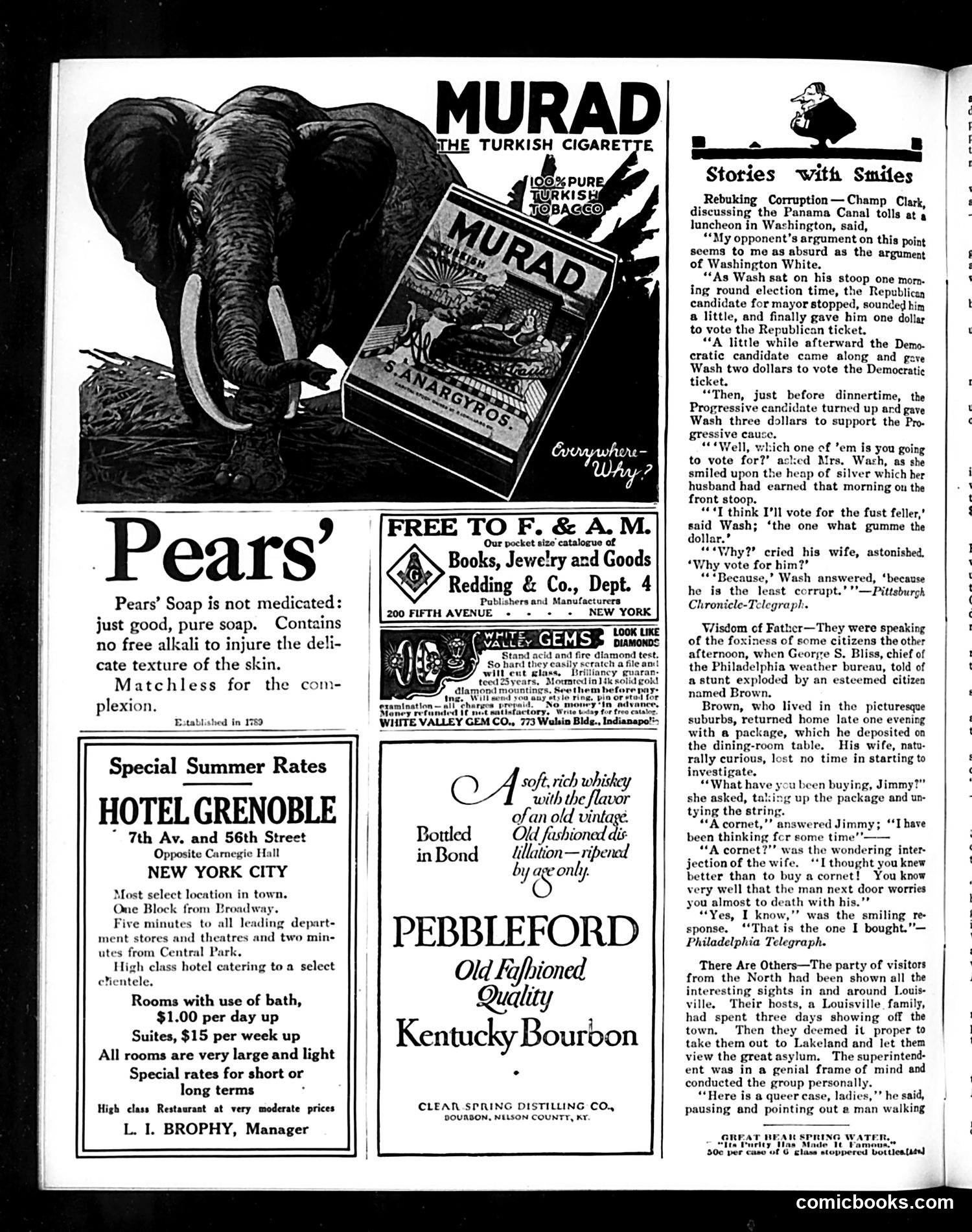
This page primarily contains **advertisements and humorous anecdotes** rather than political cartoons. The main visual element is a **Murad cigarette ad** featuring an elephant holding the product, with text asking "Everywhere—Why?" (a marketing slogan). The rest of the page consists of hotel, soap, jewelry, and bourbon advertisements. The humor section titled "Stories with Smiles" contains three anecdotes: 1. **"Rebuking Corruption"**: Champ Clark (a Democratic politician) tells a story mocking election bribery. A voter named Washington White receives money from Republican, Democratic, and Progressive candidates, then votes for the Republican because he's "the least corrupt"—satirizing that all politicians are equally corrupt. 2. **"Wisdom of Father"**: A boy buys a cornet to annoy his neighbor, since his neighbor already torments him with one. 3. **"There Are Others"**: An incomplete anecdote about asylum visitors (punchline cut off). These are gentle, conversational jokes rather than sharp political satire, reflecting Judge's lighter content mixed with period advertising.
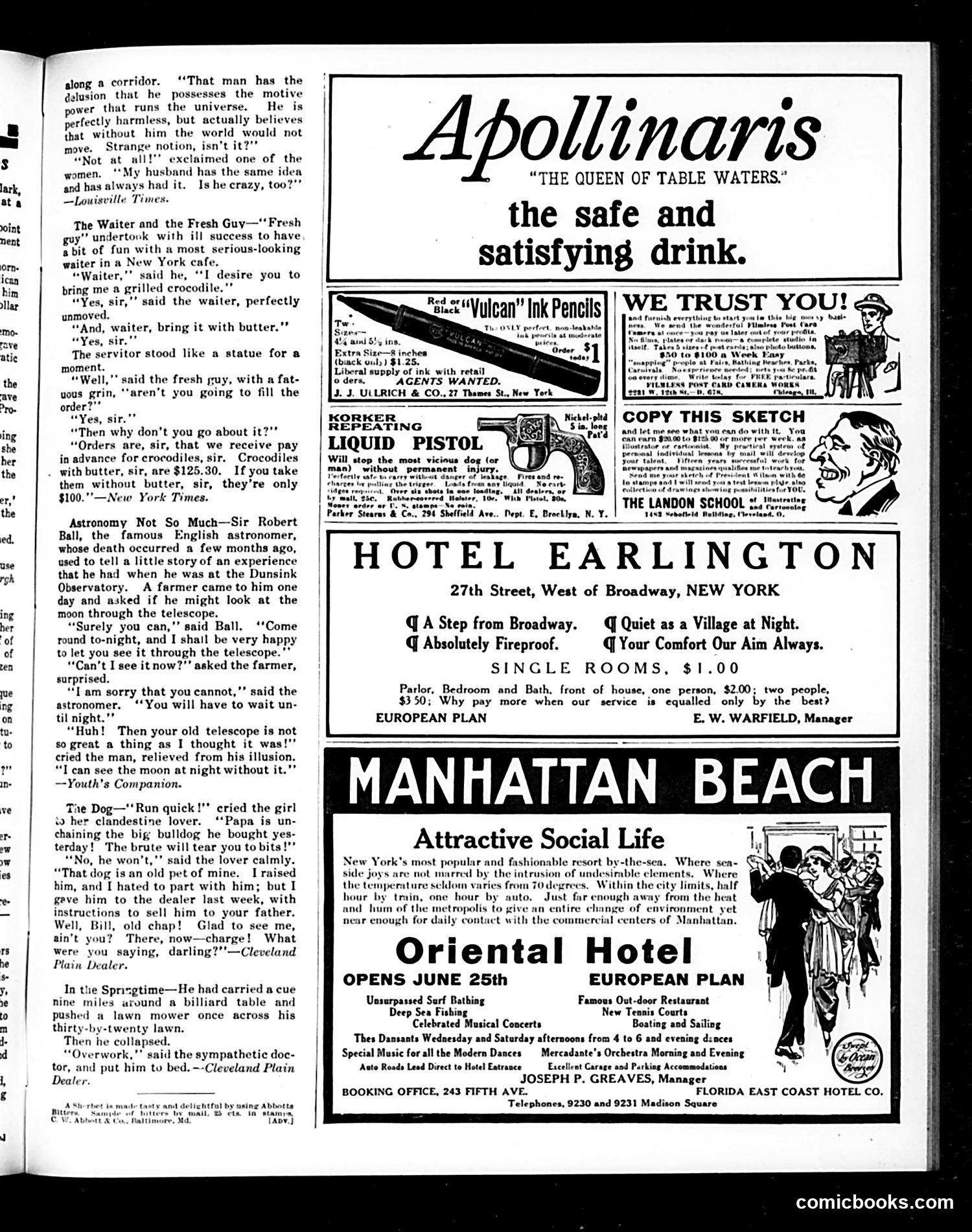
This page is primarily **advertisements and humorous anecdotes**, not political cartoons. The content includes: **Humorous Stories** (not satire): Several brief, lighthearted tales about misunderstandings—a waiter's literal response to an absurd food order, an astronomer's telescope that can't see the moon during daylight, a man unknowingly rescuing the bulldog he'd previously sold to his girlfriend's father. **Advertisements**: The page features product ads (Apollinaris mineral water, "Vulcan" ink pencils, a repeating liquid pistol toy) and New York establishments (Hotel Earlington, Manhattan Beach resort, Oriental Hotel). There is **no visible political content or caricature work** on this page. Judge magazine, while satirical, used this particular page for gentle domestic humor and commercial notices rather than social or political commentary.
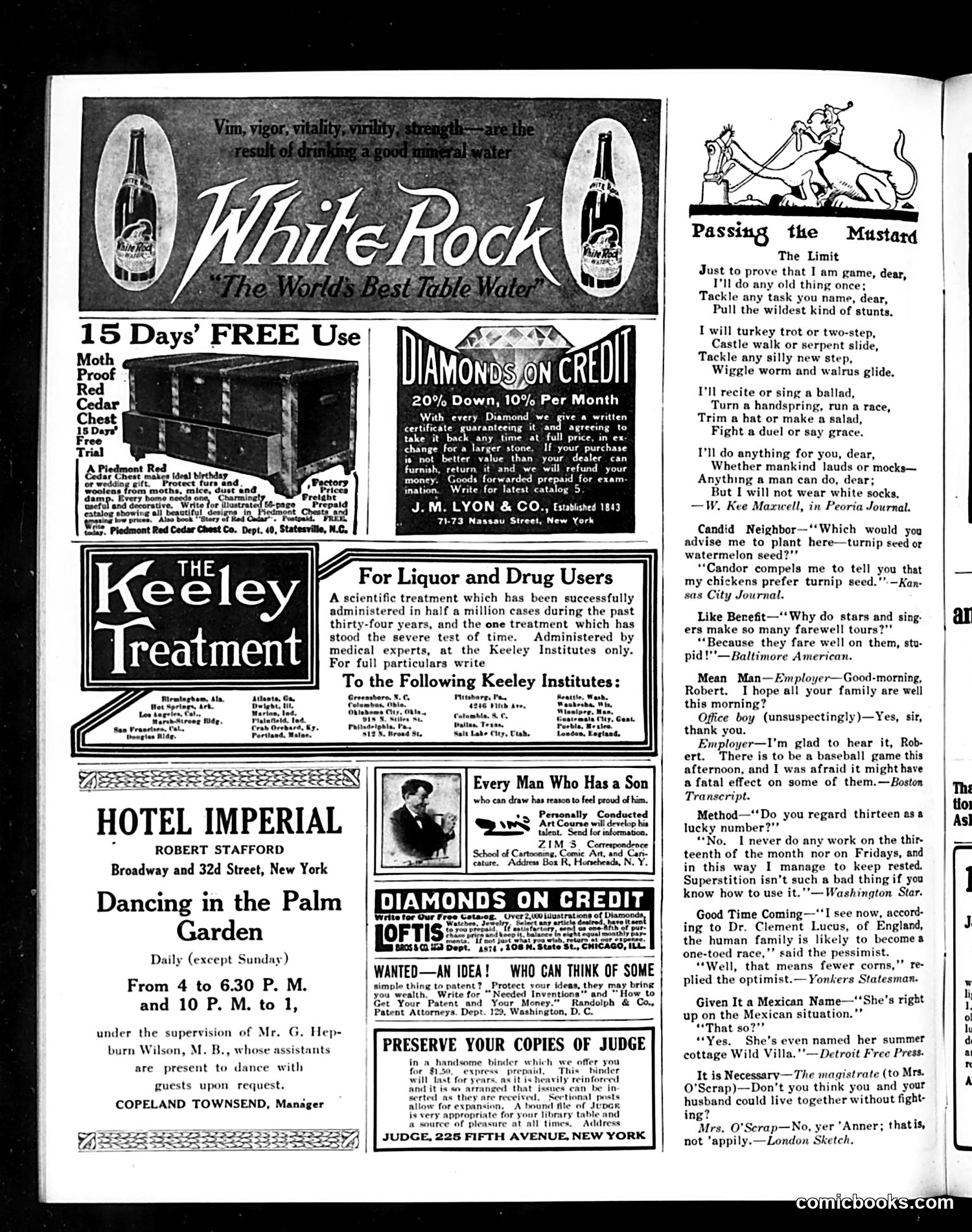
This page is primarily **advertising and advice columns**, not political satire. The dominant content includes: - **White Rock mineral water ad** (top): Claims health benefits like "vim, vigor, vitality" - **"Passing the Mustard"** (right): A humorous illustrated poem about proving one's courage through increasingly absurd stunts - **Multiple product ads**: Keeley Institute (addiction treatment), Hotel Imperial (dancing venue), diamonds-on-credit offers - **Advice column**: "Every Man Who Has a Son" and other Q&A exchanges addressing practical life questions The "Passing the Mustard" cartoon satirizes masculine bravado and dare-taking culture, showing a figure performing dangerous stunts to prove toughness. The overall page reflects early 20th-century concerns: substance abuse treatment, consumer credit, and gender expectations.
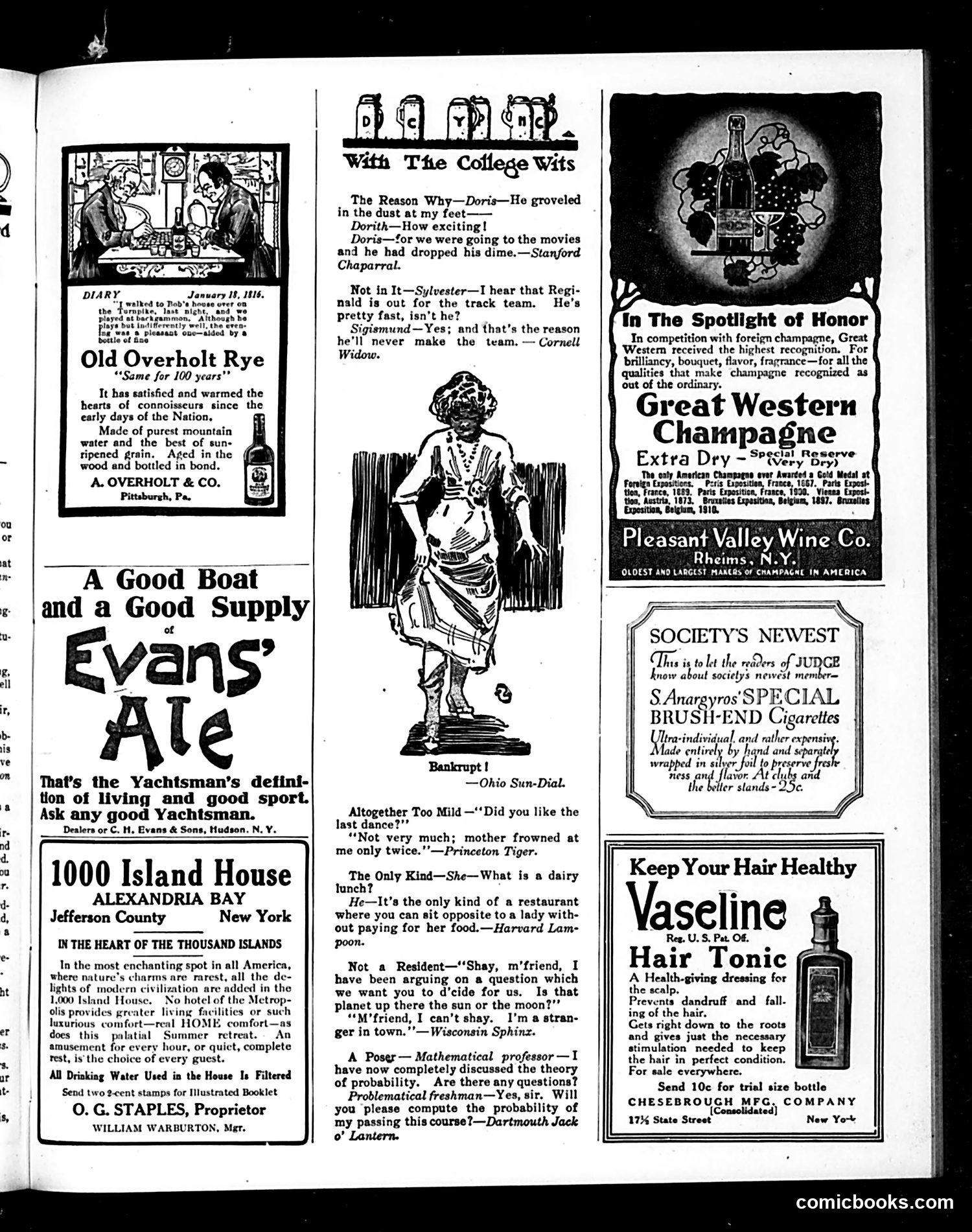
This page is primarily **advertising** interspersed with brief college humor jokes. The main satirical content consists of short, attributed comic quips from various college publications (Stanford Chaparral, Cornell Widow, Princeton Tiger, etc.). The jokes mock typical college experiences: a man groveling to retrieve a dropped dime before a movie date; a track athlete too fast to make the team (paradoxical logic); a woman requiring minimal maternal supervision at dances; a student asking a math professor to calculate his probability of passing. One cartoon, captioned "Bankrupt!" (Ohio Sun-Dial), shows a classical female figure but lacks explanatory text—its meaning is unclear. The advertisements reflect early 20th-century luxury marketing: Old Overholt Rye whiskey, Evans' Ale for yachtsmen, a Thousand Islands resort, Great Western Champagne, and Vaseline Hair Tonic. These target affluent readers with leisure time and disposable income, positioning products as markers of sophistication and good taste.
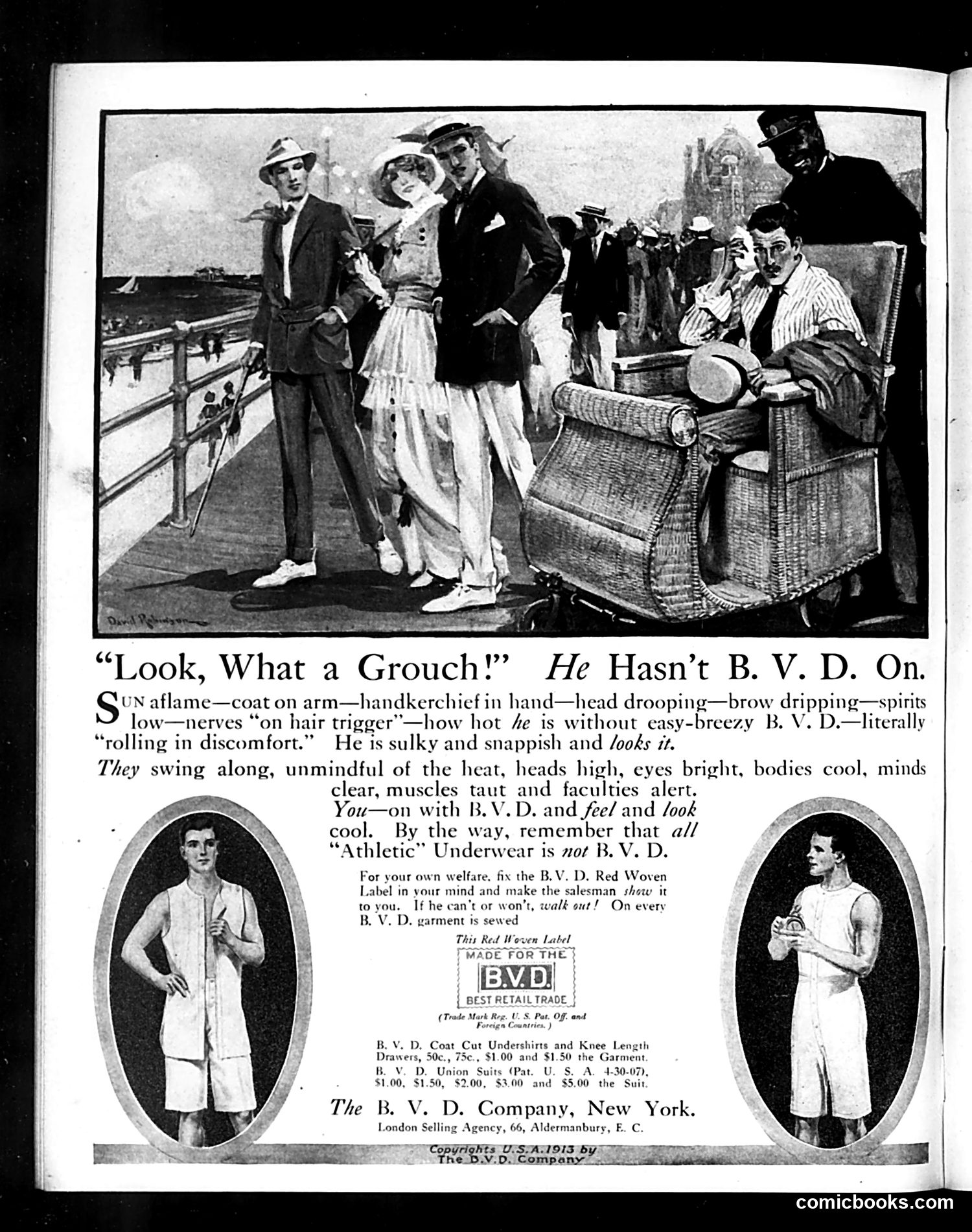
This is primarily a **product advertisement**, not political satire. It uses humor to promote B.V.D. brand underwear by contrasting two men in summer heat. The "grouch" (left) suffers visibly—coat on arm, handkerchief in hand, drooping head, irritable mood—because he lacks B.V.D. underwear. The well-dressed men (right) remain composed, cool, and alert while wearing it. The ad's joke: proper underwear determines summer comfort and temperament. The text emphasizes the "Red Woven Label" as proof of authenticity, warning consumers against imitations labeled "Athletic" underwear. This reflects early-20th-century concerns about counterfeit branded goods. The advertisement includes product details and prices ($1.00-$5.00), with offices in New York and London. The satirical element is mild—simply exaggerating the misery of inadequate undergarments versus the superiority of the branded product.