
Judge, 1914-06-06 · page 14 of 24
Judge — June 6, 1914 — page 14: what you’re looking at
What you’re looking at
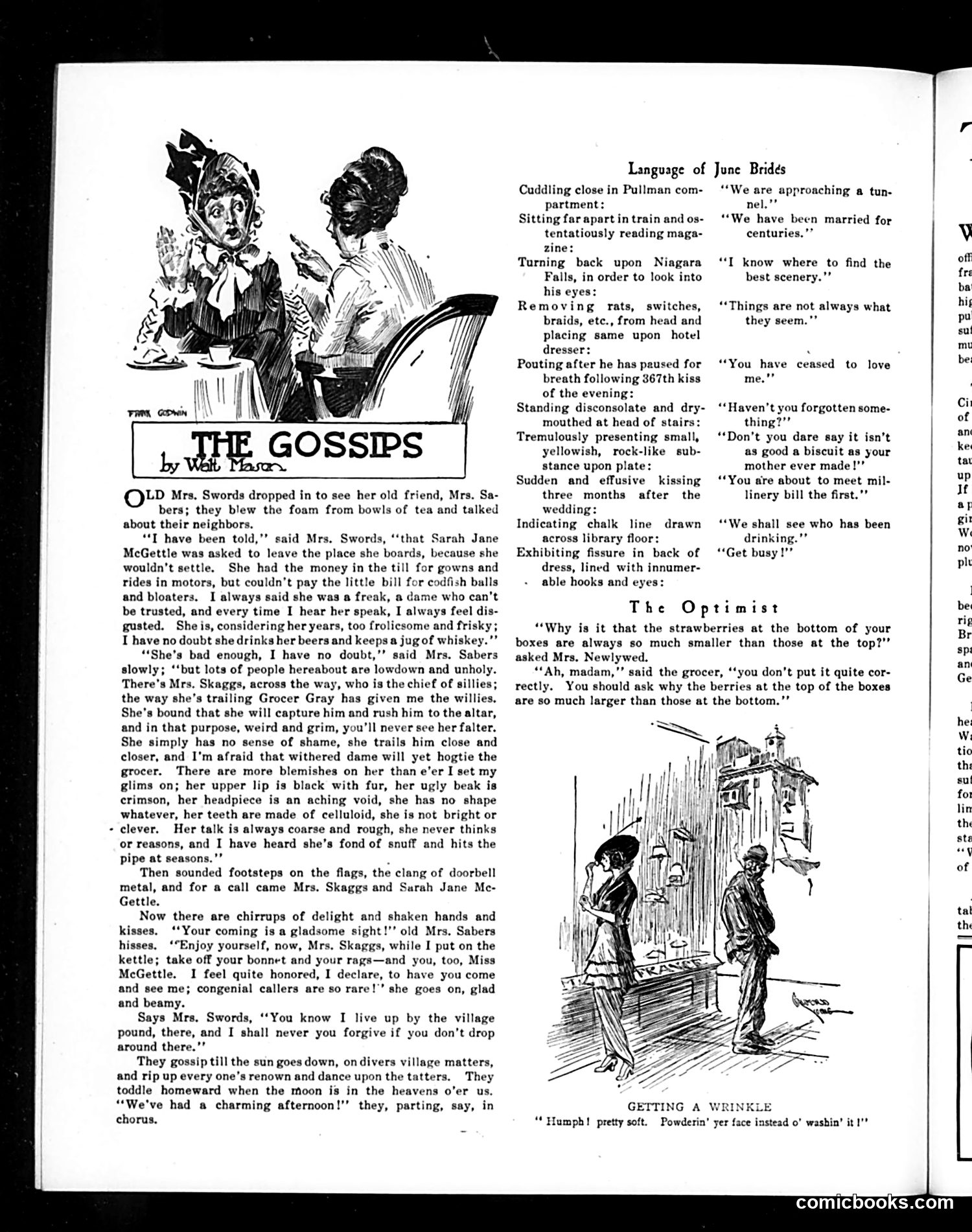
This page satirizes female gossip and newlywed behavior in early 20th-century American middle-class life. **"The Gossips"** depicts two women (Mrs. Swords and Mrs. Sabers) viciously slandering their neighbors—particularly Sarah Jane McGettle (irresponsible with money) and Mrs. Skaggs (desperately pursuing the grocer). The joke: when these same women unexpectedly arrive for tea, the gossips instantly become saccharine and welcoming, revealing their hypocrisy. The text explicitly notes they spend the evening tearing apart "every one's renown" while pretending friendship. **"Language of June Brides"** humorously catalogs newlywed clichés—honeymoon affectations ("We are approaching a tunnel"), post-honeymoon disillusionment ("We have been married for centuries"), and domestic disappointments (burned biscuits, mounting bills). The illustrations show awkward marital moments. Both pieces mock female social dishonesty and the gap between romantic expectations and matrimonial reality—common satirical targets in Judge magazine's commentary on American society.
📄 Transcribed text from this page (OCR, searchable)
Machine-transcribed from the original scan — historical spelling and the odd misread are preserved.
—, Mt \| | | | PATA OrpD Mrs. Swords dropped in to see her old friend, Mrs. Sa- bers; they blew the foam from bowls of tea and talked about their neighbors. “T have been told,"’ said Mrs. Swords, ‘that Sarah Jane McGettle was asked to leave the place she boards, because she wouldn't settle. She had the money in the till for gowns and rides in motors, but couldn't pay the little bill for codfish balls and bloaters. I always said she was a freak, a dame who can’t be trusted, and every time I hear her speak, I always feel dis- gusted. She is, considering her years, too frolicsome and frisky; I have no doubt she drinks her beers and keeps a jug of whiskey.’’ “She's bad enough, I have no doubt,’’ said Mrs. Sabers slowly; ‘‘but lots of people hereabout are lowdown and unholy. There's Mrs. Skaggs, across the way, who is the chief of sillies; the way she’s trailing Grocer Gray has given me the willies. She's bound that she will capture him and rush him to the altar, and in that purpose, weird and grim, you'll never see her falter. She simply has no sense of shame, she trails him close and closer, and I'm afraid that withered dame will yet hogtie the grocer. There are more blemishes on her than e’er I set my glims on; her upper lip is black with fur, her ugly beak is crimson, her headpiece is an aching void, she has no shape whatever, her teeth are made of celluloid, she is not bright or clever. Her talk is always coarse and rough, she never thinks or reasons, and I have heard she’s fond of snuff and hits the pipe at seasons.’” < Then sounded footsteps on the flags, the clang of doorbell metal, and for a call came Mrs. Skaggs and Sarah Jane Mc- Gettle. Now there are chirrups of delight and shaken hands and kisses. ‘‘Your coming is a gladsome sight!’’ old Mrs, Sabers hisses, ‘Enjoy yourself, now, Mrs. Skaggs, while I put on the kettle; take off your bonnet and your rags—and you, too, Miss McGettle. I feel quite honored, I declare, to have you come and see me; congenial callers are so rare!’ she goes on, glad and beamy. Says Mrs, Swords, ‘You know I live up by the village pound, there, and I shall never you forgive if you don’t drop around there.’ They gossip till the sun goes down, on divers village matters, and rip up every one’s renown and dance upon the tatters. They toddle homeward when the moon is in the heavens o’er us, “‘We've had a charming afternoon!’’ they, parting, say, in chorus, Cuddling close in Pullman com- partment: Sitting far apart in train and os- tentatiously reading maga- zini Turning back upon Niagara Falls, in order to look into his eyes: Removing rats, switches, braids, etc., from head and placing same upon hotel dresser: Pouting after he has paused for breath following 367th kiss of the evening: Standing disconsolate and dry- mouthed at head of stairs: Tremulously presenting small, yellowish, rock-like sub- stance upon plate: Sudden and effusive kissing three months after the wedding: Indicating chalk line across library floor: Exhibiting fissure in back of dress, lined with innumer- able hooks and eyes: drawn Language of June Brides “We are approaching a tun- nel.’ “‘We have been married for centuries.”’ “I know where to find the best scenery.”’ “Things are not always what they seem."" “You have ceased to love me." “‘Haven’t you forgotten some- thing?” “Don't you dare say it isn’t as good a biscuit as your mother ever made!’’ “You are about to meet mil- linery bill the first.’’ “We shall see who has been drinking.’’ “Get busy !’’ The Optimist “Why is it that the strawberries at the bottom of your boxes are always so much smaller than those at the top?’’ asked Mrs. Newlywed. “‘Ah, madam,”’ said the grocer, ‘‘you don’t put it quite cor- rectly. You should ask why the berries at the top of the boxes are so much larger than those at the bottom.’’ GETTING A WRINKLE “ Humph! pretty soft. Powderin' yer face instead o’ washin’ it !'" comicbooks.com tal the