
Judge, 1914-06-06 · page 4 of 24
Judge — June 6, 1914 — page 4: what you’re looking at
What you’re looking at
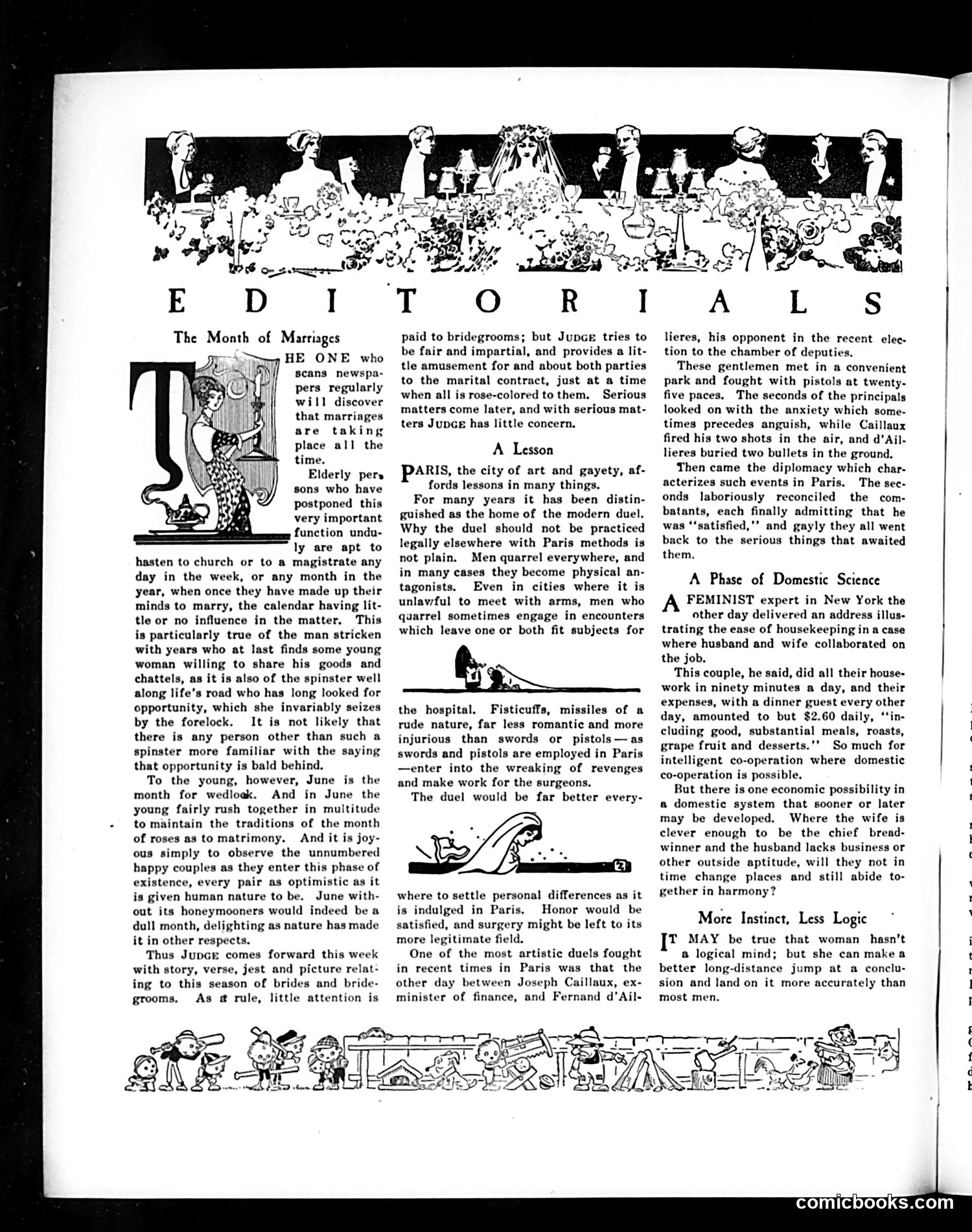
This Judge magazine page contains three opinion pieces satirizing early 20th-century social issues: **"The Month of Marriages"** mocks the June wedding season, suggesting judges spend considerable time settling marital disputes. The satire implies marriages are hastily entered and frequently troubled, requiring legal intervention. **"A Lesson"** references a recent Parisian duel between Joseph Caillaux (finance minister) and Ferdinand d'Aillieres, satirizing how Europeans resolve disputes through violence rather than law—contrasting with the American legal system. **"A Phase of Domestic Science"** critiques a feminist lecture about household efficiency. The satire suggests that while wives might mathematically optimize housework, practical harmony requires less logic and more genuine cooperation between spouses—implying feminist "science" oversimplifies marriage dynamics.
📄 Transcribed text from this page (OCR, searchable)
Machine-transcribed from the original scan — historical spelling and the odd misread are preserved.
The Month of Marriages HE ONE who scans newspa- pers regularly will discover that marriages are taking place all the time. Elderly pers sons who have postponed this very important function undu- ly are apt to hasten to church or to a magistrate any day in the week, or any month in the year, when once they have made up their minds to marry, the calendar having lit- tle or no influence in the matter. This is particularly true of the man stricken with years who at last finds some young woman willing to share his goods and chattels, as it is also of the spinster well along life’s road who has long looked for opportunity, which she invariably seizes by the forelock. It is not likely that there is any person other than such a spinster more familiar with the saying that opportunity is bald behind. To the young, however, June is the month for wedloak. And in June the young fairly rush together in multitude to maintain the traditions of the month of roses as to matrimony. And it is joy- ous simply to observe the unnumbered happy couples as they enter this phase of existence, every pair as optimistic as it is given human nature to be. June with- out its honeymooners would indeed be a dull month, delighting as nature has made it in other respects. Thus Jupce comes forward this week with story, verse, jest and picture relat- ing to this season of brides and bride- grooms. As @ rule, little attention is paid to bridegrooms; but Jupce tries to be fair and impartial, and provides a lit- tle amusement for and about both parties to the marital contract, just at a time when all is rose-colored to them. Serious matters come later, and with serious mat- ters JupGE has little concern. A Lesson Paris, the city of art and gayety, af- fords lessons in many things. For many years it has been distin- guished as the home of the modern duel. Why the duel should not be practiced legally elsewhere with Paris methods is not plain. Men quarrel everywhere, and in many cases they become physical an- tagonists. Even in cities where it is unlawful to meet with arms, men who quarrel sometimes engage in encounters which leave one or both fit subjects for the hospital. Fisticuffs, missiles of a rude nature, far less romantic and more injurious than swords or pistols—as swords and pistols are employed in Paris —enter into the wreaking of revenges and make work for the surgeons, The duel would be far better every- where to settle personal differences as it is indulged in Paris, Honor would be satisfied, and surgery might be left to its more legitimate field. One of the most artistic duels fought in recent times in Paris was that the other day between Joseph Caillaux, ex- minister of finance, and Fernand d’Ail- his opponent in the recent elec. tion to the chamber of deputies. These gentlemen met in a convenient park and fought with pistols at twenty. five paces. The seconds of the principals looked on with the anxiety which some- times precedes anguish, while Caillaux fired his two shots in the air, and d’Ail- lieres buried two bullets in the ground, Then came the diplomacy which char- acterizes such events in Paris. The sec- onds laboriously reconciled the com- batants, each finally admitting that he was ‘‘satisfied,’’ and gayly they all went back to the serious things that awaited them. A Phase of Domestic Science A FEMINIST expert in New York the other day delivered an address illus- trating the ease of housekeeping ina case where husband and wife collaborated on the job. This couple, he said, did all their house- work in ninety minutes a day, and their expenses, with a dinner guest every other day, amounted to but $2.60 daily, ‘‘in- cluding good, substantial meals, roasts, grape fruit and desserts.’’ So much for intelligent co-operation where domestic co-operation is possible. But there is one economic possibility in a domestic system that sooner or later may be developed. Where the wife is clever enough to be the chief bread- winner and the husband lacks business or other outside aptitude, will they not in time change places and still abide to- gether in harmony? More Instinct, Less Logic It MAY be true that woman hasn't a logical mind; but she can make a better long-distance jump at a conclu- sion and land on it more accurately than most men.