
A complete issue · 25 pages · 1914
Judge — May 9, 1914
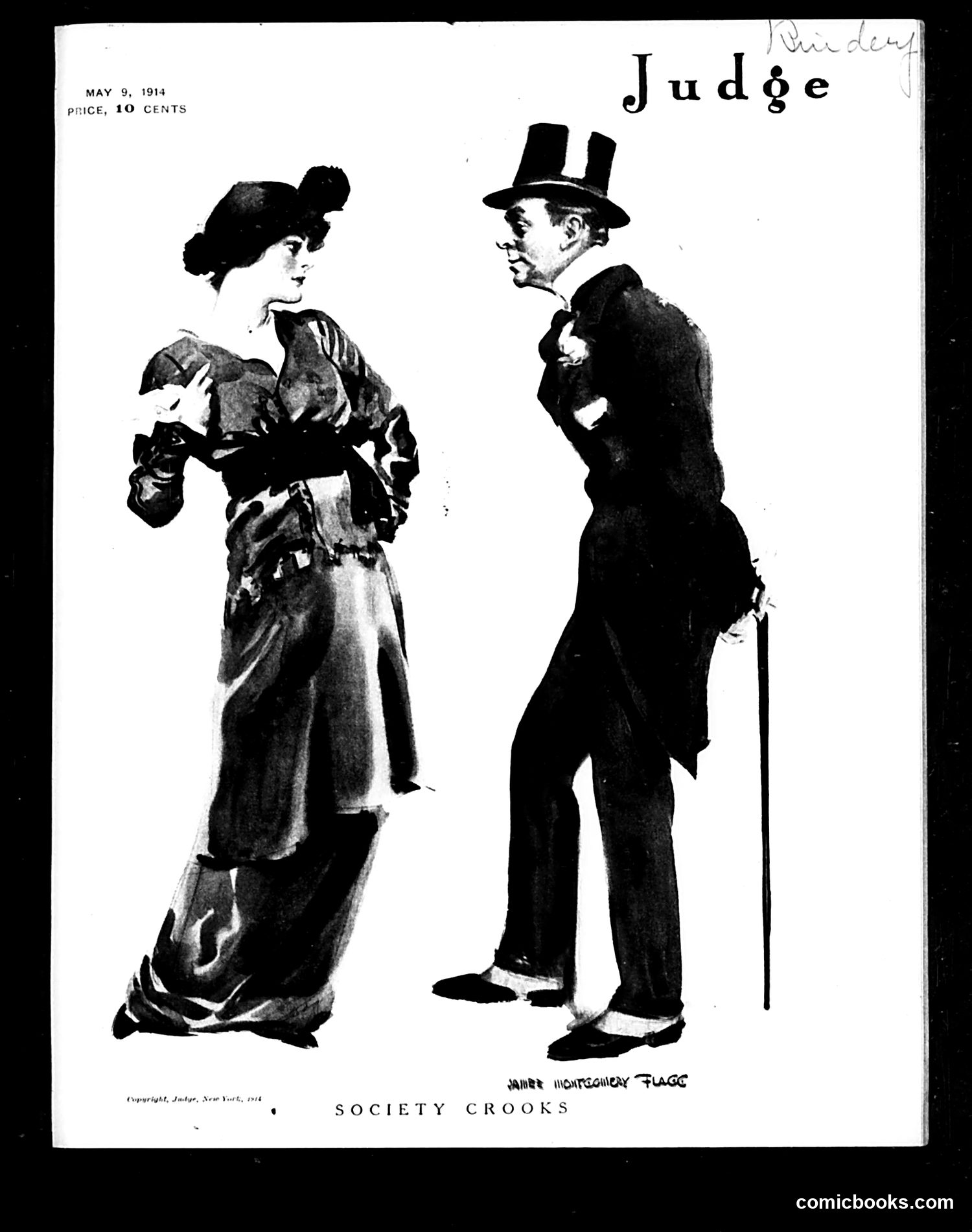
This satirical cartoon by James Montgomery Flagg contrasts two figures labeled "Society Crooks." On the left is an elegantly dressed woman in fashionable Edwardian attire; on the right is a well-dressed gentleman in top hat and formal wear with a cane. The satire suggests that wealthy "society" people engage in dishonest or immoral behavior despite their refined appearance and social status. By calling both figures "crooks," the cartoon mocks the hypocrisy of the upper class—implying that polished exteriors and social respectability mask criminal or unethical conduct. This reflects Progressive Era skepticism toward wealthy elites and their actual character beneath their public veneer of respectability.
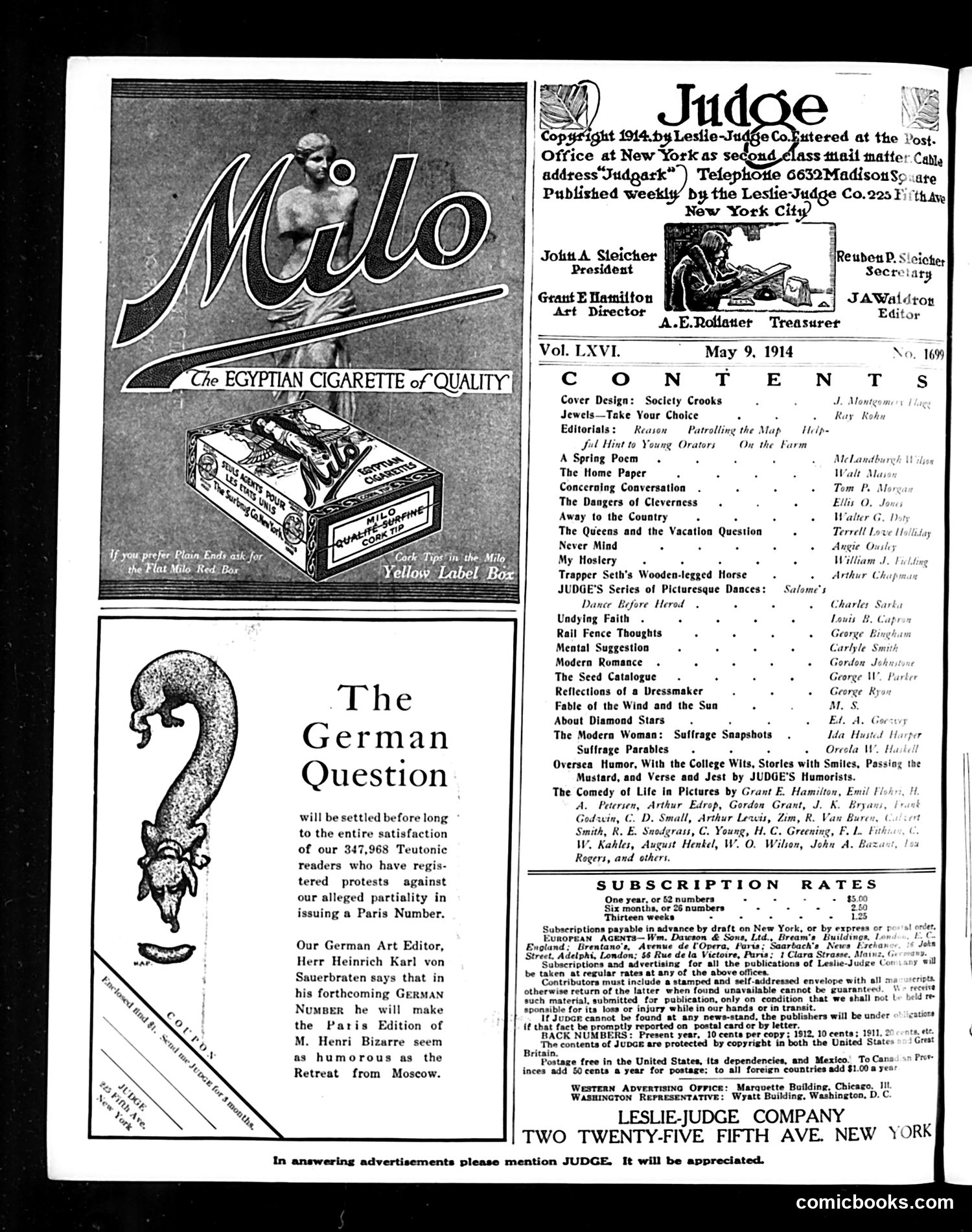
The page contains primarily **advertising and editorial content** rather than political cartoons. The main visual elements are: 1. **Milo cigarette advertisement** (top) - promoting "Egyptian cigarettes of quality" with product packaging imagery 2. **"The German Question" illustration** (bottom) - a large question mark with decorative flourishes, accompanying text about a dispute involving 347,958 Teutonie readers and protests regarding partial representation in *Judge* magazine The German Question section mentions the magazine's German art editor, Heinrich Karl von Sauerbraten, and references a "Paris Edition" and "Retreat from Moscow" - likely contemporary World War I references, as this was published May 1914, just months before WWI began. The exact nature of the dispute remains unclear from the text provided. The bulk of the page lists table of contents and subscription information.
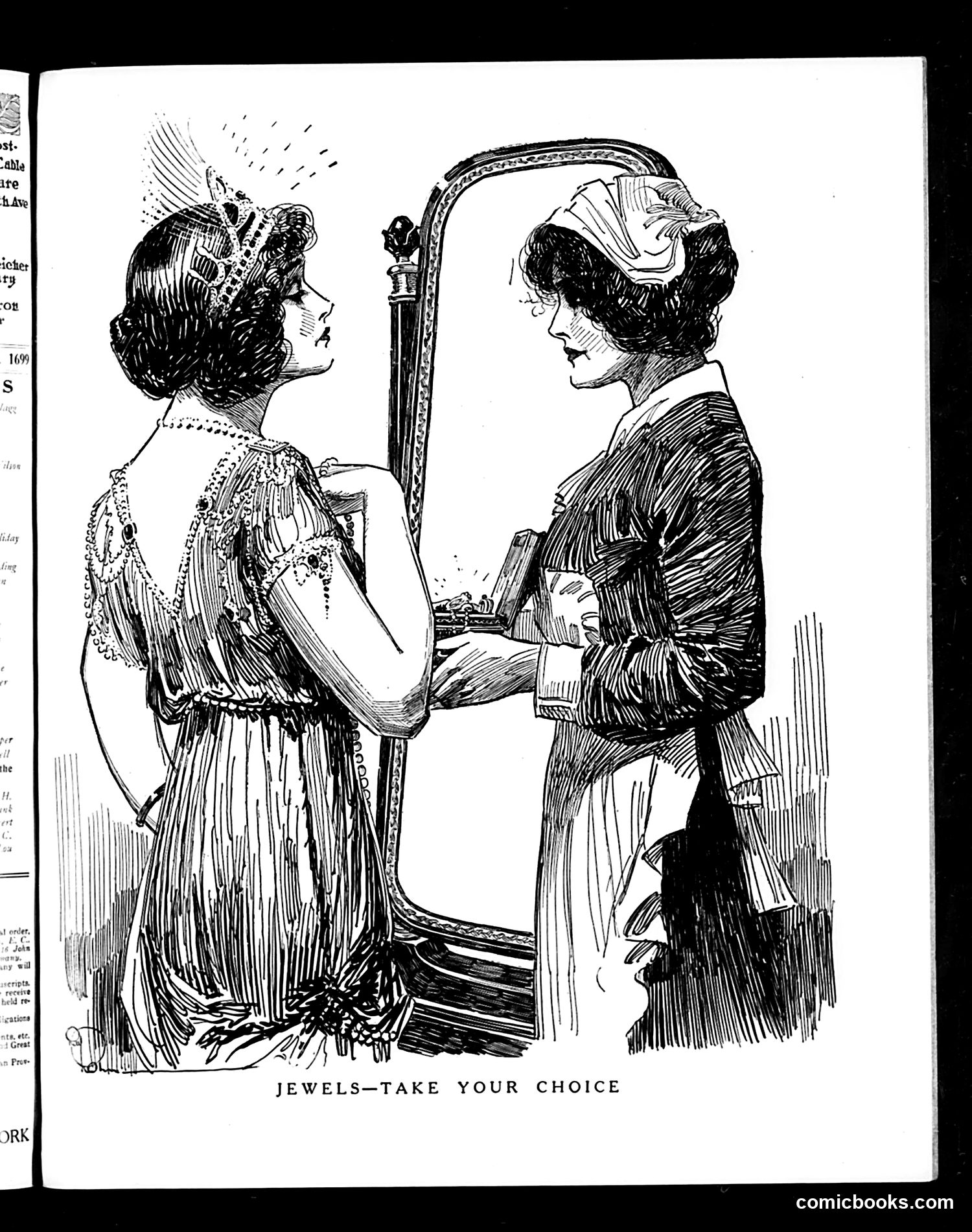
This cartoon depicts two women examining their reflections in a mirror, with the caption inviting a choice between them. The image likely satirizes early-20th-century attitudes about women's appearance and materialism. The woman on the left wears elaborate jewelry and an ornate, detailed gown with decorative beading, while the figure on the right appears simpler or more plainly dressed. The mirror serves as the central device—suggesting vanity, self-perception, or perhaps comparing different types of women or social classes. Without additional context from the magazine's date or surrounding articles, the specific social commentary remains unclear. It may critique wealthy women's obsession with jewelry and fashion, or comment on women's choices regarding marriage, status, or identity. The "take your choice" framing suggests Judge is presenting contrasting ideals for satirical examination.
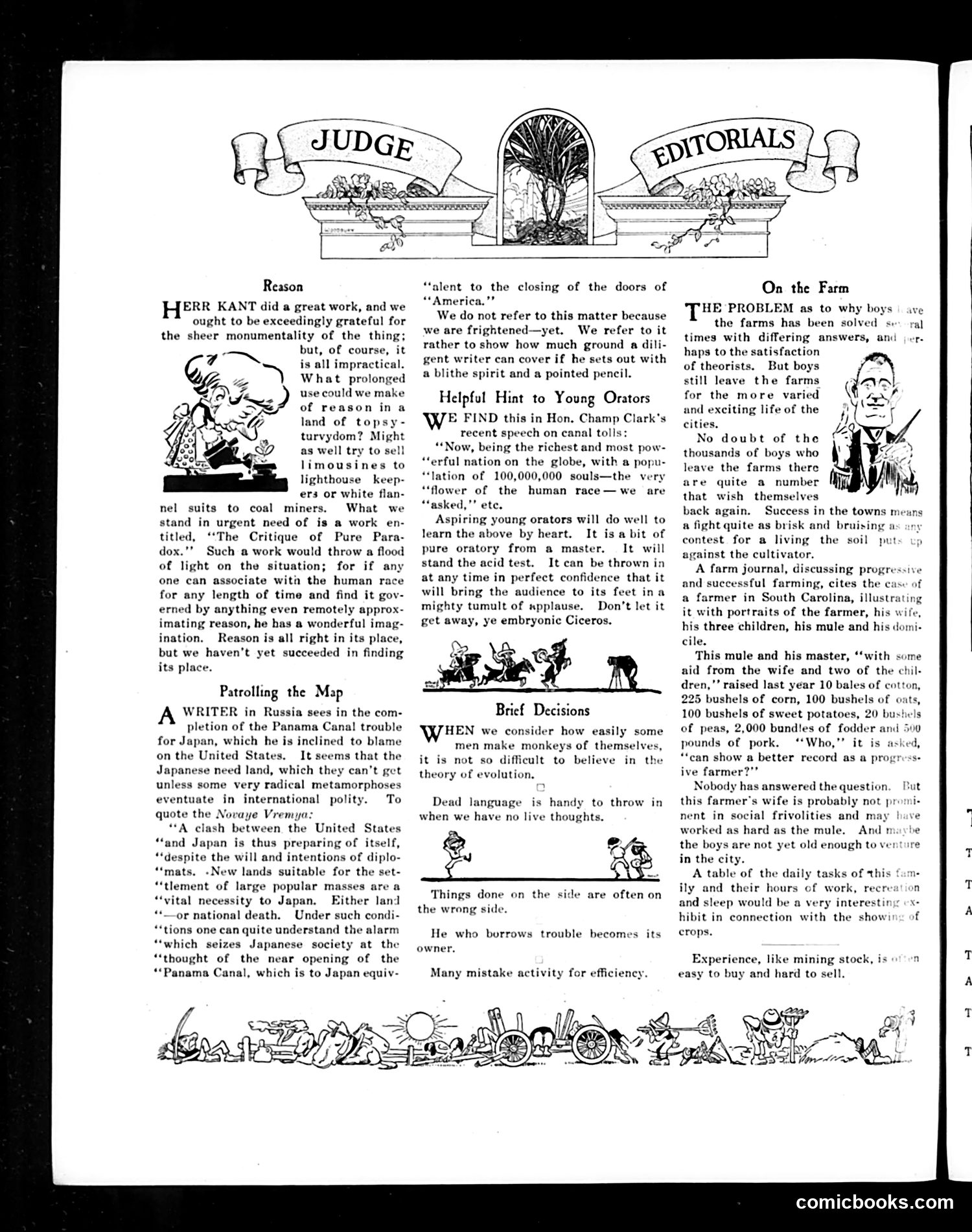
This page contains four editorial pieces rather than political cartoons. The "Judge" section praises Immanuel Kant's philosophical work on reason. "Editorials" discusses why farm boys leave rural life for cities, noting the "varied and exciting life" appeals more than agricultural labor. "Patrolling the Map" satirizes a Russian writer's analysis of the Panama Canal, suggesting Japan should bear blame rather than the United States—likely referencing contemporary imperial tensions and American canal interests. "Brief Decisions" offers aphoristic observations: dead language is useless without live thoughts; borrowed trouble becomes the owner's problem; and mistaking activity for efficiency represents a common error. The illustrations are small decorative vignettes rather than political caricatures.
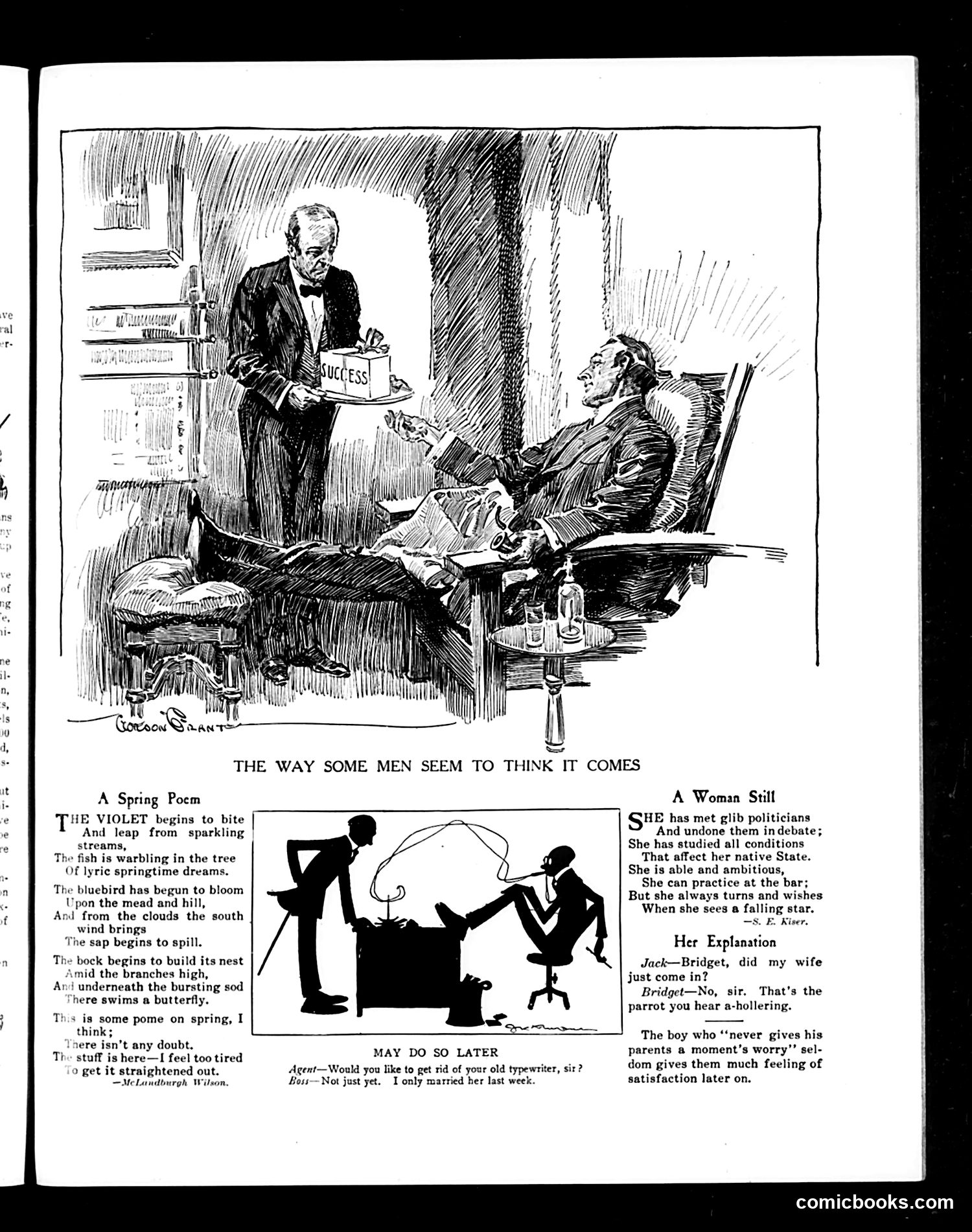
**Top Cartoon:** "The Way Some Men Seem to Think It Comes" A waiter serves "SUCCESS" on a platter to a seated businessman, satirizing the naive belief that success comes automatically—like restaurant service—rather than through effort. **"A Spring Poem"** and **"A Woman Still"** These paired poems contrast romantic spring imagery with a woman's pragmatic reality. She's educated, ambitious, and politically engaged ("glib politicians"), yet society expects her to defer and "wish / When she sees a falling star"—implying women should remain passive and hopeful rather than active agents. **"May Do So Later"** A man asks an agent about discarding his old typewriter; the agent notes his wife "only married her last week," suggesting newlyweds replace things impulsively. The joke implies women are frivolous shoppers. The page critiques both masculine delusions about success and feminine stereotypes.
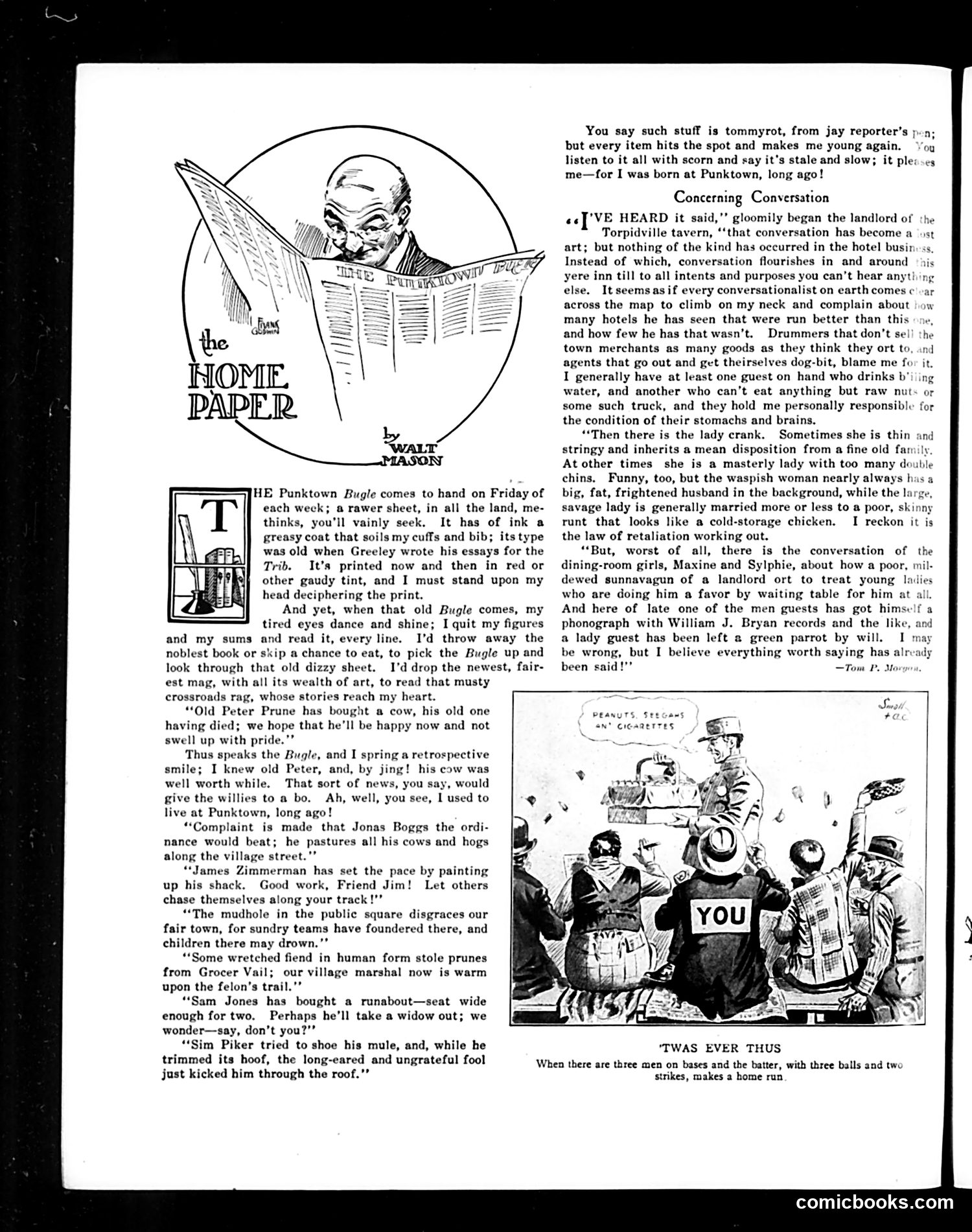
This page from *Judge* magazine presents nostalgic small-town Americana alongside social commentary. **"The Home Paper"** (left): A sentimental piece celebrating a local rural newspaper—the *Punktown Bugle*—despite its shabby printing and dated content. The speaker cherishes it because it reports on familiar neighbors (Old Peter's cow, Jonas Boggs's ordinance violations, James Zimmerman's home improvements). This romanticizes provincial life and community connection. **"Concerning Conversation"** (right): A tavern keeper complains about hotel guests' relentless socializing—drummers (traveling salesmen) griping about management, complainers about food, demanding waitresses, and a guest playing William J. Bryan phonograph records. The piece satirizes both the modern traveling businessman culture and the perceived entitlement of service workers and guests, suggesting constant conversation has become an exhausting modern plague. **"'Twas Ever Thus"** (bottom): A baseball cartoon with minimal caption, likely a simple visual gag about the game. The satire targets modern annoyances while celebrating rural simplicity.
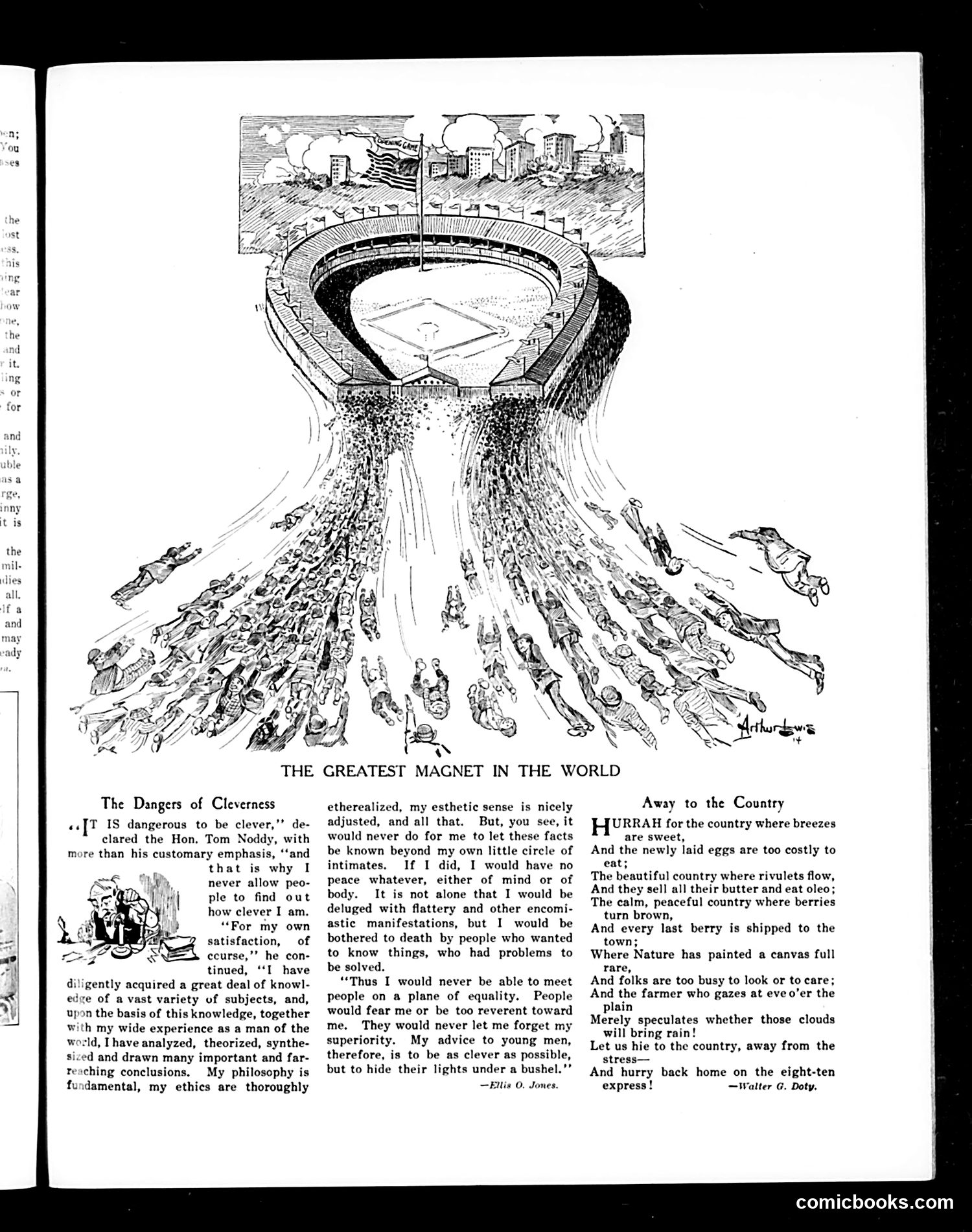
**Main Cartoon: "The Greatest Magnet in the World"** The illustration depicts a baseball stadium acting as a massive magnet, pulling crowds of people upward from below. The satire targets the enormous drawing power of professional baseball, suggesting it exerts an almost irresistible force on the American public. The "magnet" metaphor emphasizes how the sport attracts masses of people, likely commenting on baseball's explosive popularity in early 20th-century America. **Text Content:** Two accompanying pieces provide social commentary: 1. "The Dangers of Cleverness" quotes a character (Hon. Tom Noddy) advising young men to hide their intelligence to maintain social equality and avoid unwanted solicitations—satirizing how intellectualism creates distance between people. 2. "Away to the Country" ironically celebrates rural life while cataloging its harsh realities: expensive eggs, rancid butter, shipped-away produce, and farmers anxiously watching weather. The punchline—rushing back to the city on the express train—mocks the romantic idealization of country living.
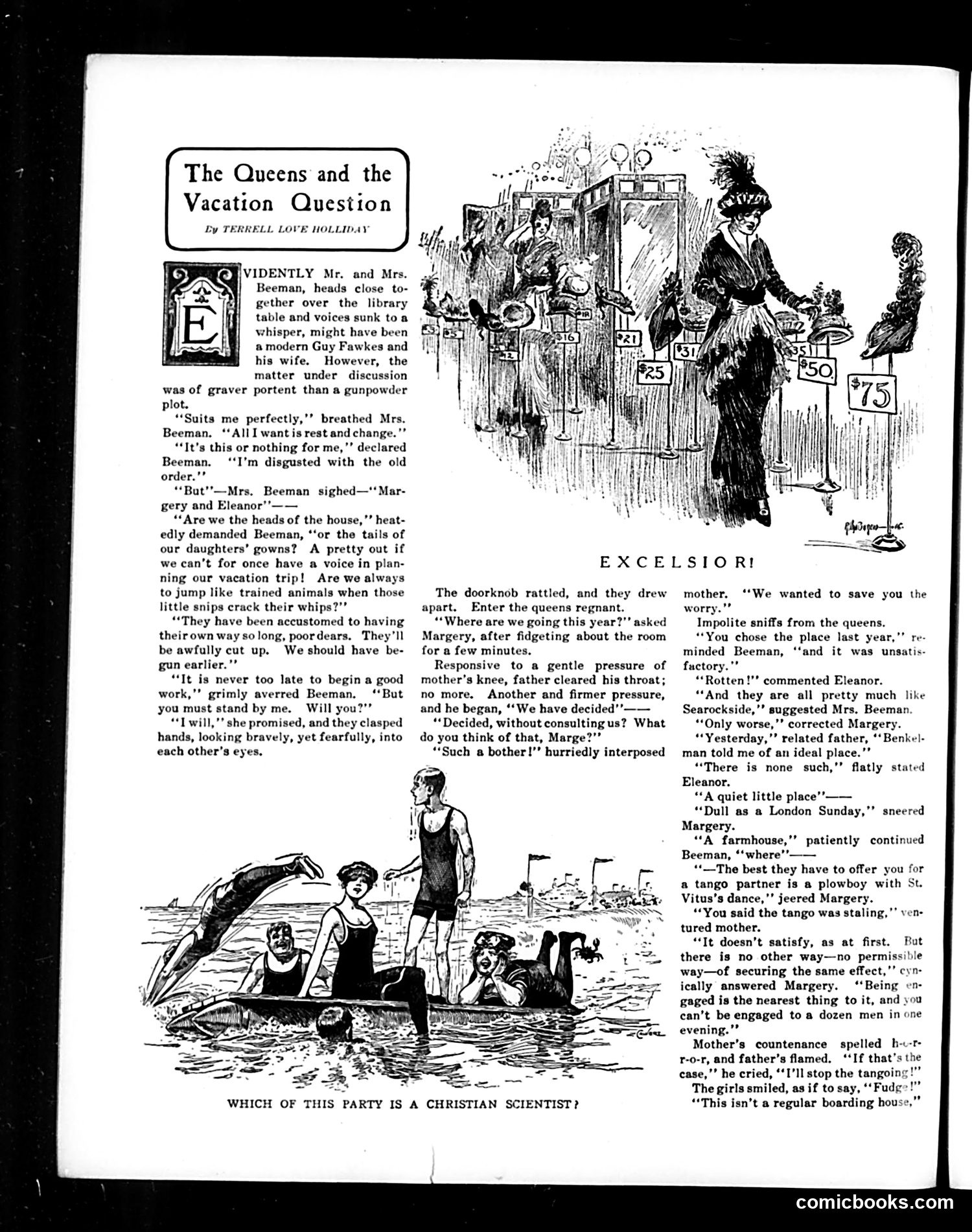
This satirical story mocks the growing independence and demands of young women in the early 20th century. Mr. and Mrs. Beeman attempt to assert parental authority by choosing their vacation destination without consulting their adult daughters, Margery and Eleanor—a revolutionary act they compare to Guy Fawkes's gunpowder plot. The daughters immediately dominate the discussion, dismissing every parental suggestion (a farmhouse, quiet location) as boring or inadequate. They demand a place offering entertainment like tango dancing and suitable male partners. The parents ultimately capitulate when Eleanor threatens to stop participating in family activities. The satire targets the "New Woman"—financially independent, pleasure-seeking, and increasingly resistant to parental control. The daughters' casual dismissal of their parents' authority and their focus on romance and modern amusements embodies anxieties about changing gender roles and generational power dynamics in this era.
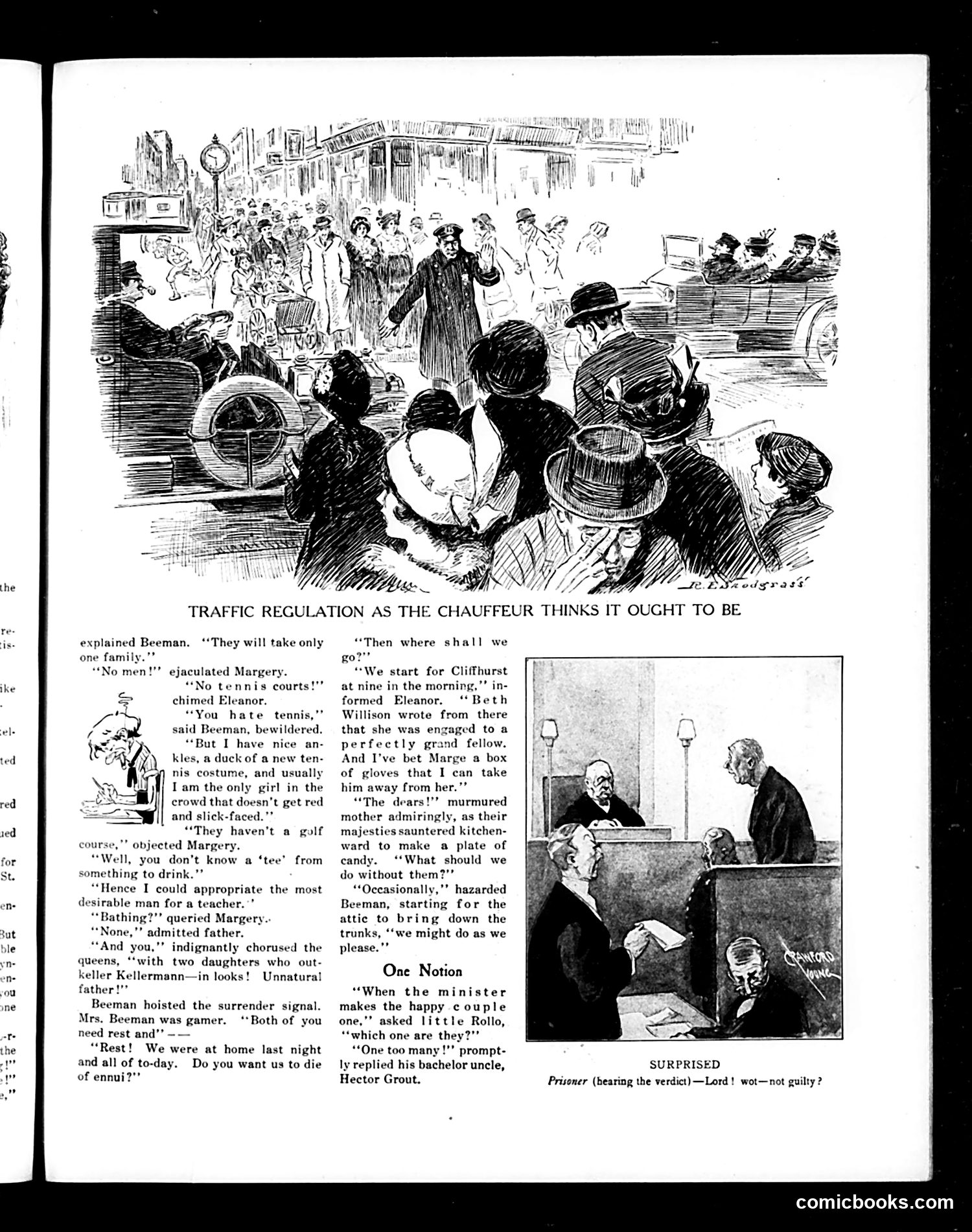
The main cartoon satirizes wealthy families' traffic congestion in early automobile era. A chauffeur navigates a crowded street while the Beeman family quarrels about vacation destinations—they demand tennis courts, golf courses, and other leisure amenities. The satire mocks upper-class entitlement: the daughters are so spoiled they threaten "ennui" (boredom) despite constant outings, and their mother admiringly notes they're incapable of independent thought. The chauffeur's implied solution is controlling these self-centered passengers through traffic regulation. The page includes two additional jokes: one about a minister marrying a couple (bachelor uncle quips "One too many"), and a courtroom scene of a prisoner surprised by acquittal. These appear standard humor filler typical of Judge magazine's miscellaneous content rather than cohesive political satire. The overall message targets wealthy automobile owners' frivolous demands during the early motoring craze.
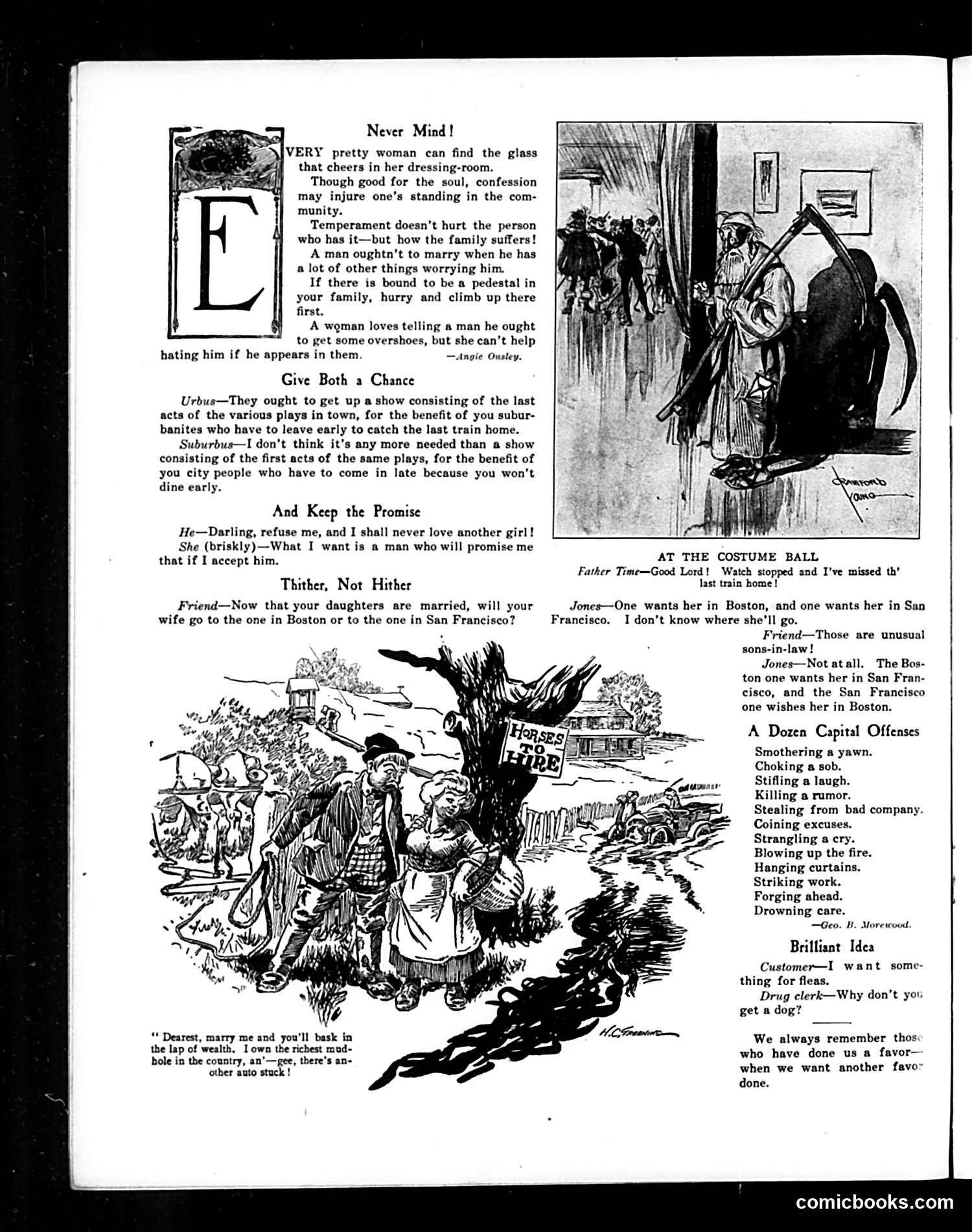
This page contains multiple short humorous pieces typical of early 20th-century satirical magazines: **"Never Mind!"** offers cynical observations about gender relations and marriage—critiquing women's drinking habits, the hypocrisy of confession, and marital incompatibility. The tone is misogynistic by modern standards. **"Give Both a Chance"** presents a dialogue between city and suburban commuters debating theater schedules, satirizing the conflicting needs of each group. **"Thither, Not Hither"** jokes about a man whose two married daughters (in Boston and San Francisco) each want their mother to visit the *other* daughter instead—implying unwanted in-laws. **"At the Costume Ball"** shows Father Time missing his train because he was distracted at a party. **"A Dozen Capital Offenses"** is a clever word-play list using verbs of suppression (smothering, choking) alongside "capital" crimes like forging ahead or drowning care. **"Brilliant Idea"** is a brief drugstore joke: the customer wants flea treatment; the clerk suggests getting a dog (implying the customer has fleas, not a pet). The page emphasizes domestic comedy and social observation typical of the era.
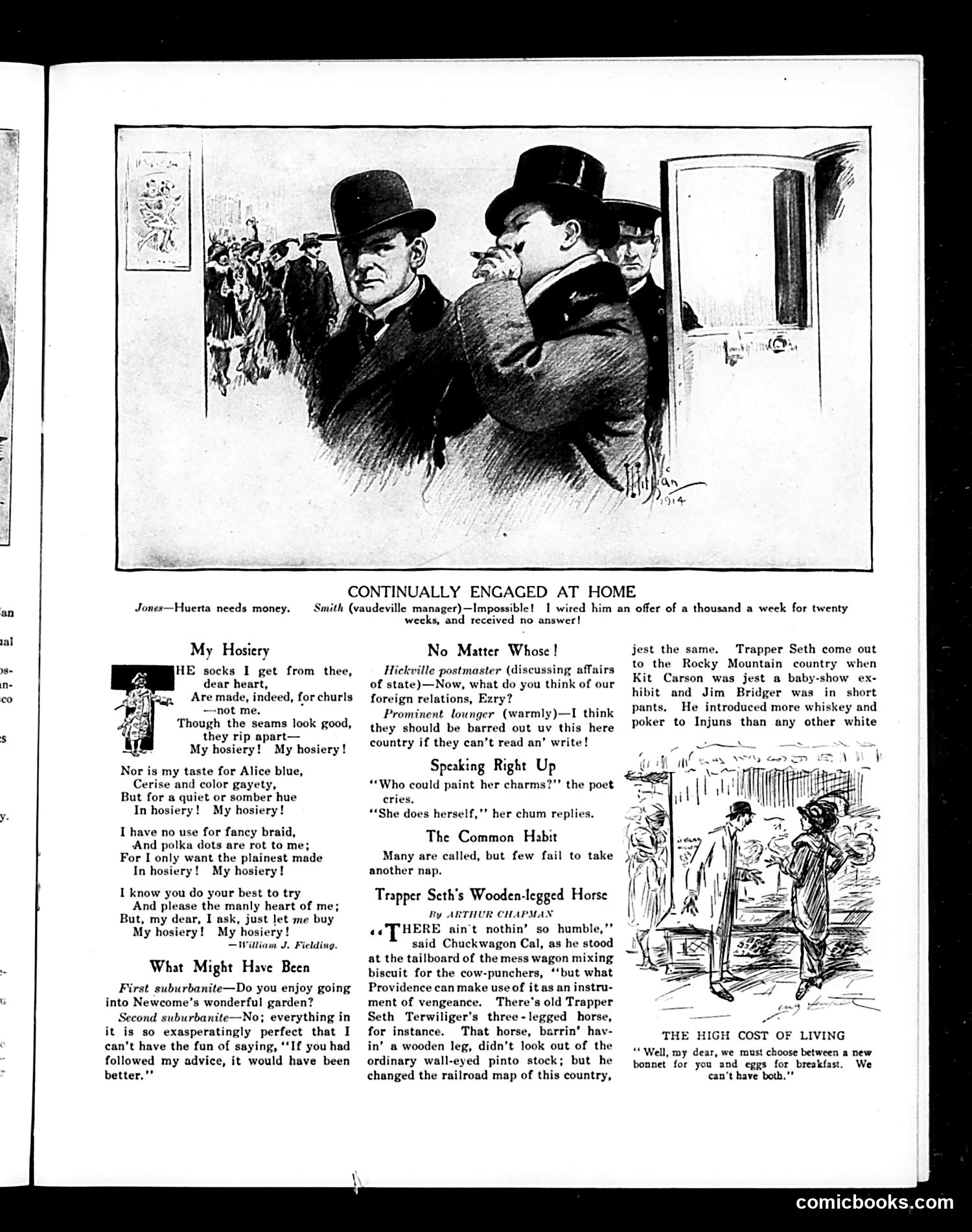
**Top Cartoon**: "Continually Engaged at Home" depicts a vaudeville manager (Smith) approaching men in formal dress—likely representing wealthy or prominent figures—with a business proposition. The caption reveals he's wired someone (presumably a performer named Huerta, referenced as needing money) offering "$1,000 a week for twenty weeks" with "no answer." The satire mocks both desperate job-hunting and the dismissive attitudes of the powerful toward such pleas. **Text Content**: The page contains light satirical verse and humorous observations—a poem mocking men's pickiness about hosiery quality, a joke about suburbanites' competitive gossip, rural character sketches poking fun at small-town postmasters and their provincial opinions, and a Western tall tale about a trapper's wooden-legged horse that "changed the railroad map." The final panel jokes about "The High Cost of Living," showing the economic pressure on households choosing between luxuries (bonnets) and necessities (eggs)—a contemporary concern during economic uncertainty.
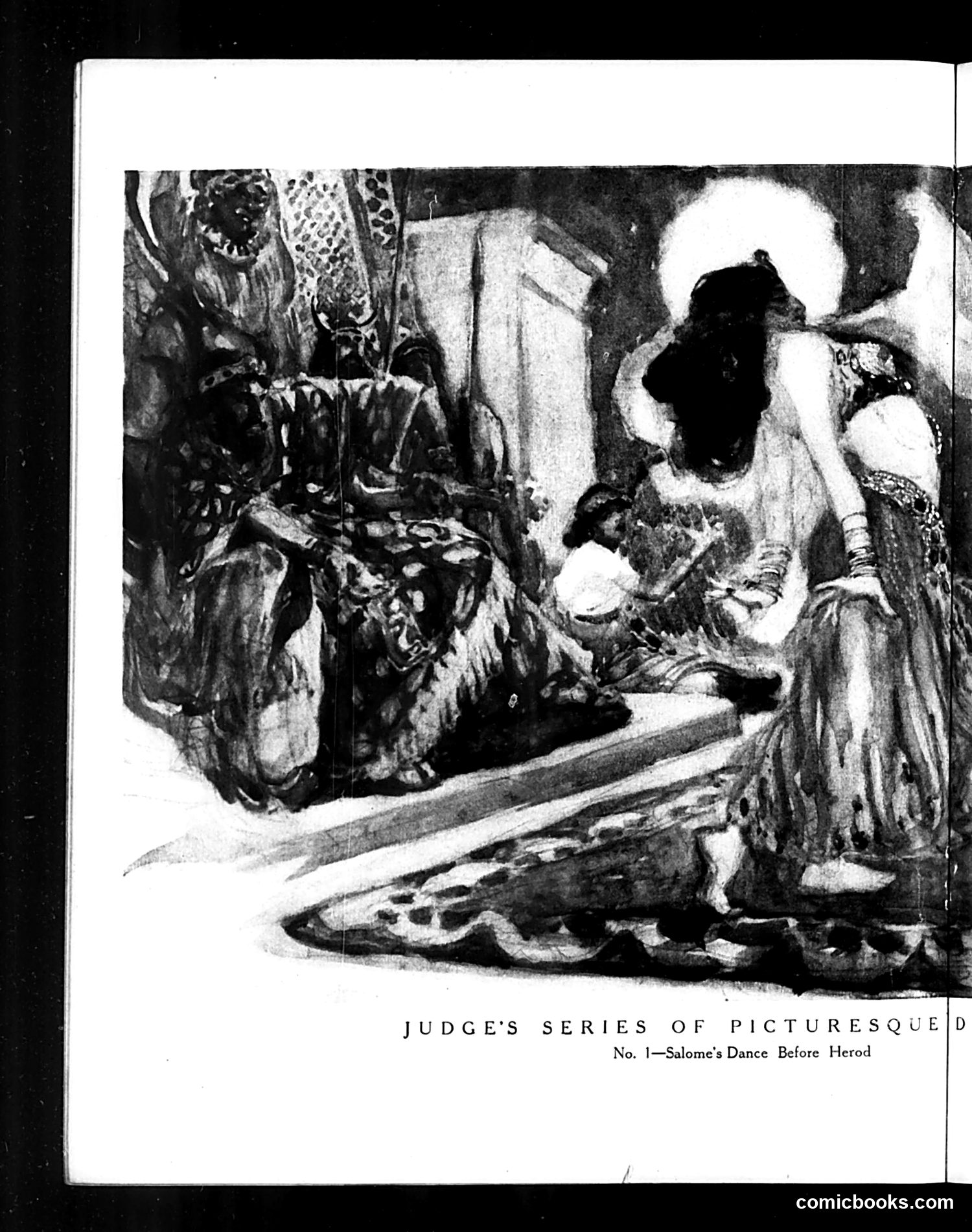
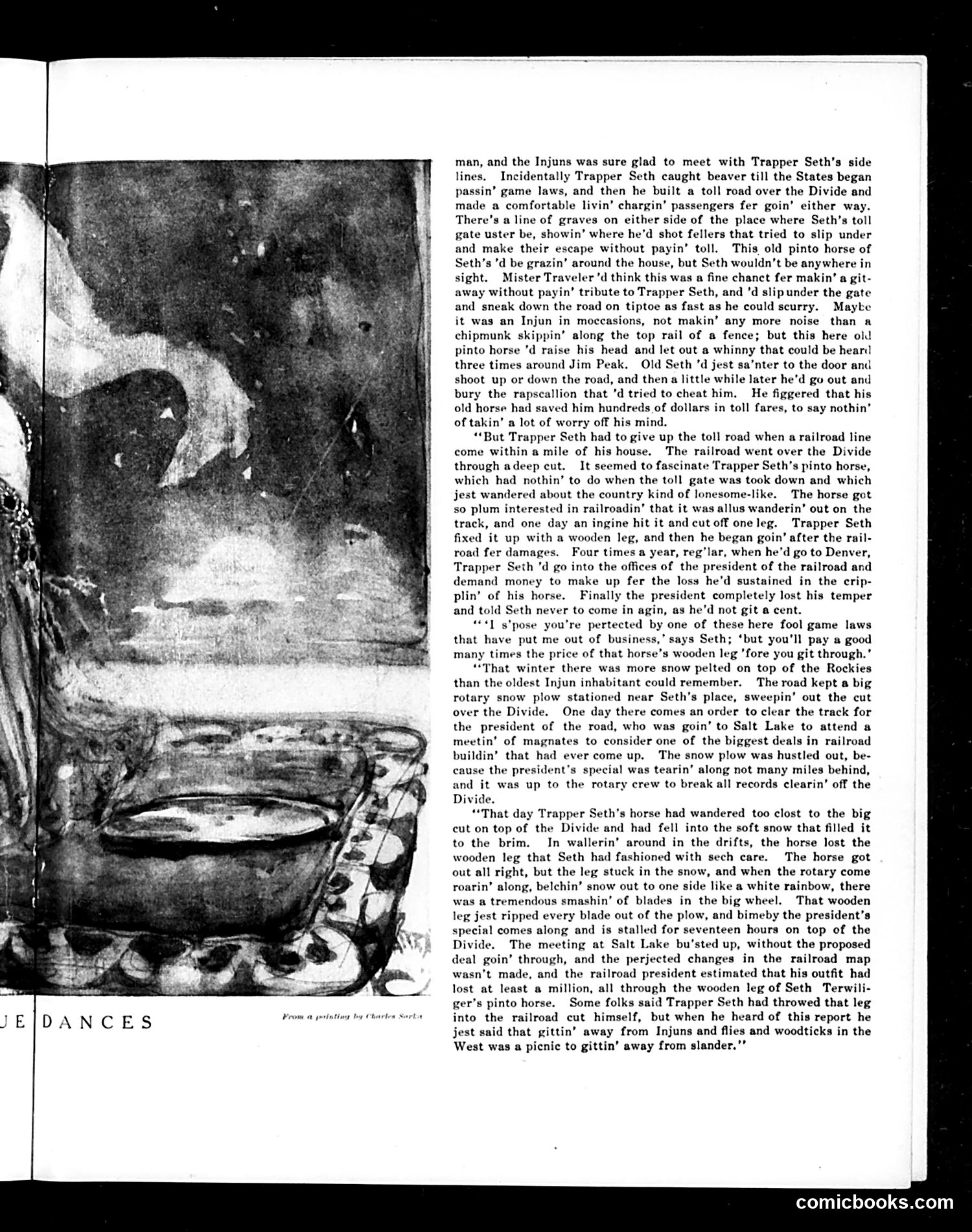
This is the first entry in Judge magazine's "Series of Picturesque" illustrations, depicting the biblical story of Salome's Dance Before Herod. The image shows an elaborate, orientalist theatrical scene with figures in exotic costumes and draped fabrics. The caption suggests this is likely referencing the popular "Salome" subject matter that fascinated late 19th/early 20th-century Western culture—particularly through Oscar Wilde's 1891 play and Richard Strauss's 1905 opera. Judge's satirical intent appears to be mocking the era's obsession with decadent, orientalist renderings of this biblical narrative, treating it as theatrical spectacle rather than serious religious content. The "picturesque" framing suggests ironic commentary on contemporary aesthetic fashions.
This page contains an illustrated tall tale about Trapper Seth, a frontier character who runs a toll road and relies on his alert pinto horse to catch would-be cheaters. When a railroad arrives and his horse loses a leg to a train, Seth demands compensation from the railroad president, who refuses. Seth's revenge arrives unexpectedly: his horse's wooden replacement leg falls into snow near the railroad tracks. When the president's special train passes, the rotary snow plow strikes the wooden leg, causing catastrophic damage to the plow's blades. The satire targets **railroad monopolies and their arrogant executives** who ignore legitimate grievances from ordinary citizens. The joke's appeal lay in frontier humor—the idea that a humble trapper's discarded wooden leg could cripple the railroad's expensive equipment, delivering poetic justice against corporate indifference. The narrative celebrates cleverness and persistence over corporate power, resonating with Gilded Age anxieties about railroads' unchecked influence.
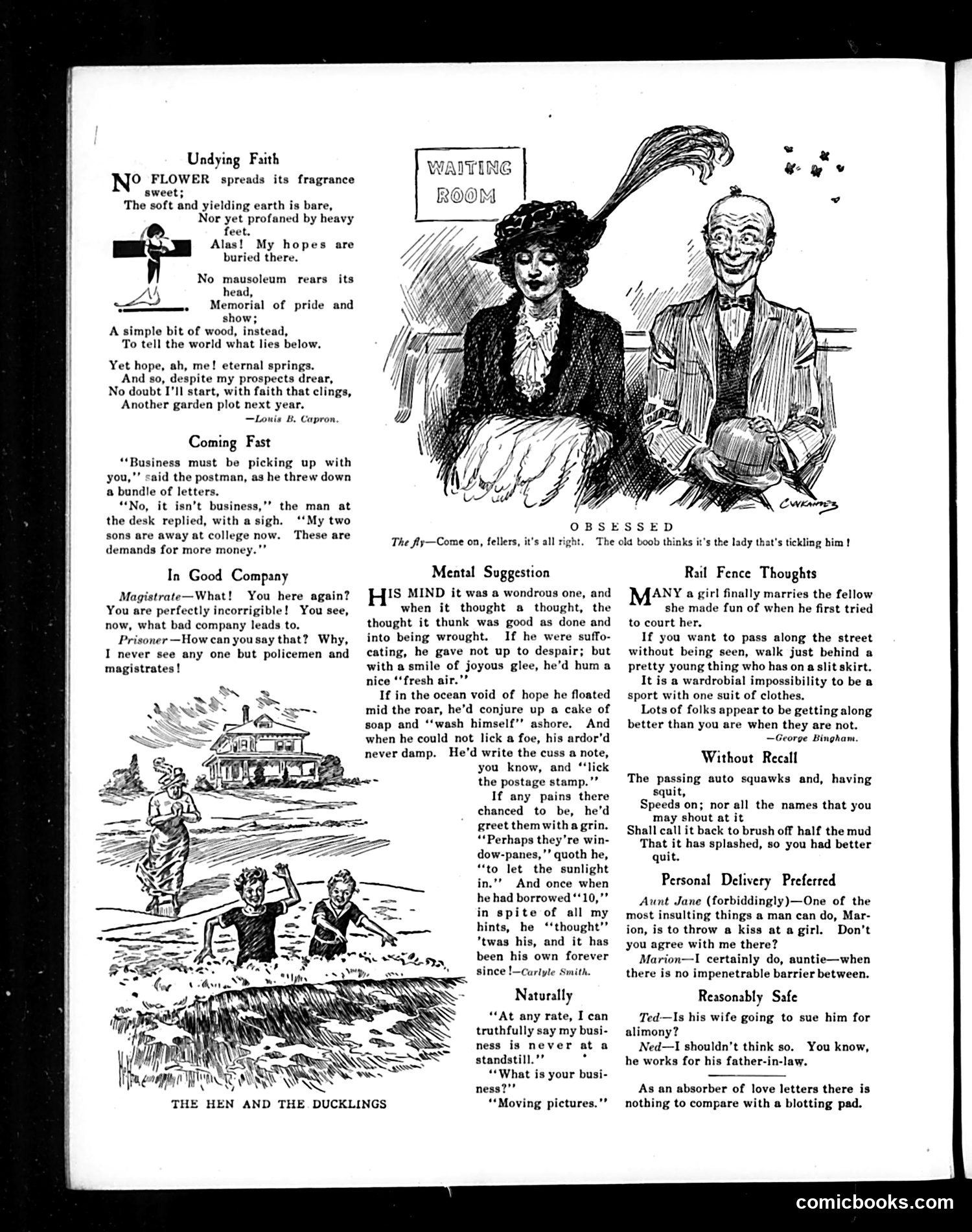
This page contains miscellaneous short humorous pieces typical of early 20th-century satirical magazines: **"Undying Faith"** — A sentimental poem about buried hopes and resilience, likely referencing a cemetery or failed investment. **"Coming Fast"** — A joke about college costs: a man receives many letters, which the postman assumes indicate business success, but they're actually bills from his sons in college demanding money. **"In Good Company"** — A prisoner appears before a magistrate repeatedly. The joke: he claims he only socializes with policemen and magistrates, so they themselves are his "bad company." **"Mental Suggestion"** and other short pieces satirize human psychology and behavior—positive thinking, romantic mishaps, automobile rudeness, and family dynamics. **"The Hen and the Ducklings"** illustration depicts a domestic farm scene. **"Obsessed"** cartoon shows a couple in a waiting room; the caption jokes that the man thinks the woman is flirting with him when she's actually just fidgeting. The page is largely non-political filler content—domestic humor, relationship jokes, and observations about contemporary social life (college expenses, automobiles, moving pictures).
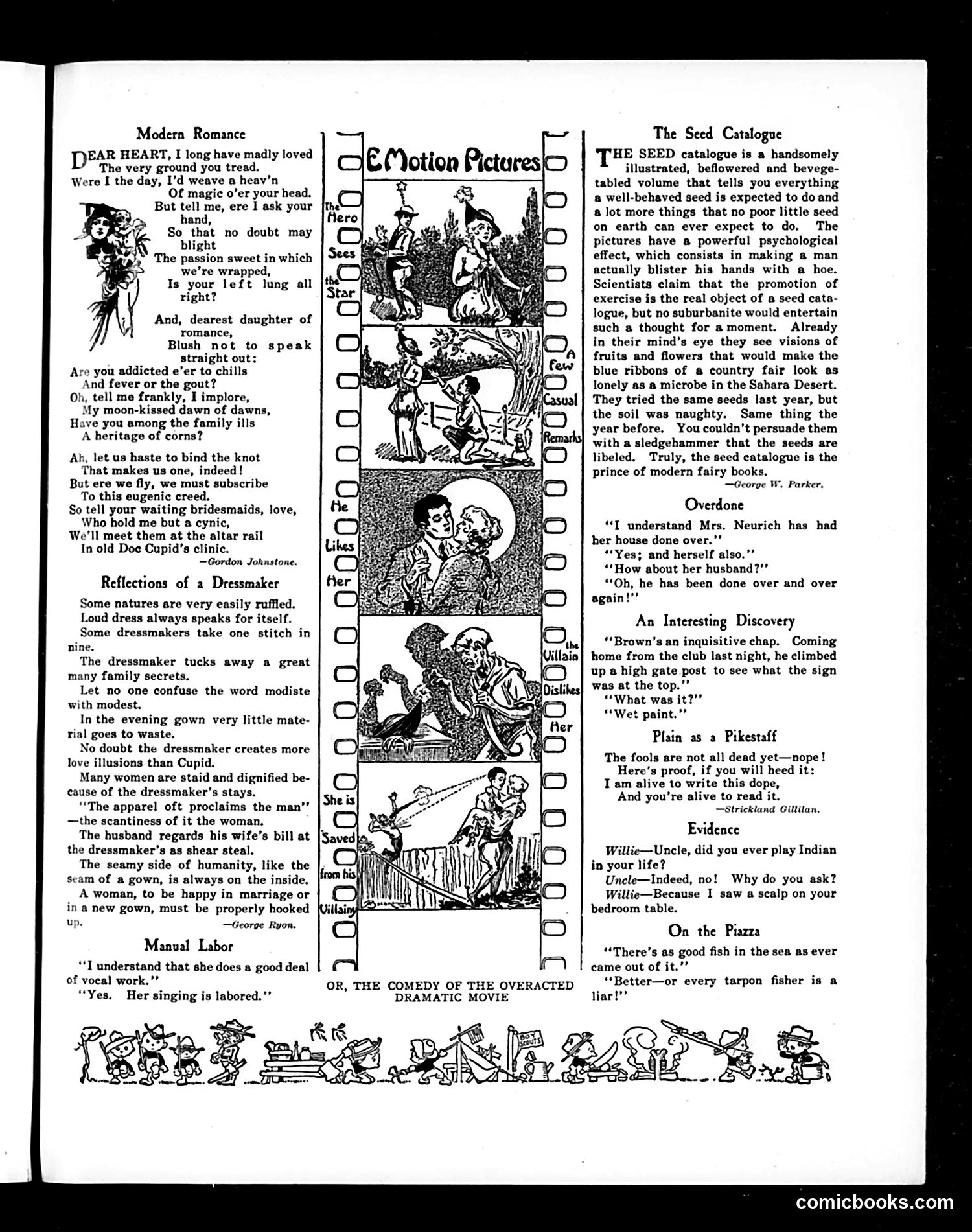
This page contains several satirical pieces mocking early-20th-century social trends: **"Modern Romance"** parodies the emerging eugenics movement by depicting a suitor who replaces romantic poetry with medical interrogations about hereditary diseases, lung capacity, and family ailments before proposing marriage. The joke: modern "scientific" courtship has replaced passion with clinical evaluation—he compares it to "Doe Cupid's clinic." **"Reflections of a Dressmaker"** offers witty observations on women's fashion and marriage, sarcastically noting that dressmakers create more "love illusions than Cupid" and that husbands view tailoring bills as "shear steal" (pun on "sheer"). **"The Seed Catalogue"** humorously describes how seed catalog pictures psychologically manipulate suburban men into exhausting gardening labor, despite repeated annual failures—the catalogues are "fairy books" selling false hope. The remaining brief items are light humor about overwork, social pretense, and wordplay. The central theme: satirizing how modern life (eugenics science, consumer culture, suburban aspiration) has corrupted traditional romance and simple living.
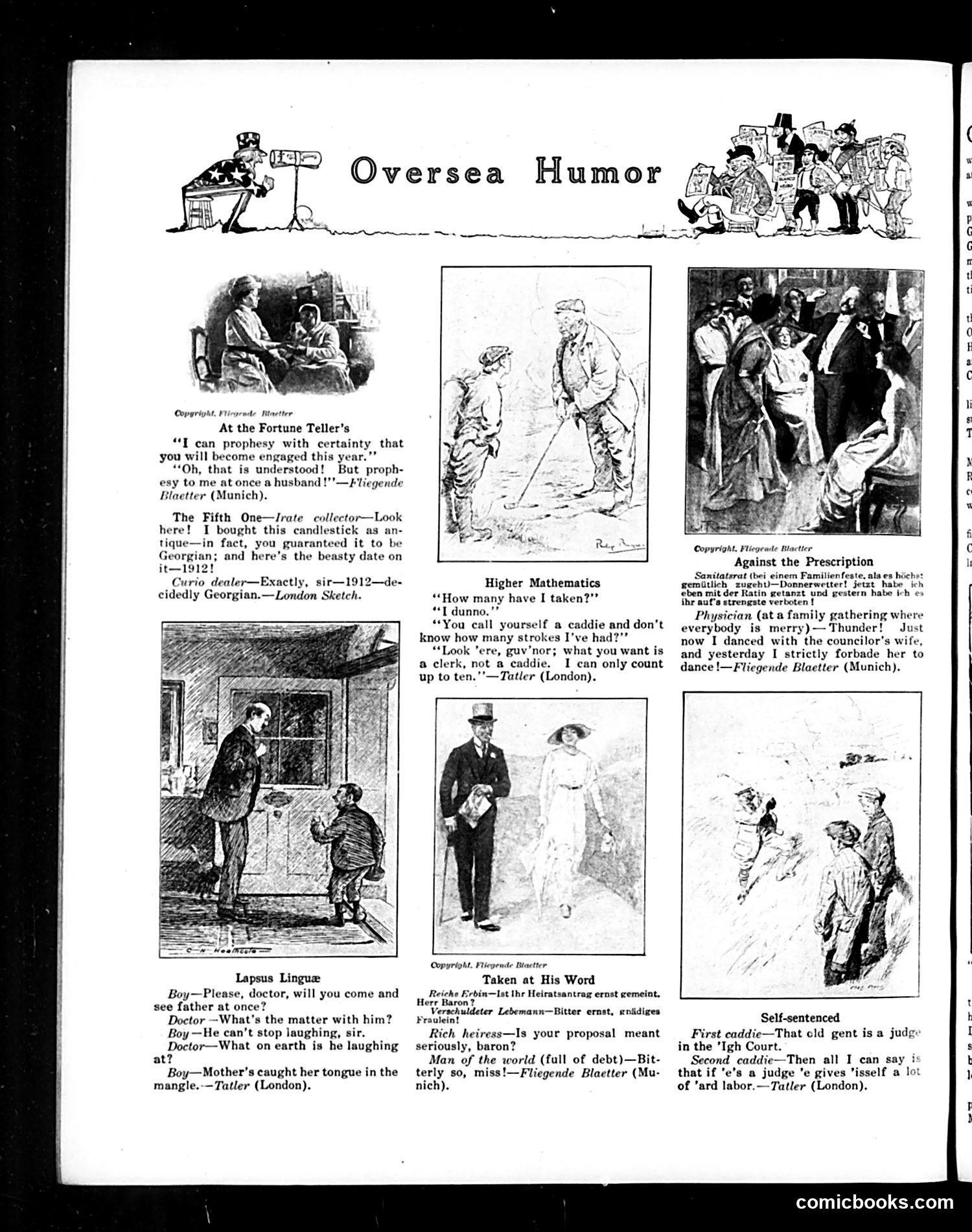
This page collects humorous anecdotes from European publications (primarily *Fliegende Blätter* from Munich and *Tatler* from London), translated for American readers of *Judge* magazine. The jokes target recognizable social types and situations: - **"At the Fortune Teller's"**: A woman seeking marriage prospects, satirizing women's preoccupation with matrimony. - **"The Fifth One"**: Mocks antique dealers' dishonesty—selling modern items (1912) as Georgian antiques. - **"Lapsus Linguae"**: Dark humor about a man laughing at his wife's accident (tongue caught in mangle), satirizing marital discord. - **"Higher Mathematics"**: A golf caddie who can only count to ten—satire of working-class limited education. - **"Taken at His Word"**: A debt-ridden nobleman seriously proposes to a rich heiress purely for money; satire of mercenary aristocracy. - **"Against the Prescription"**: A physician caught violating his own medical orders, satirizing professional hypocrisy. - **"Self-sentenced"**: A judge working as a caddie; satire suggesting judicial labor is punishment. These are gentle, class-conscious European satires reflecting early 20th-century social anxieties.
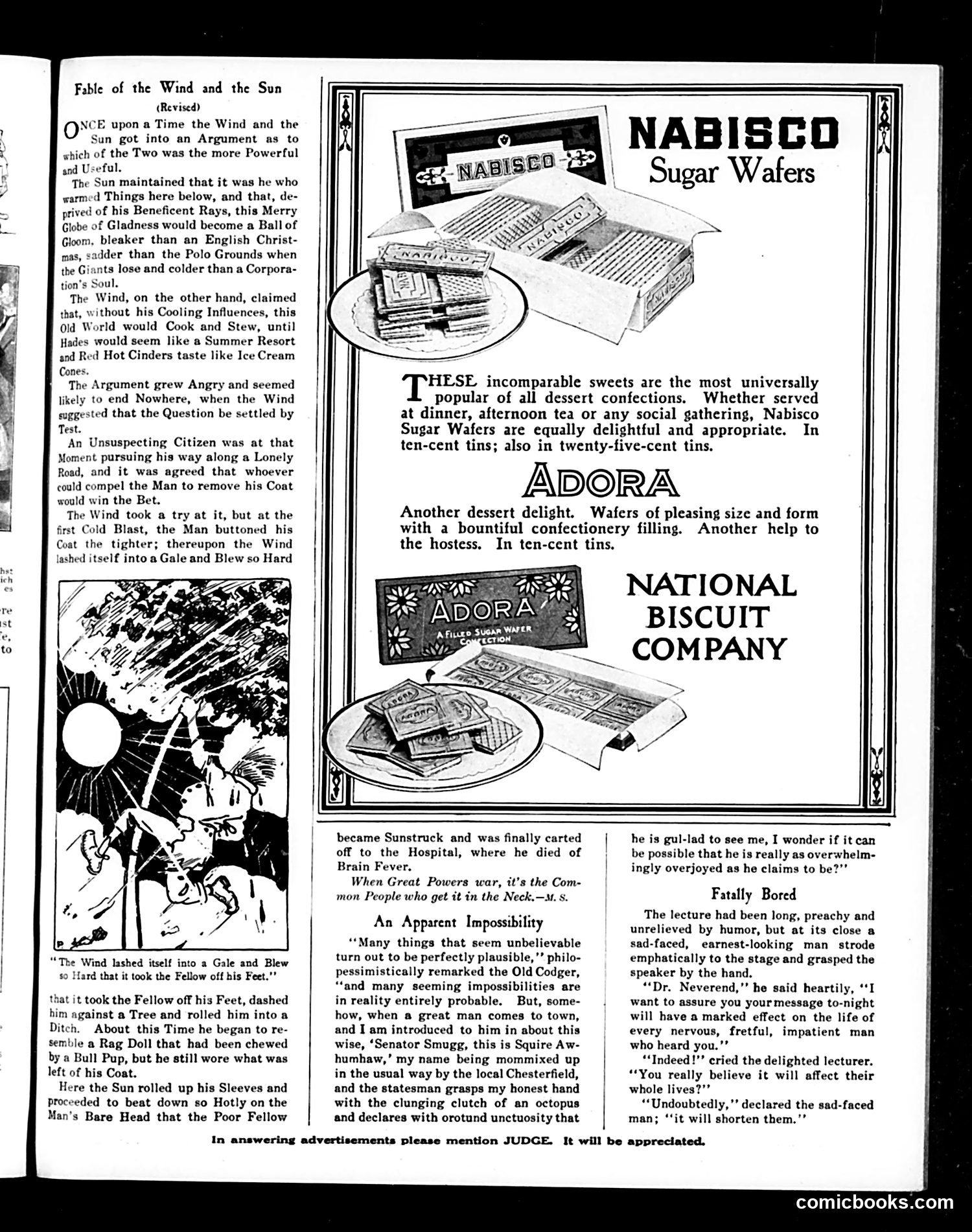
This page contains a satirical fable and humorous anecdotes alongside advertising. The main cartoon is a revised version of Aesop's "Wind and the Sun," where both forces compete to remove a man's coat. The twist: the Wind fails violently, and the Sun succeeds—but kills him via heatstroke. The moral ("When Great Powers war, it's the Common People who get it in the Neck") is a cynical commentary on international conflict and imperialism, suggesting that ordinary citizens suffer when powerful nations clash. Below are two brief humorous pieces: "An Apparent Impossibility" mocks the insincere flattery politicians offer constituents, and "Fatally Bored" is a dark joke where a listener claims a tedious lecture will "shorten" people's lives—meaning they'll die from boredom. The page also advertises Nabisco Sugar Wafers and Adora biscuits, typical early-20th-century confectionery products marketed to hostesses.
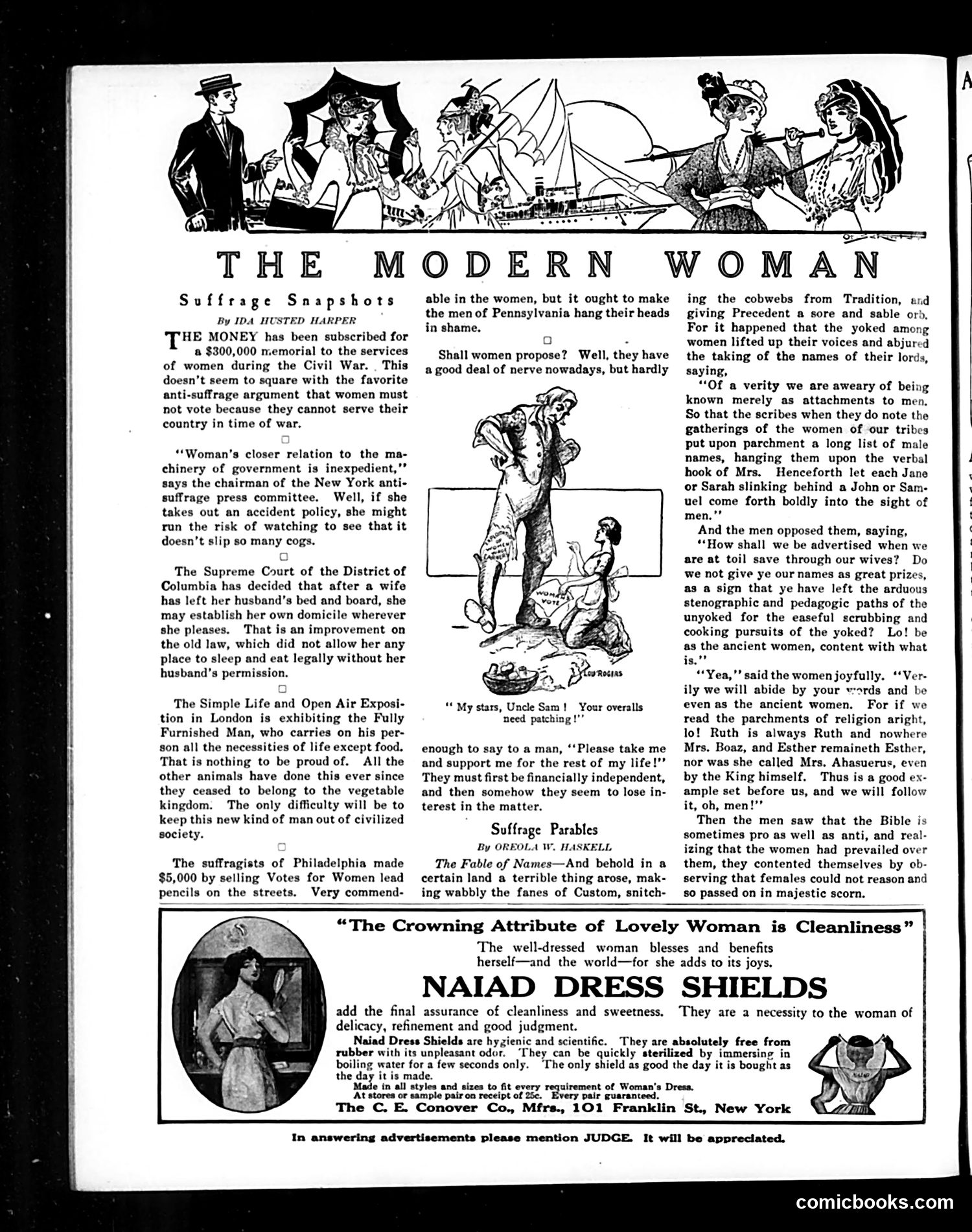
This page satirizes **anti-suffrage arguments** against women's voting rights. "Suffrage Snapshots" by Ida Husted Harper uses irony to expose the hypocrisy of opponents: - Women raised $300,000 for a Civil War memorial, yet anti-suffragists claim women cannot "serve their country" - A wife cannot legally establish her own residence without her husband's permission, yet anti-suffragists worry about women's "inexpedience" in government - Philadelphia suffragists earned $5,000 selling "Votes for Women" pencils, shaming men who oppose women's rights The "Fable of Names" parody shows women claiming their own identities rather than being identified solely as wives (Mrs. + Husband's Name). Men oppose this, but women cite Biblical examples (Ruth, Esther) who kept their own names—turning men's own religious texts against their arguments. The page mocks anti-suffrage reasoning as logically inconsistent, suggesting women already demonstrate capability and deserve political voice.
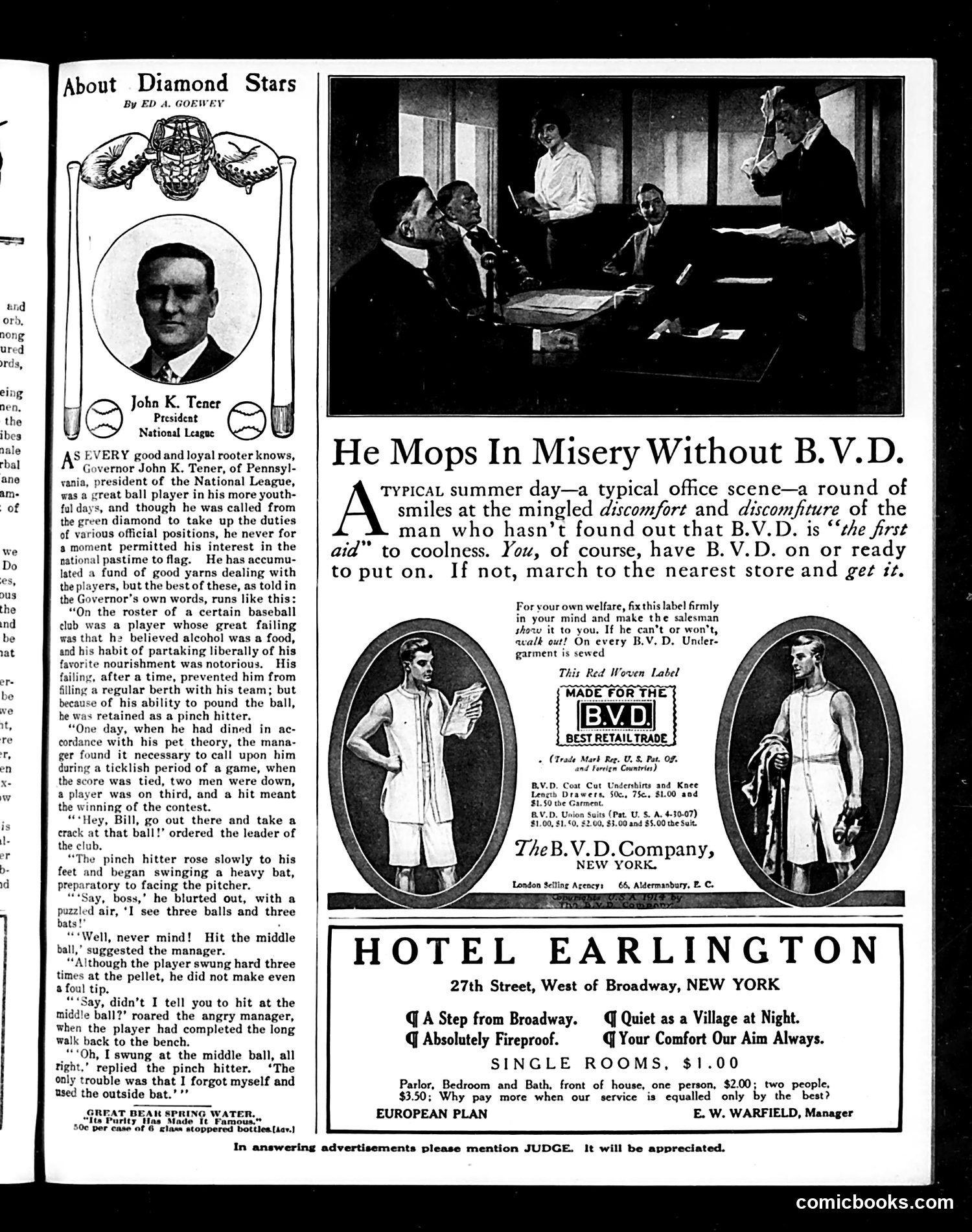
This page contains two distinct elements: **Left side:** An anecdote about John K. Tener, president of baseball's National League, recounting a humorous story about a drunk pinch hitter so intoxicated he sees three bats instead of one. When instructed to hit the middle ball, the player swings at the middle *bat* instead, missing entirely. The joke plays on the player's alcohol-impaired perception and logic. **Right side:** Primarily advertising for B.V.D. brand underwear, using a satirical office scene showing a disheveled, uncomfortable man without proper undergarments amid colleagues. The ad suggests that B.V.D. underwear is essential for summer comfort and dignity. A smaller inset shows the product's distinctive red woven label as proof of authenticity. The page also includes hotel and water advertisements. The humor relies on period assumptions about masculinity, propriety, and product necessity that modern readers would recognize as dated marketing rather than legitimate practical advice.
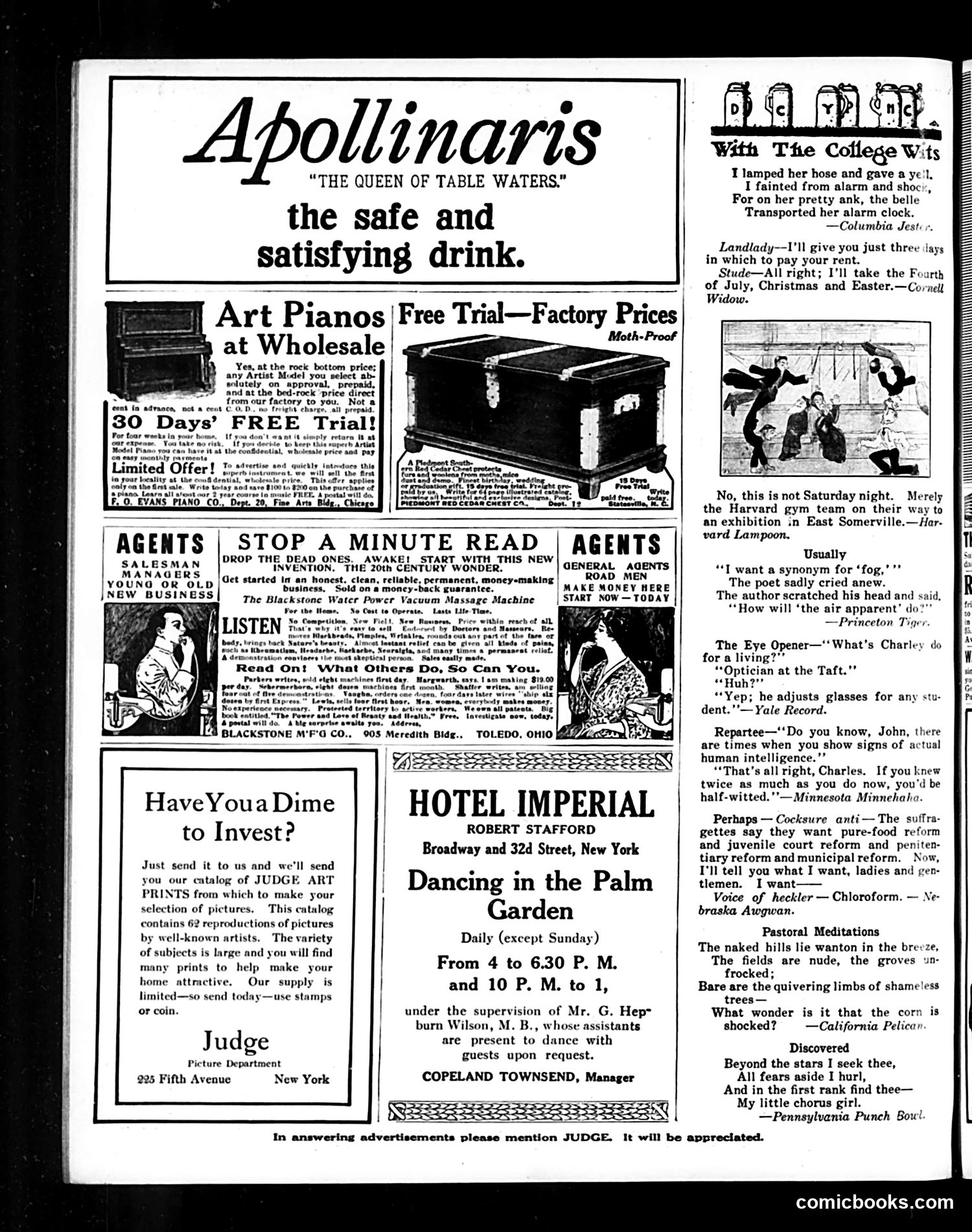
This is primarily an **advertising page** with minimal editorial content. The page features various product advertisements (pianos, water, massage machines, hotel services) interspersed with brief college humor pieces in the right column. The humor section—"With The College Wits"—contains **jokes from university publications** (Columbia, Cornell, Harvard, Yale, Princeton, Minnesota). These are gentle, non-political quips about student life: a landlord demanding rent, an optician making glasses jokes, and romantic musings about chorus girls. The only item approaching satire is "Perhaps—Cocksure anti," which mocks suffragettes by claiming they want various reforms but the author "wants chloroform"—a crude jab suggesting their advocacy is tiresome rather than substantive political commentary. Overall, this reflects Judge's shift toward **commercial content over satirical cartooning** by this era, with college humor serving as filler material.
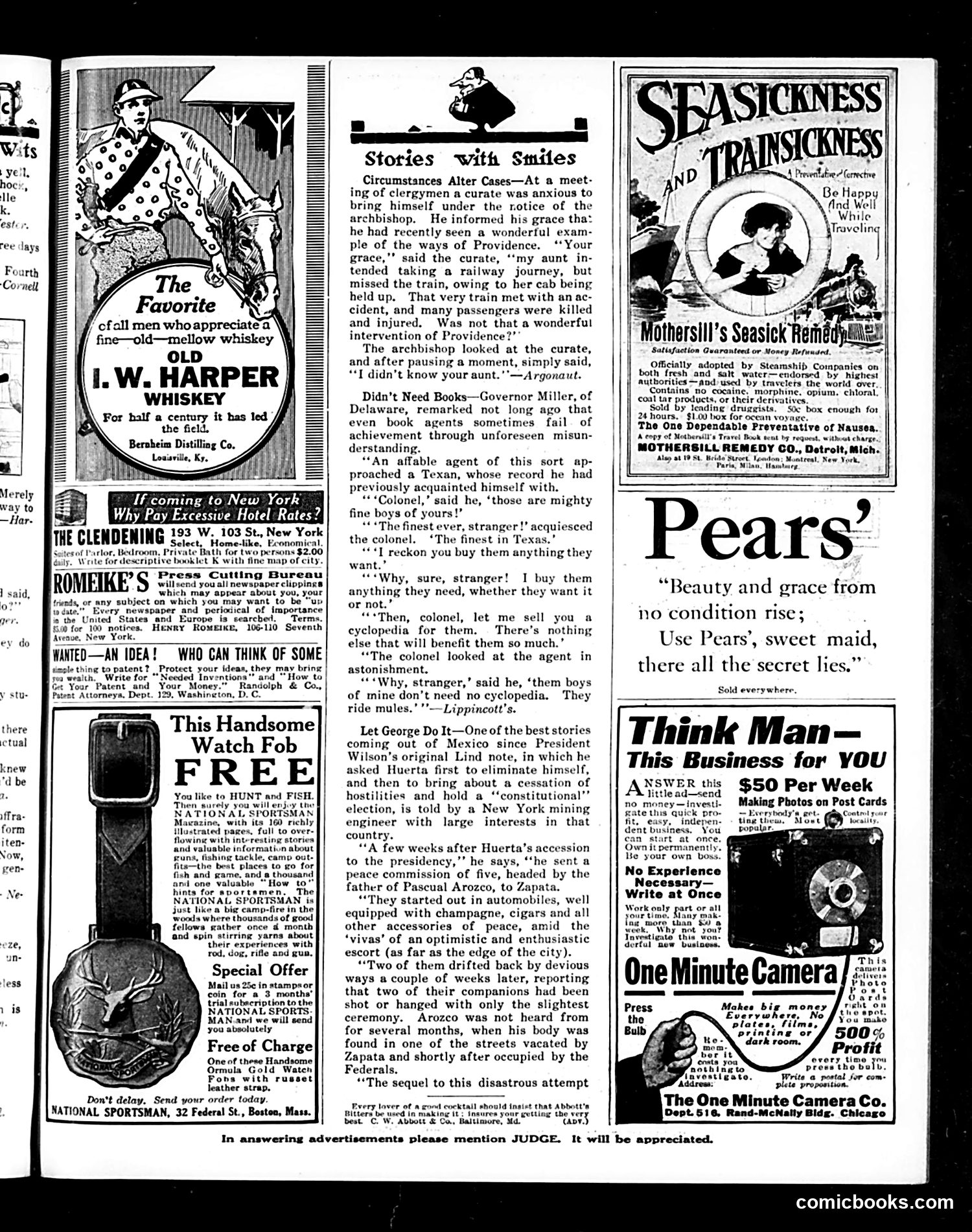
This page from Judge (a satirical magazine) is primarily **advertising with embedded humor pieces**, rather than political cartoons. The main content includes: **"Stories with Smiles"** section features three anecdotes mocking human nature: - A clergyman's pompous attempt to impress an archbishop backfires - A book agent fails to sell encyclopedias to a Texan who dismisses them as unnecessary for men who "ride mules" - A story about Mexican President Huerta's peace commission (likely referencing the Mexican Revolution era) that devolves into hedonism The humor relies on irony and class commentary—educated pretension meeting frontier pragmatism, and corruption undermining diplomatic efforts. The page is dominated by product advertisements (I.W. Harper Whiskey, Mothersill's Seasick Remedy, Pears' Soap, One Minute Camera, etc.), typical of Judge's commercial model. **No identifiable political figures are caricatured** in the illustrations shown; the cartoons are generic character types supporting the humorous anecdotes rather than topical satire.
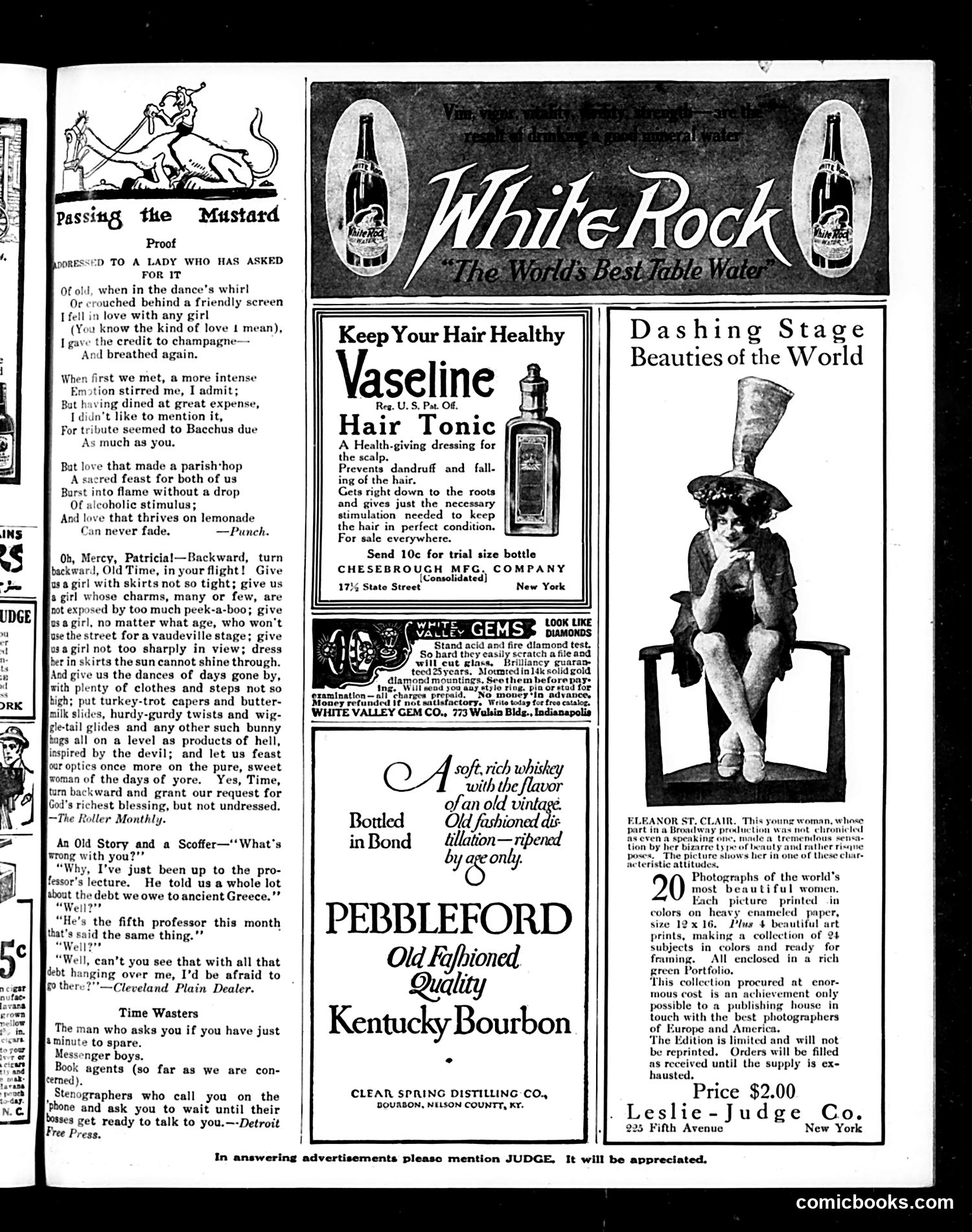
This page is primarily **advertising with satirical text pieces**, not political cartoons requiring historical context. The main content includes: **"Passing the Mustard"** — A humorous poem (attributed to *Punch*) about romantic love, contrasting old-fashioned courtship with modern dance-hall culture. The satire mocks both excessive drinking as an excuse for emotions and the tight, revealing clothing and provocative dancing styles of the era (turkey-trot, etc.), appealing to nostalgia for "days of yore." **Other humor pieces** include light jokes about professors repeating lectures and people who waste time. **The advertisements** are period products: Vaseline Hair Tonic, "White Valley Gems" (imitation diamonds), Pebbleford Kentucky Bourbon whiskey, White Rock table water, and a photo collection of "Stage Beauties of the World" featuring actress Eleanor St. Clair. The page reflects early 20th-century anxieties about modern dancing, women's fashion, and changing social mores—typical Judge magazine fare blending humor with commercial promotion.
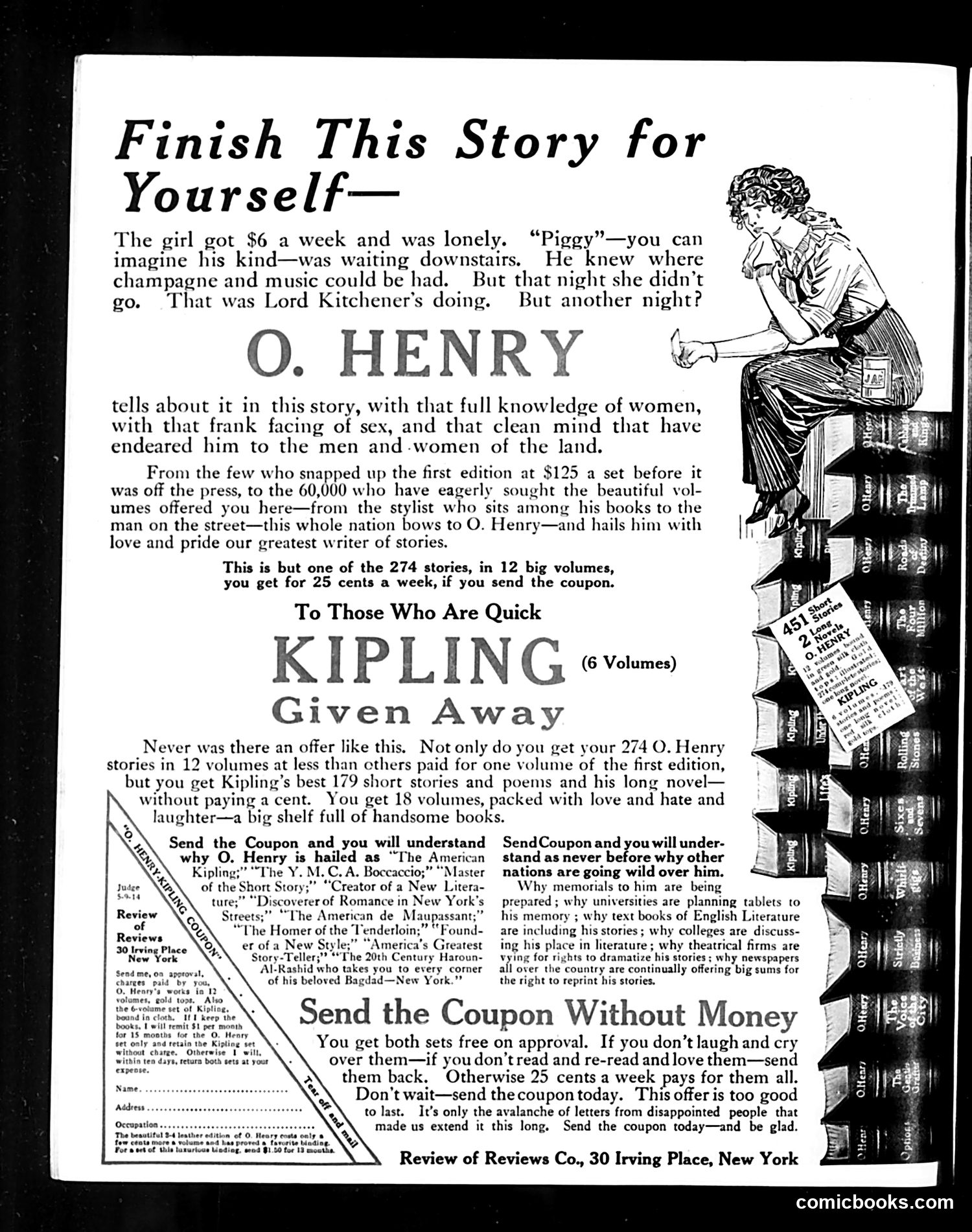
This page is primarily a **book advertisement**, not a political cartoon. It promotes subscription sets of O. Henry and Rudyard Kipling stories through the Review of Reviews Company. The brief story teaser at top references **Lord Kitchener** (British military leader during WWI era), suggesting a young working woman must choose between a night out with "Piggy" or remaining virtuous—implying Kitchener's patriotic call to duty influences her morals. This appears designed to sell O. Henry as a writer who understands modern sexual and social tensions with "frank facing of sex." The Kipling section notes international admiration for him, hinting at his global literary fame and cultural influence. The satire is minimal and indirect—mostly the ad's breathless hyperbole about these authors' greatness and the subscription offer's supposed generosity ("free on approval," etc.) to encourage impulse coupon-sending. The real pitch: get 18 volumes for 25 cents weekly.
I can see this is a page from *Judge* magazine, but the image is almost entirely black with only a visible margin stripe on the left side showing what appears to be publication information or indexing marks. The main content area is too dark to discern any cartoon illustrations, caricatures, text, or satirical content. To provide accurate historical context about the cartoon(s), political figures, social references, and satirical intent, I would need a clearer, higher-contrast version of this page where the actual artwork and text are legible. I cannot reliably identify specific figures, references, or the point of the satire without being able to see the actual content.