
Judge, 1914-05-09 · page 4 of 25
Judge — May 9, 1914 — page 4: what you’re looking at
What you’re looking at
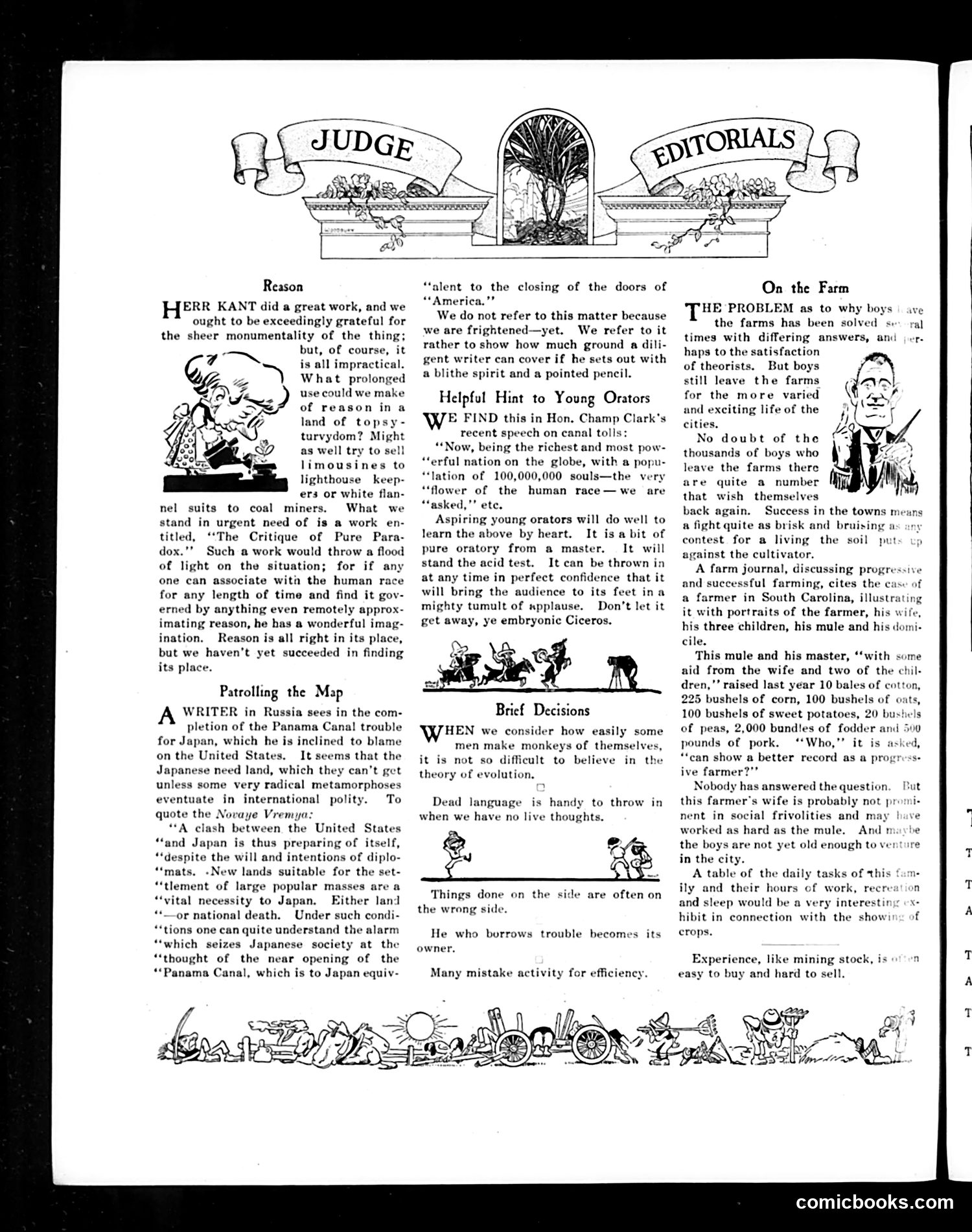
This page contains four editorial pieces rather than political cartoons. The "Judge" section praises Immanuel Kant's philosophical work on reason. "Editorials" discusses why farm boys leave rural life for cities, noting the "varied and exciting life" appeals more than agricultural labor. "Patrolling the Map" satirizes a Russian writer's analysis of the Panama Canal, suggesting Japan should bear blame rather than the United States—likely referencing contemporary imperial tensions and American canal interests. "Brief Decisions" offers aphoristic observations: dead language is useless without live thoughts; borrowed trouble becomes the owner's problem; and mistaking activity for efficiency represents a common error. The illustrations are small decorative vignettes rather than political caricatures.
📄 Transcribed text from this page (OCR, searchable)
Machine-transcribed from the original scan — historical spelling and the odd misread are preserved.
ERR KANT did a great work, and we ought to be exceedingly grateful for the sheer monumentality of the thing; but, of course, it is all impractical. What prolonged use could we make of reason ina land of topsy- turvydom? Might as well try to sell limousines to lighthouse keep- ers or white flan- nel suits to coal miners. What we stand in urgent need of is a work en- titled, “The Critique of Pure Para- dox.’’ Such a work would throw a flood of light on the situation; for if any one can associate wita the human race for any length of time and find it gov- erned by anything even remotely approx- imating reason, he has a wonderful imag- ination. Reason is all right in its place, but we haven't yet succeeded in finding its place. aN Patrolling the Map A WRITER in Russia sees in the com- pletion of the Panama Canal! trouble for Japan, which he is inclined to blame on the United States. It seems that the anese need land, which they can’t get ss some very radical metamorphoses eventuate in international polity To quote the Novaye Vremya: “A clash between the United States “and Japan is thus preparing of itself, “despite the will and intentions of diplo- “mats. -New lands suitable for the set- “tlement of large popular masses are a “vital necessity to Japan. Either land or national death. Under such condi- tions one can quite understand the alarm which zes Japanese society at the “thought of the near opening of the “Panama Canal, which is to Japan equiv- “alent to the closing of the doors of “*America.’” We do not refer to this matter because we are frightened—yet. We refer to it rather to show how much ground a dili- gent writer can cover if he sets out with a blithe spirit and a pointed pencil. Helpful Hint to Young Orators WE FIND this in Hon. Champ Clark's recent speech on canal tolls: Yow, being the richest and most pow- “erful nation on the globe, with a popu- “lation of 100,000,000 souls—the very “flow of the human race—we are d,”’ ete, spiring young orators will do well to learn the above by heart. It is a bit of pure oratory from a master. It will stand the acid test. It can be thrown in at any time in perfect confidence that it will bring the audience to its feet ina mighty tumult of xpplause. Don’t let it get away, ye embryonic Ciceros. Brief Decisions HEN we consider how easily men make monkeys of themsel it is not so difficult to believe in theory of evolution, ome Dead language is handy to throw in when we have no live thoughts. 2 Things done on the side are often on the wrong side. He who burrows trouble becomes its owner, Many mistake activity for efficiency. On the Farm HE PROBLEM as to why boys | ay the farms has been solved se ral times with differing answers, and | er. haps to the satisfaction of theorists. But boys still leave the farms for the more varied and exciting life of the cities. No doubt of the thousands of boys who leave the farms there are quite a number that wish themselv back again. Succe: the towns meuns a fight quite as brisk and bruising a contest for a living the soil put against the cultivator. A farm journal, discussing progres and successful farming, cites the case of a farmer in South Carolina, illustrating it with portraits of the farmer, his wife, his three children, his mule and his domi- cile. This mule and his master, ‘‘with some aid from the wife and two of the chil- dren,’ raised last year 10 bales of cotton, 225 bushels of corn, 100 bushels of oats, 100 bushels of sweet potatoes, 20 bushels of peas, 2,000 bundles of fodder pounds of pork. ‘Who,’ it is an show a better record as a pre farmer?’ Nobody has answered the question. But this farmer's wife is probably not promi- worked as hard as the mule. And the boys are not yet old enough to ver in the city A table of the daily tasks of this ily and their hours of work, recre and sleep would be a very interestin hibit in connection with the showi crops. Experience, like mining stock, is y to buy and hard to sell. comicbooks.com