
A complete issue · 24 pages · 1914
Judge — February 28, 1914
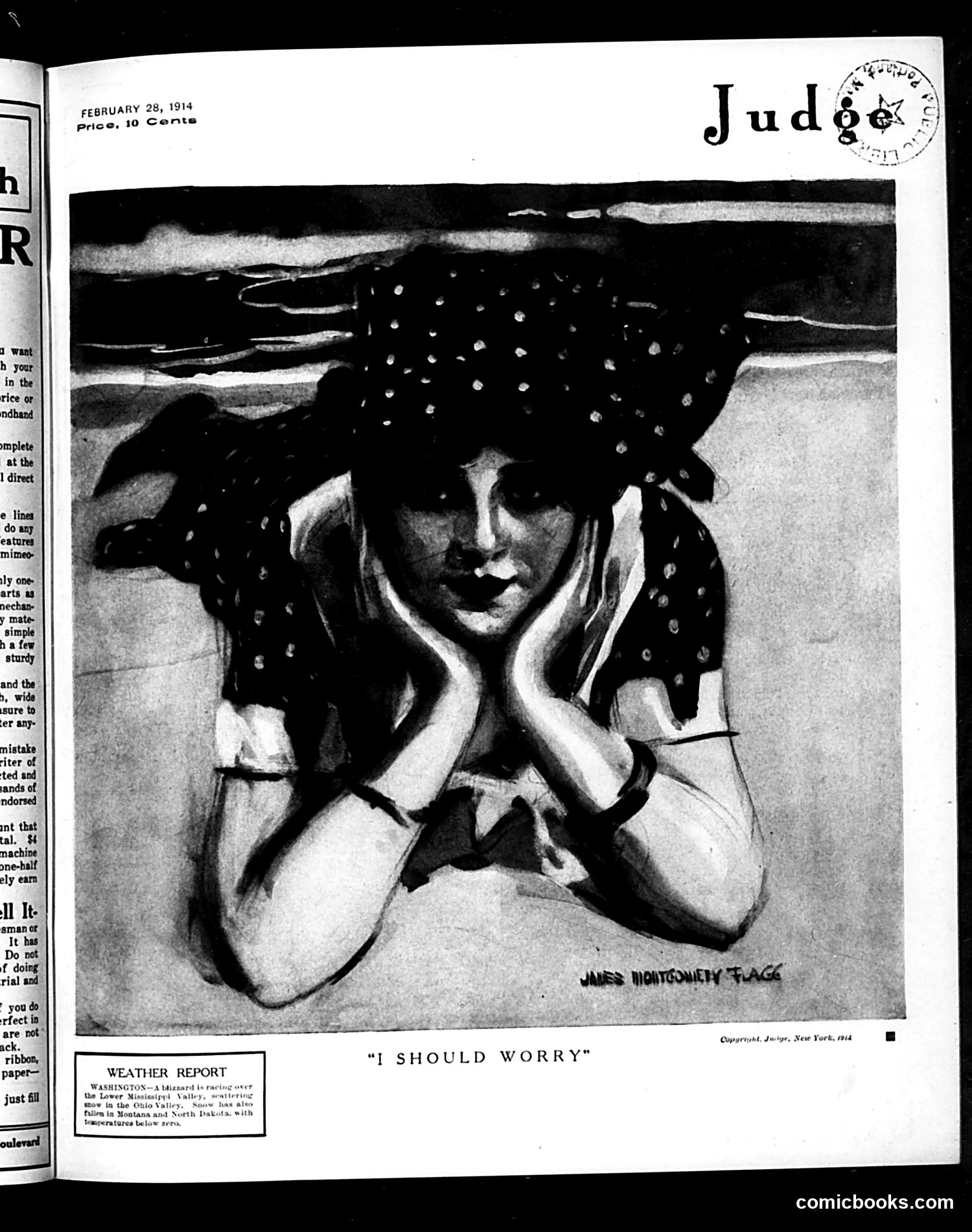
This Judge magazine page from February 28, 1914 features an illustration credited to James Montgomery Flagg showing a worried woman with her head in her hands, wearing a polka-dotted bonnet. The caption "I Should Worry" appears ironic—suggesting the figure *shouldn't* worry despite her anxious pose. The accompanying "Weather Report" box mentions a blizzard crossing the Lower Mississippi Valley with snow in the Ohio Valley and cold temperatures below zero, indicating the cartoon likely comments on winter weather concerns or economic/social anxiety of the period. Without additional context from the magazine's editorial content, the specific satirical target remains unclear, though it likely references contemporary public worries about weather, economics, or other 1914 concerns.
This page is primarily **advertising and masthead material** rather than satirical content. The left side features an advertisement for the "Studio of Pictorial Art" recruiting aspiring illustrators, emphasizing that "good artists are in demand everywhere and earn big pay." It promotes training under "some of the most noted illustrators in America" with international reputations. The right side displays Judge's masthead, contents page, and subscription information. A brief note at the bottom references a recent "tremor felt in the Eastern States" caused not by earthquake but by Judge's forthcoming **Paris Edition** — a self-promotional joke suggesting their publication's importance merits such excitement. The page contains no significant political satire or cartoon analysis.
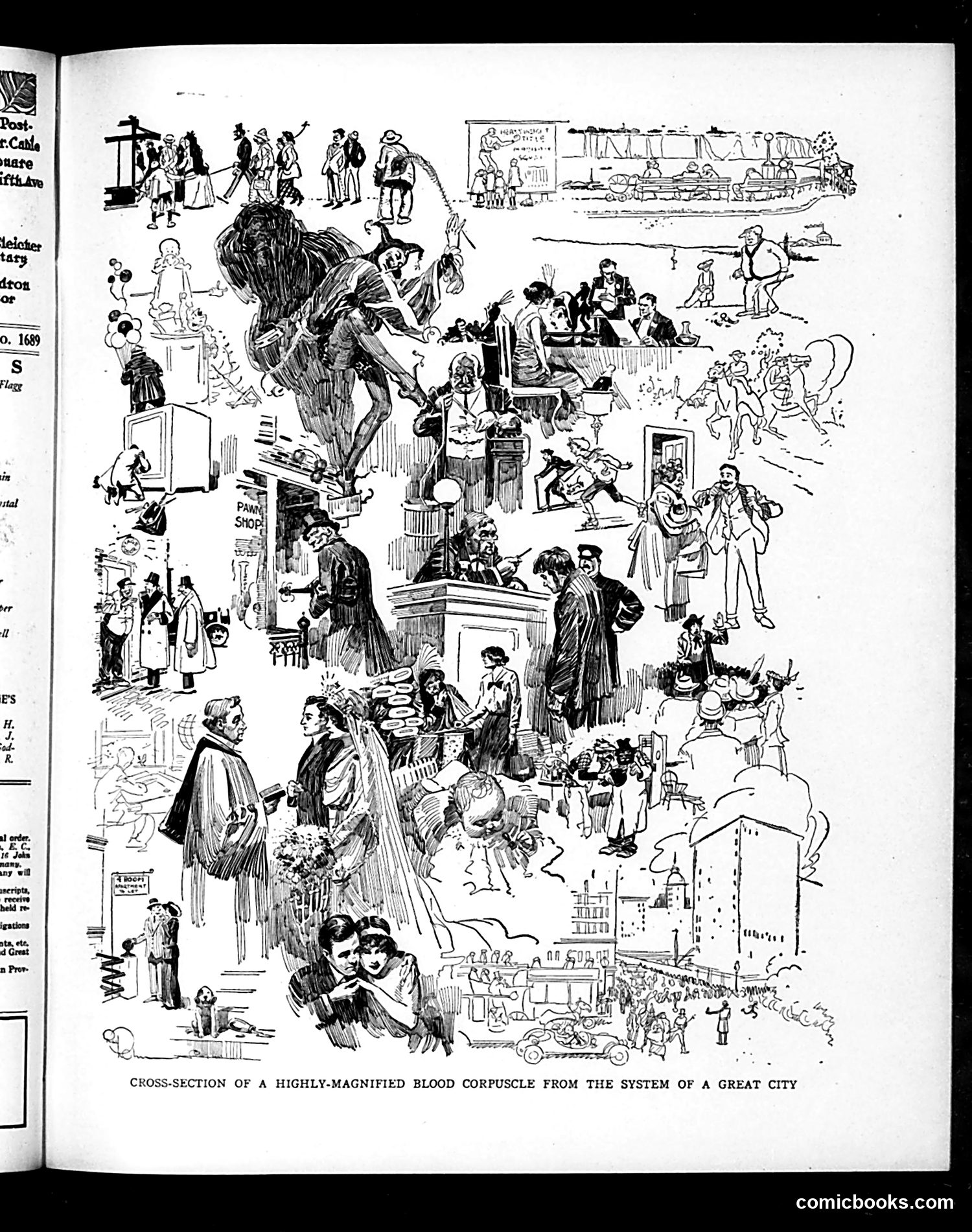
This illustration uses a medical metaphor to critique urban life in a major American city. The caption "Cross-Section of a Highly-Magnified Blood Corpuscle from the System of a Great City" presents the city as a living organism, with various social elements depicted as cellular components. The cartoon satirizes the chaotic complexity of urban existence: we see crowds, transportation (trains, carriages), commerce, entertainment, social classes mixing, and various human activities packed densely together. The "blood corpuscle" metaphor suggests the city's circulatory system—how people, goods, and money flow through it. The satire appears to mock both the overcrowding and the pretension of viewing urban life through pseudo-scientific analysis, likely critiquing Gilded Age city growth and its social consequences.
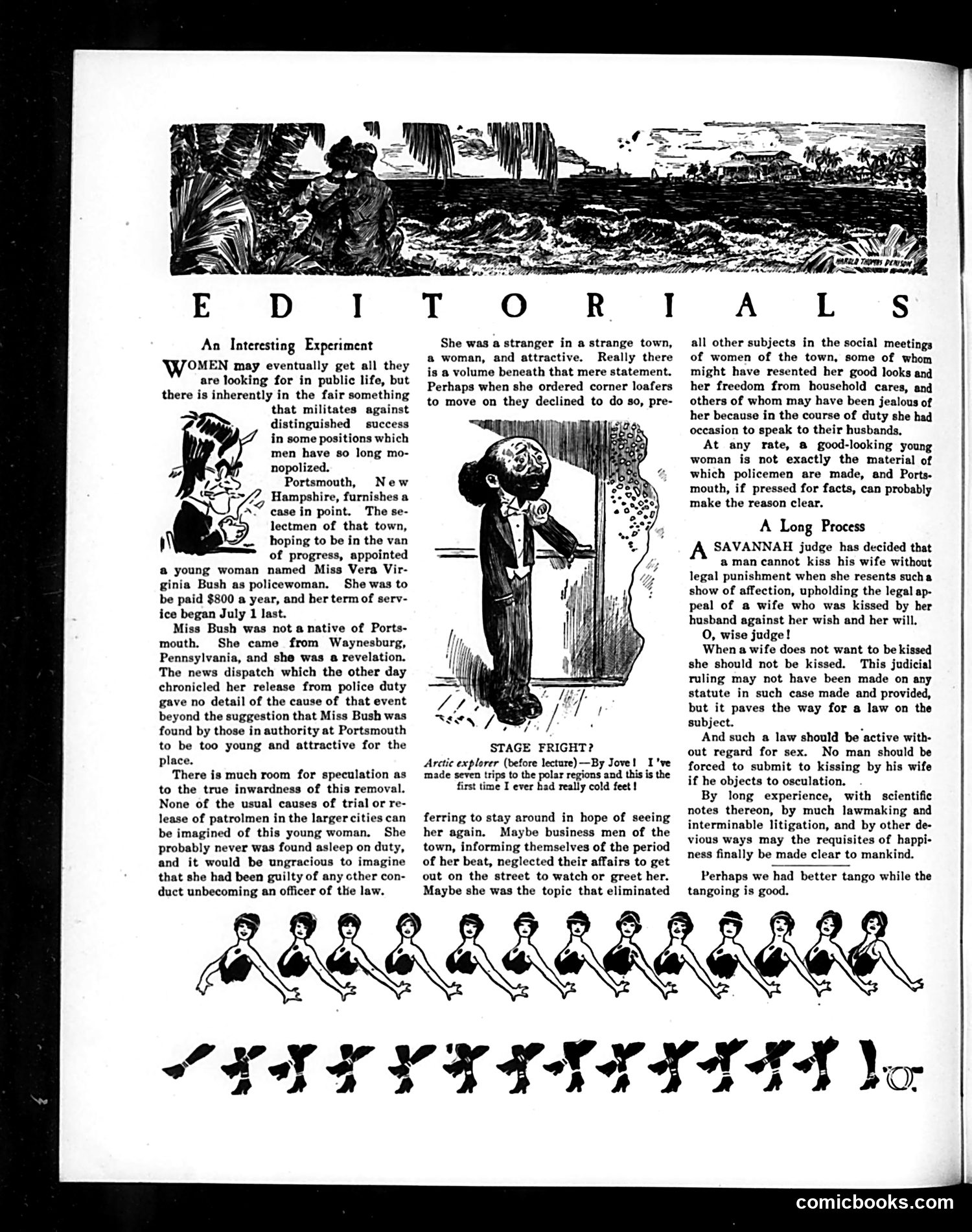
This editorials page contains three distinct pieces: 1. **"An Interesting Experiment"**: Satirizes the hiring of Miss Vera Virden as a young woman employee in Portsmouth, New Hampshire at $800/year. The piece questions whether women can succeed in "positions which men have so long monopolized," suggesting skepticism about female professional advancement. 2. **"Stage Fright?"**: A humorous anecdote about Arctic exploration, using cold as a setup for a punchline. 3. **"A Long Process"**: Critiques a Savannah judge's ruling that husbands cannot kiss wives without consent. The satire argues this demonstrates how slowly legal progress occurs regarding women's rights and marital autonomy—mockingly suggesting tangos would be preferable to such litigation. The decorative footer shows women dancing in chorus-line formation, reinforcing the era's gender commentary.
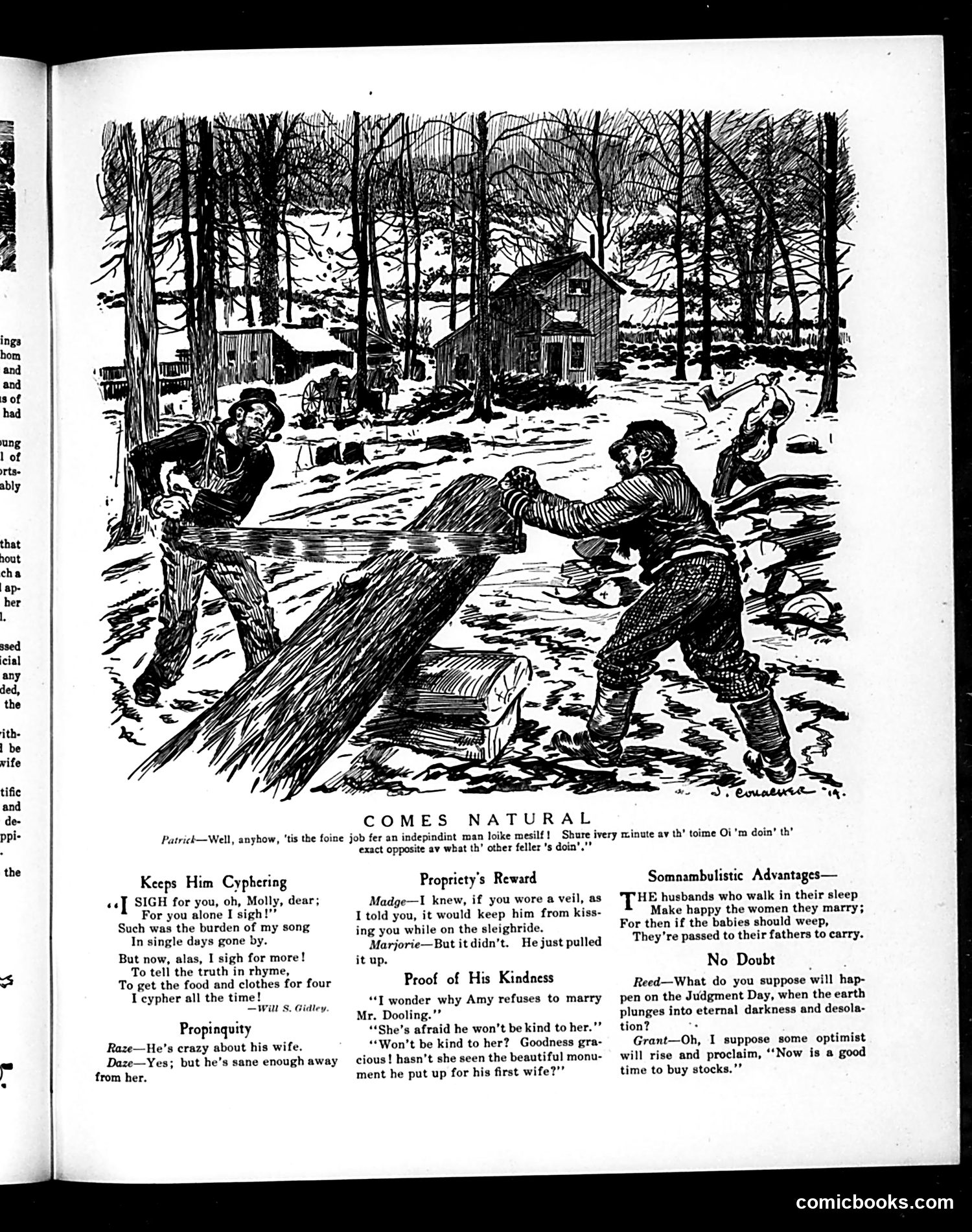
The main cartoon depicts men sawing logs in a snowy forest clearing—manual labor typical of frontier or rural work. The caption "COMES NATURAL" and subtitle suggest this illustrates how independent work suits certain men naturally, contrasting with dependent domesticity. Below are brief satirical dialogues mocking marital dynamics: - **"Keeps Him Cyphering"**: A wife burdens her husband with financial obligations - **"Propriquity"**: A man is "crazy" about his wife but stays sane by keeping distance - **"Proof of His Kindness"**: Humor about reluctant marriage and monuments to wives - **"Somnambulistic Advantages"**: Jokes about sleepwalking husbands avoiding crying babies - **"No Doubt"**: Cynicism about optimism and marriage timing The page satirizes contemporary tensions between masculine independence and domestic obligations, presenting wives as financial and emotional burdens on men.
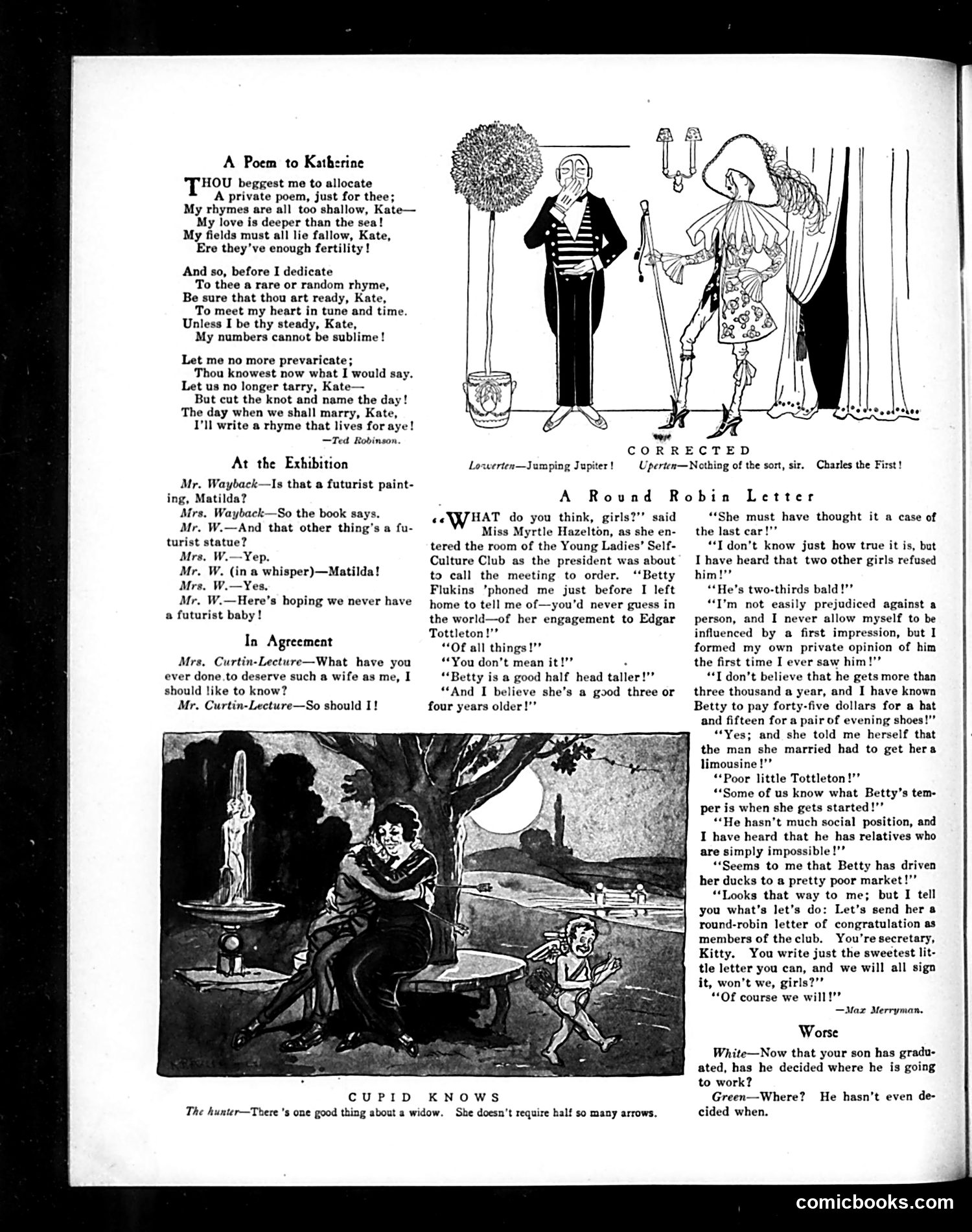
This *Judge* page contains three satirical pieces mocking early 20th-century social conventions: **"At the Exhibition"** ridicules "Futurist" art (the avant-garde movement), with a couple worried they might have a "futurist baby"—implying the art style is so bizarre and incomprehensible it represents societal decay. **"A Round Robin Letter"** satirizes female social hypocrisy. Young ladies gossip viciously about their friend Betty's engagement to Edgar Tottleton, cataloging his flaws (bald, poor, low social status, difficult relatives). They then decide to send a congratulatory "round robin" letter—a collective letter they'll all sign—pretending warmth while concealing their contempt. The satire exposes the performative nature of women's club culture and their cattiness disguised as propriety. **"Worse"** is a brief joke about a graduate unable to decide *when* to work—laziness presented as worse than not knowing *where* to work. The page satirizes artistic pretension, female social artifice, and generational idleness common to *Judge*'s upper-middle-class readership concerns.
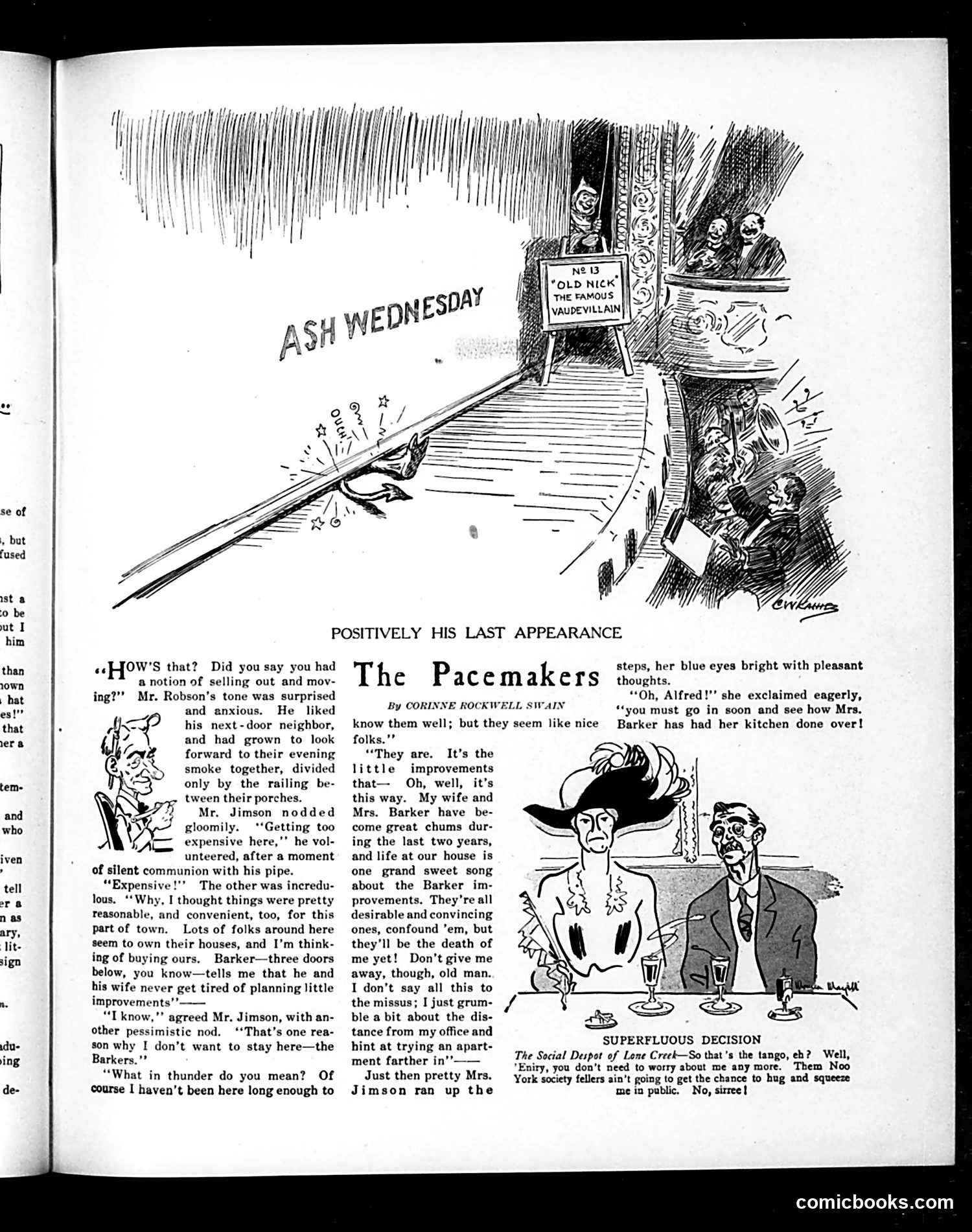
This page contains two distinct pieces satirizing American middle-class suburban life in the early 20th century. **"The Pacemakers"** (main story) depicts suburban competition and social pressure. Mr. Jimson wants to sell his house and move, citing expense—but admits the real reason: his wife has befriended Mrs. Barker, whose constant home improvements (kitchen renovations, etc.) set an impossible standard. The Barkers' improvements pressure Jimson into competitive home ownership and upgrading, threatening his financial comfort. The satire mocks how neighbors' ambitions can trap homeowners in cycles of costly "keeping up." **"Superfluous Decision"** (bottom cartoon) jokes about rural social anxieties. A country man announces he's quitting the tango to prevent "New York society fellers" from embracing him publicly—humorously exaggerating rural fears of urban sophistication and physical intimacy. Both pieces ridicule aspirational behavior: suburban consumerism-driven competitiveness in one, and defensive small-town anxiety about cosmopolitan influences in the other.
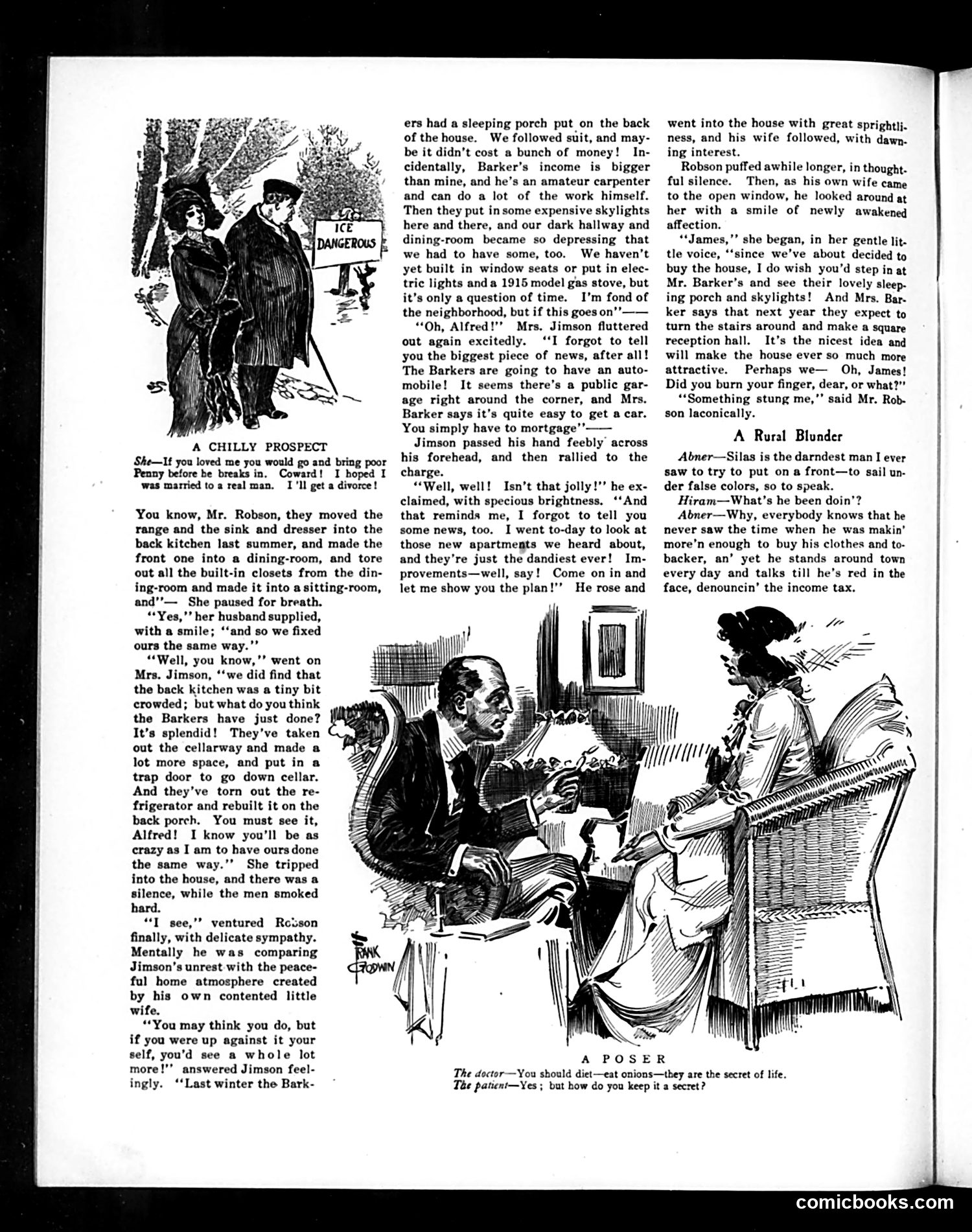
This page satirizes **keeping up with the Joneses**—the 1910s anxiety about social competition through home improvements. **"A Chilly Prospect"** depicts Mr. Jimson trapped in an exhausting cycle: the Barkers (wealthier neighbors) add a sleeping porch, so the Jimsons must too. The Barkers install skylights; the Jimsons follow suit despite financial strain. When Mrs. Barker announces plans for an automobile, Jimson desperately counters by promoting apartment living instead—a transparent deflection. The satire shows how Mr. Robson, observing this performance, gains perspective: when his own wife begins listing Barker improvements, he deflects with a feigned injury, suddenly appreciating his contented home. **"A Rural Blunder"** (bottom section) briefly mocks Silas for "putting on a front"—maintaining false pretenses about his status. The cartoon criticizes both consumer-driven status anxiety and the exhausting performance of middle-class respectability that forcing couples into debt and domestic friction. The humor lies in masculine pride collapsing under social pressure.
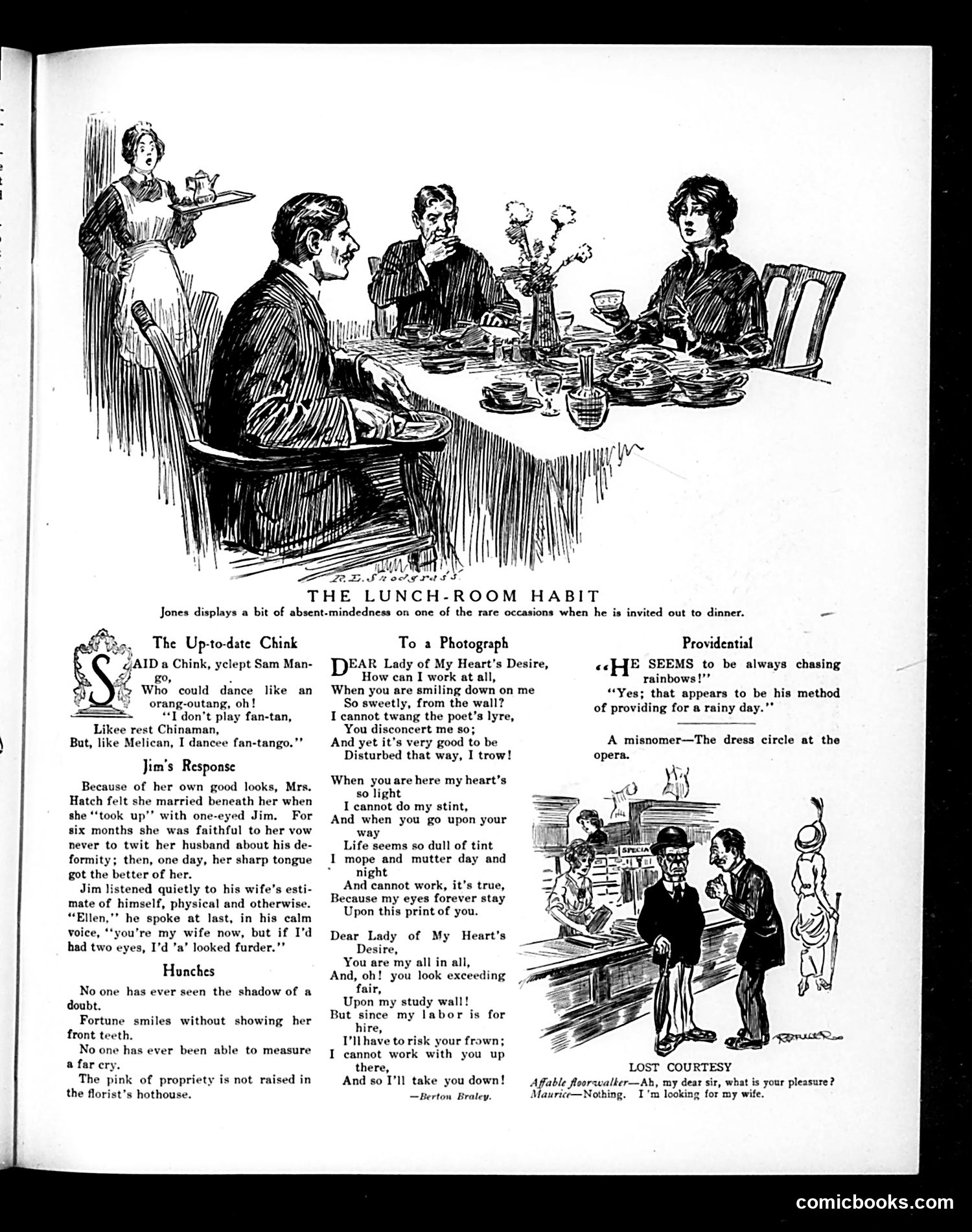
This page contains several unrelated humor pieces typical of early 20th-century Judge magazine. The main cartoon shows "Jones" absent-mindedly displaying poor dinner etiquette—likely fidgeting, distraction, or awkward behavior—when invited to dine out, satirizing social pretension and the anxiety of formal dining among middle-class Americans. The other pieces include: - **"The Up-to-date Chink"**: A dated ethnic stereotype featuring a Chinese character speaking broken English, reflecting the casual racism common in period publications - **"Jim's Response"**: A domestic humor piece about a one-eyed man's witty comeback to his critical wife - **Poetry and aphorisms** on romance, labor, and social observation The "Lost Courtesy" panel depicts a husband at a store counter searching for his wife—a common marital humor trope of the era. The satire targets middle-class social anxieties, domestic relations, and workplace interactions rather than specific political figures or events.
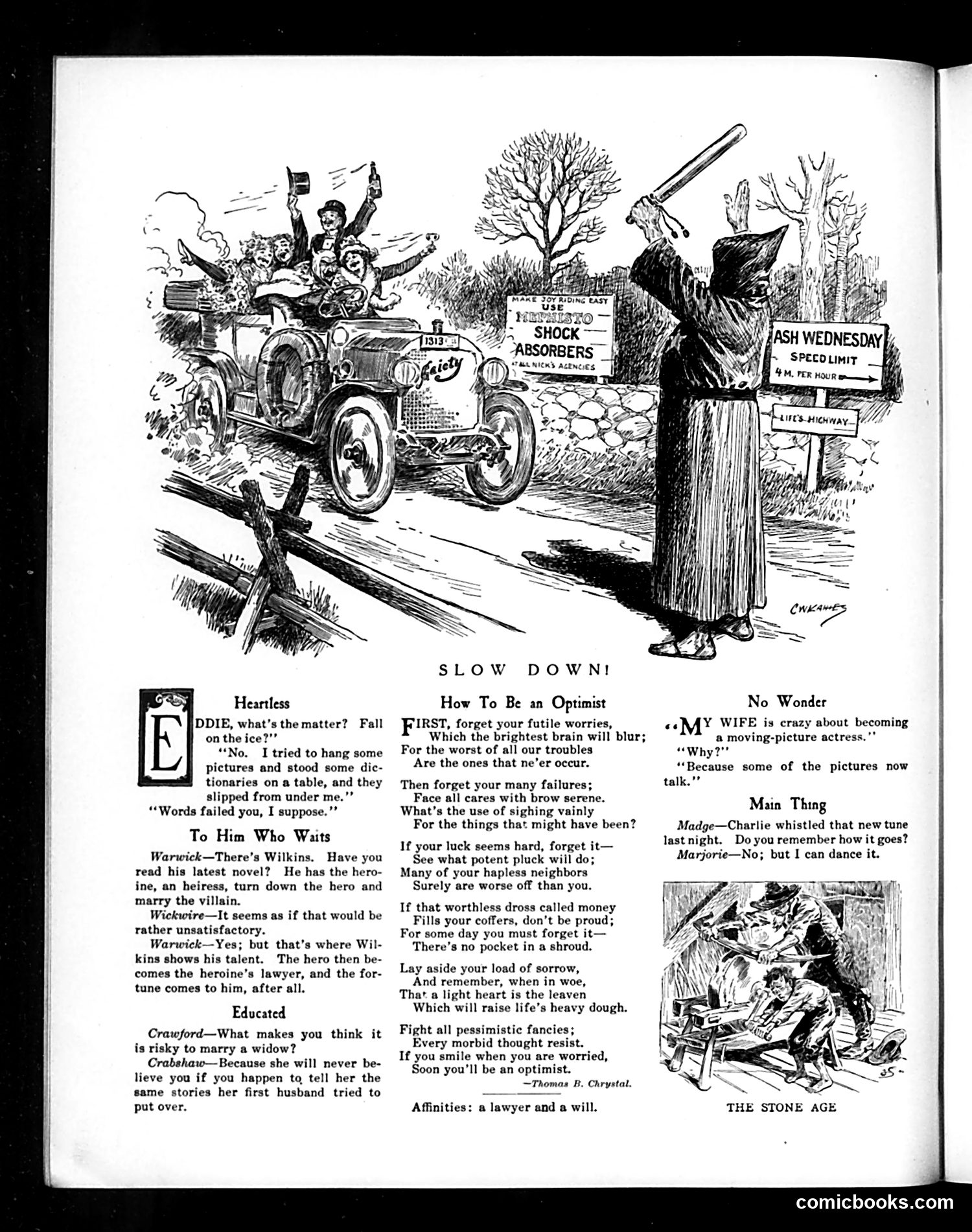
The main cartoon "SLOW DOWN!" depicts a reckless early automobile speeding past traffic signs and a reaper-like figure with a scythe, satirizing dangerous driving habits. The vehicle's occupants appear celebratory despite the hazard, contrasting with the grim warning imagery. The page contains several brief comic dialogues mocking contemporary social behaviors: a pun about someone falling while hanging pictures ("Words failed you"), a joke about a widow's skepticism toward repeated excuses, and a quip about movie actresses now being valued for talking ability rather than appearance. The poem "How To Be an Optimist" offers earnest life advice about forgetting failures and maintaining positive thinking—typical self-help fare of the era. The cartoons collectively reflect early 1920s concerns: automobile safety, marital discord, changing entertainment technology (talkies), and the tension between optimistic philosophizing and practical modern anxieties.
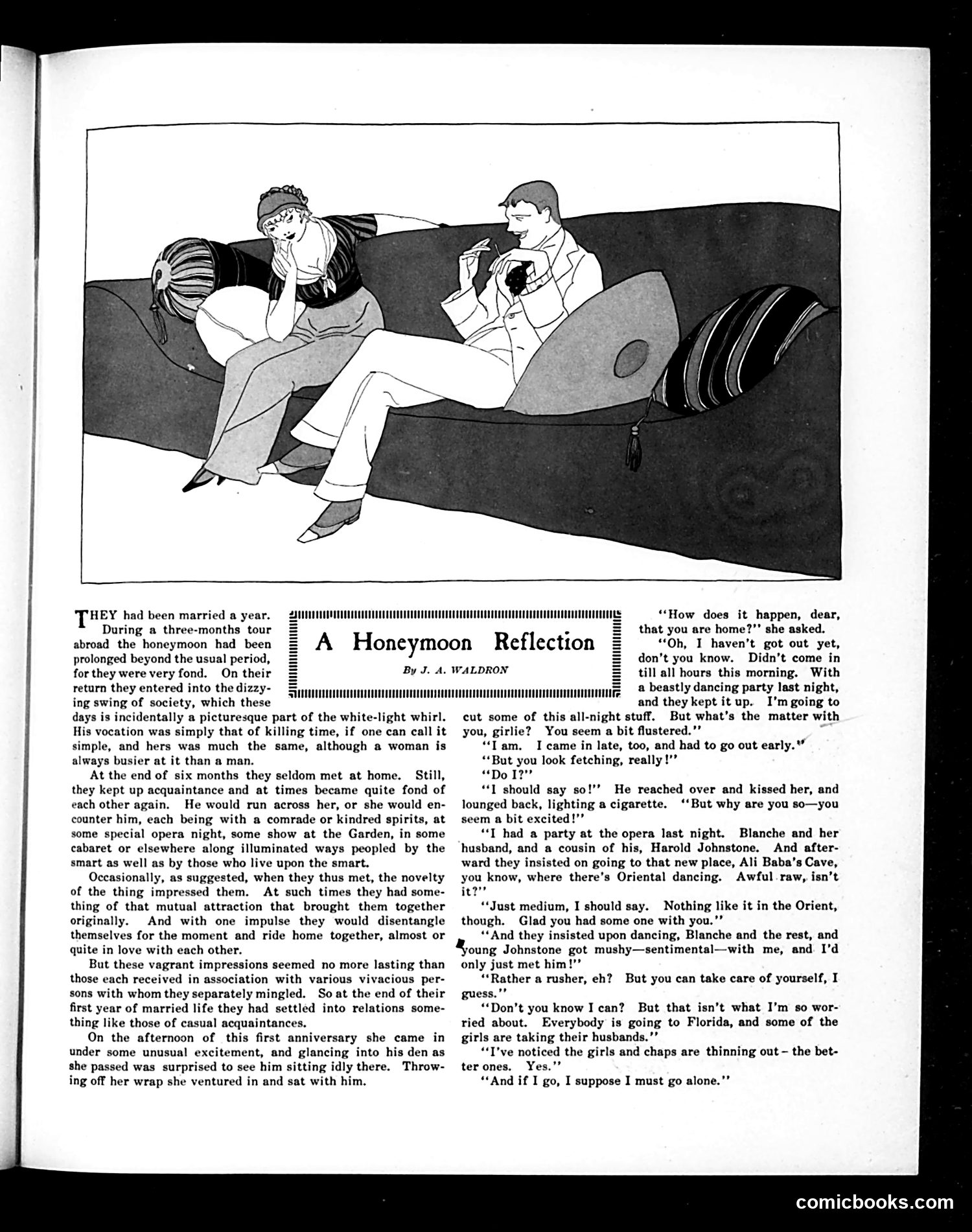
This satirical short story illustrates the disillusionment of 1920s marriage among the wealthy leisure class. A couple married one year has devolved from romantic newlyweds into virtual strangers, each perpetually occupied with society events—opera nights, cabarets, dancing parties—rather than domestic life together. The satire targets the era's "white-light whirl" of constant social activity as spiritually empty. Though they occasionally rediscover affection, these moments are fleeting. The husband kills time as his "vocation"; the wife does the same, though "busier at it." The cartoon illustrates their disconnect: two stylishly dressed figures lounge on a sofa, physically close yet emotionally distant. Their conversation reveals mutual acceptance of this arrangement—she attends parties with other men, he stays out all night—without real jealousy or commitment. The piece critiques how modern society's pursuit of novelty and entertainment has replaced genuine marital connection among the fashionable set.
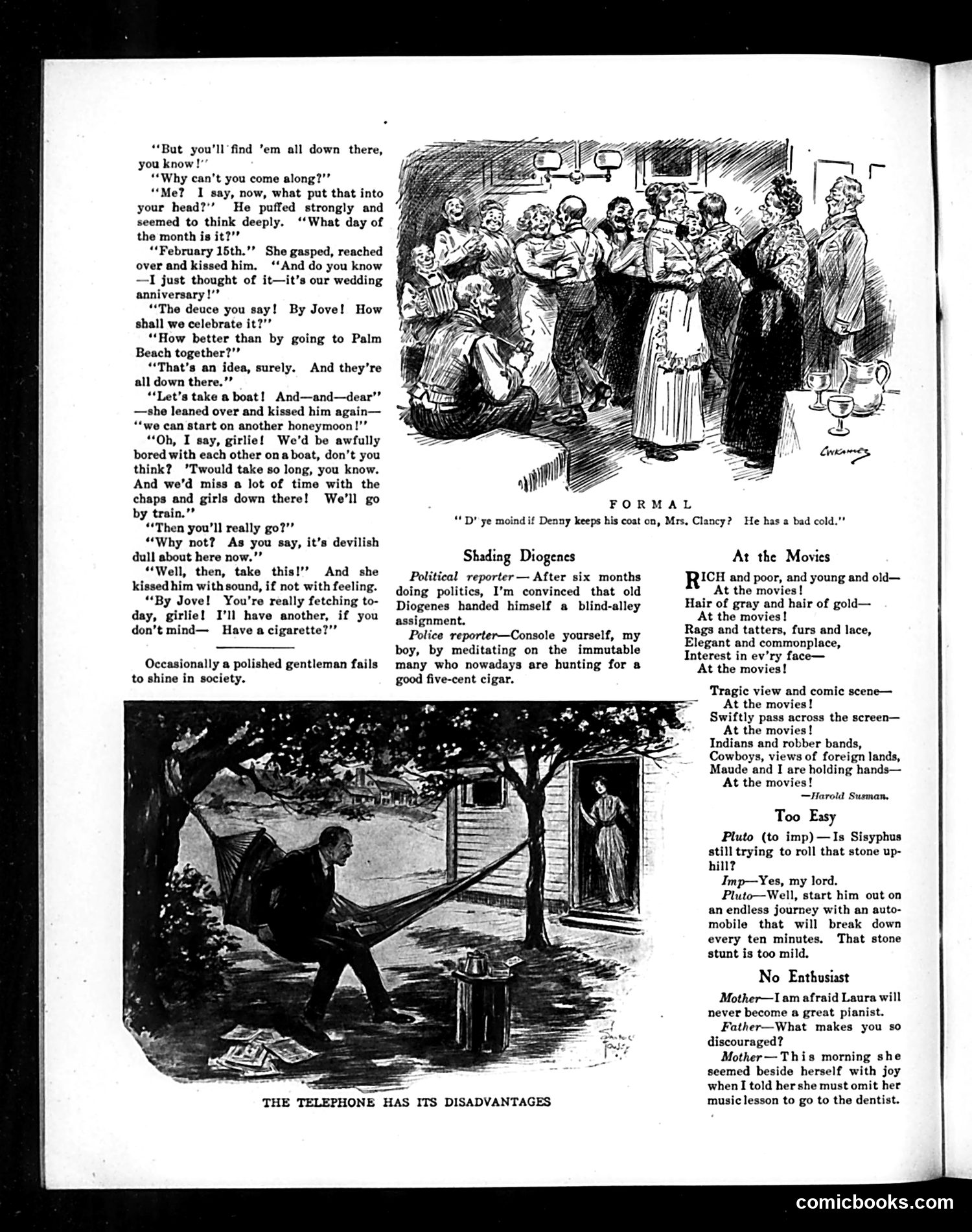
This page contains several satirical pieces typical of early 20th-century humor: **Main Cartoon (top):** "The Telephone Has Its Disadvantages" depicts a man conducting a domestic negotiation via telephone. The joke satirizes how the telephone enables wives to pursue their husbands' attention and coordinate social plans, disrupting male leisure. The man tries to avoid a Palm Beach trip by claiming it's the wrong date, but ultimately capitulates—the "disadvantage" being that telephones make it harder for gentlemen to escape domestic obligations. **Other Content:** The page includes brief satirical pieces: "Shading Diogenes" mocks political reporters' frustrations; "At the Movies" is sentimental verse about cinema's universal appeal; and "Too Easy" jokes about Hell's punishments (Pluto finding the stone-rolling task insufficiently torturous compared to car breakdowns). The underlying theme reflects upper-class anxieties about technology and changing social dynamics between men and women.
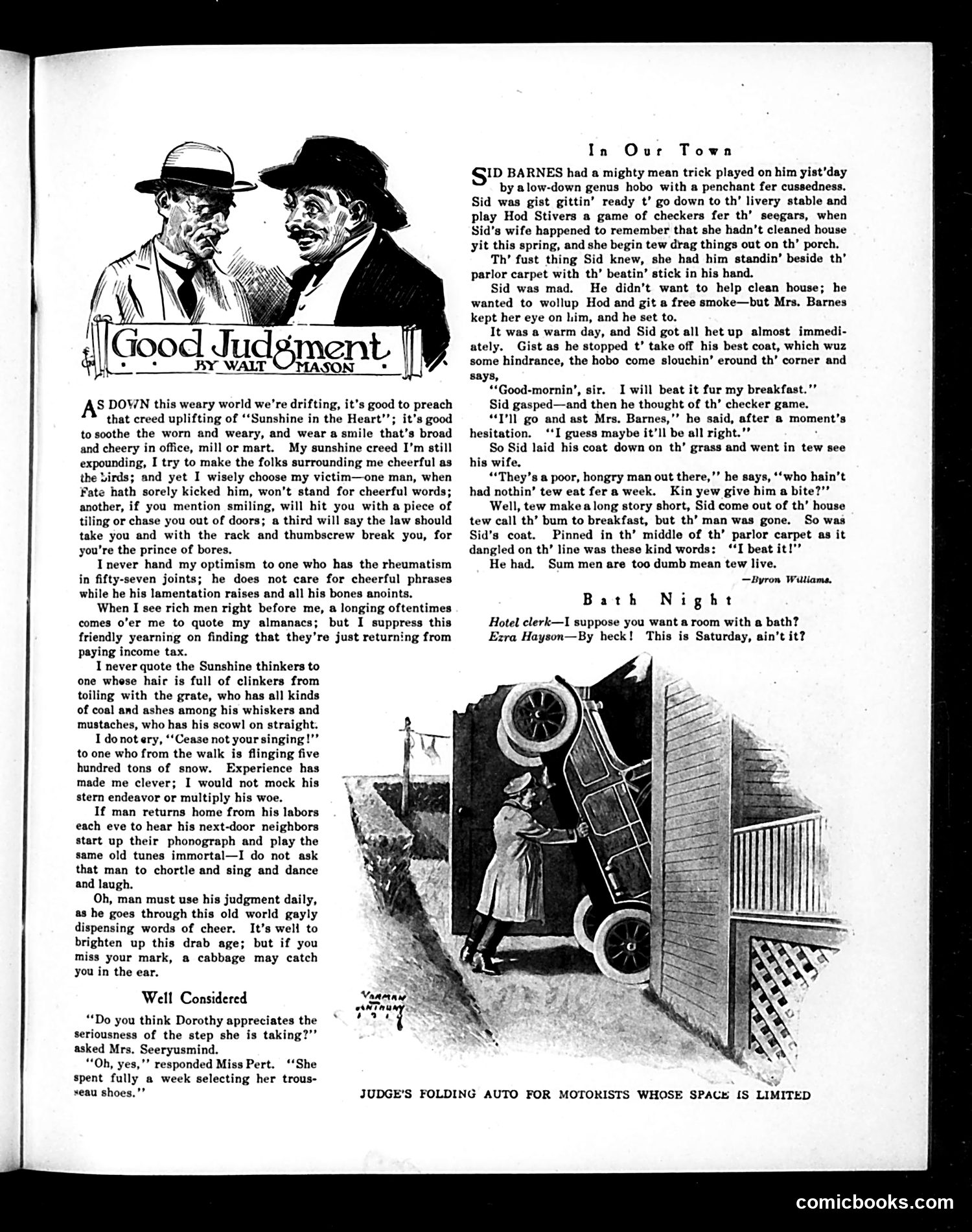
This page contains two unrelated pieces of satirical humor typical of early 20th-century Judge magazine: **"Good Judgment" by Walt Mason** (top): A humorous essay about choosing when to dispense optimism and cheerfulness. Mason argues that indiscriminate positivity is foolish—don't preach sunshine to the rheumatic, the recently taxed, coal miners, or snow-shovelers. The satire mocks both relentless optimists and the genuine hardships that make cheerfulness inappropriate. The closing cabbage metaphor suggests poorly-aimed advice backfires. **"In Our Town"** (right): A folk-style anecdote about Sid Barnes, a working man tricked by a vagrant. While Sid beats carpets (spring cleaning), a hobo asks for breakfast. Sid consents, but the hobo steals Sid's coat left on the grass—a cautionary tale about misplaced charity. The crude dialect reflects period working-class stereotypes. **"Bath Night"** (bottom): A brief joke about hotel amenities and Saturday availability—likely commentary on modest accommodations lacking private baths. These pieces reflect early 1900s American humor emphasizing practical wisdom and class-based humor.
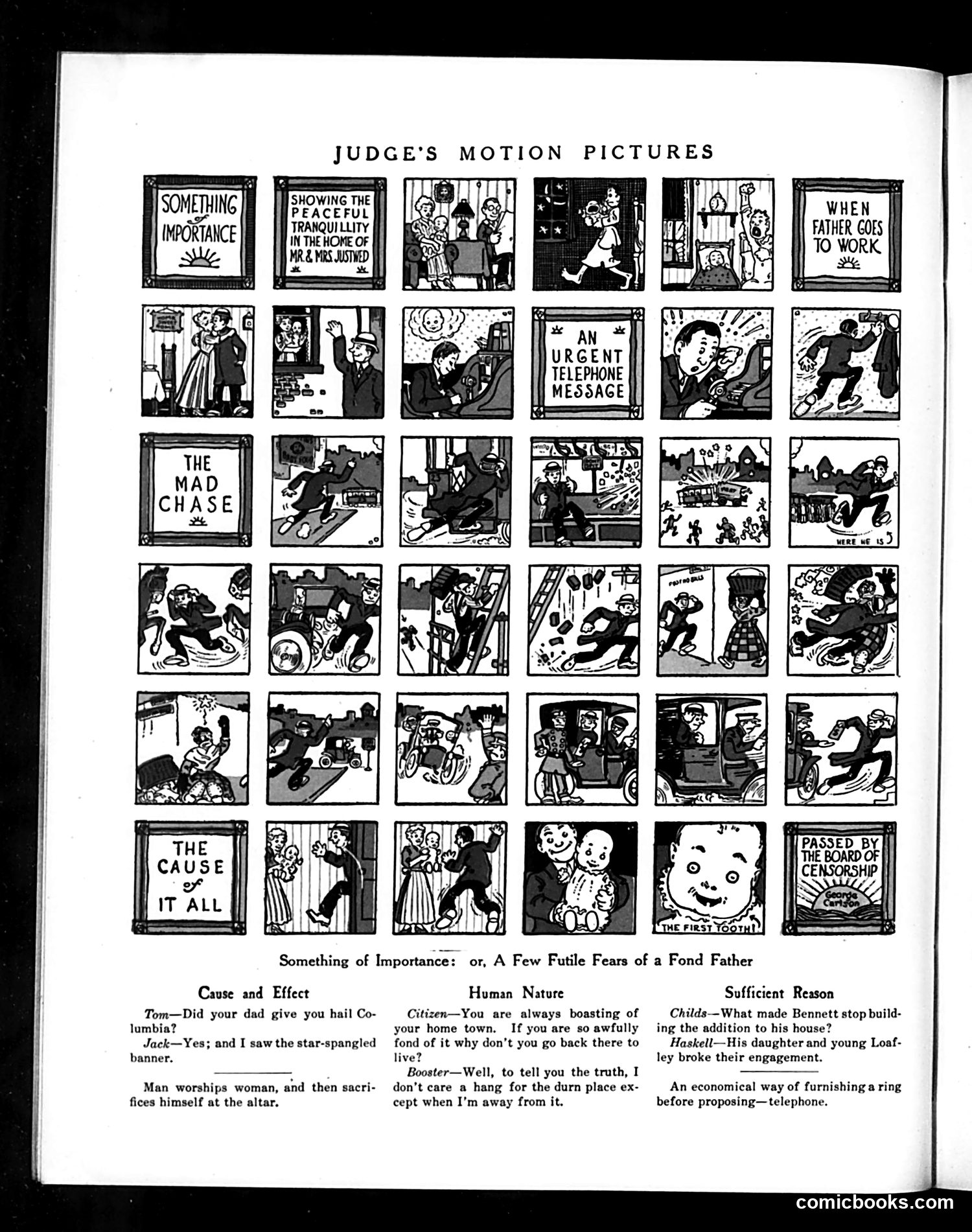
This page presents a grid of short comic strips illustrating domestic situations and humorous observations about early 20th-century life. The title suggests the overall theme concerns a father's anxieties. The three labeled sections at bottom offer brief joke exchanges: **"Cause and Effect"**: A father gives his son a patriotic gift (hail Columbia/the flag), establishing masculine tradition. **"Human Nature"**: A man boasts of his hometown yet won't return to it—satirizing hollow civic pride and human hypocrisy. **"Sufficient Reason"**: A building project stops because an engagement breaks; an economical ring-buyer uses the telephone instead of buying jewelry. The comic strips above depict various family scenarios: fathers working, children misbehaving, domestic chaos, and courtship concerns. The satire targets typically *turn-of-the-century anxieties*: paternal responsibility, youth behavior, marriage prospects, and social propriety—the everyday middle-class concerns that Judge's audience recognized.
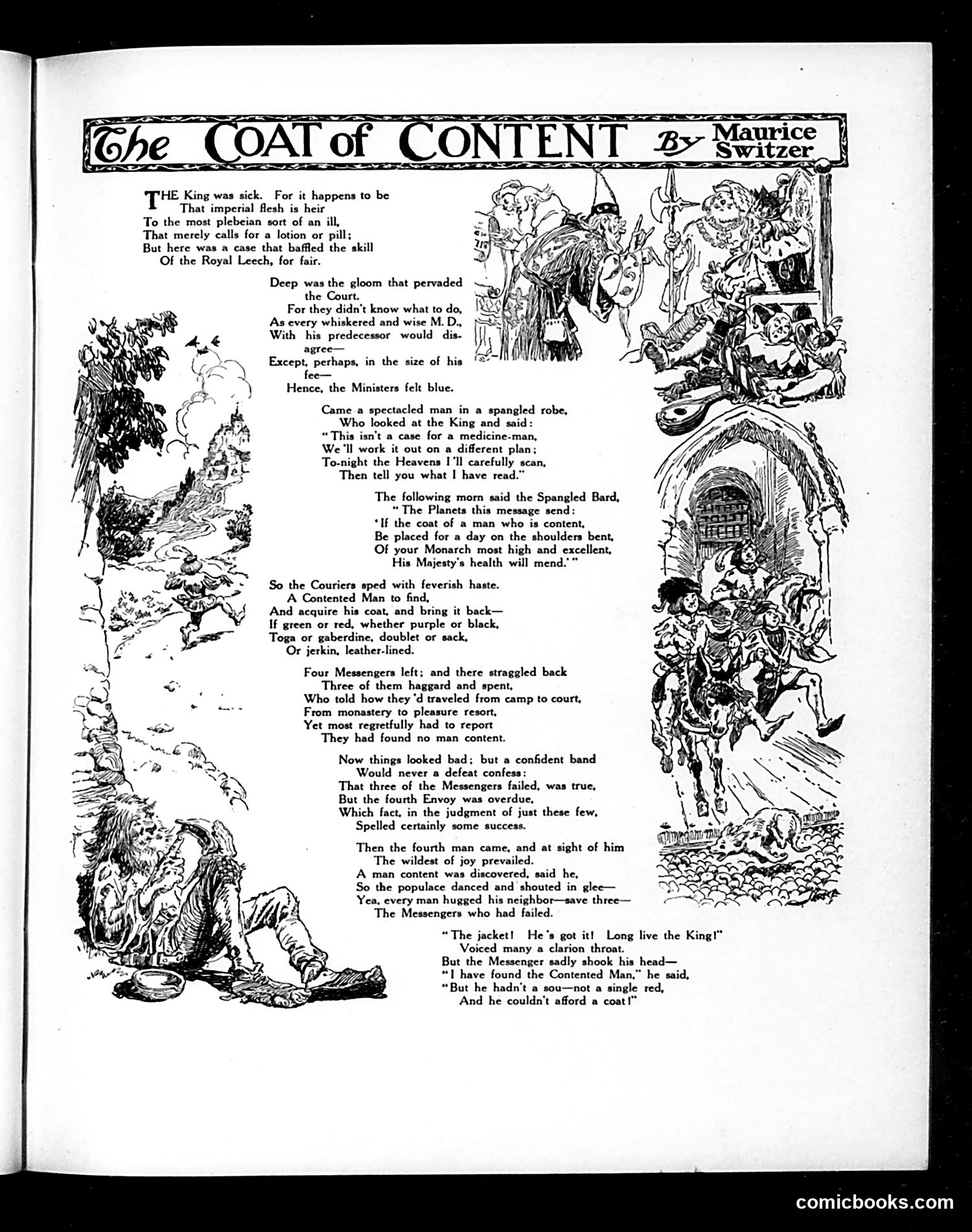
This illustrated poem satirizes the futility of seeking happiness or contentment. When a king falls ill, courtiers consult an astrologer who prescribes finding a contented man's coat to cure him. Four messengers search everywhere—camps, courts, monasteries, pleasure resorts—but three return empty-handed: contentment simply doesn't exist among the population. The fourth messenger finally locates a genuinely contented man, offering hope. However, the punchline reveals the bitter truth: this rare contented person is so poor he owns no coat to give. The satire suggests that true contentment is either impossible to find or belongs only to those with nothing to lose—making it useless as a cure for a wealthy, powerful king. It's commentary on the incompatibility of wealth/power and genuine satisfaction.
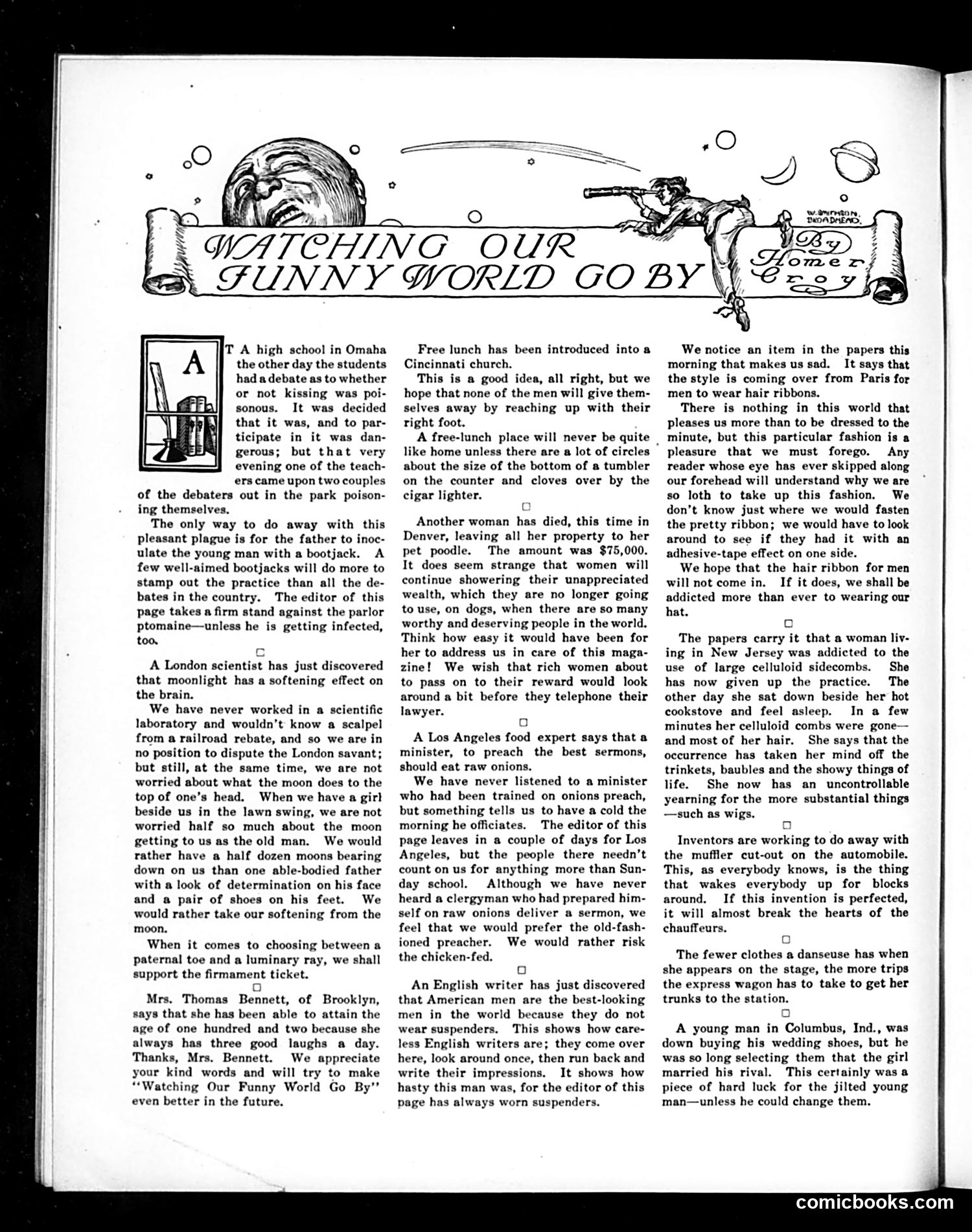
This page contains **humorous social commentary** on early 20th-century American life, presented as short satirical vignettes rather than a single cartoon. The header illustration shows a figure with a telescope observing the world—a visual metaphor for the column's purpose: mocking contemporary social trends. Key satirical targets include: - **Youth behavior**: Omaha high schoolers debating kissing's danger, then doing it anyway—mocking youthful hypocrisy - **Class commentary**: A wealthy Denver woman leaving $75,000 to her dog instead of deserving people - **Gender critique**: Women's supposedly foolish devotion to pets and fashion over charity - **Religious satire**: A minister eating raw onions to preach better; free lunch in churches - **National vanity**: Americans' supposed superiority in appearance (lacking suspenders) The tone is cynical but lighthearted—poking fun at human foolishness, romantic behavior, wealth mismanagement, and social pretension. The satire assumes educated readers sharing Judge's middle-class perspective and comedic worldview.
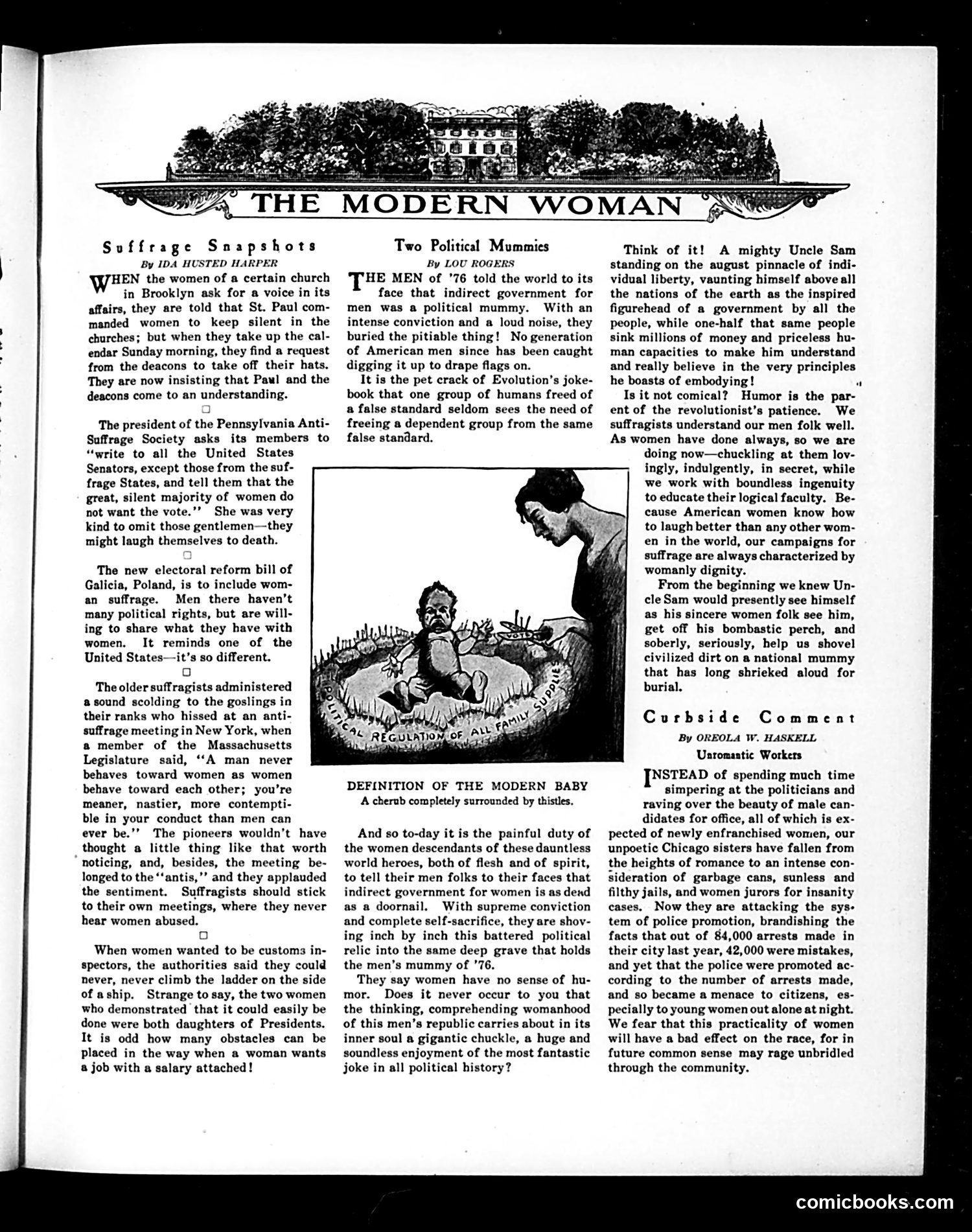
This page satirizes the women's suffrage movement circa 1910s-1920s through three pieces: **"Suffrage Snapshots"** (Harper) uses anecdotes to mock anti-suffrage hypocrisy: churches cite scripture to silence women, then ask them to remove hats; anti-suffrage leaders claim a "silent majority" opposes voting rights; and obstacles mysteriously disappear when Presidents' daughters want jobs. **"Two Political Mummies"** (Rogers) features a cartoon of a baby surrounded by thistles, satirizing the logical contradiction that Revolutionary men rejected "indirect government" for themselves but imposed it on women. Rogers argues this is comically absurd—women must convince men to grant rights the nation supposedly already embodies. **"Curbside Comment"** addresses urban crime, appearing unrelated to suffrage content. The page's core argument: women's exclusion from voting contradicts American democratic ideals, making the situation farcical rather than tragic. The satire targets male politicians' logical inconsistency, not female suffragists.
This humorous story mocks a naive woman (Mrs. Williams) who joins a poker game at a friend's house. She loses money she didn't realize she was gambling, blaming Mrs. Jones unfairly for winning while ignoring the others' roles in her loss. The satire targets early-20th-century upper-middle-class women who played cards socially but claimed ignorance about gambling's real stakes. Mrs. Williams wants to blame a single winner rather than acknowledge her own foolish participation—a pointed critique of self-deception and convenient scapegoating. The piece also gently mocks the "genteel" poker game itself: women explaining rules to her, the pretense that chips represent "learning" rather than genuine wagering, and the social pressure to participate. The joke exposes the hypocrisy of ladies who gamble while maintaining plausible deniability about doing so. The story fills the advertising-heavy page and reflects Judge's interest in satirizing middle-class social pretensions and gender dynamics of the era.
This page is primarily **advertising**, with a brief satirical section titled "Snap Judgments." The main content is a humorous anecdote about women learning poker and arguing over payment—likely satirizing debates about women's education and independence. The narrator's female acquaintances insist she must pay to learn poker, comparing it to learning piano or dancing. When she refuses to pay the full amount (keeping carfare home), Mrs. Jones demands additional money, illustrating female pettiness or hypocrisy about women's advancement. The "Snap Judgments" section contains three brief political/social quips: mocking the Prince of Monaco naming a fish after his family, commenting on foreign royalty (Egypt's Khedive, Tibet's Llama) discovering modern activities, and joking about Colorado women voters' promised "talkless campaign" regarding women's suffrage—implying women voters are inherently talkative. The rest consists of period advertisements for whiskey, cigars, hats, pianos, and patent services—typical of early 20th-century magazine content.
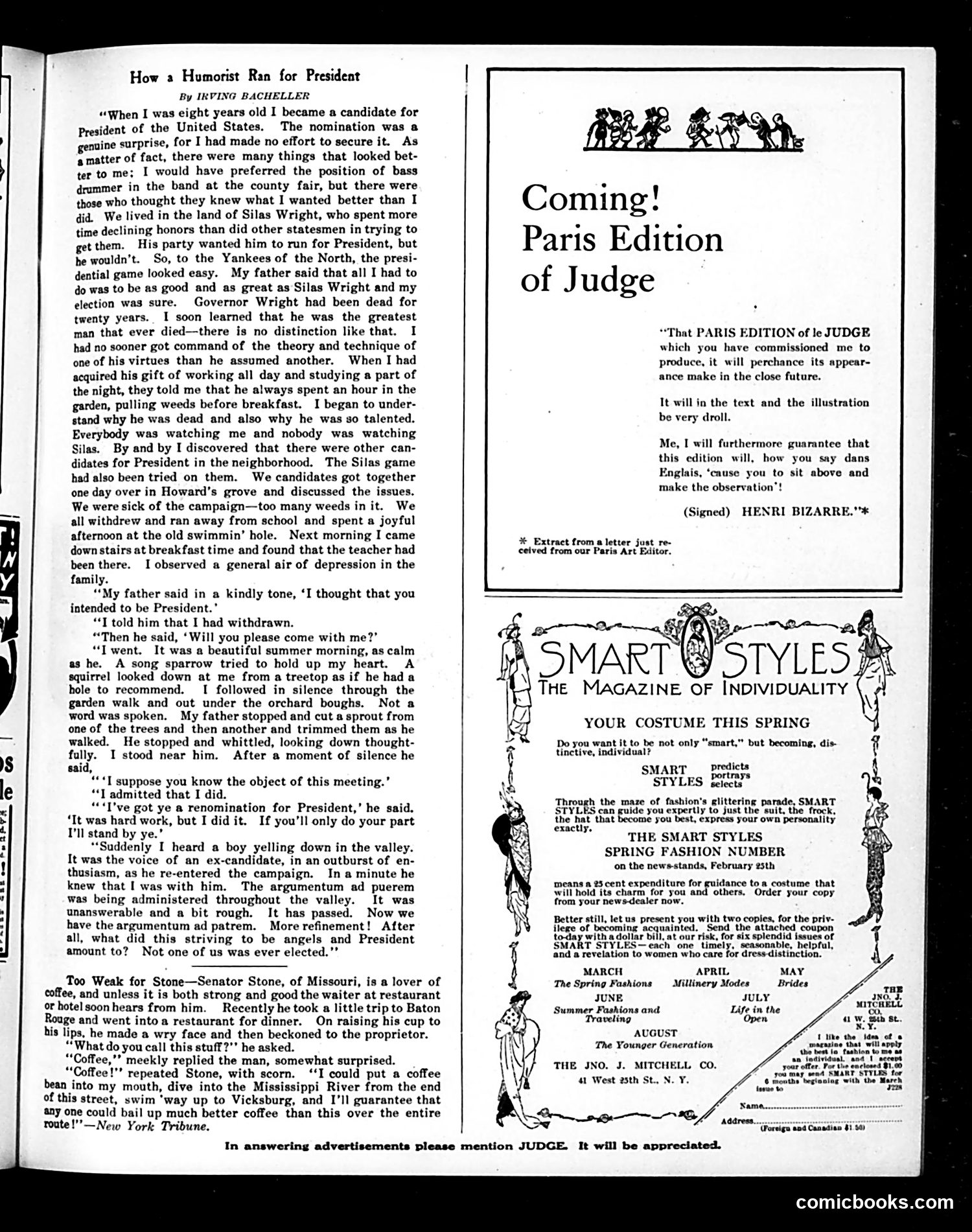
This page contains a humorous autobiographical essay by Irving Bacheller about running for president as a child. The satire operates on multiple levels: **The Main Joke:** Bacheller describes how his father and neighbors pressured him—an eight-year-old—to become a presidential candidate, comparing him to the deceased statesman Silas Wright. The absurdity lies in adults imposing impossible standards on a child, then being disappointed when he withdraws to go swimming. **The Political Reference:** Silas Wright was a real 19th-century New York politician famous for declining high offices. The humor mocks how Americans idealize dead politicians while placing unrealistic expectations on the living. **The Broader Satire:** Bacheller critiques the American political process itself—how campaigns seduce participants with false hope, how candidates eventually withdraw, and how the whole enterprise is fundamentally childish. The essay suggests that presidential ambition is inherently ridiculous and that even children can recognize its futility.
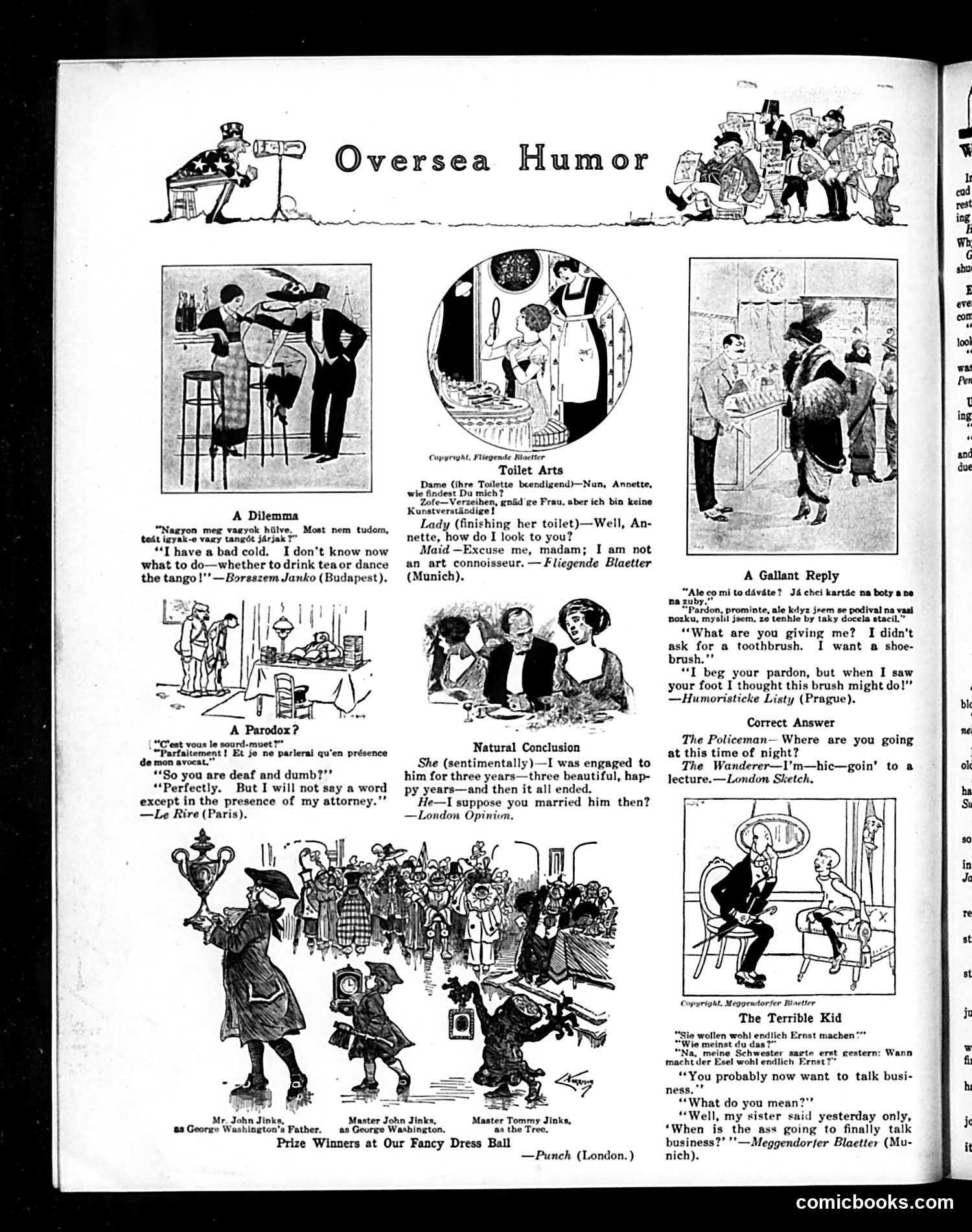
This page collects humorous comics and jokes translated from European publications (Budapest, Paris, Munich, Prague, London). The content reflects genteel, middle-class concerns of the era: **Key themes:** - **Social propriety**: A maid's tactful deflection when asked to critique her employer's appearance; a drunk man claiming he's attending a lecture - **Legal/bureaucratic absurdity**: A deaf-mute who refuses to speak except with his lawyer present - **Marital/romantic humor**: A woman who was engaged three years but "then it all ended" (implying she didn't marry him after all) - **Class dynamics**: Servants navigating their subordinate position with wit - **Physical humor**: A costume ball featuring children dressed as historical figures The page illustrates Judge magazine's practice of republishing European humor to amuse American readers. The jokes rely on wordplay, irony, and social observation rather than overt political commentary. The overall tone is lighthearted commentary on etiquette, romance, and human folly.
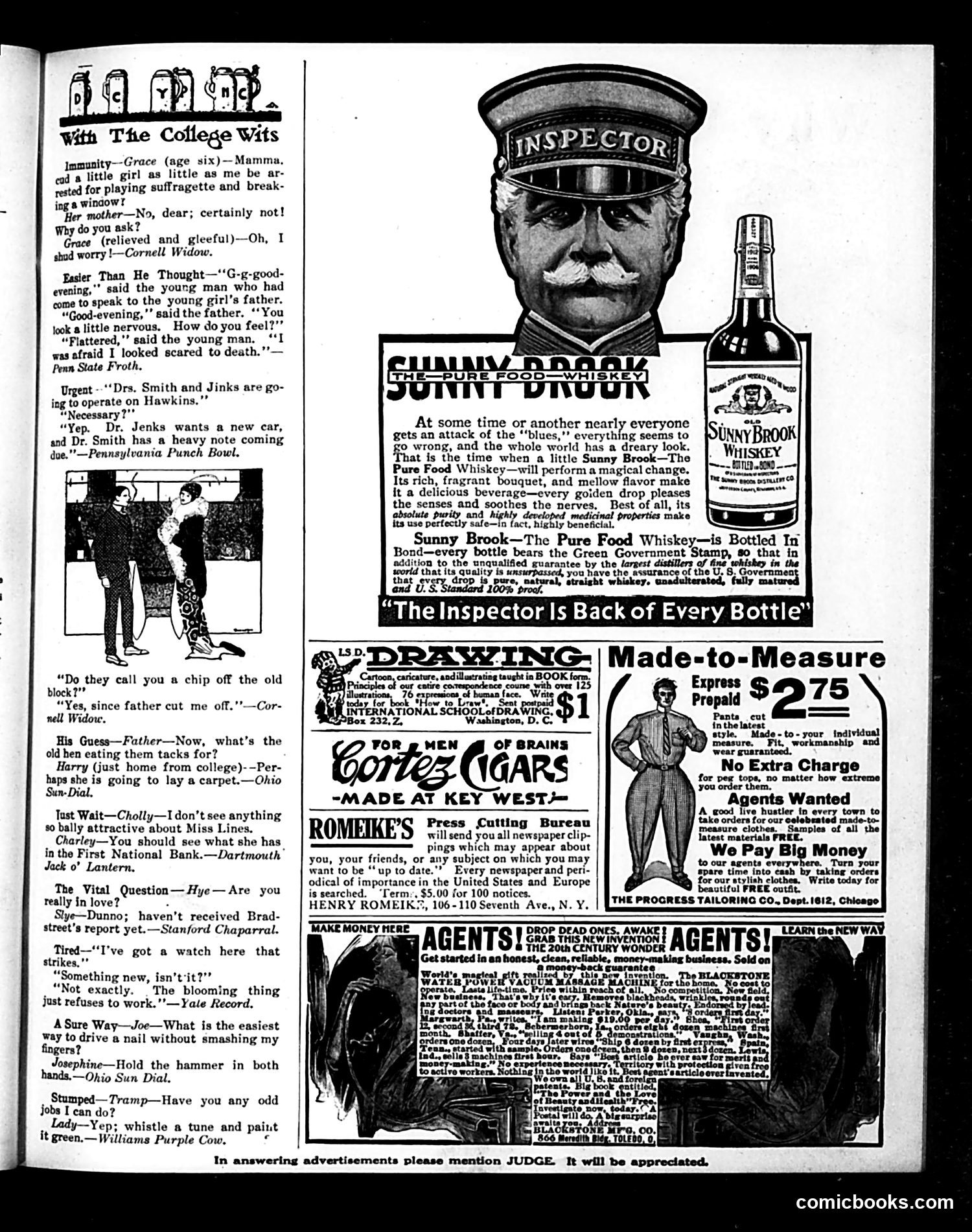
This page from Judge magazine contains primarily **short humor pieces and advertisements** rather than political cartoons. The humor section, "With The College Wits," features brief jokes from college publications. Notable content includes a joke about a six-year-old girl playing "suffragette" and breaking a window—a reference to the women's suffrage movement, which was actively contentious in the early 20th century. The joke's premise (that breaking windows wouldn't result in arrest for a child) reflects contemporary debates about suffragettes' militant tactics. The largest editorial content is a **Sunny Brook Whiskey advertisement** prominently featuring an "Inspector" character with the tagline "The Inspector Is Back of Every Bottle." This appears to reference government inspection and the "Pure Food" movement following the 1906 Pure Food and Drug Act. Remaining content consists of classified advertisements for drawing courses, tailoring services, and various money-making schemes typical of period publications. The page is primarily **commercial**, with minimal satirical commentary beyond the college humor section's light social jabs.
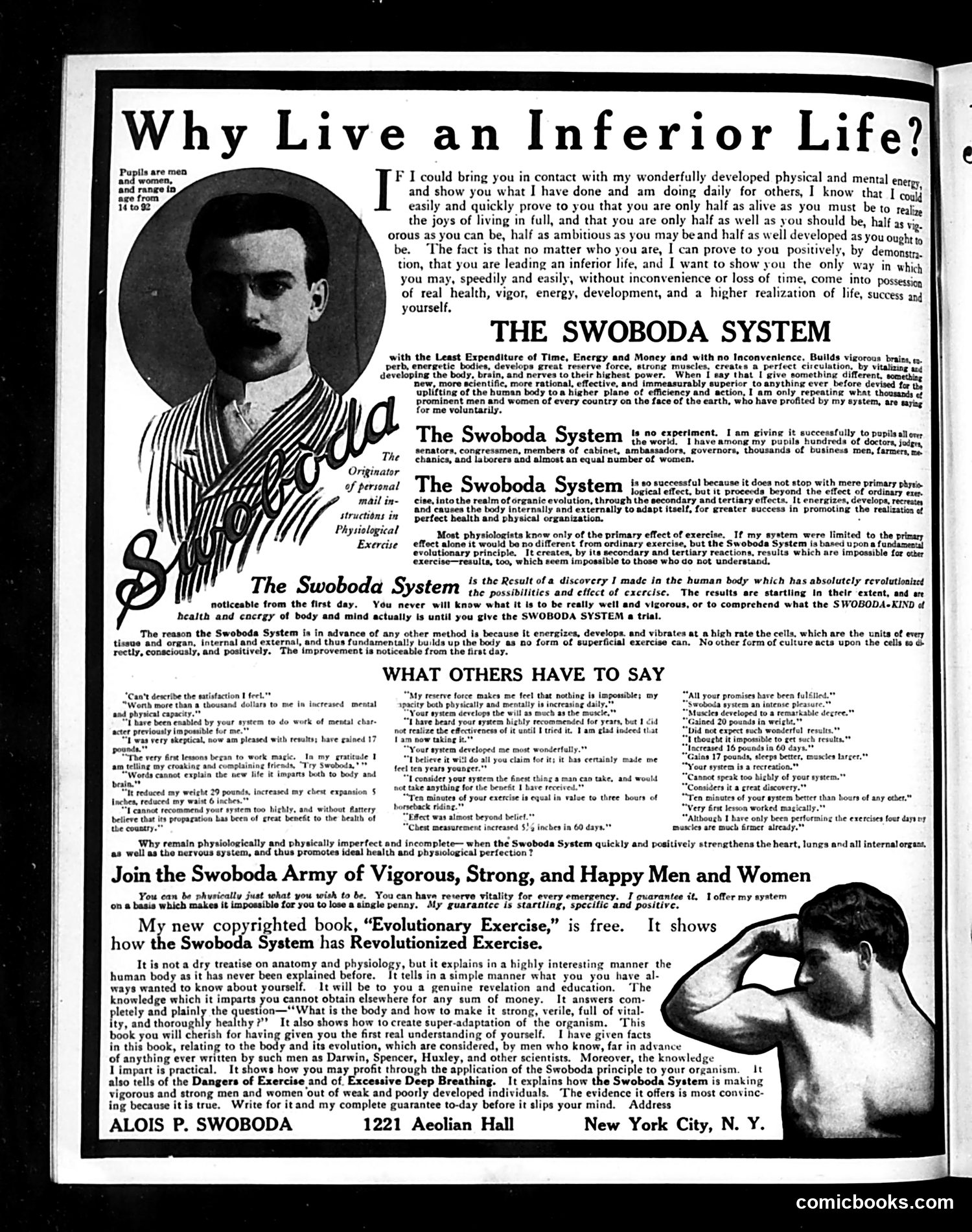
This is not a political cartoon but rather a **full-page advertisement** for the "Swoboda System," a physical exercise and health regimen promoted by Alois P. Swoboda of New York City. The page features a photograph of Swoboda himself (identified by his signature) and extensive promotional text claiming his system produces superior physical and mental development beyond ordinary exercise. The ad promises results to "senators, congressmen, members of cabinet, ambassadors, governors" and others. The testimonial section ("What Others Have to Say") includes brief quotes praising the system's effects. **Context for modern readers:** This represents early 20th-century pseudoscientific fitness marketing—making grandiose health claims without scientific validation. The appeals to authority (prominent government figures) and promises of rapid transformation are familiar modern advertising tactics but were presented here in a reputable satirical magazine, suggesting such claims were more widely accepted then.