
Judge, 1914-02-28 · page 16 of 24
Judge — February 28, 1914 — page 16: what you’re looking at
What you’re looking at
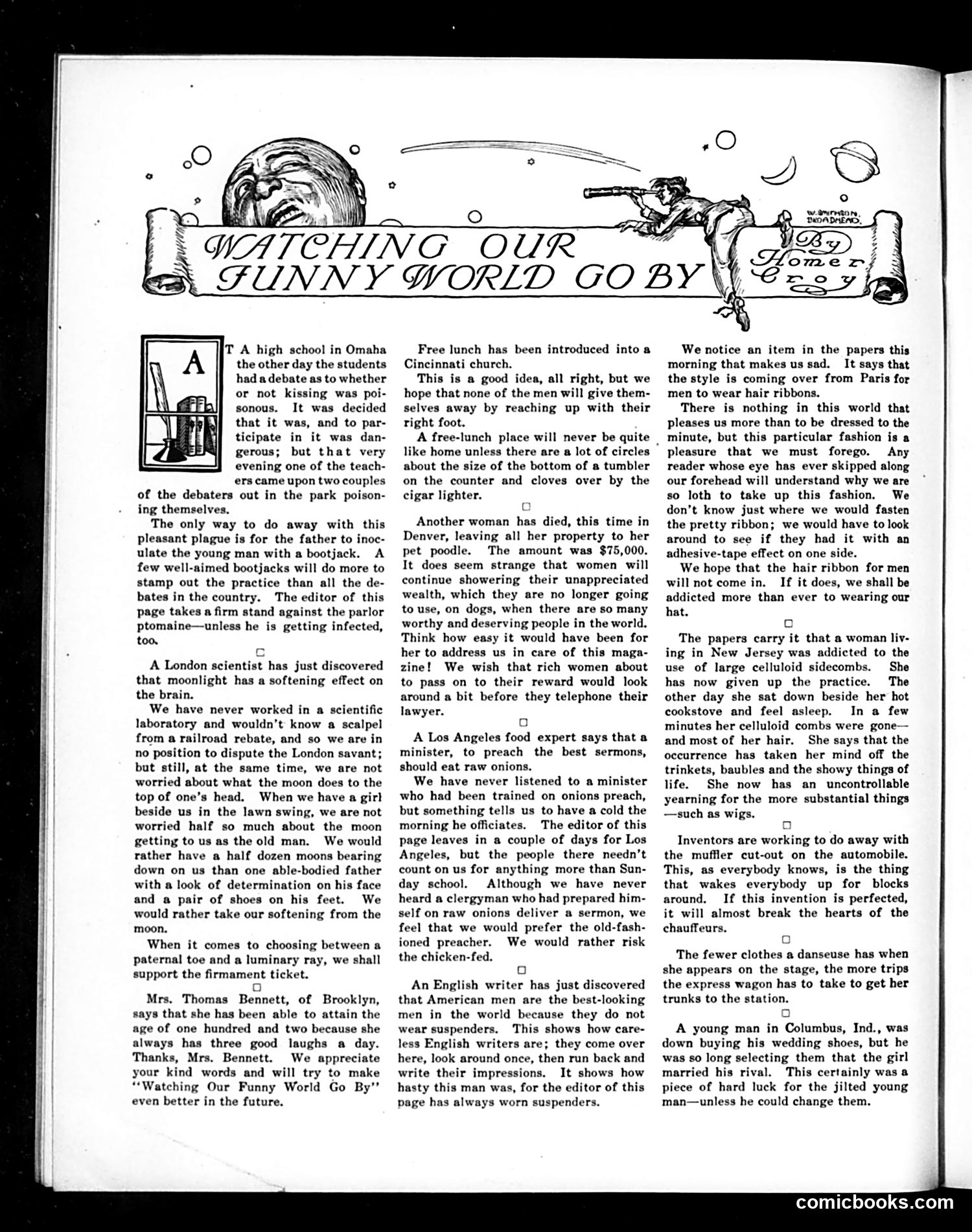
This page contains **humorous social commentary** on early 20th-century American life, presented as short satirical vignettes rather than a single cartoon. The header illustration shows a figure with a telescope observing the world—a visual metaphor for the column's purpose: mocking contemporary social trends. Key satirical targets include: - **Youth behavior**: Omaha high schoolers debating kissing's danger, then doing it anyway—mocking youthful hypocrisy - **Class commentary**: A wealthy Denver woman leaving $75,000 to her dog instead of deserving people - **Gender critique**: Women's supposedly foolish devotion to pets and fashion over charity - **Religious satire**: A minister eating raw onions to preach better; free lunch in churches - **National vanity**: Americans' supposed superiority in appearance (lacking suspenders) The tone is cynical but lighthearted—poking fun at human foolishness, romantic behavior, wealth mismanagement, and social pretension. The satire assumes educated readers sharing Judge's middle-class perspective and comedic worldview.
📄 Transcribed text from this page (OCR, searchable)
Machine-transcribed from the original scan — historical spelling and the odd misread are preserved.
IT A high school in Omaha the other day the students had a debate as to whether or not kissing was poi- sonous. It was decided that it was, and to par- ticipate in it was dan- gerous; but that very evening one of the teach- ers came upon two couples of the debaters out in the park poison- ing themselves, The only way to do away with this pleasant plague is for the father to inoc- ulate the young man with a bootjack. A few well-aimed bootjacks will do more to stamp out the practice than all the de- bates in the country. The editor of this page takes a firm stand against the parlor ptomaine—unless he is getting infected, too, c A London scientist has just discovered that moonlight has a softening effect on the brain. We have never worked in a scientific laboratory and wouldn’t know a scalpel from a railroad rebate, and so we are in no position to dispute the London savant; but still, at the same time, we are not worried about what the moon does to the top of one’s head. When we have a girl beside us in the lawn swing, we are not worried half so much about the moon getting to us as the old man. We would rather have a half dozen moons bearing down on us than one able-bodied father with a look of determination on his face and a pair of shoes on his feet. We would rather take our softening from the moon. When it comes to choosing between a paternal toe and a luminary ray, we shall support the firmament ticket. is] Mrs. Thomas Bennett, of Brooklyn, says that she has been able to attain the age of one hundred and two because she always has three good laughs a day. Thanks, Mrs. Bennett. We appreciate your kind words and will try to make “Watching Our Funny World Go By” even better in the future. Free lunch has been introduced into a Cincinnati church. This is a good idea, all right, but we hope that none of the men will give them- selves away by reaching up with their right foot. A free-lunch place will never be quite _ like home unless there are a lot of circles about the size of the bottom of a tumbler on the counter and cloves over by the cigar lighter. o Another woman has died, this time in Denver, leaving all her property to her pet poodle. The amount was $75,000. It does seem strange that women will continue showering their unappreciated wealth, which they are no longer going to use, on dogs, when there are so many worthy and deserving people in the world. Think how easy it would have been for her to address us in care of this maga- zine! We wish that rich women about to pass on to their reward would look around a bit before they telephone their lawyer. ie} A Los Angeles food expert says that a minister, to preach the best sermons, should eat raw onions. We have never listened to a minister who had been trained on onions preach, but something tells us to have a cold the morning he officiates. The editor of this page leaves in a couple of days for Los Angeles, but the people there needn’t count on us for anything more than Sun- day school. Although we have never heard a clergyman who had prepared him- self on raw onions deliver a sermon, we feel that we would prefer the old-fash- ioned preacher. We would rather risk the chicken-fed. is] An English writer has just discovered that American men are the best-looking men in the world because they do not wear suspenders. This shows how care- less English writers are; they come over here, look around once, then run back and write their impressions. It shows how hasty this man was, for the editor of this page has always worn suspenders. We notice an item in the papers thi: morning that makes us sad. It says that the style is coming over from Paris for men to wear hair ribbons. There is nothing in this world that pleases us more than to be dressed to the minute, but this particular fashion is a pleasure that we must forego. Any reader whose eye has ever skipped along our forehead will understand why we are so loth to take up this fashion. We don’t know just where we would fasten the pretty ribbon; we would have to look around to see if they had it with an adhesive-tape effect on one side. We hope that the hair ribbon for men will not come in. If it does, we shall be addicted more than ever to wearing our hat. o The papers carry it that a woman liv- ing in New Jersey was addicted to the use of large celluloid sidecombs. She has now given up the practice. The other day she sat down beside her hot cookstove and feel asleep. In a few minutes her celluloid combs were gone— and most of her hair. She says that the occurrence has taken her mind off the trinkets, baubles and the showy things of life. She now has an uncontrollable yearning for the more substantial things —such as wigs. Inventors are working to do away with the muffler cut-out on the automobile. This, as everybody knows, is the thing that wakes everybody up for blocks around. If this invention is perfected, it will almost break the hearts of the chauffeurs, [a] The fewer clothes a danseuse has when she appears on the stage, the more trips the express wagon has to take to get her trunks to the station. A young man in Columbus, Ind., was down buying his wedding shoes, but he was so long selecting them that the girl married his rival. This certainly was a piece of hard luck for the jilted young man—unless he could change them. comicbooks.com