
Judge, 1914-02-28 · page 13 of 24
Judge — February 28, 1914 — page 13: what you’re looking at
What you’re looking at
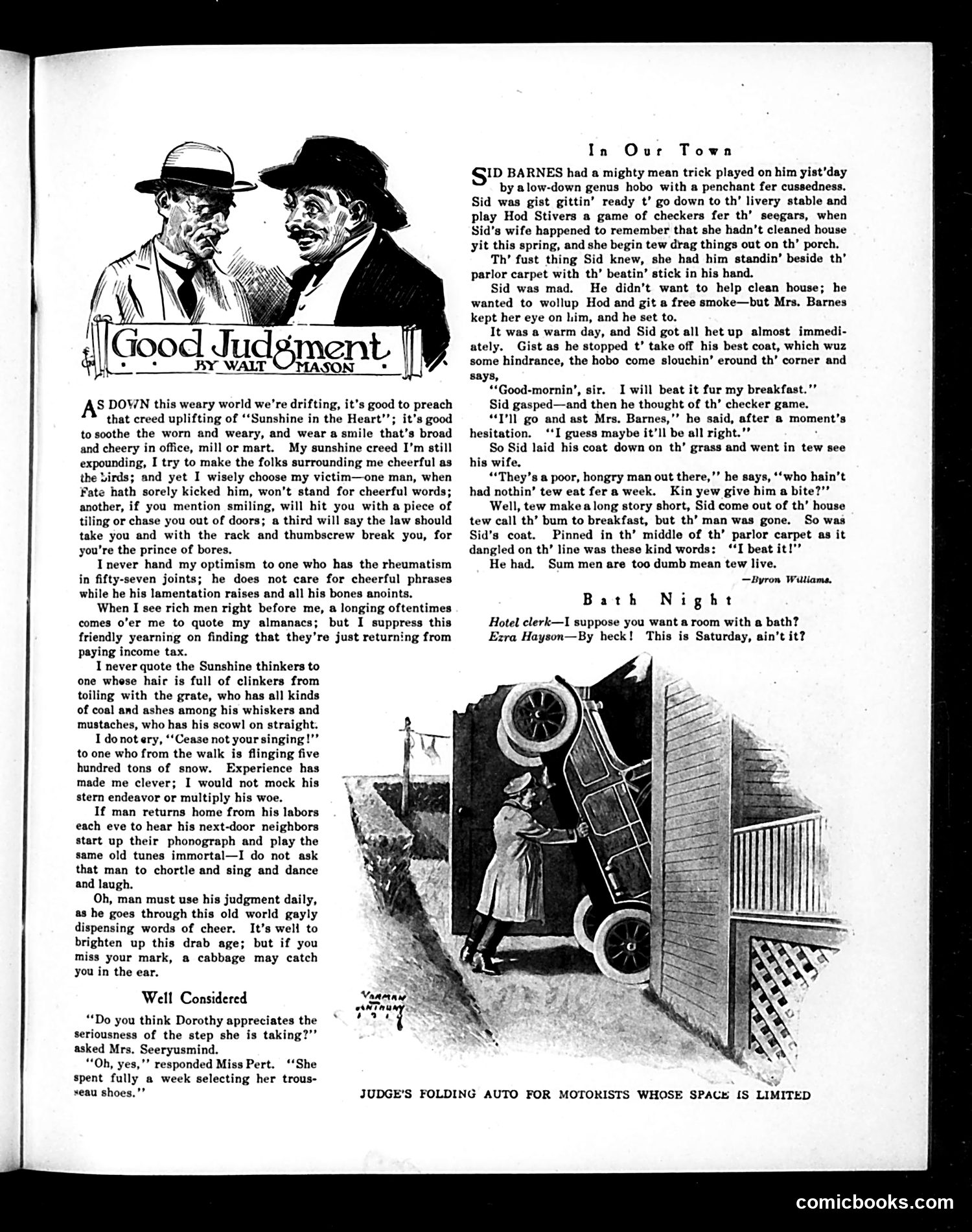
This page contains two unrelated pieces of satirical humor typical of early 20th-century Judge magazine: **"Good Judgment" by Walt Mason** (top): A humorous essay about choosing when to dispense optimism and cheerfulness. Mason argues that indiscriminate positivity is foolish—don't preach sunshine to the rheumatic, the recently taxed, coal miners, or snow-shovelers. The satire mocks both relentless optimists and the genuine hardships that make cheerfulness inappropriate. The closing cabbage metaphor suggests poorly-aimed advice backfires. **"In Our Town"** (right): A folk-style anecdote about Sid Barnes, a working man tricked by a vagrant. While Sid beats carpets (spring cleaning), a hobo asks for breakfast. Sid consents, but the hobo steals Sid's coat left on the grass—a cautionary tale about misplaced charity. The crude dialect reflects period working-class stereotypes. **"Bath Night"** (bottom): A brief joke about hotel amenities and Saturday availability—likely commentary on modest accommodations lacking private baths. These pieces reflect early 1900s American humor emphasizing practical wisdom and class-based humor.
📄 Transcribed text from this page (OCR, searchable)
Machine-transcribed from the original scan — historical spelling and the odd misread are preserved.
od Jucsment By WALT UMASON = AS DOWN this weary world we're drifting, it’s good to preach that creed uplifting of “Sunshine in the Heart’’; it’s good to soothe the worn and weary, and wear a smile that’s broad and cheery in office, mill or mart. My sunshine creed I'm still expounding, I try to make the folks surrounding me cheerful as the birds; and yet I wisely choose my victim—one man, when Fate hath sorely kicked him, won't stand for cheerful words; another, if you mention smiling, will hit you with a piece of tiling or chase you out of doors; a third will say the law should take you and with the rack and thumbscrew break you, for you’re the prince of bores. Inever hand my optimism to one who has the rheumatism in fifty-seven joints; he does not care for cheerful phrases while he his lamentation raises and all his bones anoints. When I see rich men right before me, a longing oftentimes comes o’er me to quote my almanacs; but I suppress this friendly yearning on finding that they’re just returning from paying income tax. I never quote the Sunshine thinkers to one whese hair is full of clinkers from toiling with the grate, who has all kinds of coal and ashes among his whiskers and mustaches, who has his scowl on straight. I donot ery, ‘‘Cease not your singing!’’ to one who from the walk is flinging five hundred tons of snow. Experience has made me clever; I would not mock his stern endeavor or multiply his woe. If man returns home from his labors each eve to hear his next-door neighbors start up their phonograph and play the same old tunes immortal—I do not ask that man to chortle and sing and dance and laugh. Oh, man must use his judgment daily, as he goes through this old world gayly dispensing words of cheer. It’s well to brighten up this drab age; but if you miss your mark, a cabbage may catch you in the ear. Well Considered “Do you think Dorothy appreciates the seriousness of the step she is taking?” asked Mrs, Seeryusmind. “Oh, yes,"’ responded Miss Pert. ‘‘She spent fully a week selecting her trous- xeau shoes,’’ Town In Our 1D BARNES had a mighty mean trick played on him yist’day by alow-down genus hobo with a penchant fer cussedness. Sid was gist gittin’ ready t’ go down to th’ livery stable and play Hod Stivers a game of checkers fer th’ seegars, when Sid’s wife happened to remember that she hadn’t cleaned house yit this spring, and she begin tew drag things out on th’ porch, Th’ fust thing Sid knew, she had him standin’ beside th’ parlor carpet with th’ beatin’ stick in his hand. Sid was mad. He didn’t want to help clean house; he wanted to wollup Hod and git a free smoke—but Mrs. Barnes kept her eye on him, and he set to. It was a warm day, and Sid got all het up almost immedi- ately. Gist as he stopped t’ take off his best coat, which wuz some hindrance, the hobo come slouchin’ eround th’ corner and says, “‘Good-mornin’, sir. I will beat it fur my breakfast.’’ Sid gasped—and then he thought of th’ checker game. “I'll go and ast Mrs. Barnes,’’ he said, after a moment's hesitation. ‘‘I guess maybe it’ll be all right.’’ So Sid laid his coat down on th’ grass and went in tew see his wife. “‘They’s a poor, hongry man out there,’’ he says, ‘‘who hain’t had nothin’ tew eat fer a week. Kin yew give him a bite?”’ Well, tew make a long story short, Sid come out of th’ house tew call th’ bum to breakfast, but th’ man was gone. So was Sid’s coat. Pinned in th’ middle of th’ parlor carpet as it dangled on th’ line was these kind words: “I beat it!"’ He had. Sum men are too dumb mean tew live. —Byron Wiliams. Bath Night Hotel clerk—I suppose you want a room with a bath? Ezra Hayson—By heck! This is Saturday, ain’t it? JUDGE'S FOLDING AUTO FOR MOTORISTS WHOSE SPACE IS LIMITED comicbooks.com